The Bottom Line: iSportConnect Business Index – January 26

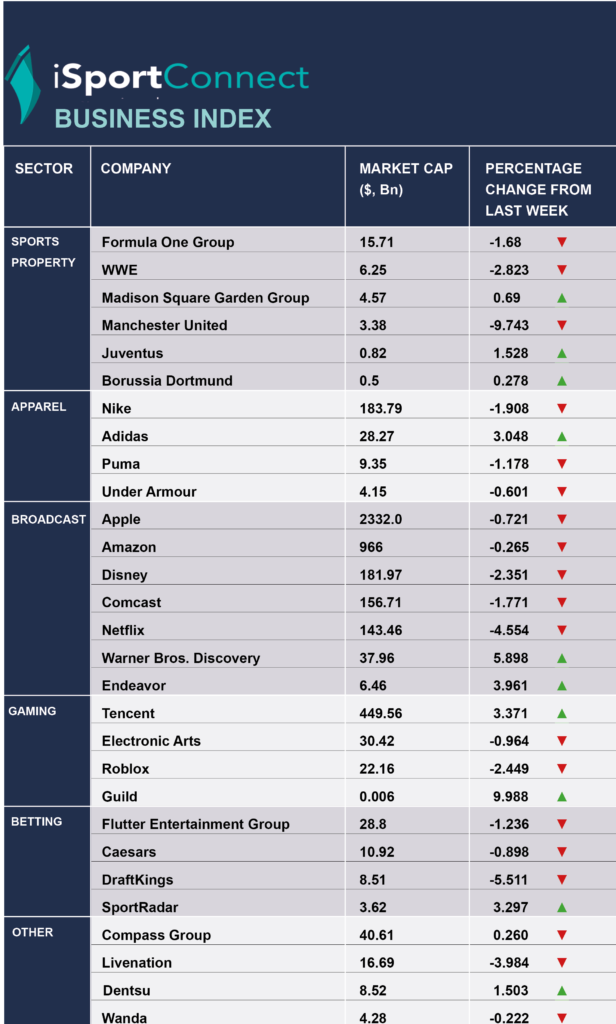
Welcome to the third edition of the iSportConnect Business Index, we are still tracking the top 30 most relevant publicly listed companies that are involved in sport.

Right, lets get into this weeks winners and losers.

Here is our complete index for this week:

We are more than open to changing the companies in our Index, don’t be afraid to get in contact with suggestions.

The House View: FIFA walk a tightrope between host cities and commercial partners as 2026 world cup preparations get real

It’s easy to criticise decisions that are taken by the likes of the IOC and FIFA as well as how they are communicated. However, it is difficult to fathom the complexity of relationships that have to be managed behind the scenes for an event of the magnitude of the Olympic Games or FIFA World Cup. 

Despite the US, Mexico and Canada appearing on the surface to be the perfect hosts for the next mens football world cup in 2026, the financing of the event, particularly in the United States, has been a particularly complex topic involving two key stakeholders – host cities and commercial partners.

11 of the 16 host cities are located in the US and in contrast to Russia and Qatar, the host countries of the two most recent world cups, the federal government does not budget for the billions required to stage the event.

Therefore the news reported this week by Sports Business Journal (SBJ), that FIFA will be allowing host cities to sell their own corporate sponsorships to offset hosting costs, was inevitable given the reality of major event funding in North America. SBJ reported that the 16 host cities would be allowed to sign up to 10 companies each as “supporters”, in what is a world cup first.

Host cities having their own sponsors is not without precedent in the US for events such as the Super Bowl. However, and with all due respect, the Super Bowl does not take place across 16 cities, 3 countries and 4 time zones (or incorporate a reported 80 matches as part of an expanded 48 team tournament)..

The host city supporters programme will reportedly neither form part of FIFA’s commercial programme nor leverage any FIFA IP. Host cities will own their intellectual property (IP) which is said to differ to a “meaningful degree” from FIFA’s official IP and supporters are likely to be limited to striking a maximum of two host city deals.

These restrictions will likely not go far enough to appease the commercial partners already signed up for 2026 (namely adidas, Coca-Cola and Wanda) who will feel that, beyond the unprecedented marketing clutter that this brings, the host city programme has the potential to be a huge sanctioned ambush marketing programme if not properly managed. 

Added to this, the opportunity to build relationships with national and local authorities is one of the unwritten benefits enjoyed by major event sponsors. FIFA’s commercial partners may feel that this latest move significantly undermines that benefit. In some cases they will be forced to put additional money on the table to buy into host city supporter packages that protect existing relationships (e.g. can Coca-Cola get away with not supporting their iconic home city of Atlanta?) or to forge new relationships that they might have expected to open up in the absence of this programme. Clearly some cities will be more valuable than others and we will likely see a small number of key cities enjoy the lion’s share of investment.

FIFA will be acutely aware of the threat this host city programme poses to the success of its own commercial programme and will ring fence a long list of product categories covering both current commercial partners and the most attractive sponsorship prospects. This list will represent a balancing act for FIFA. Reserving all remotely valuable categories for themselves on the off chance that they will be able to sell them directly will inevitably be a source of significant frustration to the host cities. On the flip side, cutting the cities some slack will reduce FIFA’s own potential gains and ability to commercialise. The same delicate balance will need to be struck in respect of the rights packages on offer for host city supporters and you can be sure that these will be scrutinised carefully by FIFA’s commercial partners.

It is worth remembering that just over a year ago FIFA announced a new commercial structure with three different commercial pillars; women’s football; men’s football and esports and gaming. This may well add further uncertainty for commercial partners, both existing and new, and potential opportunities for yet more brands with no world cup rights to play in the margins of a world cup association.

Given the news that this host city supporter programme is still being scoped out, we can assume that these benefits were not originally foreseen (or at least not explicitly granted) in the agreements signed by the cities and that the pressure on FIFA to relax the commercial restrictions became too great. These unforeseen changes are a normal part of the stakeholder management around major events. 

It remains to be seen how smooth FIFA’s transition to a new integrated operating model (which will see a subsidiary of FIFA established locally to deliver the tournament) will be and what impact this will have on their ability to successfully navigate the complex stakeholder landscape.

One thing is for sure, this week’s news gives FIFA’s commercial partners something to ponder as they strategise ahead of the competition in 2026 and will further test FIFA’s ability to walk a very delicate tightrope of relationships.

By David Fowler, MD Advisory iSportConnect.

Our man in Lausanne: The challenges and opportunities for Sports Federations to adopt direct-to-consumer broadcasting solutions

With the emergence of new technologies such as video streaming, sports federations have unprecedented growth potential to reach fans, supporters, and spectators around the world by delivering direct-to-consumer broadcasting solutions.

However, in order to successfully implement a D2C broadcasting solution, Sports Federations must be prepared to face different challenges, on the other hand they can benefit from opportunities that can bring positive results.

Among the challenges are the complexity of the broadcasting landscape, with its various solutions, platforms, vehicles, and systems; and different countries’ laws and regulations regarding content broadcasting, which must be complied with.

The second challenge for international federations is to develop a financially viable and sustainable business model.

Broadcasting content is expensive and requires a significant upfront investment, making it necessary to create a business model that can generate revenue to cover costs.

Another challenge is the technical knowledge, specialised professionals, technological resources, and need for constant information updates that are required for successful broadcasting.

This represents a huge effort for the organisations, making it very difficult to apply; consequently, the efficiency and quality of the transmissions and content will be reduced. Most federations have few technical resources, including personnel, to manage this kind of solution; thus, requiring large investments in the short, medium, and long term to be sustainable.

Finally, sports federations must also be prepared to face the challenge of marketing their
content to a worldwide audience and must determine the best way to monetize their content,
either through subscription fees, advertising, or other means.

With so many different streaming platforms and services available, sports federations must identify the most effective ways to promote their content to the widest possible audience, this could involve partnering with digital agencies and companies, utilising social media, and leveraging other marketing techniques.

The challenges associated with implementing a direct-to-consumer streaming solution can be daunting, but the rewards can be great.

Sports federations around the world have the opportunity to reach a larger audience, increase their revenues, and expand their global reach.

By undertaking the effort necessary to understand the technology, legal considerations, and marketing potential, as well as establishing good partnerships with companies that provide this type of technology, sports federations can create a successful direct-to-consumer (D2C) broadcasting solution that benefits both them and their fans.

One opportunity is to create an international content repository. This would allow international federations to create a single source of content from around the world, making it easier for viewers to access content from multiple countries.

The creation of an international repository would reduce the cost of acquiring content and
the amount of time required to manage content rights.

Another opportunity is the creation of a global streaming platform, which would allow organisations to provide high-quality streaming services to viewers in multiple countries, eliminating the need for multiple streaming services for each country.

A global streaming platform could also facilitate content sharing between different federations, such as national federations, allowing organisations to leverage content from other federations to create a more robust and integrated content library while still respecting the peculiarities of each region or country.

By implementing a direct-to-consumer (D2C) solution, international federations can also consider the potential to leverage their existing relationships with broadcasters by becoming content providers rather than service providers. This would allow federations to exploit content rights and create broadcasting agreements that might not otherwise be available to them.

Another benefit is that broadcasters can also provide access to valuable resources, such as marketing and advertising, that can help organisations reach a larger audience.

By taking advantage of these opportunities, international federations can ensure that they remain competitive in the ever-evolving broadcasting landscape.

Broadcasting solutions for international sports federations can be an effective way to extend the reach of their sport beyond its traditional geographic boundaries. This can be done through live streaming or through established broadcast outlets.

By providing their content available to a wider audience, federations can raise awareness of their sport and reach a wider base of potential fans, as well as create new opportunities to increase advertising and publicity revenues.

Also, sports federations can improve the quality of their content. With the right broadcast solution, federations can provide fans with higher-quality content tailored to their specific interests, providing a more engaging broadcast experience.

This benefit meets the federations’ need to increase engagement with fans, spectators, and the community that follows the sport, as they have a direct channel to their own audience.

Finally, perhaps one of the biggest advantages of the direct-to-consumer broadcasting solution is the ability to capture data of all kinds, especially individual viewer data.

In traditional broadcasting, using third-party platforms, the audience data is under the ownership of the broadcasters, and as a result, the federations end up only having access to general audience statistics.

However, being the rights holder and having the ownership and management of the data of each person that accesses the content offered, federations can exploit this data in several ways, either to increase the relationship, or to establish new partnerships, especially with sponsors, or to develop specific projects for a certain group or segment of people.

Developing a direct-to-consumer solution for international sports federations is a complex but ultimately rewarding challenge. With the right technology, these federations can open up their sports to a wider audience, increase fan engagement, and strengthen their own financial stability.

Michel Cutait is a Senior Executive Sports Manager, lawyer and professor. He currently works as Deputy Secretary General at World Obstacle, institutional name Fédération Internationale de Sports d’Obstacles, the international governing body for obstacle sports (Obstacle Course Racing, Ninja and Adventure Racing) and related events, where he runs the Secretariat working actively in the areas of governance, membership, partnership, development and compliance. He also works as Strategy Advisor at the Brazilian Triathlon Confederation. Graduated in Law, has a Masters in Law in Brazil, Marketing in Australia and a Masters in Sports Administration and Technology at EPFL (AISTS) in Lausanne, Olympic Capital. He has written 5 books, the last one called Management Performance Rio 2016 Olympic Games.

Carling returns to football by becoming official beer partner of Emirates FA Cup and Vitality Women’s FA Cup

The Emirates FA Cup and Vitality Women’s FA Cup have today partnered up with Carling, who become the new official beer partner for both competitions.

The partnership brings together two national icons with rich football heritages ahead of the fourth round of both the men’s and women’s competitions over the coming weekend.

As part of the deal, which will run until at least 2025, the number one lager brand in Great Britain will be rolling out promotional activity throughout the remainder of this season’s competitions to generate further excitement among fans.

It follows recent football-themed campaign activity ahead of and during the winter World Cup, including a limited-edition shirt giveaway and partnership with talkSPORT’s coverage of the tournament.

Speaking about the new deal, our commercial director, Navin Singh, said: “This new partnership with Carling will help to provide vital investment across all levels of the Emirates FA Cup and the Vitality Women’s FA Cup. 

“Carling has a proven track-record of sponsorship in the football industry, and we look forward to working closely with them during this exciting time for our showpiece competitions.”

Lee Willett, Carling brand director at Molson Coors Beverage Company, added: “We firmly believe the beautiful game should be open to everyone, which is why this is a perfect partnership. The FA Cup spans every level of the game, from non-League to Premier League, and we’re delighted to be supporting both the men’s and women’s competitions.”

“Sporting occasions are a massive opportunity for our customers to drive sales and fans will have the competition rounds earmarked in their calendars. We’ll be helping our customers to capitalise on the excitement it generates and drive more footfall in their venues.”

FIBA Basketball World Cup 2023 announce Toyota Motor Philippines as a partner

The Local Organizing Committee in the Philippines has welcomed Toyota Motor Philippines as a partner of the FIBA Basketball World Cup 2023.  

The Philippines will co-host FIBA’s flagship men’s event with Japan and Indonesia, which is to be staged in five different venues across the three countries from August 25 to September 10, 2023.

Hailing the sponsorship deal with Toyota Motor Philippines in this year’s global event that will see 52 of the 92 games played in Manila, including the Final Phase, are SBP Chairman Emeritus Manny V. Pangilinan and SBP President Al S. Panlilio.

“It is with great appreciation and warmth that we welcome Toyota Motor Philippines to the FIBA Basketball World Cup 2023 family,” said Pangilinan, a member of FIBA’s Central Board and Chairman and CEO of Metro Pacific Investments Corp.

“This partnership will go a long way in ensuring the success of our country’s efforts to host this grand event, a national endeavor if ever there was one, since this marks only the second time in our history that we will be hosting the biggest international basketball event.”

The Philippines played host of the FIBA Basketball World Cup in 1978, where the former Yugoslavia emerged as champions.

For his part, Panlilio, a member of the FIBA Asia Board and President and CEO of PLDT and Smart Communications, sounded off a call to potential sponsors.

“As we thank Toyota Motor Philippines for agreeing to be part of this once in a lifetime experience, we are inviting others as well who wish to also share in this global activity, this journey which in a sense is truly a merger of world caliber sports and global business opportunities.”

Atsuhiro Okamoto, President of Toyota Motor Philippines, stated: “By being part of the FIBA Basketball World Cup 2023 journey, one of the biggest global sports events this year, we aim to further inspire and encourage more Filipinos to use the power of movement to reach their full potential. This is the spirit of our START YOUR IMPOSSIBLE global sports campaign. With this partnership and the unity basketball brings to Filipinos, we are always moving closer to our goal of producing happiness for all.” 

David Crocker, Executive Director of the FIBA Basketball World Cup 2023, also expressed his gratitude to Toyota Motor Philippines for its involvement in the event.

“To be able to welcome such a prestigious brand as Toyota Motor Philippines as a partner for our pinnacle men’s event is of special importance to us, and we look forward to working closely with them in the near future,” said Crocker.

Highlighting the Toyota Motor Philippines brand in various local events leading up to the FIBA Basketball World Cup 2023 will be a top priority in the lead-up to the historical tip-off on August 25 with the world’s top 32 teams.

NBA and Meta announce multi-year partnership extension

The National Basketball Association (NBA) and Meta today announced a multiyear partnership extension that will feature a new virtual reality experience for fans through Meta Horizon Worlds via Meta Quest, the official VR headset of the NBA and WNBA.  The NBA Arena in Meta Horizon Worlds experience will feature live NBA League Pass games in virtual reality throughout the season.  The partnership extension will also include the launch of NBA-licensed apparel in the Meta Avatars Store and authenticated NBA League Pass access in Xtadium, a VR sports hub app that offers shared watching experiences in high-definition.

“Our extended partnership with Meta will provide more immersive and innovative ways to experience the NBA,” said Jennifer Chun, NBA Executive Vice President and Head of Content Partnerships.  “Meta’s digital world opens up exciting possibilities for NBA fans to virtually attend our games and to interact with other fans around the world.”

“Meta’s immersive VR technology is opening up new opportunities for sports fans to engage and interact with their favorite NBA teams,” said Meta Director of Sports Media and League Partnerships Rob Shaw.  “The NBA is always pushing us to innovate and leverage the latest technology to open the door to new fan experiences, and this chapter of our partnership achieves exactly that.”

Through Meta Horizon Worlds on Meta Quest, fans will have access to an immersive VR experience.  The NBA and Meta will also bring 52 live NBA League Pass games – including five immersive 180-degree monoscopic live VR games in 2880 resolution – in “NBA Arena” in Meta Horizon Worlds.  Fans can now visit the NBA Arena in Meta Horizon Worlds to watch NBA content with friends, compete in interactive mini-games and cheer on their favorite teams.

The preliminary game schedule for the NBA Arena is highlighted below:

  • Monday, Jan. 23: Milwaukee Bucks vs. Detroit Pistons – 7 p.m. ET
  • Tuesday, Jan. 24: Denver Nuggets vs. New Orleans Pelicans – 8 p.m. ET
  • Wednesday, Jan. 25: Denver Nuggets vs. Milwaukee Bucks – 8 p.m. ET
  • Friday, Jan. 27: Cleveland Cavaliers vs. Oklahoma City Thunder – 8 p.m. ET
  • Sunday, Jan. 29: LA Clippers vs. Cleveland Cavaliers – 7 p.m. ET
  • Tuesday, Jan. 31: Miami Heat vs. Cleveland Cavaliers – 7 p.m. ET

As part of the partnership extension, NBA-licensed apparel will be available in the Meta Avatars Store soon.  Fans will be able to purchase their favorite NBA or WNBA team apparel for their Meta Avatar and showcase it across Facebook, Instagram, Messenger and on the Meta Quest.  Additionally, existing NBA League Pass subscribers will be able to access their subscription in YBVR’s Xtadium app within Meta Quest VR in the coming weeks.  Fans will then be able to sit in a “virtual” courtside seat to watch live NBA League Pass games and host private watch parties with friends.  Live WNBA, NBA G League and NBA 2K League games will also be available via a Meta Quest headset.

Member Insights: Audience winners hold some surprises

In this opinion article the iSportConnect Content Director Jay Stuart looks into the biggest sports TV audiences around the world from 2022.

TV ratings are pretty predictable by and large. Broadcasters and their advertising customers wouldn’t have it any other way. TV as a medium doesn’t work without some consistency. Sports programming plays a big part. The top audiences of the year in many countries will be live sports and in Europe that’s almost certain in years when there’s a big FIFA or UEFA event. The USA takes the cake in this respect. In 2022, sports made up 94 of the Top 100 programmes, with the NFL alone accounting for 82 of them. Generally the thing that is most consistent of all around the world is that of there is a national team or star in a competition, those events will be at the top.

That said, there are always wrinkles. The most interesting of all in 2022 was in Germany, Europe’s biggest market. Yes, there was a football event at the top and yes, it was a national team game. However, it was not the men’s team but the women’s.

The final match of Euro 2022 between Germany’s women and the tournament-winning Lionesses of England was number one with 17.592 million viewers with a 64.5% audience share on ARD. The men in the World Cup in Qatar came second, by a whisker. Germany’s match in Qatar against Costa Rica drew 17.495 million viewers and a 53.1% share on the same channel. The final between Argentina and France was in fifth place with 13.884 million and a 53.3% share on ARD.

Viewers in the UK didn’t rally around England’s women to quite the same degree. The Euro 2022 final came well behind the men’s team’s defeat by France in the World Cup quarter-finals. The women’s final drew 17.4 million viewers on BBC1. The men’s match had 21.3 million on ITV1. The World Cup final pulled a combined 19.2 million on both of those channels.

In Australia, women were also number one of the year, but the sport was tennis. The presentation of the Australian Open women’s trophy to Ash Barty, the first local to win the tournament since 1978, pulled 4.128 million viewers on Network Nine. 

The FIFA World Cup gave Australian public channel SBS, a ratings laggard against commercial competition, its best viewing figures of the year with 1.34 million for Australia versus Tunisia.

In France, TF1’s coverage of the World Cup final was of course the top programme of the year with 24.1 million viewers and a massive 81% share for the nail-biter which the French team lost on penalties. The French women in the Euro 2022 semi-final against Germany came in at number 64 with 6.2 million and a share of 31.4% on TF1. Six Nations rugby on France 2 was number 16 of the year and the Champions League final on TF1 came in at number 83.

Argentina’s victory in the World Cup final unsurprisingly set a viewing record in that country with 6.3 million viewers on the main public channel and TyC. The match scored a whopping 63 rating (meaning not just that 63% of viewers watching TV at the time watched the match but 63% of all televisions were tuned in).

With the USA and Canada in the World Cup, the tournament did well in non-traditional football markets of North America. Canada’s match against Croatia attracted the biggest audience with 4.4 million viewers on CTV, TSN and RDS. That was the second biggest sports audience on the year. But it was a far cry from the NFL Super Bowl’s 8.1 million on the same channels, the biggest audience of any programme in 2022.

In the USA, the Super Bowl pulled 99.2 million viewer for NBC. In second place was the NFC championship game on Fox with 50.2 million, and the AFC championship game on CBS was third with 47.9 million. 

Those three games underline a unique thing about the NFL in the American market. In no other country do competing channels share the top of the sports ratings as they do in the USA. Because the NFL rights are not exclusive, NFL programming does help to make any single network dominant. On the contrary, the NFL actually helps to even up the competition among the main networks. The whopping rights fees are a result of being non-exclusive.

The World Cup’s top audience in the States was number 38 of the year, behind college football at number 34 and the Winter Olympics at 34. College basketball and the Kentucky Derby also figured in the Top 100 of the year. The NBA and MLB did not.

In Spain, the Spanish team’s final match in the World Cup against Morocco was number one of the year with 12.6 million viewers for the penalty shoot-out, just ahead of the Argentina-France final with 12.2 million, both on TVE 1.

In The Netherlands, the Dutch team’s closing Word Cup match against Argentina in the quarter-finals was number one of the year with 8.754 million on NPO1 and a 70.4% share. The tournament final pulled 7.231 million viewers. Speed skating (a national passion in Holland) from the Olympics in Beijing came in at number 24 of the year with 3.364 million viewers. Bear in mind that the event was shown in the morning Dutch time. The share on NPO1 was 80.1%.

Irish ratings are fun to look at because Ireland remains in a world of its own. Sports on RTE dominated the top of the charts but unlike in other markets the number one show of the year in 2022 was not a sports event but the Late Toy Show, a Christmas shopping feature, with 1.5 million viewers. The All-Ireland football final (Kerry vs. Galway) was number two (872,000), Six Nations rugby (Ireland vs. France) was number three (818,000) and a hurling cup match was number four (786,000). Go, Limerick and Kilkenny!

By iSportConnect’s Content Director, Jay Stuart

Is esports at a cultural tipping point?

In a globally connected world, brands can no longer shy away from issues of our time. The new breed of fan is constantly online, constantly innovating and constantly learning. They are demanding that brands listen to them and take demonstrable actions to support the causes they care about.

How can brands be culturally relevant and stand out in the saturated esports market?

This is an extract from Ear to the Ground’s report: email stevynmonaghan@eartotheground.org to download it in full.

Introducing the 22/23 Fan Intelligence® Index.

Ear to the Ground’s newest Esports Report slices through the noise to highlight the most important insights for a brand looking to be connected to the ideas, customs, and behaviours important to fans at any point in time.

The Esports Report Method

The 22/23 Fan Intelligence uses a robust combination of quantitive, qualitative and desk-based research.

Stage 1 – Desk Based Review

We reviewed our year-long discussions with the Fan Intelligence® Network. This enabled us to gain a fresh perspective on the seven characteristics.

Stage 2 – Fan Intelligence Review

To understand how they specifically impact a brand with their sights on cultural relevance in global esports markets, we spoke to our global esports collectives.

These conversations aimed to understand:
– What it takes for a brand to find cultural relevance in esports – What specific brands are doing it best right now in esports – What cultural relevance will look like in 2023.

3A Drive Positive Change

Esports can, and should be, for everyone. Brands that champion and drive this message within the Esports industry are highly respected by the new breed of fan. Driving positive change has been the most important characteristics of the last two Fan Intelligence Index’s.

By providing a platform for women in esports, Team Raidiant is driving positive change within the industry. This is done through amplifying their stories, giving career advice and hosting women’s-only tournaments.

Click here to find out about Radiant

Click here to visit Ear to the Ground’s website

Meet the Member: “We’ve got a blank canvas which is really exciting, but it is certainly daunting”

Airspeeder is one of the biggest disruptor sports coming through at the moment. Their Head of Media, Stephen Sidlo caught up with the iSportConnect Content Manager, Alex Brinton to discuss how they are progressing, their plans to build an audience and Back to the Future.

Firstly, for those who don’t know please explain what Airspeeder is?

Airspeeder is the world’s first flying car racing series. So electric Octocopter vehicles with vertical take off and landing capabilities. They’re not available for the consumer market but like all forms of urban transportation it starts with competition to enable that market to grow, similar to how the Space race and early motorsport helped spur innovation and growth in their respective industries, Airspeeder aims to do the same for flying cars through the development and manufacturing of these craft and the organisation of the sports rights holder series.

What was your background before you joined Airspeeder?

I began my career in breaking news and digital journalism at the beginning of the social media era. I assisted in verifying video content during the Arab Spring with a company called Demotix. However, my constant exposure to negative current events led to a growing cynicism, and I eventually transitioned to sports media. What I quickly discovered was that many rights holders were hesitant to embrace new digital technology or be creative with social media around 2008. Specifically, ball sports were resistant to change. Nevertheless, I was determined to find lesser-known or Tier 2 and 3 sports and assist them in innovating. That is when I came across the autonomous racing series, Roborace. Through trial and error I became quite obsessed with how fans found new sports, what they like and don’t like, measurement and habits.

This was when I knew I wanted to work in niche sports and answer the question, How do we bring a new sport to market in 5 years? It was this sort of work that led me to Airspeeder and I am really happy here, the project is such an exciting one. 

What was it that made you want to be part of the company?

Our founder, Matthew Pearson, always had the vision that we should all have flying cars. If you think about the movie Back to the Future, they travel to 2015 and their vision was that there would be flying cars. The best way to introduce this concept to the world is through motorsport as it is the easiest way to gain acceptance. So, we are now building the cars and creating the broadcast sport from scratch. He made some wise early hires, including people from Formula One, Ferrari, and McLaren.

For me, it was great because I joined a company that gave me the time and resources to create, while also allowing me to bring my experiences working with rights holders like World Rugby, Major League Baseball, Arsenal, and Goodwood. The opportunity to work on frontier technology was something that really excited me because you learn and implement sports technology at such a fast pace. A lot of what we are doing is testing and learning, but we are shaping the future of sports consumption. We are a true testing ground for the future of sport.

One of the most exciting – yet challenging – things about Airspeeder is that you are starting with a completely blank canvas, tell us a bit about that experience?

It’s certainly exciting, but also quite daunting. We’ve determined that the element of danger is what truly drives interest in sports. Racing with flying cars brings its own level of risk, especially when they become manned, and fans will be able to experience the sensations of the pilots through 5G haptic gloves at home.

Before joining this field, I was not fully aware of the numerous aspects involved. The extensive testing and legislation that has gone into designing and making these crafts legal to fly has been a meticulous process. I have to constantly visualise what the sport will look like in the next 6 to 12 months. How the tracks will appear in XR, how our filming drones will safely interact with our speeders, and all of this has to align with what the audience expects from a flying car series. It’s a lot of uncharted territory decisions, which is what makes it so exhilarating.

We have peers in other new motorsports who are a few years ahead of us; Extreme E is a great example of this. We have the opportunity to observe what worked for them and what didn’t and learn from them, which is extremely valuable. I also think we’re getting a bit of a grace period because we’re building brand new crafts that haven’t been used for anything else. If we were using SUVs or scooters, I don’t think we would have that advantage.

How much have your thoughts and ideas evolved from when you first started?

My ideas are constantly evolving, especially when we bring on partners like IWC and Telstra. To be honest, we had hoped to have more partners onboard by now. The pandemic did slow down our progress a bit in that regard. However, we are hoping to bring more partners onboard in the first half of this year, as it relates to the element of jeopardy, I will have something more concrete to focus on. 

I will be able to tell the stories of the pilots, which will engage the audience in a new way, and bring more people into the sport. However, to address your original point, we are always evolving as our timelines can change quickly. Sometimes new legislation must be met or something that we thought would help the craft fly, doesn’t work when we test it.

Audience growth is perhaps the most important piece of the jigsaw because that brings in sponsorships and TV money further down the line, how are you planning on doing that?

Yes, that’s the big question, isn’t it? The question I am always working hard to answer is “How does an audience watch this sport?” There’s no track, no pylons, and no helicopters. We can film it with drones, but then how does the audience know where the track is? This requires a 5G technology partner and a telecommunications partner to make all the drones and craft communicate with each other, which has never been done before.

At the moment, our audiences come from a variety of places, including motorsport fans, esports fans, science and technology fans, and aviation fans. We are also planning to release a simulator game this year, which will be another way to engage an audience.

The digital track is also very exciting because it opens up many opportunities for sponsors to bring their own exciting activations that would never be possible at a traditional race track.

Currently, our audience is mostly from esports and those interested in the future of motorsports, but that could change quickly.

There’s still a long way to go, but it is very exciting.

Australian Open Special Report: Rebuilding a global sports brand in a multi-crisis world

Olympic Games and major events consultant Michael Pirrie, looks at how the Australian Open tennis grand slam has recovered and re-positioned after the Novak Djokovic deportation crisis and Russia’s war on Ukraine.

While the heat, controversy and impact of Qatar’s Football World Cup and towering final may still be settling, the new-year in sport has commenced already with fresh controversy amid the heat of the Australian summer.

Ignited by familiar geopolitical tensions that shaped much international sport over the past 12 months, diplomatic drama gripped the Australia Open on day one of the grand slam showpiece, the biggest sporting event in the world this month.

While an extreme heat break was called on outside courts for player safety, it was the presence of a Russian flag in the stands that sent spectator and political temperatures soaring.

The flag complaints and condemnation transformed court settings into a new year cauldron of controversy.

Anger at the Russian display of pride boiled over, forcing organisers to immediately ban Russian and Belarusian flags and triggering the biggest international incident in tennis since the players ban at Wimbledon.

While the flag fury was predictable – Australian is helping to train Ukraine forces –  the incident was another flashpoint in a new multi crisis world impacting sport in myriad ways.

This is becoming sport’s new normal.

The flag furore followed the Novak Djokovic visa crisis a year ago, which exploded into an international incident on the eve of the Australian Open, prompting high level diplomatic discussions between Australian and Serbian officials.

The incident – which saw the unvaccinated sport star challenge Australia’s Covid public health regulations – generated political and public anger towards event organisers as well as Djokovic for failing to follow pandemic protocols and embarrassing a sports proud host nation on the world stage.

This resulted in Djokovic’s infamous deportation;  the high profile vaccine opponent passing hospitals stretched to capacity with severely ill unvaccinated patients as he travelled through the host city where he has had most grand slam success to catch a flight back home – one of modern sport’s most surreal journeys.  

The Russian flag ban and Djokovic deportation reflect the new challenges for major events organisers negotiating the rapidly shifting geopolitical landscapes of international sport and society.

While Australia’s recently retired tennis heroine Ashleigh Barty and Spain’s grand slam conquistador Rafael Nadal saved the Australian Open with two of last year’s most electrifying title winning performances, the ensuing months were spent reviewing and recovering from the Djokovic crisis – and replanning the Australian Open brand and experience.

This has focussed on managing the high cost and risk involved in staging major events in a poly crisis world, while highlighting the relevance of the Australian Open in local and international communities and markets.

Organisers recently reported lucrative new contracts, pointing to the commercial power of sporting events, even in difficult times.

These outcomes, which may be reassuring also for other national and world governing bodies, include:  

– The biggest sponsorship deal in Australian sporting history with Korean car manufacturer and Australian Open partner, Kia, signing a new five-year deal worth $100 million

–  A new domestic broadcast deal with a national network worth $500 million in cash, advertising and other services. 

– Money-making deals with international broadcasters such as ESPN, Eurosport and affiliates to generate interest and grow revenue in sports tourism from China, India and other key markets. 

These deals, along with other new sponsorships, mean more money will come into tennis than before Covid.

The business strategy for governing bodies moving forward must focus on future proofing finances in order to cover disruption to major sporting events as much as possible, underlined by the toll of the pandemic.

This includes lost revenue of approximately $100 million in 2021 and savings spent on biosecurity measures and services to keep the Australian Open tournament operating at the height of the pandemic.  

While Djokovic has returned – still unvaccinated – following the removal of Covid restrictions, organisers have attempted to move on, echoing the position of the Premier of the grand slam host state of Victoria, Dan Andrews, who famously declared “that (the) tournament is a lot bigger than any one person…”

Organisers have better communicated, marketed and promoted a wider vision for the grand slam event beyond the controversial Serbian tennis star who has divided public and player opinion.

“No one really thought they could come to Australia unvaccinated and not having to follow the protocols,” leading tennis player Stephanos Tsitsipas said last year as the Djokovic drama unfolded.  

“…it takes a lot of daring to do (that) and putting the grand slam at risk, which I don’t think many players would do.” 

Tournament relations and goals have been reinforced and realigned around the interests of key stakeholders – especially the public and state government, which has spent $1billion redeveloping the Melbourne Park site of the event over the past decade 

While grand slams inevitably produce great tennis, great sporting events must also provide meaningful benefits for host cities and communities, with the Australian Open reaching out to priority groups.

This include Australia’s First Nations people, and a program at the mega tennis event devoted to young indigenous youth, who often come from disadvantaged backgrounds.

The program features two of Australia’s greatest and most respected players –  Evonne Goolagong Cawley and Ashleigh Barty, both former Wimbledon and Australian Open champions, and proudly indigenous.

“We use tennis as a vehicle to create better education and health…and to grow as people,” said Goolagong Cawley, the first woman in the modern era to win Wimbledon as a mother  

Greater awareness of the tennis skills and opportunities for hearing impaired and blind players has also been generated through the Australian Open, further extending the reach and relevance of the sport in the wider community.      

The Melbourne Australian Open has also hosted programs have highlighted the relevance of tennis to more distant audiences across Australian and worldwide, including the Tennis Plays for Peace charity initiative.

The exhibition event, to raise money in support of Ukraine, featured a superstar line up, including Rafael Nadal, Coco Gauff, Andy Murray, Alexander Zverev and Ukranian players Marta Kostyuk and Dayana Yastremsk.

The ‘Tennis for Peace’ programme reflects new challenges and priorities involving sport in a multi crisis world.

The support for the Russian flag ban at the Australian Open, and in nations beyond, also reflects growing global turbulence and uncertainty impacting sport and organisers.

This may influence locations and nations involved in international sport. 

Cricket Australia recently withdrew from a series in Afghanistan following further restrictions by the Taliban on women’s and girl’s education and employment.

The Russia flag ban will remain in place for the remainder of the Australian Open, strongly endorsed by the local state government.

“This is the right move. This is a good move from Tennis Australia,” the acting Victorian Premier, Jacinta Allen said.

The state government deputy leader said the ban “sends a very clear message that human rights is important, whether it’s in sport or more broadly in our community.” 

While the Russian embassy has been highly critical, there is growing pressure on the IOC to also ban the Russian flag – and teams – from the Paris Olympic Games next year.

The growing range of sports related measures against Russia has pushed the super power to the furthest extremities of international sport since World Athletics banned members of Russian track and field from the 2016 Rio Games.

This followed the discovery of secretive state sponsored doping in the rogue nation’s sports systems.

The Australia Open’s revival following Djokovic’s deportation and bans on Russian flags and teams following the Ukraine invasion show more than ever no individual or country is bigger than sport.