Is esports at a cultural tipping point?

In a globally connected world, brands can no longer shy away from issues of our time. The new breed of fan is constantly online, constantly innovating and constantly learning. They are demanding that brands listen to them and take demonstrable actions to support the causes they care about.

How can brands be culturally relevant and stand out in the saturated esports market?

This is an extract from Ear to the Ground’s report: email stevynmonaghan@eartotheground.org to download it in full.

Introducing the 22/23 Fan Intelligence® Index.

Ear to the Ground’s newest Esports Report slices through the noise to highlight the most important insights for a brand looking to be connected to the ideas, customs, and behaviours important to fans at any point in time.

The Esports Report Method

The 22/23 Fan Intelligence uses a robust combination of quantitive, qualitative and desk-based research.

Stage 1 – Desk Based Review

We reviewed our year-long discussions with the Fan Intelligence® Network. This enabled us to gain a fresh perspective on the seven characteristics.

Stage 2 – Fan Intelligence Review

To understand how they specifically impact a brand with their sights on cultural relevance in global esports markets, we spoke to our global esports collectives.

These conversations aimed to understand:
– What it takes for a brand to find cultural relevance in esports – What specific brands are doing it best right now in esports – What cultural relevance will look like in 2023.

3A Drive Positive Change

Esports can, and should be, for everyone. Brands that champion and drive this message within the Esports industry are highly respected by the new breed of fan. Driving positive change has been the most important characteristics of the last two Fan Intelligence Index’s.

By providing a platform for women in esports, Team Raidiant is driving positive change within the industry. This is done through amplifying their stories, giving career advice and hosting women’s-only tournaments.

Click here to find out about Radiant

Click here to visit Ear to the Ground’s website

Meet the Member: “We’ve got a blank canvas which is really exciting, but it is certainly daunting”

Airspeeder is one of the biggest disruptor sports coming through at the moment. Their Head of Media, Stephen Sidlo caught up with the iSportConnect Content Manager, Alex Brinton to discuss how they are progressing, their plans to build an audience and Back to the Future.

Firstly, for those who don’t know please explain what Airspeeder is?

Airspeeder is the world’s first flying car racing series. So electric Octocopter vehicles with vertical take off and landing capabilities. They’re not available for the consumer market but like all forms of urban transportation it starts with competition to enable that market to grow, similar to how the Space race and early motorsport helped spur innovation and growth in their respective industries, Airspeeder aims to do the same for flying cars through the development and manufacturing of these craft and the organisation of the sports rights holder series.

What was your background before you joined Airspeeder?

I began my career in breaking news and digital journalism at the beginning of the social media era. I assisted in verifying video content during the Arab Spring with a company called Demotix. However, my constant exposure to negative current events led to a growing cynicism, and I eventually transitioned to sports media. What I quickly discovered was that many rights holders were hesitant to embrace new digital technology or be creative with social media around 2008. Specifically, ball sports were resistant to change. Nevertheless, I was determined to find lesser-known or Tier 2 and 3 sports and assist them in innovating. That is when I came across the autonomous racing series, Roborace. Through trial and error I became quite obsessed with how fans found new sports, what they like and don’t like, measurement and habits.

This was when I knew I wanted to work in niche sports and answer the question, How do we bring a new sport to market in 5 years? It was this sort of work that led me to Airspeeder and I am really happy here, the project is such an exciting one. 

What was it that made you want to be part of the company?

Our founder, Matthew Pearson, always had the vision that we should all have flying cars. If you think about the movie Back to the Future, they travel to 2015 and their vision was that there would be flying cars. The best way to introduce this concept to the world is through motorsport as it is the easiest way to gain acceptance. So, we are now building the cars and creating the broadcast sport from scratch. He made some wise early hires, including people from Formula One, Ferrari, and McLaren.

For me, it was great because I joined a company that gave me the time and resources to create, while also allowing me to bring my experiences working with rights holders like World Rugby, Major League Baseball, Arsenal, and Goodwood. The opportunity to work on frontier technology was something that really excited me because you learn and implement sports technology at such a fast pace. A lot of what we are doing is testing and learning, but we are shaping the future of sports consumption. We are a true testing ground for the future of sport.

One of the most exciting – yet challenging – things about Airspeeder is that you are starting with a completely blank canvas, tell us a bit about that experience?

It’s certainly exciting, but also quite daunting. We’ve determined that the element of danger is what truly drives interest in sports. Racing with flying cars brings its own level of risk, especially when they become manned, and fans will be able to experience the sensations of the pilots through 5G haptic gloves at home.

Before joining this field, I was not fully aware of the numerous aspects involved. The extensive testing and legislation that has gone into designing and making these crafts legal to fly has been a meticulous process. I have to constantly visualise what the sport will look like in the next 6 to 12 months. How the tracks will appear in XR, how our filming drones will safely interact with our speeders, and all of this has to align with what the audience expects from a flying car series. It’s a lot of uncharted territory decisions, which is what makes it so exhilarating.

We have peers in other new motorsports who are a few years ahead of us; Extreme E is a great example of this. We have the opportunity to observe what worked for them and what didn’t and learn from them, which is extremely valuable. I also think we’re getting a bit of a grace period because we’re building brand new crafts that haven’t been used for anything else. If we were using SUVs or scooters, I don’t think we would have that advantage.

How much have your thoughts and ideas evolved from when you first started?

My ideas are constantly evolving, especially when we bring on partners like IWC and Telstra. To be honest, we had hoped to have more partners onboard by now. The pandemic did slow down our progress a bit in that regard. However, we are hoping to bring more partners onboard in the first half of this year, as it relates to the element of jeopardy, I will have something more concrete to focus on. 

I will be able to tell the stories of the pilots, which will engage the audience in a new way, and bring more people into the sport. However, to address your original point, we are always evolving as our timelines can change quickly. Sometimes new legislation must be met or something that we thought would help the craft fly, doesn’t work when we test it.

Audience growth is perhaps the most important piece of the jigsaw because that brings in sponsorships and TV money further down the line, how are you planning on doing that?

Yes, that’s the big question, isn’t it? The question I am always working hard to answer is “How does an audience watch this sport?” There’s no track, no pylons, and no helicopters. We can film it with drones, but then how does the audience know where the track is? This requires a 5G technology partner and a telecommunications partner to make all the drones and craft communicate with each other, which has never been done before.

At the moment, our audiences come from a variety of places, including motorsport fans, esports fans, science and technology fans, and aviation fans. We are also planning to release a simulator game this year, which will be another way to engage an audience.

The digital track is also very exciting because it opens up many opportunities for sponsors to bring their own exciting activations that would never be possible at a traditional race track.

Currently, our audience is mostly from esports and those interested in the future of motorsports, but that could change quickly.

There’s still a long way to go, but it is very exciting.

Australian Open Special Report: Rebuilding a global sports brand in a multi-crisis world

Olympic Games and major events consultant Michael Pirrie, looks at how the Australian Open tennis grand slam has recovered and re-positioned after the Novak Djokovic deportation crisis and Russia’s war on Ukraine.

While the heat, controversy and impact of Qatar’s Football World Cup and towering final may still be settling, the new-year in sport has commenced already with fresh controversy amid the heat of the Australian summer.

Ignited by familiar geopolitical tensions that shaped much international sport over the past 12 months, diplomatic drama gripped the Australia Open on day one of the grand slam showpiece, the biggest sporting event in the world this month.

While an extreme heat break was called on outside courts for player safety, it was the presence of a Russian flag in the stands that sent spectator and political temperatures soaring.

The flag complaints and condemnation transformed court settings into a new year cauldron of controversy.

Anger at the Russian display of pride boiled over, forcing organisers to immediately ban Russian and Belarusian flags and triggering the biggest international incident in tennis since the players ban at Wimbledon.

While the flag fury was predictable – Australian is helping to train Ukraine forces –  the incident was another flashpoint in a new multi crisis world impacting sport in myriad ways.

This is becoming sport’s new normal.

The flag furore followed the Novak Djokovic visa crisis a year ago, which exploded into an international incident on the eve of the Australian Open, prompting high level diplomatic discussions between Australian and Serbian officials.

The incident – which saw the unvaccinated sport star challenge Australia’s Covid public health regulations – generated political and public anger towards event organisers as well as Djokovic for failing to follow pandemic protocols and embarrassing a sports proud host nation on the world stage.

This resulted in Djokovic’s infamous deportation;  the high profile vaccine opponent passing hospitals stretched to capacity with severely ill unvaccinated patients as he travelled through the host city where he has had most grand slam success to catch a flight back home – one of modern sport’s most surreal journeys.  

The Russian flag ban and Djokovic deportation reflect the new challenges for major events organisers negotiating the rapidly shifting geopolitical landscapes of international sport and society.

While Australia’s recently retired tennis heroine Ashleigh Barty and Spain’s grand slam conquistador Rafael Nadal saved the Australian Open with two of last year’s most electrifying title winning performances, the ensuing months were spent reviewing and recovering from the Djokovic crisis – and replanning the Australian Open brand and experience.

This has focussed on managing the high cost and risk involved in staging major events in a poly crisis world, while highlighting the relevance of the Australian Open in local and international communities and markets.

Organisers recently reported lucrative new contracts, pointing to the commercial power of sporting events, even in difficult times.

These outcomes, which may be reassuring also for other national and world governing bodies, include:  

– The biggest sponsorship deal in Australian sporting history with Korean car manufacturer and Australian Open partner, Kia, signing a new five-year deal worth $100 million

–  A new domestic broadcast deal with a national network worth $500 million in cash, advertising and other services. 

– Money-making deals with international broadcasters such as ESPN, Eurosport and affiliates to generate interest and grow revenue in sports tourism from China, India and other key markets. 

These deals, along with other new sponsorships, mean more money will come into tennis than before Covid.

The business strategy for governing bodies moving forward must focus on future proofing finances in order to cover disruption to major sporting events as much as possible, underlined by the toll of the pandemic.

This includes lost revenue of approximately $100 million in 2021 and savings spent on biosecurity measures and services to keep the Australian Open tournament operating at the height of the pandemic.  

While Djokovic has returned – still unvaccinated – following the removal of Covid restrictions, organisers have attempted to move on, echoing the position of the Premier of the grand slam host state of Victoria, Dan Andrews, who famously declared “that (the) tournament is a lot bigger than any one person…”

Organisers have better communicated, marketed and promoted a wider vision for the grand slam event beyond the controversial Serbian tennis star who has divided public and player opinion.

“No one really thought they could come to Australia unvaccinated and not having to follow the protocols,” leading tennis player Stephanos Tsitsipas said last year as the Djokovic drama unfolded.  

“…it takes a lot of daring to do (that) and putting the grand slam at risk, which I don’t think many players would do.” 

Tournament relations and goals have been reinforced and realigned around the interests of key stakeholders – especially the public and state government, which has spent $1billion redeveloping the Melbourne Park site of the event over the past decade 

While grand slams inevitably produce great tennis, great sporting events must also provide meaningful benefits for host cities and communities, with the Australian Open reaching out to priority groups.

This include Australia’s First Nations people, and a program at the mega tennis event devoted to young indigenous youth, who often come from disadvantaged backgrounds.

The program features two of Australia’s greatest and most respected players –  Evonne Goolagong Cawley and Ashleigh Barty, both former Wimbledon and Australian Open champions, and proudly indigenous.

“We use tennis as a vehicle to create better education and health…and to grow as people,” said Goolagong Cawley, the first woman in the modern era to win Wimbledon as a mother  

Greater awareness of the tennis skills and opportunities for hearing impaired and blind players has also been generated through the Australian Open, further extending the reach and relevance of the sport in the wider community.      

The Melbourne Australian Open has also hosted programs have highlighted the relevance of tennis to more distant audiences across Australian and worldwide, including the Tennis Plays for Peace charity initiative.

The exhibition event, to raise money in support of Ukraine, featured a superstar line up, including Rafael Nadal, Coco Gauff, Andy Murray, Alexander Zverev and Ukranian players Marta Kostyuk and Dayana Yastremsk.

The ‘Tennis for Peace’ programme reflects new challenges and priorities involving sport in a multi crisis world.

The support for the Russian flag ban at the Australian Open, and in nations beyond, also reflects growing global turbulence and uncertainty impacting sport and organisers.

This may influence locations and nations involved in international sport. 

Cricket Australia recently withdrew from a series in Afghanistan following further restrictions by the Taliban on women’s and girl’s education and employment.

The Russia flag ban will remain in place for the remainder of the Australian Open, strongly endorsed by the local state government.

“This is the right move. This is a good move from Tennis Australia,” the acting Victorian Premier, Jacinta Allen said.

The state government deputy leader said the ban “sends a very clear message that human rights is important, whether it’s in sport or more broadly in our community.” 

While the Russian embassy has been highly critical, there is growing pressure on the IOC to also ban the Russian flag – and teams – from the Paris Olympic Games next year.

The growing range of sports related measures against Russia has pushed the super power to the furthest extremities of international sport since World Athletics banned members of Russian track and field from the 2016 Rio Games.

This followed the discovery of secretive state sponsored doping in the rogue nation’s sports systems.

The Australia Open’s revival following Djokovic’s deportation and bans on Russian flags and teams following the Ukraine invasion show more than ever no individual or country is bigger than sport.


The Bottom Line: The iSportConnect Business Index – January 18

Welcome to the second edition of the iSportConnect Business Index, we have come a long way in a week. Thanks to everyone who helped out and suggested companies that we should include in this index.

We have taken out Ajax, apologies to the late, great Johan Cruyff’s friends and family. But we have added Livenation, Compass Group, Draft Kings, Caesars, Genius and Tencent. We are still open to hearing your suggestions so feel free to drop me an email by clicking here.

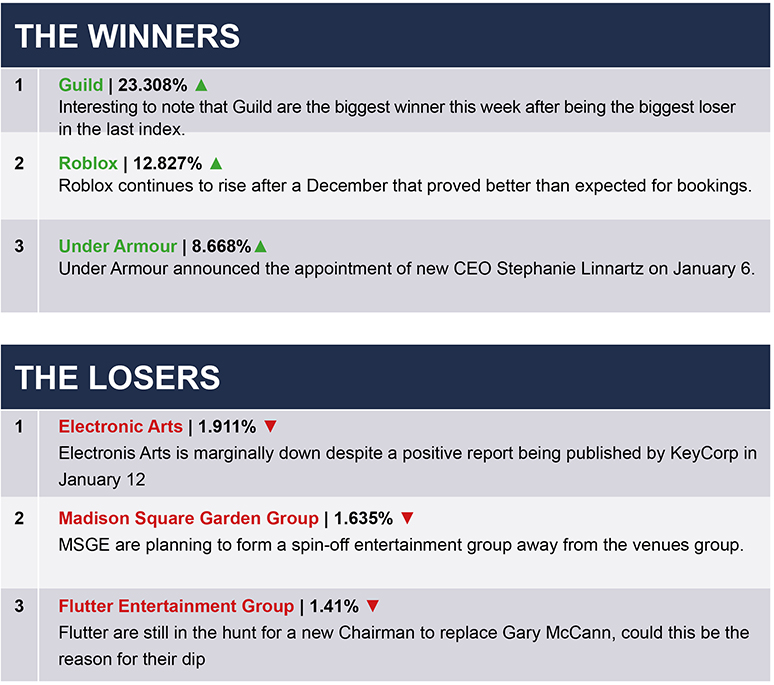
Let’s get into the winners and losers of this week then:

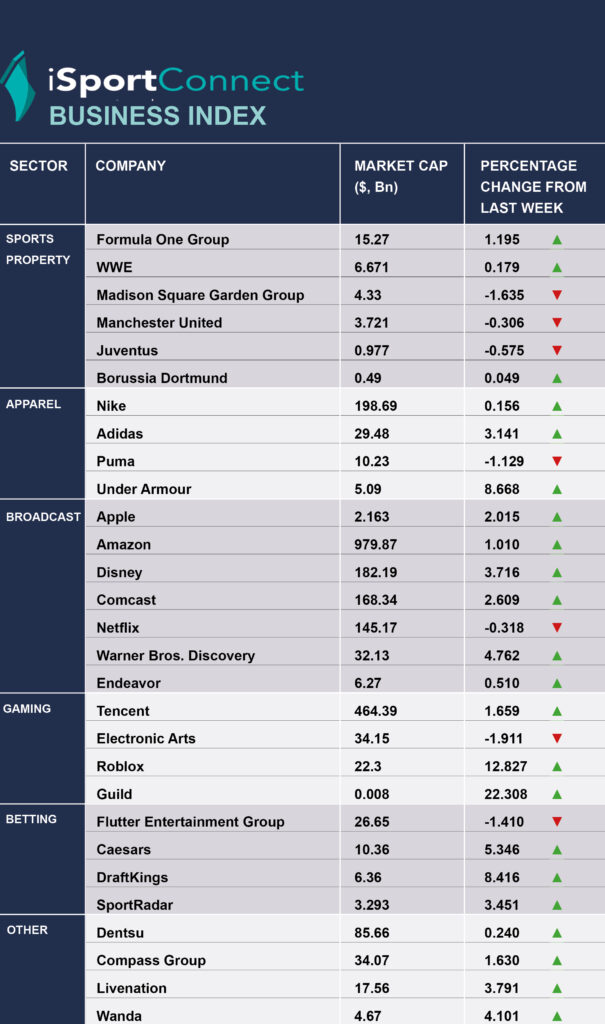
Here is the full Index for this week

Data correct as of 12:00, GMT, 18/11.

Not subscribed to our new weekly newsletter? Click here to sign up and receive more content like this

Ear to the Ground announce webinar on “Is esports at a cultural tipping point and what does this mean for brands?”

With over half a billion fans globally, esports is no longer a niche interest. As the cultural credibility of esports grows, the opportunity for brands is evolving.

Global Fan Intelligence® Network Members will join our own experts to share their opinions on the topic and the opportunity for brands.

Join us from 4PM GMT (11AM EST, 8AM PST) on Tuesday 24th January.

Click here to sign up

BBC announce nine-game broadcast deal with NBA

BBC Three will be broadcasting nine NBA games throughout the rest of the season starting with the Chicago Bull’s against the Detroit Pistons on Thursday night.

That contest will take place in Paris with tip off at 8pm GMT.

The deal for BBC Three includes four regular season games, two Playoff games, one Conference Finals game and one NBA Finals game.

https://twitter.com/BBCSport/status/1615661738493444096?ref_src=twsrc%5Etfw%7Ctwcamp%5Etweetembed%7Ctwterm%5E1615661738493444096%7Ctwgr%5E3e9dcaf97608f38df0c3da1df7e7757999a58b40%7Ctwcon%5Es1_&ref_url=https%3A%2F%2Fwww.hoopsfix.com%2F2023%2F01%2Fbbc-announces-nine-game-broadcast-deal-with-nba%2F

APT Padel becomes A1 Padel after rebrand

Trailblazing Padel circuit, APT Padel, announced today that it has completed a major rebranding globally.

The rebrand to A1 Padel comes after the development of its circuit and strategic growth initiatives and reflects their goal of being a first class experience for players and fans within the sport of Padel.

A1 Padel offers a more modernised, and memorable name that transcends throughout the diverse Padel community.

A1 Padel (formerly APT Padel Tour) was founded in 2020 by Fabrice Pastor, in order to expand the sport of Padel as well as provide players with the best professional environment possible. After the partnership with Infinity Sports owner, Ike S. Franco in October 2022, A1 Padel will continue to expand globally, as the U.S. becomes a major growth strategy for the circuit.

The new brand of A1 Padel includes a new identity consisting of a revised logo, tagline, that will appear across all platforms both digitally and in person. The tour collateral, website, social media, and merchandise feature the clean stream-lined look that is the the new A1 Padel brand, a modern and easily recognisable logo.

The essence of A1 connotates a positive and aspirational brand. A1 Padel achieves to be a leader in world class events with the best players in the world while celebrating its six year player contracts. A commitment that has not been accomplished by any other Padel circuit in the world.

“A1 Padel‘s focus has always been to enhance the player and fan experience and the new branding brings innovation and rebellion to the sport of Padel,” said Fabrice Pastor, Founder of A1 Padel. “The former brand, APT Padel Tour, will always be a part of our history, but a new and progressive brand will better align with the property’s objectives. With an evolving, youthful fan base, A1 Padel meets the needs and engagement of this global audience.”

As A1 Padel’s expansion continues in North America, there is a plan to roll out a grassroots program that will help continue to develop players. The Fabrice Pastor Cup will be a major initiative introducing audiences to the sport. In addition, a franchise plan will roll out in 2023 where official A1 Padel Clubs will be developed throughout the U.S.

“We are excited to get audiences of all ages engaged with the sport of Padel,” said Ike S. Franco, CEO of Infinity Sports and partner in A1 Padel. “As we initiate a grassroots program with A1 Padel, the engagement with U.S. fans will continue to rise and allow the sport to be positioned as a lifestyle platform in America. We are certain that athletes and sports fans all over the U.S. will enjoy the competitive nature and excitement of the sport of Padel.”

Member Insights: Why 2023 could be the year cricket changes forever

Since what feels like the dawn of time, the world’s second most popular sport has been in ‘crisis’. Indeed, this article could probably have been written in many a year from 1882 – when English cricket ‘died’ after losing against Australia at The Oval – to now. But, trust me, 2023 really could be the year the sport makes an irreversible change.

Money is, of course, at the centre of all of this, and in that fashion Cricket Australia (CA) kicked off the year by announcing its new broadcast deal. In a statement CA said: “The deal runs from 2024-31 and will be worth $1.512 billion to Australian Cricket.”

But it is away from Australia where the real changes are going to happen.

The SA20 kicked off on January 10 and is South Africa’s latest attempt at creating a T20 tournament that stands out on the world stage. It was announced that Sky have signed a broadcast deal to show the SA20 in the UK for the next five years. What is different about this, though, is that all the teams are owned by the same companies that run the Indian Premier League (IPL) franchises, rather than being owned by Cricket South Africa or the states themselves. 

Over in the United Arab Emirates, they also have a new T20 tournament, which started on January 13. It really is a late Christmas present for everyone who loves T20 franchise cricket. The UAE T20 League also has six teams, three of which are owned by IPL franchises. You can see the pattern emerging here.

There is a future where if leading players are contracted to the Mumbai Indians in the IPL, they will also be  contracted to the MI Cape Town in South Africa and MI Emirates in the UAE league. That would mean spending your January and February in South Africa and the UAE before going to India in March through to the end of May. While that sounds great to those on the outside, it is a massive part of the international calendar taken up.

The IPL and the BCCI have set the pace in cricket since the tournament’s first edition in 2008 when superstars from all over the world gathered to play extremely high-quality T20 cricket for the first time. Last summer the IPL secured an astronomical broadcast deal worth a total of $6.2 billion, making it one of world sport’s most valuable properties, again money talks.

The financial muscle IPL owners have is astronomical, the governing bodies and other tournaments can’t come close to matching what they are prepared to pay for the services of the world’s best players.

My point here is this: with these new leagues popping up and money flowing faster than a Jofra Archer bouncer, the international game is inevitably going to be left in limbo. Players will find it hard to turn down the huge sums on offer and international cricket is going to have to fit in around the world’s franchise competitions. 

You can certainly see a future where cricket becomes more similar to football with international breaks where teams attempt to squeeze in a Test match here or a one-day series there. Or Test cricket will be played only by the three wealthiest nations – India, England and Australia. Even the Ashes, eagerly awaited as ever this summer and approaching its 150th birthday, could become a sideshow.

20 years since the launch of the first T20 competition in England and 15 since the IPL began, the shortest format of the game appears ready to take over the sport completely. 

By Alex Brinton, Content Manager of iSportConnect

Not subscribed to our new weekly newsletter? Click here to sign up and receive more content like this:

How can teams engage their fans 24/7?

Just as clubs have found their feet and solidified their fan engagement strategies for game days, fans are now searching for opportunities to interact with their favorite team every day of the week. Fans are hungry for content that brings them closer to the action between game days, and it’s imperative that clubs keep up.  

The truly progressive sports clubs are well into building a complete fan engagement strategy that seeks to engage with their supporters every day of the week. Fan engagement now plays a significant role in the growth strategy of teams, leagues and organizations whilst also representing a prime opportunity to collect customer data from a range of touchpoints.  

Hosting Supporters

The two key aims of non-match day fan engagement campaigns are to both host and connect fans, which can be achieved both online and in person. It’s no secret that sports clubs understand the potential value of their home stadiums outside of match days, and many are using their grounds to extract that value.  

Almost every major stadium now hosts some form of museum for the club or ground as well as tours that fans can access every day of the week. Other venues have hosted community events such as job fairs and charity drives to reach a multitude of potential new fans and gain valuable new data points. Hosting fans at team venues provides them with an intimate experience outside of the hustle and thrill of game day and can provide teams with the opportunity connect with their fans in meaningful ways.

Connecting Fans 

Although hosting fans is a long-proven strategy for non-match day interactions, not all fans will be able to visit the home ground or in person activations. That is why connecting fans online is a crucial element of club’s fan engagement strategies.  

Fans are always on the lookout to engage with one and other as well as their club, and the digital revolution has created a swathe of new avenues teams can use to achieve this. Partnerships with online meeting platforms such as Zoom, or Skype have enabled teams to create bespoke chatrooms for fans from across the globe to communicate. 

VR and Web3 technologies represent an almost untapped set of tools that connect fans in more ways than one. The NBA’s NBA Lane launched earlier this year to celebrate the competition’s 75th anniversary, connecting fans from all over the world through the Metaverse. Incentivizing fan interaction is key for organizations to create robust spaces where fans can feel closer to the action and their team.  

Fan Engagement Platforms  

As time goes on, more and more clubs are recognizing the importance of having a digital platform that allows fans to connect with the team and each other 24/7. Many teams enhance the live experience, bring fans closer to the action and connect supporters from all over the globe on one app.   

After years of development, apps now host live streams of the tunnel or bench, replays of key moments from various cameras around the stadiums and chat rooms. All these elements contribute to a holistic one stop shop for fans, and a plethora of touchpoints for teams to gather valuable data.  

As CRM solidifies itself as an important backbone and source of business growth for teams, integrating a holistic CRM into these fan engagement platforms is crucial. The numerous interactions on these apps provide significant potential for business growth through the millions of data points available. When apps are linked into a backend CRM system, these data points can be turned into valuable insights for clubs.

Engaging Fans  

It’s no walk in the park to continually engage fans every day of the week, but when successful the heavy load match days once had can be lifted and fans feel connected to their clubs. As is the way of the world, technology will continue to drive the fan engagement space and push the boundaries of what can be done. However, it’s crucial teams have a robust CRM to underpin their operations and maximise opportunities for growth through understanding their data.   

By EngageRM, If you would like to find out more about what they do, click here

Not subscribed to our new weekly newsletter? Click here to sign up and receive more content like this

Meet the Member: “The costs in terms of getting involved in football are high, but there’s nothing else that can compete in terms of eyeballs”

Sean Maddocks is the Sales Director for UK and Ireland for Davanti Tyres, our Content Manager Alex Brinton sat down with him to speak about sports partnerships, Everton and why it is so hard to define the ROI from those partnerships.

Davanti started in 2015, tell us a bit about the journey the business has been on since then?

Yes, it was a new company formed in 2015 but the parent company has been a leading company in the tyre industry since the 1980s. Our parent company, Oak Tyres, has been at the forefront of the wholesale tyre market for the last few decades, but then in 2012 the owners decided the market conditions were right to start the process of creating a brand which they wholly owned and manufactured. From a standing start in 2015 we now export Davanti Tyres to over 70 countries and we are now the third highest selling mid -range tyre brand in the UK.

And your role in that particular journey?

I am the Sales Director for the UK and Ireland, which is our home market. We sold our first tyre in April 2015 and I came on board in August so I have really been here from the start. I’m responsible for the sales in the UK and Ireland which is our highest volume market, but is only a small part of the global jigsaw really. I also have a hand in the development, strategy and marketing of the brand.

What makes sport and football in particular an attractive opportunity for Davanti?

Football has always been something that has been attractive to the tyre industry because it is a great way to reach the masses. The costs in getting associated with football are obviously high, but there is nothing else that can compete with it in terms of eyeballs. Strangely, the aim wasn’t primarily to directly influence a consumers purchase choice, even though it was customer-led advertising, the aim was really to introduce the brand identity to the global tyre market as well as increase the awareness of the brand name with potential consumers.

Is the reason you are a Liverpool-based company a big part of the reason you have partnered with Everton?

It definitely came into it, but it wasn’t Everton or nothing. A lot of us here are Everton fans here, which helps. At the time we started the relationship the team were doing well and were regularly finishing within touching distance of the top six. We also saw the investment from the owners in the club and the stadium. The importance of the partnership with Everton is shown when we go travelling around the world doing trade shows and people already have knowledge of the brand. 

Also being a local brand we are able to put on events in partnership with Everton in the local community, which is a real bonus. We really believe in long-term partnerships so even though the team hasn’t been performing well recently we are committed to the longevity of the partnership within the Premier League. 

What sort of sports teams and brands do you look to partner with? 

We try to partner with different teams/individuals depending on what we want to achieve from the partnership, so Everton was done to try and create an awareness globally. Being a locally-owned company we do a lot of activities with the local community around Liverpool. Over the past few years, we’ve tried to support the local community through CSR activities like providing school uniforms for underprivileged children, helping to feed children during the school holidays when the government withdrew support, and supporting grassroots football teams by providing equipment. It’s very important to us, being a family-owned business, that we are active in the local community and are seen as a partner which takes a greater involvement with the club outside of the standard advertising commitments. We are also the back-of-shirt sponsors for the Wigan Warriors, who are one of the most successful Super League teams. That partnership is based a lot on visibility of the brand so we do a lot of engagement with the players, the clubs and the fans.

Unsurprisingly we do also do some work in motorsport – being a tyre company there really isn’t much substitute for the credibility actually having your tyres on a racing car can give you. We have partnered with a race track in Portugal for the past 6 years as the Official Tyre Partner, the Autodromo Internacional in the Algarve, which is the home of the Portuguese F1.

We have a long-term partnership with British racing driver Dan Zelos, who recently won the Mini Challenge Championship in a fully branded Davanti car. The championship is the undercard to the British Touring cars, so we get great visibility through their coverage on ITV4 and with the racing community in general. We’ve worked with Dan since he was racing go karts, so you can see that longevity is very important to us with all of our partnerships.

In a two team city such as Liverpool did you have to weigh up the possible negatives of siding with the blue side of the city?

No to be honest that hasn’t been an issue at all, if anything Liverpool fans probably feel a bit sorry for us. Liverpool as a city is massively passionate about football, but I feel like over the last 10 years or so the rivalry between the two clubs has calmed down a bit and the city has really come together. Both clubs are such a massive part of the city and you saw how the fans came together after the Hillsborough enquiry, the rivalry is more based on banter rather than particularly bitterness. Also when you are selling around the globe the benefit of being partnered with one Premier League club, vastly outweighs any possible negativity people might have because of a rivalry.

What are you looking for in terms of ROI from a sports partnership because the benefits of this type of partnership are often hard to quantify?

It is always hard to quantify ROI from sports-based partnerships but particularly in our field. Tyres are a distress purchase, you don’t wake up in the morning and decide ‘oh brilliant, I am going to buy some new tyres today’. So we can’t measure ROI by a sudden spike in sales. We have to speak to our dealership network and find out if they are using it as a selling point? Are customers speaking about it? Are they displaying it at their depots? Partnering with a Premier League club also creates a lot of momentum behind your brand which is really helpful and shows your partners that you are serious about investment in marketing. The international benefits of the partnership were almost more important than the UK strangely. Because it gave us validation and recognition when we went to trade shows around the world so that was a great way of seeing ROI from the partnership.

There’s a lot of talk at the moment around brands being culturally aware at the moment. Is this something you are paying attention to?

We have never been a contentious brand in terms of our approach to marketing or our background, so it isn’t really a problem. In recent years we started a carbon offset partnership with Ecologi as part of our continued journey to become climate positive. 

We also do a lot of work with charities both in and outside of Liverpool, so it is very important to us that we are seen as doing something to give back to the community as well and I think that stems from still being a family business.

Not subscribed to our new weekly newsletter? Click here to sign up and receive more content like this