FIFA announce record-breaking viewing figures

The FIFA World Cup Qatar 2022™ is continuing to engage TV audiences around the world with record-breaking numbers across multiple markets.

In Asia, the group game between Japan and Costa Rica on Sunday 27 November drew an average audience of 36.37 million viewers. This surpassed the audience of their incredible comeback against Germany in their tournament opener by over 10 million and was 74% higher than the average domestic group stage audience during the FIFA World Cup in 2018.

On Thursday 24 November in Korea Republic, 11.14 million people watched their tournament opener against Uruguay. The broadcast saw a 97% increase in TV audience compared to the average for group stage matches at the FIFA World Cup in Brazil in 2014; 18% higher than at Russia 2018.

Fans in Europe have also been tuning in for the second round of group stage matches in great numbers

On Sunday 28 November, 65% of people watching TV in Spain saw La Roja take on Germany in one of the most anticipated games of the tournament so far. 11.9 million was the combined audience across coverage on La1 and GOL MUNDIAL, exceeding the audience of any group stage game for the FIFA World Cup in 2018.

Incredibly, over three quarters (76.6%) of all people watching TV in the Netherlands witnessed Cody Gakpo’s wonder strike in their 1-1 draw with Ecuador. This was the highest TV audience in the country in 2022 and greater than any match during the FIFA World Cup in 2018.

In France, Les Bleus’ encounter with Denmark, was broadcast on TF1. Averaging an audience of 11.6 million viewers, the programme audience peaked in the closing minutes of the match as 14.56 million watched Kylian Mbappe score a late winner. This was the highest peak of the tournament in France so far, beating 14 million viewers during France’s opening match against Australia.

Portugal’s match with Uruguay on Monday 28 November was the highest TV audience in Portugal for a FIFA World Cup match ever. In total, 5.35 million viewers in Portugal watched at least one minute of coverage as the team progressed to the knockout stages. The coverage held an audience share of 69.5% as A Seleção got their second win in as many games at the tournament. Over 80% of the Portuguese TV landscape has now watched at least one minute of the tournament’s coverage.

In addition, interest in the beautiful game in the United States continues to grow with new records continuously being broken.

The English-language coverage of USA’s encounter with England on Friday 25 November was the most watched men’s football match on US television ever, with a peak audience of 19.65 million viewers on FOX. NBC-Universal’s Spanish-language coverage of the match on Telemundo was the second-most watched FIFA World Cup Group Stage match featuring a United States team in Spanish-language history.

The following day, as Argentina and Mexico met in a crucial Group C tie, the Telemundo broadcast in the US was the most-watched FIFA World Cup Group Stage match in Spanish-language history in the country, and the second largest of any stage, ever.

Meanwhile, in Mexico, coverage of the same match delivered a national audience of 20.96 million viewers. The combined share across three channels broadcasting the game was 67.9%. This was higher than the top combined rating in the territory for any match of the FIFA World Cup in 2018.

In addition, the average audience in Canada for their make-or-break tie with Croatia was 4.33 million, with a share of 68.4%. This was 17% higher than Canada’s opening match and 12% higher than the top combined audience in the territory for the 2018 tournament. 

Passion for the game in South America knows no bounds with fans as engaged as ever.

In Argentina, the average audience for the two-time winners of the FIFA World Cup in their pivotal match with Mexico was 8.48 million; delivering an amazing audience share of 81.3%. The programme audience was the highest of the tournament so far in the country and 5% higher than both their first match against Saudi Arabia, and the average audience for their group stage matches during the FIFA World Cup 2018.
Roundtable Roundup: Acquisition v Retention

“Different sports with different demographics require different approaches for both retention and acquisition”

This was one of the key learnings to come out of the iSportConnect Roundtable on How To Optimise Revenues From Premium & Partnership last week. 

The discussion at the event, held at Queensland House in London, centred around the ongoing battle of sports organisations to retain partners and fans while acquiring new ones. Ned Coten, CEO of EngageRM, and Tim Barber, the company’s Global Commercial Director, were thought leaders in a lively and very open discussion featuring leading sports rights owners.

“At the end of the day people want to be part of a tribe”

Making partners not only feel valued but ‘part of your tribe’ is a vital part of partner retention. You need to make sure they feel valued and appreciated. Every partner is different. Retention is all about knowing and understanding your partners.

“You have to have a good knowledge of who is in your database because potential partners are hiding in there”

This was an eye-opening point. Clubs and governing bodies have piles of information on their fans. But understanding your database and then using it to your advantage is a challenge, and the most valuable work still probably needs to done manually. Attendees agreed that there are few if any organisations out there that can say they are well and truly on top of their data. 

One club admitted that they approached a company about a partnership only to find out later much to their chagrin that the CEO was in their database as one of their season ticket-holders.

A mass participation company said that it was only after putting on a race for a charity they had a dive into their database and found that they had senior figures at some of the world’s biggest banks taking part in their races. The phrase ‘sitting on a gold mine’ springs to mind.

“Find the people who love your sport, then find the ones among them who have money for partnerships – not the other way around”

When looking to acquire new partners many organisations target companies with money and then try to convince them to invest in their sport. Ned of EngageRM recommended that instead, you should search for the people who are already emotionally invested in your sport and your team and then from there find those with deeper pockets. If people already have a connection, it’s easier to get them financially engaged as well.

“Web3 presents a great opportunity for partner acquisition”

Web3 gives clubs the chance to strengthen their relationships with fans around the world who cannot attend in person by giving them value through digital assets. 

Adding a Web3 dimension to some current partnership packages might not work so well for traditional partners looking for a tried-and-tested route to ROI. But if the aim is to attract a new type of partners, then an NFT or a metaverse experience can add a lot of value to packages. 

Attendees agreed that the potential for Web3 has barely been scratched so far.

To find out more about the work EngageRM do, click here

FIBA announce U17 and U19 World Cups host from 2024 to 2026

Following the candidatures received for the FIBA U17 and U19 Basketball World Cups for both men and women, FIBA’s Central Board has confirmed the hosts of the upcoming Youth World Cups. 

The multi-year hosting model, introduced by FIBA in 2019, enables National Federations to host consecutive Youth World Cups, both U17 and U19 men’s and women’s. This model was put in place in order to maximize synergies and better organize and manage events while allowing National Federations to showcase their event-hosting capabilities at the world stage.

Below are the confirmed hosts for the U17 and U19 World Cups for both men and women taking place in 2024, 2025 and 2026:

FIBA U17 Basketball World Cup 2024
Host
: Turkish Basketball Federation       
Dates: June 29 to July 7
 
FIBA U17 Women’s Basketball World Cup 2024
Host
: Mexican Basketball Federation
Dates: July 13 to 21
 
FIBA U19 Basketball World Cup 2025
Host
: Swiss Basketball
Dates: June 28 to July 6
 
FIBA U19 Women’s Basketball World Cup 2025
Host
: Czech Basketball Federation
Dates: July 12 to 20
 
FIBA U17 Basketball World Cup 2026
Host
: Turkish Basketball Federation
Dates: June 27 to July 5
 
FIBA U17 Women’s Basketball World Cup 2026
Host
: Czech Basketball Federation
Dates: July 11 to 19
 
FIBA U19 Basketball World Cup 2027
Host
: Czech Basketball Federation
Dates: June 26 to July 4

One of FIBA’s long-term strategic objectives is to ‘Develop Youth Basketball’, with the aim of enhancing development opportunities for young players, coaches and National Federations, and for the first time ever, Mexico and Switzerland have been awarded hosts of a FIBA world-level event. 

The 2023 U19 World Cups were awarded in 2020 and 2021 and are set to take place in Madrid for the FIBA U19 Women’s Basketball World Cup 2023 from July 15 to 23 and in Debrecen for the FIBA U19 Basketball World Cup from June 24 to July 2. 

Olympic champion Sandor Totka will compete at ICF Virtual World Cup next month

Tokyo canoe sprint Olympic champion Sandor Totka will be one of the athletes to catch when the ICF hosts its first Virtual World Cup next month.

Totka issued the challenge to paddlers all over the world to take him on in the 2000 metre virtual race, which will be held online on December 17. Competitors will use the latest cutting edge technology to measure their progress against opponents located in loungerooms, garages and gymnasiums around the world.

Hungary’s Totka stormed to Olympic gold in the men’s 200 metres at the Tokyo Olympics, claiming the scalp of Great Britain’s reigning Olympic champion, Liam Heath, along the way. In the lead-up to Tokyo Totka also won European gold.

“The virtual world cup is an exciting new format, and I can’t wait to take on paddlers from all over the world,” Totka said.

“2000 metres is not really my ideal distance, so there will be a good chance for paddlers to really challenge me. And I know that because I am the Olympic champion, everyone will want to beat me.”

The virtual world cup will offer opportunities for individual races in three categories – junior, senior and masters 40+ – for both men and women. There will also be races for men’s and women’s paracanoe. Each race will have a cut-off of 15 minutes.

The ICF has partnered with world-leading ergo manufacturer KayakPro to ensure the competition offers the best possible athlete experience. Competitors will need access to a KayakPro machine, and the cutting edge Genesis Port Bluetooth Smart Console. Athletes who don’t have the console may qualify for an ICF donation.

Competitors will also need to be able to film their performance, to be part of the ICF livestream program.

Entry to the event costs just EU 5. Registration closes December 7, and a trial competition run will be held for interested participants on December 15.

GAISF dissolved at EGM in Lausanne

The Global Association of International Sports Federations (GAISF) was dissolved yesterday at the organisations Extraordinary General Meeting in Lausanne.

The organisation’s President Ivo Ferriani believes that this is a “step forward towards a better future for sport”.

The decision was decided by a vote secured more than a two thirds majority, with 70 people voting in favour and and just 22 against.

It was agreed that the GSAIF’s total assets of £4.9 million will be transferred over to SportAccord with 79 voting in favour and 11 against.

Ivo Ferriarni said: “Now we can move forward and build a stronger entity under SportAccord though the representation of the umbrella organisation.

“Today we are taking the right decision for the future of GAISF and, more importantly, the future of the global sporting community.

“This is a key step towards a better future and we are taking this step together.

“Most of the services once provided by GAISF are now provided by other bodies as was the case with the anti-doping to the International Testing Agency,” said Ferriani.

“The underlining business operation of the GAISF has been loss making over recent years and there is considerable doubt regarding its future financial stability.

“GAISF does not have the expertise in its staff to successfully organise a multi-sport event.”

World Table Tennis unveils first half of events calendar for 2023

World Table Tennis on Wednesday 30th November unveiled the first half of its events calendar for the 2023 season of WTT Series and WTT Feeder Series.

The calendar promises a year of firsts as the WTT Series kicks off in January with WTT Contender Durban. It will be the first time a WTT Series event will be staged in the Republic of South Africa. All eyes will remain on Durban as the city is set to host the ITTF World Table Tennis Championships Finals in May. Africa continues to be a hotspot for the 2023 calendar as Nigeria will host WTT Contender Lagos in June, a first for the country, followed by the third edition of WTT Contender Tunis.

The first half of the year will also bring a return of a blockbuster event. Singapore hosted the first ever Grand Smash event in 2022, marking the start of a grand new legacy for table tennis. This legacy continues to unfold next year as Singapore Smash 2023 will set the Lion City alight once again, promising an even bigger and better event for players and fans. Building on 2022 momentum continues to be a key theme in the latest calendar.

While Doha and Zagreb will host a WTT event for the third and second consecutive year respectively, maiden hosts round out the first half of the 2023 calendar, adding momentum to the international growth of table tennis. WTT Star Contender Goa and WTT Star Contender Bangkok brings the series to India and Thailand for the first time while WTT Contender Amman introduces the global series to Jordan.

WTT Star Contender Ljubljana embodies the growth of the sport. The capital of Slovenia hosts a WTT event for the first time after the country successfully delivered several WTT Feeder and Contender events in regional cities over the past years.

Click here to download the 2023 WTT Series calendar and the WTT Feeder Series calendar.

Liu Guoliang, Chair of World Table Tennis Board, commented, “World Table Tennis’s future shines ever brighter in 2023, further demonstrating the global influence of this sport we love. I hope more cities around the world, especially those beyond the traditional powerhouses, will play host to WTT events, experience the charm of table tennis through that and ultimately attract more people to participate in the sport. This has always been our most fundamental goal.”

The WTT events structure provides the perfect showcase for both athletes and fans. The event tiers exhibit and highlight the phenomenal talent of world-class table tennis stars in a fresh, dynamic and entertainment-driven settings.

At the top is the WTT Series, the official professional table tennis series of events, with the world’s best table tennis players facing off in events of different levels:

WTT Contender and WTT Star Contender events, designed to mix global stars, national heroes and rising stars across Men’s and Women’s Singles, Doubles and Mixed competitions.

WTT Champions events, featuring high-octane action with the 32 best men’s and women’s singles players

WTT Grand Smashes, the foundation of the WTT Series and the pillars of the season, bringing two-week-long thrills with the best 128 Men’s and Women’s Singles players as well as Doubles and mixed doubles action.

WTT Cup Finals, one prestigious event at the end of the season, held separately for men and women, with the best of the best only

Under the WTT Series, the WTT Feeder Series serves as a critical stepping-stone bringing together a mix of the world’s up and coming stars, local and regional heroes, players fighting to return to the WTT Series due to form or returning from career breaks. WTT Feeder Series events are driven by player participation with up to 400 players to deliver international competitive table tennis with grassroots and community activation. In the first half of 2023, WTT Feeder Series events will be hosted in Doha, Amman, Düsseldorf, and Antalya.

The WTT Youth Series is where it all begins. Forming an important part of the WTT events pyramid, it establishes the playing pathway and journey from day one to World No.1. The 2023 events calendar of WTT Youth Series was announced in October with an record number of events organised in every corner of the world.

Steve Dainton, ITTF Group CEO, commented, “The first two years of World Table Tennis provided a learning experience, and more importantly a launchpad for the future growth that begins now. As the COVID-19 pandemic continues to recede, the calendar for World Table Tennis will continue to grow. Providing a worldwide, cutting-edge experience is the goal of World Table Tennis, and this year will show just how we much we can deliver.”

The first half of the year sends the WTT Series and WTT Feeder Series across three continents for more than 15 events; but that’s just the beginning. Players and fans can look forward to the series landing in the Americas, Europe and Asia in the second half of 2023, creating a truly global series. Champions events will also be touching down in new locations around the world and a second Grand Smash will be unveiled, rounding out an action-packed 2023 WTT Series calendar. The stage will then be set for players to chase World Ranking points in a bid to qualify for the season ending WTT Cup Finals and pursue the top honour of closing out the season as the year-end World No.1.

Member Insights: Sporting sustainability – how major events can get involved

Winning a bid for a major sporting event is a huge honour. It puts your country on the world’s stage, increases tourism and boosts the economy. Not to mention what hosting does for increasing a sports’ following and inspiring people to get active. But what about the impact these events have on our planet?

Qatar 2022 is here. From articles about human rights to concerns about the heat the game will be played in, FIFA’s choice has been controversial from the get go. The hope is that this criticism has been turned into opportunities for improvement.

Architecture appears to be integral to Qatar 2022’s sustainability strategy. A lot of effort and attention has gone into sustainable design and the legacy of the tournament’s eight stadiums. Most notably, Stadium 974. Made of 974 storage containers, it will be dismantled at the end of the tournament, while six others will become hotels or business centres. New parks have also been created surrounding the stadiums and training sites, which are irrigated using recycled water.

They’re sustainable builds for sure. But as the world is watching, and likely judging how sustainable this tournament will be, the big question is: will Qatar 2022 bring about social change?

Sustainability extends to far more than the environment alone. From the Latin ‘sustinere’, meaning to ‘hold upright’; the upholding of human rights should be high on this World Cup’s agenda. Recycling bins won’t cut it, as the tournament claims to be working in line with the United Nations 17 Sustainable Development Goals. Sport is undoubtedly a force for good, but organisations need to dig deep and think of more than promising to offset their emissions. Perhaps there should be more recognition for sports that really are in the lead where sustainability is concerned.

The Olympic Games in Paris 2024 are set to be both ‘spectacular and sustainable’. The hosts have given themselves the target of being the first major sporting event to positively impact the climate. ‘Prioritising frugality and utility’, Paris placed environmental responsibility at the core of its bid, putting a lot of planning into reducing emissions prior to the games starting. Most notably, 95% of the games will be hosted in existing or temporary venues – all specifically chosen to reduce the number of new builds needed and environmental impact. Only two new venues are being built – the Olympic and Paralympic Village. Both are designed to be an eco-district for French residents following the games, giving Paris 2024 a lasting eco-legacy. Très magnifique.

Of course, major sporting events can also play a part in helping societies move towards a circular economy. Banning single use plastics from events is a nice start – but it can’t be the finish line. The Tokyo Olympics was a great example of this. Podiums were made from recycled plastic, athlete’s beds were made using cardboard, and even the medals were constructed with recycled electronic devices. But it’s not just down to organisers, sponsors should get involved with sustainability too. Events are a great opportunity to live your brand’s values by doing acts, not just ads. For the 2022 Australian Open, in their ‘Aces for Oceans’ campaign, long term sponsors Kia pledged to remove plastic from the sea for every Ace scored. Kia currently turns recycled plastic bottles into seats in their electric models. With so much waste in the world, isn’t it time we had a bit of competition to see how we could reuse materials around sporting events?

If they’re going to have a place in the future, longer standing sporting events need to step up and do more, as new organisations are entering the arena who have sustainability baked into who they are.

Take Sail GP for example; ‘Powered by Nature’. Sustainability is one of the things that sets this sailing championship apart. Alongside the races themselves, the sport has an ‘Impact League’ – a secondary leaderboard in which teams earn points for actions that reduce their carbon footprint or help accelerate inclusivity in sailing. Every team competes across 10 different sustainability criterias, from travel and accommodation to how they use their voice and influence. Initiatives such as this stop progress being held back by policy and bureaucracy and give teams the autonomy to take matters into their own hands and sail ahead with better solutions.

Sail GP events also go to great lengths to reduce their carbon footprint. The Denmark Sail Grand Prix moved fans to the venue using electric buses, offered plant-based food options and recyclable cutlery. Even sponsor Carlsberg got involved; designing a new beer bottle consisting of wood fibres, with an internal barrier made of a plant-based mass to keep the beer fresh and full of flavour. Carlsberg are testing the new packaging, with the vision that these new fibre bottles should have a CO2 release that’s 80% lower than a disposable glass bottle. Cheers to that.

From the food and drink we choose, to the sponsors we support, to the sports we play – sustainability is something we can all choose to get behind. Sporting events are a special thing to behold; the culmination of a lot of hard work, discipline and determination; full of human stories of endeavour, setbacks and triumph. Imagine if we harnessed this energy into forming solid sustainability strategies? With a bit of creative thinking, design support and scientists on side, I have no doubt sporting events can be a great play in helping the planet win.

Written by Niamh Deehan, Senior Strategist at Cravens.

To find out more about Cravens, visit their website here

Gymnastics Australia and InCrowd announce new partnership

Gymnastics Australia, the national governing body for gymnastics within Australia and the 8 State & Territory Associations have agreed an exciting partnership with InCrowd to launch new digital platforms at the end of this year.

Established in 1949, Gymnastics Australia’s mission is to promote, develop and grow gymnastics for the enjoyment of all, and a key part of this strategy is to enhance the digital experience for its new and existing audiences. Having undergone brand and data transformations in the last couple of years, Gymnastics Australia’s focus has turned to the website platforms and how the online experience can be improved to drive better value for the organisation and its members.

InCrowd has a proven track record of producing industry-leading fan technology, data driven solutions and professional services for it’s portfolio of clients that includes UEFA, Major League Soccer, United Rugby Championship (URC), Premiership Rugby, EuroLeague Basketball, Formula 1, ECB, Rugby Football League, World Snooker and a number of Premier League and Championship football clubs.

In Australia and New Zealand, InCrowd is currently working with organisations such as the AFL, Fijian Drua Rugby and Golf Australia, and delivers in-stadia LED display technology across 41 venues including the SCG, GMHBA Stadium, Stadium Australia and CommBank Stadium.

The new websites will be built upon InCrowd’s Digital Experience Platform, Bridge, which includes a sports specific headless CMS, digital asset manager, fan activations, reporting & insights and audience targeting tools that enable personalised content delivery and communications based on 1st party data.

InCrowd’s Head of Partnerships AU & NZ Seb Lear said “the sport of Gymnastics in Australia is heading into an incredible period.. With the Commonwealth Games coming to Victoria in 2026, and the Brisbane Olympics in 2032, InCrowd is extremely excited to support Gymnastics Australia and the State & Territory associations in capitalising on these milestone events. By delivering best in class digital platforms that engage new and existing audiences, 

InCrowd believes that these fan-first developments by Gymnastics Australia will enable the sport to continue to grow and thrive for years to come.”

Alexandra Ash, Chief Executive Officer at Gymnastics Australia added “We’re thrilled to partner with InCrowd, an organisation which constantly pushes the boundaries in providing a unique digital experience for sports fans around the world. ”

“This is a significant and welcome partnership for Gymnastics in Australia as we enter what is an exciting decade of sport in this country. We look forward to working with Seb and the entire InCrowd team to engage further with our members and supporters.”

Alexandra Ash

Case Study: The Helsinki Cup App, the No. 1 channel for the junior football tournament

In large tournaments good communication tools come in handy. Here’s how one of the largest junior football tournaments in Europe uses their mobile app.

When you’re hosting a football tournament for over 20 000 junior players and their support groups, there are a lot of moving parts. In that setting, good communication tools come in handy.

Here’s a look into our collaboration with Helsinki Cup, one of the biggest junior football tournaments in Europe, and how their mobile app became the number one source of information for the tournament attendance.

We started working with the Helsinki Cup team in the spring of 2020. The tournament had used a different app in 2019 but it didn’t serve the tournament’s needs anymore. The management chose Choicely’s mobile app for its diverse features, and the amount of flexibility that comes with the app builder. Choicely team built the app for Helsinki Cup in the spring, well in time for the tournament in early July.

Using the app in tournament setting

The new Helsinki Cup app was a huge hit during its first year, as it was downloaded over 3 times more than the old 2019 app. It racked up an impressive 17 000 downloads and had an average usage time of 9 minutes and 30 seconds. It ranked first in App Store and Google Play Sports app listing 24 hours after the app launch. In the post tournament survey 74% of the participants said that the app was their primary source of information regarding the tournament, compared to the old app with only 40% favoring it in 2019.

Why did the attendees like to use the mobile app? Some reasons include:

The attendees can find the timetables and the tournament program easily in the app. This is crucial as the tournament has many football fields in the city of Helsinki, and it is critical for the players and attendees to be on time. If you need information fast, the experience is faster and better with a mobile app rather than using a website.

Users can find maps and directions in the app. Most of the attendees aren’t familiar with Helsinki. The directions are easy to use with the mobile phone and GPS.

The scoreboard can be found in the app, so players and their parents can follow the results easily in the app. This is done by integrating Helsinki Cup’s scoreboard solution Torneopal into the app.

The parents can watch the games through a livestream. If they want to follow the match but also explore the city, it can be done with the stream. The streaming service Solidsport was integrated into the app for the 2021 tournament. 90% of the games were streamed and the attendees could pay a fee to watch the stream.

Social media updates. Helsinki Cup’s Instagram feed has been integrated into the app where users can see them in one place.

On top of serving the attendees, there are also a number of reasons why the app is so useful for the organizers:

Push messages are a fast way to inform attendees. Organizers can send out a push message if something comes up that attendees need to know immediately. Pushes can also be scheduled in advance for certain times. Both are useful features in hectic tournaments like Helsinki Cup.

Sponsor visibility. A mobile app brings a new possibility to showcase the tournament sponsors, which benefits the partners and Helsinki Cup organization to fund, grow and develop the tournament even further.

Informing attendees also before and after the tournament. Right now Helsinki Cup is showing a compilation video from the previous tournament, offering registrations for next year – including an early bird raffle to win free tickets. The tournament is also sending a monthly push message about the latest news and keeping the audience active around the year.

This way the mobile app truly helps the whole tournament ecosystem connect before, during and after the intensive event.

Growth in numbers

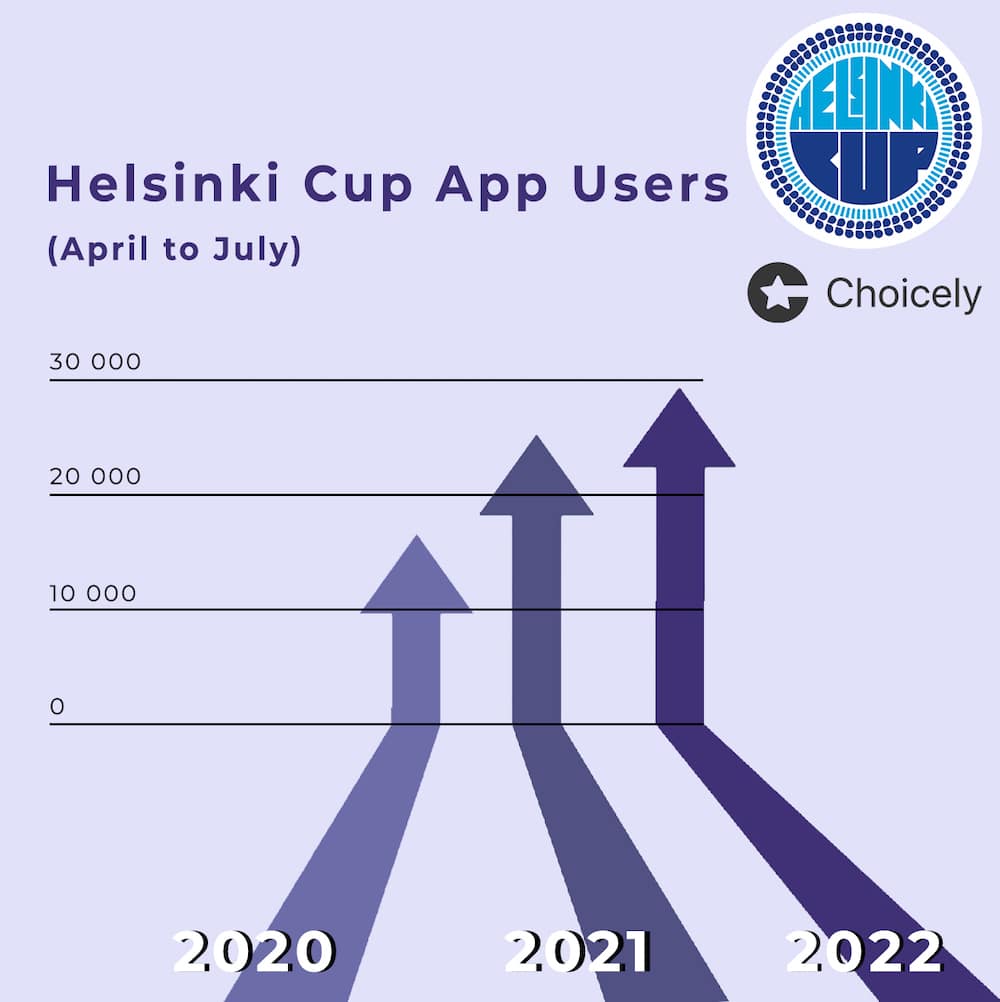
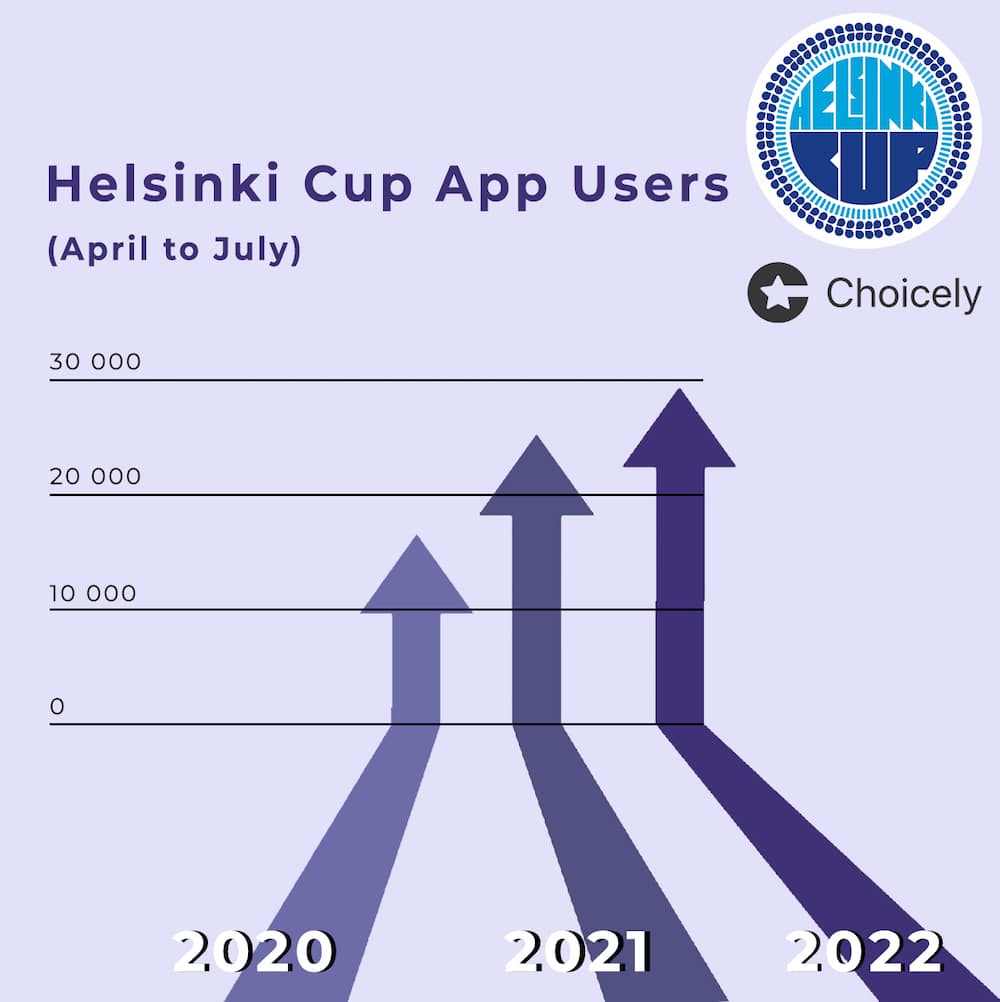
Both the tournament and the app have seen growth in numbers during the three years of our collaboration.

For Helsinki Cup, 2022 was their biggest tournament in its 46-year history with 5140 teams attending.

In 2022, the mobile app had:

over 28 000 users between April and July – 24% more than the previous year.

440 000 sessions, a growth of 25% compared to 2021

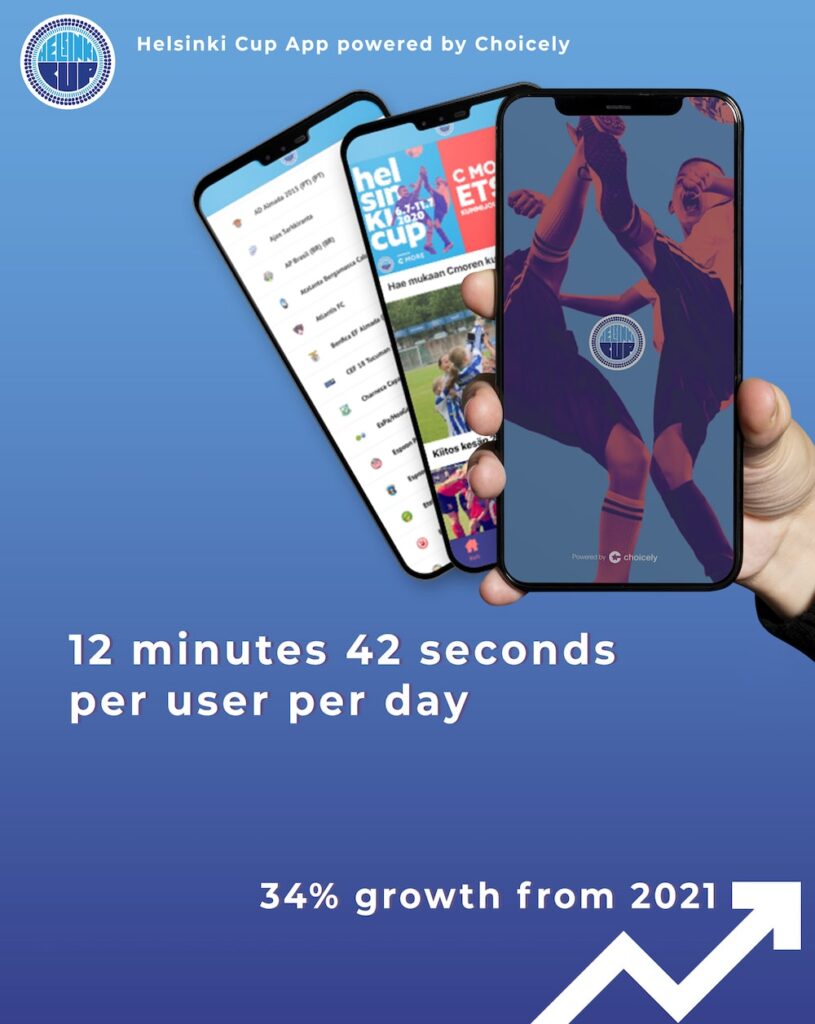
average time spent of 12 minutes 42 seconds per user per day.

During the three years of the app has cemented its position as the most important communication channel, reported by the attendees. The app is popular among the users, and the information about the app has spread fast.

Kirsi Kavanne, Helsinki Cup CEO says: “We at Helsinki Cup have been extremely satisfied with the mobile application. In my opinion it is straightforward, customer-friendly, easy to use and convenient to update.

“Parents of children participating in Helsinki Cup also agree, according to the feedback we’ve received. Our annual visitor survey indicates that the Helsinki Cup mobile application has very quickly become the most important channel for following the tournament and getting news updates related to it.”

Click here to visit Choicely’s website

WTT announces Corpay as official Global FX Payments Supplier

World Table Tennis is pleased to announce an agreement with Corpay1, a FLEETCOR® brand, for Corpay’s Cross-Border business to become World Table Tennis’s official Global FX Payments Supplier.

Corpay, a global leader in business payments, will handle all World Table Tennis’ global foreign exchange payments for the 2023 season. With a record number of events planned on every continent, the need to process foreign exchange payments quickly and efficiently is a must to showcase the record-setting prize money World Table Tennis has to offer.
 
Corpay Cross-Border’s platform will enable eligible companies to manage their global payments from a single point of access, streamlining this process and limiting any potential exposure through currency exchanges. As part of the arrangement, World Table Tennis and its stakeholders – subject to Corpay compliance – will have access to Corpay’s innovative solutions and network.
 
Michael Brown, World Table Tennis Chief Financial Officer, commented, “In 2022, World Table Tennis has disbursed over $6M USD in prize money, processed more than 3,000 individual transactions, to over 80 different territories around the world. This was a record year, and we expect the prize money purse to continue to grow in the coming years, and likely to have doubled again by 2024. World Table Tennis has placed the athletes at the heart of its events. Therefore, it is crucial to ensure we have partners, such as Corpay, to help ensure they receive their prize money as easily as possible.”

“Corpay is very honoured to be named the official Global FX Payments Supplier for World Table Tennis,” said Brad Loder, Vice-President, Cross-Border Marketing, Corpay Cross-Border Solutions. “I am confident that World Table Tennis, the players and their business partner network will benefit from access to our comprehensive cross-border payments and FX risk management solutions, along with benefit from our payments experience gained within the world of sports.”
 
Kimberly Koh, World Table Tennis Partnerships Director, added, “We are delighted to welcome Corpay, a global leader in business payments, as World Table Tennis’s official Global FX Payments Supplier. As World Table Tennis continues to grow since its 2021 launch, Corpay will provide innovative payment services, playing a significant role in the transformation of the sport. We look forward to introducing Corpay through our corporate hospitality and business partner network and continuing to grow this partnership in the longer term.”