British Olympic Association appoint new Chief Financial Officer

Experienced financial leader Sarah Wallace has joined the British Olympic Association (BOA) as the organisation’s new Chief Financial Officer (CFO).

Sarah, who previously worked in the sport sector for Virgin Sport, joins the BOA’s senior leadership team at an exciting time ahead of the Paris 2024 Olympic Games.

The BOA is an entirely independently funded organisation, reliant on its commercial revenues to take athletes to the Olympic Games. Joining from B2B media company Unleash Group, where she was CFO, Sarah will work closely with the BOA’s CEO Andy Anson to drive the organisation’s finances, which are crucial to the long-term success of the Olympic team and movement in the UK.

Sarah replaces David Glassey as CFO, following his departure after a successful eight-year career at the BOA.

Speaking of her appointment, Sarah said: “I’m thrilled to be joining the BOA as their new CFO. I’ve experienced first-hand the inspirational impact sporting events have on participants and spectators.  With Paris 2024 on the horizon, the chance to be involved in supporting Team GB was too big an opportunity to turn down, and I cannot wait to get started.”

CEO, Andy Anson, added: “Sarah was the outstanding candidate, and she will bring both great expertise and her strong personality to the business. I’m looking forward to working with her in the coming years to ensure we can continue to support our outstanding athletes at Games-time, in the best possible way.

“I’d like to thank David Glassey for his hard work and dedication to the BOA. He leaves the organisation in great shape and with our very best wishes for the future.”

iSportConnect announce 2023 Events Calendar

Our events are evolving. Next year our Masterclass+ series will be smaller, more intimate and focus on helping you solve real industry problems.

We will have fewer panels, more roundtable discussions and allow you to learn from your peers and other experts. 

Additionally our Web3 Summit will be having an exciting rebrand so look out for this in the New Year.

The provisional calendar is below so please do register your interest for any event now as places for our Masterclass+ series will be limited to 50 people per event.

Register your interest here:

https://share.hsforms.com/1Bp3Vw9ZbSDaPXLrHMSm7Ww31xsb

#event #2023 #sportsbiz

Member Insights: Sport is better when it reflects the real world

In this Member Insights piece Richard Brinkman, looks back at the last year in sport and why authenticity and generosity seem to be the way forward.

Beyond 2022’s wins, losses and outstanding sporting performances my over-riding impression this year is just how much better sport is when it acts as a metaphor for real-life. When it is reflective of the world that we all really live in. When it has a meaning and resonance in our lives over and above the result.

Achieving incredible feats on the pitch, track, court, table or track is well out of range for the vast majority of us. They remain purely aspirational, a (very!) distant dream. However, when we can relate to the struggle, the battle, the endurance, tenacity and determination; to the disappointments, the heartbreak, near-misses, humiliations and occasional triumphs then what we see and discuss becomes truly involving. The magic comes to life and the unique emotional pull and value of sport is realised.

This is where, for me, Women’s sport has really made an impact in 2022. Humility plays a big role in how relatable many sportswomen are. However, even more than that, it is the mutual respect between players and the fact that they just look like they are having fun, enjoying what they are doing, that is appealing to the average fan. This is sport as the majority would like to see it. As the majority experience it – generous of spirit and borne of enjoyment.

Is 2022 the year that sport really has finally started to blend with entertainment – beyond merely sharing some mutual audiences and distribution platforms? Entertainment is so much more accessible when it is delivered with a smile and surely that is indicative of what most want from their sport – an entertaining and engaging distraction. Particularly in the current climate where most of us have far more pressing matters to occupy us than whether our team has won or lost. 

Indeed, memories of 2022 are not just focussed around winning. Like most I couldn’t help but be captivated by the Lionesses enjoying each other’s company and their roller-coaster ride to the Euros trophy. Equally, Rachel Blackmore’s sheer excitement and utter disbelief after the Cheltenham Gold Cup is the sort of authentic human reaction that we all love to see. However, the dignity, good grace and beaming smile that Sarah Hunter displayed after what must have been an agonising loss in the World Cup Final will live equally long in the memory. 

This authenticity and relatability, to my mind, is much of the “secret sauce” that Women’s sport enjoys. Long may it last and I very much hope that it is not lost as female sport continues to grow and “professionalise”. Far too much of the polemic around it is focussed on what Women’s sport is not (ie what we are familiar with in Men’s sport) rather than on what it can be. To fulfil its potential Women’s sport needs to add to the entertainment offering, not be more of what sports fans already have.

With a news cycle of discontentment, increasingly polarised views and a paucity of good news it is perhaps no surprise to see sports teams and organisations respond to what fans want to see – to how we want to be entertained. The Stokes/McCullum approach to Test cricket (ripping up the rulebook and just “going for it” at all times and any cost) is “on brand” at the end of 2022. The pragmatism and seemingly joyless and risk-averse approach of Eddie Jones’ England rugby team is not tolerable – even if it does reduce the team’s chances in next year’s World Cup. 

It seems that, in the current climate we all want our sport to be more Kevin Sinfield, and less Cristiano Ronaldo. The court of public opinion seems to be responding harshly to those that do not act authentically and generously. Behaviour and values appear to be at least as important as achievements.

Will 2022 go down as the year that sport’s focus on “playing the system”, doing “a professional job” and whatever it takes to win is surpassed by a greater focus on what you do and how you do it – regardless of result? The year when being entertaining and genuine becomes more valuable than being victorious?

Member Insights: It is good to talk – but not all publicity is good publicity

In this Member Insights piece, David Alexander looks into some of the PR nightmares that have faced sport over the past year.

The opportunity for sport to engage and inspire a wide range of diverse audiences endures.

And yet, a lack of communication or a total failure to understand internal and external audiences has led to another catalogue of crises that have damaged reputations and potentially the bottom line.

Organisations should certainly be undertaking regular communications audits, preparing for the unpredictable and utilising communications executives to provide strategic counsel.

However, there have been so many examples this year that suggest that communications executives are not being given the support and influence that their expertise deserves.

What is clear this year is that many sports organisations do not put enough thought into some of the things that they do, or they treat their audiences with indifference, confident that they will stick with them come what may.

Whether that results in sponsors departing, leadership leaving or fans boycotting, it’s another reminder that what you do is as important as what you say.

We saw it with FIFA, breaking commitments to sponsors and trying to proclaim football to be the global game for all while banning rainbow armbands and failing to support the LGBTQ+ community with a raft of deflections that no communications director could have been party to.

Rainbow campaigns were a theme of 2022 – with Australian rugby league side Manly Sea Eagles ultimately getting relegated after a breakdown in communications.

Seven of the team boycotted a game in July, citing religious and cultural beliefs they said prevented them wearing the pride jumper with coach Des Hasler also seemingly unaware of the initiative.

Protests abounded from those angry or supportive of the players, the Sea Eagles never recovered and their divided team ended up getting relegated, Hasler was sacked and leaked emails suggested that the campaign had been months in the planning.

Human rights remain a big issue where sport is concerned. The Australian Open’s heavy handed approach to demonstrators campaigning for the release of Peng Shuai, while at the same time enjoying fruitful partnerships with Chinese brands, was at odds with the WTA, who admirably took a financial hit and scrapped events in China until Peng’s long-term wellbeing was resolved.

Those who think sport and politics cannot mix may look to FIA president Mohammed Ben Sulayem, who argued the sport had become ‘too political’ because of drivers taking the knee or wearing rainbow helmets to support marginalised strands of society.

He quickly backtracked when he realised that the issues weren’t going away while delays in team punishments for financial misdemeanours created an information vacuum and a brutal war of words which did little to benefit the sport.

In mid-February, Brittney Griner, possibly the greatest female basketball player of all time, was detained and later imprisoned for nine years in a highly political move by the Russian government amid the backdrop of the Ukraine war.

The somewhat muted response from the WNBA, whose relatively low salaries are connected with Griner’s appearances in Russia, is a reminder that not all governing bodies fight the corners of their athletes as vigorously as they should.

Equally, some do not always value all their athletes the same, with the ICC’s Independent Chair, Greg Barclay, pouring scorn on the idea of five day tests for women, increasing the clamour for a separate women’s cricket governing body once again.

Talking of women’s teams, Raith Rovers Women cut ties with the club when they signed former striker, David Goodwillie, who had been found by a civil court in 2017 to have raped a woman.

Sponsors, employees and even the Scotland First Minister condemned the decision, which the club declared was purely for footballing reasons, before having to accept their error of judgement and cancel his contract.

That fate also fell to Henrik Stenson, who was relieved of his duties as Europe’s Ryder Cup captain after signing with LIV Golf.

The Saudi-backed golf competition, looking to shake up the game, took an aggressive approach under CEO Greg Norman rather than engage with the PGA and DP World Tour.

Under-briefed players were left to face the media, critical journalists were thrown out of press conferences and golf legend Tiger Woods joined World Number One Rory McIlroy in condemning the competition’s format and conduct, fracturing the sport perhaps irrevocably.

Sport should be about building relationships, sharing cultures and, most importantly, providing a fair and reasonable platform for athletes that dedicate their lives to competition.

The International Boxing Association (IBA), which relies upon a strong and collaborative relationship with the International Olympic Committee (IOC), remains in exile after years of corruption and mismanagement.

Abortive elections which remain under a cloud, the banning of Ukraine’s boxing association while welcoming back internationally suspended Russia and Belarus and a refusal to seriously address the IOC’s concerns suggests that only when an entirely new regime takes over Olympic boxing can the sport move forward at amateur level.

These, and so many more, are reminders of the importance of engaging with stakeholders, from athletes to fans, coaches to staff and suppliers and sponsors.

Transparency, authenticity and ethical behaviour should be at the heart of the culture of every organisation – and take precedence over short-term gain that usually causes long term pain.

Research shows that people want to support or associate themselves with organisations that do good and behave ethically, treating every stakeholder with respect and consideration.

That so many lose sight of this, so often, underlines how much work there is to do.

David Alexander is Managing Director of Calacus PR, a sports public relations consultancy which provides communications and crisis support to a wide range of organisations in sport

Digital Cafe: The annual review of the digital world of sport

As part of our end of year wrap up here is David Granger’s now (nearly) annual review of the digital world of sport, the Digital Café takes a look back at another great year online.


Tweet of the Year:


Before Twitter got all Elon-gated, it was one platform you could guarantee you’d find athletes, and occasionally federations, who should really have applied a PR-filter before they posted. The tweet of the year fits that bill perfectly. It goes to a football boot customisers Zebra Customs who managed to pimp a pair of Nike for Wrexham striker James Mullins.

Why tweet of the year? Well, we’re politically neutral here in the Digital Café, but what this did was demonstrate some great guerrilla marketing, a swift response from the apolitical club and a new chant for the Racehorse Ground faithful.

https://twitter.com/CustomsZebra/status/1584571625965441031

Digital Campaign of the Year:


Nike brought out the big guns and enlisted a galaxy of soccer superstars for its 2022 World Cup ad. The premise was what would happen if the greatest football players of all time could be brought to play together in one mad-lab in Geneva. It had everything: players from all ears, jokes at the expense of Ronaldo’s expanded waistline, a nod to Back to the Future, an acknowledgement of esport and an inclusive message. Genius.

Bandwagon of the Year: The Documentary


Currently groaning under the weight of Drive to Survive, Hollywood took sporting storytelling to an even further degree when Wrexham (yep, them again) real life started imitating Ted Lasso art and two American actors took over a Welsh football club. It makes great telly, it’s given Wrexham a new lease of life and a new load of cash and an interesting line on Ryan Reynolds and Rob McElhenney’s CVs. But, like Drive to Survive, will the entertainment outlive the loyalty of the supporters? If you’re really looking for great sports documentaries, then check out Last Chance U – what it lacks in pantomime team principals and Welcome Hollywood to Wales shtick, it makes up for in gritty, occasionally grim stories of young athletes for who sport is life, not just an entertaining side gig.


Don’t Believe the Hype Award: The Metaverse
This one will divide those who believe that augmented/virtual reality and crypto are going to revolutionise the fan experience, the in-stadium engagement and the way we pay players and those who think it’s not actually going to change anything. Apart from Mark Zuckerberg’s credibility. The concept of playing or watching sport in a virtual space would seem to be a concept which fails to comprehend the nature of live sport. But that doesn’t stop tech trying. From keeping kids amused at baseball games to a Manchester City connected scarf, technology and removing the live elements of live sport were all the rage. Let’s see if they survive as well as crypto currencies.

Prediction of the Year: The World Cup


According to FIFA (the game) it was going to be an Argentinian win beating Brazil in the final… at the time of writing at least one of those is not correct. It’s been one of the most topsy-turvey sporting tournaments of all time, but next time, perhaps we really should leave it to Paul the Psychic Octopus.

Formula E announce Hankook Tire as Technical Partner for five E-Prix races

Formula E today announced Technical Partner, Hankook Tire, as title sponsor of five E-Prix races in Mexico City, Rome and London in Season 9 of the ABB FIA Formula E World Championship.

The 2023 Hankook Mexico City E-Prix on 14 January is the first race of the Season 9 and the competitive debut of the new Gen3 car – the fastest, lightest, most powerful and efficient electric race car ever built.

As Technical Partner of the ABB FIA Formula E World Championship from Season 9, Hankook Tire will showcase their new high-performance EV race tyres on the Gen3 race car, with materials made from 26% sustainable rubber that will be fully recycled at their end of life.

Season 9 concludes on 29 and 30 July with the 2023 Hankook London E-Prix, a double-header race weekend taking place on the unique outdoor and indoor circuit at the ExCeL London events venue.

Ahead of the season finale weekend in London is the 2023 Hankook Rome E-Prix, another double-header race weekend taking place on the streets of the Eternal City on 15 and 16 July. 

Jamie Reigle, CEO, Formula E, said:

“As the new Technical Partner of the ABB FIA Formula E World Championship, Hankook delivers tyres and technology integral to the success of the championship.  With high-performance and sustainability central to Hankook’s custom developed EV race tyres, fans can expect even closer and more dramatic wheel to wheel racing on all of our city centre circuits.”

Sooil Lee, President & CEO, Hankook Tire & Technology: 

“We are extremely proud to be title sponsor of three very high-profile stops in the coming Formula E season. Experience shows that the public watches the season-opener and the finale particularly closely. We are also putting our name to the double-header in Rome, where it is possible that the destination of the title could be decided.”

DP World Tour and PGA TOUR expand relationship with Korea Professional Golfers’ Association

The DP World Tour and PGA TOUR jointly announced today an expansion to the relationship with the Korea Professional Golfers’ Association (KPGA) that will see the KPGA’s Genesis Point Award Winner earn membership onto the DP World Tour for the ensuing season, beginning with the current 2023 campaign, and the launch of a brand new US$2 million tournament in Korea.

A raft of benefits will also see the top finishers on the Genesis Point list earning entry into various stages of the DP World Tour Qualifying School, which takes place later in 2023. The three Tours intend to further discuss expansion of additional pathway commitments for 2024 and beyond.

Youngsoo Kim has secured this exemption for the 2023 DP World Tour season after finishing the 2022 campaign as the Genesis Point Award Winner, having claimed his first career KPGA victory in October at the Genesis Championship before winning again at the season-ending LG Signature Players Championship.  As announced previously, as a result of winning the Genesis Championship in October, he will also gain entry into July’s Genesis Scottish Open, the Rolex Series event which is co-sanctioned by the DP World Tour and PGA TOUR.

As part of its commitment to supporting professional golf in Korea, the DP World Tour will also mark its return to the country for the first time in 10 years next April for the inaugural Korea Championship. The tournament, which will be co-sanctioned by the DP World Tour and KPGA, will be played at Jack Nicklaus Golf Club Korea in Incheon with a US$2 million prize fund on offer. Additional information regarding the Korea Championship will follow in due course.

Today’s announcement further enhances the playing opportunities for international players to compete at the highest levels of men’s professional golf. As part of this system, the leading 10 players on DP World Tour’s Race To Dubai Rankings [in addition to those already exempt] will earn cards on the PGA TOUR, beginning with the 2024 season – an aspect of the partnership between the PGA TOUR and DP World Tour announced in June.

In addition to the exemptions confirmed today, the KPGA will also work alongside the DP World Tour and PGA TOUR on other key business areas, including strategic development and commercial growth, as well as future collaboration on media rights strategy and enhancements to the player pathway, including access to the Korn Ferry Tour.  

Keith Pelley, Chief Executive Officer of the DP World Tour, said, “The KPGA has a strong history of producing exceptional talent and we are delighted to confirm these formal pathways, giving players clearly defined routes to showcase their skills on the DP World Tour and PGA TOUR.

“Combined with our tournament in Korea next April, we look forward to working closely with the KPGA and the PGA TOUR to inspire, and to enable, future generations of Korean players to reach the very top of the men’s professional game.”

Jay Monahan, Commissioner of the PGA TOUR, said: “Sungjae Im, K.H. Lee, Si Woo Kim and Joo-hyung ‘Tom’ Kim are all becoming household names in the United States thanks in large part to the contributions they made this past September for the International Team at the 2022 Presidents Cup. What each of those young stars has in common is that they all honed their craft at the KPGA, which continues a proud tradition of producing world-class talent each and every year. We look forward to seeing the next set of young stars from this proud golf country make their way onto the DP World Tour and perhaps subsequently onto the PGA TOUR in future seasons.”

Ja-Cheol (J.C.) Koo, Chairman of the Korea Professional Golfers’ Association, said, “It has been our honour to see Korean Tour winners go on to have similar success at the top echelon of the men’s professional game. We are certain that today’s announcement will help further grow the sport in Korea, and we are grateful to be officially welcomed into the meritocracy that the men’s professional game provides.”

Korean stars who have previously been victorious on both the DP World Tour and PGA TOUR include K.J. Choi, Y.E. Yang and Seung-Yul Noh. Choi jointly holds the record for most PGA TOUR victories by an Asian golfer with eight, including the 2011 PLAYERS Championship.

Choi said: “I’m delighted the KPGA, DP World Tour and PGA TOUR have expanded their relationship which will only benefit Korean golfers. Our young players will have added motivation to excel in the game as there is now a clear career pathway for them to compete on the KPGA, and subsequently play against the best players in the world on the DP World Tour and PGA TOUR. This announcement is a wonderful development for Korean golf.”

Basketball Champions League announce media rights partnership with Dyn Media

The Basketball Champions League announced on Wednesday that it has agreed to a long-term media partnership with Dyn Media which will enable fans in Germany, Austria and Switzerland to watch the competition on a new broadcasting platform.

The agreement includes the exclusive audiovisual media rights to the BCL in those three central European countries, is valid with immediate effect and runs until the end of the 2025-26 season.

Viewers in Germany, Austria and Switzerland will still be able to follow the competition on the official BCL YouTube channel until the conclusion of the current season.

With the start of the 2023-24 campaign the soon-to-be-launched Dyn Platform will become the new home of the BCL in the region, thus broadcasting a minimum of 170 games of top-level European basketball per season.

“We are truly delighted with this partnership as it guarantees a comprehensive viewing experience for basketball fans. Dyn is an ideal partner for the BCL as, following its collaboration with the BBL, it becomes effectively the ‘home of basketball’ In Germany. It is essential for basketball fans to have an inclusive offering and the BCL will provide for extensive game and post-game content throughout the week, promoted by Dyn’s significant media outreach,” said Basketball Champions League CEO Patrick Comninos.

“The BCL is a truly pan-European competition providing excitement and passion on basketball courts in a host of countries and we remain convinced that basketball fans will appreciate the high level of competition as well as all additional content that we will be delivering with our new German broadcasting partners,” Mr. Comninos added.

“With the Basketball Champions League we offer basketball fans top-class sports on an international stage. The performance in the easyCredit Basketball Bundesliga is the basis for the qualification of German teams. Hence the cooperation with the BCL is consistent for us. Fans can follow their team in an international comparison – on one platform, without an additional subscription,” said Dyn Media’s COO, Marcel Wontorra.

Tigran Sirunyan, Senior Vice President Media at SPORTFIVE, added: “As a partner of the BCL, we are proud to continue growing this great international competition. We are pleased to have teamed up with Dyn Media on the Basketball Champions League and are looking forward to delivering a fantastic basketball experience towards their audience.”

Two title contenders in the German Basketball Bundesliga, Telekom Baskets Bonn and MHP Riesen Ludwigsburg, are competing in the BCL Regular Season this year. Bonn have already secured a spot in the Round of 16 and MHP Riesen are hoping to do likewise next week. 

MHP Riesen are already familiar with making a deep run in the BCL, as last season they reached the Final Four of the competition, for the second time in club history.

Changing The Game: “Getting people through the gate is obviously a major revenue generator but the fan experience starts with the ticket purchase”

Ben Phillips, Business Development Lead at Outbox, spoke to the iSportConnect Content Manager Alex Brinton about the transition from paper to digital ticketing and the commercial opportunities an effective ticketing platform can create for sports businesses.

So for those who don’t know, what is it you do at Outbox?

Outbox is a cloud-based, all-in-one ticketing solution designed for the sports and entertainment industry. The business is built on software which has been created to provide a single point of control when managing large, complex and multifaceted events. We are currently managing the ticketing operations for Cirque du Soleil shows all over the world, as well as the European Tour Group and Ascot here in the UK. 

The solution is designed to enable sports organisations to take complete control of their ticketing operation. That includes everything from customer experience and fan data to inventory management. We are trying to switch the perception of ticketing from something that is purely operational and cost based, to something that is considered a revenue generating asset for sports organisations.

We have seen a massive evolution over the last few years in the ticketing space from paper to digital, tell us a bit about that journey from your perspective?

The journey from paper to digital tickets has been driven a few factors. For sports organisations it’s generally safer, cheaper and offers a better customer experience. But it’s also been accelerated on the fan side by people’s consumption habits and the ‘Amazon effect’ of expecting things to be more instant and conveniently accessible. The notion of a paper ticket in any situation, take a boarding pass at an airport for example, is considered inconvenient for a lot of people now. When the ticket is digital and accessible on your phone it just gives you one less thing to worry about.

The other aspect of course is data collection. Understandably lots of sports organisations are making a push for digital-only event ticketing for exactly that reason. If your fans are all utilising digital tickets, it becomes much easier for an organisation to gather more data and better understanding of the fans as a result.

We do understand though that sport is built on nostalgia and a connection to occasions that is often created through physical items whether that be a shirt, scarf or a ticket. And with a digital ticket you remove that physical token of attendance which means that feeling can get lost.

I think we’re kind of walking this interesting balance between providing complete convenience, flexibility for fans, and on the rights holder side a rich fan data source, while understanding and trying not to lose sight of the elements of an event experience that are meaningful to sports fans.

If we want to take a look into the future and consider Web3 and NFTs, I think ticketing is in a prime position as an early step into that world for sports organisations and their fans. Creating that token of attendance, that collectable, just like the paper ticket but in a digital world is really interesting. For sports organisations it represents an opportunity to add to the mix and offer the best options to fans. 

As someone who has a board in his room with tickets from FA Cup finals, Ashes Test matches and music festivals. I feel like that special connection to the event is lost from not having paper tickets. How do you feel about that and is there any way digital tickets can help improve this?

I think you could definitely argue that not having the physical ticket does remove some of that special connection. That traditional aspect of getting your ticket for the game is something we are all pretty familiar with and it makes up part of the event experience. We have a connection to the physical ticket, a sense of ownership and a sense of responsibility that you need to look after it, because that’s how you’re going to get in!

In contrast there is a younger and newer audience who are less wedded to the ‘old school’ paper ticket. As I mentioned earlier, they now see paper as an inconvenience and that desire for a smoother, easier experience using a digital barcode outweighs the sentimental aspect of the ticket itself.

What is interesting is how sports organisations can use those differing attitudes to their advantage. Yes, deliver digital tickets for a better fan experience and the obvious data capture benefits, but play on the nostalgia and sentimental value of a physical ticket too. As an example, you could offer a physical souvenir version of your match ticket as an optional add-on to the ticket purchase. That way you open up supplemental revenue streams and maybe even new sponsorship opportunities.

The final part is obviously that as fans begin to adopt NFTs and place more value on digital assets, that digital ticket could well end up playing the same sentimental role as our paper tickets have for us. They’ll just be in a digital wallet rather than on the wall in your room!

Tickets aren’t just something that get you into the event; they can be used for lots of commercial opportunities as well. Tell us more about how you see ticketing as a gateway for sports organisations to grow?

What I have learnt since being with Outbox is that ticketing is often viewed by sports organisations as a cost centre, rather than a place for generating revenue. If you are going to put on an event you need to have tickets to get people through the door, so you have to have a ticketing provider, and that’s a cost.

Where we see the opportunity is for sports organisations to switch that way of thinking and start utilising their ticketing platform as a revenue generating asset. Not just for selling the tickets themselves, but for tailored upsells, cross-sells, upgrades and new sponsorship opportunities. Most of the time the period between ticket purchase and event day isn’t really utilised to its full potential. But you’ve got a pre-engaged audience there, and with the right platform and approach, you can really maximise that.

With the right platform, sports organisations can fully control and customise their customer experiences from start to finish. We often think of a fan experience starting at the gate of the venue, but if you consider it to start at the point a fan decides to look for a ticket, there are a whole host of commercial opportunities you can exploit. Take regional partnerships as an example. If you’re using an effective white-label ticketing solution like Outbox, you can create unique branded customer ticketing journeys for every territory that you sell in. If you sell globally, that’s a huge number of new partnership opportunities you have just created for regional partners to own a slice of the customer experience for your event.

Another commercial opportunity is the fact that an effective ticketing operation can be a lucrative data capture opportunity, which in turn can allow sports organisations to deliver more personalised messaging. With traditional ticketing methods, organisations will often only know the ticket bookers details. Say for example I go with five friends to an event, and I buy the tickets every year. The event organisers know me and can market to me, but they know nothing about the other four people that come to their event every year and have no way of communicating with them. With digital ticketing and ticket journey tracking, you can understand the details of everyone that interacts with your event, which means more bespoke upsell opportunities and far more targeted activations for potential partners. 

Where do you see the biggest challenges in the ticketing space at the moment?

I think adoption presents our biggest challenge to be honest with you. Just today we have spoken a lot about the move from paper to digital tickets and a lot of people are naturally a bit reluctant to make the switch. So I really think our biggest challenge as an industry is to make that transition as smooth for fans as possible.

I think we also need to educate sports teams and rights holders about the opportunities that digital ticketing can present to them in terms of both data collection and sponsorship activation. 

They need to know they’ve got this great window of opportunity to communicate with fans and need to grab it with both hands to maximise their own revenue generating opportunities.

There is a lot of talk about the role Web3 can play in ticketing, how do you see the future and is Web3 an exciting new opportunity?

For ticketing it does present an exciting opportunity. With its emphasis on ownership, collectibles and NFTs seem such a natural place for the sports business to start in Web3. But education has a big role to play first. We are still working through a transition to digital ticketing, so the introduction of NFTs and how they are associated with the ticket journey and event experience needs to be navigated with caution to begin with.

But we spoke earlier about your wall of tickets, you can easily see a world where having that isn’t the thing anymore, and instead you have your tickets displayed as part of our online persona. My view is that the first steps should be to link the physical and digital assets together. Having a physical asset that fans already understand (a ticket) directly associated with a corresponding digital asset (an NFT) will help to build some trust and bridge that initial gap of understanding for sports fans.


Member Insight: How viewer interaction is going to take the broadcast experience to the next level

What’s new under the sports viewing sun?

It’s no secret that technology has changed the way we watch sporting events. Viewership has changed since the days of cheering for your favourite team from the sidelines of a grassy field or listening to the game on radio.

While the consumption of sporting events has become a lot more convenient with the invention of plasma TVs and smartphones — no technology has significantly changed the way viewers interact with sporting events since television sets became a mainstay in people’s homes through the 1960s.

Screens are light years ahead of where they started off, as well as sound and availability across mobile devices, but at the end of the day when it comes to our TV experience, it’s still us and the remote with little to no engagement with the content we consume.

Big events such as the World Cup and the Olympics shine a spotlight on our viewing experience. In 2018, more than 3.5 billion people tuned in to watch the World Cup at home and FIFA predicted that 5 billion people will be glued to their screens during the 2022 tournament.

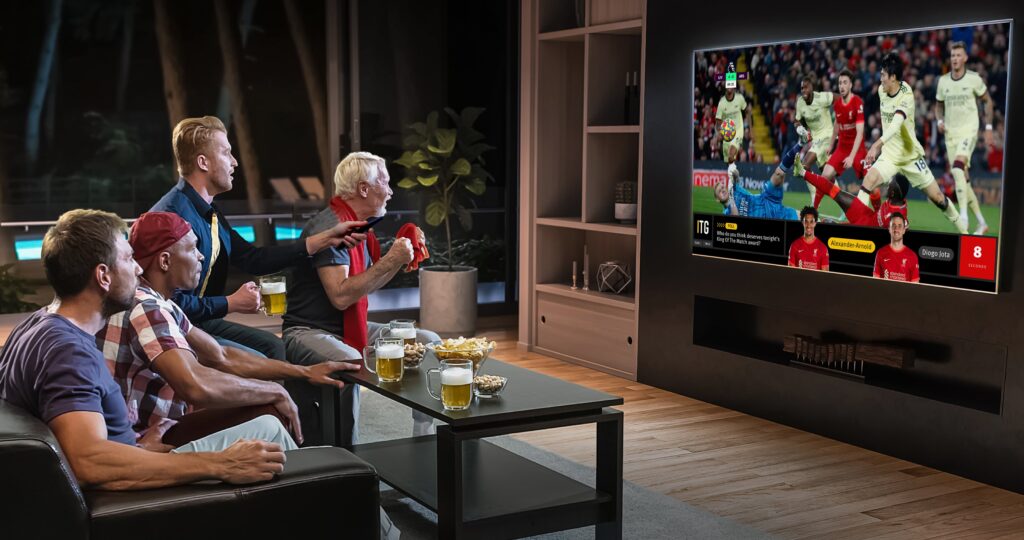
According to a study about the 2022 World Cup conducted by Amdocs, viewers have a growing desire for more interactive experiences with 25 per cent saying they’d like to participate in interactive gaming challenges, 37 per cent reporting a desire to receive player insights throughout the game, and 36 per cent saying they want to view behind-the-scenes content during the game.

The Content Marketing Institute also found interactive content is twice as likely to engage viewers over standard content, and that 81 per cent of respondents felt that interactivity retains attention more effectively than non-interactive content.

This tells us a lot about the future of sports viewing. Though broadcast platforms and content owners rightly protect the screen cleanliness as a precious asset, viewers are becoming more open to dynamic viewing, especially when engagement is initiated by the views themselves.

“If I as viewer am watching at the 70th min of a football game, and already there were a couple of goals and a red card- I would want to see those, right on my TV screen by clicking the remote, rather than having to look for those goals online or wait for the replays,” said, Aviram Sharon, CEO of Inthegame, which specialises in interactive overlays for connected TV’s and mobile devices.

“If a viewer wants to check the stats, or see odds it really should be as easy as tapping a button. From a sports fans perspective we need to be minded of what we want instant access to, and from a platform/broadcaster perspective we deliver engaging experiences and new monetisation and commerce opportunities”.

So what has been stopping interactivity from being more widespread across CTV’s and mobile viewing when it comes to sports content?

“One of the main challenges most platforms have when seeking to deploy interactive experiences, in-stream shopping and such, is the wide range of connected TV’s and mobile devices viewers are consuming the content on. Inthegame’s technology enables deployment of interactive overlays across all connected TV’s and mobiles with a simple integration from the platform side, so viewers don’t need to download anything in order to interact.

“Our management system enables automated engagement as well as customised offers to specific audiences. We definitely see it becoming much easier for streaming platforms to engage, monetise, and better understand their audiences.”

Inthegame is not alone in the ecosystem, as Interactive viewing has been moving into mainstream media for a few years now. Netflix has already released multiple ‘choose your own’ adventure episodes of their most popular shows including Black Mirror and The Unbreakable Kimmy Schmidt.

Additionally, Amazon Prime recently introduced an interactive clip-sharing feature powered by X-Ray which allows viewers to share their favourite clips with friends, and family.

It’s clear that sports viewing is moving in the same direction as most mainstream media and that interactive viewing will start to become a mainstay in most fans’ lives.

Find out more about InTheGame by clicking here