SEG3 2023 – The key takeaways

InCrowd’s Joshua and Ben attended the SEG3 event on the 28th and 29th June, at the iconic Emirates Stadium. Two days of incredible insight into the roles of new technology in creating valuable digital experiences. Josh and Ben sat down with Helen to discuss key takeaways from the event; what’s “hot” and what’s “not”, what the future looks like in this space and importantly how we can utilise new tech effectively for sports audiences.

Key takeaways:

  • Community sits at the heart of great fan engagement piece. The network effect cannot be understated and should be fully embraced to propagate marketing campaigns and digital platforms, by: Building communities; empowering individuals to forge their own experience; leveraging social media platforms and chat applications to drive the conversation.

  • Community presents itself at different levels, from friends watching sports around a TV at home, to swathes of fans cheering for their team in a stadium. Use of technology must enhance these social experiences as opposed to abstracting-away from them, and this should influence which technologies we use in any given scenario. This was evident in the use of Augmented Reality to enhance the at home / in-stadia experience throughbring additional stats; data and views.

  • Emerging fan engagement enabling technologies allow rights-holders and brands to connect with fans on a more personal level, by harnessing the essence of fandom: emotion, community, and loyalty.

  • The digital space allows us to engage fans beyond traditional matchday focused campaigns, enabling continuous contact points with fans even in the off-season.

  • While many WEB3 technologies are still in their infancy, it’s important to build effective user journeys using appropriate technologies to ensure that engagement experiences are made accessible to all fans, as this empowers communities to grow and creates a feedback loop of engagement.

  • Every fan is different, but gamification and fan engagement technology gives us the tools to create unique experiences for each individual, bringing them closer to the action and celebrating their personal achievements. Hyper-personalisation helps sports bodies to focus-in on who their fans are and understand them better than ever before.

  • The most successful use-cases resulted from using new and emerging technologies in applications which provided added utility to fans, solving real problems instead of using them as a off, before potentially losing interest.

Making it work for sports audiences:

Gamification and emerging Web3 technologies present a new and incredibly exiting layer of engagement opportunities on top of sports.

Although the barrier to entry is high for some Web3 technologies, other industries (including the digital fitness and gaming spaces) have demonstrated with great success that mainstream technologies can be used to great effect to deliver equally, if not more, engaging experiences right now.

As it stands, the sports industry is somewhat at the start line but by embracing new technology and applying them in a way that works for sports audience and doesn’t just “tick the technological innovation box”, we can bring fans closer to the action; build valuable communities; help fans feel rewarded and valued; and open up the excitement & passion of fandom to fans of all walks of life, irrespective of their individual circumstances or ability to attend.

By enabling all-new digital inventory for rights-holders and brands, and by building upon the habits, emotions and communities which sit at the core of sports fandom, these technologies are set to revolutionise the digital sports experience for fans around the world.

Furthermore, the benefits don’t stop with the fan; there is a wealth of untapped commercial benefits for any club, league or rights-holder who wants to maximise on this opportunity to create added value. The ability to reach new audiences domestically and internationally through connection and the capture of first party data brings the ability to incentivise new habit-forming behaviours among fans including membership/ticket purchases, and educating & encouraging fans to engage with other teams beyond the first-team. There is also the opportunity to create significant new revenue streams for brand partners and sponsors across the array of brand new, high traffic and high engagement digital inventory.

Want to discuss this further with InCrowd’s experts? Get in touch via enquiries@incrowdsports.com in order to set up a no obligation, 30 minute chat.

The World Round-up: what have we learnt over the past five weeks

Over the last five weeks we have been jetting around the world and had fantastic insights from the US, Africa, Lausanne, Asia and the Middle East.

“Last year, Sportico valued the Senators at $655 million, 27th in the 32-team league. The Senators have missed the playoffs in six straight seasons, generate the NHL’s third lowest revenue and consistently lose money.”

Sportico’s, Kurt Badenhausen, Scott Soshnick and Eben Novy-Williams, look into the recent sale of the Ottawa Senators for almost $1 billion. Read it here

“The world of sports management increasingly focuses on achieving two important goals: fan loyalty and retention. Although these concepts may appear similar, they possess distinct strategies that differentiate their implementation. This article aims to explore the strategies that drive fan loyalty and retention while providing some examples.”

Michel Cutait, Acting Secretary General of the World Obstacle Federation, looks into how federations and teams can improve fan engagement through memberships. Read here

“The signings of such football stars as Cristiano Ronaldo and Karim Benzema by the Saudi Pro League have made headlines worldwide. Yet the logic of such signings is not well-understood, and it is easy to dismiss as no more than a spending spree.”

Adam Paker, Partner at Portas Consulting, looks into the the profound changes in Saudi football beyond Ronaldo and Benzema. Read Adam’s thoughts on one of the hottest topics in sport here

“Content is King, but Distribution is clearly the Queen as OTT in post-pandemic Asia has come on par, and, in some places, is beginning to exceed audience share compared to traditional television.”

Unmish Parthasarathi, the Singapore-based Founder of Picture Board Partners, the Strategy, Innovation & Venture Development boutique, reflects on why, how & who is making OTT more mainstream. Read Unmish’s views here

“Kenya’s government has taken a significant step forward by embracing digital technology with the launch of a mobile application for its flagship talent development programme, Talanta Hela, which literally translates to Monetise Talent in Swahili.”

In this week’s View From Africa piece Cynthia Mumbo, CEO of SportsConnect Africa, shines a light on how Kenya’s government is moving forward in its embracing of technology. Read the rest of Cynthia’s piece here

Meet the Member: “It is going to inspire and it is going to be the hottest ticket in town”

Jane Fernandez is the COO (Australia) of the FIFA Women’s World Cup Australia & New Zealand 2023. Last year, she spoke to iSportConnect’s Content Manager Alex Brinton from Sydney, now with a matter of hours before the tournament kicks off we take a look back at the interview.

When was the idea of hosting the tournament first come about and how did that process play out?

A number of years ago Football Australia always had hosting these major football events as part of their strategy. The Women’s World Cup was one of those.

And when I was working on the AFC Asian Cup, with my colleague, Mark Falvo, who’s the COO of Football Australia, we entertained the idea of bidding for the 2019 tournament. 

We just weren’t ready. It wasn’t the right time. And they say timing is everything. And thankfully, we went forward and bid for 2023, and here we are today.

Both Australia and New Zealand are sports-mad countries. But football isn’t traditionally one of the biggest. How big is the fan base going to be for this tournament?

In Australia, football is the largest participation-based sport. There are over 2 million participants in our game here. And as you say, Australians and Kiwis are sports mad, we love going to major sporting events. We have a strong supporter base of those that are very proud of their countries, and really love watching international sport. 

The other thing that we have here is that we’re both very multicultural. Over 300 languages are spoken, over 200 nationalities represented. And we saw during the Asian Cup that matches like Iraq v Iran can sell out stadiums.

It was just so, so exciting. It’s a true reflection of the multicultural nature of Australia and New Zealand as well. The supporter base will be huge, every person will have a second team and maybe even a third team. We’re confident of seeing all of the fans in the stands, singing in full voice and supporting every team, all 32 teams that are going to participate in this competition.

There are big challenges around two nations hosting a tournament – as opposed to one – how have you dealt with that?

The first challenge was the COVID pandemic. We actually won the bid during the pandemic. Then we recruited our staff during the pandemic as well. So a number of staff, a large number of my heads of department, actually didn’t meet in the flesh until a year into the job. 

It is going to be a tournament of firsts. The first time a FIFA Women’s World Cup will be held in the Asia Pacific region, the first time in the southern hemisphere and the first time it will have 32 teams, the best footballers in the world coming from 32 countries. 

That brings with it the opportunity to increase participation, to really excite more girls and boys to lead active healthy lives, to put on their football boots, have a kick, and to really enjoy the game that we all love.

What exciting things can the fans expect when they attend games?

This FIFA Women’s World Cup will be the biggest event we’ve hosted in Australia since the Sydney 2000 Olympic Games. This is going to be an absolute moment in time and people will have memories for a lifetime. 

You know, I can see people saying ‘Where were you on the 20th of August 2023? When that winning goal was scored at Stadium Australia in the final of the FIFA Women’s World Cup.’

We will see the best footballers in the world taking centre stage, but it will also be a connection between sport, art, music and culture. We’re going to bring our cities to life through the FIFA fan festivals. So, fans can really taste football outside of the stadiums as well. This will be a huge community celebration and using football as the platform, as the tool to bring people together.

After the Euros, everyone is calling it a turning point, not just for women’s football, but for women’s sport. Have you got the same impression on the other side of the world?

We’ve been watching here and soaking it up, taking it all in, what an unbelievable tournament. I think women’s sport in Australia and New Zealand has really seen this growth, this momentum for a number of years now. I was lucky enough to be at the 2020 Women’s T20 World Cup final at the MCG. I remember sitting in the stands and really feeling then that this is an absolute turning point in women’s sport and in women’s major sporting events. 

We’ve seen that growth across all sports, and specifically in football. We know that the Matildas are now such a household name, such a strong brand, attractingthousands of fans to games. 

It does take time. But absolutely the momentum is 100 per cent behind it.

Is it the perfect time to be hosting a Women’s World Cup?

I believe this is absolutely the perfect time. As I said, you can see this growth is on an upwards trajectory. We’ve just seen 50,000 people attend the Morocco v South Africa match at the Africa Cup of Nations. This is the moment I think, and I really do believe that in the winter months next year, we’re going to see that this tournament will capture hearts and minds. It is going to take people to this next level of understanding and appreciation. It’s going to inspire, it’s going to entertain, and it’s going to be the hottest ticket in town.

A lot of brands have thrown their support behind women’s football at the moment. How much of a boost is that?

Investing in the game is absolutely critical for its success. It’s critical for its commercial sustainability. We know greater investment leads to a better product and a better outcome. For the first time FIFA has actually implemented a standalone commercial pillar for the women’s game. It’s fantastic that we’ve now got Visa onboard, we’ve got Xero onboard. And there’s more to come.

If lots of money does find its way into the women’s games, and it’s starting to, is that only a good thing?

I believe so. I believe it’s a great thing that smart investors got on board from the very beginning when this growth started. And you know, there are a lot more investors out there now who know that this is a great product. This is something that we want to be part of now. But they shouldn’t wait. They should get onside now, and really ride that momentum with us.

Both countries are in the fortunate position of having a large amount of sporting infrastructure in place already and you’ll be utilising some of each country’s biggest stadiums. How much of a statement is it that you’re going to use in places like Stadium Australia and the Cake Tin in Wellington?

They’re the most prestigious, the biggest venues. And they’re the venues that have held Olympic Games and amazing tournaments for other sports as well. I believe it is an absolute sign of the importance and the level at which we will be delivering the FIFA Women’s World Cup at.

I can’t wait to be there in the stands at the final at Stadium Australia with a full house. But I think it is a really important message that the competition will kick off here in Sydney on July 20 at our brand-new Sydney Football Stadium. It places the FIFA Women’s World Cup at the top of major sporting events, which is exactly where it should be.

The women’s T20 World Cup was hosted in Australia just before the pandemic it was a huge success for the crowd over 80,000 attending the final. So, there’s obviously great interest in women’s sport in the country. What does success look like for you from this tournament?

Our aim is always to continue doing better to take this tournament Beyond Greatness. We know in France, there were 1.1 million attendees, we want to take that to 1.5 million, we know the broadcast was over a billion, we want to continue to grow that let’s get to 1.2 billion. 

I think ensuring that there is continual growth, continual investment in the FIFA Women’s World Cup, to make sure that we can take it to the next level. I think that’s what this is all about. It’s also about ensuring that the legacy outcomes are achieved through hosting the tournament. You know, the data, the numbers that are critical around viewership, and attendees, but also, the social and economic benefits are really critical as well.

What can the legacy of this tournament be both in the host countries and around the world?

Well, globally, FIFA are investing over $1 billion dollars into the investing in women’s football and the growth of women’s football. We have a target of 60 million women and girls playing football by 2026. So from a participation base, we want to absolutely continue to grow that right across the globe. We also want to make sure that we’re investing in the development of female leaders in football. 

Football Australia and New Zealand Football are bringing their legacy plans to life. They are really focused on participation growth, with the target of getting to 50:50 by 2027. 

The investment in facilities is another really important legacy outcome, and will have a real impact from hosting the tournament. 

There’s the leadership pillar ensuring domestically, female leaders are developed to continue to be working in and leading the game. We want football to be the sport of choice for women and girls both on and off the pitch. So developing female leaders, coaches, referees, administrators is really, really critical. 

Obviously, there’s a high-performance pillar. We want to keep investing in the development of the game. And then there is no better way to remind the world that Australia and New Zealand are open for business. So ensuring that from a tourism perspective and an International Relations perspective, we are front and centre and that is the power of football. That is the power of the global game. 

It opens doors internationally. It’s a sport that the world plays and the opportunities are just endless.

The House View – The opportunity in sporting jeopardy

Wimbledon makes me think about the great future that lies ahead for women’s sport. That’s because of the prize money: £2.35 million for both the men’s and the women’s champions.

What feels me with optimism is not just that the jackpots are equal.

It’s that they are so big.

And the gap between the winners and the runners-up, who ‘only’ get £1.175 million, is also big.

I have to confess that I can find it difficult to root for any of the female tennis players. Frankly, I often find it hard enough to tell them apart.

But it’s easy to know exactly what they are playing for at Wimbledon. The big bucks.

And that to me that is the key to irresistible professional sport. Excellence is all very admirable. But pros compete for money. It’s what distinguishes them from amateurs and what makes pro sports more compelling, when it’s done right.

And I’m afraid that a lot of men’s sports don’t get it quite right. I’m talking about team sports.

Take baseball, for example. There was a time when winning the World Series meant that the average player could more or less double his annual pay. Making twice as much is a pretty serious incentive. And every casual fan was aware of the big money at stake.

Nowadays with guys on multi-million-dollar guaranteed salaries the monetary upside for winning the Series is a lot less meaningful.

Frankly I sometimes even find myself wondering what high-priced team players are playing for.

To win a ring? A cup? A trophy?

Really? 

The papers, especially the British papers, always talk about ‘how much is at stake’ in a match.

Really?

What exactly is at stake for an individual player making £10 million?

I make an exception for the importance of national team competition, which is a more complex phenomenon.

But a Champion’s League place for a club?

How exactly is that an incentive for the player

To me it’s like an actor being in a hit film. Great for the producers. But kinda so what.

Now, if the players on a team stood to win, say £10 million each, for a Champion’s League spot, that would be a different proposition.

If there are huge win bonuses like that already in place, why are they not in the headlines? That’s a great story. Why isn’t being told? Headlines are always all about player transfers. How about player win bonuses for tomorrow’s game?

Now I’m not saying that players need more incentive to play harder. They give their all or they wouldn’t be there, right?

I’m saying that fans can always use more incentive. 

More incentive to care about every game all season long. More incentive to pay attention and stay engaged.

Especially casual fans with lots of other entertainment options.

I’m all for bringing more of what I call ‘authentic jeopardy’ to professional team sports.

The team wins, you make those big bucks.

You lose, not so much.

And this where I see a fantastic opportunity for women’s sport, football especially.

We hear about how attending a women’s football match is so different, so much nicer and more family-friendly. than going to men’s events.

Why not make the actual competition on the pitch more dramatic too?

Try making it about big jackpots. And promoting that.

By adding more ‘authentic jeopardy’ to the competition, making the rewards for success versus failure outsized, women’s football can become a truly differentiated product instead of just a female version of the men’s game. 

By Jay Stuart, Content Director iSportConnect

Compare the Market announced as new Principal Partner of The Hundred

The Hundred has today announced a new partnership with Compare the Market, who will become the Principal Partner of the competition.

Alongside the excitement of the unmissable 100-ball competition and live DJs and music at each ground, Compare the Market will be adding to the experience with the help of its Meerkat characters and newest family member, Carl the wombat. Compare the Market have also teamed up with leading online gamers to help engage new audiences in-ground and at-home.

Combining a short, fast format of world-class cricket, with each game lasting less than three hours, and incredible entertainment beyond the sport, The Hundred is making cricket more accessible and reaching a broader audience.

In 2022, The Hundred attracted a total of 14.1m viewers across Sky and BBC. In addition to this, more than half a million fans attended matches, including a rise in family spectators compared to 2021. 

Sanjay Patel, Managing Director of The Hundred said: “As we approach the start of this year’s competition, we are delighted to be able to announce Compare the Market as Principal Partner of The Hundred. 

“Compare the Market are one of the most recognisable UK brands. They will add even more fun and entertainment to go alongside the world-class cricket on show, and that is what The Hundred is all about. This partnership will spread the reach of cricket to more families across England and Wales, and we are looking forward to what Compare the Market has in store for the third edition of the competition in August.”

Mark Bailie, Chief Executive Officer of Compare the Market, commented: “The Hundred has become a much-loved fixture on the sporting calendar, offering up an exciting and energetic new take on cricket.

“The Hundred plays a critical role in cricket’s drive to become the most inclusive sport in the country, and that’s something we are proud to support. 

“Bringing together our entertaining brand with one of the most entertaining sports is an exciting partnership and we’re looking forward to revealing the plans we have in place to support this year’s competition and beyond.’’

The View From Africa: Kenya’s Talenta Initiative goes digital: changing talent scouting and monetisation

In this week’s View From Africa piece Cynthia Mumbo, CEO of SportsConnect Africa, shines a light on how Kenya’s government is moving forward in its embracing of technology.

Kenya’s government has taken a significant step forward by embracing digital technology with the launch of a mobile application for its flagship talent development programme, Talanta Hela, which literally translates to Monetise Talent in Swahili. The Kenyan government’s unique platform promises to streamline the process of identifying and fostering exceptional individuals while also giving chances for them to monetise their abilities. The Talanta Hela app is poised to revolutionise talent management in sports and creative sectors because of its user-friendly layout and simple registration process.

Government of Kenya’s Goals and Objectives

The Kenyan government, through its Talanta Hela initiative, has set forth ambitious goals in the realm of talent development. By digitising the process and utilizing a mobile application, the government aims to achieve the following objectives:

  1. Identify Hidden Talents: Kenya’s government is dedicated to identifying and cultivating talent from all throughout the country. The Talanta Hela app enables talented individuals to demonstrate their talents by offering a user-friendly and accessible platform, guaranteeing that no potential ability goes undetected or unexplored.
  2. Nurturing and Skill Enhancement: Once identified, the chosen talents are given thorough advice and support to help them improve their skills. Through training programmes, workshops, and exposure to professional contexts, the government hopes to assist these persons in developing their abilities and reaching their full potential. They will be trained at the Kenya Academy of Sports which is also a government institution.
  3. Monetisation and Economic Empowerment: Recognising the significance of economic empowerment, the Talanta Hela app allows athletes and creatives to monetise their abilities. The government hopes to establish sustainable careers in sports and the creative sectors by exposing these persons to numerous options such as endorsements, sponsorships, and professional contracts. 

Challenges that may be faced

While the digitalisation of Kenya’s Talanta Hela plan has various benefits, it is critical to recognise and solve the possible issues that may develop throughout its implementation. Some of the difficulties that this initiative may confront are as follows:

  1. Barriers to Technology: Despite attempts to assure accessibility, not everyone has access to cell phones or dependable internet connections. This may limit the involvement of brilliant persons who lack the technological tools required to interact with the Talanta Hela app.
  2. Digital Divide: In certain regions or communities, there may be a significant digital divide, resulting in unequal access to technology and digital literacy. This divide could hinder the initiative’s ability to reach and identify talented individuals from underprivileged areas, potentially perpetuating existing disparities.
  3. Connectivity and Infrastructure: Adequate network connectivity and infrastructure are critical for a digital platform’s successful operation. Talent submission, assessment, and communication procedures may be hampered in places with low or unpredictable network access, resulting in delays or challenges in the talent management process.
  4. User Adoption and Awareness: It is critical for the Talanta Hela app’s success to ensure widespread adoption among skilled individuals. The effort may confront difficulties in raising knowledge about the app and its benefits, as well as persuading talent to engage actively and submit their profiles. To solve this obstacle, education and awareness activities will be critical.
  5. Data Privacy and Security: Concerns concerning data privacy and security arise from the digitalization of talent profiles and personal information. Protecting sensitive personal data and maintaining safe information transit and storage will be critical. To earn the trust of talent and stakeholders, the government must enact strong data protection safeguards. Kenya is now one of the top African countries in this field.
  6. Talent Evaluation and Bias: While digitalisation can assist decrease some biases, the possibility of subjective judgement or biases in the talent scouting and selection process remains. It is critical to have clear and objective evaluation standards in place, as well as to guarantee that talent selection is based on merit and potential rather than personal preferences or external influences.
  7. Resource Allocation and Sustainability: The Talanta Hela plan requires adequate resources, including financing, technical infrastructure, and qualified staff, to be implemented successfully. Long-term sustainability and procuring required resources can be difficult, especially in resource-constrained regions. To address this, the government is carrying out the initiative through the Kenya Academy of Sports, a government body tasked with developing sports talent.

Positive Effects of the Kenyan Initiative

The digitalisation of Kenya’s Talanta Hela programme has various positive consequences for both athletes and the sports business scene in general:

  1. Increased Accessibility: The availability of the Talanta Hela app on both Android’s Play Store and Apple’s App Store ensures that talents from diverse backgrounds can participate in the scouting process. This inclusivity allows for a more comprehensive talent pool, ensuring equal opportunities for aspiring talents regardless of their technological preferences.
  2. Efficient Talent Identification: The availability of the Talanta Hela app on both the Android Play Store and the Apple App Store means that talents from varied backgrounds may participate in the scouting process. This inclusion provides for a more diverse talent pool, guaranteeing equal opportunity for budding talents regardless of their technological inclinations.
  3. Enhanced Transparency: Throughout the talent scouting and selection process, the Talanta Hela app provides transparency. A scout is allocated to each talent profile, and selections are made based on objective evaluation criteria. This digital platform offers a fair and transparent approach that eliminates bias and creates equal opportunity for all participants.
  4. Real-time Updates and Notifications: The digital portal provides talent with real-time information on the status of their profiles. The app keeps talents informed every step of the journey, from submission to review and invitation to physical testing, decreasing ambiguity and fear while encouraging a sense of connection and involvement.

The Case for a Digital Platform in Kenya

The decision by the Kenyan government to adopt a digital platform for the Talanta Hela initiative holds several advantages over a purely manual system:

  1. Efficiency and Scalability: The Kenyan government assures a more effective and scalable talent scouting process by using digital technologies. The automation of numerous procedures, such as profile submission, review, and notification, enables the initiative to efficiently manage a higher volume of talent, therefore increasing its reach and impact.
  2. Standardisation and Quality Control: The Talanta Hela app guarantees that talent evaluation is standardised and consistent. It lays out clear standards for submitting talent, and the digital format allows for the addition of important material such as videos and skill descriptions. This standardised technique encourages fair evaluation and quality control, ensuring that skills are evaluated using objective criteria.
  3. Data Analytics and Continuous Improvement: The use of a digital platform makes data collecting and analysis easier, offering significant insights into talent trends, preferences, and scouting habits. This data may be used by the Kenyan government to make data-driven choices, improve the talent management process, identify areas for development, and adjust offers to match the changing demands of people and industry stakeholders.

Conclusion

The government-led digitalisation of Kenya’s Talanta Hela programme represents a key milestone in the field of talent scouting and management and is a first for an African nation. The effort intends to find hidden talents, cultivate their abilities, and facilitate economic empowerment by utilising a smartphone application. The programme was recently established, so it will be fascinating to observe how the sports world, both local and worldwide, responds to this new effort, as well as the long-term influence the initiative has on sports talent and the sports business sector. 

Member Insights: Beyond Greatness: FIFA’s lucky Women’s World Cup

We are now just seven days away from the FIFA Women’s World Cup 2023, Michael Pirrie international events advisor, looks forward to a tournament that could revolutionise women’s sport.

With a vibrant economy, vast mineral reserves, sophisticated urban infrastructure, vibrant migrant communities and spectacular coastal beach and rain forest settings, Australia has often been called the ‘Lucky Country.’

Confronted post pandemic, like many nations, with high interest and inflation rates and growing cost of living pressures, Australia hasn’t felt lucky in recent times.

When challenged, the nation often expresses itself through sport, and turns to its sporting heroes and teams for inspiration.

Thousands filled pre-dawn city streets and centres late last year to watch the men’s soccer team on giant screens during the World Cup from Qatar.

The mood in the early morning gatherings swung wildly between euphoria and despair every time the Socceroos scored or were scored against in scenes rarely seen before in Australian sport.

This sports obsessed nation is preparing to take its passion for soccer to another level.

Just months after the FIFA Men’s World Cup survived a crash landing in Qatar with one of the great cup finals, the best women’s footballers are gathering on the vast island continent of Australia and neighbouring New Zealand, preparing to take football’s possibilities to new heights. 

WOMEN’S BIGGEST SPORTING EVENT

The explosive skill and dazzle of femme football will soon fill screens of all shapes and sizes around the globe as the world cup rotates from the Middle East to one of the world’s most distant and passionate regions for sport.

The FIFA Women’s World Cup beginning next Thursday will be the biggest women’s sporting event of modern times, showcasing the silky, high impact footwork and daring displays of precision football movement and planning, based on total team commitment – key characteristics of the immense appeal and popularity of women’s football.

The geographic and cultural changeover could hardly be more extreme as the world cup transitions from the smallest host nation in Qatar to one of the largest.

The Women’s Cup will play out across 12 venues in 10 cities spanning Australia and New Zealand, and several time zones. 

Cup preparations have formed a microcosm of the geopolitical and economic conditions shaping sport in a post pandemic world struggling with the widening fall out from Russia’s war and possible recession.

While the IOC encounters opposition over plans to return Russian athletes to the Olympic Games, FIFA’s bans on Russian teams remain in place for the Women’s World Cup, with co-hosts Australia and New Zealand continuing to supply military aid to Ukraine.

The Canadian Soccer Players’ Association meanwhile expressed deep concern earlier this year over cuts to the national programme, prompting a warning at the time that its women’s Olympic gold medal team from the Tokyo Games was considering possible Cup strike action.

The recent star-studded launch of the USWNT, which included US President Joe Biden, First Lady Jill Biden and pop superstar Taylor Swift, among others,  confirmed the growing geopolitical and social significance of soccer in American and global society. 

The team’s launch contrasted sharply with China’s diminishing presence on the world cup stage despite allocating vast resources to President Xi Jinpin’s directive for his nation to become a global superpower in the world game.

FIFA is hoping this Cup can regain momentum for women’s football disrupted by the pandemic and showcase the progress in women’s football since the Cup’s inception in 1991 

The positive impacts of the tournament and funding for support and development programs for women across the world, has sometimes been obscured by controversies involving the governing body.

BEYOND GREATNESS

The Women’s World Cup has been one of FIFA’s great successes with national women’s teams often out-performing their male counterparts in Cup rankings and wins.

This will be the biggest Women’s tournament with 32 teams competing for the first time, the same number as the men’s tournament in Qatar.

Teams will debut from Morocco, Panama, Portugal, the Republic of Ireland, Vietnam, Philippines and Zambia, reflecting the expanding global quality of women’s football. 

NEW CUP MODEL

The tournament has been designed around FIFA’s new “Beyond Greatness” brand and vision for the Cup, promoting the opportunities and benefits provided by football to women in sport and in life.

“The core purpose of the FIFA Women’s World Cup is to showcase women’s talent. Everything we’re trying to achieve for women in football and women in society will be on display for the world to see in Australia and New Zealand,” said Sarai Bareman, FIFA Chief Women’s Football Officer. 

Their new approach is also important to moving beyond the corruption plagued era of former president Sepp Blatter, which culminated in crippling scandals over the selection of Russia and Qatar to host the 2018 and 2022 Cups.

The electrifying Argentina-France final rescued Qatar’s tournament but did not wash away the human rights concerns.

While FIFA and others point to improved labour conditions for immigrant workers in Qatar, difficult questions remain over why the lives of workers had to be sacrificed for a sporting event to make work safer in the gulf state. 

Tensions over sport’s values, roles and responsibilities in relation to sports washing remain post Qatar, crossing borders and oceans and landing near the playing fields of the Australia and New Zealand Cup.

FIFA was forced to abandon plans for Visit Saudi, the tourism arm of the Saudi Arabian government, to become a major sponsor of the Cup.

The back down followed fierce opposition from the host nations, governments, football federations and leading footballers over Saudi’s human rights record and treatment of women. 

The Australia-New Zealand Cup heralds a new Cup era, model and management style under Fifa president Gianni Infantino.

There has been a realisation in FIFA headquarters of lingering impacts on the brand caused by human rights issues in Qatar and circumstances surrounding its selection as host, along with the event’s unprecedented $200 billion price tag, deterring future bidding nations.

It marks the first time the tournament has been staged in the Southern Hemisphere and hosted between two countries.    

The current co-hosts were chosen in the wake of reforms led by Infantino to restore credibility to the cup selection process, which can involve presidents, prime ministers and monarchs amid forensic global scrutiny.

The host nations were selected in a more transparent manner that emphasised the technical merits of bid plans for venues, transport, security, accommodation and other key services and facilities to eliminate outside influence and manipulation         

“This is the new FIFA, this is the new FIFA we want, this is the new FIFA we stand for,” Infantino enthusiastically declared after Australia and New Zealand were nominated to host the Cup ahead of Columbia in the early stages of the pandemic 2020.

Co-hosting has spread the risks, costs and opportunities from staging the Cup across Australia and New Zealand, with extensive use of existing venues and other infrastructure in both nations containing costs and preventing budget blow outs. 

This provides a new model for major international events in the current climate of global uncertainty and government spending cuts.   

The split hosting model will be used increasingly under Infantino’s presidency, with the 2026 Men’s Cup shared between, America, Canada and Mexico.  

While the treatment of immigrant workers shadowed Qatar, the Women’s World Cup comes at a time of profound introspection in Australia over the extreme health, education, social justice and family disadvantages faced by its indigenous Aboriginal and Torres Strait Islander communities.

The cultures of Australia’s First Nations people – part of the oldest continuing living culture in the world – and Maori people of New Zealand will be fully integrated into the tournament’s milestone moments.

The showcasing will include the presence of indigenous flags at the finals for the first time in a major concession by FIFA to its strict match day protocols to make the tournament as inclusive as possible. 

While indigenous recognition will form one of the tournament’s central themes, the history of mistreatment suffered by the First Nations may also its most controversial background issue.

Australia has rallied around the women’s tournament after its previous $32 million tax payer funded government bid secured just one vote in the infamous host nomination process for the 2022 Men’s World Cup awarded to Qatar.

Australia and New Zealand have enthusiastically embraced the tournament as the biggest event to hit the region since the globally-acclaimed Sydney 2000 Olympic Games set new standards for mega sporting event experiences.

FIFA is hoping for an encore mega event that also excites the world.  

Much will depend on Australia’s Matildas and the New Zealand Football Ferns to engage their nations and push as far as possible into the tournament.

While distant from football’s epicentres, the Matildas have been shaped by the skills and experiences of several players who have represented some of Europe’s top clubs.

The team will be captained by Sam Kerr, the multi-nominated Ballon d’ Or striker with Chelsea FC and Australia’s first household women’s football star.

The Matildas have been successful against some of the best qualifiers, including a 2-0 friendly win over England in London last April; in front of expected sell out home crowds the team promises to be competitive.      

FEVER PITCH 

FIFA has already announced that Australia’s opening match against Ireland will switch venue to the 83,500 capacity Stadium Australia, the former main venue for the Sydney Olympics and largest venue for the football tournament, due to high ticket demand. 

This will allow up to 100,000 fans to attend the World Cup’s opening games, with the match between co-hosts New Zealand taking place earlier in Auckland.

THE FUTURE IS WOMEN

The tournament is on schedule to become the most attended women’s sporting event ever staged with more than 1 million tickets sold, surpassing the previous tournament record in France in 2019.       

“The future is women, thanks to the fans for supporting what will be the greatest FIFA Women’s World Cup ever,” Infantino said earlier this year. 

Moving forward, FIFA needs to use funding from the 2023-26 world cup cycle to improve competition and skill levels in Asia, the most populous but least successful footballing continent.

Football cannot be considered a truly global game while China and India, the world’s two biggest nations, remain on the sidelines at Cup finals.  

CONCLUSION:

NATION CHANGING FOOTBALL

The scale and grandeur of World Cups can produce nation changing moments. 

One of the most powerful: the Japanese women team’s miraculous victory over the United States on penalties in 2011. This followed the fatal underwater earthquake that devasted east Japan, killing thousands.  

Reflecting on the importance of the win to a shattered nation, one of the Japan team’s stars, Homare Sawa, said: “We were exhausted, but we kept running…Japan has been hurt, and so many lives have been affected…We cannot change that. But Japan is coming back, and this was our chance to represent our nation.”

“We played the tournament not only for ourselves,” said goalkeeper, Ayumi Kaihori.

“We felt we had not only the support of Japan, but also the whole world.”

With score lines that can mean the difference between national failure or success and triumph or tragedy for teams involved, the World Cup inevitably produces compelling story lines, some of which are already in early draft form.

These include the American team’s historic campaign to become the first to score an unprecedented three consecutive Cup victories.    

The team’s chances depend heavily on Megan Rapinoe, America’s once in a generation soccer superstar who will retire after the Cup, creating a story within a story.

Almost as well known for her social activism as her supreme football skills, Rapinoe achieved legend status at the London 2012 Olympic Games after scoring a so-called “Olimpico” goal, directly hitting the back of the net like a missile launched from a corner kick.  

History also beckons for the Lionesses to bring the World Cup feeling back to England where, in 1863, the newly formed English Football Association drafted the first Laws of the Game of football.

Hopes are high for an epic final like Qatar but without the controversy. If so, this could be Fifa’s Lucky World Cup.


Manchester United launch first profile on Snapchat

Manchester United today launched its first official profile on Snapchat, with a mission to further inspire and entertain millions of fans around the world with new experiences that will transform how they celebrate and watch sports content.

The profile @manutd is now live ahead of the men’s first team pre-season tour across Europe and the United States – giving fans new ways to follow and experience the club ahead of and during the upcoming season which starts against Wolverhampton Wanderers at Old Trafford on 14 August.

Over 750 million Snapchatters around the world will be able to watch match highlights from the Men and Women’s team, behind the scenes content including match preparation, clips from the training ground, fan-generated content and post- match activities.

Powered by Snapchat’s Live Garment transfer tech, fans will also be able to use the app to virtually try on the official Manchester United team kit for the upcoming season and buy it directly from the club’s online store. Fans can also play with new Lenses that help them experience the view from the best seats within Old Trafford.

Fans can subscribe to the Snapchat profile HERE or by searching United on Snapchat. Fans can also virtually try-on and buy the latest home kit by scanning the code HERE using the Snapchat camera.

Ian Nolan, Chief Content Officer at Manchester United, said: “Snapchat is a hugely popular global platform that will further add to the numerous ways the club engages on social media with our millions of fans around the world.”

“We are excited to launch today as the team prepares for our pre-season tour of the United States and look forward to sharing exclusive behind-the-scenes content with fans, as well as introducing them to the innovative features of the Snapchat platform.”

“We want to reward our most loyal fans for their passionate support and through the Snapchat lenses feature we will be looking out for the most creative fan-generated content.”

Alejandro Arenas, International Sports Partnerships at Snap, said: We are thrilled to welcome Manchester United, one of the world’s biggest football clubs to

Snapchat as we continue to bring more incredible football and sports content to millions of Snapchatters around the globe. Snapchat continues to offer new ways for fans to experience, celebrate and watch sports with their friends and family – whether that’s watching catching up on goals from the weekend or using an AR Lens to try-on the latest home kit for the upcoming season. We look forward to bringing Snapchatters more ways for them to follow and engage with great football content as we countdown to the new season.

Other content from all areas of Manchester United, will include video highlights with club legends and regular giveaways of signed and match-worn kit to reward our fans who demonstrate the most creativity.

Enjoy all this and more by following the profile on Snapchat today.

Super Bowl winners Kansas City Chiefs top the NFL Brand Health Rankings

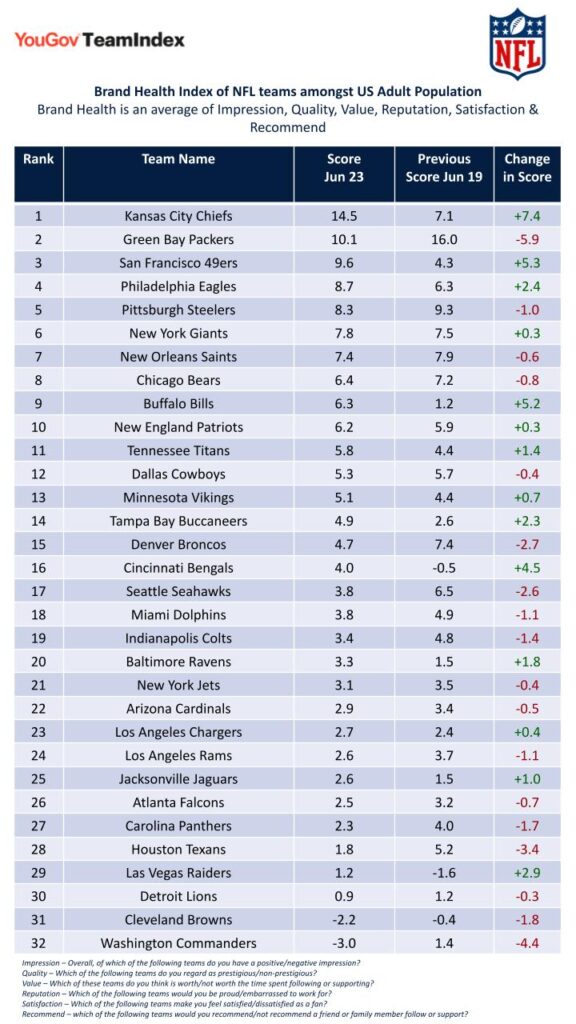
This month’s Brand Health Index powered by YouGov takes a trip across the pond to focus on NFL franchises with the Kansas City Chiefs coming out on top.

It is no surprise that the Kansas City Chiefs have come out on top of the rankings and with Patrick Mahomes at Quarterback (QB) they have won two of the last four Super Bowls and look to be on the path to creating a dynasty. 

The San Francisco 49ers are our second biggest winners. One of the NFL’s most-historic franchises, the ‘Niners, have got a stronghold of support in the Bay Area thanks to the Raiders leaving Oakland for Las Vegas. They also were one of last season’s success stories with rookie QB Brock Purdy guiding them to the conference finals.

The Buffalo Bills have also improved their score massively from 2019 by being the first franchise to have a strong TikTok following, now at 1.9 million. While having a successful season they also became famous the world over after Damar Hamlin’s on-field heart attack, after this they became the nation’s second favourite team.

The Cincinnati Bengals are another one of our biggest winners. Since the arrival of QB Joe Burrow they have seen an upturn both on the field and in fans after he brought some of the LSU fanbase with him. The Bengals are also looking to redevelop their stadium which could see them rise further up the rankings. 

Despite being second in our rankings the Green Bay Packers are our biggest losers. They have recently lost legendary QB Aaron Rogers which could have had a big effect on the franchise.

Our second biggest losers are the Washington Commanders. The Commanders are about to have a change of ownership confirmed with Joe Harris purchasing the team for $6.05 billion. The team has changed their name twice since our last poll in 2019. They were originally known as the Redskins until 2020 when they changed, for discriminatory reasons, to the Washington Football Team and then to the Commanders.

Here is the rest of the index: