Meliá Frankfurt City Hotel, part of Meliá Hotels International, is partnering with WTT Champions Frankfurt to deliver a world-class hospitality experience for the world’s best table tennis stars.
As part of the partnership, the spectacular glass skyscraper of the Meliá Frankfurt City will be hosting many of the event’s guests who will be able to take advantage of fantastic views of Frankfurt, enjoy the delightful cuisine in the oben Restaurant & Skybar as well as its relaxed atmosphere. Guests will also be able to enjoy the facilities in the hotel’s wellness centre and gym.
Players will also take to the red carpet for the WTT Champions Frankfurt Player Party hosted by the Meliá Frankfurt City which will mark the start of the biggest WTT event to take place in Europe this year. The hotel will also play host to the official draw ceremony where the match-ups will be set for the opening round of men’s and women’s singles matches at the Süwag Energie ARENA.
Bastian Becker, Director of Operations for Meliá in South Germany commented: “We are extremely happy to be involved with the WTT Champions Frankfurt event which will bring international star table tennis players and fans from all over the world to Frankfurt. We look forward to showcasing our Meliá experience and partnering with WTT and German Table Tennis to deliver a number of special events.”
Jonny Cowan, Europe General Manager, World Table Tennis said: “From the moment we met the Meliá team and experienced the warmth and quality of the hotel and facilities, we knew we had found a great hotel for our first ever WTT Champions event in Germany. We are excited to also be extending the partnership to encompass a number of activities for the event around the hotel and we look forward to promoting the Meliá brand and the Meliá Frankfurt City globally through the event and our WTT platforms.”
Claudia Herweg, President of the German Table Tennis Association added: “Our team considered a number of hotels for WTT Champions Frankfurt. Meliá Frankfurt City made a difference. The partnership that has evolved from initial discussions with the hotel management has been extremely positive right from the start. It demonstrated Meliá’s commitment to delivering a wonderful experience for our guests. I look forward to welcoming our players and partners to WTT Champions Frankfurt.”
iSportConnect is delighted to announce Tixr, the leading privately-held primary sport ticketing platform and live event commerce marketplace, as the latest strategic partner of its Advisory division.
Tixr services 500 of the most respected live entertainment brands in 40 countries including more than 20 major sports properties, teams, leagues and events – most notably the global LIV Golf Tour. With notable backers like Dragoneer Investment Group, Verance Capital, Helium-3 Ventures, and Sony Innovation Growth Fund, the 10-year-old, founder-led company is well-capitalised and profitable. Tixr has scaled rapidly and is on track to process approximately $1 billion through its platform built for unified commerce and sales beyond tickets in 2023.
Commenting on the announcement Nate Liberman, Vice President, Sports at Tixr said, “We are looking forward to partnering with the team at iSportConnect to accelerate our growth in sports in the UK. In an era where fan engagement and revenue generation are paramount for sporting organisations, our comprehensive e-commerce approach that goes beyond selling tickets sets us apart from other ticketing platforms. Our dedication to enhancing the fan journey, optimising sales, and fostering innovation is driving transformative change in the ticketing business.”
iSportConnect CEO Sandy Case added, “Our team are very impressed with the Tixr platform and the overwhelmingly positive feedback that it has received from the sports industry. We’re looking forward to working with the team to get their unique proposition into the hands of the sports organisations that can benefit from it.”
About iSportConnect
iSportConnect is all about helping organisations grow in the business of sport. Whatever the organisation. We launched in 2010 to bring together sports business professionals worldwide in a networking community enabling them to meet one another, find information and obtain access to a wide range of relevant services. The platform is now the largest global private network of sports business executives, where membership is exclusive.
About Tixr
Tixr, the largest, fastest-growing privately-held primary ticketing and event commerce marketplace in the world, is transforming the ticket-buying experience. Born from a fan-focused frame of mind, the Tixr platform empowers large-scale events, music venues, and sports properties with innovative solutions to highly complex ticketing and e-commerce needs. Founded in 2013 in Santa Monica, CA, Tixr’s modern, unified commerce experience supports all types of events, from festivals to global arena tours, and an almost limitless suite of commerce offerings beyond admission tickets. Find upcoming events at tixr.com and learn more about the Tixr platform at creators.tixr.com.
As the Riyadh 2023 World Combat Games approach the midway point of their 11 days of competition, World Combat Games Chair Stephan Fox says the multisport event is not only well on its way to leaving a lasting legacy for the Kingdom of Saudi Arabia, it is also playing a part in conveying the country’s new vision to the world.
From 20-30 October, the World Combat Games are proudly showcasing over 1,500 elite athletes from 120+ countries and 16 martial arts and combat sports: Aikido, Armwrestling, Boxing, Fencing, Judo, Ju-Jitsu, Karate, Kendo, Kickboxing, Muaythai, SAMBO, Savate, Sumo, Taekwondo, Wrestling and Wushu.
Not (yet) known as a combat sports powerhouse, Team Saudi Arabia has nevertheless performed exceptionally well so far at these Games, claiming an impressive 27 medals (3 gold, 11 silver, 13 bronze) – the most of any country and 7th in terms of gold medals won.
It’s an accomplishment that Fox says boils down to Saudi athletes taking the opportunity that Riyadh 2023 has presented and running with it.
“Obviously Saudi Arabia is not on the level of major martial arts nations yet, but they’ve done really well so far because they trained very hard knowing they will compete here against the best in the world,” he says. “This is the perfect time to dream about ending up on the podium and at the same time a wake-up call: If you want to be in the Olympic Games and you want to win an Olympic medal, you need to catch up as quickly as you can.
“So that’s the legacy and that’s the principle of Riyadh 2023: Inspiring the next generation of champions.”
Hosting major sporting events such as the World Combat Games is part of Saudi Arabia’s Vision 2030, a government-led reform initiative aimed at producing a “vibrant society, thriving economy, and ambitious nation.” The Saudi Arabian Football Federation (SAFF) recently announced its intention to host the FIFA World Cup 2034, while rumours are also circulating about a possible push for the Olympic Games as early as 2036. Riyadh is also set to host the 40-sport, 12,000-athlete Asian Games in 2034.
The World Combat Games can therefore be seen as an important springboard toward these megaprojects. Riyadh 2023 is the first major international multisport event ever held in the Kingdom and is being jointly organized by the local organizing committee, the Saudi Olympic and Paralympic Committee, and the Saudi Ministry of Sport.
The Saudi medal haul would not have been as impressive without Vision 2030, which has also prioritized women’s empowerment and youth engagement. Of the 27 medals won by Saudi athletes so far, for example, six have come from women.
“I have been involved in sport in Saudi Arabia now for a couple of years and I have been here when Saudi declared the Vision 2030 by His Royal Highness the Crown Prince,” Fox says. “This is not just an empty vision in sport. You can really see how equality has come through and you can see here as one example the event in Boxing – the Saudi female boxers won three medals. Years ago, this would have been unthinkable.”
Change and innovation are woven into the fabric of these World Combat Games. One novel idea was to hold the competition for all 16 sports under one roof – in five separate halls within the King Saud University Arena. This highly sustainable concept has worked exceptionally well so far, allowing athletes, spectators, and workers to move quickly and efficiently between the sports.
Another Riyadh 2023 invention with the potential to be adopted by future event hosts was to place para athletes and their able-bodied compatriots together on the same national teams. In a powerful display of unity and inclusion, results from all the athletes are being reflected in a single, unified medals table. Para athletes are competing here in six combat sports: Para Aikido, Para Armwrestling, Para Ju-Jitsu, Para Muaythai, Para SAMBO, and Para Savate.
“This idea has been working amazingly well,” Fox says. “I’m certain that multisport games organisers in the future will copy some of the Saudi principles introduced at Riyadh 2023, such as those of total inclusion and venue sustainability. I think there are many, many lessons to be learnt from this event for other event organizers.”
Fox takes the issue of legacy at the World Combat Games seriously. Every morning this week, he has visited local schools with Saudi athletes competing at Riyadh 2023 to introduce children to martial arts while encouraging them to give them a try.
At a recent visit, Fox and his team spoke to upwards of 600 kids about the Olympic values of excellence, friendship, and respect before demonstrating some basic techniques.
“The kids had so much fun and we will be doing these grassroots outreach programmes for five straight days so we can reach about 5,000 of them,” he says. “Saudi Arabia is hosting the Asian Games in 2034, so these children are the champions of 2034. We want to reach them now and inspire them to hopefully start doing Judo, Taekwondo, or another martial art.”
They need look no further for inspiration than 21-year-old Saudi judoka Ghadah Alateik, who competed at Riyadh 2023 and says she also became infatuated with martial arts while at school.
“I saw a sign advertising judo and I immediately fell in love with it,” she says. “I started doing it with my whole heart. Then I got noticed by my coach and eventually became a national team athlete.”
Her dream now is to become an Olympian. Maybe an Olympian at a home Games?
In this week’s Member Insights piece David Granger enlists three topics of conversation and presentation which stood out at this year’s Leaders in Sport conference.
The first, indicated by the topics discussed and the speakers themselves was the increase in recognition of the importance of women in sport – on the pitches, as well as the panels. (I spoke to one person who said the first Leaders’ Women in Sport Breakfast she attended had less than 20 people, this year there were more than 100).
The second was ensuring we engage the next generation of fans and how to do so – according to Rufus Hack, Sony’s Sports Businesses CEO, if you’re under the age of 20, there’s a 10% less chance you’re going to be an avid sports fan than if you’re over 20. That’s a diminishing return if not halted.
The third is technology in sport and how it’s – potentially – that Midas gateway to engage that next generation through gaming, and virtual and augmented reality.
But is it? While top tier sports a) have the funding and b) the established audience to warrant that investment, there are lower leagues and not-so-major sports which will miss out on both counts.
Elevating the experience at the elite level of sport simply widens the gap between top level and grassroots. All that does is make an uneven playing field even less level.
Hack stated we are, currently, seeing a decline in both the consumption of and the participation in sport. He said that for the first time in the last 20 years, the last 12 months have seen a marginal decline in sports consumption. Adam Kelly, IMG’s President of Media agreed: “To summarise the last 12 months, is to probably point towards a period of the most intense amount of complexity and complication and change we’ve seen in our industry. It’s a period where we feel certain properties, assets and sports are going to thrive as a result of that challenge and some may not survive. There are ones that are doing well, the ones that are responding to this challenge, while some people are quite fearful.”
Some may not survive.
Hack’s proposed solution? Rightsholders need to think like an FMCG (fast-moving consumer goods) company: “…segment your customers, hyper-personalise your content, and then you think about your customers or fans in terms of driving lifetime value and driving average revenue per customer.” Which could work if you’re going down the Drive To Survive route and becoming only interested in pseudo reality TV, rather than sport.
But to do so is to abdicate all pretence of investment in what Steve Parish, the owner of Crystal Palace called the ‘unscripted drama’, the very essence of sport. The balance has to be struck between preserving that unpredictable, emotive experience of watching – or participating in – live sport or throwing it all into a bucket of entertainment.
The NHL – and the NFL – are using Sony’s Hawk-Eye technology to turn live matches into cartoon versions (Toy Story and Big City Greens) in real time. Time and viewing figures will tell whether this becomes a new, innovative method of bringing new fans into the game on a longer-term basis. Will aping video gameplay be beneficial for live sport or is it likely to reinforce the target audience’s preference for video games? One near-future feature will be to take over a live game at half-time for sofa sports fans to then play as a video game and then compare the final results. This feels more like creating video gaming opportunities than opening up live sport to the next generation. The phrase “gamify the experience” was used to make sport more engaging. The partisan fans would argue it’s very gamified to begin with, both in terms of the sport and the ability to bet on its myriad outcomes.
It’s the same with cross-platform storytelling. How much can you extract from a game, a player, a competition before it just becomes content landfill? If consumption of sport is decreasing, is the answer to extract and publish even more narrative strands?
Sport is always going to be that precarious balance of the unscripted drama and industry. It was Mark Bullingham, The Football Association’s CEO, who articulated it best.
He was talking about VAR, but his sentiment could equally be applied to augmented reality, virtual reality or creating real-time cartoon versions of games: “You’ve got to have the starting point of what the fans want, and you should never have a scenario where it’s taken away from the experience inside the stadium or at home.
“We need to make sure that we’re doing it for the benefit of fans rather than doing it because we can.”
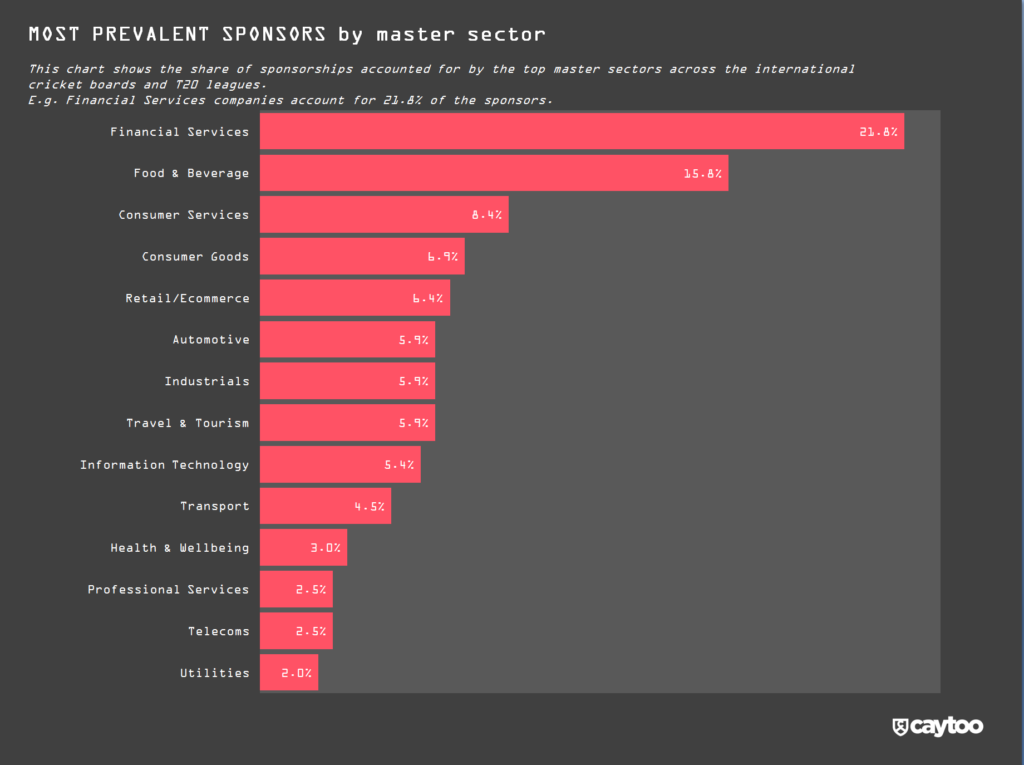
With the ICC Men’s Cricket World Cup 2023 up and running, we decided it was time to take a deep dive into the companies sponsoring the leading international cricket boards through this month’s Sponsorship Index powered by caytoo.
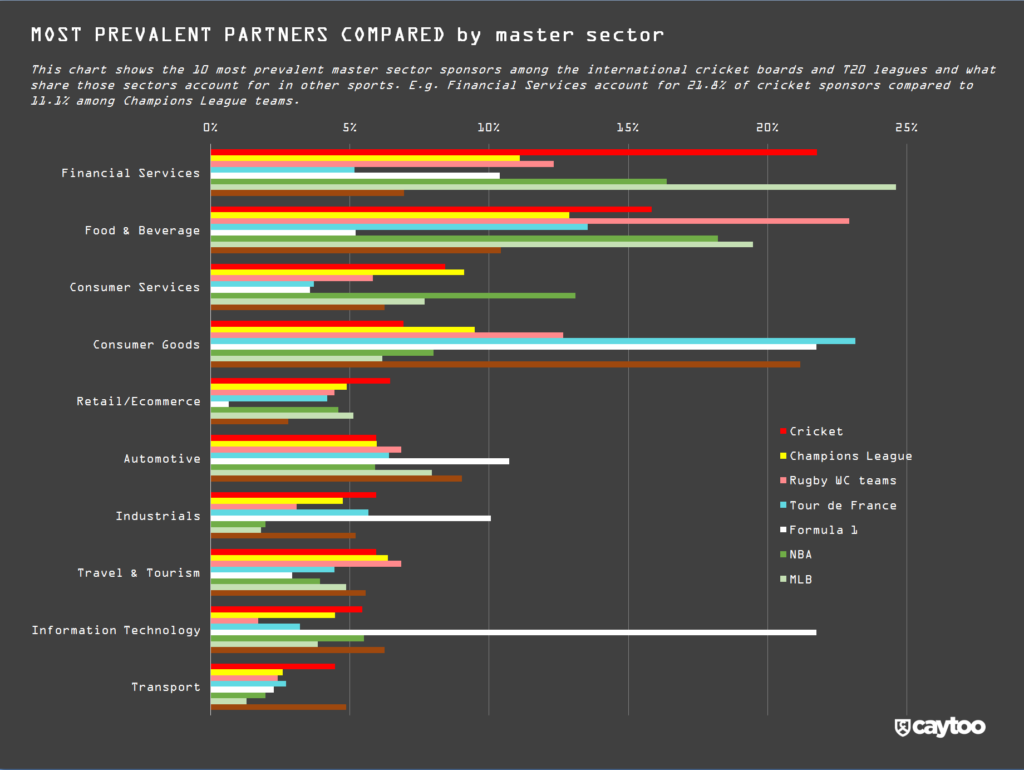
Financial Services accounts for 21.8% of sponsors, making the sector far more dominant in cricket than it is across other sports such as cycling’s Tour de France (5.2%), Formula 1 (10.4%), Champions League soccer teams (11.1%) and teams competing in the Rugby World Cup (12.3%). In fact, compared to sports federations around the world (6.9%), cricket boards are 3x more likely to have a Financial Services sponsor.
Only in US sports such as the NBA (16.4%) and the MLB (24.6%) do Financial Services have anywhere near the same share of voice.
At first glance, this would tally with the general assumption that cricket fans tend to be more skewed towards the affluent demographic than other sports such as soccer and even rugby, hence Financial Services’ favouritism towards the sport. However, the reality is different: the sector’s dominance is driven by Insurance, Payments/Transfer and Banks, almost all of whom are targeting a mass market audience. For example, Metro Bank sponsoring the England & Wales Cricket Board, Commonwealth Bank doing so in Australia and ANZ bank in New Zealand.
This is driven by two factors.
Firstly, Asian subcontinent rights holders play a much bigger part in the analysis than all the other sports. In countries such as India, Pakistan, Sri Lanka, Bangladesh and Afghanistan – where affluent audiences also account for a much smaller share of the market – cricket is much more likely to be the national sport, thus, reaching a much broader demographic. The Asia factor, for example, is illustrated by the prevalence of money transfer-related sponsors, such as India’s RuPay and Paytm, an activity that Asian consumers tend to over-index on compared to ‘Western’ markets, particularly expats sending money to families back home. Indian money transfer app Abound, for instance, sponsors Major League Cricket in the US to reach Indian expats and the broader South Asian community in that country.
Secondly, this analysis – initiated by the global event of a World Cup – factors in most of the countries’ T20 leagues as these have the most global audiences of all the cricket formats due to the much higher prevalence of overseas players. T20 leagues are designed to bring cricket to a much wider audience than the more historic, longer formats of the game – one day matches and 5-day Test Matches – hence a more mass market fanbase that relevant brands are keen to reach. For instance, Visa sponsoring the West Indies T20 Caribbean Premier League.
Following Financial Services, Food & Beverage is the next most prevalent sector (15.8%) then Consumer Services (8.4%).
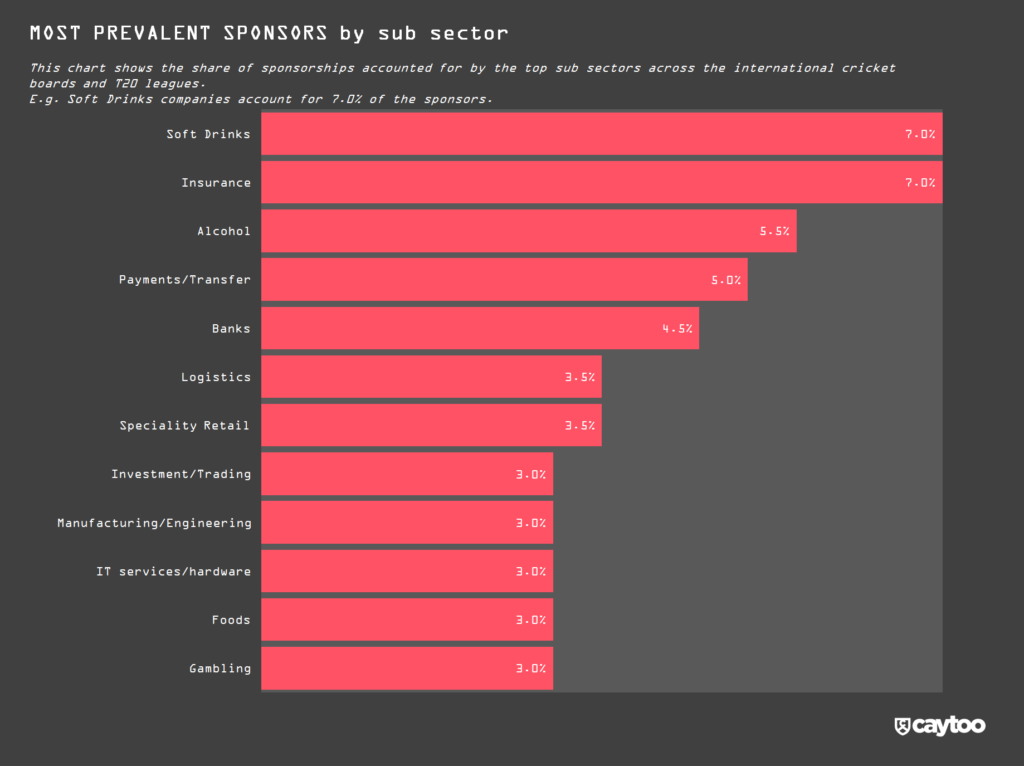
As with most of the other sports, F&B is driven by Soft Drinks (at 7.0%, the joint-top sub-sector alongside Insurance) and Alcohol (5.5%, third). Alcohol does well to feature so prominently given the lower drinking tendency in Asia, indeed only two alcohol brands from that region feature – Indian craft beer brand Bira and Nepalese vodka Ruslan.
The cricket boards also over-index on Consumer Services compared to sports such as Formula 1 (3.6%), the Tour de France (3.7%) and the Rugby World Cup teams (5.8%). The sector is driven by Gambling, QSR brand KFC – the most prevalent individual sponsor with four sponsorships – and fantasy sports game Dream11, the second most prevalent sponsor with three.
Alongside Financial Services and Consumer Services, cricket boards tend to over-index on Retail/Ecommerce and Transport sponsors (i.e. logistics and car rental brands) yet under-index on Consumer Goods, Health & Wellbeing and Professional Services.
The under-indexing on Consumer Goods is more a reflection of how the likes of Clothing/Apparel manufacturers see Champions League football teams and international rugby teams as particularly good channels to market and how Accessories and Home/Garden manufacturers see the Tour de France as the same. Electronics/Appliances also see Champions League clubs in this way as do Personal Goods brands for rugby.
Regarding Health & Wellbeing, this is likely due to sponsors seeing more physically vigorous sports such as football, rugby, cycling and basketball as a better vehicle to get their message across.
Professional Services is a surprise – given the game’s traditional link with corporate hospitality in the longer formats of the game – but again this will be due to the more mass-market consumer demographic offered by the T20 leagues being less relevant to B2B brands.
AC Milan and Corpay1, a FLEETCOR brand and global leader in business payments have announced that Corpay’s Cross-Border business has become the new Official Commercial Foreign Exchange Partner of the Rossoneri.
Global businesses trust Corpay to power their international payments, execute plans to manage their currency risk and support their growth around the world. They aim to deliver unmatched service and expertise with respect to moving money globally across 145+ currencies delivered to 200+ countries. Utilizing their award-winning online trading platform and currency risk mitigation solutions, Corpay takes pride in connecting companies large and small with the global financial markets and businesses all over the world.
This partnership unites two prominent global brands distinguished by a profound commitment to innovation. AC Milan, as an iconic football club with a rich heritage, has consistently demonstrated its capacity to adapt to contemporary global audiences. In parallel, Corpay excels in providing innovative solutions that effectively address foreign exchange exposure and global payments challenges.
Maikel Oettle, Chief Commercial Officer of AC Milan: “At AC Milan, we are delighted to embark on this exciting journey with Corpay. This partnership is a testament to our shared commitment to innovation, and it aligns seamlessly with our vision of providing the best experiences to our global fanbase.”
Brad Loder, Vice President, Cross-Border Marketing, Corpay Cross-Border Solutions, commented: “Corpay Cross-Border is very honoured to be named the Official Commercial Foreign Exchange Partner of AC Milan, which marks another significant milestone for Corpay and its presence in Italy and in the world of sports. With our strong focus on growing the Corpay brand, along with our corporate payments and foreign exchange business globally, we are excited by the opportunity to partner with one of the most successful football clubs in football history.”
American Express and Formula 1 have announced a multi-year regional partnership that will make American Express the Official Payments Partner of F1 in the Americas, with races in Austin, Mexico City, São Paulo, Las Vegas, Miami, and Montreal.
American Express is also proud to support the F1 Academy, F1’s all-female racing series committed to creating equal opportunities for women in the sport, as it strives to increase opportunities for female participation in motorsport, both on and off track.
The multi-year sponsorships add to American Express’ world-class portfolio of sports and entertainment partnerships across the globe, including basketball, tennis, golf, music, theater and more. Formula 1® is the first new sports vertical American Express has sponsored in over a decade and the company’s first multi-market sports partnership, further cementing its dedication to bringing Card Members incredible access and experiences globally.
Elizabeth Rutledge, Chief Marketing Officer, American Express, said: “The F1 fan base and viewership has grown exponentially over the past several years, so we are thrilled to bring the exclusive access and unique experiences that American Express is known for to our Card Members and racing fans. The addition of F1 to our global portfolio of partnerships helps us continue to create meaningful value for our customers, in the areas they’re most passionate about.”
Jonny Haworth, Director of Commercial Partnerships, Formula 1, said: “We are thrilled to welcome American Express as an Official Partner of Formula 1 in the Americas. As we continue to grow our presence in the US we believe American Express will introduce a new wave of fans to the sport though offering premium once-in-a lifetime moments to their Card Members, and support F1 in our efforts to further enhance and elevate the fan experience in this crucial market. It’s also fantastic to see a global brand like American Express supporting F1 Academy and the work the series is doing to drive lasting change in our sport.”
As F1 Americas’ Official Payments Partner,American Express Card Members in the Americas will get a range of special benefits, such as early access to F1 Experiences ticket packages available at all races, and to Paddock Club and Grandstand tickets in the Americas region. Additional on-site benefits will be available for American Express Card Members, and in select moments for all F1 fans, at races in North, Central, and South America. Starting at this weekend’s United States Grand Prix in Austin (Oct 20-22), eligible Card Members will have access to complimentary Amex Race Radios, to tune into commentary from around the track, and a gift with purchase at F1 stores (Terms apply). American Express will also have the opportunity to host business customers and partners at races in the Americas region.
At the inaugural FORMULA 1 HEINEKEN SILVER LAS VEGAS GRAND PRIX 2023 (Nov 16-18), taking place at night against the iconic Las Vegas backdrop, American Express will offer even more benefits, access, and experiences.
Emily Prazer, Chief Commercial Officer, Las Vegas Grand Prix, Inc., said: “As we prepare for our inaugural Vegas race, it’s crucial that we partner with brands that enhance the overall guest experience and exceed their expectations. American Express continues to bring new and exciting opportunities for sports fans around the world, and we look forward to working together to create once-in-a-lifetime experiences for their Card Members.”
A Fan Experience for American Express Card Members and their guests will be located just steps from the Las Vegas track at North Koval Zone by American Express (reservations for the space will be made available at a later date). Card Members will also have access to complimentary Amex Race Radios and a gift with a merchandise purchase, available across fan zones (Terms apply). All benefits will be offered on a first come, first served basis and specific terms will apply.
October is always a bustling month for conferences, but one event that truly stands out for me is Sportel Monaco. It has been over four years since I last attended, and I am eagerly looking forward to hearing about new innovations driving the broadcast industry. One particular area that has piqued my interest, and one that I intend to delve deep into, is the transformational role that Artificial Intelligence (AI) is playing in evaluating and reshaping fan engagement from a broadcast and rights holder perspective.
One specific area that has caught my interest is the transformational role that Artificial Intelligence (AI) is playing in evaluating and reshaping fan engagement from a broadcaster and rights-holder perspective. I plan to delve deep into this subject and attend the panel that discusses . Can AI revolutionize your understanding of your audience and deliver the content they crave? Can AI handle tasks like drafting contracts and proposals?
As a market leader in this space, I am looking forward to hearing Magnifi’s CPO Ashwin Limaye, Dave Gillett, Head of Media Rights, Extreme E and TK Gore, Head of Sports Business Development, KISWE.
Interestingly, Magnifi, built on an AI solution, has revolutionised the way sports highlights are created, personalised and distributed, and I am keen to see the difference it can make to the post-production workflows.
My view is fans are seeking new ways to engage in real-time with their favourite sports. The power of AI for fan engagement is nowhere more evident than in its capacity for personalisation. We’re living in an era where Gen Z and the emerging generation demand a highly personalised experience from broadcasters, OTT platforms and sports rights holders to provide fans with live or non-live content tailored to their unique tastes. Whether it’s a highlight or exclusive behind-the-scenes access, AI-driven personalisation ensures that fans feel seen, heard, and catered to like never before. This is something that we talk about a lot in our Masterclass+ events and provokes much discussion around best practice and how to best deliver.
Another area which presents both an opportunity and a challenge is content automation. Automation will play a pivotal role in optimising content distribution. It can tailor content for various platforms, schedule posts for optimal audience engagement, and even adapt content based on real-time feedback. It is entirely “normal” these days to be able to create and distribute a 5-minute package of the best bits of a 90-minute football match without any human intervention!
The marriage of AI and social media & liner broadcasting is a powerful force driving the evolution of digital communication and content creation. The future of social media broadcasting is intrinsically linked to AI’s capabilities, and those who lead in this space have a unique opportunity to shape how it communicates and connects. By embracing AI while maintaining a strong commitment to ethical practices, we can harness its transformative potential to create a more connected, informed, and empowered world through social media & broadcasting.
That’s it for now! See you all in weeks’ time, and I look forward to connecting with old acquaintances and fostering new connections. Please do get in touch to meet with myself or Jay Stuart.
“After years of offering larger prize money increases to early round losers, the U.S. Open is putting more money toward the brightest stars this year. The 2023 tournament has the largest purse in its history at $65 million, an 8% increase over last year for an event that has long paid the most of tennis’ four Grand Slams.”
Patrick Raupach, Partner and Head of Public Sector at Portas Consulting, looks into the region’s efforts to transform the national sports federations landscape.
“In the ever-evolving world of sports, the significance of sports federations cannot be overstated. These organizations, tasked with governing and promoting specific sports, are the linchpins of a nation’s sporting ecosystem. Across the Middle East, where sporting ambitions are soaring to new heights, sports federations are emerging as key drivers of transformation.”
Cynthia Mumbo, CEO of SportsConnect Africa pens down a whirlwind of exciting developments in the sporting world and how East African nations have stepped into the limelight with a series of groundbreaking announcements over the past few weeks.
“In a landmark move, Rwanda has partnered with one of the giants of world football, Bayern Munich. This collaboration announced recently, is set to revolutionize Rwandan football and solidify the nation’s position on the global sporting map while promoting tourism through the VISIT RWANDA platform. It is worth noting that Rwanda has had remarkable partnerships with Arsenal, PSG and the NBA through the same initiatives.”
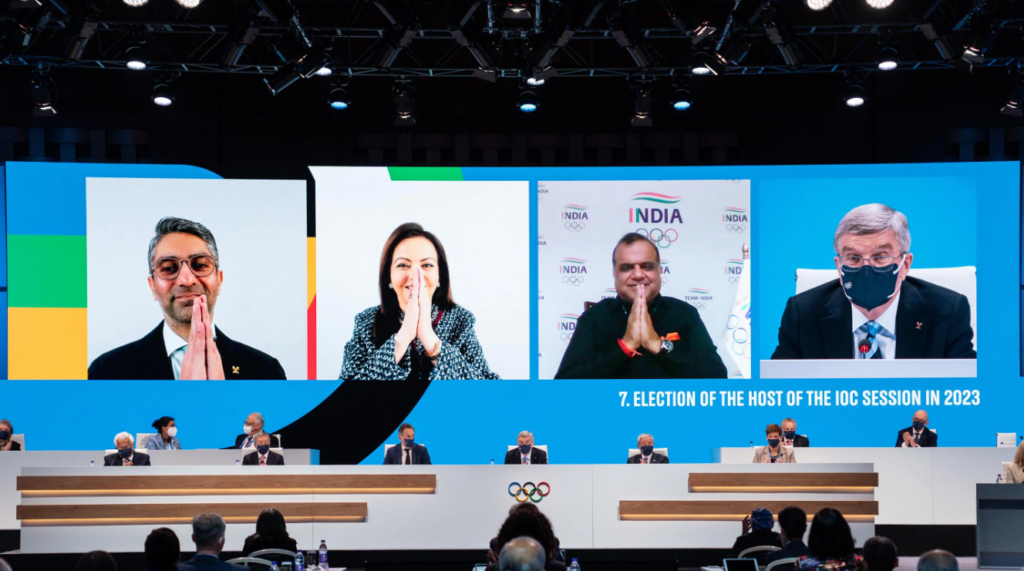
Olympic advisor Michael Pirrie looks at the IOC’s historic weekend session in Mumbai, marking the ten-year anniversary of Thomas Bach’s presidency of the Olympic Movement, the most senior position in world sport.
Sport’s constant movement into spectacle and entertainment will take a giant leap forward when Hollywood joins the Olympics at the 2028 Los Angeles Games – more than four decades after 84 pianists simultaneously performed Gershwin’s Rhapsody in Blue on 84 grand pianos perched on raised platforms at the Opening of the Los Angles 1984 Summer Games.
India may now follow in Hollywood’s footsteps, and bring Bollywood to the Olympics after Prime Minister Modi signalled strong interest in hosting the 2036 Games at the IOC’s historic weekend session in Mumbai.
The Mumbai session was vital to progressing Bach’s Olympic legacy and vision, targeting host cities and sports to cushion the Games in unpredictable global conditions.
OLYMPICS BOWLED OVER BY CRICKET
The elevation of cricket, India’s most powerful social, commercial, and political sport, to the Olympic program was critical to engaging the nation as a rising economic superpower and potential Olympic Games host.
The announcement, at the IOC Executive Board meeting also in Mumbai, was perfectly timed with the ICC Men’s Cricket World Cup also underway in India and the home team in commanding form.
The move sets the scene for India’s development as a future Olympic events destination, and counterbalance to a growing reliance on China.
The IOC’s cricket play will make the Olympics more relevant to Games nations also passionate about cricket, such as Bangladesh, Pakistan, Sri Lanka, and South Africa, and Caribbean nations.
It will also help to generate vital revenues in ticket sales for the Brisbane 2032 Olympic Games in Australia, also a cricket powerhouse.
Bach’s tenure as IOC chief and effective leader of world sport, was also celebrated and discussed at dinners and on the sidelines of Mumbai, ten years on from his presidential election at the Buenos Aires Olympic session.
While Bach’s experience as an Olympic fencing champion and elite sports administrator for Germany were important in his election win, his expanding vision beyond nation horizons has been vital since to understanding and responding to the rapidly changing international landscapes of his presidency.
“Bach has managed to keep the vast multi-billion dollar Olympic enterprise of global Games operations, sports events, and commercial programs and assets functioning and performing more effectively than most might have thought possible in such turbulent times.”
Bach has moved quickly to reform and modernise; the Olympic Movement was not left in a post-election holding pattern, as often happens under new leadership in sprawling international organisations operating in fast moving, politically and commercially sensitive environments, with complex business models and diverse stakeholder needs.
Nor was there a paralysis in decision making despite hostile global conditions, although delays in deferring the Tokyo 2020 Olympic Games as the fatal Covid virus rapidly shut down the world did surprise.
This has been a presidency steeped in the historic sweep and scale of world events and change, which have marked and shaped Bach’s time at the apex of world sport.
From clandestine meetings between North and South Korean government and Olympic officials, under satellite surveillance in a demilitarised war zone, to helping Afghan athletes escape with humanitarian visas and their lives after the Taliban’s brutal return, the IOC’s presidential and executive offices in Lausanne have often been on high alert.
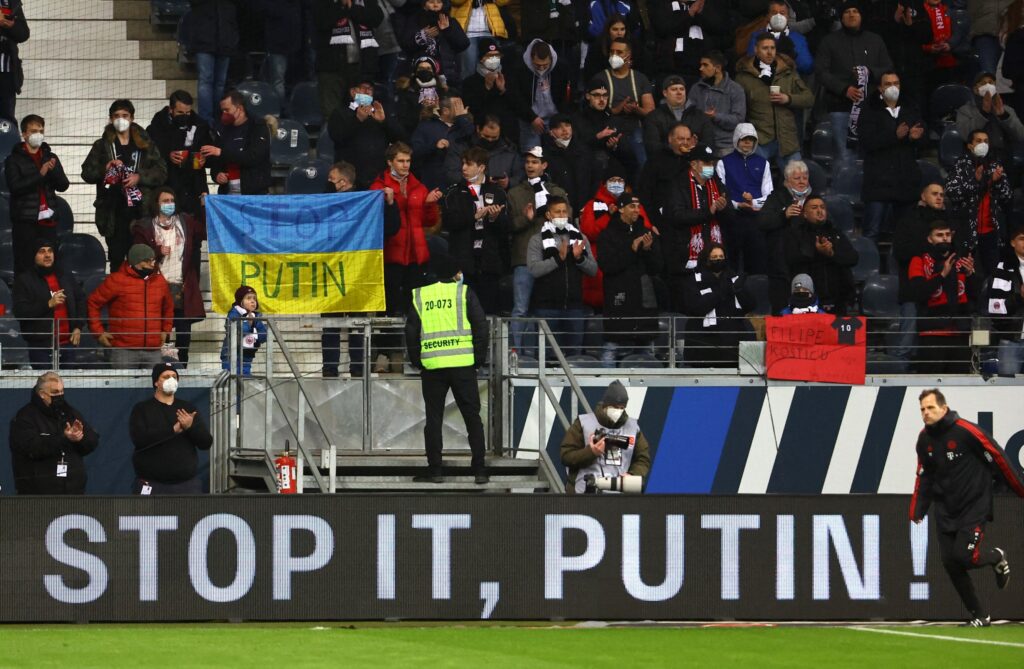
Anticipating the likely mood and managing expectations of the international community and world sport to unexpected developments – such as Russia’s invasion of Ukraine and the recent Hamas attack on Israel and its response – has been one of the major challenges of the Bach administration.
There were new war crimes and crimes against sport, clashing with traditional values and rules of sport and international society.
This was an Olympic decade that witnessed a generational cross-over of politics, conflict, security and intelligence operations, human rights violations and drugs in sport.
The cross over involved nations like Russia that see sport and the world differently.
DECADE OF DANGER
The optimism that followed the spectacular success of the Vancouver 2010 and London 2012 Olympic Games, and Bach’s election, faded rapidly as a decade of existential Russian despair descended from the pages of ‘War and Peace’ and ‘Crime and Punishment’ on the sporting world and beyond.
The distress and desperation were triggered initially by whistle blower revelations of Russia’s covert doping operations at the Sochi 2014 Winter Olympic Games.
WADA’s subsequent investigations would alert the world to the enormous, hidden scale of Russia’s doping, the fall-out from which has spanned the decade.
The WADA reports would also highlight the need to urgently dismantle Russia’s doping culture and programs, although it still remains unclear how many lives and careers had been ruined by the state sanctioned illicit drugs program.
Following his election, Bach likened his role as president to a worldwide orchestra conductor. If so, the score for the decade that has followed might have come from the epic musical drama, ‘Ride of the Valkyries,’ rather than Beethoven’s ‘Ode to Joy.’
This was the Olympic decade of living dangerously in a global obstacles course of near misses and close calls.
These included the finish of the Beijing Winter Olympics just a few days before Russia’s Ukraine invasion; issuing of shoot-to-kill orders against protestors in Almaty, the only alternative host city to Beijing for last year’s Winter Games; and diplomatic boycotts against human rights violations in China that did not develop into a withdrawal of athletes from the Beijing Games.
The soundtracks to Olympic competition events and routines, such as “Oblivion,” “Secret Spies,” and “Ring of Death,” would also reflect the political intrigue and danger of the decade.
United States Olympic basketballer Brittney Griner was detained by Russia on the eve of Putin’s invasion, and Chinese Olympic tennis star Peng Shuai disappeared suddenly after accusing a Communist Party official of sexual abuse.
Sir Craig Reedie, a former IOC vice president who led WADA during its investigations into Russian doping, was targeted by a Russian spy suspected in the poisoning plot of a former Russian double agent living in the UK with his daughter.
Meanwhile, Bach’s concern for Russian teenage skater, Kamila Valieva, who tested positive for a banned substance before competing at the Beijing Winter Olympics, was criticised as inappropriate and wrong by Russia’s deputy prime minister.
There were miraculous comebacks and escapes too. These included, in particular, the global effort against Covid and rapid vaccine development, enabling the world and international sport to recover more quickly than expected.
There were also new ways, new mantras and new mottos under Bach as the Olympic Movement sought to move Together in Unity through Diversity.
Bach did more than change the Olympic lyrics and background music. There has been much substance as well as symbolism.
CHANGING OLYMPIC FORTUNES
While Bach’s performance will be judged favourably against a variety of outcomes, Games and host cities for Games – the movement’s revenue lifeblood and global flagships – must be the essential key performance indicators.
If so, this has been a consequential presidency with consequential outcomes, achieved in some of the most daunting of circumstances.
The safe, successful and surreal delivery of the Tokyo Games in pandemic conditions transformed traditional thinking about sport and complex events.
This was essentially a world-wide sporting event held inside a giant Tokyo medical science laboratory. The Games fascinated and gripped the planet.
Hope floats, and Bach has expanded the Olympic narrative and lexicon, promoting the Games as a metaphor for hope in difficult times.
Athletes also spoke with hope in Tokyo’s mixed zones after performing under strict anti-virus protocols.
This broadened the appeal of the Tokyo Games to a world struggling with fear and death.
“I don’t want anyone to feel sorry for me, or feel like silver or any other medal besides gold is a disappointment or anything,” said US swimming legend Katie Ledecky.
“I would much rather people be concerned about people who are really, truly struggling in life.”
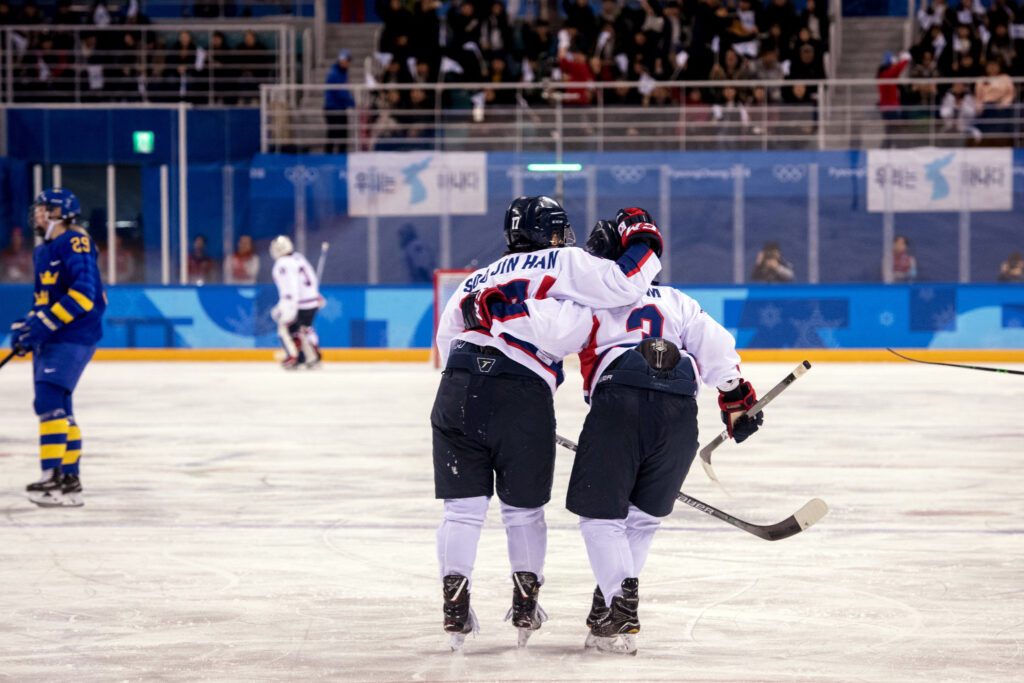
The Olympic Truce brokered between the two Koreas for the Pyeongchang Winter Games also defied expectations, a discreet network of diplomatic and political back channels and connections helping to secure the unlikely peace deal.
The Unified Korea Women’s ice hockey team brought the reclusive North temporarily out of cold isolation, and reconnected the Olympic Movement with its focus on peace.
Bach was recognised with a peace prize, and a post Olympic diplomatic career with the United Nations may await after his presidential term, which is expected to end in 2025.
OLYMPIC LEADERS
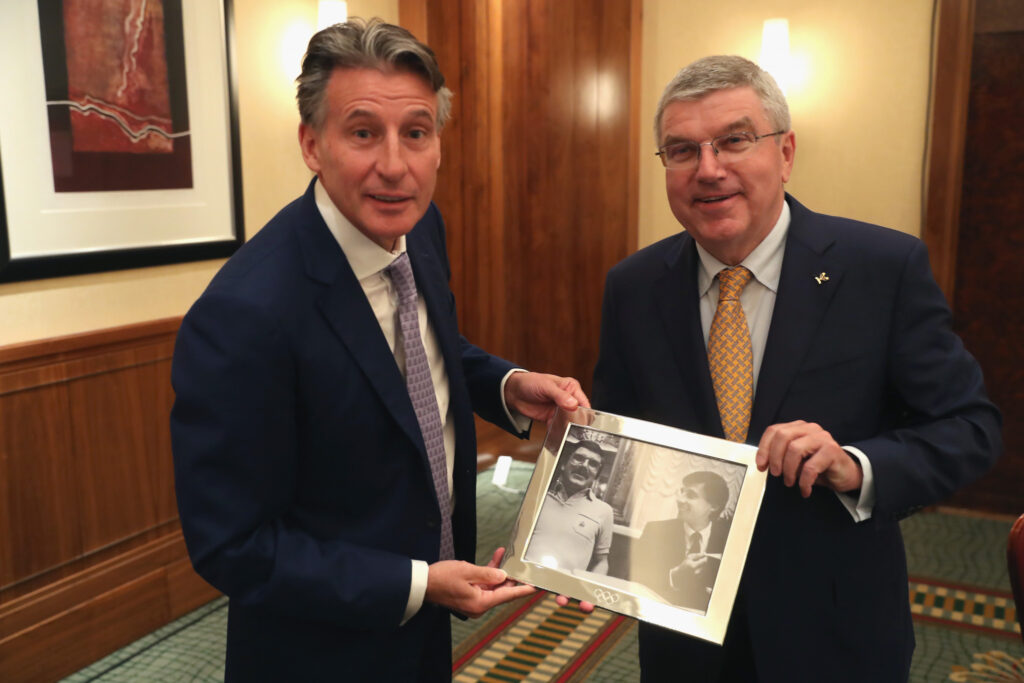
Bach was earmarked as a potential Olympic leader, along with middle distance running champion Seb Coe, who were both chosen by the late former legendary IOC president, Juan Antonio Samaranch, to represent the athletes at the Baden-Baden Olympic Congress in 1981, a landmark for the Olympic Movement.
While Samaranch brought more of the sporting world to the Games and the Games to more of the world during an unprecedented period of Olympic expansion, Bach has guided the Olympics through an era of dramatic turbulence and uncertainty with his Agenda 2020+5 roadmap; ‘Change or be Changed.’ Another mantra.
Bach has been supported in key areas by Coe and John Coates, an IOC vice president, who both dined with the future president and his wife on the eve of the Buenos Aires session vote.
As one of Bach’s key lieutenants, Coates played a central role in delivering the Tokyo Olympic Games – along with billions in revenues for Olympic sports – and in repairing the broken host city selection process.
The reforms have helped to reverse the decline in cities bidding for the Games – due to high costs and lack of local support – by making the world’s biggest event more affordable, sustainable and relevant for host nations, cities and communities.
Coe, as President of World Athletics, has reformed and rescued track and field with new sponsors, formats, and audiences following a series of devastating doping and corruption scandals, also involving Russia.
Coe’s successful overhaul of track and field has helped to transform world athletics, the most important Olympic Games sport.
The first Olympian to win consecutive 1500 metre gold medals – Coe is also a highly gifted and thoughtful international sports administrator and diplomat who led the organisation of the globally acclaimed London 2012 Olympic Games, and may be a potential candidate with skills and experience to also lead the Olympic Movement, as Samaranch envisioned.
SAFEGUARDING SPORT & ATHLETES
The intense negotiations and lobbying in the Olympic family to secure a majority position on Russia’s war and position in sport also continued in Mumbai, heralding a new geopolitical era in sport.
This was also reflected in IOC plans announced in Mumbai to establish regional sports safeguarding hubs for athletes, beginning in Southern Africa and Pacific Islands.
“Our world has changed in fundamental ways in recent years,’ Bach said on the eve of the Mumbai session.
“As we anticipated at the beginning of the Covid-19 crisis, we are now facing its far reaching social, financial, economic and political consequences, which are exacerbated by the ongoing conflicts, wars, and natural catastrophes which we must address.”
Bach has also brought the IOC much closer to the United Nations for support in troubled times, in areas important to both organisations, such as climate change and human rights.
The introduction of the Olympic Refugees team, in particular, has been important, focussing international attention on the talents, skills and needs of this globally disenfranchised and disadvantaged group.
Russia’s war continues to take world sport deeper into territory it had not anticipated nor prepared for, with UEFA recently banning the Russian U-17 team from the upcoming European Championship qualifications.
RUSSIA’S WAR ON HUMAN LIFE & SPORT
The war continues to challenge and divide the international community, on whether sport can be neutral to Russia’s unrelenting slaughter of human life and possible presence at the Paris Games.
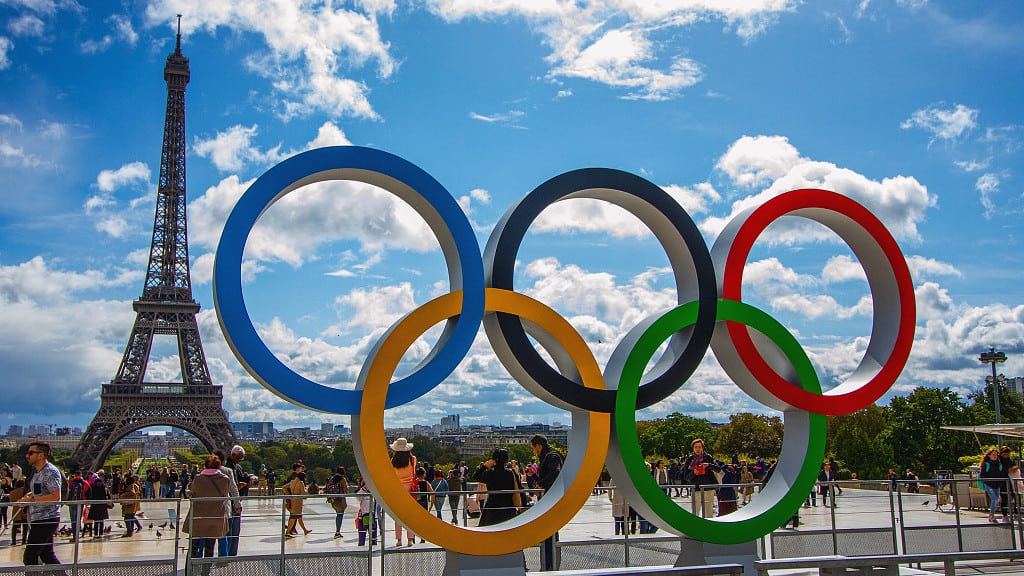
Senior international sports figures fear the unique Olympic Games vision, of athletes from the nations of the world gathering in one city for peaceful competition, may be undermined when the conduct of one nation sets it so far apart from the wider family of nations that its presence threatens the Games experience for the rest of the world.
Russia’s murderous war and ideology for many has made Olympic participation in Paris about sport’s heart, soul and humanity even more than neutrality.
While many of Ukraine’s athletes have perished on the front lines, Russia’s athletes are expected by their national Olympic Committee to support the war, but are spared military service to prepare for a possible Paris Games call up.
Their places in the war are taken by legions of disadvantaged young Russian men regarded as expendable because they are not gifted enough to compete in Paris. Instead, they are sent to early deaths by the Kremlin in a purposeless war.
While neutrality may provide a pathway back to Olympic competition for Russia, there may be no way back after Paris for Ukraine’s athletes if Putin prevails in his ‘special military project’ to destroy Ukraine.
Several of the western nations that have helped to grow, fund, and globalise the Olympic Movement are also supplying military training and weapons to Ukraine, further complicating the position on sport, Russia and warnings of nuclear attack.
A final decision about Russia’s Olympic participation is also of growing significance in how the Olympic Movement is historically perceived and positioned as the death toll escalates in Ukraine.
While Hitler’s infamous 1936 Berlin Olympic Games was used to promote Nazism pre-war, Putin’s war in contrast is already well underway, posing a growing modern-day risk to Europe and beyond in the countdown to Paris.
While Olympic leaders believe neutrality is fundamental to the identity of the Games, privately, there are also concerns about identifying the Olympic Games and brand with a war of unimaginable suffering, and a dictator also wanted by the International Criminal Court for kidnapping Ukraine’s children.
Any pretence at neutrality in Paris could ring tragically hollow, with the prospect of athletes from Russia competing in the French capital while fellow compatriots conduct mass murder and assassination operations in neighbourhoods and homes occupied by children, elderly parents, the disabled and civilians less than four flying hours away in Ukraine.
With the world heavily invested in both the Olympic Games and in saving Ukraine from genocide, the recent weekend discussions in Mumbai might prove pivotal to the future of the Paris Games and final Satz of Bach’s unfinished Olympic symphony.