McLaren Racing today announced a new agreement with Seamless Digital and the McLaren Formula 1 Team.
The pioneering collaboration brings the latest methods of digital advertising to life – the ability to dynamically change branding on Formula 1 cars across a race weekend, a first in the series. McLaren will run a two-display system around the cockpit on its MCL36 cars for Friday practice sessions for the remainder of the 2022 season, beginning at the United States Grand Prix.
The cutting-edge technology will debut exclusively with one of McLaren’s Official Partners, allowing them to dynamically change its brands on both McLaren’s Formula 1 cars.
McLaren Racing and Seamless Digital’s launch at the United States Grand Prix will demonstrate a glimpse into the future of motorsport marketing, allowing the team to connect with its fans and partners in new ways. As part of the deal, McLaren Racing also has options to explore the technology for its wider racing portfolio.
Louise McEwen, Executive Director, Brand & Marketing, McLaren Racing, said: “We are pleased to work with Seamless Digital to debut one of the most exciting innovations in digital advertising technology. Being able to rotate different brands on our cars is a game-changer in this space and we are looking forward to seeing the impact this has on the wider industry.”
Mark Turner, Founder and CEO, Seamless Digital, said: “We are delighted to be able to unveil this technology which represents the next step in the future of motorsport marketing. Being able to change branding in real-time on a Formula 1 car will give greater flexibility and value to teams and partners. Our technology enables more creative options for brands to communicate situationally relevant messages.
“We have found the perfect partner in McLaren who share our ambition for innovation and breaking convention as pioneers in the fields of technology. We believe this is just the beginning of flexible on car branding and motor racing assets. By ensuring the technology works on a Formula 1 car we have already cracked the toughest place to innovate and are set to disrupt advertising across F1, motorsport, golf, US sports and ultimately, wider more mainstream use.”
Fans across Europe will be able to enjoy the very best that winter sports has to offer with every major World Cup and World Championships event (exc Switzerland) during the 2022-23 season available to watch across the Warner Bros. Discovery Sports network.
With up to 600 races and 3,500 hours of winter sports action to be broadcast over the next six months on discovery+, Eurosport and Eurosport App, fans will have access to the most comprehensive coverage, cementing Warner Bros. Discovery’s status as the Home of Winter Sports in Europe*. (See Notes to Editors for full breakdown of winter sports rights for the 2022-23 season on Warner Bros. Discovery platforms)
Warner Bros. Discovery’s digital platforms, including Eurosport.com and its social platforms, will give fans the opportunity to experience the action live and on-demand as well as enjoy deeper analysis from its network of winter sports ambassadors, who will offer their insights exclusively throughout the season.
For the 2022-23 winter sports season, Warner Bros. Discovery has appointed a host of experts who will lend their thoughts on the key talking points in their respective disciplines as well as offering insights exclusively to fans watching on its linear and digital platforms.
The confirmed Warner Bros. Discovery Sports experts are:
The winter sports season kicks off with the opening round of the FIS World Cup in Soelden, Austria with a women’s and men’s giant slalom while the FIS Ski Jumping season starts on 5 November from Wisla, Poland.
February and March are set to be the biggest months on the calendar for winter sports fans watching on Warner Bros. Discovery Sports platforms with the Alpine World Ski Championships taking place in Courchevel Meribel between 6-19 February 2023 followed by the Nordic World Ski Championships; Planica, Slovenia between 22 February and 5 March 2023.
Scott Young, SVP Content and Production at Warner Bros. Discovery Sports, said: “We have a rich history of telling the stories of winter sports athletes and our heritage of broadcasting the world’s biggest events for more than three decades means we can continue to attract the biggest heroes and former stars of the slopes to help bring these stories to life and deepen engagement with our viewers.
“Building on our biggest ever winter sports season, where we engaged record audiences around every unmissable moment of the Olympic Winter Games and offered the greatest choice of live events of any broadcaster throughout the season, we are looking forward to combining our unrivalled scale, deep winter sports expertise and storytelling ability to unlock the power of skiing, ski jumping and snowboarding and every other major winter discipline for fans across Europe.”
Warner Bros. Discovery Sports, via Eurosport, first broadcast winter sports events in the year of its formation in 1989, and its continued approach to year-round storytelling contributed to record numbers consuming this year’s Olympic Winter Games in Beijing. More than 156 million Europeans visited Warner Bros. Discovery platforms during Beijing 2022 – where it was presented in 50 markets in Europe – with over a billion streaming minutes consumed across discovery+ and Eurosport.
The year is not yet over but it’s likely that the prize for having the biggest sporting television audience of 2022 in the UK may go to the final of the Women’s Euro football tournament in August. England’s victory over Germany pulled 17.4 million viewers on BBC1, by far the highest figure ever in Britain for a women’s sports event.
That is obviously very encouraging news for the visibility of women’s sport, but it doesn’t mean that the top of the ratings is suddenly going to become familiar territory. The truth is that the huge audience probably had more to do with the success of the home team at Wembley (England’s first international tournament triumph since 1966) than a surge in public appetite for watching women’s competitions. The true test will come when England’s Lionesses perform more like lambs.
Women’s competitions also pull big audience numbers in other markets when a team or a star from the country does well. When that’s not the case, not so much. There’s a huge gap in consistency between the ratings performance of men’s and women’s sports on television. There is clearly a big audience for women’s sport sometimes. For men’s sports it’s pretty much all the time.
Sometimes is already tremendous progress from the days when women’s events were not shown at all. Make no mistake, in general, the size of TV audiences for women’s sports remains vastly different to men’s for multiple reasons, but what the big audiences show is that the appetite is there.
The difference between men’s and sports on television is not just the size of the audience but the style of presentation.
A survey for the ITF’s Advantage All gender equality initiative conducted by research company Ipsos MORI found a marked editorial divergence in the way men’s and women’s sports are covered.
In football, the media language tends to focus on the team aspect of the women’s game more than in the men’s. Teammates are referenced more than twice as often in women’s football content.
The research shows the gender difference in presentation to be especially pronounced in tennis.
The coverage of men’s tennis is more focused on the sport, with a strong combative narrative and a sense of history, elite competition and achievement. Men’s tennis content is about twice as likely to refer to ‘battle’ terminology as women’s content. Men’s content is also 70% more likely to mention a player’s physical prowess than women’s content.
The term ‘greatest of all time’ is mentioned more in men’s tennis than in women’s and there are more references to ‘making history.’
In a nutshell, coverage of men’s tennis puts more emphasis on the sport itself.
In contrast, women’s coverage tends to focus more on the players.
Women’s content is twice as likely to mention specific age/youth of players as men’s content.
Content around women’s tennis is over two times more likely to mention health and medical treatment.
Women’s content is 30% more likely to refer to a player’s family.
‘Career’ is mentioned nearly 50% more.
Women’s content is nearly twice as likely to mention clothing.
Most significantly, women’s tennis coverage is more focused on life off the court than coverage of the men.
Basically, the media coverage of women’s tennis is softer and tends to highlight the players as people rather than as athletes at the pinnacle of their sport.
The narrative which gives women’s sports the credibility as outstanding action on the court is far from where it should be. And the same goes for other sports.
Women’s sports will not have achieved equality until this balance is redressed and female players are lauded for their prowess just as men are.
That said, the public’s interest in female players as people is a positive thing.
It is important to note that the Ipsos MORI research found that the social media behaviour of the public shows very few differences in top search terms and search questions around male and female tennis players. There is a similar level of interest in searches around relationships and family. The same goes for golf.
Audiences are engaged by stories. Sports fans want stories about their favourite teams and players. And for non-sports fans storytelling is what draws them in to begin with. The success of the Formula 1 behind-the-scenes series Drive to Survive on Netflix has shown that in dramatic fashion by engaging a wide non-sports audience and that has had a big positive knock-on effect for the viewership for live race coverage.
However, unlike for women’s sports, F1 already had a solid foundation of sporting credibility to build on. That foundation of widely viewed events ¬ women’s competition as compelling action ¬ comes first. Once it is in place, women’s sport can build the bigger future that the events, players and audiences deserve.
Whilst being led by tennis, the forum will draw from and be relevant to all women’s sport, with speakers from a range of sectors including rights holders, broadcast/media and national federations, all joining together to champion initiatives that will be a driving force in promoting gender equality within sports, business and beyond. Speakers to include Billie Jean-King, with more to be announced in the coming days.
UK sports fans will be able to follow a broad range of live events on Viaplay, including all European Qualifiers for the UEFA EURO and FIFA World Cup played by the Scotland, Wales and Northern Ireland men’s national football teams, along with the UEFA Nations League and friendlies, until 2028. Viaplay holds a comprehensive portfolio of rights to over 1,000 UEFA international matches from across Europe, including top-ranked teams such as Belgium, Denmark, France, Germany, Italy, the Netherlands, Portugal and Spain.
Viaplay will also show LaLiga, Scottish Cup, Scottish League Cup and Coppa Italia football; BKT United Rugby Championship, Rugby Football League and TOP 14 rugby; NHL, IIHF Ice Hockey World Championship, Champions Hockey League and Elite Ice Hockey League; CEV volleyball; KSW mixed martial arts; EHF handball; ISU figure skating and speed skating; World Athletics Continental Tour Gold and Indoor Tour; and much more.
Anders Jensen, Viaplay Group President and CEO: “Viaplay will offer UK viewers a compelling combination of live sports, world-class drama and superior value for money. We are launching in this dynamic and exciting market with high ambitions and a long-term perspective, and acquiring Premier Sports will significantly accelerate our entry. Viaplay has so much to offer, and local sports fans as well as devotees of premium Nordic and international storytelling can now try our unique service for themselves, starting 1 November.”
The pay-TV channels Premier Sports 1 and Premier Sports 2 will be rebranded as Viaplay Sports 1 and Viaplay Sports 2, with the free-to-air TV channel FreeSports becoming Viaplay Xtra. All channels will remain available through existing distribution partners, and will continue to broadcast live sports to pubs, clubs and other commercial premises throughout the UK.
The content offering on all Premier Sports channels will be expanded to include Viaplay’s series and film line-up. Further details of the series and films available on Viaplay in the UK will be announced shortly.
Viaplay Group’s agreement to acquire Premier Sports was announced on 21 July. The acquisition will create synergies with the Viaplay streaming service in UK sports content, distribution and production, while boosting Viaplay’s brand awareness in the country.
Premier Sports had a total of 222,000 paying subscribers at the end of June 2022. Founded in 2009 and previously majority-owned by Setanta Sports, the company generated revenues of GBP 26.4 million in 2021. The transaction values Premier Sports at GBP 30 million on a cash and debt-free basis, subject to customary closing adjustment mechanisms, and the company will be consolidated in Q4 2022. Premier Sports is based in Dublin and has 23 full-time employees, all of whom are to join Viaplay Group.
Viaplay is currently available as a direct-to-consumer service in all Nordic and Baltic countries, Poland and the Netherlands. The service is also available through Comcast in the US, with a direct-to-consumer launch in both the US and Canada to follow in early 2023. The Viaplay Select branded content concept launched in Japan in April through WOWOW, and will come to DMD’s CINDIE streaming service in nine Latin American countries in November.
Decyfr Sport have announced the appointment of Sky Sports’ NFL Broadcaster Neil Reynolds to their Advisory Board. The association will see Decyfr Sport commission original content fronted by Reynolds, who will also play an active role in providing strategic guidance to the venture, as they look to consolidate their NFL presence in the UK and European markets.
Reynolds, who has fronted Sky Sports’ NFL coverage since 2011 and been their main presenter since 2017, joins Ryan McCumber, KPMG’s former Global Director of Sports Tech, and Rod Nenner, ex-VP of Corporate Partnerships at the NFL’s Washington Commanders, on the Decyfr Sport Advisory Board.
The NFL London Games are still ongoing, and the first two games, held at Tottenham Hotspur Stadium, saw the Minnesota Vikings play the New Orleans Saints and the New York Giants face the Green Bay Packers.
The series concludes with a return to Wembley Stadium for the Jacksonville Jaguars – as they take on the Denver Broncos on October 30th.
Decyfr Sport CEO Sid Kohli said: “We’re beyond thrilled to have Neil on board. It’s no secret Neil’s been the de facto face of the NFL in the UK and is very much an ambassador for the league’s presence on these shores.
“With Neil, we hope to rapidly expand our NFL presence in the UK, as he will undoubtedly play a significant role in the sport’s growth in the decade to come.”
Six NFL teams – namely the Miami Dolphins, New York Jets, San Francisco 49ers, Minnesota Vikings, Chicago Bears and Jacksonville Jaguars have been granted access to the UK for marketing, fan engagement and commercialisation opportunities as part of the NFL’s International Home Marketing Areas (IHMA) initiative.
An exclusive podcast series is set to be launched, targeting new NFL fans, with Reynolds as host – in line with Decyfr’s overarching strategy of building global fan bases for rights-holders, sports leagues and teams in international and conventionally non-endemic markets.
Reynolds said: “I’m excited about what Decyfr is doing and where the venture is headed. It’s very much a passion of mine to create compelling content and explain the sport I love to a growing audience, especially at a historic time for American Football in the UK.”
Six Nations Rugby, the official organising body responsible for the biggest annual international rugby competitions, has announced an exciting new partnership with Sage, a global leader in software technology.
The partnership will bring rugby fans even greater insights into the game; enhancing their viewing experience through real time data and analytics captured through smart ball technology and advanced predictive analytics.
The Sage partnership with Six Nations Rugby will span the Autumn Nations Series, Guinness Six Nations and TikTok Women’s Six Nations.
The 2022 Autumn Nations Series kicks off on October 29th when Scotland host Australia and will be the first time Sage uses the smart ball data and presents its insight to fans in a Six Nations Rugby competition.
The Autumn Nations Series will consist of five rounds of international rugby fixtures that sees the best Northern Hemisphere nations welcome the best Southern Hemisphere nations, reigniting rugby rivalries that stand to offer fans a Series of truly unmissable experiences.
Sage is renowned for helping businesses make better data-led decisions and will be using this expertise through its partnership with Six Nations Rugby. The partnership with Sage will enable all participating Unions, coaches and players valuable insights to aid performance and on-field decision making.
Commenting on the partnership with Sage, Ben Morel, CEO of Six Nations Rugby, said: “Six Nations Rugby is a fan-focussed organisation, working in collaboration with each union, Federation, and partner and to deliver truly unmissable experiences. The partnership with Sage is incredibly exciting for everyone involved, as they share a desire to enhance the experience for audiences, and ultimately bring even more fans into the game.
“To offer fans even greater data and insight from the on-field action through innovative broadcast and social presentation is going to be another important step in ensuring we are offering the best possible experience for the audience, as well as supporting the teams on and off the field.”
Cath Keers, CMO of Sage said: “Becoming the Official Insights Partner of Six Nations Rugby is an exciting step for Sage, as we continue to bring our insight and decision-making capabilities to life, in a human and accessible way.
“For some teams, the Autumn Nations Series will be the first time they have been able to gather data and insight from the smart ball technology. This is incredibly exciting, given our ambition to support teams in their decision making in training and during games, based on data led insight.
“For fans watching, Sage wants to use its role as Official Insights Partner is to help bring that new insight to life and enhance their experience, both through broadcast coverage and across social media. Our Sage customers, partners, employees and communities internationally will also benefit from the partnership with access to tickets, experiences, and content.”
This new partnership follows Sage’s successful integration as Official Insights Partner to the Hundred, in cricket, and most recently a new partnership with Major League Baseball.
Peter Silverstone joins the club from OneFootball, the world’s largest football media platform, where he was Senior Vice President of Global Development, responsible for OneFootball’s clubs, leagues, federations and players network and partnerships division.
Peter brings almost two decades of commercial experience in the football industry that will be critical to delivering the club’s ambitious commercial growth plans.
Prior to OneFootball, Peter spent almost seven years at Arsenal FC, leaving his role as Chief Commercial Officer in February 2022. Peter initially joined Arsenal in 2015 as Business Development Director before becoming a key member of the Arsenal executive team in 2018 in the roles of Commercial Director and then Chief Commercial Officer.
During his tenure at Arsenal, Peter led several successful commercial initiatives, including the onboarding and development of Arsenal’s Adidas partnership, and the signing and extension of Arsenal’s sleeve partnership with Visit Rwanda.
He also oversaw the rapid growth of Arsenal’s e-commerce business and the agreement with Amazon for Arsenal’s much acclaimed ‘All Or Nothing’ documentary.
Peter also drove Arsenal’s club-wide commercial focus on the Arsenal Women’s team and the initiative to bring an increased number of women’s matches to the Emirates Stadium during the 2021/22 season.
With experience on various Premier League, Football Association and European Club Association groups and committees, as CCO, Peter led Arsenal’s full commercial function managing over 150 people across the Retail & Licensing, Brand Marketing, Partnership Development, Partner Services, Digital Experience and Venue departments.
Born in Glasgow, Peter attended Edinburgh University where he read law before beginning his professional career in investment banking with Morgan Stanley.
Prior to joining Arsenal, Peter worked at Pitch International in London and South America where he built and led their Brasil Global Tour project which was responsible for the organisation and commercialisation of the Brazil national football team’s global friendly schedule.
Peter said: “I am delighted, and honoured, to join Newcastle United as the club embarks on its exciting journey to build a sustainable, leading, Premier League and European club. Achieving that position will reward the unrivalled passion and loyalty of the incredible Newcastle United fans.
“I am committed to immersing myself in the heritage and culture of this giant club, and the vibrant city of Newcastle, while building and leading a talented and diverse commercial operation that will deliver the commercial success vital to power the fans’ and the club’s ambitious growth plans.”
Newcastle United CEO, Darren Eales, said: “We are delighted to announce Peter Silverstone as the club’s new CCO. After an extensive recruitment process, we are confident we have found the right person to work with our team to deliver our commercial growth plans.
“He will be a key member of the club’s executive team as we look forward to delivering on the club’s commercial potential.”
Deltatre, one of the world’s leading sports and entertainment technology providers, today announces the launch of a new turnkey end-to-end video and application platform that will allow new entrants to the OTT sector to go live with market-ready video streaming services within 90 days.
Deltatre has distilled a combination of its award-winning products and expertise behind some of the world’s biggest sports and entertainment platforms to offer a complete out-of-the-box solution, opening its offering to a host of new OTT players.
The new easy-to-use and intuitive platform gives both existing streaming services seeking to enhance their current offering, and new market entrants looking to monetize content, a toolkit of templates and ready-to-launch features that can be branded to suit their needs.
Quick launch capabilities enable clients to build an OTT platform supporting a range of unique devices and revenue models in under 12 weeks, meaning clients can increase reach and generate revenue while testing their solution in the market.
Through the platform, which can support AVOD and SVOD business models, clients have access to Deltatre’s best-in-class publishing platform and powerful data analytics tools. This allows them to use a combination of metrics, including number of hours watched, video quality, user device and location, and popular content to guide the evolution of the platform for their customer base.
Deltatre can then support clients with growth plans and adapt the platform, adding new features and tailoring the solution to meet customer needs informed by collected data.
In addition to Deltatre’s proprietary tools, the platform encompasses a range of selected partner products and services to offer a one-stop-shop solution. Working with top-tier partners across the OTT ecosystem, the new platform can deliver best-in-class performance with guaranteed compatibility between components to provide a smooth-running service from launch.
Gilles Mas, President Video Experiences at Deltatre: “Our latest innovation marks a new era in Deltatre. We are distilling the key components of our award-winning solutions and hard-won expertise to deliver a platform that breaks down barriers to entry for the OTT market. Where there is content there is opportunity. We aim to enable a broader range of customers to capitalize on that opportunity and monetize it without needing to onboard a significant technical team to support the revenue stream.”
Andrea Marini, CEO at Deltatre: “The development of the new platform was a hugely exciting proposition when looking at the company’s growth. We firmly believe that there is a large market of specialist, regional and niche content players that technology vendors have traditionally underserved, and we look forward to working with new customers to both deliver streaming services and accelerate growth.”
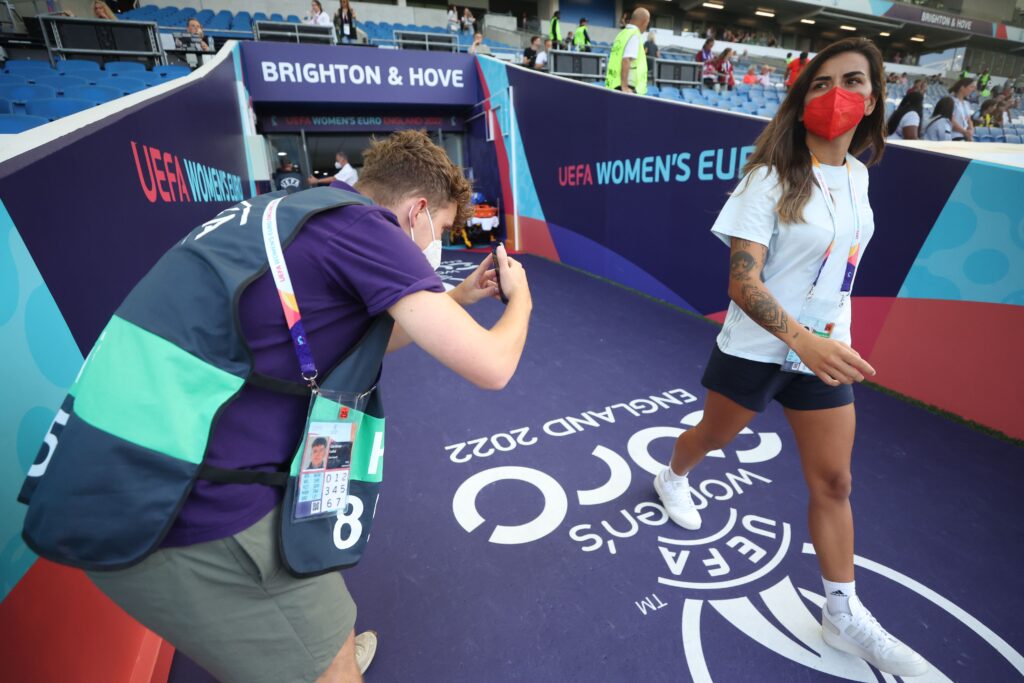
The Women’s Euros was the sporting highlight of the summer, captivating a nation and changing the shape of women’s sport for the future. Helma von Zadow (Women’s Football Content Lead) and Sam Adams (Content Team Lead) led the team that delivered the app, web and social media content for UEFA, building excitement in the lead up to the tournament, during the event and beyond. Our Content Manager, Alex Brinton, sat down with them to talk about it.
For a bit of background, what projects do you work with UEFA on and when did the partnership begin?
Sam (S): InCrowd took on the UEFA content contract in the summer of 2019. The team have been delivering the content across The Champions League, Europa League and the Euros. When planning began for the Women’s Euro competition it quickly became apparent that we needed to establish a specific team to exclusively cover women’s football
The team needed a figurehead to lead the charge on this big project. Helma von Zadow joined us with great experience having worked on the Women’s Euro project with The FA before the pandemic hit and was a perfect choice to lead the team.
To focus on the Women’s Euros more specifically, when did the planning process for the tournament start from your side?
Helma (H): The tournament work specifically started a year and a half or two years out. There were two phases, the preparation phase that covered certain milestones like 500 days to go, 100 days to go, the ticket sales milestones, and then of course the second phase was the in-tournament content which was very different.
We have a super close relationship with UEFA because as much as we create all the content, the official photography, the video content is all sourced and created by the team in Switzerland and we work hand in hand with them.
S: There was a lot of emphasis from UEFA on women’s football, and the Women’s Euros marked the halfway point of that strategy.
H: 2019 was the first time ever that UEFA had a women’s football specific strategy in place, and a specific budget allocated to it which was amazing.
What were some of the issues you faced in this project and how did you resolve them?
H: In times of remote work, it took a little bit of time to build the infrastructure for the team and how we work together to prepare, meet objectives etc, with us all working from home and/or in and out of the office.
For me personally, getting an understanding for how UEFA and InCrowd work together, was definitely a bigger task than it might have been in-non pandemic times. But the positive side of it is because you come into a job that’s new, you also get to build your own ways of working.
S: In terms of the tournament itself, and the build up to it, especially, we were expecting coverage levels on a completely different scale to anything that we’ve done before in women’s football. So there wasn’t anything for Helma to really go off. In the men’s European Championship, you can always look at the last time and think right, what did we do there? How are we going to tweak it to make it better? What are the recent trends in the digital industry that we can capitalise that have changed our last few years? Helma wasn’t starting completely from scratch, but it really was a completely different level of coverage that we are planning.
What was great was that we could also draw on the experience of members of the team covering men’s football, and Helma and her team could collaborate with them to work in the slightly different way a women’s tournament required.
What were your goals before the tournament and how did you make sure you achieved them?
H: We had topline goals from UEFA that came from their “Time For Action” plan. They have very specific goals, like doubling web traffic from 2017. We also had internal targets in terms of engagement and the closer we came to the tournament knew that we were definitely going to reach these targets,
I think overall, what was really important is that we wanted to create a unique tone of voice and premium content. We wanted to portray the women’s game in the best way possible, especially because last year we had the men’s Euros. We felt like people expect to see similar content on the same level, in terms of concrete numbers, and potentially channel growth. But for the Women’s Euro we saw x10 in web traffic compared to 2017, and engagement numbers were x30. These are massive numbers that we will never see on the men’s side.
S: Benchmarking is so tough in such a fast growth industry like women’s football. The coverage levels of the sport have changed massively, so it was hard to benchmark. But for me all I wanted to do was make sure we were setting them up to succeed.
There were more partners involved than ever before, how was it handling their content commitments?
H: I think that I would probably say two things. First TikTok, a big sponsor that is also a social media platform. Having them as a partner on board definitely helped to lift the content and offered us expertise to produce content in a way that would resonate with the audience and become the type of content we wanted it to be.
From the hashtag #WEURO2022, the number of shares was over 1 billion which is the biggest number we have across any platform.
S: I just think it’s worth saying that UEFA puts incredible emphasis on producing successful branded content. The result is that it’s been refined to such a level that they’ve managed to create brand-associated content that does well, despite the penalties that the platform’s sometimes associate with overly branded content. Having the men’s Euros the year before really helped, because we essentially had a portfolio of sponsored products that we could roll out.
InCrowd’s TikTok producer Luke Gardner films a video before the England v Spain match
When you first start putting one of these plans together you’ll see a spreadsheet with a thousand different colours. You see all these branded and sponsored posts that need to be published, and you think it’s just not possible to maintain the quality but with scheduling, collaboration and communication with partners, it is possible to create engaging, branded content…… and we did!
What did you find was the most successful form of content? Did anything surprise you in terms of engagement levels?
H: I would say the most successful pieces were those from the pitch side, post match, because they’re very authentic and close to the players. It felt like people fell in love with some of these players during the tournament, which is part of our strategy; to create brands of the athletes to grow their following
Of course, all the record-related content always sees high engagement..
What sort of increases are we looking at in terms of engagement?
H: The increase in engagement on social channels for the tournament was great, I think probably even more than we would have expected for it to be.
We saw a huge increase in UEFA web/app sessions compared to the same reporting period for Women’s EURO 2017, which is massive.
What is your favourite moment of this experience overall?
H: Probably one of them definitely would be our TikTok Producer Luke coming back from all these games and saying, it’s the best football experience he’s ever been part of. This is a guy who was pitchside during the Men’s Euros and literally standing next to Lionel Messi during Finalissima this year. Luke represents the audience we were hoping to capture but where we might see the most resistance and he just loved it so much. He would chat about games with all his mates in group chats and that made us so happy.
S: The first week altogether as a team we had the best atmosphere in the office kicking around loads of ideas.
The day of the first game, I’ve never felt so confident that we were going to deliver; watching the collaboration within the team and those that we hosted from the UEFA digital team and Nyon (UEFA HQ). Incredible feeling.
People have called it a turning point for not only Women’s football, but Women’s sport in general, does it feel a bit surreal to say you played a role in that?
H: To think that we were a part of it! For me, always having played football and my MBA was on the developments in women’s football and national associations – women’s football has always been a huge part of life. Seeing the progress of the game is so exciting, and rewarding.
It’s also such a joy to work with all these really talented people.When I look back these last two years, a lot has happened. It’s the year of women’s football, but then also the Women’s Champions League with the new format, the partnership with DAZN that lets fans see all these matches. I personally know that living in Germany it was never possible to see a game that was taking place in England.
Having some of these experiences… it doesn’t feel like work. We are creating content for sport which is something we are all truly passionate about. We love what we do.
The 2022 NBA Champion Golden State Warriors today announced a dynamic, multi-year partnership with DoorDash. A key component of the partnership will allow fans attending games and events at Chase Center to order in-arena food and beverage items using the DoorDash mobile app. Additionally, to celebrate the partnership and the start of the 2022-23 season, the Warriors and DoorDash have announced various opportunities for fans to win prizes, redeem discounts on orders, and more.
“We are honored to partner with DoorDash to elevate the food and beverage experience for fans at Chase Center and in the Bay Area,” said Warriors Executive Vice President, Mike Kitts. “Chase Center will be one of the first NBA venues to offer fans the ability to order food and beverage through DoorDash. This is the beginning of a multi-faceted partnership that will redefine the food and beverage experience both in-arena and for Dub Nation around the Bay Area.”
As the 2022-23 Warriors season begins, the team and DoorDash will soon offer mobile ordering from Chase Center eateries through the DoorDash mobile app for fans attending events, becoming one of the first NBA venues to offer this experience.
Additionally, the Warriors and DoorDash have launched Golden Gamedays, a season-long campaign for DashPass members, DoorDash’s membership program. Eligible Bay Area fans can discover the best of their neighborhood food offerings, while entering for a chance to win a “Warrior for a Day” experience. By entering “GOLDEN” on any eligible DashPass order at checkout, eligible Bay Area fans will be automatically entered to win the experience, which includes custom jerseys, participation in an on-court skills clinic, gift cards and more. Throughout the season, DoorDash will give away tickets to DashPass members to certain Warriors home games as part of Golden Gamedays *. The first Golden Gameday will tip-off on October 18, the Warriors first regular season game, with support from four-time NBA Champion Andre Iguodala.
On October 18, the Warriors’ first home game this season, DoorDash customers in the Bay Area can enjoy 50% off their order of $20 or more, up to $10 off, by using the code WARRIORS50.** As the team’s exclusive on-demand delivery platform partner, DoorDash will be featured throughout Chase Center, including LED signage, on-site activations and more.
“We’re thrilled to be an official partner of the Warriors, an organization that’s truly committed to making an impact both on and off the court,” said DoorDash’s Senior Director of Partnerships, Vanessa Carr. “We look forward to working together to meaningfully accelerate our shared values, uplifting our shared hometown of the Bay Area community and championing hometown pride as we work together to bring the best of the neighborhood to fans.”
The partnership also names DoorDash the Official On-Demand Pick-Up Platform and Official Grocery Partner of the team.