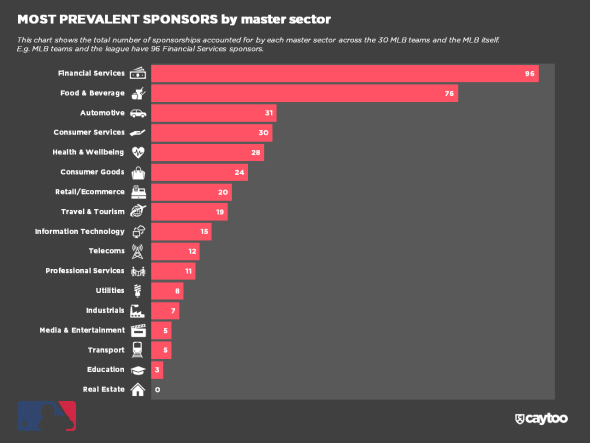
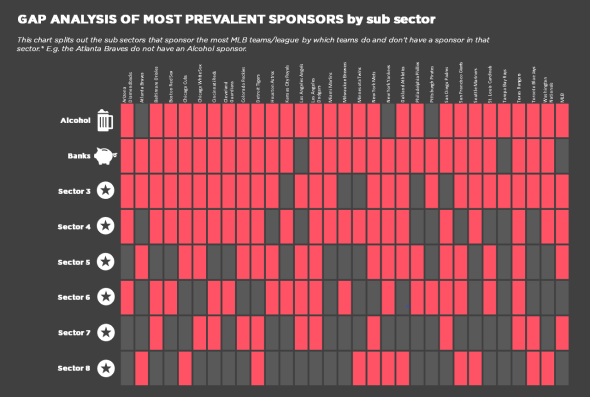
This week’s iSportConnect Sponsorship Index powered by caytoo, dives into Major League Baseball sponsorships. Who is sponsoring them and why?
While F1 is dominated by IT and consumer goods brands which both fit into the very fabric of the sport in terms of its technological foundation and globetrotting nature (clothing, watches, sunglasses and luggage), MLB is dominated by financial services and food & beverage brands, so what does this speak to about baseball?
The dominance of these two sectors is driven by insurance, banks, alcohol and soft drinks; in fact, these four sub sectors (caytoo tracks over 50 sub sectors) account for a whopping 35% of all MLB sponsors. Baseball is historically referred to as America’s national pastime as it reflects many aspects of American life; in particular, the idea of a hot dog in one hand and a cold beer in the other. This is symbolic to American culture – drinking while watching sports is also a classic pastime – and baseball embodies that, particularly as the games are over 2.5 hours long – which explains why alcohol brands lead the way. Alcohol is followed by soft drinks (dominated by Coke and Pepsi) as the kids need refreshment too.
The link with financial services isn’t so overtly obvious but in more ‘dry’ product sectors in which product differentiation is harder and there’s less connection with emotion or lifestyle, sports such as baseball enable these brands to differentiate themselves from the competition.
It does this by deepening the emotional bond with consumers through the sport and team they identify strongly with. Baseball is also the oldest of the US’s four major professional sports leagues so there’s a naturally strong association with heritage and a sense of safety/security which is an association financial services crave.
In this View From article Michel Cutait, Acting Secretary General of the World Obstacle Federation, dives into the benefits of individual athletes being members of international federations.
When discussing innovation, the first thought that often comes to mind is technology. However, it’s important to note that innovation can take many different forms. The objective of this article is to explore how international sports federations can innovate their business models to drive growth and success.
It’s essential to clarify that the proposal presented in this article does not intend to conclude the subject, nor does it suggest that the current model is necessarily obsolete. On the contrary, the main objective is to evaluate new possibilities and opportunities to enhance the existing business model.
It is worth stating that the suggestion outlined here is feasible and has the potential to innovate governance in sports.
Traditionally, international sports federations grant membership to national federations, which represent their respective countries. However, this model limits the action of the international federations, and above all makes the relationship with athletes and the community dedicated to sport more difficult.
There is an alternative that has not yet become effective among international federations, and which could bring several benefits for the growth of the organisations, by allowing individual athletes to become members of international federations with rights and obligations according to the statutes of the international federations.
This article will explore the benefits of allowing individual athletes to become members of international sports federations.
National Federations Just to frame the discussion, it is important to clarify that national federations are responsible for the development and organisation of sports in their respective countries, which is why they are members of international federations.
Among various responsibilities, in addition to organising sports nationally, they select and send teams to international competitions and ensure that their athletes comply with the rules and regulations of the international federations.
The participation of national federations in international federations provides a platform for collaboration and cooperation between countries, a model that has allowed sports to keep evolving around the world.
Individual athletes Allowing individual athletes to become members of international federations as well would establish a new paradigm in the world of sports that could intensify the scope and purpose of international federations, without undermining the importance of the work done by national federations.
A small number of federations have already started to draft, and even include individual athletes as affiliates, but not exactly as members, and this proposal could be undertaken by many other federations, especially those that aim to grow the sport and its community of athletes.
Advantages Here are at least six interesting advantages of implementing the proposed change in this article.
Engagement It would increase their engagement with the sport. They would have a direct link to the international federation, which would give them access to information about the sport, training opportunities and updates on international competitions, as well as establishing a feeling of belonging for the athlete.
Revenue Moreover, implementing a membership fee for athletes, even a token amount, would generate significant financial benefits for the federation. This complementary revenue could be utilised to develop the sport, support training programs, and endorse international competitions.
However, it is crucial to emphasise that a portion of this revenue must be allocated towards enhancing the benefits of membership for the athletes. One way to achieve this is by creating a membership program.
Participation Individual athletes, as members of international federations, would have a voice to participate in discussions of committees, commissions, and even assemblies.
They could provide feedback, suggestions, and recommendations based on their experiences as athletes. This would benefit the federation with a more diverse and representative perspective of the sport and put athletes at the centre of the decision-making process.
Benefits
Additionally, It would offer direct benefits to athletes. These athletes would have access to resources and support provided by the federation, such as anti-doping education, medical support, training, and other benefits that the federation may extend to athletes.
Partnerships could also be expanded with companies and organisations, such as insurance companies, retailers, service providers, etc., who might be able to offer benefits based on agreements made with the international federations.
This would help athletes make the best of their performance with all the support that an international federation can offer.
Communication
One of the big challenges that international federations face is the difficulty of communicating with their community, because they depend on this bridge being largely made by the national federation.
Unfortunately, many times, this bridge is not made in an efficient way, and communication about the actions implemented by the international federation, such as projects, programs, and other initiatives, end up being poorly understood by the athletes.
Obviously, communication between the international federation and its national federations can be improved, but if the athletes could be considered as individual members, communication could be done in a direct way, and therefore much more efficient and assertive.
Database
Ultimately, the inclusion of athletes as individual members of the international federations would provide an advantage which turns out to be extremely important for expanding the database of the international federations.
All the technological innovations of this digital world, augmented by artificial intelligence, require organisations to maintain a comprehensive, reliable, and detailed database on their members, athletes, participants, and/or stakeholders.
In this case, if international federations could build their databases using the athletes’ information directly, without necessarily depending on the national federations, they could leverage this database meaningfully and productively.
For example, it could increase communication, boost engagement, facilitate sponsorship and fundraising, and create a collaborative environment in which all athletes would be connected right up to the leadership of the international federation.
Of course, this can be done by the national federations, and in practice this is what happens, but from the international federation’s point of view, having direct access to this information would be an excellent turning point for governing the sport.
Recommendations In order to ensure that this model not only proves to be useful but also yields positive outcomes for international federations, particularly given the crucial role played by national federations, it is imperative to take into account at least four key recommendations when implementing this new model.
First, any athlete who wants to join an international federation must also join the national federation of his or her respective country, following the specific requirements established in the statute of the national federations.
This would ensure that the national federations preserve their autonomy, independence and growth.
The proposed recommendation suggests a reciprocal affiliation process whereby if an athlete becomes affiliated with a national federation, it would be possible, based on the criteria set by each organisation, for the athlete to also affiliate with the international federation.
This would broaden the athlete’s participation at both national and international levels and provide advantages for both organisations.
Second, to uphold the principle of representation, it is crucial to limit voting rights in assemblies and committees only to national federations. This measure does not impede the rights of athletes, as they are already represented by their respective national federations.
It also does not hinder the national federations’ authority to make decisions in the assemblies and committees that have a significant impact on the future of the international federation and the sport.
If an individual athlete exercises the right to vote, he would be expressing his own interest and not the collective interest, which is why this prerogative would not become a solution for the common good of the organisation.
Third, this proposed model shift requires a modification of the statute, which can only be accomplished through a deliberation by members via an assembly set up for this specific purpose, in accordance with the statute of each organisation.
As it is essentially a statutory modification, implementing the proposal may pose a challenge due to the requirement for a highly qualified quorum.
However, for organisations that are currently in the process of forming, the foundation has the potential to propose the change.
Finally, fourth, the nomenclature for individual membership, associate, or participant can be decided by each organisation in accordance with the rules outlined in their statutes.
Nonetheless, it is crucial that athletes could exercise their rights and prerogatives in an effective and participative manner.
Conclusion Allowing individual athletes to become members of international sports federations is a step forward for the federation business model.
It would intensify athlete and community engagement, increase revenue generation, strengthen athlete participation in matters of relevance to sport, allow for more benefits to be provided to athletes, bridge the communication gap between the organisation and the community, and represent a turning point in building a reliable and relevant database on behalf of the international federation, and, of course, on behalf of the national federations.
International federations could also create different separate membership categories for other stakeholders such as coaches, judges to ensure that everyone participates in the development of the federation, promoting a more collaborative approach to the governance of sport.
Recognising the benefits of this model, international federations can progress in a more collaborative and inclusive manner, ultimately benefiting both the national and international sports communities.
Michel Cutait is a Senior Executive Sports Manager, Consultant, Lawyer, Professor and Author. He is currently the Acting Secretary General of World Obstacle, the international governing body for obstacle sports (Obstacle Course Racing, Ninja and Adventure Racing) and related events, where he runs the Secretariat, and works actively in the areas of governance, membership, partnership, development, and strategy. He served as the Brazilian Triathlon Confederation’s Strategy Advisor. Graduated in Law, holds Masters degrees in Social Relations (Brazil), Marketing (Australia), and Sports Administration and Technology (AISTS) from EPFL in Lausanne, the Olympic Capital. In addition, he serves as an editorial board member and reviewer for the Journal of Global Sport Management. He has authored five books, with his most recent work titled “Management Performance Rio 2016 Olympic Games,” which is catalogued in the Olympic Library in Lausanne.
Tata Communications, a global digital ecosystem enabler, today announces completion of the acquisition of The Switch Enterprises LLC (The Switch) through its wholly owned international subsidiary Tata Communications (Netherlands) B.V. The US $58.8 Mn (₹486.3 Crores) cash transaction has been closed post customary adjustments and regulatory approvals.
Tata Communications, through its wholly owned international subsidiary Tata Communications (Netherlands) B.V. entered into a definitive agreement to acquire 100% equity stake in New York-headquartered The Switch Enterprises LLC on 22nd December 2022.
With the close of this transaction, the combined strength of Tata Communications and The Switch is set to usher in a new world of end-to-end video production and transmission of high-quality, high-speed, and more immersive live video experiences for viewers and fans from event venues and racetracks to screens across varied equipment such as televisions, mobile devices, etc.
“Immersive video experiences in real-time are going to be the next game changer for enterprises, and our combined expertise will make for a formidable force creating shared value for all,” said Tri Pham, Chief Strategy Officer, Tata Communications. “We’re gearing to bring more powerful platforms for sports federations and broadcasters to help them deliver fast-paced, always-on and interactive entertainment forms for viewers across borders. We’re extremely pleased to welcome The Switch team to Tata Communications.”
Dhaval Ponda, Global Head of Media & Entertainment Business, Tata Communications added, “Tata Communications and The Switch are now a powerhouse with the combination of live production capabilities, global edge platform dedicated for media & entertainment industry along with end-to-end managed services. These are exciting times in the world of video production for us to make a difference for enterprises and engage consumers. Together, we are leveraging the expertise of both companies to bring some never-before-known experiences for fans globally – whether they are playing esports, watching a live tournament or live streaming a concert. We welcome and wish our colleagues from The Switch all the very best for their future.”
Eric Cooney, President & CEO, The Switch said, “The Switch is a market leader offering live production and transmission services to hundreds of customers in the United States and abroad. This acquisition by Tata Communications is a key milestone in our growth journey and enables us to expand our horizons. Together with Tata Communications, we are excited to step up our customers’ growth journeys, enhance viewer experiences and expand globally.”
With the completion of this transaction, The Switch Enterprises joins the Media and Entertainment Services (MES) business of Tata Communications under the leadership of Dhaval Ponda, Global Head of Media and Entertainment Business, Tata Communications.
Matchroom and DAZN are delighted to announce a three-year extension to their broadcast deals in the USA and Mexico – a deal further cements Matchroom as a true global leader in boxing while also confirming DAZN as THE home of global combat sports with the platform available in over 200 territories.
Matchroom held their first event live on DAZN in October 2018 when Jessie Vargas took on Thomas Dulorme in Chicago, and since that night in the Windy City, President Eddie Hearn has teamed up with the global streaming giants to put on over 50 events in America and Mexico.
The first Mexico night took place in February 2019 when Humberto Soto defeated Brandon Rios in Tijuana, and Hearn has hosted seven more thrilling nights in the country and Matchroom’s latest event saw World-rated Lightweight Angel Fierro stop Eduardo Estela in Culiacan to move closer to World title action. Matchroom are in a strong position in Mexico after Mauricio Lara joined Juan Francisco Estrada and Julio Cesar Martinez as World champions from the boxing hotbed with his stunning KO win over Leigh Wood in Nottingham, England to become WBA Featherweight ruler, as they meet in a rematch in Manchester, England in May.
Matchroom kicked off 2023 in America in style with a double-header of Undisputed World title action in New York that saw Amanda Serrano and Alycia Baumgardner crowned the undisputed rulers at Featherweight and Super-Featherweight respectively and San Antonio had it’s first two-weight World champion in April, as future pound-for-pound star Jesse Rodriguez bravely boxed on with a broken jaw to add the WBO Flyweight crown to the Super-Flyweight strap he won and defended in style in 2022.
The blockbuster action continues in May as Canelo Alvarez defends his undisputed Super-Middleweight crown against and John Ryder in what promises to be a spectacular homecoming for the Mexican hero in Guadalajara on Cinco de Mayo weekend. The next action in America sees Hearn’s newest signing in action as Super-Middleweight star Edgar Berlanga faces Jason Quigley in New York in June, with the Brooklyn-based Puerto Rican KO artist the latest addition to a stacked Stateside stable along with young talents Criztec Bazaldua and Yankiel Rivera, with promoter Eddie Hearn ready to add more great nights and fighters to the already stacked schedule with this announcement.
Paris Saint-Germain Esports is returning to Rocket League in style, thanks to a partnership with leading organisation Tundra Esports. Determined to break into the global elite, the two have their sights set on producing long term championship results together. Competing under the name PSG Tundra, the team will be leveraging the Paris Saint-Germain brand’s growing stature in gaming with the unique expertise of Tundra in esports performance and content creation to build a highly engaged global audience of fans.
The aim of this partnership is to create a competitive Rocket League team capable of winning every competition it enters and a brand that reflects the mainstream interests of its fans. The full team information including players and coach will be announced in due course.
Regarded as one of the most technically complex of video games, Rocket League quickly became an esports sensation. Released in July 2015, this football/driving hybrid is played by nearly 100 million people globally every month, which is an indication of its success with gaming and football fans.
Paris Saint-Germain Chief Brand Officer Fabien Allègre said: “We are delighted to be back in Rocket League, one of the most popular games in the world. We are anxious to see the PSG Tundra team succeed. In putting together our team Paris Saint-Germain is looking to make the most of its presence in Europe and to continue its expansion. Thanks to the PSG Tundra team, the club now has seven Esports teams.”
Tundra Esports was formed in 2019 with the aim of bringing together the best Esports talent worldwide. Winning countless titles including the Dota International 2022 and FNCS EU Championship, the British organisation has developed a breakthrough profile with their disruption to the esports scene and is the one to watch on the international stage.
Tundra Esports Executive Chairman, Carleton Curtis said “We are delighted to partner with the elite French team Paris Saint-Germain. PSG shares the same values as us at Tundra – excelling beyond the competitive game and offering fans a unique and unforgettable experience through gaming culture, art and music! We are very much looking forward to seeing what this dynamic duo can achieve.”
Less than a year ago Web3 was all over the media as the next big thing. Since the end of the cryptocurrency craze you hardly hear about it anymore. Now it’s AI everywhere you look. The similarity in hype is hard to miss. But don’t think that just because Web3 isn’t making as much noise, blockchain is any less important or less likely to be shaping the future of the internet ¬ and of the sports and entertainment businesses.
The simple fact is that AI is easier to “get” than Web3. You can easily experience it first-hand. All you have to do is pop a question into ChatGPT and say “wow” when you see what comes out. Web3 is about the underlying architecture of the internet. It’s like plumbing. You don’t want to see plumbing, it’s just supposed to work. When the buzz was around Web3, the curious had to buy crypto or an NFT or at the very least you needed to get a wallet.
My point is that AI has now become the hot topic that Web3 and the metaverse were last year, maybe hotter.
The thing that I find striking is that Web3 and AI are at different ends of the spectrum of the future internet.
AI is about centralization. Look at who’s calling the shots in headline-making generative AI at present. The usual Big Tech suspects. Microsoft is behind ChatGPT. Google has countered with Bard. I will also mention Adobe’s Firefly. AI underpins Big Tech. It’s at the heart of Facebook.
Web3 is about de-centralization of the internet. The whole premise is that control of data and interaction will reside, not with the platforms that control Web2 but with individuals and the communities they choose to be a part of. Put simply, the logic of the Web3 vision for internet users is anti-Big Platform (just as the logic of crypto is anti-Big Banks).
Does this mean that AI will not have a place in a Web3 future? Not at all. That would be a backwards step. But it does seem to suggest that the answer-bots would have to navigate the internet in a different way than they currently do, by scraping every bit of Web2 in order to appear all-knowing.
Indeed, it has been suggested that Web3 can be the much-needed “trust layer” protecting us from the potential excesses of AI. Pay attention!
Martin El-Khouri of Bertelsmann Investments, who will be a speaker at the SEG3 Sports, Entertainment & Gaming conference in London coming up June 28-29, told me this week that he sees Web3 as the future of the internet, and that advertising and the media business will be transformed by blockchain and the potential for brands to reinvent their relationships with fans and consumers. Given that Bertelsmann is one of the world’s largest media conglomerates (the 68 TV channels of their RTL Group reach 99% of European homes), anyone in sports and entertainment should pay heed.
In a similar vein, Accenture’s business trends survey shows that executives expect 4.2% of their revenues to come from the metaverse in the next three years.
And yet, the current levels of Web3 attention and understanding still remain far from where they should be. While Web3 and the metaverse are enthusiastically embraced by the initiates, too many sports and entertainment decision-makers have just not got their heads around what is happening. And that’s a shame because beyond Web2 the opportunities for building deeply engaged communities and profitable new businesses are far bigger than they imagine
Volleyball World has announced that Stake.com will become the exclusive betting partner of the Volleyball Nations League (VNL).
Volleyball World and Stake.com are excited to announce a far-reaching new collaboration for the VNL in 2023. The new partnership follows Stake’s involvement in the VNL Osaka event in 2022 and will now extend to cover all rounds of both the Men’s and Women’s VNL. This thrilling development underscores the strengthened trust, mutual respect, and shared dedication to promoting the sport of volleyball worldwide.
“We are ecstatic to welcome back Stake.com as our partner for the 2023 VNL. With our reach in multiple markets, including Brazil, Canada, and beyond, our partnership will offer an unparalleled platform to connect with a passionate and engaged fanbase from around the globe. We look forward to seeing how Stake.com will elevate the matchday experience for our fans and add even more excitement to the tournament.” said Finn Taylor, CEO of Volleyball World.
Akhil Sarin, Director of Acquisition for Stake.com added: “Our involvement with the VNL in 2022 was a resounding success, so it was an easy decision to secure a partnership on a larger scale for 2023. We’re looking forward to seeing the Stake branding light up the courts and offering Volleyball fans globally an unbeatable proposition on our platform throughout the tournament.”
We have been touring the world in our articles over the past six weeks, from Africa we have flown to Lausanne, the Middle East, Asia, Lausanne and the US. Here is a recap of what we have learnt so far.
Cynthia Mumbo, CEO Sports Connect Africa, explains some of the challenges the sports business has in order to grow in Africa.
Despite Africa’s sports business industry’s potential for growth and development, significant challenges must be addressed. One of the most difficult challenges is infrastructure. Africa has 54 countries, over 2000 languages, and a wide range of cultures and norms. What works in Nigeria may not work in Ghana or elsewhere in Africa to the east. It is critical to comprehend these dynamics.
Donal McElwee, Head of Middle East and Africa for Portas Consulting, talks about sports growth in the Middle East.
A recent World Economic Forum report suggested that the Middle East’s sports industry is expected to grow by 8.7% by 2026 – compared with global sector growth of 3.3% over the same period. This is driven by a significant public investment, underpinned by both economic and social policy ambitions, and increasingly supported by local and global private sector investors.
Unmish Parthasarathi, Founder and Executive Director of Picture Board Partners, writes about why India and cricket are a commercial match made in heaven.
Cricket is a whole new ball game when it comes to India, a media market unlike any other in the world – it’s the lone BRIC worth building a house in! One notable international benchmark is the $71.3 Billion sale of 21st Century Fox to Disney, the Hotstar-Star Sports combine was reportedly valued at 20% enterprise value or $14bn.
During March Madness, Sportico’s Eben Nova-Williams and Lev Akabas looked into how it works on a commercial level.
The SEC sent eight teams to this year’s tournament, more than anyone except the Big Ten, and those teams will end the tournament having played 17 games. Each game played will be worth roughly $2 million, according to Sportico’s calculations, paid out in annual installments through 2029, bringing the SEC’s haul to roughly $34 million. The Big 12 is next with 16 games played for $32 million, followed by the Big East with 15 games for $30 million.
Deputy Secretary General of the World Obstacle Federation, Michel Cutait, looks into the sources of income for sports federations
To understand this reality, it is necessary to discuss the business model of these organisations, which are commonly set up as non-profit associations.
Being a non-profit organisation means that the organisation cannot share its profits among its members. So, unlike a for-profit company or corporation, the purpose of an association (or sports federation) is not to make a profit but to develop its purposes regarding the sport they are governing.
This week saw the launch of the Union of European Clubs (UEC), a new representative body for European club football which wants to “fill the governance gap”.
The body was set up to address the lack of a voice for the small- and medium-sized clubs outside of the “elite” as well as a perceived imbalance in the redistribution of commercial revenues from UEFA club competitions.
It is those who fund the game that hold the key to the future
UEFA reported revenues of over EUR 3 billion from its club competitions in the 2022/23 season, and typically around 80% comes from media rights. It is the prospect of not only growing the overall pie but counting on these revenues year on year that is so appealing to the ownership groups that control many of the elite clubs.
In a media market which is ever more fragmented, no sports property outside of the US provides an appointment to view for so many and so often as the Champions League. However, the competition for Champions League spots is fierce and even the mighty Bayern Munich, Real Madrid, PSG and Manchester City, who rarely finish outside of the top two in their respective leagues, are in theory only a few seasons away from missing out on the competitions’ millions.
The customer is king but currently has no voice
Increasing the value of the current club competitions or creating more value for clubs in a closed Super League is predicated on the assumption that fans will pay through increased attention and/or by dipping deeper into their wallets.
While the success of the Champions League has proven there is a huge value in the best in Europe competing against the best, it still feels like the voice of the customer (no apologies for using this term given the importance of delivering a quality product), which is the most important for any business, is the only voice not proportionately represented in the current debate.
This is complex and challenging to solve given the various interests at play. But it remains one of the single most important problems to be solved in European club football.
The politicians will also have their say
As the football “family” continues to remain split over the future of European club football, the government regulators are closing in.
The European Court of Justice is examining the question of whether UEFA retains the right to be both a regulator and organiser of European competitions. A22, the organisation behind efforts to launch a European Super League, are challenging UEFA’s monopoly.
The European Commission, which is an important institution within the European Union and responsible for proposing and implementing EU laws and policies, was represented at the launch of the UEC by Vice President Margaritis Schinas and he was quoted as saying, “UEFA should ensure that the commercial success of the elite level supports all the other levels”.
Earlier this year the British government announced plans to introduce an independent regulator whose powers will include, amongst others, blocking clubs from joining a breakaway Super League.
Where do the athletes stand?
The recently announced plans to introduce an enlarged 32-team FIFA Club World Cup, which is set to take place every four years, has raised tensions between FIFA and UEFA. The new tournament would generate significant revenue for FIFA and the participating clubs. However, the biggest clubs in Europe have been reluctant to participate, citing concerns about scheduling and player fatigue.
FIFPRO, the global players union, has also publicly spoken out against moves to introduce the tournament which is planned to commence in 2025. FIFAPRO said in a statement released in late 2022 that it is working with another representative body, the World Leagues Forum, “on the alignment of the match calendar with mandatory health protections for players”.
A question of governance
In the end, much of the debate around who gets what shines a light on questions over how football, and sport at large, is governed.
Football is still a cottage industry and estimated to be worth single digit billions per year compared to global retail which is estimated to be a double-digit trillion dollar industry.
Nevertheless it is still an industry and requires certain minimum standards of governance. Ethics, transparency and accountability are the terms we often hear and when you dig into the stakeholder relationships of those represented in the current debate, as well as those potentially not represented, everything about the future of European club football comes back to these three fundamental principles.
It is of course naive to think that European club football can flick a switch and turn on a bright and happy future but until there is an acceptance that basic principles of good governance are key to a sustainable future, the current state of play is set to become even more complex and fragmented.
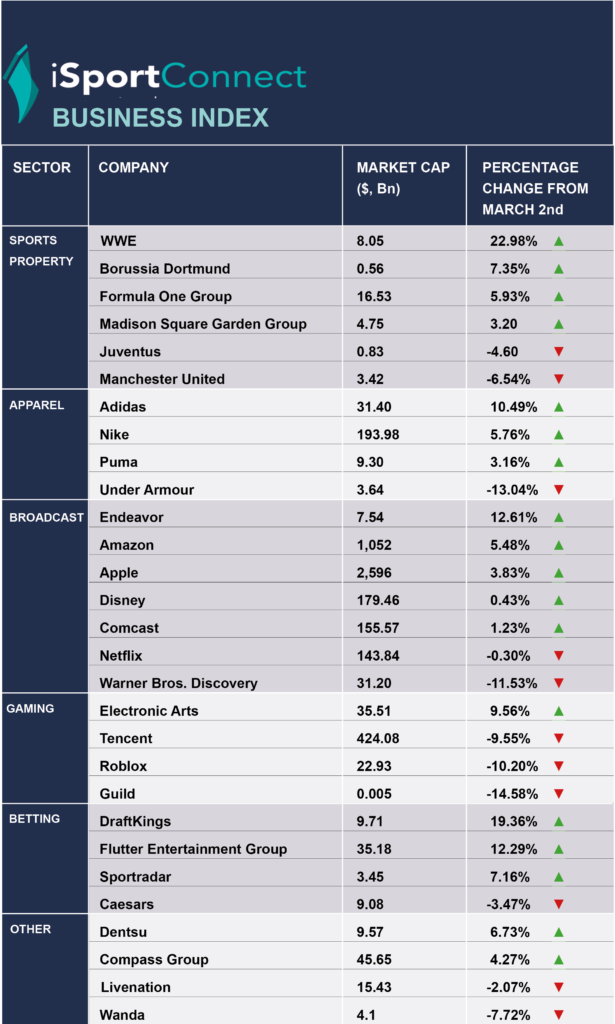
In this month’s iSportConnect Business Index Ian Whittaker, Founder and MD of Liberty Sky Advisors, and twice City AM Analyst of the Year, looks into the WWE and Endeavor deal and what is going on at Manchester United.
There has been a lot happening in the iSC Top 30 Sports Index this month, with a number of major moves in the space. Probably the major item has been the tie up between WWE and Endeavor’s UFC which has been very well received by the market which sees a number of opportunities from the $21bn combination. Both sides have arguably a lot to earn from each other – WWE leads in consumer products while UFC does in sponsorship. Bringing the two together the transfer of best practice but also give them much bigger muscle when it comes to renegotiating media rights, which makes up over 70% of revenues. Given the growth of ‘non-traditional’ sports such as UFC amongst younger audiences, the combined entity should be in a prime position to get more for its rights, especially given the entry of the Tech giants into the sports rights arena and the desire of other players such as Netflix to look at alternatives to the main sporting rights.
Elsewhere, Flutter rose by more than 12%, mainly driven by hopes that it will move its listing from London to New York, which should (presumably) lead to a higher valuation for the stock. But more generally, the sentiment around the gambling space remains positive with Draft Kings rising nearly 20% as investors continue to be positive on the potential opportunities of the US market. Within Media and Tech, WBD has fallen as investors digested the implications of the investor day, which saw HBO dropped from the Max+ brand, causing much discussion about the drivers behind the move while Tech has continued its gradual recovery, which is likely to be boosted by the results coming through from Alphabet (Google), Meta (Facebook) and Microsoft, whose results have all pleased investors. In the Retail space, Under Armour continues to suffer over fears around inventory and future revenue trends but the ‘controversy’ over Nike’s campaign featuring Dylan Mulvaney has not impacted the share price, more the opposite.
And what about the saga at Manchester United? Well, that continues. The latest news reports suggests the Glazier Family may be looking for alternative financing that allows them to remain owners which has impacted already concerned sentiment about whether a sale would actually take place as the Glaziers demand a higher price. This one continues to roll and, while it looks like Manchester United are heading back to the Champions League (as long as they do not suffer an end of season collapse), the continued uncertainty will raise fears about the longer-term future.