After the high demand from broadcasters, fans, and sponsors WBSS AG is delighted to announce Season III of the World Boxing Super Series; one tournament, one weight class, and one winner to be the first woman to raise the Muhammad Ali Trophy.
Ali Trophy winners Aleksander Usyk, Callum Smith, Josh Taylor, Naoya Inoue, and Mairis Briedis forever testaments to what this sport can be when you match the best fighters in the ring. It catapults our champions into true greatness. It elevates the entire sport.
Women’s Super-Featherweight is the sixth edition and third season of WBSS since September 2017.
https://www.youtube.com/watch?v=CQ-DWUUb50o
Andreas Benz, CEO of WBSS AG:
“Boxing is and has always been much more than a sport. It is a metaphor for life. The fighters walk into the squared circle with big dreams of winning and glory and sometimes even, a better life. In no other sport is so much at stake.”
“In Season I and II we delivered the best tournaments in men’s boxing, but it was always our dream to not only deliver the best tournament in men’s boxing but to prepare a worthy stage for women’s boxing and support these fantastic fighters, too. Now it’s time to realise it!”
“It will be much more than the greatest women’s boxing tournament. We plan to strategically help to broaden women’s boxing, both at the grassroots and elite level, and develop a professional environment where talents and profiles can grow and legacies are born.”
“As always, the WBSS will do everything to deliver the best fights and productions possible and we are dedicated to entertaining boxing fans around the globe. We can’t wait to turn the lights back on!”
Kalle Sauerland, WBSS Chief Boxing Officer:
“It’s been something we have talked about since our inauguration and it gives me great, great pleasure – and us great pleasure at the World Boxing Super Series to announce Season III; the women, the super featherweights.”
“The sport is an amazing place. Competition is hotter than ever. The super featherweights we feel is a division that has such depth and also allows those in the divisions around it to take part. We feel that this is the time, the right time, women’s boxing has never been this good. We are looking forward to a spectacular season.”
“Women’s boxing goes back to a time where it was banned to times where it was non-existing is a male-dominated sport. It goes back to fighting for places on cards to get any sort of attention.
“I remember the first world title fight I promoted for Cecilia Brækhus two decades ago. It took place on an undercard. Cecilia went on to unify the sport and became a headliner in her own right, a national hero, a global ambassador for the sport.”
“Many other greats have also held the flag of female boxing. Going back to Regina Halmich, Jane Couch, Nicola Adams, Holly Holm, Katie Taylor. There are so many. But the opportunity the World Boxing Super Series brings for female boxing is second to none.”
“In short, the quest, another quest, for the Muhammad Ali Trophy has begun. The WBSS is back!”
Announcement on the Season III roster and schedule will be made in due course, in the meantime check the new WBSS webpage and social channels for updates.
Boxer reactions to the WBSS Season III news:
Jane Couch MBE, Britain’s first licensed female boxer and former five-time Champion: “I want to send a massive, massive shout-out to the World Boxing Super Series for doing great things for women’s boxing. Massive luck in Season III and good luck to all.“
Regina Halmich, Germany’ former Flyweight Champion and Hall of Fame member: “This is very good news for women’s boxing. It was about time that my sport gets more credit. I really believe this will be a great tournament. I’m looking forward to great fights and new superstars.
Callum Smith, Britain’s WBSS Season I Super-Middleweight Champion: “It’s good to see the women get a chance to lift the trophy this season. I want to wish everyone involved a massive ‘good luck’. I’m looking forward to watching a great tournament.”
The WBSS: The World Boxing Super Series (WBSS) is a first-of-its-kind boxing tournament organised by WBSS AG since 2017. Each weight class features eight boxers competing in a knockout competition with the champion taking the Muhammad Ali Trophy, The Greatest Prize in Boxing.
Muhammad Ali Trophy winners: Season I: Aleksandr Usyk (Cruiserweight), Callum Smith (Super-Middleweight) Season II: Josh Taylor (Super-Lightweight), Naoya Inoue (Bantamweight), Mairis Briedis (Cruiserweight)
Pedro Febrero, Head of Blockchain at RealFevr dives deep into bitcoin and blockchain technology and discusses the power of smart contracts and how these technologies can be adopted by the Sports and eSports industry, enhancing clubs, companies, fans and every single individual operating in the space.
(how bitcoin works, by CryptoNerds)
Bitcoin was the first cryptocurrency that ever existed and the catalyst for developing the plurality of blockchain technology projects we see today. Without bitcoin, there would be no blockchain.
Bitcoin is also a network and a protocol, as much as it is a currency, which makes it even harder to understand. It’s a way for anyone in the world to send a message that contains financial information.
There are core technologies that the Bitcoin protocol uses, which we think are critical to fully understand before we move forward into how the blockchain and cryptocurrency will revolutionize the sports and Esports industries. The most important are:
Encryption and anonymity: the Bitcoin protocol uses standard encryption (PGP) and a hashing algorithm, SHA256, to anonymize and link transactions and blocks. Some users confuse “privacy” with “anonymity”. Bitcoin grants users some level of anonymity because transactions are pseudo-anonymous. In the Bitcoin network, we can see the amounts transacted and the addresses of users.
Proof-of-Work(or high energy requirements): Bitcoin mechanism to mint new bitcoin and validate transactions is called mining. Essentially mining requires users to spend enormous amounts of computational power to participate in each minting round. We dive deeper into mining in the next module but think of mining as the same process humans need to find gold. It’s energy-wasteful and needs a bunch of resources, including the capital. This makes each bitcoin unique and impossible to counterfeit. High energy requirements make Bitcoin transactions immutable.
Peer-to-peer (P2P): to make Bitcoin usable, each transaction must be done directly from user to user. Essentially, if you own your private keys, explained further down the road, it means you’re able to spend your bitcoin directly, and you can do it without a central trusted party. Information is sent directly between nodes which anyone can run from anywhere in the globe. Pretty cool, right?
Open participation: one of the most important characteristics of Bitcoin is that no single entity owns the network. Because the software is open-source and the network is decentralized (P2P), anyone can contribute to the Bitcoin protocol by developing or testing code, mining, running a node to validate transactions or simply by buying and “holding”. Bitcoin is censorship resistant since no single entity can block others from participating. Additionally, the Bitcoin network is a public network.
The blockchain (or time-locks): Each bitcoin transaction gets stored in a block. And each block receives linked to a previous block containing previous transactions. There is a time sequence we can follow to connect transactions outputs. Meaning, each block links to the last block by a hash, which creates a barrier for double-spending or counterfeiting. If we change one block, all consequent blocks need to be changed as well. Because Bitcoin requires massive amounts of energy to create a single block, it’s near impossible to change past blocks. Hence, accountability increases since we can link transactions through time.
Monetary incentives: finally, we need a system to incentivize participants in the Bitcoin network to maintain good behaviour. Bitcoin was built with positive game-theory assumptions like people will behave according to the rules if the protocol awards good behaviour. Hence, miners who maintain the Bitcoin network alive and participate in the mining process will be rewarded several bitcoin, such as a block reward, decreasing with time. Additionally, users pay transaction fees to block validators, or miners, when their transactions are posted.
The power of blockchain and smart contracts
Now that you’ve understood why bitcoin is unstoppable, you may extend that into other areas related to cryptocurrency, namely smart contracts.
Essentially, by creating code that runs on top of a blockchain (i.e., Binance Smart Chain), one can make it genuinely unstoppable. As long as smart contracts creators respect the rules of the underlying protocol and smart contracts users respect the rules of the smart contracts, this means anyone can run the code and verify its operations.
Not only that, but anyone can run nodes that contain those smart contracts and the entire history of the blockchain. Therefore, what are the main advantages of blockchain and smart contracts?
Improved accuracy by removing human involvement in verification,
Cost reductions by eliminating third-party verification,
Decentralization makes it harder to tamper with,
Transactions are secure, private, and efficient,
Transparent technology.
Open participation by any player who follows the rules of the protocol and smart contracts.
While there are many critical advantages for the use of smart contracts and blockchain technology in various industries, we argue that no other field will benefit as much as Sports and eSports. Let’s discuss why.
Blockchain in sports
We’ve previously discussed how bitcoin works and why it empowers its users. Next, we’ve seen the advantages of using blockchain and smart contracts. Now, we’ll finally dive into how both technologies are changing the face of the Sports and eSports industries forever.
According to Statistica, the global sports betting industry surpassed $203 billion in 2020 alone. Not only that, but by 2024, there are expected to be 577.2 million viewers of Esports worldwide, a significant increase from the 397.8 million in 2019. This is an enormous market that blockchain can streamline with cost and efficiency thanks to the nature of the technology.
For example, blockchain is widely used to incentivize fan interaction and create unique experiences, with digital collectibles like RealFevr is soon releasing. Blockchain also allows athletes to crowdfund performances by utilizing income share agreements. Blockchain technology in the sports industry is reimagining the fan experience to create innovative fan engagement opportunities.
“Blockchain has created new revenue streams for teams and clubs while monetizing fan engagement through tokenized teams and loyalty reward schemes.”
Furthermore, blockchain has created new revenue streams for teams and clubs while monetizing fan engagement through tokenized teams and loyalty reward schemes. To conclude, right-holders will also benefit from royalties generated through smart contracts and content creators will also see their IP protected by unchangeable code that runs in a decentralized platform.
Also, blockchain is rapidly developing in the collectible and gaming worlds, pushed by organizations like RealFevr that are currently building the next-generation fantasy games and collectibles marketplaces.
Sports and Esports blockchain use-cases
To go further down the rabbit hole, we would like to take a more expressive look at some of the most critical use cases, ones that RealFevr is developing, that will have an immediate impact on how both industries operate.
Fantasy Leagues
Similar to real-life sports betting, blockchain technology has created the opportunity for fans to create and monetize their own fantasy sports teams. Through the use of tokenized assets, fans may soon be able to purchase a non-fungible token (NFT) of their favourite player that could be valued based on performance, for example. Blockchain-based games allow participants to use their NFTs in-game or trade on an NFT marketplace, such as the RealFevr Marketplace coming out soon.
Token Leagues (wagering)
Token leagues have a similar format to Fantasy Leagues, with the main difference being fans are able to wager tokens. Let’s use Real Fevr’s case as an example.
Not only can fans compete in free leagues, but they will also be able to bet tokens, like FEVR, into matches. This way, the competition becomes far more interesting because there is a final prize to win, per round. Still, use-cases do not stop in fungible tokens (ERC20) with a limited use case of fan service.
Sports Collectibles
One of the excellent blockchain use cases in esports and the traditional sports industry is verifiable authentication of memorabilia and collectibles. Organizations and clubs can securely sell merchandise directly to their fans and remove intermediaries. Also, this creates a new way for fans to show their support and commitment to a team.
Additionally, the technology can potentially eradicate counterfeit sporting merchandise and goods. Using blockchain, each branded collectible item or memorabilia can be given a unique digital identity.
However, in RealFevr’s case, it does not stop here. Collectibles can also be used in Fantasy and Token Leagues.
Subscriptions
Subscriptions work as a “staking” model, where fans can lock cryptocurrencies during a fixed period to receive periodic NFTs. Let’s dig into RealFevr’s use case.
Fans who wish to receive packs regularly may lock FEVR tokens in a specified smart contract that will award them a fixed number of packs per drop. Hence, instead of waiting in a queue at each drop or avoiding missing packs every time there is a new drop, fans can adopt the subscription model.
The price for each subscription depends on the number of spots available.
Borrowing and Lending
A final example of how NFTs are helpful in sports is borrowing and lending digital collectibles, so that fans can use them in-game.
“Instead of waiting in a queue at each drop or avoiding missing packs every time there is a new drop, fans can adopt the subscription model.”
Instead of just selling the digital asset in the marketplace, fans can borrow and lend video collectibles from and to other fans, maximizing their utility.
When a fan lends a video collectible, he will get extra FEVR tokens. When a fan borrows a video collectible, he will pay FEVR tokens to the other fan. However, because the asset is returned to the original owner, the amounts charged will be much more affordable.
What does the future look like?
Adding to the use cases above, we’ve identified a plurality of additional use-cases that will also play a major role in clubs, players, fans and agents involved in the Sports and eSports industries:
Ticketing
Using NFTs, an additional blockchain use case for esports and the sporting industry is digital tickets. Cryptographically and mathematically verifiable, unique, blockchain-based sports tickets mean token fraud could soon be a thing of the past.
Player Rights
There is much detail that goes into creating a player transfer contract. Mandatory in every contract is the breakdown of the players’ rights when signing to a new club.
“Players now have blockchain-backed protection with their club contracts through the use of immutable smart contracts.”
Players now have blockchain-backed protection with their club contracts through the use of immutable smart contracts. Adding to that, it’s much easier to fractionalize one’s contract through NFTs and cryptocurrencies.
Doping Management and Regulation
Introducing blockchain technology in the sports industry brings with it increased transparency and liability. Any medical data provided to a blockchain is immutably stored, meaning it can not be altered or removed. Different types of medical data could be stored between public and private blockchains. This would protect an athlete’s data, but additionally, be publicly transparent about any test results.
This would increase the honesty and liability of players as it would be near-impossible to cheat or lie about drug test results. Only if a player managed to tamper with the result before it being appended to the blockchain could this technology provide inaccurate information.
Player Analytics
Like players’ rights and doping management, another blockchain use case in the sports industry is storing and viewing player analytics. Through immutable smart contracts, multiple data types about a player can be stored in one convenient place.
Moreover, this information could be accessed publicly or securely, using a private key given to potential employers or sponsorships.
Conclusion
Cryptocurrency and blockchain is rapidly becoming critical technology in various fields. Sports and eSports will soon enjoy massive gains with the adoption of both technologies.
With blockchain technology and smart contracts, it’s possible to decentralize and remove middle-man, as well as to give power to network participants in a simple form: by entitle them to rewards such as cryptocurrency or digital collectibles (NFTs).
Not only that, but other protocols will enable commerce to develop around these digital assets, greatly empowering its owners.
RealFevr is connecting all the above technologies with the best fantasy football app built to date. We believe that this nouveau and next level game architecture will be the catalyst to a cambrian explosion of new types of applications that shift the incentives from the platform, to the user.
iSportConnect would like to congratulate our Chief Operating Officer Ray James on his election to the board of Table Tennis England this week.
Ray was one of three new board members selected from 20 applicants, and officially begins his four-year term today after attending yesterday’s meeting.
Ray says: “I’m truly delighted and excited to be joining Table Tennis England as a Non-Executive Director and look forward to adding my experience to an already strong and diverse board.”
Throughout his career Ray has worked for a number of the most high-profile organisations in British sport and he is a vastly experienced sports business executive. His CV includes Chelsea Football Club, Sky Sports, City Football Group and Millwall Football Club and we are sure he’ll be a fantastic addition to the board at Table Tennis England.
In the announcement, Table Tennis England Chairman Sandra Deaton commented: “The three successful candidates were all delighted to be appointed and will bring different and important skills to the Board. I wish them all a warm welcome and look forward to working together.”
Kwadjo Adjepong and Dr Emma Vickers join Ray as the two other applicants appointed to the Board of Table Tennis England.
José Miranda, Founder and Game Architect at RealFevr, looks at some of the key reasons RealFevr was born and how the fantasy sports industry has developed through some keywords.
On its own, the expression Fantasy Sports could mean many different things, but for a continuously growing mass of people, it defines not only the game that they spend most of their time on but also a new layer that was added to Sports, enhancing them into a level of addictiveness like no other.
For us, at RealFevr, this is what we do: a game. Or games, to be more specific, given the different types of fantasy games we are currently providing. And RealFevr was born from this addictiveness, molded by it.
GAME
A competitive activity involving skill, chance, or endurance on the part of two or more persons who play according to a set of rules, usually for their own amusement.
Born in the US of A, somewhere in the early 60s (you can know more about its origins in the ESPN documentary “Silly Little Game”), it was just natural that American sports, with their box scores, the old habit of collecting data, registering games, evaluating player production, keeping track of everything, worked as the perfect vehicle for a new kind of game. Apparently, having records back to the 19th century had an unforeseen value that football missed along its path.
DATA
Individual facts, statistics, or items of information.
At the turn of the millennium, the massification of computers and Internet access opened the doors of fantasy sports to the big crowds, putting what was, until then, a niche hobby that was played by fax between friends into the spotlight of the public eye. Big corporations, like Yahoo and CBS among many others, and professional leagues, like the NBA, stepped in, creating their own fantasy sports models, cross-selling their product to users throughout the United States and Canada (and also small communities around the world of sports followers) using several types of competitions to fuel fan engagement.
COMPETITION
Rivalry between two or more persons or groups for an object desired in common, usually resulting in a victor and a loser.
This new reality, where you could compete with thousands of other users at the same time, in a subject where everybody sees themselves as experts in the matter, built the foundations for the first growth spurt of Fantasy Sports.
“This perfect storm, of amazingly fast connectivity, detailed real-time data, and a user-base eager to follow suit with the game’s evolution, allowed for the Fantasy Sports industry to enter a whole new dimension.”
Coincidentally, at the same time, a new standard of operations was catching steam in American sports and its clubs, after Michael Lewis kicked off the Moneyball era in the Oakland A’s office. By fighting the established conceptions on player analysis, with the introduction of a mathematical and scientific approach that goes not only deeper than what the eyes of the analyst can perceive but also fighting most of the cognitive biases that are natural to human perception, he started a revolution in the analytics field like never seen before. One so big that it generated its own movie, with Brad Pitt as the main character.
The development in the sport itself, around a new winning formula, prompted a reeducation of the fan base, subjecting them to a series of new terminologies and statistics that were being invented almost on a weekly basis.
ANALYTICS
The analysis of data, typically large sets of business data, by the use of mathematics, statistics, and computer software.
This perfect storm, of amazingly fast connectivity, detailed real-time data, and a user-base eager to follow suit with the game’s evolution, allowed for the Fantasy Sports industry to enter a whole new dimension, becoming a multi-billion-dollar industry in less than ten years.
And while this was happening across the pond, football (soccer for some) albeit taking its first steps into this new era had an awfully specific nuance to this process, as unlike the North American reality, and many other sports, where the latest discoveries and new theories were brought up for discussion, in Football most of the developments were made with the same secrecy as the Manhattan Project.
“Nowadays, people show up with good ideas on Twitter and a few weeks later they may find themselves working for a football club, with the current need for data scientists that can translate football into numbers and back into football.”
The football community, specially the online one and all the kids that played every single version of Championship Manager or Football Manager, was starving for this, for this evolution in the game we love. And so were we at RealFevr, in order to continue to lay out our development plans, expand to new game models and more intricate scoring systems.
EVOLUTION
Any process of formation, growth, or development.
It took some time for Football to overcome its natural conservatism, a sport in which the usual box score had only two numbers that really mattered: home score vs. away score. The process was slow, as only now, almost 20 years after the Michael Lewis book and 10 after the Brad Pitt movie, we can honestly say that analytics are a vector to be reckoned in the decision-making processes of many clubs around the world, throughout the several moving parts of their operations: signing and releasing players, game-plan preparation for weekly matches or the daily analysis of practice sessions and conditioning of players.
This is where we find ourselves now, with all the conditions in place for a perfect storm to happen again, this time in the football sphere, with the certainty that recent successes like the ones of Leicester and Brentford are the signs of a revolution that will not stop.
Nowadays, people show up with good ideas on Twitter and a few weeks later they may find themselves working for a football club, with the current need for data scientists that can translate football into numbers and back into football.
REVOLUTION
A radical and pervasive change in society and the social structure.
Football is now on a path where professionally managed clubs, with proper orientation and a defined set of goals can achieve competitive heights well beyond their perceived and expected level.
At RealFevr, this is not the only revolution that we are currently putting ourselves behind, trying to motor it forward. If our evolution so far has taken advantage of the recent advancements in analytics, the ones that paved the way for better and more accessible stats, our future steps should go beyond that. We must not stay within the confines of our industry, we should not isolate ourselves from what is happening around us. Instead, we should dig deep into our community and beyond that as well.
“We must not stay within the confines of our industry, we should not isolate ourselves from what is happening around us.”
We have been able to continuously upgrade our offer, widen the number of available competitions for our users, making use of this new reality of in-depth real-time data to be used in different ways throughout our platform, taking our games a little bit further every time we iterate them, making them more interactive, engaging, and challenging.
And that is why we are stepping into the world of blockchain, creating our own NFTs, a marketplace to go along with it, and an utility token that fuels an entire new ecosystem of fantasy games.
NFT
Short for non-fungible token, cryptographic assets on blockchain with unique identification codes and metadata that distinguish them from each other.
Not only do we seek to be on the forefront of games, sports and technology, we thrive from it. With the upcoming developments in the RealFevr universe, set for this summer, I believe we will expand our goals even further, delivering what is an absolute game-changer, not only for the growing number of fantasy players orbiting around us but also for the industry itself.
NFTs may be just another small step for RealFevr. But they are a giant leap for Fantasy Sports.
The author José Miranda is Founder and Game Architect at RealFevr, fantasy league expert, analytics aficionado, football lover.
Global sponsorship will showcase how Pega is the right partner for the Ryder Cup, while highlighting the importance of problem solving and teamwork throughout the competition
The Ryder Cup and Pegasystems Inc. (NASDAQ: PEGA), the software company that crushes business complexity, have announced a multiyear agreement establishing Pega as a worldwide supplier of the 43rd and 44th Ryder Cup. Pega’s sponsorship will contribute toward the distinguished experience both teams and spectators have come to expect from this event. Pega will also work with Ryder Cup broadcast partners to create online content on the value of partnerships.
Established in 1983, Pega creates software that helps enterprises make better decisions and get work done. Delivering meaningful business outcomes as clients look to digitally transform, its scalable architecture and low-code/no-code platform help enable even the biggest organizations to stay streamlined, agile and ready for what’s next. Ryder Cup spectators, golfers and event staff have likely already used Pega in their daily lives – including when they travel, use a credit card, call a company for service or perform other everyday tasks.
“Pega is known for problem solving and delivering the right solutions to the world’s most sophisticated enterprises,” said PGA of America CEO Seth Waugh. “At its core, the Ryder Cup is about turning challenge into opportunity which makes Pega a natural fit as a partner for our next two competitions.”
“We are delighted to welcome Pega to the Ryder Cup commercial family for the next two editions,” said Guy Kinnings, European Ryder Cup Director. “The Ryder Cup is all about partnerships and teamwork, and we look forward to Pega’s innovation helping us to continue to deliver a first-class service for everyone involved in the biennial contest.”
“As Pega continues to push boundaries to meet our ambitious goals, we are seeking opportunities to increase awareness for our brand and the great work Pega is doing for our clients,” said Hayden Stafford, President of Global Client Engagement, Pegasystems. “Given the prestige and excitement around the Ryder Cup, it is a natural fit for Pega to sponsor, as we continue to grow our business and help the world’s leading organizations achieve breakthrough outcomes.”
Pega’s sponsorship includes the 43rd Ryder Cup at Whistling Straits in Kohler, Wisconsin, from Sept. 21-26, 2021; and the 44th Ryder Cup at Marco Simone Golf and Country Club in Rome, Italy, from Sept. 26-Oct. 1, 2023.
More than ever, brands are at the heart of the business of sport. iSportConnect Brands Masterclass will provide an exclusive opportunity to engage with thought leaders in a challenging and fast-changing global business.
We’re therefore very pleased to be able to announce our esteemed speakers who will be joining us live on the day: Michael Robichaud- SVP Global Sponsorships, Mastercard and Willem Dinger – Global Sponsorship Director, Unilever.
Join the debate with thought leaders on the future of apps, smart storytelling and other key topics in learning how data can help separate the real digital opportunities from the hype – and the practical limits of data.
The event will be taking place on Thursday, 1st July between 2-5pm BST.
Michael Robichaud- SVP Global Sponsorships Mastercard
As a senior-level strategic executive, Michael has an in-depth insight into today’s evolving sports and entertainment marketing programs in key areas such as creative development, media planning, and product integration. With a unique combination of executive management and operations leadership experience, He has earned a proven track record of developing, executing, and maximizing lucrative opportunities for major corporations such as Mastercard and Sprint Nextel.
At Mastercard, Michael built sponsorship platforms vital to supporting 5 business regions with key contributions to new card activation and usage by hundreds of millions of cardholders. He also developed new programs which rose above traditional sponsorships and drove improvement across all metrics, while lowering media spend. Additionally, Mastercard won Clio Awards for sports and entertainment programs worldwide.
Willem Dinger – Global Sponsorship Director Unilever
A results driven marketing and sponsorship specialist with over 17 years of experience within the sports and entertainment industry.
Have worked within client, rights-holder and agency environments building strategic partnership portfolios and activation plans across a broad selection of sports, music, lifestyle and celebrity properties.
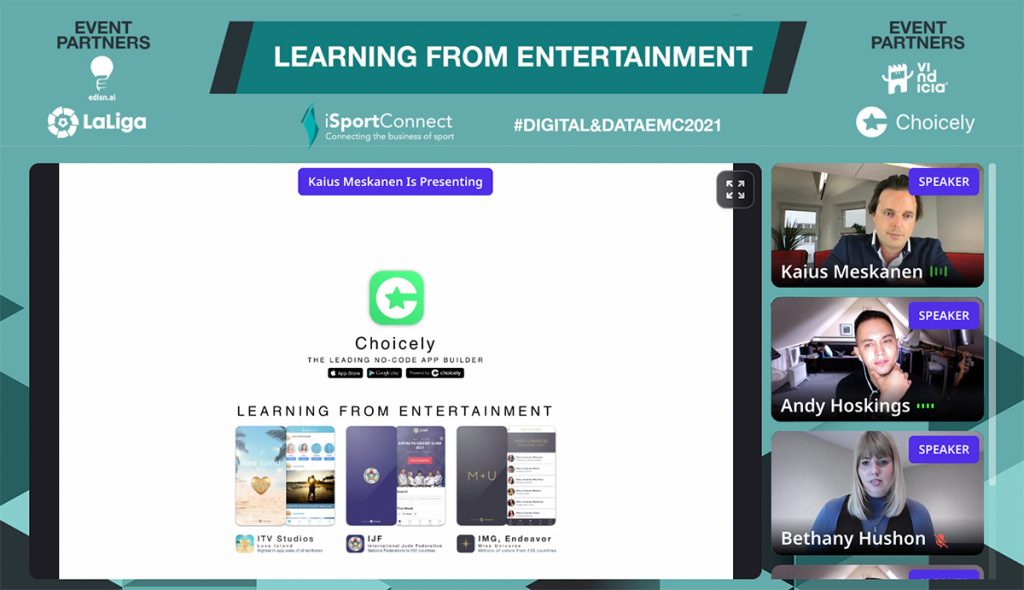
A panel session during iSportconnect’s first Digital & Data Analytics eMasterclass on May 20 delivered valuable insights on how the sports industry can learn from entertainment when it comes to getting the most from digital assets.
Kaius Meskanen, CEO at Choicely, and Andrew Hoskings, Digital Production Manager of Banijay Mobile, focused on how entertainment franchises such as Love Island use apps to capture and engage audiences, and the sport’s potential for deriving the benefits from similar initiatives
“It’s about hitting that emotional passion point,” said Hoskings. “The fans of a show become a family who want to engage with it,” said. “Sport offers the same passion and emotion to build on.”
Online delegates attending the eMasterclass got an exclusive peek at a new app developed by Choicely for a major international federation that will be launching in a few weeks. Sport can use engagement tools such as voting/poll, forums and e-commerce to make the fan experience more compelling and improve the customer journey.
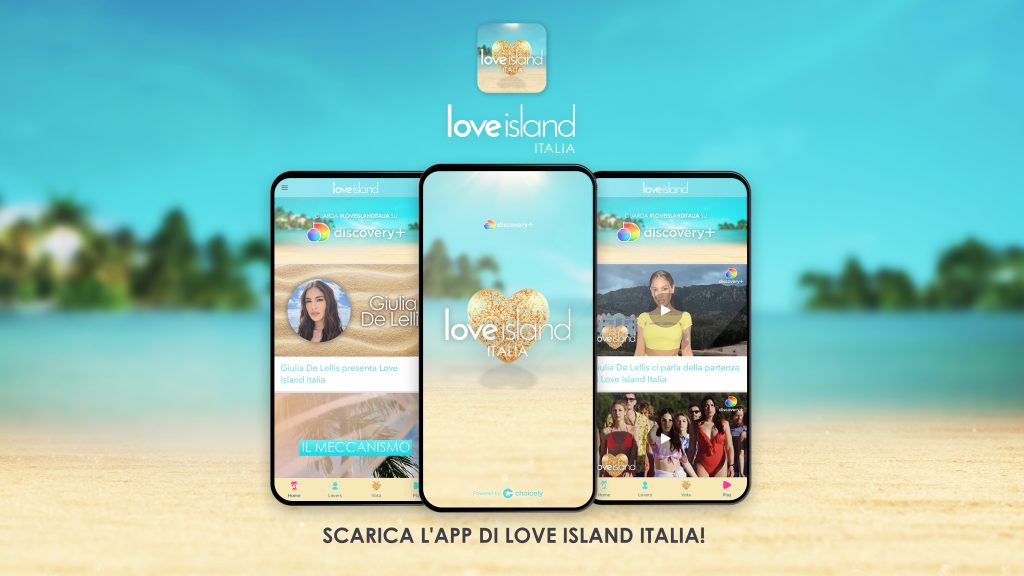
Choicely has also announced a new partnership in entertainment with Discovery Italia and Love Island Italia.
For the Love Island franchises around Europe, Choicely has developed voting mechanisms, push notifications and e-commerce functionality in a one-stop-shop for any fan. The app enables fans to vote on outcomes in the show, such as who stays in the Villa.
Choicely also produces the Miss Universe app, with over 3 million downloads over five weeks in 200+ countries. The Finnish tech company’s sports portfolio includes KuPS, Imatran Kettera and the Helsinki Cup.
Apps have already become the dominant way for sports fans to access content with user behaviour now 90% based in apps and 10% in mobile browsers.
Meskanen and Hoskings offered the following tips for sports:
Find an app provider providing high quality, or don’t build the app at all.
Focus on creating a mobile user experience with business objectives.
Activate your customers/fans with high-quality engagement tools that give users access to data showcasing their user behaviour.
More engaging app = more downloads & more dwell time = more sales & more data
iSportConnect, the world’s largest Sports Business Network and STWS (“SportsTechWorldSeries”), the world-leading sports technology community and advisory specialist, have today announced a global strategic partnership to pursue global consulting and international trade partnership opportunities to drive “The Future of Sport”.
Re-imagining tomorrow
The global network partnership is game-changing for the future sports innovation and digitalisation of sports for government and mature, fast-growth startups.Founded in 2010, iSportConnect has a network of over 23,000 sports executives and sports rights holders internationally. STWS has a global community network of 53,000 sports technology, practitioners and sports entrepreneurs worldwide. Working together globally, the parties will explore partnership opportunities with governments, cities to create new jobs from the new sports economy, as well as world-class mentoring and global growth programs for Sports, Media and Esports entrepreneurs and maturing scale-ups (Series A and beyond) as they move towards IPO and the complex transition from SME to large company.
Solving challenges – Governments Legacy and Sports Scale-ups
“We see two major gaps around the Future of Sport and Sports Technology economy. First is the lack of support for governments, regions and cities looking to build and develop pathways and how they measure legacy for future jobs, major events, international trade and exports, sports events best practice and ecosystem development programs for the new sports economy. Secondly, there is a major gap helping fast-growth companies – Series A or 30+ staff and larger – becoming world-leaders and expanding globally to reach their maximum potential(especially in a post-covid recovery). Working collaboratively, we believe iSportConnect and STWS as two global leaders can help solving these complex challenges and creating for governments and sports entrepreneurs” said John Persico, director of STWS.
Sree Varma, Founder of iSportConnect said: “At iSportConnect we always try to be ahead of the curve and with these evolving times which have reinforced the importance of digital and innovation more than ever, we are excited to partner with STWS and support them in their endeavors.”
Announcements will be made soon around up-coming international programs and initiatives.
Pedro Febrero, Head of Blockchain at RealFevr, provides some special insight into the world of blockchain and NFTs, the hottest topic in sport at this current time.
NFTs stands for non-fungible crypto tokens that represent a unique digital item. Such as an image, video, motion graphic, some artwork, music, etc.
They are managed on a blockchain, which traces the ownership and transaction history of each NFT, providing it with a unique code ID and metadata that no other token or user can duplicate. They are also impossible to counterfeit and immediately authenticated.
Imagine that each Bitcoin could possess different properties from one another. Or that Ethereum tokens could be endowed with unique properties that distinguish them from one of their peers.
That’s precisely what NFTs are. A digital collectable that can attribute specific properties to each of the tokens that compose a token set.
“NFTs possess qualities that make them a brand new asset class that we think will dominate the digital world.”
However, NFTs have been mostly restricted to newborn games and aesthetic collectables.
RealFevr is about to change that for good.
In this article, we’ll describe what NFTs are and how they’ve evolved since they were conceived; we’ll dive deep into the booming NFT space and look into some critical statistics and predict what type of applications will emerge that will boost the adoption of NFTs. Finally, we’ll explain what RealFevr NFTs are, how they work and why they’re the first digital collectable that not only possesses unique aesthetic properties, but can also be used in a broader ecosystem, outside the blockchain-space.
RealFevr will be the first organization to connect and power-up an off-chain fantasy football game with on-chain NFTs and to build a digital marketplace for NFT owners to lend their assets in return for a yield.
The Early Days of NFTs
One of the earliest NFT and crypto ideas.
NFTs exist in the realm of digital collectables. As you’ll soon learn, they are unique digital assets that contain attributes that make them distinct from their peers. However, this idea was born a few years back, and was conceptualized by a key player in the cryptography and cryptocurrency space.
In “Shelling Out: The Origins of Money”, Nick Szabo describes the power of collectables as money-transfer mechanisms. He wrote: “Indeed, collectables provided a fundamental improvement to the workings of reciprocal altruism, allowing humans to cooperate in ways unavailable to other species.”
Essentially, Szabo highlights the importance of collectables in society, not only as a means to exchange value, but because collectables represent a common goal with shared values by a group of individuals – a community.
The late Hal Finney also understood this concept and brought it to the digital realm.
“Collectables are becoming the leading trend in the cryptocurrency space.”
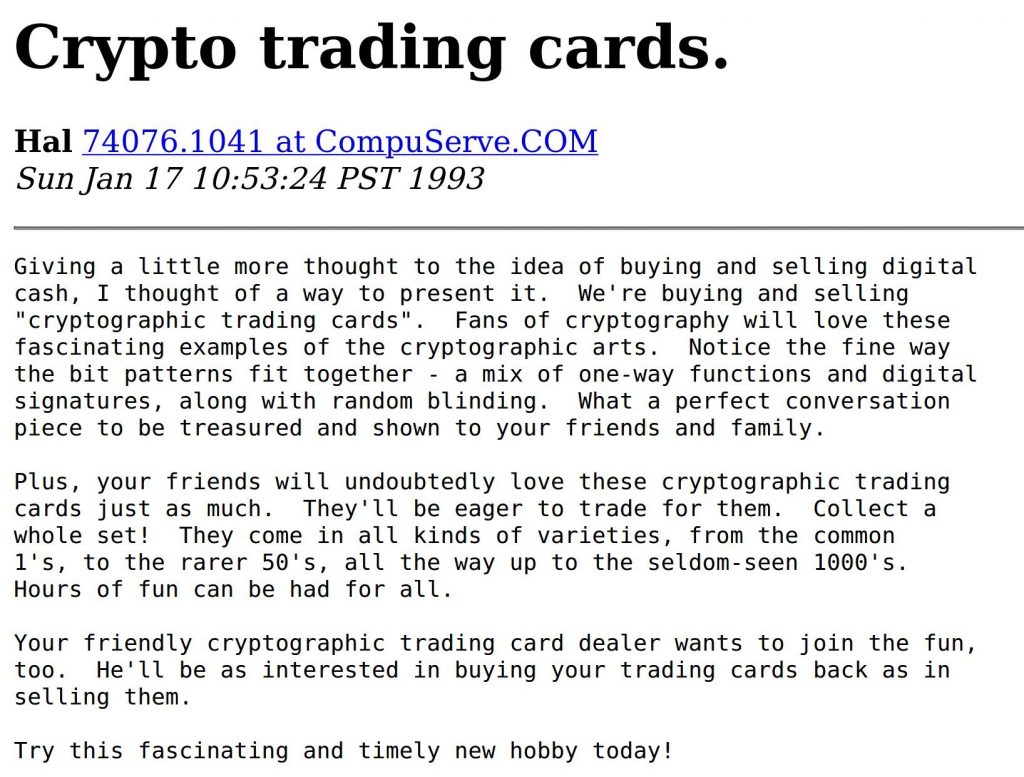
Finney wrote in 1993: “We’re buying and selling ‘cryptographic trading cards’. Fans of cryptography will love these fascinating examples of cryptographic arts.”
The cryptographer absolutely nailed it. Collectables are becoming the leading trend in the cryptocurrency space, and we think that when combined with the power of DeFi, or Decentralized Finance, NFTs will become a digital commodity accepted and traded by the majority of cryptocurrency enthusiasts.
Properties of NFTs
A non-fungible token (NFT) is a type of cryptographic token on a blockchain representing a single asset. These can be entirely digital assets or tokenized versions of real-world assets. Since NFTs are not interchangeable, they can function as proof of authenticity and ownership within the digital realm.
NFTs possess qualities that make them a brand new asset class that we think will dominate the digital world shortly. NFTs critical properties are:
Uniqueness – These assets have many analogies with works of art, of which there may be copies (it is even easier to make copies of digital works), but here the owner can certify that he is the sole and actual owner of the original work, although it can be easily shared on the internet (and it is). It’s a curious situation and a shift in the value we place on physical and digital works of art.
Non-interoperable: one NFT may possess different attributes than one of its collection counterparts. Hence, they’re not interoperable.
Indivisible: Unlike cryptocurrencies, NFTs cannot be divided into smaller pieces, and they have a total value as a whole entity or token without more. You can’t have 1/1000 of a crypto kitty.
Indestructible: the data of an NFT is stored in the blockchain through a smart contract (Smart Contract), which makes it impossible to destroy, delete or replicate.
Absolute ownership: unlike music or movies, your property is yours if you buy one of these goods. You do not buy a license to see the movie or listen to the song, but that intangible good is entirely yours.
Verifiable: the blockchain makes it possible to verify something that is much more complex to demonstrate or certify with topics such as art collecting or stamps; for example, the blockchain maintains a history of who has bought or sold an NFT and who is its current (absolute) owner, including the original creator from whom that digital asset was purchased in the first place.
At the moment of writing this, most NFTs created are associated with digital games and art.
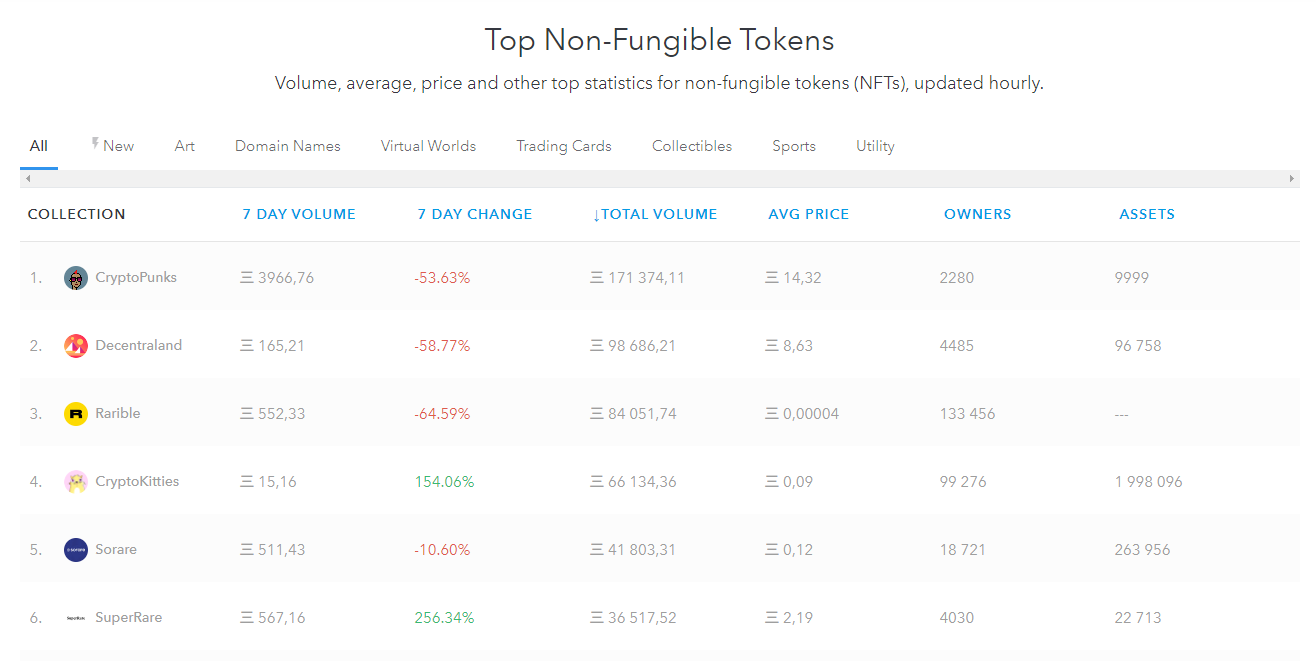
The top-5 collections currently according to OpenSea are CryptoPunks, a digital art collection, with a total volume above 171,000 ETH; followed by Decentraland, a virtual world, with 98,000 ETH; then Rarible, an NFT marketplace with over 84,000 ETH in total volume; CryptoKitties comes after with over 66,000 ETH in total volume; and, finally, Sorare, a football digital trading card game with over 41,000 ETH in trading volume.
In total, the total volume of the five projects above almost reaches 500,000 ETH. At the current price, that’s over $1.5 billion in total volume.
If we now look at the past thirty days, the outlook is staggering.
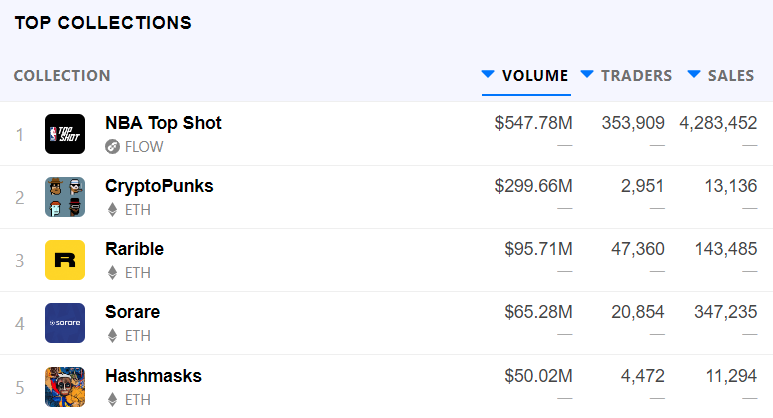
NBA Topshot, a project from Dapper Labs, the home of CryptoKitties, is ranked first with over $568 million in trading volume.
CryptoPunks, Rarible and Sorare come next, with $337 million, $103 million and $70 million, respectively.
Nevertheless, we notice that most NFT-related applications are sprouting in the art space; what about financial applications of NFTs? Are there any?
Financial Applications of NFTs
RealFevr believes the most prominent NFT applications being developed will be born in the financial space. Let’s discuss some of the markets we think will emerge in the next few years in the DeFi space related to NFTs:
NFTs Indexes: NFTs incur high risk. Because they’re unique, they’re less liquid. Therefore, we think NFT indexes will emerge from combining many NFTs into one NFT-backed token that will become highly liquid.
Yield-Bearing NFTs: NFTs that can be collateralized. Hence, investors can lend them to borrowers for a yield. If the NFT is stolen, the collateral is given to the lender.
Fractionalized NFTs: these markets will allow NFT owners to mint tokenized fractional ownership of their pieces, facilitating the buying and selling of percentages of the full NFT. Not only that, but NFT owners may sell portions of their NFTs, instead of the whole thing, increasing liquidity.
Off-chain NFT Oracles: while NFTs are pretty awesome, it would be great if they could be used outside the blockchain. We envision a world where NFT holders will be able to use their digital collectables in various games that will accept them due to their unique properties.
Risks
While NFTs are exciting new tech, there are risks investors need to be aware of, such as low liquidity and an exponential risk of not being able to sell the NFT for a higher price, due to its uniqueness.
RealFevr NFTs: Changing The Game For Good
RealFevr is the most unique and experience-focused fantasy football application. Our mission is to provide players with the best fantasy game experience and to do that we have built a state-of-the-art application that runs on top of blockchain technology.
RealFevr is composed of a series of moving parts:
Free Fantasy Leagues to play with family and friends,
Video Collectibles that can be traded, collected and used to boost your teams’ players,
FEVR Tokens that incentivize players to wager against each other,
Token Fantasy Leagues to compete like pros,
Other incentives, bonuses and deposit pools for players that lock-up tokens and lend video collectibles to other players.
RealFevr’s revamped business model will be based on video collectibles. It is within the marketplace that fans can buy packs, check their collections, trade, borrow and lend video collectibles to other users.
“RealFevr delivers the most immersive experience to all players, and enables a new business model where users can benefit directly from the $FEVR token ecosystem.”
Additionally, RealFevr collectables are protected by IP and cannot be duplicated by any other company in the world.
In summation, RealFevr delivers the most immersive experience to all players, and enables a new business model where users can benefit directly from the $FEVR token ecosystem, from using and lending collectables, and from sharing value with the in-game community.
Conclusion
There are likely hundreds of thousands of financial applications we cannot even begin to comprehend, that will most likely leverage NFTs beyond our wildest dreams.
Therefore, we aim at bringing all $FEVR holders exposure to this brand new asset-class that will enable them to collect the most unique and everlasting moments in football.
LAUSANNE, Switzerland – Dmitry Chernyshenko, Russian Federation Deputy Prime Minister and Chairman of the SportAccord 2021 Organising Committee, Igor Levitin, Aide to the President of the Russian Federation, and Minister of Sport Oleg Matytsin have hosted a positive meeting with SportAccord President Raffaele Chiulli and Managing Director Nis Hatt.
Dr. Chiulli and Mr. Hatt were welcomed less than seven months before the rescheduled SportAccord World Sport & Business Summit 2021 takes place from 7-12 November in Ekaterinburg, Russia.
Mr. Chernyshenko said: “The Summit is one of the largest international sporting events. The preparations are being carried out on behalf of Russian President Vladimir Putin. We make every effort to ensure that this event is held at the highest level.”
Mr. Chernyshenko went on to say: “Particular attention will be paid to the preparation of a cultural and business program for participants and guests of Russia. Today, representatives from more than 50 countries have already been registered, such as Argentina, Australia, Japan, Malaysia, France, Germany, Singapore, etc.”
The commitment to ensuring the highest level of safety and security of delegates was reiterated with special attention being paid to the various measures that will be put in place in the context of Covid-19. Amongst others, one option being explored is making complimentary vaccines available for registered delegates.
Numerous other topics have also been discussed in recent days, including the support foreign participants at SportAccord 2021 will receive with visa processes, as outlined by Mr. Chernyshenko during an Organising Committee meeting in Ekaterinburg earlier this week.
Mr. Levitin said: “The participation of Russian President Vladimir Putin in the event will significantly increase its level and significance. Preparation is going on at the highest level.”
He also noted: “Sport needs to adapt to challenges such as the pandemic. And we can discuss, including at the site of the SportAccord World Sport & Business Summit in Ekaterinburg, with our scientists, the issues of protecting the health of athletes and vaccinations.”
The SportAccord delegation has seen first-hand the on-the-ground preparations for sport’s most influential global gathering this week in Ekaterinburg, where they also met with Sverdlovsk Region Governor Yevgeny Kuivashev regarding the impressive preparations to date.
“There is no doubt that Ekaterinburg is ready to host SportAccord and it was especially important to reconnect with Mr. Chernyshenko, Mr. Levitin, and Mr. Matytsin and to have their full support,” Dr. Chiulli said.
Dr. Chiulli went on to say: “We are also grateful for the continued backing of the Organising Committee, the Sverdlovsk Region and the Russian Federation for the outstanding preparations that have taken place and that the vision of delivering the most important 2021 event in Russia – the SportAccord World Sport & Business Summit in Ekaterinburg.”
The annual World Sport & Business Summit is a six-day event attended by leaders of the global sports community. As the only global sports industry event attended by all International Sport Federations and their stakeholders, SportAccord also brings together organising committees, hosting cities and regions, governments and administrations, rights-holders, agencies, and athletes, as well as top-level experts and organisations from the sports media, technology, investment, medical and legal sectors.