FIFA+ to roll out full tournament offering ahead of Qatar World Cup

FIFA+, the official digital destination of football fandom that launched earlier this year, is now set to redefine the way in which fans – all over the world – enjoy the FIFA World Cup, as it rolls out its full tournament offering in 11 languages ahead of kick off on 20th November.

Throughout the global event, FIFA+ will become the official companion experience of the FIFA World Cup Qatar 2022™, with a reimagined global FIFA app and web platform, available across select connected devices – making it the all-in-one destination for FIFA World Cup fans.

Built to ensure fans have a complete tournament experience, FIFA+ will also compliment the tournament’s broadcasters– helping fans find their favourite team’s live games through the ‘Where to Watch’ feature and sharing behind-the-scenes and Original content created throughout.

The completely free platform, which launched with a slate of Original content, in-depth archive, and extensive live coverage, is transforming ahead of the tournament to welcome a host of new, immersive, and engaging features that will provide a truly game-changing experience for fans around the world.

Among them:

–          Full Tournament Coverage

FIFA+ will be capturing the tournament in full across its channels, with an industry-leading live blog running non-stop, capturing the sights, sounds, atmosphere and energy of the world’s biggest football celebration. The FIFA+ editorial team will be on hand to bring photos and video from every match, the FIFA Fan Festival, around Qatar and beyond, while the platform will be the source of all official stats and data throughout.

–          Official Highlights 

Throughout the FIFA World Cup, FIFA+ will be FIFA’s official home of highlights, with each and every match recapped within minutes of the final whistle and all the thrills, drama and emotion available to fans in every corner of the globe – with a version available to watch in sign language as well.

–          FIFA+ Stadium Experience

For those in Qatar, the ground-breaking FIFA+ Stadium Experience will revolutionise how fans enjoy the beautiful game. Available on the app for fans attending the match in the stadium, the function allows FIFA+ users to experience the action like never before – with a live augmented reality overlay of stats, heatmaps, insights, different camera angles, VAR replays as on TV, and much more. The all new viewing experience is designed specifically to complement and enhance how those in the ground celebrate and support.

–          FIFA+ Fantasy, Panini, and more games

One for both casual and core gaming fans, FIFA+ will be the official home of FIFA World Cup Fantasy throughout the tournament. Fans can lead their team to glory with Fantasy Classic, or take on each other globally each day to win prizes in Fantasy Daily, both of which are complemented by other FIFA+ Play Zone favourites such as the digital Panini Album, Daily Predictor and World Cup Trivia game.

–          The FIFA World Cup Daily, By Hisense 

Meanwhile, FIFA+’s commitment to high-quality content will continue apace with The FIFA World Cup Daily, By Hisense, brought to fans live every day direct from the FIFA Fan Festival, bringing celebrities, creators, influencers and legends together to recap the day’s play.

–          FIFA+ Collect 

FIFA+ Collect, FIFA+’s official digital collectables marketplace, will also go from strength to strength during the tournament, with a special World Cup drop set to launch ahead of kick-off.

–          FIFA Store

The newly launched FIFA Store will be available on FIFA+. Fans can enjoy product lines from the 32 qualified nations as well as wider FIFA Member Associations, merchandise, memorabilia and accessories. It will also home a new line of ‘FIFA’ products featuring artwork and designs inspired by storytelling from FIFA’s biggest events.

–          Archive, Originals and Live

Outside of the FIFA World Cup, FIFA+ remains the home of 40,000 live regional matches every year, an existing extensive archive featuring every men’s and women’s FIFA World Cup match ever produced, and a slate of Original programming – including the landmark docuseries Captains which intimately goes behind-the-scenes with 6 leading global icons (among them Luka Modric and Thiago Silva) on their journey to qualify for Qatar.

–          Personalisation and FIFA ID

All of the above is underpinned by a personalised experience and a rich notifications integration, where fans can register for free, choose their favourite World Cup team, and enjoy a bespoke journey through the FIFA World Cup, with news, highlights, insights and analysis relevant to them specifically. The same login is then used across FIFA+ Fantasy, FIFA+ Collect, and a range of other digital FIFA features.

FIFA Director of Strategy, Digital and FIFA+, Charlotte Burr, said:

“This is a significant moment, as we welcome the entire world to FIFA+ during the FIFA World Cup in Qatar. FIFA+ is set to truly change the game by providing a new blueprint for how fans enjoy their World Cup on FIFA’s channels for years to come.

“FIFA+ is set to become the official companion experience for the tournament, giving fans around the world a unique and personal experience and reshaping how they enjoy sport’s biggest tournament now and in to the future.”

This all comes following the initial launch of FIFA+ in early 2022. The world-class digital destination for football fandom is available for free on app or web, and across select connected TVs and devices.

There’s a dark cloud behind rising rights fees in the Balkans

With FIFA catching so much flak for the Qatar World Cup, it’s easy to see the blowback that can result when rights owners overlook the societal dimensions of their decisions.

Indeed, FIFA and the IOC have become perennial targets. For other rights owners that operate globally ‘business as usual’ rarely attracts attention outside the countries that are impacted.

A case in point is the sale of TV rights in the former Yugoslavia, where media competition appears to be endangered, with possible repercussions for news and opinion.

The English Premier League recently concluded a bumper deal in the Balkans that increased its rights fees nearly ten-fold. The new owner of EPL rights for 2022-28, Arena Sport TV, is paying an estimated €100 million per year. The previous partner, Sports Klub, was paying only about €12 million.

Arena Sport TV has also snatched rights to the NBA and LaLiga from Sports Klub.

That’s great for the guys selling the rights, but the back story is not just about sports. Sport Klub belongs to a private telco and media company, United Group, owned by UK-based private equity giant BC Partners.

As part of the programming mix across its many channels, the company is a major news provider in the region.

Arena Sport TV on the other hand is owned by Serbia’s state-owned telco, Telekom Srbija, whose leadership has close ties to the ruling Serbian Progressive Party. The current president of Serbia, Aleksandar Vučić, has a questionable track record in the media space, having been minister of information under Slobodan Milošević, when he was widely criticised for restrictive policies. 

It may well be that sports rights in this case are being used as a tool not only to take subscribers from the competition but also to suck oxygen from channels not controlled by the government. It’s hard to make sense of the disproportionate rights fees Arena Sport TV is paying unless there is a wider purpose.

Indeed, during the negotiations for the rights in mid-2021, Peter Horrocks, former director of BBC World Service, sent a letter to Premier League CEO Richard Masters expressing dismay about the situation.

He wrote: “I sit on the editorial board of N1, one of the last sources of reputable, independent news in Serbia. N1 is also broadcast across the region. Independent news and information services in Serbia, including N1, are increasingly at threat from a government intent on silencing its critics and stifling media freedom.

“I am concerned that the broadcasting rights to the Premier League are now being used in the furtherance of this cause.”

The letter said: “Telekom Srbija is using state funds in order to make aggressive bids for major football tournaments. As a state-owned company, Telekom Srbija’s objective in owning football rights is political and not commercial. It is designed to starve competition in the pay TV market by taking customers away from independent providers. By switching to a TV package provided by Telekom Srbija, customers lose all access to independent news channels, like N1. The result is a package of channels controlled by the state that presents little more than party propaganda.”

The letter continued: “The Serbian government’s assault on media freedoms is well documented. Since 2014, Serbia has fallen from 54/180 to 94/180 in the Reporters Without Borders (RSF), World Press Freedom Index. According to the 2021 RSF report Serbia is a country with “weak institutions that is prey to fake news spread by government-backed sensational media, a country where journalists are subjected to almost daily attacks that increasingly come from the ruling elite and pro-government media.”

The former BBC World Service chief concluded: “It is my firm belief that Arena Sports’ over-priced bid to broadcast the Premier League can be explained by the Serbian authorities’ desire to further weaken competition in the media market and exert its control over the minds of the population. I would like to understand what due diligence the Premier League puts on the broadcasters that it chooses to engage with, particularly when dealing with state-owned companies in areas where democratic freedoms are at risk.”

Sport Klub is still number one in the region. Formula 1, ATP and Euroleague basketball remain on a rich schedule. United Group’s operations also extend into Bulgaria and Greece.

But ex-Yugoslavia is the core market and things there have changed.

By Jay Stuart, iSportConnect’s Content Director

DP World eTour crowns new winner

The winner of the DP World eTour Global Finals was crowned last night, in a live finale at the DP World FLOW Pavilion at Expo City in Dubai.
 
Four finalists, all from the USA, battled it out on the stunning Wolf Creek Golf Course in Nevada, with gamer Joshua Smithers, screen name Jsmithers, winning all three of his matches and beating Young46 in the final to take home the title. He was presented with his trophy and prize money of $15,000 from DP World Tour star and current US Open Champion Matt Fitzpatrick.  
 
Smith, a father of five and train driver from Illinois, has now won three eTour tournaments in his career and commenting on his victory said: “It’s been awesome. Coming to Dubai, hanging out with the guys in person for the first time has been an unbelievable experience. There were some great shots there on the back nine with Jason (Young46), but I am delighted to get over the line.”
 
The eTour Global Final was held in advance of this week’s DP World Tour Championship, the final Rolex Series event of the DP World Tour season. The eTour saw 110,000 entries from gamers in 215 different countries, resulting in a total of 1.2million rounds started, 6.4million holes played, and 31.2million balls hit. The competition was launched in August 2022 in partnership with the leading online and mobile game World Golf Tour (WGT) by TOPGOLF, and esports specialists DreamHack Sports Games.
 
In the first round of matches, Jsmithers defeated the number one seed masterhacker, real name Donald Cox. Smith closed out the match on the 15th hole after rolling in a birdie putt from 20 feet. In the other first round match, defending champion Young46, whose real name is Jason Young, defeated pjbhai, real name Prajwal Prakash, one-up on the 18th hole.
 
In round two, Jsmithers got off to a fast start against pjbhai, storming to a four-up lead through nine holes before he closed out the match six and five. Masterhacker, arriving as the number one seed, recovered from defeat in his first game to beat Young46 despite the latter making a hole in one at the 11th.
 
Victory for masterhacker meant that he along with Jsmithers and Young46 could still claim the title heading into the final round of matches, depending on various permutations. But the man with his destiny in his own hands was Jsmithers. Playing his close friend Young46Jsmithers headed into the back nine with a slender one-hole advantage. However, an eagle by Young46 on the 18th green took the match to extra holes. On the first extra hole,Jsmithers converted from 20 feet for birdie to claim the title.
 

FINA announce 2023 Open Water Calendar

The FINA Open Water Tour 2023 will feature six events, with the annual series complementing the open water swimming at the 20th FINA World Championships Fukuoka 2023.

As the FINA Open Water Tour returns for its 17th season, the schedule for the world’s top open water swimmers has been set:

20-21 May, Golfo Aranci, Sardinia (ITA) 

27-28 May, Setubal (POR)

5-6 August, Paris (FRA) 

28-29 October, Sun Moon Lake, Nantou (TPE)

4-5 November, Hong Kong (HKG)

1-2 December, Eilat (ISR)

The first stop of 2023 is Golfo Aranci, Sardinia, marking the first time Italy has hosted a FINA open water event.

From Sardinia, the FINA Open Water Tour 2023 will head for the familiar waters of Setubal. The Portuguese coastal city hosted the FINA Olympic Marathon Swim Qualifier events in 2012, 2016 and 2021, and the FINA Marathon Swim World Series 2022 opener.

The Paris event will then follow the 20th FINA World Championships Fukuoka 2023. This stop in the French capital will also serve as an official test event for the Paris 2024 Olympic Games.

Marking a change from last year’s event in Paris, next summer’s competition will take place in the Seine.

The tour will then move to Asia, with Sun Moon Lake hosting its second FINA open water event. Racing will return to Hong Kong a week later, with the city set to host its 12th event.

The FINA Open Water Tour 2023 will then head to the Gulf of Eilat on the northern tip of the Red Sea in Israel, for the year’s final event. An experienced host, Eilat has hosted four previous FINA Marathon Swim events – including the 2022 finale – as well as the FINA World Junior Open Water Swimming Championships in 2018.

Athletes at each FINA Open Water Tour 2023 event will share a prize purse as well as an overall tour winner award, all equally paid out between men and women.

Brazil’s Ana Marcela Cunha comes in as the reigning women’s overall tour champion, while Italy’s Gregorio Paltrinieri and Hungary’s Kristof Rasovszky are the co-reigning men’s overall tour winners.

Olympic and FINA World Champion Paltrinieri is among those eagerly anticipating next season’s competitions. “It’s a great feeling to hear that next season we’ll start in Sardinia,” said Paltrinieri. “Racing in Italy is always special. I’m sure we’ll get a lot of fans and friends coming over to Sardinia to cheer us on. Sardinia is a beautiful place, especially for open water swimming. I’m really glad that a FINA event is back in Italy.”

On the women’s side, reigning Olympic champion Cunha is already eagerly looking forward to a new year with new challenges. “While I’m coming in as the two-time defending champion and six-time overall world series winner, it’s a really exciting and competitive time in open water racing,” said Cunha. “There’s a new generation of swimmers coming from the junior ranks, which will make next year’s tour that much more compelling.”

Added Cunha: “As one of the more experienced racers, I like this challenge. From the FINA World Championships to the FINA Marathon Swim World Series, I’m proud of what I was able to accomplish this year. Looking to 2023, I’m ready to take on a new year with new challenges.” 

FINA President Husain Al-Musallam also expressed his excitement for next season’s competition calendar. “We have the right mix of familiar hosts together with a new entrant and competition venue to add to our open water swimming racing calendar in 2023,” the FINA President said. “From our start in Sardinia to the season’s end in Eilat, we can continue to see some of the best performances and closest finishes ever in open water throughout the FINA Open Water Tour 2023.”

Red Bull Racing to put NFT on F1 car for the first time

Oracle Red Bull Racing, its Principal Team Partner, Bybit and Azuki creator, Chiru Labs, have made Formula One history by emblazing a Tezos-based Non-fungible Token, NFT, on the Team cars for the season finale in Abu Dhabi. It’s the first time a blue-chip NFT has ever adorned a F1 race car or taken part in a race.

The NFT, Lei the Lightning Azuki, will ride shotgun for both Max and Checo as they chase a final victory of the season. Lei, a maverick, whose raw power, passionate personality, striking image, and boundless spirit epitomizes all the values of Oracle Red Bull Racing, is a perfect match for the 2022 World Champions.

Lei the Lightning Azuki, builds upon the IP of Azuki #8494, an original Azuki from the anime inspired NFT collection and represents the transcending of worlds, symbolized by the real and virtual world. It also highlights the diverse backgrounds of the partners who came together to create it: Bybit is a leading cryptocurrency exchange and a gateway to Web3. Chiru Labs, creator of Azuki, creates decentralized brands at the intersection of art, technology, and culture. Tezos, is an open-source and pioneering energy-efficient blockchain that has become one of the top platforms for artists and NFT’s. Combined, they form a perfect storm of creativity, innovation, and passion.

An NFT is a unique digital token on the blockchain, corresponding to a work of art or other assets, where the provenance of the NFT is publicly traceable. Much of the current market for NFTs is centred around collectibles, such as digital artwork. They are highly desirable and sought-after creative works — with traditional art houses now carrying them in their catalogues.

To commemorate the Teams’ record-breaking season and unique event, fans will have their chance to own a limited-edition version of Lei the Lightning Azuki. 8,494 NFTs will be minted on Tezos and made available for free on a first come first served basis on the Bybit NFT marketplace.

Christian Horner, Team Principal and CEO, Oracle Red Bull Racing said: “The nature of our sport means we are always pushing boundaries, and to be the first to put a blue-chip NFT on an F1 car is a tremendous feat. Our partnership with Bybit and Azuki has been an ideal way to help us explore the Web3 world. In many ways, it’s been an eye opener for us to the vast opportunities Web3 has to offer. This unique project is the perfect combination of creativity, innovation, and passion which matches our ethos on the track.”

Ben Zhou, Bybit co-founder and CEO added: “This is a unique piece of artwork and a timeless moment. We anticipate exciting things from this unique collaboration and Lei the Lightning Azuki. He’s such a striking character and a bridge linking the racing, crypto, and NFT communities. We know they are all going to jump at the chance to own a piece of history.”

Azuki founder Zagabond said: “We are excited to announce our partnership with Oracle Red Bull Racing and Bybit. Lei the Lightning Azuki reflects the passion, precision, and raw power of Oracle Red Bull Racing. We look forward to telling Lei’s story in the 2023 F1 season.”

Meet the Member: “We wanted to build something that is specifically designed with esports in mind and give our viewers at home the best possible experience”

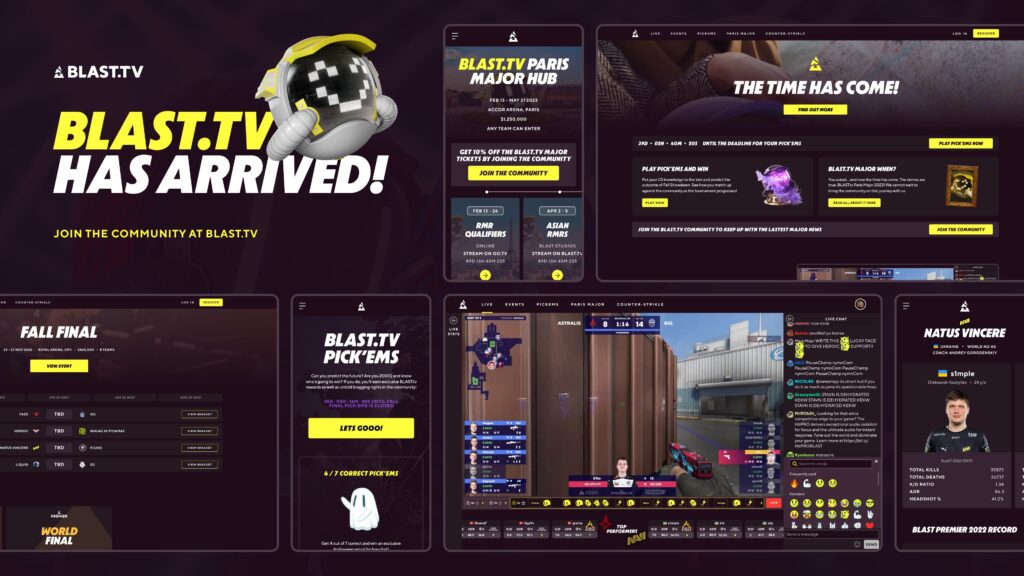
Today saw the launch of BLAST.tv, the first streaming platform designed specifically for esports. We spoke to BLAST’s Chief Growth Officer, Tom Greene to speak about the development and why they felt it was important for them.

For those who don’t know, tell us a little bit about BLAST?

Blast is an esports company and we operate some of the biggest events and tournaments in the esports world. We started originally with the game Counter Strike, so we had the BLAST Pro Series that then went to BLAST Premier. Now though, we are working across a wide variety of games, we have FIFA and Valorant. We also do all the competitive Fortnite as well.

Blast Premier still remains the crown jewel for us though. We think of ourselves as an esports entertainment company and doing what we can to sort of elevate the broadcast and consumer experience from the best of esports. 

Esports has grown massively in the last few years, how has BLAST adapted to the changing landscape?

I think you are right to identify the huge increase in viewership because of the Covid pandemic. I think BLAST has been successful for a number of reasons. The first would be that we have been quite strategic in the areas in which we have chosen to grow. BLAST.tv is a great example of this.

We have also moved into different games in a more meaningful way. I think we also approach competitive esports with both an entertainment and premium mindset. A lot of the guys who work for us are experienced in esports but also some of them are from outside esports and have more of a background in entertainment. I think this mix gives us a real edge.

The team we have built treats esports like a traditional sports league or media enterprise, where you’re thinking through all the 360 degree commercialisation and the fan opportunities that come from such high viewership.

You have been at BLAST close to 18 months, how has it evolved in the time you have been there?

When I arrived we were still focussed on BLAST Premier and it made up 90 per cent of our revenue.  We had done five or six more sort of solo enterprises into different games, but they weren’t necessarily building other leagues, they were more like operating one off events in different games. 

I think that was really awesome. It was an opportunity to test the water to see if the BLAST formula resonates across different esports and found that it really did. And that was sort of lucky enough to arrive at a time when we wanted to extend how we reach fans. 

So not just being a broadcaster but also having a D2C home, that is BLAST.tv is a big move for us. 

We have moved from the one-off events I spoke about earlier to creating leagues and ecosystems, what we have done with Fortnite is a prime example of this. Really since I have been at BLAST the business itself has got a lot more complex and a lot bigger.

You have partnerships with Betway and Maersk, why do you think traditional companies want to invest in esports?

I think we have quite an attractive demographic for these companies. It is as simple as that. We are reaching a young and tech savvy audience, if you think about the penetration of crypto and other technologies within that demographic it’s higher than the average.

I also think that our audience understands that partnerships and sponsorships are a vital way in which the whole system is funded. So I think our audience is very receptive to the right sort of brand entering in the right way. 

We give brands the tools they need to be able to enter the broadcast in a way that adds to the experience rather than taking away from it.

Tell us a bit about BLAST.tv and what it means for esports?

The at home streaming experience was probably the last frontier for BLAST to be honest. We have been investing a lot of time, money and manpower really into thinking about how we could take our esports events to the next level and this is what we came up with. 

Twitch and YouTube are massive parts of our community and they certainly aren’t going anywhere so you don’t have to worry about that, but they are not engineered for competitive esports. 

We wanted to build something that is specifically designed with esports in mind and give our viewers at home the best possible experience. We really want to build something that keeps fans coming back again and again. 

We really wanted to design a product for specialist esports, they’re our audience and from their feedback we are going to build this thing from the ground up.

You have a following of 1.4 million on Twitch, how will your relationship with the platform change with this development?

I don’t think it will change at all really, we have a great following on Twitch as you say, and a really good relationship with those guys. But Twitch is not an exclusive distribution partner for us; we use YouTube and even BBC Sport as well. BLAST.tv will just be another option for this really.

Because our platform is specifically designed for esports we aren’t going to be competing with Twitch either. If people want to watch the content on Twitch it will still be there.

There is a lot of talk about the use of a second screen to complement and improve the experience of the first screen, is this something you have looked into?

We deliberately designed BLAST.tv with this in mind. Fans of esports will watch the events and could be using a lot more than two screens to get information. A lot of fans will have HLTV – which is like BBC Sport but for Counter Strike – on one screen and then be scrolling through Twitter for the conversation around what is going on and Reddit as well for some deeper analysis.

Our aim with BLAST.tv is to have the tools to work with as many fans as possible. For example, viewers can vote on things that happen in the game and can even spam the commentators and show whether they are liking or disliking what they are saying. That will be done using a second screen that is very much a companion piece to what is happening on the first screen.

Why was it important for BLAST to make this development?

I think for us it is sort of the final frontier, is where most of our fans watch our content. We thought we should take our technology, esports and entertainment expertise and bring them together and apply them to a fan engagement platform and create the best place for fans to watch Counter Strike and BLAST Premier.

Web3 is something that everyone’s talking about at the moment, what are BLAST doing in that area and how can it be used by esports?

It is an interesting question because, as a company, we haven’t moved into Web3 yet. Other esports teams have done drops but we haven’t fully entered the space yet. We are obviously big believers in technology and we are building this digital home for our fans, so anything that can augment that experience and deepen the level of engagement then we will look into it.

If there is a model out there that we can use in an authentic way, is true to our brand and can deepen the fan experience then it is definitely something we would be interested in. The right partner is probably out there but we haven’t found them yet.

Find out more here: https://blast.tv

Sevilla launch Fan Token in partnership with Socios

Given that Sevilla FC are one of the most successful clubs in Spanish and European football and given that they boast a unique atmosphere and culture, Los Nervionenses have supporters all over the world. It used to be difficult to involve these fans in the day-to-day decision-making processes of the club, but Sevilla FC partnered with Socios.com earlier this year to launch the $SEVILLA Fan Token.

Owners of $SEVILLA Fan Tokens enjoy special discounts and promotions, access to exclusive content and the chance to win unique prizes and rewards, from signed merchandise to VIP tickets to once-in-a-lifetime experiences. The big attraction for Sevilla FC, though, is that any supporter who holds a $SEVILLA Fan Token can take part in the club decisions that are determined through polls held on the Socios.com app.

As the club explained: “It is a very effective way to involve our fans in helping us with some very important decisions, such as a selecting the motivational message for our dressing room, choosing a new look for our bus or picking the design for a new limited-edition shirt.”

The is the key reason why Sevilla FC became one of six LaLiga clubs to have partnered with Socios.com, the app launched by leading blockchain provider Chiliz in 2019. Atlético de Madrid, FC Barcelona, Real Sociedad, Valencia CF and Levante UDalso work with Socios.com to boost fan engagement via cutting-edge technology and it was natural for Sevilla FC to join in. Innovation is at the heart of Sevilla FC’s business model, so much so that the club even has its own Innovation Center.

Outlining the reasoning for taking this step into the world of Fan Tokens, Sevilla FC stated: “At Sevilla FC, we are a club committed to innovation and we consider Fan Tokens to be an innovative product, one which allows our fans to feel closer to our club since they can participate in certain decisions. Our objective is to continue our commitment to innovation, in this case alongside a partner, and to get closer to our domestic and international fans. Working with a leading platform like Socios.com, which has more than 1.5 million users in 160 different countries and agreements with some of the most important clubs in the world, also helps us to position ourselves as a global club.”

Sevilla FC are very much a community club, one that runs various initiatives in the city of Seville and across Andalusia and Spain. The club has always enjoyed strong connections with the fanbase, but, as more and more football fans around the world cheer on Los Nervionenses, it becomes harder to involve everyone in the day-to-day life of the club.

Therefore a Fan Token was such an attractive idea for the club, which stated: “Thanks to the Fan Tokens, our international fans can feel much more connected to us. The thousands of kilometres that separate us are no longer such a problem when it comes to making these fans feel involved in certain club decisions. Breaking the barrier that this distance usually entails will undoubtedly lead to an increase in our international audience.”

It is already clear that the $SEVILLA Fan Tokens will bring international fans together, as the first issue of these Fan Tokens on the Socios.com app sold out in just over 48 hours, with people from 91 different countries purchasing them.

Furthermore, half of the buyers were under the age of 35, making clear that the $SEVILLA Fan Tokens will also help the club connect with younger audiences and with tech enthusiasts. As the club pointed out: “We can also benefit by reaching an audience that is excited about new technologies. Younger generations are demanding new ways of engaging with football clubs, and Fan Tokens offer something completely new and innovative.”

By reaching fans who are international, young and enthusiastic about technology, Sevilla FC are able to grow their fanbase and make these supporters feel involved. This is, above all, the primary objective of the partnership with Socios.com.

As Sevilla FC concluded: “We believe that feeling involved in the day-to-day running of the football club should be possible for everyone. We’re not looking to increase turnover with this, as what we’re looking for is for our fans to feel that their relationship with the club has gone to the next level. If we achieve that goal, then it will also naturally lead to a positive impact on our turnover.”

IMG renew International media rights agreement with Cricket South Africa

IMG today announced it has renewed its international media rights distribution agreement with Cricket South Africa (CSA) until 2031.

The agency, which has been working with CSA for more than 30 years, was instrumental in securing the governing body’s recently announced Viacom18 Sports deal, which will see the channel air all senior men’s and women’s international competitions played in South Africa from 2024 to 2031.

Chris Guinness, EVP, IMG Media, commented: “We are delighted to extend our relationship with CSA. This is a testament to our longstanding partnership and success over the last 30 years and underlines the strength of expertise IMG brings to cricket, having been centrally involved in some of the most ground-breaking deals and developments in the sport. The Viacom18 deal was the perfect way to kick-off this exciting new chapter for IMG and South African cricket.”

Pholetsi Moseki, CEO, Cricket South Africa, said: “After 30 years of working together with IMG to generate the key commercial revenues that support cricket in South Africa and around the world, we look forward to continuing our long-lasting partnership. This partnership will continue to bring the best action from South Africa’s high-profile series to cricket fans globally, starting in India with our major new deal with Viacom18 Sports.”

Case Study: ATPI supports British Wheelchair Basketball

ATPI, is responsible for organising British Wheelchair Basketball’s travel logistical and accessibility requirements, having worked with the team parasport since October 2019, to great shared success.  

For the past three years, ATPI has supported British Wheelchair Basketball’s performance team with thorough logistical planning and required travel arrangements, transporting them to international training sessions and competitions, as well as navigating the impact of COVID and the resulting restrictions on travel.  

The British Wheelchair Basketball team faced regular challenges and complications when travelling, from accessibility requirements to transportation of expensive specialist kit. For the athletes, travel needs to be restful and stress-free. Excellent travel experiences mean the players can arrive at international competitions and training events well-rested and clear of mind, fully focused on the upcoming competition.   

Understanding the logistical requirements, of the team, ATPI focused on supporting the performance teams with experienced logistical planning that focused on details that would support stress free transportation to international events for the GB athletes. The experience ATPI has cultivated over 20 years of travel management aided the business in making diligent and efficient decisions that would best serve the athletes and staff, allowing them to focus on training and competition. 

As well as commending the work of ATPI, the British Wheelchair Basketball team also praised the Travel Management Company (TMC) on their values, passion, and dedication. The decorated parasport team is certain this is required to achieve success within performance sport. The GB team closed by recommending the services of ATPI to any sporting organisation who have athletes and staff requiring travel planning. 

Member Insight: “The World Cup in Qatar is a unique sports environment, unfolding in a parallel universe away from football’s epicentres”

International sports consultant Michael Pirrie, explains why Qatar’s tournament has been such a controversial turning point in world sport, and outlines the new player power movement that has shaped FIFA World Cup Qatar 2022

We live in a world of sport, but inhabit a football planet. 

The most popular sporting items on the globe, footballs are found almost everywhere – in every nation, on back streets, beaches, school yards, back yards, and neighbourhood parks or wherever there is enough space to kick, head, pass or poke a ball.

The worldwide phenomenon of football reaches a crescendo every four years when the FIFA World Cup reconnects the globe with its favourite sport and most talented players.

This World Cup reflects football’s changing world and how the world can change between tournaments.

Rarely however has the pinnacle of football changed so dramatically. The Qatar World Cup looms as the most radical experiment in modern world sport.

As organisers rush to complete final preparations for the planet’s most anticipated sporting event in a land long the domain of falconry and camel racing, little is certain about the outcome of this tournament.

Qatar’s tumultuous preparations have produced a football environment never encountered before, no host nation has faced Qatar’s set of challenges or controversies when trying to stage football’s showpiece. 

This World Cup is football’s moon landing, in arid and ancient landscapes not previously regarded as a promised land for elite football nor capable of sustaining elite sporting activity.  

The World Cup in Qatar is a unique sports experiment, unfolding in a parallel universe culturally distant from football’s epicentres in cities, clubs and leagues of Europe and South America.

From backdrops with sand dunes, soaring sky scrappers and human rights and corruption scandals, to rising geopolitical tensions and challenging culture and climate, Qatar’s world cup is unprecedented.

From super stadiums and super ambassadors like David Beckham, almost every contingency has been considered.

This cup is a stunning feat of advanced sports architecture and urban engineering, conjured from a science fiction-like football competition creative.

Preparations have transformed Doha into a sports laboratory in a highly controlled desert state and society suspicious of outside influences.

The unique football environment includes advanced stadium cooling, essential to conquer desert heat, even if the full impact of the technology on player performance and competition conditions remains unpredictable.

One national coach, heading to Qatar with his team, said the combination of moisture and heat may be like “playing on tiles” in air conditioned venues where “the ball hangs longer in the air.”

Qatar 2022 is a microcosm of the complex challenges facing modern sport. 

The stadium cooling has not been able to control the climate of protest outside the venues.

Almost no expense has been spared, except on the conditions for immigrant workers who have strived amidst some of the harshest of circumstances to transform Qatar into the Cup host nation.

This has been a deadly occupation for foreign workers on whom Qatar and FIFA have depended, primarily from India, Nepal, Bangladesh and Pakistan.

Many have paid an excessive price, in lost wages and loss of life for the Cup to entertain the world, according to Amnesty International and labour monitoring organisations. 

The still unknown death toll among workers who have suffered on construction sites has brought ominous new meaning to the Cup’s ‘Group of Death.’ 

The clash between history and modernity in Qatar has opened up new fronts in sport’s culture wars.

With sport one of the most influential features of global society, the World Cup has become a lightning rod for several hot button issues that have coalesced around the football showpiece.  

The first World Cup in an Arab nation has shifted the gravitational pull of international sport further towards a part of the world different in climate and culture, and in customs and values of traditional host nations.

The explosive backdrop to Qatar 2022 has prompted heated debate about the future of international sport and funding sources to grow sport beyond traditional comfort zones of Europe, North America, Australia and south-east Asia. 

Qatar’s vast wealth and use of sport and methods to modernise the nation and normalise customs and practices not widely shared within the broader international community, on which sport depends, has made this Cup journey neither comfortable nor normal.

This collision between history and modernity in Qatar around the world’s most popular sport is also a watershed for modern sport.  

These problems occur in and around the host cities and nations, distant from the international players and teams.

The problems are left to local organisers, governments, partners and sponsors to resolve.

Qatar has been dramatically different. 

Players have not stayed silent nor out of sight on the sidelines, as tradition on non-competition matters has dictated.

The treatment of vulnerable immigrant workers and minority groups, including same sex couples, has triggered unprecedented international unrest during the long build up to the tournament.

The culture clash has included many footballers and other stakeholders in the sporting world in response to conditions in Qatar.

This has established an emerging new sports protest movement, which has widened the parameters and impact of this Cup.

This is pushing sport into new directions and shifting the balance of power in world sport.

Players have run a clear line under human rights in the sands of Doha, placing basic personal protections and freedoms on to international sport agendas like never before.

For some players, the treatment of workers and other minorities was an attack on the humanity of sport and the human spirit, the cornerstone of modern sport.

Like the tournament’s greatest players, World Cups are shaped by their times and circumstances.

The Qatar World Cup was born and raised in controversy.

It was sealed during a period of escalating commercial and financial growth, greed and corruption in sport.

This was an era when risks were taken on host cities, non-traditional partnerships and alliances were formed and the sins of corruption took their toll in myriad ways.

The Qatar tournament experienced problems from the outset in the tiny Gulf nation with ambitions of sporting grandeur and glory.

Qatar’s selection over established sporting powerhouse nations defied conventional thinking regarding host nations, and controversy has since over shadowed the cup. 

Organisers had hoped difficult questions about Qatar’s defeat of the US, South Korea, Japan and Australia to secure the cup would clear over time, like sand storms crossing the desert horizon.

More than a decade on, controversy clings like the majestic falcons to the skyline of the world cup capital, Doha.

The doubts have not passed, only deepened, with the United States Department of Justice concluding in 2020 that representatives of Russia and Qatar had bribed FIFA officials to win hosting rights for the 2018 and 2022 World Cups.

The allegations of vote buying rocked the sports establishment.

This prompted changes to host selection processes amid fears global events could become the sole preserve of highest bidding and wealthiest nations, creating an international sports underclass.

Money, unlike protests, has not been an obstacle.

The Qatar cup is the most expensive ever staged, with all infrastructure, services and facilities associated with the event surpassing $200 billion according to reliable estimates.

This includes extensive infrastructure costs for new stadiums, high tech metro, hotels, and airports brought forward from Qatar’s broader 2030 national development plan.

This dwarfs the $4.3 billion estimated for the 2006 World Cup in Germany.

Costs for new venues in Qatar are estimated at between $6.5-10 billion, exceeding the $4 billion initially proposed.

This has highlighted the urgent need to contain soaring costs of mega events, forcing the finances for the next World Cup to be split between three co host nations, US, Mexico and Canada. 

Preparations have also struggled to keep pace with the tumultuous social and geopolitical change in sport and society since Qatar was awarded the mega event.

In a time of growing push back against use of sport to wash the image of host nations, resistance to the World Cup has strengthened, even as the showpiece comes into sharper view.

The Qatar cup could be the most controversial sporting event of modern times.

While innovative stadium cooling has modified the microclimate inside the stadiums, outside temperatures remain high.   

The protests have spread from the international community into the final stages of cup preparations and even to the final teams themselves.

The Australian team, known as the Socceroos, scored first with an unprecedented team protest video, decrying treatment of workers and same sex couples and calling for lasting reforms.

While Australia is a World Cup minnow that faces a first up David and Goliath battle against France, the video protest was important, reflective of a new player power era.

Past major sporting protests traditionally have been impromptu, involving single or small groups of athletes like the iconic famous 1968 Mexico Olympic Games Black Power Salute.

The protests over Qatar have been profoundly different.

The Socceroos protest video featured 16 players from the squad united in expressing concerns about Qatar’s human rights record and calling for decriminalisation of same sex relationships and further work safety reforms. 

The protest video was also well informed. 

Players spoke to respected advocacy groups such as Amnesty International, accredited labour organisations and even some workers who helped to construct Cup venues before recording the video.

While the Chinese government warned athletes and national Olympic committees that human rights objections would not be tolerated at the Winter Olympics in Beijing earlier this year, the Socceroos protest was on line, not on the field of play, and released before arriving in Qatar, before any potential Cup-time bans.  

Football will continue to reflect global change and tensions in the tournament, with Russia absent after its invasion of Ukraine.

There will be further protests in the days ahead with Polish captain and superstar Robert Lewandowski vowing to wear Ukraine’s colours in solidarity in the Cup.

The protests will continue throughout the tournament with the captains of nine European teams vowing to wear rainbow armbands on their sleeves.

The Portugal midfielder Bruno Fernandes is among the players who have expressed human rights concerns.

“We’ve seen the surroundings over the past few weeks and months and about the people who have died on the construction of the stadiums,” he said recently. 

“We are not happy for that. We want football to be for everyone …a World Cup that is more than football,” the Portuguese star said after a recent Manchester United fixture.

The concessions gained from local organisers by the international campaign, including footballers, has brought human rights in from the margins of sporting events.

“Let me repeat this clearly,” FIFA boss Gianni Infantino said. “Everyone will be welcome regardless of their origin, background, religion, gender, sexual orientation or nationality.”

The growing force of player power will impact future World Cups.

Governing bodies and government organising committees must increasingly respond to the views, voices and concerns of athletes beyond fields of play.

The human rights focus will make it more difficult for FIFA and China to bring the world’s biggest tournament for its most popular sport to the world’s biggest nation. 

Unable to control the narrative, Infantino and local organisers have focussed on player services and supports to enable teams to perform at their best.  

The focus has been on design and extensive testing of operations for venues, transport links, medical and training facilities, and security arrangements.

“We always said Qatar will deliver the best-ever edition of the FIFA World Cup,” said Infantino.

“As you look around the country at the state of the art stadiums, the training pitches, the metro, the wider infrastructure, everything is ready and everyone is welcome.”

Great World Cups are the product of great players and great performances, and Qatar is now relying on the world’s fascination with football to save the tournament from controversy.

Organisers above all are relying on uplifting performances from the world’s most gifted footballers to change the Qatar storyline as players begin to emerge, engage and charm worldwide audiences on and off the fields of play.

The farewell performances of three of the best footballers of the generation will be at the centre of attention, as Messi, Ronaldo and Neymar take their final Cup bows.

The goal scoring exploits of football’s Big Three will determine much of the tone as the fates of the world’s most fabled footballers and their expectant nations are decided in stadiums filled with hope, destiny, super human movement and extreme air conditioning.

The pitch battles for tournament supremacy look set to override corruption controversy as the world tunes in to the human opera of football with score lines that can define the difference between national glory or failure, and tragedy or triumph for teams

The player power that has helped to keep the spotlight on Qatar’s preparations, will ultimately save the tournament.

Every major world championship has problems – this is inherent in the vast scale and complexity of such events.