SEG3 is thrilled to announce its comprehensive program for the upcoming summit being held at the Emirates Stadium, London, on June 28th-29th, 2023.
With web3 and immersive technologies offering the opportunity to transform the way organisations interact with their audiences and generate revenue, SEG3 will provide a meeting place for the sports, entertainment and gaming communities to learn and collaborate with the web3 community.
The conference will feature two packed days of interactive sessions, immersive experiences, and deep dives into the latest trends, developments and projects in the sports, entertainment, and gaming industries.
Co-Founder & Managing Partner of Web3 Media Group & SEG3, Joe Condon said: “Despite the wider macro and web3 market conditions, there has been an overwhelming amount of development and innovation across our industries since we last gathered together for our inaugural event in June. This year’s event will not only give the opportunity to learn from these industry-leading organisations, but also the opportunity to see, test and experience the products and platforms that are utilising immersive and web3 technology to change the face of the industries”.
Key sessions will cover themes of how to build communities, how to build your brand in web3, how to maintain control and value of your rights in an open environment, the impact of generative AI on building games and experiences, and much more.
Basketball England has been lauded as the top publicly funded national governing body (NGB)in sport for delivering diversity, equity and inclusion within their working practices – evidenced by the Race Representation Index (RRI) 2022 from Sporting Equals.
Sporting Equals – an independent body that actively works to champion ethnic diversity within sport and physical activity – launched the RRI last year to act as a method of measuring and monitoring sport and physical activity organisations against progress with the race equality agenda, with a particular focus on ethnic representation.
The RRI evaluates and grades data submitted by NGBs across four criteria; Board, Senior Leadership/Management Teams, Senior Coaches and Players/Athletes, and then provides an aggregated grade; ranging from A to F.
For 2022, Basketball England was the only NGB to achieve an overall A grade. Other notable mentions include the Lawn Tennis Association who rose from 23rd to 13th place, and the England & Wales Cricket Board and Rugby Football Union who debuted this year at 7th and 35th place respectively.
Ama Agbeze MBE, former England Netball Captain and member of the Sport Monitoring Advisory Panel set up by Sporting Equals to manage the RRI, commented; “Basketball England has achieved the highest grading, which is not by accident.
“They attract diverse candidates through their governance, coaching and talent pathways from a wide range of diverse backgrounds. They also have an EDI committee and have put in place EDI training to support recruitment and retention.”
The 2022 RRI saw limited change among NGBs on race representation compared to the previous year, with the overall average grade remaining at a D.
Densign White MBE, Chair of Sporting Equals commented; “The RRI is a baseline for NGBs to work from and show the journey they are making in delivering DEI in the workplace.
“This will be a long process, but we can see from the NGBs who submitted data for this year’s RRI are committed to the journey. By continuing to improve diversity this will mean the quality and equity of participation within each NGB’s sporting activities will be positively impacted.”
2022 saw more NGBs invited to participate in the RRI, and a greater number of those invited did participate; with this year seeing an 86% engagement rate compared to 2021’s 75%. This highlights that there is more cross-sport commitment to monitoring progress and making actionable changes to improve ethnic diversity in the workplace.
Arun Kang OBE, CEO of Sporting Equals added; “We are hopeful that the RRI will continue to be a useful tool for NGBs undertaking changes to better reflect the UK’s ethnic diversity. The rise in engagement illustrates there is an appetite from NGBs to change and to be transparent with the public. Sporting Equals will be there to support and work with them as they undertake this lengthy journey.”
Airspeeder is delighted to announce a new collaboration with Intel that brings the global tech giant’s computing technologies to flying car racing. As the Airspeeder Series’ Official Intelligence Partner, Intel® Core® processor and Intel® Xeon® Scalable processors will help shape the sport to maximise its appeal to racers and fans alike.
The new strategic sponsorship deal was revealed in a joint presentation at the Motorsport Show in Adelaide on March 25th, where Adelaide-based Alauda unveiled its new Mk4 Airspeeder – the first-ever piloted craft to take part in the Airspeeder race series.
“We’re incredibly excited to have Intel on board. The technology, insight and innovation it’s bringing to Airspeeder will transform our racing series, making it even more immersive and dynamic for pilots and spectacular for our audiences. Just as importantly, Intel’s ‘pervasive connectivity’ perfectly matches our vision of an always-connected, vertical-enabled future. Through the actionable insights provided by AI, we can achieve next-level eVTOL performance and control, which we see as the key to unlocking the future of private air mobility.” – Matt Pearson, CEO, Alauda Aeronautics
“This is another example of Intel continuing to deliver the compute power needed to stretch the notion of what’s possible, make what was once science fiction a reality, and transform the way we live our lives. Helping Airspeeder bring this new concept to life has the potential to not only change the way we race, but also opens up endless possibilities in urban mobility.”- Andrew McLean, Managing Director ANZ, Intel
There will be a striking new dimension to this year’s edition of the FIBA U19 Women’s Basketball World Cup with the first ever use of an innovative glass flooring court in an official FIBA competition.
This exciting state of the art surface will provide a fantastic opportunity for some of the best young female players and teams in the world to become the first to play on it at a flagship FIBA event.
Rigorously tested and having gone through FIBA’s Equipment and Venue Centre Approval program, ASB GlassFloor systems have already been utilized in the 3×3 Pro League in the Netherlands and in pre-season German Bundesliga games, as well as other sporting competitions.
The introduction of the glass flooring court contributes strongly to the successful delivery of one of FIBA’s strategic priorities – namely, to ‘Enlarge the FIBAFamily’ by endorsing and encouraging innovation in basketball.
The LumiFlex court provided by ASB GlassFloor is a full video floor allowing for interactive applications as well as an enhanced show staging with additional options for advertising.
The flooring can also feature the ability to add player tracking to the video floor, making it possible to display live stats and athletic achievements on the floor, providing fans with enhanced interaction and better engagement.
FIBA Secretary General Andreas Zagklis said: “It is with great pride that we look forward to witnessing the premiere of this glass flooring court on the world stage in July. This innovative surface, made possible by the recent rule change, clearly demonstrates FIBA’s appetite to embrace new technology and innovation.
“Delivering on one of our strategic priorities, it also underlines just how much FIBA is determined to advance our sport so we can make basketball even more appealing and engaging for fans, while also enhancing the experience for players.”
Meanwhile, Spanish Basketball Federation President Jorge Garbajosa was also quick to point out the benefits ahead of his nation hosting the FIBA U19 Women’s Basketball World Cup 2023 in Madrid between July 15 and 23.
“We are very happy and supportive of the decision to use the glass flooring court for this important event, especially as we celebrate our 100th anniversary this year,” enthused Garbajosa.
“As a former player, I know the athletes getting ready to compete at the FIBA U19 Women’s Basketball World Cup will now be even more excited knowing they will be the first to play at such a big event on this new state of the art surface.”
He added, “As the host nation, we know it can provide us with additional opportunities from a marketing and branding standpoint, both in terms of engaging with commercial partners and enhancing the fan experience.”
The use of the glass flooring court at the FIBA U19 Women’s Basketball World Cup 2023 was made possible by the decision of the FIBA Central Board last year to implement a rule change to allow the use of LED glass in Level 1 competitions. The glass flooring will be used for all Final Phase games at the Palacio de los Deportes de la Comunidad de Madrid.
The NBA’s current media rights cycle comes to an end in 2025. Our content manager Alex Brinton takes a look at why they might struggle to get the figure they want.
It is not for a humble fan of the NBA to tell one of the best-run, forward-looking sports organisations that they have got something wrong, but there are a few issues around the next round of media rights that I think might cause the NBA more problems than they expect.
Record-breaking media rights deals are being done with incredible regularity all over the sports business at the moment, as broadcasters look for something that will guarantee subscribers and viewers – nothing can compete with sport on that front.
The Premier League’s rights are out for tender and there is plenty of talk that Apple plan to enter the market, and that the price is expected to increase from the £5.1 bn deal signed in 2021.
The NBA are expecting a considerable increase as well. The ten-year deal they signed with ESPN and Turner Media (owned by Warner Bros. Discovery) worth $24bn in 2014 will run out in 2025, and it is reported they are looking for $75bn for the next decade.
ESPN and Turner have been broadcasting the NBA for over 20 years, and to many Americans the networks are the home of the NBA. Turner’s Inside the NBA show has won a combined 17 Sports Emmy Awards and was inducted into the NBA Hall of Fame in 2021.
When the tender process opens, the money the NBA are reportedly looking for could price Turner out of the market.Despite handing huge contracts to the Inside the NBA team in October, including a ten-year $317m deal for pundit Charles Barkley, the CEO of Warner Bros. Discovery then said a month later: “We don’t need the NBA.”
The NBA already have a streaming platform of their own called NBA League Pass which gives subscribers access to every game, every night, for $49.99 a season. Despite this it wouldn’t be a surprise if one of the big streaming platforms decided to get involved, Apple and Amazon are said to be looking at the NBA as part of their expansions into sport.
So far, so good for the NBA in their pursuit of $75bn. Indeed, around the league journalists and teams are already looking forward to what a TV deal of this magnitude could mean to the salary cap. The NBA has a cap on players’ wages which is currently set at $123.655m per team. Income from media deals has a direct impact on the salary cap: when the income from the $25bn deal signed in 2014 kicked in before the 2016-17 season, the cap was raised by a record $24m. The cap increase allowed the Golden State Warriors to add All-Star Kevin Durant to their roster and create arguably the greatest team of all time. The franchises will be well aware of the opportunities created by a new, lucrative media rights deal.
I see a few potential bumps in the road, though.
Firstly, the viewing numbers for the biggest games are in decline. Since the last TV deal was signed in 2014, the NBA finals have attracted an average viewership of 15.4m. The highest came in 2017 when the Golden State Warriors, with the addition of Durant, took on Lebron James and the Cleveland Cavaliers and avenged their loss in the previous year’s finals.
Of the last nine NBA finals, the last three have had the lowest viewership. The 2020 Covid-related finals pulled in an average of only 7.45m, despite containing LeBron James and his Los Angeles Lakers team winning their first title in a decade. The 2021 finals saw a rise to 9.91m and last year’s finals rose again, but only to 12.4m.
The NBA All-Star Game is a marquee moment in the league’s calendar, but this year it flopped. Just 4.59m people tuned in to watch the game – an all-time record low. The previous lowest was 6.1m in 2021. This is the biggest decline from one game to another since 2000.
Looking at the figures, is it possible that the NBA have misjudged the appetite of the American public for live basketball?
The second problem the league faces is load management. For those not familiar with the term, it refers to players missing games to rest so that they are at the optimal level for when the play-offs begin. This has led to some star players missing large parts of the 82-game regular season. With an increase in ticket prices around the league, there have been complaints from fans shelling out for tickets without knowing whether or not they are going to be seeing the best players.
This problem has grown in the last few years. Of the 52 players to be awarded the regular season MVP, 35 have played in at least 80 games. In the 1970s, 90% of the MVPs played in at least 80 games, in the 1980s this fell to 70%. But of the last ten MVP winners only four have played 80 games and this trend will continue this year.
One possible solution is reducing the number of games, something commissioner Adam Silver hasn’t ruled out, although he certainly isn’t keen on the idea. “It’s something we have been talking a lot about the last few years,” Silver said before Game 1 of the 2022 finals. “I’m not against potentially changing the format of the season, possibly even shortening it a bit, if we can demonstrate that’s going to have a direct impact on injuries.”
If broadcasters can’t be sure the stars are going to be playing in the games they select, or even how many games are going to be in a season, they may feel uneasy about tripling the amount of money they will be paying to broadcast the games.
The NBA is all about its star players. This is one of the things it has over the NFL, because NFL players are required to wear their helmets, while they are on the field even during touchdown celebrations it is harder to market them. With NBA players you can see their emotions at all times.
Stars such as James, Steph Curry, Durant and James Harden are moving towards retirement age: it is time for the league to have a new face. After the Dream Team won Gold in the 1992 Olympics, basketball became a global game and the league has increasingly been filled with foreign stars. But now they are taking over: the MVP hasn’t been won by an American since 2018 and of the five main contenders for it this season four are from abroad. At the moment there are several candidates for taking over as the ‘face’ of the league; only two are American. In addition to this, next year’s projected No.1 draft pick, Victor Wembenyama, is French. The 7ft 4in Frenchman is predicted to revolutionise the NBA and is the most anticipated draft prospect since LeBron James entered the league back in 2003.
This is great for the NBA globally, but it will be interesting to see how the American audiences react to a foreign invasion, and whether or not it will put them off the sport.
With memories of the Qatar World Cup fading into the rearview mirror, we turn our attention to the 2026 edition of the tournament. The tournament is hosted over three countries and 16 cities. We caught up with Chris Canetti, the man who led Houston’s successful bid to find out how preparations are going, why Houston and his thoughts on host cities being able to secure their own commercial partnerships.
So Chris to kick us off, take us through your professional journey in sport?
I graduated from college in 1992 as a Communications Major. I guess I had visions of working at ESPN, at least to be involved in sports because I loved it so much. I was a baseball player in college, then in 1993 Minor League Baseball moved to my hometown in New Haven, Connecticut. I thought Christmas had come early.
Unfortunately, they weren’t too keen to let a young guy with no real experience work with them. After a lot of persuasion they hired me as clubhouse manager. At the end of the season they let me move to become Head of Operations, a proper front office job which was really exciting. A few years later, aged 26 I became the General Manager of the team, I was the youngest GM in Minor League Baseball at the time and was in the position until I got headhunted by the New York Metro Stars, three years later.
To be completely honest, I wasn’t the biggest fan of soccer at the time, but the chance to move to New York was so appealing to me. At first I saw the job as simply a pathway into the New York market and the opportunities to work with the likes of the Yankees, the Mets or the Knicks. But I really fell in love with the sport and over the next five or six years I moved up to assistant general manager.
Then in 2006, Red Bull came in and bought the team and I was a victim of the changes they made. I found myself moving south to be Chief Operating Officer of the Houston Dynamo. I then progressed from COO to President and I was in that position until 2018 and from there I took on this role with the Houston 2026 World Cup Bid Committee.
Let’s have a look back at USA 94, what are your memories of the tournament? And as a non-football fan at the time did it make any impression on you?
I will be honest with you, I had very little awareness that the World Cup was going on in the summer of 1994. I was really busy with my Minor League Baseball position and that was taking up a lot of my time, but also I think was very similar to the experience of a lot of Americans at the time. But this time around we are really engaged, you only have to look at the viewing numbers of the game against England at the 2022 World Cup to see that.
Take us back to June when you found out you won the bid, what was that feeling like?
It was an amazing feeling and a crowning moment for my career personally. I know how badly the city wanted it and how much it meant to the city. It has been so exciting to play a role in this for the city of Houston and we really didn’t know until the moment it was announced. When they called our name out it was a real feeling of jubilation, excitement and real pride as well that the work we had done had come off.
In your opinion, why was Houston chosen as one of the host cities? It is actually the fourth largest city in America and punches a bit below his weight when it comes to cultural significance, so why do you think it was chosen?
I don’t think there was a specific thing we did better than any other city but we do so many different things well across the board. Like you say, Houston is the fourth largest city in America and the largest in Texas. We have incredible infrastructure here as it pertains to our stadiums, our airports, our training facilities, hotels, transportation network, we’ve got an incredible track record of hosting major sporting events.
We have actually hosted more major sporting events than any other city in North America since 2004, and we have done them well and got a great reputation from that. We also have brilliant travel links, it is easy to get to Houston and then once you are here it is easy to travel to Mexico, Canada or anywhere in North America.
Take us through the bidding process then from when you came on board to the announcement in June?
As we said North America was awarded the bid in 2018 and I joined the bid committee in January of 2019. At that time I thought it was only going to be a two to two and a half year job, but Covid meant it dragged on a lot longer than that. It isn’t like anything I have been involved in before, even though I have worked in football for 19 years. I think as a city we put forward a good strategy and showed it is organised and ready to host an event of this magnitude.
As will be the case in a lot of the cities, NFL grounds are being used to host the matches. What changes to the stadium are going to have to be made to make it ready to host football?
Yes that is the case for a lot of the cities, we are in the really fortunate position that the NRG Stadium really doesn’t need much work done at all. It has been well kept over the years and has hosted several major football matches and tournaments, we’ve had the Manchester derby, El Classico and matches in the Copa America. The one thing we need to bring in is a grass pitch, it is currently an artificial pitch but we are going to start growing that a few months out from the tournament. Besides that there are other improvements that are going on to the stadium that are the pre-scheduled ones.
What was your reaction FIFA announced cities would be able to secure their own commercial partnerships for the first time?
It is a really interesting opportunity, but if we are going to be totally honest we have known that this was going to be happening for a little while. We knew it was going to be a piece of the puzzle in terms of how cities were able to fundraise the dollars that are necessary to cover the obligations that we have as host cities. We’re excited to be able to take advantage of it and use it to generate the revenue that we need to cover our costs.
This could easily mean cities competing for the same partners, what are you planning on doing to avoid that and if it is an issue what gives Houston the edge?
That certainly is a possibility and brands are only allowed to align with a maximum of two host cities. Look there’s a possibility that cities are going to be going for the same brands, but to be honest it doesn’t really concern me. A lot of the deals will be done with brands who have a large corporate presence within the city. So Houston is, for example, the energy capital of the world, we’re home to numerous major Fortune 500, Fortune 100 companies, these companies have been supportive of major sporting events that have come through Houston in the past Super Bowls, Final Fours etc. Next season we have the College Football Championship as well, which I know isn’t the biggest event in Europe but over here it really is.
We are fortunate in the sense that there’s a culture in this city that the major corporate partners want to support major events, they understand the value of what it means for our city and its future. We have ten of these spaces to fill, so with all of the above it isn’t something that is keeping me up at night.
Two days jam packed with an array of interactive sessions, immersive experiences and deep dives into innovative use cases all being used across sports, entertainment and gaming industries.
Featured sessions include Napster, BITKRAFT Ventures, Upland, Animoca Brands, NASCAR & many more.
In the world of sports federations, one of the most difficult challenges undoubtedly concerns the sources of income needed to enable their core business and achieve sustainable growth of the sport at international and national levels.
This article is not intended to discuss the aims and objectives of a sports federation, but rather to outline some of the challenges that these organisations face in making their existence possible.
It is clear that the success of any sport depends on the efforts of these federations and the resources they have at their disposal.
However, many non-profit sports federations have limited resources, making it difficult to provide the best possible support for their sports and their communities.
To understand this reality, it is necessary to discuss the business model of these organisations, which are commonly set up as non-profit associations.
Being a non-profit organisation means that the organisation cannot share its profits among its members. So, unlike a for-profit company or corporation, the purpose of an association (or sports federation) is not to make a profit but to develop its purposes regarding the sport they are governing.
This observation is relevant because this characteristic ends up driving the way these organisations are managed, creating some difficulties from a financial point of view on the one hand but also ensuring a responsible and transparent attitude in governance and compliance issues on the other.
As the sports federations are not for profit, they cannot promise a return on investment in relation to the financial contributions that may eventually be made by other organisations, such as sponsors, the government, investors, donors, etc.
The counterpart that an association can offer is to ensure that these resources are being applied properly, responsibly, efficiently, and productively for their purposes, which ultimately are the development of the sport.
Just to clarify, being a non-profit organisation does not mean that you cannot be a profitable organisation, much less that you cannot get revenues and income from several different sources.
On the contrary. It can and should be profitable, after all, the maintenance and growth of the organisation depend, above all, on the financial capacity to make its activities and its existence economically possible.
The problem is that being a non-profit organisation, it is more difficult to access financial sources because the counterpart is based on other advantages that are not directly based on profit.
Of course, sponsors who eventually provide financial resources to federations can enjoy brand visibility, marketing activations, and all the other benefits of associating their brands with a particular organisation, sport, or competition.
But this return is not profit distribution and therefore differs from other types of commercial businesses.
This is also true for public or private financiers, donors, and any other type of entity that provides financial resources to a federation; i.e., the federation will not be able to return this investment in the form of profit.
This is where the difficulties begin, because a sports federation needs to offer many attractive assets to benefit the entity that decides to invest, lend, or donate a certain financial contribution to this type of organisation.
On the other hand, the sports federation has many other ways of raising revenues that do not necessarily require a sponsor, investor, or donor.
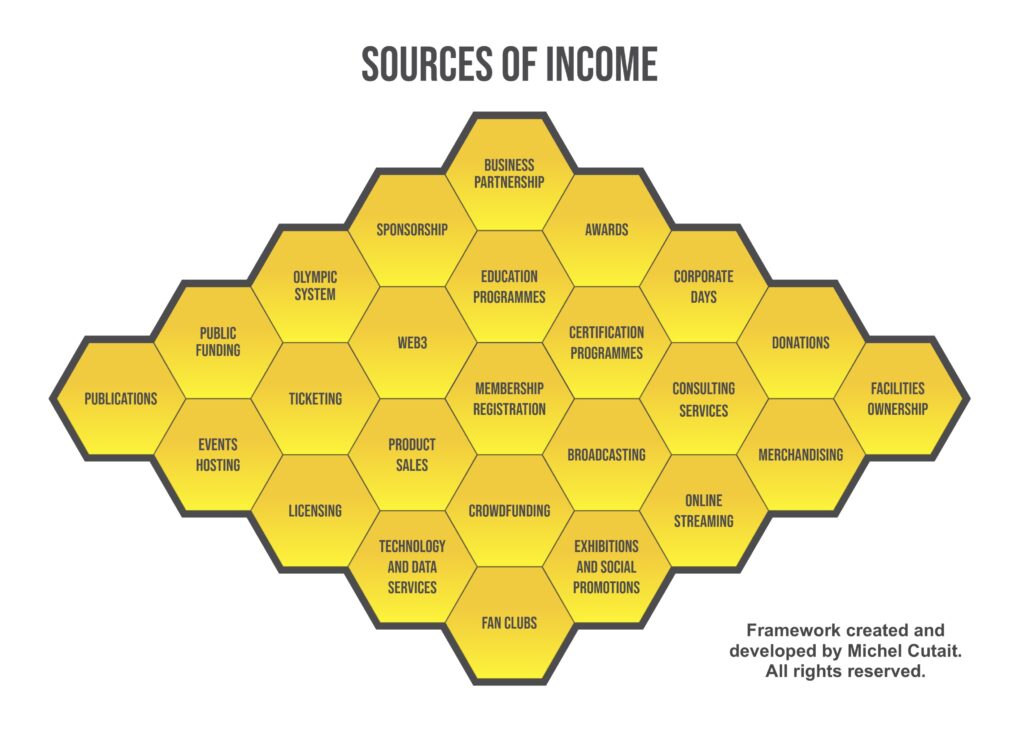
In order to identify all the possible sources of income for sports federations, I have made a study entitled the “Hive Model”, in which I have identified 25 different sources of income that can be used by a sports federation to “nurture” its organisations in order to fulfil its purposes and objectives.
All these resources are feasible and compatible with the principles of governance and accountability required for non-profit organisations such as federations, associations, and even foundations that are dedicated to the world of sport.
The proposal for this study was obtained through a process of reverse engineering.
Instead of defining the main objectives, we can specify the sources of income and, recognising those that we consider feasible, we can establish new objectives and, consequently, the strategic actions to achieve positive results.
This model proposes interesting advantages for managing a sports federation because it allows to expand strategic perspectives, discover new ideas that were out of our pipeline, and be more assertive in finding solutions that will be successful in materialising these sources of income.
Obviously, not all sports federations will be able to develop projects that are compatible with all the income sources I identified in the study above.
Some income sources are more common than others, for example, membership fees, sponsorships, events and competitions, broadcasting, and product licensing.
However, in order to ensure that their sports are properly developed, non-profit sports federations need to find different ways to generate extra revenue.
For this strategy to be implemented efficiently and cost-effectively, sports federations need to reach a level of maturity and improvement that is neither easy nor simple or quick to achieve, especially if the organisation has limited resources.
The organisation needs to have a clear awareness of what its strengths are, to know deeply who the members of its community are and their needs and aspirations, to have a professional team capable of delivering its activities, and also to have a leadership that has a broad, modern, and creative vision to take the organisation to the next level.
Obviously, it’s not as simple as writing an article, but faced with the challenges of the non-profit business model of sports federations, finding new sources of income is a fundamental step to ensure that these organisations, and consequently their sports and their communities, continue to grow in a sustainable, solid, and promising way.
Michel Cutait, Executive Sports Manager, lawyer and professor. He currently works as Acting Secretary General at World Obstacle, institutional name Fédération Internationale de Sports d’Obstacles, the international governing body for obstacle sports (Obstacle Course Racing, Ninja and Adventure Racing) and related events, where he runs the Secretariat working actively in the areas of governance, membership, partnership, development and compliance. He also formerly worked as Strategy Advisor for Brazilian Triathlon. Graduated in Law, has a Masters in Social Relations (Brazil), Marketing (Australia) and a Masters in Sports Administration and Technology at EPFL (AISTS) in Lausanne, Olympic Capital. He has written 5 books, the last one called Management Performance Rio 2016 Olympic Games.
Unless you’ve been living under a very large, internet-restricted rock, you’ve probably heard about ChatGPT. From students using it to cheat on essays and spitting out god-awful dad jokes, to writing entire marketing strategies (definitely, not ours 😳) ChatGPT has brought to life the power of AI.
But what does this mean for the sport and entertainment industry? Our world is certainly not exempt from this disruptive innovation, and organizations have an enormous opportunity to leverage this newfound power.
In part 1, we’ll cover ticketing and partnership and next month, we’ll dive into marketing and omnichannel customer service.
* And we promise we actually wrote this ourselves.
Part 1: Ticketing & Partnerships
The skinny
Integrating AI technology will be a game-changer for sports organizations looking to improve their day-to-day business activities.
By using natural language processing and machine learning, AI can provide personalized recommendations, automate routine tasks, and handle customer inquiries with speed and accuracy.
As a Microsoft powered business, we are integrating it within the EngageRM platform. This will help sports organisations to enhance their customer experience, increase sales, and optimize their business operations with these new features at your fingertips.
How it will change ticketing
Improved Efficiency
By automating responses and handling common inquiries, ChatGPT can reduce the time spent on routine tasks, allowing sales reps to focus on higher-value interactions.
This should be music to sales departments’ ears the world over – less time on process and more time selling and building relationships.
This will improve efficiency and lead handling, resulting in more sales productivity and revenue generation. In a tough economic climate, this has never been more vital.
Personalised Interactions
ChatGPT can quickly analyze mountains of data related to ticketing and sales operations, providing personalized recommendations for tickets and promotions to potential customers based on their preferences and budget.
This feature can improve the chances of conversion by delivering tailored offerings that meet customer needs, which will again boost revenues and bolster your customer satisfaction metrics.
Enhanced Lead Qualification
ChatGPT can ask specific questions to potential customers to qualify leads and determine their level of interest, helping sales reps to prioritize the best leads.
This feature can help businesses optimize their sales funnel, leading to higher conversion rates.
By providing a more effective and efficient way to qualify leads, ChatGPT can help sports and entertainment organizations close more deals and grow their customer base.
How it will change partnerships and deals
Streamlined Asset Management
ChatGPT can be trained with information on the team’s assets and partnerships, getting across sponsorship tiers, contract terms, and activation requirements.
This enables the chatbot to provide quick and accurate answers to the salesperson’s questions and helps to streamline the management of these assets across multiple partnerships.
Personalised Proposals and Efficient Communication
ChatGPT’s ability to provide recommendations based on a partner’s preferences and needs can help to improve the quality of proposals and increase your chances of closing deals.
It can also easily handle routine inquiries and alert the salesperson to more complex or urgent issues, allowing for more efficient communication.
Improved Lead Qualification and Performance Tracking
ChatGPT can ask specific questions to prospects to help qualify leads and determine their level of interest in specific assets or partnership opportunities. Furthermore, the chatbot can be integrated with analytics and reporting modules to track the performance of specific assets and partnerships, identifying areas for improvement and optimizing sales strategies.
So there you have it. You will soon be able to work faster, smarter, and more efficiently across your business. We’ve got more content across our channels coming out in the next month about ChatGPT in sport and entertainment, but if you want to have a chat about this, drop us a line.
By Callum Chambers, Global Head of Marketing, EngageRM. To find out more about EngageRMclick here.
Shell has today announced a multi-year extension of its Technical Partnership with Ducati Corse factory racing team, up to 2027. The Technical Partnership between Shell and Ducati Corse has seen great success on the racetrack, including the most recent campaign which saw Ducati win the 2022 MotoGP Constructors’ Championship and Riders’ title with the Italian Francesco Bagnaia.
The partnership, which originally began in 1999 when Ducati was racing in the FIM Superbike World Championship, marks 24 years of collaboration and 20 years in the FIM MotoGP™ World Championship, since the Italian team joined in 2003.
Today, the Desmosedici GP racing bikes of Ducati Corse use a bespoke Shell V-Power race fuel formulation as well as a bespoke blend of Shell Advance Engine Oil with Shell’s PurePlus Technology. Designed to withstand the extreme conditions of the MotoGP racetracks, Shell Advance is formulated to help extract the maximum performance while maintaining reliability for the bike’s four-stroke V4 engine over the duration of a race season.
As part of the partnership renewal announced today, Shell and Ducati will be continuing to work hand-in-hand in preparation for MotoGP’s new era of more sustainable fuels, which begins in 2024. Development for these fuels, which must be 40% non-fossil origin from 2024 and aim at an ambitious 100% by 2027 , will be a key area of focus for the Shell and Ducati teams. They will also continue to explore ways in which the collaboration can further the development of electric drivetrains in electric motorcycles for future use, both on and off the racetrack.
Throughout this 24-year partnership, the learnings and innovations from the racetrack have been used to develop better road-going products for Shell customers around the world. What’s more, the relationship extends to Ducati road bike, with new motorbike Shell Advance formulations being developed and tested for road bike applications.
Commenting on the partnership renewal, Sabrina Qu, Vice President Global Lubricants Marketing at Shell, said: “The extension of our Technical Partnership with Ducati until 2027 signals our commitment to the Ducati Corse team to provide them with technical support as MotoGP moves towards a more sustainable future. Motorsport is the ultimate testbed for our technology, providing Shell with valuable insights into the performance of our products, whilst allowing them to test formulations to match the future sustainability ambitions of both Shell and Ducati. This in turn will continue to benefit Shell Advance and Ducati customers around the world, both on the track and on the road, as the Technical Partnership continues to develop.”
Ducati Corse Sporting Director, Paolo Ciabatti, added: “It gives us great satisfaction to announce the extension of Ducati’s multi-year agreement with Shell until 2027. Last year was the most successful season ever for Ducati Corse since the start of our fuels and lubricants Technical Partnership with Shell in 1999, and we are delighted to be able to enter a third decade of collaboration with them. It is also thanks to the vital contribution of technically advanced partners like Shell that Ducati is able to achieve success in such a technically challenging championships like MotoGP and WorldSBK, where every little performance detail counts. With this strong support behind us we are confident that we can continue to obtain excellent results in the future.”