Why Web3 may have an answer for AI

Less than a year ago Web3 was all over the media as the next big thing. Since the end of the cryptocurrency craze you hardly hear about it anymore. Now it’s AI everywhere you look. The similarity in hype is hard to miss. But don’t think that just because Web3 isn’t making as much noise, blockchain is any less important or less likely to be shaping the future of the internet ¬ and of the sports and entertainment businesses.

The simple fact is that AI is easier to “get” than Web3. You can easily experience it first-hand. All you have to do is pop a question into ChatGPT and say “wow” when you see what comes out. Web3 is about the underlying architecture of the internet. It’s like plumbing. You don’t want to see plumbing, it’s just supposed to work. When the buzz was around Web3, the curious had to buy crypto or an NFT or at the very least you needed to get a wallet. 

My point is that AI has now become the hot topic that Web3 and the metaverse were last year, maybe hotter.

The thing that I find striking is that Web3 and AI are at different ends of the spectrum of the future internet.

AI is about centralization. Look at who’s calling the shots in headline-making generative AI at present. The usual Big Tech suspects. Microsoft is behind ChatGPT. Google has countered with Bard. I will also mention Adobe’s Firefly. AI underpins Big Tech. It’s at the heart of Facebook.

Web3 is about de-centralization of the internet. The whole premise is that control of data and interaction will reside, not with the platforms that control Web2 but with individuals and the communities they choose to be a part of. Put simply, the logic of the Web3 vision for internet users is anti-Big Platform (just as the logic of crypto is anti-Big Banks). 

Does this mean that AI will not have a place in a Web3 future? Not at all. That would be a backwards step. But it does seem to suggest that the answer-bots would have to navigate the internet in a different way than they currently do, by scraping every bit of Web2 in order to appear all-knowing. 

Indeed, it has been suggested that Web3 can be the much-needed “trust layer” protecting us from the potential excesses of AI. Pay attention!

Martin El-Khouri of Bertelsmann Investments, who will be a speaker at the SEG3 Sports, Entertainment & Gaming conference in London coming up June 28-29, told me this week that he sees Web3 as the future of the internet, and that advertising and the media business will be transformed by blockchain and the potential for brands to reinvent their relationships with fans and consumers. Given that Bertelsmann is one of the world’s largest media conglomerates (the 68 TV channels of their RTL Group reach 99% of European homes), anyone in sports and entertainment should pay heed. 

In a similar vein, Accenture’s business trends survey shows that executives expect 4.2% of their revenues to come from the metaverse in the next three years.

And yet, the current levels of Web3 attention and understanding still remain far from where they should be. While Web3 and the metaverse are enthusiastically embraced by the initiates, too many sports and entertainment decision-makers have just not got their heads around what is happening. And that’s a shame because beyond Web2 the opportunities for building deeply engaged communities and profitable new businesses are far bigger than they imagine

I’m not sure ChatGPT will tell them that.

By Jay Stuart, Content Director iSportConnect

Volleyball World announce betting partnership with Stake.com

Volleyball World has announced that Stake.com will become the exclusive betting partner of the Volleyball Nations League (VNL).

Volleyball World and Stake.com are excited to announce a far-reaching new collaboration for the VNL in 2023. The new partnership follows Stake’s involvement in the VNL Osaka event in 2022 and will now extend to cover all rounds of both the Men’s and Women’s VNL. This thrilling development underscores the strengthened trust, mutual respect, and shared dedication to promoting the sport of volleyball worldwide.

“We are ecstatic to welcome back Stake.com as our partner for the 2023 VNL. With our reach in multiple markets, including Brazil, Canada, and beyond, our partnership will offer an unparalleled platform to connect with a passionate and engaged fanbase from around the globe. We look forward to seeing how Stake.com will elevate the matchday experience for our fans and add even more excitement to the tournament.” said Finn Taylor, CEO of Volleyball World.

Akhil Sarin, Director of Acquisition for Stake.com added: “Our involvement with the VNL in 2022 was a resounding success, so it was an easy decision to secure a partnership on a larger scale for 2023. We’re looking forward to seeing the Stake branding light up the courts and offering Volleyball fans globally an unbeatable proposition on our platform throughout the tournament.”

The World View: Around the world in five insightful articles

We have been touring the world in our articles over the past six weeks, from Africa we have flown to Lausanne, the Middle East, Asia, Lausanne and the US. Here is a recap of what we have learnt so far.

Cynthia Mumbo, CEO Sports Connect Africa, explains some of the challenges the sports business has in order to grow in Africa.

Despite Africa’s sports business industry’s potential for growth and development, significant challenges must be addressed. One of the most difficult challenges is infrastructure. Africa has 54 countries, over 2000 languages, and a wide range of cultures and norms. What works in Nigeria may not work in Ghana or elsewhere in Africa to the east. It is critical to comprehend these dynamics.

Read the rest of her piece here

Donal McElwee, Head of Middle East and Africa for Portas Consulting, talks about sports growth in the Middle East.

A recent World Economic Forum report suggested that the Middle East’s sports industry is expected to grow by 8.7% by 2026 – compared with global sector growth of 3.3% over the same period. This is driven by a significant public investment, underpinned by both economic and social policy ambitions, and increasingly supported by local and global private sector investors. 

Read the top 10 drivers of sport in the Middle East here

Unmish Parthasarathi, Founder and Executive Director of Picture Board Partners, writes about why India and cricket are a commercial match made in heaven.

Cricket is a whole new ball game when it comes to India, a media market unlike any other in the world – it’s the lone BRIC worth building a house in! One notable international benchmark is the $71.3 Billion sale of 21st Century Fox to Disney, the Hotstar-Star Sports combine was reportedly valued at 20% enterprise value or $14bn. 

Read the rest of Unmish’s thoughts here

During March Madness, Sportico’s Eben Nova-Williams and Lev Akabas looked into how it works on a commercial level.

The SEC sent eight teams to this year’s tournament, more than anyone except the Big Ten, and those teams will end the tournament having played 17 games. Each game played will be worth roughly $2 million, according to Sportico’s calculations, paid out in annual installments through 2029, bringing the SEC’s haul to roughly $34 million. The Big 12 is next with 16 games played for $32 million, followed by the Big East with 15 games for $30 million.

Find out more about March madness here

Deputy Secretary General of the World Obstacle Federation, Michel Cutait, looks into the sources of income for sports federations

To understand this reality, it is necessary to discuss the business model of these organisations, which are commonly set up as non-profit associations.

Being a non-profit organisation means that the organisation cannot share its profits among its members. So, unlike a for-profit company or corporation, the purpose of an association (or sports federation) is not to make a profit but to develop its purposes regarding the sport they are governing.

Read the rest of Michel’s piece here

Not subscribed to our weekly newsletter? Click here to sign up and receive more content like this to your inbox every week. 

The House View: Good governance remains fundamental as European club football remains at war

This week saw the launch of the Union of European Clubs (UEC), a new representative body for European club football which wants to “fill the governance gap”.

The body was set up to address the lack of a voice for the small- and medium-sized clubs outside of the “elite” as well as a perceived imbalance in the redistribution of commercial revenues from UEFA club competitions. 

It is those who fund the game that hold the key to the future

UEFA reported revenues of over EUR 3 billion from its club competitions in the 2022/23 season, and typically around 80% comes from media rights. It is the prospect of not only growing the overall pie but counting on these revenues year on year that is so appealing to the ownership groups that control many of the elite clubs.

Not subscribed to our weekly newsletter? Click here to sign up and receive more content like this to your inbox every week. 

In a media market which is ever more fragmented, no sports property outside of the US provides an appointment to view for so many and so often as the Champions League. However, the competition for Champions League spots is fierce and even the mighty Bayern Munich, Real Madrid, PSG and Manchester City, who rarely finish outside of the top two in their respective leagues, are in theory only a few seasons away from missing out on the competitions’ millions. 

The customer is king but currently has no voice

Increasing the value of the current club competitions or creating more value for clubs in a closed Super League is predicated on the assumption that fans will pay through increased attention and/or by dipping deeper into their wallets. 

While the success of the Champions League has proven there is a huge value in the best in Europe competing against the best, it still feels like the voice of the customer (no apologies for using this term given the importance of delivering a quality product), which is the most important for any business, is the only voice not proportionately represented in the current debate.

This is complex and challenging to solve given the various interests at play. But it remains one of the single most important problems to be solved in European club football.

The politicians will also have their say

As the football “family” continues to remain split over the future of European club football, the government regulators are closing in.

The European Court of Justice is examining the question of whether UEFA retains the right to be both a regulator and organiser of European competitions. A22, the organisation behind efforts to launch a European Super League, are challenging UEFA’s monopoly.

The European Commission, which is an important institution within the European Union and responsible for proposing and implementing EU laws and policies, was represented at the launch of the UEC by Vice President Margaritis Schinas and he was quoted as saying, “UEFA should ensure that the commercial success of the elite level supports all the other levels”.

Earlier this year the British government announced plans to introduce an independent regulator whose powers will include, amongst others, blocking clubs from joining a breakaway Super League. 

Where do the athletes stand?

The recently announced plans to introduce an enlarged 32-team FIFA Club World Cup, which is set to take place every four years, has raised tensions between FIFA and UEFA. The new tournament would generate significant revenue for FIFA and the participating clubs. However, the biggest clubs in Europe have been reluctant to participate, citing concerns about scheduling and player fatigue.

FIFPRO, the global players union, has also publicly spoken out against moves to introduce the tournament which is planned to commence in 2025. FIFAPRO said in a statement released in late 2022 that it is working with another representative body, the World Leagues Forum, “on the alignment of the match calendar with mandatory health protections for players”.

A question of governance

In the end, much of the debate around who gets what shines a light on questions over how football, and sport at large, is governed.

Football is still a cottage industry and estimated to be worth single digit billions per year compared to global retail which is estimated to be a double-digit trillion dollar industry.

Nevertheless it is still an industry and requires certain minimum standards of governance. Ethics, transparency and accountability are the terms we often hear and when you dig into the stakeholder relationships of those represented in the current debate, as well as those potentially not represented, everything about the future of European club football comes back to these three fundamental principles. 

It is of course naive to think that European club football can flick a switch and turn on a bright and happy future but until there is an acceptance that basic principles of good governance are key to a sustainable future, the current state of play is set to become even more complex and fragmented. 

By David Fowler, MD Advisory iSportConnect

The Bottom Line – WWE share price rises by over 20%

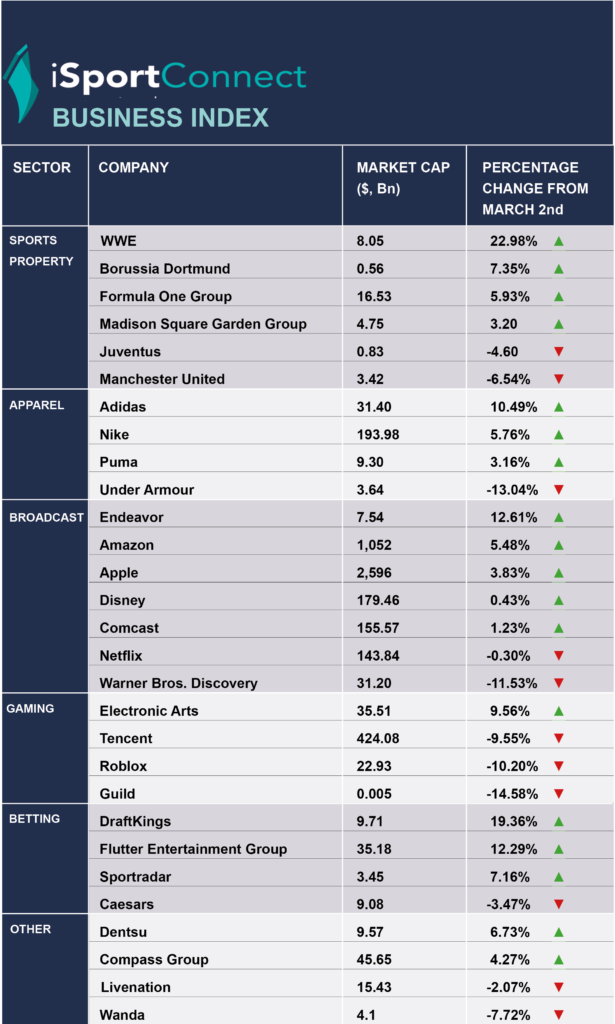
In this month’s iSportConnect Business Index Ian Whittaker, Founder and MD of Liberty Sky Advisors, and twice City AM Analyst of the Year, looks into the WWE and Endeavor deal and what is going on at Manchester United.

There has been a lot happening in the iSC Top 30 Sports Index this month, with a number of major moves in the space. Probably the major item has been the tie up between WWE and Endeavor’s UFC which has been very well received by the market which sees a number of opportunities from the $21bn combination. Both sides have arguably a lot to earn from each other – WWE leads in consumer products while UFC does in sponsorship. Bringing the two together the transfer of best practice but also give them much bigger muscle when it comes to renegotiating media rights, which makes up over 70% of revenues. Given the growth of ‘non-traditional’ sports such as UFC amongst younger audiences, the combined entity should be in a prime position to get more for its rights, especially given the entry of the Tech giants into the sports rights arena and the desire of other players such as Netflix to look at alternatives to the main sporting rights. 

Not subscribed to our weekly newsletter? Click here to sign up and receive more content like this to your inbox every week. 

Elsewhere, Flutter rose by more than 12%, mainly driven by hopes that it will move its listing from London to New York, which should (presumably) lead to a higher valuation for the stock. But more generally, the sentiment around the gambling space remains positive with Draft Kings rising nearly 20% as investors continue to be positive on the potential opportunities of the US market. Within Media and Tech, WBD has fallen as investors digested the implications of the investor day, which saw HBO dropped from the Max+ brand, causing much discussion about the drivers behind the move while Tech has continued its gradual recovery, which is likely to be boosted by the results coming through from Alphabet (Google), Meta (Facebook) and Microsoft, whose results have all pleased investors. In the Retail space, Under Armour continues to suffer over fears around inventory and future revenue trends but the ‘controversy’ over Nike’s campaign featuring Dylan Mulvaney has not impacted the share price, more the opposite. 

And what about the saga at Manchester United? Well, that continues. The latest news reports suggests the Glazier Family may be looking for alternative financing that allows them to remain owners which has impacted already concerned sentiment about whether a sale would actually take place as the Glaziers demand a higher price. This one continues to roll and, while it looks like Manchester United are heading back to the Champions League (as long as they do not suffer an end of season collapse), the continued uncertainty will raise fears about the longer-term future.

Member Insights: Olympic Games in crosshairs of Russia’s war

Olympic Games advisor, Michael Pirrie, says Russia’s push for inclusion at the Paris Olympic Games while it continues its devastating war in Ukraine presents a confronting vision for the future of sport in turbulent times.

Russia has taken world sport to a new flashpoint – this time over plans for its athletes to compete again in international sport at the Paris Olympic Games.

After initially recommending the removal of Russian sporting teams and events from the world stage post the Ukraine invasion, the IOC is attempting to navigate a pathway back for Russian and Belarusian athletes in Paris as neutral competitors. 

The military war has also become a fierce war of words in some of the highest offices of international sport and government.

Russia’s Olympic return has been hit by volleys of incoming missiles of resistance from sporting bodies and political leaders.

Not subscribed to our weekly newsletter? Click here to sign up and receive more content like this to your inbox every week. 

The matter is now escalating and has divided world sport, Olympic continents, nations, and Paris 

The unresolved issue has become a growing global sporting and political crisis amid concerns the preconditions for a possible Games boycott may again be forming on the horizon.

This would be crippling for the Olympic Movement, its sponsors, that include some of the world’s biggest and most successful brands, and funding from junior to elite levels of sport.  

Olympic officials are now under growing pressure from more than 30 governments, including the United  States, United Kingdom, Germany and host nation France  – all leading, loyal and committed Olympic nations – to ban athletes from Russia.

International federations, world governing bodies, national Olympic committees and government leaders have formed the front lines of defence to block the pathway to Paris next summer. 

The opposition to Russia also includes lingering concerns amongst a number of senior sports leaders about Russia’s long-time use of banned drugs and corruption of the Olympic sports system

Some senior Olympic sports insiders indicate Russia’s regular reference to UN anti-discrimination articles to argue its case lack credibility – especially after Russian athletes have long discriminated against sporting rivals through extensive use of powerful performance enhancing drugs.

Ukraine supporters also claim it is not against Olympic traditions nor discriminatory to exclude a team from a country that is attempting to destroy another Olympic nation.

The widening division between Olympic leaders and several Olympic sports governing bodies and nations over Russia’s Olympic qualification options is now looming as one of the biggest external challenges for the Olympic Movement in decades.

This could lead to a dramatic reshaping of the global Olympic landscape. 

The clash over Russia’s Olympic future has also become a heated moral battle about war crimes and punishment.

While Olympic officials believe Russia’s presence in Paris will contribute to a greater understanding about sport’s role in turbulent times, many in the international community believe Russia’s invasion cannot be understood nor justified in Paris. 

While sports neutrality has been a pillar of the Olympic Movement, Russia’s growing list of sports crimes and violations under Putin has also raised questions about whether it is the right nation to go to war for in order to defend the principle of sports independence.

The Paris Games controversy is the latest in a slew of sports scandals involving Russia that have rocked international sport over the past decade under Putin, including the Kremlin’s notorious athlete doping and testing manipulation programs.  

Russia’s Paris Olympics offensive also comes after allegations Russia was awarded the 2018 World Cup after bribing FIFA officials.

The most recent scandals have included Russia’s teenage skating prodigy, Kamila Valieva, whose positive drugs test revealed during last year’s Beijing Winter Olympics shocked the international community.

The Russian-linked secretive cyber criminal intelligence team known as “Fuzzy Bear” is also suspected of hacking the files of the World Anti-Doping Agency after it recommended a ban on Russian athletes at the Rio 2016 Olympics.

With its style of government and sport so intertwined and so foreign to most Olympic nations, some senior international sports regulators believe Russia may be almost beyond rehabilitation will remain an Olympic outlier under Putin.  

For many in the international community, sports neutrality becomes less urgent as more cemeteries in Ukraine are filled with soldiers, citizens and children.

While Olympic officials attempt to find a Paris pathway, the worsening war violence has made it increasingly difficult to remain neutral.

Russia’s invasion has forced the international community to take sides – overwhelmingly with Ukraine – on and off the sporting field, and in other key sectors including national security.

This has seen some of Europe’s most traditionally neutral countries including Finland sign up to NATO, with Sweden also set to follow, and both firm supporters of moves to keep Russia out of the Paris Games.        

While preparations for Paris continue, the resistance against Russia shows little sign of subsiding.  

Opposition is still strongest in the Olympic heartland of Europe, closest to the war’s epicentre, where sporting and political leaders are strongly united in support of Paris Olympic sanctions.

Sport can’t stop war, but Ukraine President Zelensky, backed by European sports leaders and politicians, believes that removing Russia from the Paris Games can help to keep the spotlight on Putin’s war crimes and atrocities.

While IOC President Thomas Bach has often reached out with support to President Zelensky, the Ukraine leader and experienced Russia watchers believe that Putin gains enormous domestic support and international prestige from Olympic success.

Europe’s leaders believe that Olympic bans can be a key weapon in the armoury of sanctions to further isolate Putin on the world stage.  

This would also help to maximise the Olympic experience for Ukraine athletes in Paris, which could be the last Games for the proud sporting nation if Putin prevails. 

Continental power brokers believe it may be time for Olympic sport to move on without Russia, which was recently banned from the European Games in Poland, Europe’s biggest multiple sport event, organised by the European Olympic Committee.   

The Russia ban cuts vital qualifying opportunities from Russia athletes in a variety of sports, and will reduce the number of competitors who may be able to attend Paris.   

The Olympic Council of Asia, which includes Russia’s closest ally, China, has provided a pathway for Russian and Belarusian athletes to qualify for Paris at the Asian Games in China later this year, stating that athletes “should not be punished for the actions of their governments.” 

While Russia may try to host a smaller breakaway multi-national, multi-sport event if banned from France, this is unlikely due to the IOC’s Olympic Solidarity programme that funds National Olympic Committees.

China would also be unlikely to support a rival international event, despite its deepening relationship with Russia, because of the deep prestige and regard it holds for the Olympics.

Conclusion

Russia’s war and Olympic push have taken the world into unchartered territory involving life and death situations decisions that sport had not anticipated before nor prepared for.

While athletes from many countries of war have been participating at the Olympic Games in recent times, none of the waring nations have Russia’s vast nuclear arsenal nor threatened to deploy. 

Russia’s plans to participate in Paris while still waging war, along with previous violations of international sport and criminal interventions in wider international society – including the downing of Malaysian Airlines passenger flight 17 by Russian-controlled forces that killed more than 290 on board – heralds a dramatic new landscape in the geopolitics of sport.

It heralds a new cross over of politics, sport, security, spying and military operations involving nuclear weapons, and covert doping operations and governments like Russia that see sport and the world differently.

This includes national agendas and goals that clash with long standing codes of international conduct and values both on and off the sporting field. 

While a negotiated diplomatic settlement for Paris currently seems almost impossible without significant concessions from Russia, a new approach will be needed that protects the world’s best athletes and integrity of the Olympic Games experience, sport and security in Paris – all of which could be undermined if Russia attends 

The strategy must also help to support future athletes of Ukraine who may still be defending themselves and their nation against Russian bombs and murder squads during the Paris Games, where athletes from the rogue nation may be competing, just three flying hours from the killing fields of Ukraine created by its Russian invasion 

The intense positioning, bargaining and lobbying currently underway over Russia’s Olympic relevance and future in wake of the Ukraine crisis heralds a profound new era of geopolitical change in sport this century

This is an era in which IOC President Thomas Bach warned that sports governance will need to be rethought in the post Covid climate of rising global uncertainty and mistrust. 

While neutrality was an early casualty of widely endorsed sports sanctions in the early response to Europe’s first major war this century, Russia’s attempts to have bans lifted for the Olympic Games while it continues its horrendous war could be a Rubicon crossing moment in sporting history.

The Russia crisis indicates the rules and articles of faith and engagement that guided the Olympic Movement through much of the last century may no longer be sufficient to deal with violent geopolitical shifts and challenges from nations like Russia in the decades ahead 

The IOC has attempted to de-escalate the crisis by deferring a final decision. 

While Olympic officials have attempted to thread a needle through from the fog of war to allow athletes who have not been involved to compete in Paris, new processes must be developed to enable international sport to continue – with or without Russia.

Castore continue expansion with Athletic Club deal

We’re proud to announce our multi-year partnership with Athletic Club, the collaboration sees us becoming the club’s ‘Official Kit Partner’ for the 2023-2024 season and onwards. 

The partnership signifies our ongoing commitment to the highest level of football, while further strengthening our presence in La Liga. 

We will be manufacturing and designing high-performing, playing and training kits, which will be worn by the Athletic Club’s first team, women’s team and youth academy sides. 

Athletic club is currently enjoying a successful season in the Spanish topflight, with the Basque side sitting in the top half of the La Liga and challenging for a place in Europe. 

Castore and Athletic Club are aligned in future goals for both the sportswear brand and the club, with commitment to innovation and high-performance at the forefront.

Tom Beahon, co-founder at Castore, said: “We are incredibly proud to announce our partnership with Athletic Club today. The club is full of heritage and tradition, but also shares Castore’s desire for innovation which will be the key to our success as partners.

“Together we look forward to getting fans excited about our bespoke product and retail offering which will cement Castore’s position in the Spanish & Basque football market.”

Jon Uriarte, President at Athletic Club, said: “Castore is a leading sportswear manufacturer that already works with some of the most important entities in the world. It is another example of the club’s intention to be at the forefront of innovation and high performance.”

IMG ARENA announce partnership with National Women’s Soccer League

IMG ARENA, a leading sports data and technology supplier for the betting, media and professional sectors, has secured the exclusive worldwide data and streaming rights for the National Women’s Soccer League (NWSL) and been appointed as its official integrity partner. 

The multi-year deal will see IMG ARENA capture and deliver data from more than 161 NWSL and UKG NWSL Challenge Cup games per season for its global network of more than 460 sportsbook operators, as well as distribute live streaming for betting. 

As the league’s official integrity partner, IMG ARENA will also provide NWSL with full monitoring services to safeguard competitions and tournaments.

“As the NWSL continues to grow on and off the field, delivering new opportunities to further engage with our teams and players is critical to unlocking our potential as an entertainment business,” said NWSL Chief Revenue Officer Mitch Poll. “This new partnership is a key step in increasing the value add of our league and we are excited to work alongside IMG ARENA as we continue enhancing the fan experience for NWSL fans and sports enthusiasts alike.”

Andrew Turner, Commercial Partnerships Manager – Americas, IMG ARENA, added: “We are delighted to be partnering with the world’s premier women’s soccer league to help grow the NWSL’s global reach and engage fans with a front-row seat to every moment of the action. With last season’s record-breaking attendance, new Utah and Bay Area franchises set to join in 2024, and a new-format Challenge Cup, the NWSL is one of the most exciting properties in global sports and a fantastic addition to our expanding US soccer portfolio.”

The 11th NWSL season kicked off on 25 March after a record-breaking 2022 season that saw more than one million fans attend games during the season for the first time in the league’s history. This year’s multi-stage UKG NWSL Challenge Cup tournament is being played concurrently with the regular season for the first time.

The partnership builds on IMG ARENA’s global portfolio of top tier properties which includes MLS, the USTA, UFC, PGA Tour, and multiple European soccer leagues via its partnership with European Leagues. 

Headquartered in London, IMG ARENA is IMG’s sports data and technology hub serving the sports betting sports media and sports performance sectors. IMG ARENA delivers live streaming and data feeds for more than 65,000 sports events annually, as well as for on-demand virtual sports products and front-end solutions including the UFC Event Centre.

The NWSL’s global media rights are distributed by IMG and its parent company Endeavor, and Endeavor Streaming is powering the NWSL’s international direct-to-consumer streaming service, creating a global home for fans outside the US to watch every live NWSL match for the 2023 season.

Airspeeder announce global media partnership with DAZN

Airspeeder, a pioneering company in flying car racing technology (eVTOLs), has teamed up with DAZN, a leading global sports streaming platform, to bring excitingcontent from the Airspeeder EXA series race to audiences worldwide. This one-year non-exclusive content partnership will feature highlights from the first Airspeeder EXA Series Race in South Australia, the “Road to Flying Car Racing” series as well as “Finding Extreme Pilots” and “Building Flying Cars” series.

Stephen Sidlo, Airspeeder’s Global Media & Marketing Director, said, “We are thrilled to partner with DAZN and showcase the excitement and innovation of our new sport to a global audience. DAZN’s worldwide reach has made it the go-to destination for sports fans, and we

are excited to be part of their premium sports content lineup. The content aims to capture a new generation of motorsport and extreme sports fans wanting behind-the-scenes action and jeopardy, and we can’t wait to show the world.”

Tom Burrows, EVP Global Head of Rights says: “We are excited to bring the Airspeeder EXA series race to DAZN’s global audiences and passionate fans worldwide. This adds to our extreme sports and motorsport offering, including F1, MotoGP, WSX alongside a wide range of exclusive content, which further cements us as the ultimate destination for sports fans”.

The content filmed in partnership with Airspeeder’s in-house media team and Aurora Media Worldwide, will give viewers an inside look at the latest in flying race car technology and the pilots, teams, and technology that make this cutting-edge sport possible. With excitingaccess to Airspeeder and Alauda Aeronautics’ racing series, DAZN will be the go-to destination for fans looking to experience the future of motorsports.

The programming lineup will feature a “Road to Flying Car Racing” series, “Race Highlights,” “Finding Extreme Pilots,” and “Building Flying Cars.” These 30-minute shows will target a technology, sci-fi, and electric motorsport-aware audience with a passion for futurism and a deep love of behind-the-scenes jeopardy.

The inaugural 2022 season race of the pioneering Airspeeder EXA racing series was also captured by Aurora Media Worldwide, who executive produced a Road to Flying Car Racing documentary, providing audiences with a behind-the-scenes look at the season and the advanced air mobility technology that underpinned it.

The technical package proven in these inaugural EXA races will underpin future crewed Airspeeder races. This includes the 4.1-meter flying racing car (eVTOL), a carbon fiber construction full-scale racing quadcopter, at the heart of which is a performance machine that can deliver up to 320kW. The technical ecosystem has been created by a team drawn from some of the most celebrated names in Formula 1, motorsport, and advanced aerospace development, including engineers from Ferrari, Boeing, Airbus, McLaren, Jaguar Land Rover, and Rolls-Royce.

The Airspeeder-DAZN deal is set to revolutionize the way viewers experience cutting-edge sports and motorsports, offering an unparalleled, high-octane experience.

Stay tuned for more information on when these series will air, and be sure to tune in to DAZN to catch all the action.

For media inquiries, please contact: media@airspeeder.com.

Meet the Member: “I fell in love with Esports because it doesn’t matter about physical differences between people”

The Esports industry is growing at a rapid speed, to find out what the International Esports Federation is doing we caught up with its President Vlad Marinescu. We discussed the challenges the industry faces, what it can learn from traditional sport and what makes a great host city for a World Championships.

Vlad, take us through your journey in sport and how did you end up at the International Esports Federation?

I have always been around sport from a really early age, my father was actually massive in the martial arts space in Romania so naturally that was a sport I had to pick up. As I suspect is the case with so many people you interview, sports played a massive role in founding me as a person.

In terms of esports, I have always been a bit of a gamer. When I was growing up in California we used to take the old LAN Router out of the school at the weekend and take it to someone’s house and just play games from Friday evening through to Sunday morning. It was so much harder to game back then because you couldn’t just turn on a controller like you can now, this is where my passion for technology started. 

This is where I fell in love with Esports because I realised it doesn’t matter what the physical differences between two people are, it just comes down to who is better at the game. 

Going back to my work in traditional sport, I got involved in martial arts and helped organise my first Olympic Games for Judo at Beijing. The skills I learnt in the traditional sports world helped so much when it came to working and leading the International Esports Federation.  

How different has it been working for an Esports Federation to your previous positions?

As I touched on in my last answer I was so fortunate for everything that I learnt while working with Judo and SportAccord. In my role at the International Judo Federation we were organising 20 events a year and doing so much for it with TV rights, prize money, TV production and also working on the Olympics and with the IOC as well. 

I understood very quickly that the differences between passion and professionalism and throughout the lifecycle of a federation, traditionally, we can see that at the beginning of the federation, you have passionate people, people who love that, that’s their sport, they’ve grown up in it, they bleed it, they breathe it, they cry it, they’ll do anything for it. As the sport develops, professionally, and financially, you start having more professional people. Like I said I was really lucky to be able to learn from all these different people, which meant when I came into lead the International Esports Federation I was in a good place. 

Not subscribed to our weekly newsletter? Click here to sign up and receive more content like this to your inbox every week. 

The team here are so passionate about Esports, it really is amazing and especially working through the pandemic we really came together as a team and evolved like so many different federations. Esports and gaming really took off in the pandemic as well, in many ways I think it saved a lot of people’s mental health, because it enabled people to socialise even without social distancing.

What are the challenges that Esports faces as an industry in order to grow?

Like so many sports the pandemic meant we couldn’t host our 2020 World Championships in person. I do acknowledge that we were probably in a better position than most when it came to moving events online but it still wasn’t easy. What has emerged though is actually a much better World Championships as a result. Instead of a ten-day in-person event the Championship’s now last three months. Starting with national qualifying events which take place online and then build up to an in-person finals in the host city. The three month build up to the finals gives us better opportunities to create narratives around players, get fans invested and also it is fantastic for the host cities because they get a big increase in exposure.

We also have a fantastic team here, I am incredibly confident that whatever challenges we are facing as a sport we will be able to overcome together.

Coming from the traditional federation world, how do you see Esports fitting into the olympics?

The International Olympic Committee has just undergone the Olympic Esports week. I’m very happy to see them taking a strong direction in assisting the International Federation to modernise and to control and develop what they want to do with Esports. 

We also need more people playing sports generally and if Esports can lead to that along with traditional sports then that is a massive positive.

There’s obviously esports which is professional gaming and then there is using informal gaming as a route towards increasing participation in the sport. Do you think both can help each other grow?

I mean, how many hours do you have. Firstly, learning about the rules and how to play a sport through gaming definitely leads to people taking up the sport for real. 

We are also partnering together with fitgamer to instil such principles of physical fitness around the sports athletes. It’s very evident through all the research and the studies that have been conducted, from all the research papers that in order to be very successful in Esports. If you’re physically healthy, as well, you will have a higher capacity of delivery, and of course, a better result.

It’s one of our top priorities, to ensure the physical competencies, and mental health and lifestyle of all our sports athletes.

In your view, what can traditional sports learn from Esports and what can Esports learn from traditional sports?

Esports has a lot to learn from traditional sports values, particularly the Olympic values which underpin so many great things about sports. A few of these values are socialisation and teamwork which can easily be lost in an Esports setting. We are increasingly trying to get these values into Esports and overtime we will be able to implement them.

What Esports can give back to traditional sports is modernisation and fun and access most importantly, to a young demographic of people who today are not interested as much in the participation of traditional sports nor viewing it. 

I think there is a massive value exchange to be had between Esports and traditional sports, it is definitely something that we are looking to facilitate. 

Looking forward you’re looking to find host cities for World Championships in 2024 and 2025. With Esports being different to traditional sports, what sort of requirements are you looking for from a host city?

We obviously need the technological infrastructure to start with which most cities do have but it is a pretty key element of what we are doing. We are getting a lot of interest from cities because of the young demographic that we bring in and give them an opportunity to communicate with. 

It isn’t just about the cities and an arena though it is about the environment. We want to give our athletes and spectators the opportunity to visit and experience great culture, great food and music. We want a city that is going to really buy into it with us and really try and show themselves off as much as possible.