iSportConnect Sports Tech Index powered by SportsTech Match – March 16

Who’s hot in Sports Tech? Who is doing deals, launching new products and generally doing some of the best work in the sector? That’s what the Index attempts to dig into….

Whether established players or the up-and-coming stars, we go a little deeper for you…..

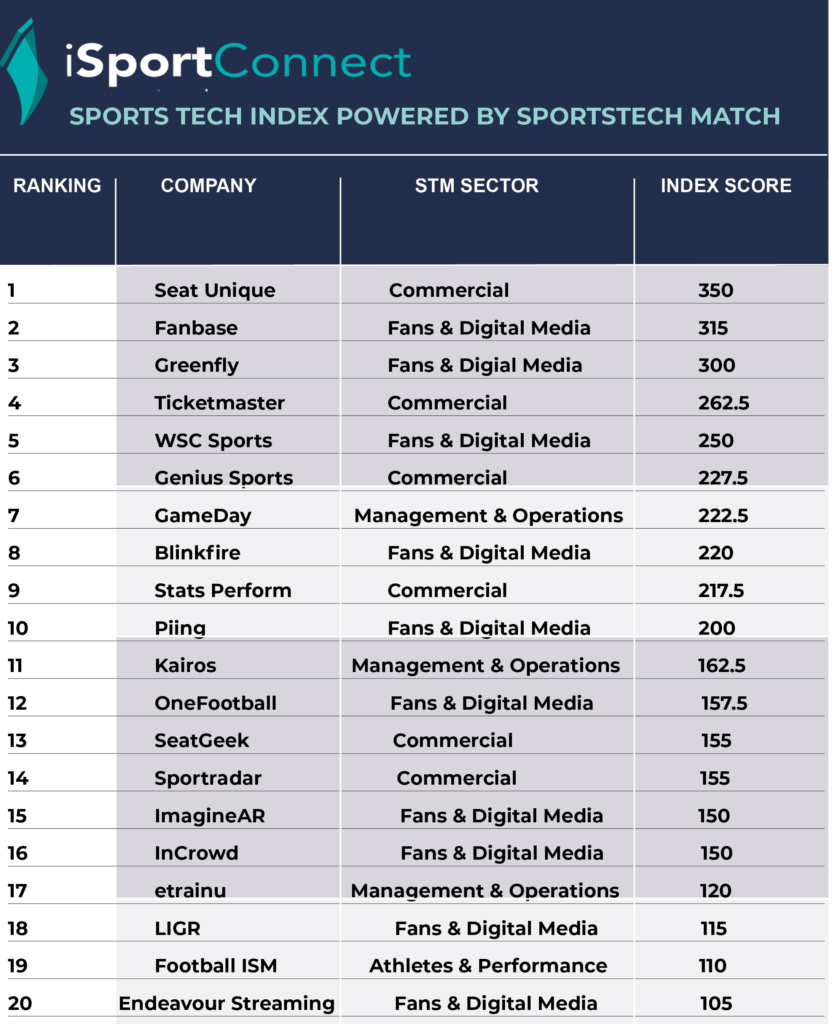
Our inaugural sports tech index threw up an interesting top 20 with ticketing marketplace platform SeatUnique topping the table following several new business wins in Q1 of 2023.

Ticketing and ticketing-related companies are well represented in this edition with Seat Unique being joined by Fanbase (#2), Ticketmaster (#4) and SeatGeek (#13), who all announced a spate of new business wins in Q1.

Completing our top five this month were Greenfly (#3), who recently announced four new golf clients, and GameDay (#7) who scored highly for a recent customer renewal as well as a clutch of new business wins and continue to announce new product features.

The major betting and sports data companies have had a busy period with Genius Sports (#6), Stats Perform (#9) and Sportradar (#14) all winning new business and all demonstrating a commitment to innovate through new products and major new product feature announcements. Both Sportradar and Stats Perform also recently announced customer renewals.

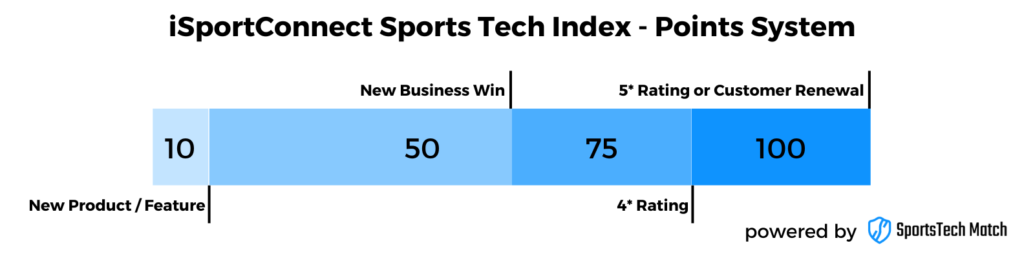
A special mention goes to Piing (#10) who made it into the top ten on account of having collected two verified 5-star customer ratings in Q1 as part of SportsTech Match’s Ratings & Reviews programme.

Want to know more?

The iSportConnect Sports Tech Index is designed to help rights owners and investors quickly assess who is “hot” from a product and new business perspective and provides sports tech vendors with an incentive to focus their PR announcements on what matters to the market. It follows a simple scoring system (see below).

The iSportConnect Sports Tech Index will be published on a monthly basis on iSportConnect (subscribe to the newsletter here to stay informed) with in-depth analysis provided by SportsTech Match every 2 weeks (subscribe to the STM newsletter via sportstechmatch.com).


Click here to read more about how the Index is calculated.

EXCEL ESPORTS announce partnership with HSBC

British competitive gaming culture brand EXCEL ESPORTS is thrilled to announce its new partnership with leading banking and financial services provider, HSBC UK.

The partnership welcomes HSBC UK as the esports organisation’s Official Financial Services Partner and Financial Health Provider, working together to support young people and entrepreneurs build financial skills to make the most of their money now and in the future.  

With an overarching ambition to promote financial health and education to EXCEL fans, the partnership aims to break down financial stigmas and help to drive a real uplift in financial literacy amongst Gen Z, Gen A and Millennials. The collaboration will also utilise EXCEL’s talent roster, who themselves are young professionals and entrepreneurs that will face the challenge of how to manage significant wealth at a young age.

HSBC UK has a longstanding commitment to helping people build their financial health.1 In 2022 the bank helped more than 445,000 young people build financial skills through their partnerships and the HSBC UK Education Network.

Becky Moffat, Chief Marketing Officer, HSBC UK said: “We’re incredibly excited to be partnering with EXCEL, working together to help young people and entrepreneurs build financial skills and make the most of their money now and in the future.”  

Tim Reichert CEO of EXCEL ESPORTS said: “We’re proud to partner with one of the most respected and recognised financial organisations in the UK. We believe that HSBC UK aligns with our values around innovation, financial health and the Power of Better.

“EXCEL and HSBC UK are committed to working together to help promote financial health amongst young people in the UK and we’re excited to support our community through this new financially minded avenue to help our fans live more rewarding and experience-led lives, centred around their love of gaming and esports.”

HSBC UK joins a string of high-profile partners at EXCEL including landmark partnerships with Just Eat, JD Sports, Sony INZONE, PC SPECIALIST and a long-standing collaboration with EE. EXCEL has also made several other exciting announcements recently, including the reveal of the organisation’s new female VALORANT team, marking the beginning of EXCEL’s’ journey into VCT Game Changers with the hope to empower and inspire the next generation of women in esports.

FIBA 3×3 Women’s Series announce record number of events

The FIBA 3×3 Women’s Series 2023 will be bigger and better than ever before with the much-anticipated season starting in Wuhan, China, on May 6-7. 

It will be the first time the Women’s Series will be played in China since its first edition in 2019. The final will be played in Ulaanbaatar, Mongolia, on September 16-17.

There are 20 events already confirmed which would beat the previous record of 15 held in 2019.

FIBA Secretary General Andreas Zagklis said: “As we witness the rapid growth and success of the FIBA 3×3 Women’s Series, launched in 2019, it is exciting to see a record number of events announced for this upcoming season. This momentum demonstrates FIBA’s commitment to one of its key strategic priorities, Women in Basketball, and the importance of ensuring our major women’s competitions continue to grow and gain maximum impact.” 

This season’s Women’s Series will travel around the world marked by stops in several well-known 3×3 destinations such as Debrecen in Hungary, which has hosted the World Tour for 8 years as well as Prague, one of the longest-serving destinations on the professional circuit, this time for the 3rd edition of the Women’s Series Prague Stop. The city of Ulaanbaatar, hosts of the final, have also been receiving several 3×3 events since 2017, including the Asia Cup, U18 World Cup, and Challengers.

Also, there will be events in several exciting new destinations, including a trio of stops in Azerbaijan and the first visit of the competition to Spain.

The list of confirmed events:

Wuhan, China: May 6-7
Astara, Azerbaijan:  May 20-21
Clermont-Ferrand, France: June 9-10
Shusha, Azerbaijan: June 12-13
Xiongan, China: June 16-17
Orleans, France: June 21-22
Poitiers, France: June 27-28
Netanya, Israel: July 3-4
Fribourg, Switzerland: July 6-7
Pristina, Kosovo: July 14-15
Bordeaux, France: July 19-20
Edmonton, Canada: July 29-30
Prague, Czech Republic: August 4-5
Yichang, China: August 4-5
Melilla, Spain: August 18-19
Quebec, Canada: August 18-19
Baku, Azerbaijan: August 22-23
Debrecen, Hungary: August 28-29
Montreal, Canada: September 2-3

Ulaanbaatar Final, Mongolia: September 16-17

Much like in the third edition in 2022, the FIBA 3×3 Women’s Series will welcome national federations and private promoters alike.

Created in 2019, the FIBA 3×3 Women’s Series is the number one event on the 3×3 women’s professional circuit. 

Canada will enter this season as defending champions having memorably taken the crown at last year’s Constanta Final

France were the competition’s first champions in 2019, while Germany claimed the title in 2021.

UK Horse Racing to stay on ITV until 2026

ITV has agreed a new three year deal to show exclusive, free to air coverage of UK horse racing until the end of 2026. 

Well over 100 days of live coverage will be shown across ITV1 and ITV4 each year – all simulcast on ITVX – along with morning racing programme The Opening Show. 

The deal encompasses UK racing’s Crown Jewel events with the Grand National, the Cheltenham Festival, Royal Ascot and the Derby all featuring.  

Announced at the start of the Cheltenham Festival 2023, the new contract extends ITV’s current racing coverage, which began in 2017 and has seen viewing increase across the board, including for major events with average audiences for the Cheltenham Festival climbing by more than a third overall and more than 50 per cent for young viewers compared with the previous broadcaster and record figures for individual days regularly registered.  

Niall Sloane, ITV Director of Sport, said:

“This deal will take us to a decade of racing on ITV and we’re delighted to be able to continue to bring to viewers well over 100 days of live coverage of this wonderful sport, including some of the most enjoyable, storied and thrilling events of each year.  We look forward to continuing to work with Racecourse Media Group and our other partners within racing to bring audiences the very best racing has to offer in the coming years.” 

Martin Stevenson, CEO of Racecourse Media Group, said:

“On behalf of our racecourses, we are delighted to have cemented our relationship with ITV for a further three years. ITV have been an excellent partner for the sport, providing more terrestrial coverage here in the UK than in any other racing jurisdiction in the world, illustrating both the commitment of the broadcaster and the enduring popularity of the sport.”

Nevin Truesdale, The Jockey Club’s Chief Executive, said:

“We at The Jockey Club love working with the ITV Racing team to showcase the sport, our racecourses, the horses and the people who work tirelessly behind the scenes to tell their stories in an entertaining, fun and engaging way. We’re really looking forward to continuing to do that and finding new ways to collaborate in the future.”

Alastair Warwick, Acting Chief Executive, Ascot Racecourse, said:

“We are delighted to have agreed this extension to our highly successful partnership with ITV who continue to make the sport more accessible through their coverage. I would particularly like to recognise the dedication to racing the team showed throughout the pandemic period which was fundamental to our sport’s recovery. ITV are an incredibly important partner for us, broadcasting Ascot into millions of homes across the country and we look forward to working with them across the next three years.”

ARC Director of Commercial Strategy, David Leyden Dunbar said:

“ITV have been a fantastic partner for the sport since 2017, and we are delighted to continue the relationship for a further three years. Such widespread terrestrial television coverage is incredibly important to everyone involved in British Racing, and ITV should be applauded for providing the sport with such a platform.”

Julie Harrington, Chief Executive of the British Horseracing Authority, said:

“ITV’s coverage and promotion of British racing is exceptional, bringing our sport’s many wonderful stories to life with passion and pride. At the BHA we are keen to work closely with our broadcast partners in order to help them further improve the viewer experience for both new and existing fans alike, with innovation as to how the sport is packaged and presented being a core element of the industry’s strategy.”

ITV Sport’s portfolio of first class events also includes Six Nations rugby, the Rugby World Cup,  England Women football team matches, the FA Cup, EFL highlights including the Sky Bet Championship, Sky Bet League One, Sky Bet League Two, Carabao Cup and the Papa John’s Trophy,  the Tour de France, the NFL, Heineken Champions Cup, Aviva Premiership Rugby,  in motorsport, Extreme E, plus British Touring Car Championships and MotoGP and major competitions in snooker and darts.

ITV Sport’s portfolio of first class events also includes Six Nations rugby, the Rugby World Cup,  England Women football team matches, UEFA EURO 2024, the FA Cup, EFL highlights including the Sky Bet Championship, Sky Bet League One, Sky Bet League Two, Carabao Cup and the Papa John’s Trophy,  the Tour de France, the NFL, Heineken Champions Cup, Gallagher Premiership Rugby,  in motorsport, Extreme E, plus British Touring Car Championships and MotoGP and major competitions in snooker and darts.

Kukri Sports announce significant global growth

Kukri Sports has announced significant global growth for their brand, after another hugely successful year in 2022. Sales figures rose significantly by a record 23%, whilst profits rose by 58%.

After adapting to the easing of pandemic restrictions around the world the business has sustained relationships with premium global sporting events, whilst a number of high-profile partnership announcements and extensions have taken place as the brand continues to be a leading provider for National Governing Bodies, education providers and sporting clubs across the world.

In 2022, Kukri continued to provide high-quality bespoke teamwear and leisure wear for the world stage, delivering an unprecedented service to partnered teams and athletes at the Birmingham Commonwealth Games, with teams including Team England and Canada. They also continued their 17th year of sponsorship of the Hong Kong Sevens following its return in November.

As a global business Kukri also experienced exponential growth in various regions, including the Middle East, Ireland and North America, with an increase in custom-made teamwear orders from teams in the regions and an increased demand for their apparel online. To further solidify their presence, Kukri signed multiple sponsorship deals, including an extension with one of their longest serving clients, Dubai College, and a 3-year partnership with Cougar Volley as their official kit supplier.

Additionally, the sports brand also signed and extended agreements with a host of other partners such as Loughborough University, Welsh Gymnastics, British Wrestling, England Lacrosse, British Wheelchair Basketball, Rugby School and a number of other well renowned educational institutions.

Last year, the brand’s initiative to reduce their environmental effect while also caring for individuals who create and wear their products throughout the world, continued to excel.

Andrew Ronnie, Group Chief Executive at Kukri Sports, said: “This year has once again seen an expediential raise in sales numbers while we have also continued to ensure we are delivering excellent levels of customer service and satisfaction, despite some of the most challenging trading times.

“Another focus for us has been our ambition to continue to improve our products and develop our sustainability ambitions, giving our partners across the world the choice of a more environmentally friendly kit provision – something you will see at our events this year.

“The year ahead promises to be no less of a success for us and we have some exciting events to look forward to, including the forthcoming World Cycling Championships in Scotland amongst others. We continue to put a huge focus on supporting athletes across the board – be that youth, female, or male athletes.”

Member Insights: why the Cheltenham Festival represents the best of sport

In this Member Insights article, Richard Brinkman talks about his love for the Cheltenham Festival, the positive picture it paints of sport at a troubling time, and why as an industry we need to look outside the ‘bubble’ more.

I am always pleased to see the Cheltenham Festival arrive. This year it seems even more welcome than ever.

It’s a signpost in the calendar, a reassuring presence, that reaches beyond racing and the sports fan. It has a simplicity and cultural relevance well beyond racing – but delivers in spades for the purists too. Whether watching on TV, following on Facebook or actually at the track it delivers that rare alchemy – sport as entertainment. Its good fun and can be as complex or simple as you wish to make it.

The uplift in my spirits is about more than just the product though. It’s also not just due to the promise of fairer weather ahead and the back of the worst of winter, nor the magnificent top-class competitive racing, nor the unbridled enthusiasm and good nature of bumper crowds roaring their favourites on.

These are constants every year.

This year more than ever the Festival has lifted my spirits by reminding me that the best of sport creates unity and cohesion in bringing a wide array of people together through shared interests and passions. As an industry it is sometimes important to remind ourselves of that simple fact. It’s easy to lose sight of this in the hullabaloo and noise of trying to carry sport through turbulent times.

If we think about the current picture that the sport industry is presenting to the world this picture of unity and social cohesion becomes particularly important. Let’s face it wherever you look there has been a paucity of good news. The overwhelming picture can appear to be one of division and in-fighting:

Football is always tribal but its rejection of the money of the Super League but seeming welcoming of state ownership through the back-door and reluctance to trickle the money down to lower-tiers let alone grassroots is not a good look when one considers financial sustainability and top-level wages.

Cricket – the Hundred, ECB’s ham-fisted racism enquiry, and a lack of due care and attention to international cricket beyond the big 3.

F1 – governance and the application of regulations to create a competitive spectacle.

Rugby Union – head injuries, player strikes, financial sustainability of clubs, participation numbers.

Rugby League – creating relevance and competition in the international game vs the well-established club game.

Golf – LIV – need I say more!

Tennis – female prize-money, Novak vs vaccine rules, ATP vs Wimbledon, the seemingly ever-changing carousel of international competitions.

IOC – increasing ambivalence and lack of interest in hosting, handling of Russia and its allies.

The shambolic Lineker/MOTD debacle (whichever side of the debate you are on)

I could go on but the point is made. And this is even before you consider macro issues such as environmental impact and the ethics involved in dealing with certain regimes. The picture presented to the outside world is fractured at best.

Not subscribed to our weekly newsletter? Click here to sign up and receive more content like this to your inbox every week.

Many will (correctly) say that the examples are just natural instances of business evolution and that all industries are constantly adapting, innovating and changing to the environment around them (or they should be if they wish to remain successful). There is, therefore, no problem – its just normal business playing out.

Except it’s not! Sport is not normal business. Very few businesses survive for decades, become household names but never turn a profit. Not many industries have every proposed development or change, every piece of dirty laundry, aired in public; pored over in the court of public opinion.

Often for better, but sometimes for worse, this is the price sport pays for stirring the passions of large numbers of people. Its greatest strength is its greatest weakness – it elicits strong emotional (and often not very rational) responses.

So what? Why does it matter? We know that this is the natural growing pains of an industry at an inflexion point where it tries to cope with changing technologies, consumption habits, competition for leisure time, revenue models etc. Most who follow sport know that these elements add to the soap opera and, therefore, interest.

The image portrayed matters not because of what it says to us sport fans. It matters because of the impression that it presents to the non-sports fan – and there are a lot of them! Believe it or not, over half the population have little or no interest in sport. I am sure that statement leaves many of you incredulous – it was always a stat that amazed me when I worked at various insight and research agencies.

Over the past two years I have stepped away from working exclusively in the sports “bubble” and have found myself in other industries working amongst these remarkable (and strange!) folk who do not share our passion. And guess what? They are very well balanced and rational people, with interests and passions of their own!

Interestingly their impression of the sport industry is usually wholly inaccurate but informed by the impression projected to them – awash with money, unattractively confrontational and competitive, a bit of an exclusive club and riven with self-interest and infighting. That is, obviously, a gross generalisation but it probably somewhere covers the reason why they have little or no interest.

Of course, this is fine – each to their own, the world would be a very dull place if we all liked the same things! But the views of non-sports followers should matter to us in the sports industry because these people are a sizable and important constituents to politicians.

And it seems (whether we like it or not) political involvement in the sports industry is only going to increase – whether it be to keep our swimming pools open, ensure access to opportunity in schools, support bids and infrastructure projects, underwrite certain pursuits, guide on governance and safety, ensure community assets are protected in times of hardship/uncertainty, or rule on the involvement of foreign interests in British sporting assets. And that is even before you consider direct taxpayer investment via UK Sport and Sport England.

It is inevitable that, if the sport industry asks for and accepts financial and regulatory advantages as an important health, social and communal entity in tough times, that it will get greater political scrutiny on an ongoing basis. Politicians (of all hues) are compelled to take into account the views of all voters (and would-be voters) when reaching decisions about the allocation of resources. This includes the very large number of people with little or no interest in sport and, more than likely, a poor impression of what they regularly see and hear.

At a time when money is scarce, need is great and there are a large number of competing and loud voices for greater central government support there has, perhaps, never been a greater need to look beyond the “bubble” and think about the impression that sport in the UK is presenting to not just its core constituents, but to the population at large.

Fan engagement is a big (and important) topic in the sports industry but, let’s not forget, that there are also a huge number of non-fans that also need to be reached in order to appreciate the unity, cohesion and community that sport can create. This is not for their sake but in order to help sport grow.

Those of us that love it know how worthwhile and beneficial sport is. However, we cannot always rely on the Cheltenham roar and Constitution Hill transcending to the front pages to create this impression for us. Old traditional mass routes such as the BBC will also no longer have the reach and influence we have taken for granted. We need to do more to ensure that the political support sport has enjoyed up until now is ongoing and, if anything, grows.

Social and community cohesion is a priceless commodity – let’s talk it up and not allow the
dialogue around sport to be dominated and distorted by a fixation on differences.


iSportConnect evolve Masterclass format to focus on P2P exchange

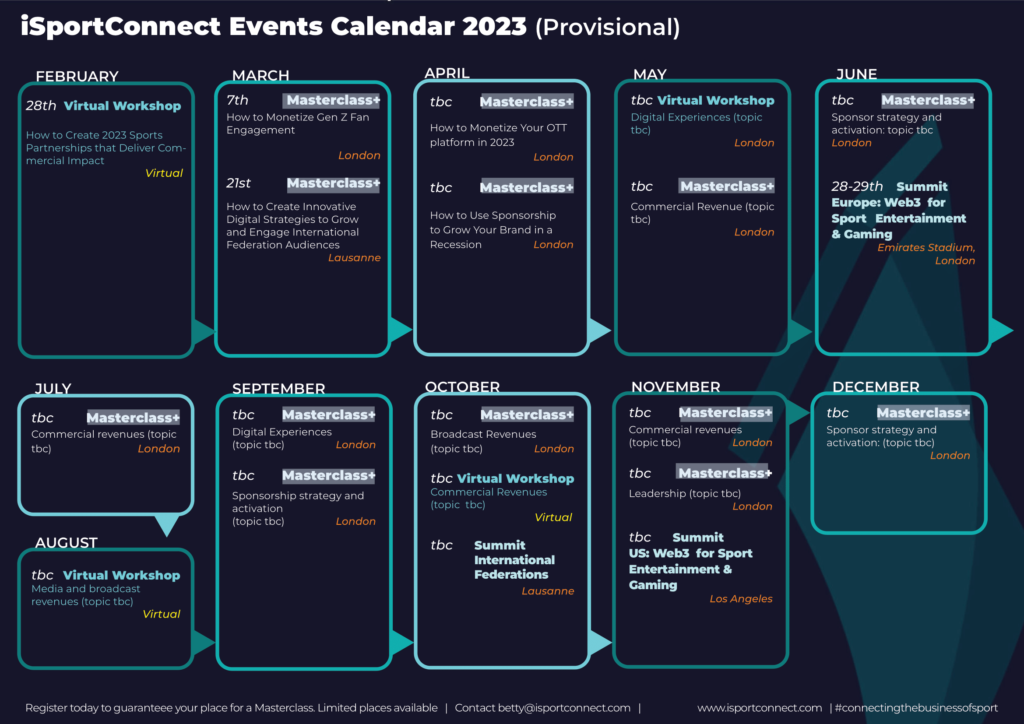
As you may have seen on LinkedIn, last week we held our first “masterclass+” event of 2023. With more than 15 of these events planned across multiple cities, there’s no getting away from the fact that it is going to be a busy year for the iSportConnect team.

We have decided to take our events in a different direction this year. The emphasis has swung from keynote speakers, panels and fireside chats to knowledge sharing around pain points that our community of rights holders are facing. Amidst the change, two things will remain the same. These events are unique in that they are both exclusively open to rights holders and are free to attend by invitation only. 

The change in plan isn’t something that was decided overnight. We have been thinking about it for a while. We spoke to you – our community – to understand what you wanted from the ideal event format.

Not subscribed to our weekly newsletter? Click here to sign up and receive more content like this to your inbox every week.

All our events this year are going to be compressed into a half day format with space for networking. We kick off each event with an insights-led presentation to help set the scene for the day and give the audience some concrete information to frame the topic at hand. So far these have come from YouGov and Omdia and have provided our delegates with a great platform upon which to have more in-depth discussion.

But away from the presentations, and while each event will have space for an inspiring panel discussion, the interactive roundtables that now occupy the majority of the Masterclass+ event format, are what we are most proud of. The sports industry is often accused of being too insular and, with rivalries on and off the field often getting in the way of knowledge exchange, it is easy to understand why. However, sports business executives have a lot to learn from each other (as well as those beyond our borders) and we see our events as a great vehicle to facilitate that.

It was great to see and feel the room relax after just five minutes of discussion as delegates started to share their pain points and offer each other solutions. 

The team at iSportConnect don’t plan to put their feet up and we will continually look to improve the value we can bring to the industry in step with our community.

If you would like to register your interest for more of our events moving forward, click here

By David Fowler, MD Advisory iSportConnect, click here to contact David

Meet the Member: “Fighting piracy is a bit like a game of Whack-a-Mole”

Piracy is an uphill battle for rights holders. To find out how the Sports Rights Owners Coalition is trying to fight it we sent our Content Manager, Alex Brinton, to speak to Mark Lichtenhein, the coalition’s Chairman.

Mark, briefly explain what it is that the Sports Rights Owners Coalition do and your role within that?

The coalition has been in existence for coming up to 20 years. I got involved right at the start when I was working for the European Tour, or as it is now called the DP World Tour. It was created because we understood that despite competing for some things like sponsorship and TV contracts we had many common challenges – and the protection of our underlying intellectual property rights was the most important. 

I think the best way to look at it is a sports trade body. It is the only body that represents sport as a whole out there. Over the last 20 years we have gone from a handful of UK sports into a global organisation representing between 50 and 60. It is still predominantly European but we now have representatives from the US and Asia. The issues have changed over the years but the mission hasn’t. 

For my sins, I was elected chairman of the coalition eight years ago, so I am in my fourth term at the moment. As you pointed out piracy is the hot topic of the day and has really brought the coalition closer together than ever before.

Piracy is obviously the biggest challenge facing Sports Rights Owners at the moment, how has that battle changed as we have moved from TV to digital?

Yes, it has changed a lot over the last few years. In the early days it was more down to card and password sharing. The big change is actually the increase in quality of digital retransmission getting so much better.

In the early days, when you were relying on dial up internet it wasn’t really a problem but with the broadband you can get now, you are able to watch sport in 4K over the internet. So for the pirates the retransmission possibilities have become much, much greater and obviously with that more lucrative. That is what has turned this into a multi-billion dollar illegal market that is incredibly difficult to police.

The unique challenge with sport is that the value is concentrated in the live experience. So for a pirate it is really easy to extract value in a two-hour football or rugby match because it takes some time for the anti-piracy wheels to come into motion. That has been our main task over the past few years is to get an immediate solution to these problems that  sport specifically faces. 

Are any of the rights holders finding success in the battle against piracy, who are they and what are they doing?

Football is obviously the most lucrative sport so they have led the way in terms of anti-piracy measures. I think a lot of them have done fantastic jobs in their own geographies of identifying the bad actors and platforms where the content is being carried. 

The first thing is identifying where the pirates are operating from and we are getting fairly good at that. Between us we are sending out millions of ‘Take Down’ notices every year. The real problem is though that there is no obligation for people to actually take action on these notices during the time of transmission. At a European level we have this notion of expeditious removal – but that isn’t a time frame so it is really hard to police. 

Not subscribed to our weekly newsletter? Click here to sign up and receive more content like this to your inbox every week.

We do have some legal precedent though, that comes from the ECATEL case in The Netherlands that ruled that an illegal stream needs to be taken within 30 minutes. Again this isn’t ideal but it is something.

The issue is how 30 minutes translates for different sports so for a football match it is a third of the game, for a boxing fight it could be over already, whereas with longer sports like golf or cricket 30 minutes isn’t as critical..

You come from a tech background, can tech provide an answer to this problem?

Well tech has already provided a lot of the tools we use, certainly in the identification and discovery stage of the process. Particularly on a political level because watermarking, fingerprinting and the ability to actually track where the signal is actually coming from. 

We actually have legal certainty that our content has been stolen and retransmitted, which is really important when it comes to policy making. Everybody knows about the content that social media companies need to have taken down with hate speech, misinformation and alternative facts, what’s different with our case is that we have real proof that our content is stolen.

In short the technology is providing the tools, but it is just the application that needs to improve and the politics around it.

You spend a lot of your time lobbying for new piracy legislation in Europe, why is this so slow and what could new legislation really look like?

Well as I say one of the issues is that we get put into the same box as the removal of harmful content and we have just spoken about how that causes us problems. I think the bigger hurdle though is that the piracy ecosystem is extremely complex and hard to understand. 

If you’re a politician that has not studied anything to do with software engineering then getting your head around IP address and DNS blocking then it can be hard, these aren’t things that typically fall into your daily remit. 

I also think that at a political level there is this notion that sport should be freely available to all, which from our side doesn’t make a great deal of sense. So getting our point of view across takes a bit of time. There is also a massive misrepresentation of what Pay TV has done for sports to make the  coverage so much more compelling.

Golf is the sport I have been involved in for most of my life and if you look at the way that used to be covered and compare it to now, it is so different. You used to only be able to watch the majors and not even in their entirety and now you can watch practically every shot of all the majors if you want and probably around 30 hours of content a week from regular tournaments.

This sort of production comes at massive cost. There is no way of getting around that, people forget that the prices people pay for TV subscriptions are not just to make money, they are to cover their own costs as well. There is also the return to the athletes and that then filters down to the grassroots of their respective  sports 

I also think policy makers struggle to understand the value of the live broadcast as well, we have to move quickly or there isn’t a great deal of point in removing content once the event has finished. 

Can European legislation truly fix a global problem?

Well obviously not, but having clear pan-European legislation can go a long way towards it. We had similar problems in China, when copyright wasn’t viewed in the same way that we did in the West. That wasn’t a reason for giving up on copyright, it was an opportunity to educate China and now we have seen massive changes in their approach. But to bring it back to piracy, we have to get it right in Europe first before we can transfer a policy to the rest of  the world. 

Also due to bandwidth limitations and from the data our members have we know that the majority of the piracy that is being consumed in Europe is coming from Europe.

We know that piracy is costing rights owners money, but does stopping piracy have a price tag?

The thing about piracy is that it is something that you can never truly stop. It is a bit like a game of Whack-A-Mole. What I will go back to though is the value of the live experience that sport holds. If you’re watching pirated content then there needs to be a significant risk that you will only get to see the beginning  because it will get taken down. This makes it a lot less attractive for viewers to watch. We  need to be able to disrupt the system as quickly as possible. It isn’t the case for all but I don’t think pirates would be able to sell many subscriptions if their illegal streams were unreliable and unwatchable.

There was an independent study conducted by Ampere Analysis a couple of years ago that estimated that the piracy market is worth around half of the legitimate rights market. So that would make it worth $26 billion with the legitimate market being worth $52 billion. Even if that is out by 10 or 20% that is still a massive market. This has even caused issues in certain countries in relation to rights renewals where piracy is prevalent. And major rights holders get up to  80% of their income from media rights sales, so if that legitimate market is significantly undermined it has the potential to change the way sport is financed. 

So in short, there’s a lot at stake here.

How Pay TV is going to make 2023 the year of recurring revenue

We are living in interesting times. 

The relationship between brands and consumers continues to evolve. Forget the simple “buy and sell.” It’s not even about making sure that customers come back and buy again. We’ve moved beyond that now. Today, consumers want to sign up and pay up so they can stay connected to the brands, products and services they love, without having to think about it. More companies than ever are focusing their energies on providing frictionless experiences to customers, and in return, they get the promise of recurring revenues.

In short, the world is turning to subscriptions and memberships.

The beauty of subscriptions – and why they are proven time and again to be the future of commerce – is that they address and solve some key pain points. Both for consumers and companies.

For consumers, a good subscription is one that keeps them connected 24/7 to the product or service, so they can access the things they want, whenever they need. Whether it’s streaming their favorite music or content, or receiving their monthly box of shaving supplies, a subscription is magical – the customer does not need to put in any thought or effort. It’s just there.

For companies, the subscription model is an effective way to maintain relationships with customers over time. A subscription is not a one-time purchase – it’s a recurrent commitment from the customer. With subscriptions, the focus shifts from acquisition to retention to extend the lifetime value of each subscriber. And as we all know, it is far cheaper to retain an existing customer than acquire a new one.

In times of economic uncertainty, consumers become more sensitive to cost. They cut back on non-essential items, particularly if the payoff is not perceived as being worth it.

Subscriptions can overcome this, and that’s why we believe that 2023 will be the year of recurring revenue. The subscription mindset is already well-ingrained in the consumer landscape. There will be starts and stops, upsets and coughs, but the road to revenue is clear.

At the cusp of a new year, the challenges that companies face are enormous. The world is still reeling from the pandemic, inflation continues to rise, and chatter about recession has not let up.

Through all this, subscriptions enable companies to engage and delight customers on an ongoing basis. This is very powerful to make them stick around.

With the right subscription tech stack, companies can provide their subscribers with seamless experiences, including frictionless payments that do not leave any room for the customer to consider canceling or dropping off.

Here’s an example: a customer subscribes to a health food brand for a weekly box of healthy snacks delivered to their door. Sure, it’s a “non-essential” purchase. But on the other hand, the customer places great value on eating healthy. As the cost of living gets higher, the customer feels a certain internal tension as to whether to continue the subscription relationship.

Imagine that the customer’s credit card payment fails, and there was no automatic fix to this issue. The customer passively churns. But they had some doubts already, so when the sales rep calls to get the new credit card information and sign them up again, it is all too easy for the customer to stay unsubscribed.

Not subscribed to our weekly newsletter? Click here to sign up and receive more content like this to your inbox every week.

Now imagine that same scenario, however the company uses Vindicia Retain as part of their subscription operations. Retain “heals” the failed payment transaction and re-captures the payment, before the company is in need to contact the consumer to address the problem with the failed payment, and the subscription continues smoothly. This seamless and pleasant interaction creates a sense that the customer is cared for and appreciated. They don’t need to quibble over the subscription or price, because they feel the value of being a signed-up customer.

When a customer subscribes to a company, they are in the mindset to commit. In return, the company must make good on the relationship. 

By focusing on engagement and retention, and by using strategic tools like Retain, subscription companies can provide the seamless experiences that help customers stay committed. What’s more, your company stays a step ahead. Instead of investing precious financial resources in a call center trying to win back lost customers, you won’t lose them in the first place.

And that’s the key to recurring revenues in 2023. Happy New Year!

By Jesus Luzardo, VP Global Head of Sales at Vindicia. To find out more about the work Vindicia doing click here.

EngageRM launch The Engage Nation Podcast

EngageRM have recently launched a new podcast, don’t worry it isn’t just about CRM systems, they are speaking to leading figures in the sports and entertainment industry.

The monthly podcast has already had two episodes and has featured interviews with Jordon Kolosey, Vice President, Business Strategy and Innovation at Spurs Sport & Entertainment, owners of the San Antonio Spurs and Lea Miller-Tooley, President of Complete Sports Management.

With more exciting interviews to come over the following months, be sure to check out an episode by clicking here.

It takes one to know one, but we are loving this emerging monster of a newsletter from EngageRM, ‘The Crowd’. All the latest trends and stories from the world of sport and entertainment – your inbox is big enough for the two of us. Go and subscribe here.