

Meet the Member: “We have hosted more major sporting events than any other city in North America since 2004”

With memories of the Qatar World Cup fading into the rearview mirror, we turn our attention to the 2026 edition of the tournament. The tournament is hosted over three countries and 16 cities. We caught up with Chris Canetti, the man who led Houston’s successful bid to find out how preparations are going, why Houston and his thoughts on host cities being able to secure their own commercial partnerships.

So Chris to kick us off, take us through your professional journey in sport?

I graduated from college in 1992 as a Communications Major. I guess I had visions of working at ESPN, at least to be involved in sports because I loved it so much. I was a baseball player in college, then in 1993 Minor League Baseball moved to my hometown in New Haven, Connecticut. I thought Christmas had come early. 

Unfortunately, they weren’t too keen to let a young guy with no real experience work with them. After a lot of persuasion they hired me as clubhouse manager. At the end of the season they let me move to become Head of Operations, a proper front office job which was really exciting. A few years later, aged 26 I became the General Manager of the team, I was the youngest GM in Minor League Baseball at the time and was in the position until I got headhunted by the New York Metro Stars, three years later. 

To be completely honest, I wasn’t the biggest fan of soccer at the time, but the chance to move to New York was so appealing to me. At first I saw the job as simply a pathway into the New York market and the opportunities to work with the likes of the Yankees, the Mets or the Knicks. But I really fell in love with the sport and over the next five or six years I moved up to assistant general manager. 

Then in 2006, Red Bull came in and bought the team and I was a victim of the changes they made. I found myself moving south to be Chief Operating Officer of the Houston Dynamo. I then progressed from COO to President and I was in that position until 2018 and from there I took on this role with the Houston 2026 World Cup Bid Committee.

Let’s have a look back at USA 94, what are your memories of the tournament? And as a non-football fan at the time did it make any impression on you?

I will be honest with you, I had very little awareness that the World Cup was going on in the summer of 1994. I was really busy with my Minor League Baseball position and that was taking up a lot of my time, but also I think was very similar to the experience of a lot of Americans at the time. But this time around we are really engaged, you only have to look at the viewing numbers of the game against England at the 2022 World Cup to see that. 

Take us back to June when you found out you won the bid, what was that feeling like?

It was an amazing feeling and a crowning moment for my career personally. I know how badly the city wanted it and how much it meant to the city. It has been so exciting to play a role in this for the city of Houston and we really didn’t know until the moment it was announced. When they called our name out it was a real feeling of jubilation, excitement and real pride as well that the work we had done had come off.

In your opinion, why was Houston chosen as one of the host cities? It is actually the fourth largest city in America and punches a bit below his weight when it comes to cultural significance, so why do you think it was chosen?

I don’t think there was a specific thing we did better than any other city but we do so many different things well across the board. Like you say, Houston is the fourth largest city in America and the largest in Texas. We have incredible infrastructure here as it pertains to our stadiums, our airports, our training facilities, hotels, transportation network, we’ve got an incredible track record of hosting major sporting events.

Not subscribed to our weekly newsletter? Click here to sign up and receive more content like this to your inbox every week.

We have actually hosted more major sporting events than any other city in North America since 2004, and we have done them well and got a great reputation from that. We also have brilliant travel links, it is easy to get to Houston and then once you are here it is easy to travel to Mexico, Canada or anywhere in North America. 

Take us through the bidding process then from when you came on board to the announcement in June?

As we said North America was awarded the bid in 2018 and I joined the bid committee in January of 2019. At that time I thought it was only going to be a two to two and a half year job, but Covid meant it dragged on a lot longer than that. It isn’t like anything I have been involved in before, even though I have worked in football for 19 years. I think as a city we put forward a good strategy and showed it is organised and ready to host an event of this magnitude.

As will be the case in a lot of the cities, NFL grounds are being used to host the matches. What changes to the stadium are going to have to be made to make it ready to host football?

Yes that is the case for a lot of the cities, we are in the really fortunate position that the NRG Stadium really doesn’t need much work done at all. It has been well kept over the years and has hosted several major football matches and tournaments, we’ve had the Manchester derby, El Classico and matches in the Copa America. The one thing we need to bring in is a grass pitch, it is currently an artificial pitch but we are going to start growing that a few months out from the tournament. Besides that there are other improvements that are going on to the stadium that are the pre-scheduled ones.

What was your reaction FIFA announced cities would be able to secure their own commercial partnerships for the first time?

It is a really interesting opportunity, but if we are going to be totally honest we have known that this was going to be happening for a little while. We knew it was going to be a piece of the puzzle in terms of how cities were able to fundraise the dollars that are necessary to cover the obligations that we have as host cities. We’re excited to be able to take advantage of it and use it to generate the revenue that we need to cover our costs.

This could easily mean cities competing for the same partners, what are you planning on doing to avoid that and if it is an issue what gives Houston the edge?

That certainly is a possibility and brands are only allowed to align with a maximum of two host cities. Look there’s a possibility that cities are going to be going for the same brands, but to be honest it doesn’t really concern me. A lot of the deals will be done with brands who have a large corporate presence within the city. So Houston is, for example, the energy capital of the world, we’re home to numerous major Fortune 500, Fortune 100 companies, these companies have been supportive of major sporting events that have come through Houston in the past Super Bowls, Final Fours etc. Next season we have the College Football Championship as well, which I know isn’t the biggest event in Europe but over here it really is. 

We are fortunate in the sense that there’s a culture in this city that the major corporate partners want to support major events, they understand the value of what it means for our city and its future. We have ten of these spaces to fill, so with all of the above it isn’t something that is keeping me up at night.
First speakers announced for SEG3

Two days jam packed with an array of interactive sessions, immersive experiences and deep dives into innovative use cases all being used across sports, entertainment and gaming industries.​

Featured sessions include Napster, BITKRAFT Ventures, Upland, Animoca Brands, NASCAR & many more.

The full agenda is coming soon…

The view from Lausanne: The sources of income for Sports Federations

In the world of sports federations, one of the most difficult challenges undoubtedly concerns the sources of income needed to enable their core business and achieve sustainable growth of the sport at international and national levels.

This article is not intended to discuss the aims and objectives of a sports federation, but rather to outline some of the challenges that these organisations face in making their existence possible.

It is clear that the success of any sport depends on the efforts of these federations and the resources they have at their disposal.

However, many non-profit sports federations have limited resources, making it difficult to provide the best possible support for their sports and their communities.

To understand this reality, it is necessary to discuss the business model of these organisations, which are commonly set up as non-profit associations.

Being a non-profit organisation means that the organisation cannot share its profits among its members. So, unlike a for-profit company or corporation, the purpose of an association (or sports federation) is not to make a profit but to develop its purposes regarding the sport they are governing.

This observation is relevant because this characteristic ends up driving the way these organisations are managed, creating some difficulties from a financial point of view on the one hand but also ensuring a responsible and transparent attitude in governance and compliance issues on the other.

As the sports federations are not for profit, they cannot promise a return on investment in relation to the financial contributions that may eventually be made by other organisations, such as sponsors, the government, investors, donors, etc.

The counterpart that an association can offer is to ensure that these resources are being applied properly, responsibly, efficiently, and productively for their purposes, which ultimately are the development of the sport.

Just to clarify, being a non-profit organisation does not mean that you cannot be a profitable organisation, much less that you cannot get revenues and income from several different sources.

On the contrary. It can and should be profitable, after all, the maintenance and growth of the organisation depend, above all, on the financial capacity to make its activities and its existence economically possible.

The problem is that being a non-profit organisation, it is more difficult to access financial sources because the counterpart is based on other advantages that are not directly based on profit.

Of course, sponsors who eventually provide financial resources to federations can enjoy brand visibility, marketing activations, and all the other benefits of associating their brands with a particular organisation, sport, or competition.

But this return is not profit distribution and therefore differs from other types of commercial businesses.

This is also true for public or private financiers, donors, and any other type of entity that provides financial resources to a federation; i.e., the federation will not be able to return this investment in the form of profit.

This is where the difficulties begin, because a sports federation needs to offer many attractive assets to benefit the entity that decides to invest, lend, or donate a certain financial contribution to this type of organisation.

On the other hand, the sports federation has many other ways of raising revenues that do not necessarily require a sponsor, investor, or donor.

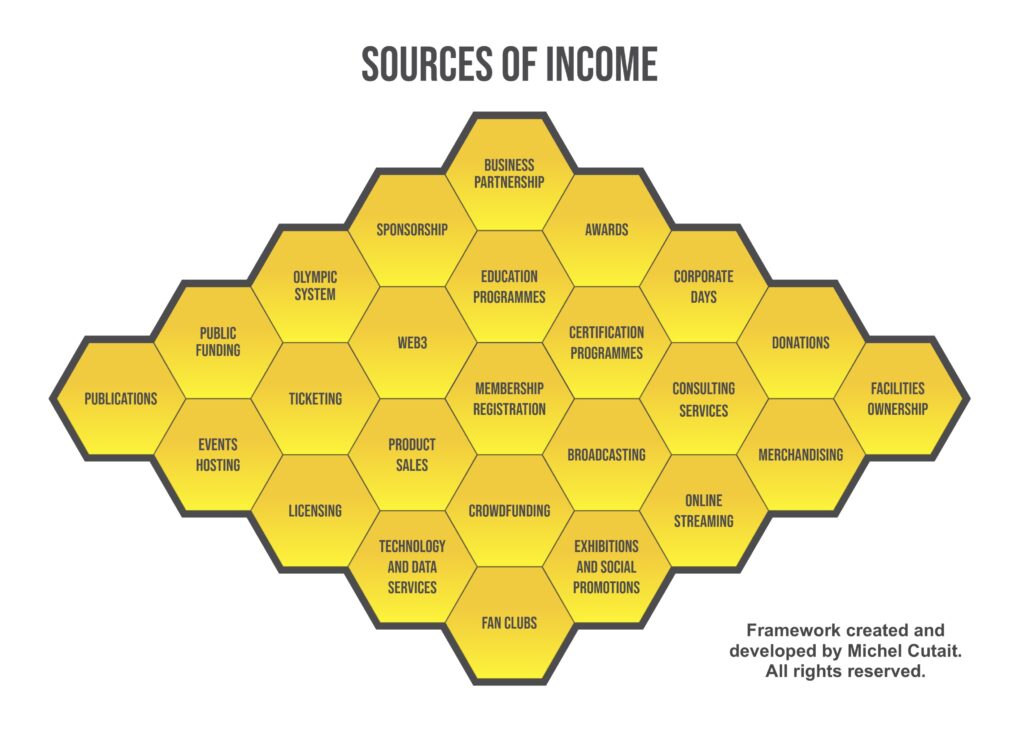
In order to identify all the possible sources of income for sports federations, I have made a study entitled the “Hive Model”, in which I have identified 25 different sources of income that can be used by a sports federation to “nurture” its organisations in order to fulfil its purposes and objectives.

Here follows the model, which you can also see explained in the following link: The Hive Model (Michel Cutait)

All these resources are feasible and compatible with the principles of governance and accountability required for non-profit organisations such as federations, associations, and even foundations that are dedicated to the world of sport.

The proposal for this study was obtained through a process of reverse engineering.

Instead of defining the main objectives, we can specify the sources of income and, recognising those that we consider feasible, we can establish new objectives and, consequently, the strategic actions to achieve positive results.

This model proposes interesting advantages for managing a sports federation because it allows to expand strategic perspectives, discover new ideas that were out of our pipeline, and be more assertive in finding solutions that will be successful in materialising these sources of income.

Not subscribed to our weekly newsletter? Click here to sign up and receive more content like this to your inbox every week.

Obviously, not all sports federations will be able to develop projects that are compatible with all the income sources I identified in the study above.

Some income sources are more common than others, for example, membership fees, sponsorships, events and competitions, broadcasting, and product licensing.

However, in order to ensure that their sports are properly developed, non-profit sports federations need to find different ways to generate extra revenue.

For this strategy to be implemented efficiently and cost-effectively, sports federations need to reach a level of maturity and improvement that is neither easy nor simple or quick to achieve, especially if the organisation has limited resources.

The organisation needs to have a clear awareness of what its strengths are, to know deeply who the members of its community are and their needs and aspirations, to have a professional team capable of delivering its activities, and also to have a leadership that has a broad, modern, and creative vision to take the organisation to the next level.

Obviously, it’s not as simple as writing an article, but faced with the challenges of the non-profit business model of sports federations, finding new sources of income is a fundamental step to ensure that these organisations, and consequently their sports and their communities, continue to grow in a sustainable, solid, and promising way.

Michel Cutait, Executive Sports Manager, lawyer and professor. He currently works as Acting Secretary General at World Obstacle, institutional name Fédération Internationale de Sports d’Obstacles, the international governing body for obstacle sports (Obstacle Course Racing, Ninja and Adventure Racing) and related events, where he runs the Secretariat working actively in the areas of governance, membership, partnership, development and compliance. He also formerly worked as Strategy Advisor for Brazilian Triathlon. Graduated in Law, has a Masters in Social Relations (Brazil), Marketing (Australia) and a Masters in Sports Administration and Technology at EPFL (AISTS) in Lausanne, Olympic Capital. He has written 5 books, the last one called Management Performance Rio 2016 Olympic Games.

How AI and ChatGPT is changing the game (part 1)

Unless you’ve been living under a very large, internet-restricted rock, you’ve probably heard about ChatGPT. From students using it to cheat on essays and spitting out god-awful dad jokes, to writing entire marketing strategies (definitely, not ours 😳) ChatGPT has brought to life the power of AI.

But what does this mean for the sport and entertainment industry? Our world is certainly not exempt from this disruptive innovation, and organizations have an enormous opportunity to leverage this newfound power.

In part 1, we’ll cover ticketing and partnership and next month, we’ll dive into marketing and omnichannel customer service.

* And we promise we actually wrote this ourselves.

Part 1: Ticketing & Partnerships

The skinny

Integrating AI technology will be a game-changer for sports organizations looking to improve their day-to-day business activities.

By using natural language processing and machine learning, AI can provide personalized recommendations, automate routine tasks, and handle customer inquiries with speed and accuracy.

As a Microsoft powered business, we are integrating it within the EngageRM platform. This will help sports organisations to enhance their customer experience, increase sales, and optimize their business operations with these new features at your fingertips.

How it will change ticketing

Improved Efficiency

By automating responses and handling common inquiries, ChatGPT can reduce the time spent on routine tasks, allowing sales reps to focus on higher-value interactions.

This should be music to sales departments’ ears the world over – less time on process and more time selling and building relationships.

This will improve efficiency and lead handling, resulting in more sales productivity and revenue generation. In a tough economic climate, this has never been more vital.

Personalised Interactions

ChatGPT can quickly analyze mountains of data related to ticketing and sales operations, providing personalized recommendations for tickets and promotions to potential customers based on their preferences and budget.

This feature can improve the chances of conversion by delivering tailored offerings that meet customer needs, which will again boost revenues and bolster your customer satisfaction metrics.

Enhanced Lead Qualification

ChatGPT can ask specific questions to potential customers to qualify leads and determine their level of interest, helping sales reps to prioritize the best leads.

This feature can help businesses optimize their sales funnel, leading to higher conversion rates.

By providing a more effective and efficient way to qualify leads, ChatGPT can help sports and entertainment organizations close more deals and grow their customer base.

How it will change partnerships and deals

Streamlined Asset Management 

ChatGPT can be trained with information on the team’s assets and partnerships, getting across sponsorship tiers, contract terms, and activation requirements.

This enables the chatbot to provide quick and accurate answers to the salesperson’s questions and helps to streamline the management of these assets across multiple partnerships.

Personalised Proposals and Efficient Communication

ChatGPT’s ability to provide recommendations based on a partner’s preferences and needs can help to improve the quality of proposals and increase your chances of closing deals.

It can also easily handle routine inquiries and alert the salesperson to more complex or urgent issues, allowing for more efficient communication.

Improved Lead Qualification and Performance Tracking

ChatGPT can ask specific questions to prospects to help qualify leads and determine their level of interest in specific assets or partnership opportunities. Furthermore, the chatbot can be integrated with analytics and reporting modules to track the performance of specific assets and partnerships, identifying areas for improvement and optimizing sales strategies.

So there you have it. You will soon be able to work faster, smarter, and more efficiently across your business. We’ve got more content across our channels coming out in the next month about ChatGPT in sport and entertainment, but if you want to have a chat about this, drop us a line.

By Callum Chambers, Global Head of Marketing, EngageRM. To find out more about EngageRM click here.

Shell and Ducati extend partnership as MotoGP enters new era of more sustainable fuels

Shell has today announced a multi-year extension of its Technical Partnership with Ducati Corse factory racing team, up to 2027. The Technical Partnership between Shell and Ducati Corse has seen great success on the racetrack, including the most recent campaign which saw Ducati win the 2022 MotoGP Constructors’ Championship and Riders’ title with the Italian Francesco Bagnaia.

The partnership, which originally began in 1999 when Ducati was racing in the FIM Superbike World Championship, marks 24 years of collaboration and 20 years in the FIM MotoGP™ World Championship, since the Italian team joined in 2003.

Today, the Desmosedici GP racing bikes of Ducati Corse use a bespoke Shell V-Power race fuel formulation as well as a bespoke blend of Shell Advance Engine Oil with Shell’s PurePlus Technology. Designed to withstand the extreme conditions of the MotoGP racetracks, Shell Advance is formulated to help extract the maximum performance while maintaining reliability for the bike’s four-stroke V4 engine over the duration of a race season.

As part of the partnership renewal announced today, Shell and Ducati will be continuing to work hand-in-hand in preparation for MotoGP’s new era of more sustainable fuels, which begins in 2024. Development for these fuels, which must be 40% non-fossil origin from 2024 and aim at an ambitious 100% by 2027 , will be a key area of focus for the Shell and Ducati teams. They will also continue to explore ways in which the collaboration can further the development of electric drivetrains in electric motorcycles for future use, both on and off the racetrack.

Throughout this 24-year partnership, the learnings and innovations from the racetrack have been used to develop better road-going products for Shell customers around the world. What’s more, the relationship extends to Ducati road bike, with new motorbike Shell Advance formulations being developed and tested for road bike applications.

Commenting on the partnership renewal, Sabrina Qu, Vice President Global Lubricants Marketing at Shell, said: “The extension of our Technical Partnership with Ducati until 2027 signals our commitment to the Ducati Corse team to provide them with technical support as MotoGP moves towards a more sustainable future. Motorsport is the ultimate testbed for our technology, providing Shell with valuable insights into the performance of our products, whilst allowing them to test formulations to match the future sustainability ambitions of both Shell and Ducati. This in turn will continue to benefit Shell Advance and Ducati customers around the world, both on the track and on the road, as the Technical Partnership continues to develop.”

Ducati Corse Sporting Director, Paolo Ciabatti, added: “It gives us great satisfaction to announce the extension of Ducati’s multi-year agreement with Shell until 2027. Last year was the most successful season ever for Ducati Corse since the start of our fuels and lubricants Technical Partnership with Shell in 1999, and we are delighted to be able to enter a third decade of collaboration with them. It is also thanks to the vital contribution of technically advanced partners like Shell that Ducati is able to achieve success in such a technically challenging championships like MotoGP and WorldSBK, where every little performance detail counts. With this strong support behind us we are confident that we can continue to obtain excellent results in the future.”

SuperTennis to broadcast US Open in Italy

Sportcast, the FITP (Italian Tennis and Padel Federation) group company that manages the SuperTennis TV channel, announces that it has reached an agreement with the United States Tennis Association to acquire all the media rights of the US Open in Italy on an exclusive basis.

Secured by IMG, the multi-year agreement starting from 2023 will allow Italian tennis fans to watch America’s Grand Slam® tournament from start to finish live on free to air for the first time.

SuperTennis will broadcast the US Open’s best daily match ups both live and delayed, alongside coverage on the SuperTenniX digital platform which will give FITP members and their subscribers the opportunity to stream all matches across the tournament.

Angelo Binaghi, president of FITP states that “the Italian Tennis and Padel Federation continues its development policy through the promotion of great tennis in our country, and with the founding of the SuperTennis channel 15 years ago, we saw the sport of tennis brought back to our dedicated audience. Alongside providing extensive coverage of Wimbledon, we are now proud to make another Tennis Grand Slam® tournament available to all Italian tennis fans. The US Open is a tournament that has recently provided some incredible stories, including the historic 2015 US Open final won by Flavia Pennetta over Roberta Vinci. The level of access that SuperTennis can provide to its viewers will only contribute to the further promotion of tennis and the increased support of our national tennis players.

Kirsten Corio, Chief Commercial Officer, USTA said: “SuperTennis has proven to be a trusted home for the sport in Italy. With a number of Italian players at the forefront of this rising generation of talent, it’s an exciting time to begin this new partnership and we look forward to working together with SuperTennis to continue growing the audience for the US Open.”

ATPI and DAZN announce global partnership

DAZN, the leading global sports streaming service, that is changing the landscape of sports broadcasting, marks successful partnership with world-leading travel management company, ATPI, as the business’s sole global travel management company (TMC).

Founded in the UK in 2015, DAZN has established itself as a pioneer in on-demand sports streaming and is fast becoming the global leader in digital sports media providing ground-breaking live and on-demand sports streaming services to users in over 200 countries and territories.

The partnership is significant for ATPI as the TMC continues to firmly secure its place as a media production expert following its successful bid for the ITV account in May 2021. ATPI’s expertise in sports and media production travel, moving large groups of people and working with global brands were all key factors which supported the appointment.

ATPI has been servicing DAZN since July 2022, managing all elements of the company’s crew and production travel. After a successful implementation period, the TMC is managing travel of DAZN employees and partners to the 15 markets in which the business operates, including the United Kingdom, North America and other key countries throughout Europe and Asia.

Kim Trenter, DAZN Global Travel Manager:

“Working with the experienced ATPI team has already made such a positive impact for us. Their knowledge and proven track record in managing media production travel and previous collaboration with global sports brands makes them the right partner for our growing company. The single booking portal is of extreme importance to us. This, combined with their best in market online booking tools and reporting capabilities, have been invaluable to us so far. After a successful implementation period, we’re looking forward to seeing how we can drive the  programme forward, to make us fit for the future and continue to grow.”

Katie Skitterall, ATPI Group Commercial Director:

“Working with DAZN is such an incredible step in expanding our crew and media production travel portfolio. I am so proud of the team around me, with the implementation complete, we now walk into business as usual, which for me, is where the real fun starts as we collaborate, challenge and support DAZN to transform their programme into one that is yet to be seen in the industry. 

The ATPI Group has a global presence, operating from more than 190 offices worldwide and has successful operations within corporate travel, corporate event management, sports and media travel utilising the lasts innovations in online travel technology and specialist travel management for several key industries, including the film and broadcast sectors. In addition to large production crews, ATPI also has extensive experience of managing the complex travel requirements of a number of specialist groups.

Sports Industry Group and SportsPro announce partnership

Sport Industry Group and SportsPro are delighted to announce the launch of a strategic partnership for 2023 and beyond which will see the creation of a new premium networking package and the joint promotion of the Sport Together Fund.

Inspired by the idea of ‘Change’ – a key focus for the upcoming 10th edition of SportsPro Live – the two leading sport business platforms will work together on a number of initiatives designed to foster a closer working relationship between one another and the sector they jointly serve, with a view to facilitating change among the industry.

To celebrate the new relationship, both organisations are offering their audiences the opportunity to easily attend both days of SportsPro Live and the FEVO Sport Industry Awards 2023 by purchasing a SIG x SportsPro Joint Package. In doing so, individuals will be able to enjoy a series of dedicated sports networking events designed to shape the future of sports business and celebrate the very best of the industry.

In addition to the cross promotion of content and campaigns across both brands’ event series and digital platforms, a further initiative will see the Sport Together Fund serve as key focal point on the agenda during day one at SportsPro Live.

Created by SIG sister company Beyond Sport and launched at the Sport Industry Awards 2022, the Sport Together Fund provides grants and capacity-building support to non-profit organisations, sports clubs and collectives who are assisting communities facing conflict, human rights violations and climate change disasters.

Nick Meacham, SportsPro CEO, said, “SportsPro are delighted to collaborate with Sport Industry Group in uniting the sports industry in London this April and shine a light on the Sport Together Fund. This year’s SportsPro Live will be built to drive much needed change within our industry and together we look forward to creating positive change for those assisting the communities facing conflict.

“We’re delighted to be working with Sport Industry Group to drive awareness of the Sport Together Fund, and bring together leading figures from across the industry in London later this year. We believe that this collaboration will provide immense value for everyone involved.

“We see great synergies between the role SportsPro Live plays in uniting the industry to discuss change and purpose, and the role the FEVO Sport Industry Awards plays in celebrating the industry’s achievements and value to wider society. Through this collaboration, we hope that we’ll be able to
drive more value to attendees of our respective events, and further support to the Sport Together
Fund to provide support to those needing it most.”

Nick Keller, SIG Chairman, added, “The Sport Together Fund is not just about the impact we can have on those that are trying to rebuild their community, but also how our industry can work in together and face some substantial challenges. We are going to have to think creatively and build radical collaborations that can drive real change and awareness. The SportsPro team not only share that view but have the courage to see the potential of doing things differently to drive positive change.

“The FEVO Sport Industry Awards is the biggest night of the year and celebrates the best of the industry while the two days of learning at SportsPro Live are another key moment. The combination offers a compelling focus for the industry to reflect great work and to look forward to what partnerships and innovation will shape the future, and I’m delighted that we have been able to package that up for a powerhouse industry week.”

The 10th edition of SportsPro Live will take place at the Kia Oval, London on 25th and 26th April, while the Sport Industry Awards 2023 will take place on the evening of 27th April at Evolution London.

iSportConnect MLB Brand Health Index powered by YouGov

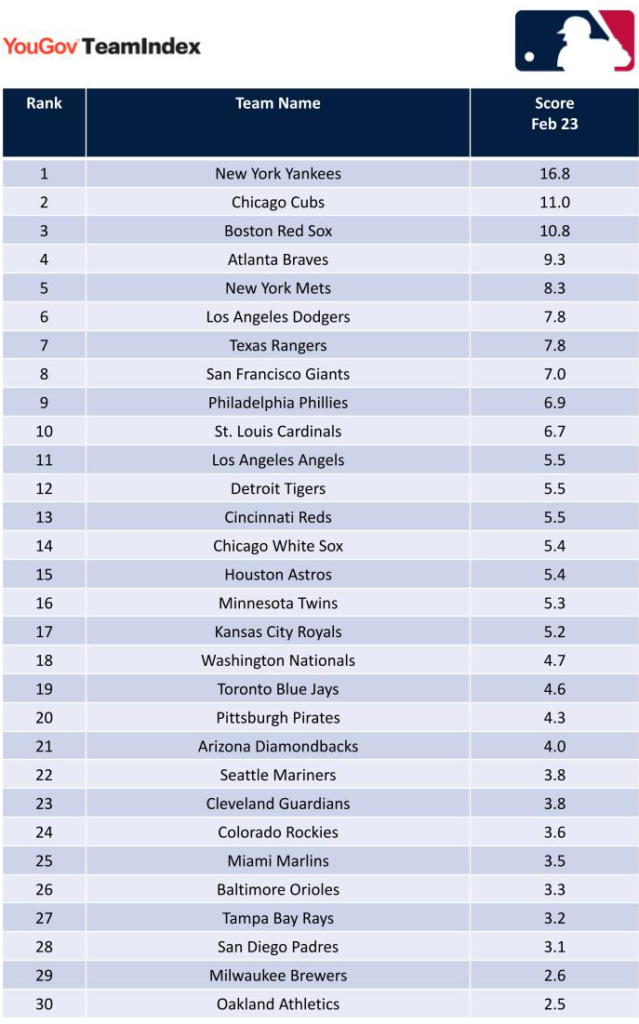
We are just seven days away from the start of the Major League Baseball season. So this month our Brand Health Index powered by YouGov is taking a look at each of the 30 teams to see where they rank. 

Think of Brand Health as a combination of ingredients that include perception, reputation, reviews, awareness and popularity. So where are the stories? 

The Chicago Cubs – What is surprising is that they have landed themself in second place, they currently have the highest brand impression among the US population. YouGov defines Brand Impression simply as whether or not you have a positive or negative impression of the team. The Cubs ended their 108-year title drought in 2016, finally vanquishing the curse of the Billy Goat which had been hanging over the team since their finals appearance in 1945. Unusual to see loveable losers doing so well.

Fans in the UK will be pleased with the Cubs coming over to play in the 2023 MLB London Series. The Cubs are taking on their rivals, the St Louis Cardinals, at London Stadium on June 24-25. England cricketers Harry Brook and Issy Wong both put down their cricket bats and gave Baseball  a go last week. Brook said: “The basics are very similar. Having a strong base is one of the things I picked up, for sure. Your rotation of your hips and trying to use them for power and the legs too.”

The Houston Astros – Despite winning the World Series last season they find themselves languishing in 15th place out of the 30 teams. Houston is the 4th most populous US city but this clearly doesn’t offset the 2017 cheating scandal they got embroiled in that involved them using technology to call signs. 

The New York Yankees – No story here as unsurprisingly they top the rankings with the highest Brand Health Index. They are not only the most successful team in MLB history, they are also one of the most famous teams in all of sports so this is hardly surprising. 

Los Angeles Angels – Have moved up the Index despite not having won much of note for 20 years but they have the popularity of two of the best players in the world on their roster. Shohie Ohtani and Mike Trout – who literally went head to head in the World Classic Baseball Trophy this week (the effective World Cup Final). This is a clear sign of individual players having huge influence over a club’s positioning. When players move the fanvase can often move with them….

Take a look at the full Index below, what has jumped out to you?

The YouGov Brand Health score is decided by the six metrics below: 

Impression – Overall, of which of the following teams do you have a positive/negative impression?

Quality – Which of the following teams do you regard as prestigious/non-prestigious?

Value – Which of these teams do you think is worth/not worth the time spent following or supporting?

Reputation – Which of the following teams would you be proud/embarrassed to work for?

Satisfaction – Which of the following teams make you feel satisfied/dissatisfied as a fan?

Recommend – which of the following teams would you recommend/not recommend a friend or family member follow or support?

Meet the Member: “The days of Olympic sports sitting back and thinking the world owes them something are gone”

With just under 500 days to go until the Paris Olympic Games gets underway we caught up with the CEO of World Aquatics, Brent Nowicki. We spoke about his journey to becoming CEO of one of the biggest international federations, the change from FINA to World Aquatics and Paris 2024.

So Brent, to start if you could just take us through your journey in sport?

I started my recreational sport journey as a swimmer believe it or not. I think that some of the attributes that have served me well are ones that have come from swimming including commitment, being punctual and certainly getting up early. 

In my teen years I transitioned to playing a lot of Lacrosse. I played it through university and then for various teams before coming over here to play for Switzerland. I started as an assistant coach of the national team and then ended up joining as a player. 

In terms of my professional involvement in sport, that started around 2007. My early career was spent as a lawyer in New York, the way I got involved in sport was by representing athletes in commercial matters and anti-doping cases. I slowly got pulled into more contractual and player engagement work, before I found myself in Lausanne in 2012 working for the Court of Arbitration for Sport. That was when I realised that this is the sort of thing I should be doing, it made me want to get up in the morning and that is such a great feeling to have.

You have been at World Aquatics for nearly two years, what has surprised you about leading one of the biggest international federations?

It hasn’t been a surprise but I would say what is underappreciated from those outside the federation is the amazing commitment of the aquatics community. They are really underappreciated, like every International Federation they are essential to all the work we do. Despite some of the public opinion these people aren’t flying around everywhere first class, they don’t get massive per diems. They are doing it through their love of the sport.  

We have obviously seen a change in branding since you have been in charge, what was the thought behind the move from FINA to World Aquatics?

We went through a reform process at a very early stage in the President’s term. One of the first things we did was take a look at every aspect of the business and question whether or not it was fit for purpose? Does it represent who we really are and does it represent what we are trying to achieve?

We looked at the name for what it was and that is a French acronym for an amateur swimming federation, which we aren’t anymore. We are also now not predominantly a swimming federation, because we have added a lot of the other water-based disciplines over the years. 

We went through a very exhaustive process, looking at different options. Should it be global or world, water or aquatic. Eventually after listening to our community and sort of realising what we were aiming for, we landed on World Aquatics. It was important that it felt inclusive to all the sports we have and also that it was in a language we all understood. In the end we are really pleased with what we have ended up with.

World Aquatics must be close to rivalling FIFA in terms of participation levels, there is obviously a bit of gap in terms of commercial revenue. How are you planning on increasing the commercial revenue of the international federation?

Do more people play football than swim? That is a really interesting question that I haven’t thought a great deal about to be honest. I see so many different statistics about how many people swim around the world and none of them seem to be within millions of the other. Either way it is definitely a lot of people.

I don’t know the commercial revenue figures for FIFA, but I follow your logic because they definitely have a different commercial model to the one we have. I think we have a different social obligation to that of FIFA really. For our President it isn’t really about maximising revenue streams it is more about working out how to use the revenue we have in the most effective way possible. 

Not subscribed to our weekly newsletter? Click here to sign up and receive more content like this to your inbox every week.

I really think what our President has done in terms of making sure we are spending money on sustainability and water safety has been fantastic. We have to make sure that our athletes have clean water ways, make sure that when a pool closes an alternative is put in place and we need to give families and children the opportunity to be able to learn to swim. 

We can compare commercial revenues with FIFA, but I don’t see their goal as being the same as our goal. We have to make sure that the infrastructure is there for the child who is inspired after watching the athlete win the gold medal. There is a local pool where they can be taught how to swim and become an Olympic swimmer in the future. If an individual does not know how to play soccer, he or she will not die.  But if that same child can’t swim, the risk of death is much greater.  Preventing that occurrence is one of our main goals.

This is your first Olympic cycle, how are preparations for Paris 2024 going?

The President and I took up our positions just six weeks out from Tokyo, so we were really thrust into those Games because of that. The special nature of those Games meant it was tough to build any sort of experience from that. 

It has been really nice to have a full cycle with Paris 2024 and preparations have gone very smoothly so far. We been very lucky with our Aquatics Manager in Paris, so things are going really smoothly. Our leadership team has been working really well with theirs since day one and we have got the opportunity to know them both personally and professionally. 

I think we are also going to be able to showcase our events around France in the build up to Paris, there is also a lot of energy around the city about the hopes that the France team will achieve great things in their home waters. Hopefully that is a great legacy for the Games.

Interest in the sport obviously peaks after an Olympic Games, what plans do you have in place to try and keep as much of that audience as captive as possible and convert those viewers into participants?

Yes the peaks and troughs of Olympic sports, it is unavoidable really. We think that as long as you are always progressing in an upwards trajectory, and you are doing what you can to keep the gap between the peaks and troughs as small as possible, then you are doing the right things. 

One of the things we have done is work with our athletes more to get them brought into what we are trying to achieve. I think the days of International Federations being able to sit back and think that just because they’re an Olympic sport the world owes them something are gone. That might have been the case at one point in time but today I can honestly say nobody owes us anything, we actually owe our athletes everything.

The more we engage and work with our athletes and get them to work with us in trying to keep audiences inspired and captive then I think we can try and keep our sport going in an upwards trajectory in terms of interest and participation numbers. 

I don’t think people come to our events just to see people take part in swimming or diving, they come to see the stars of the sport. They come to see the Olympians, the Olympic champions. In swimming, the retirement age is a bit later than in other sports, so we need to work on building that bond between the younger and older generations. 

You have recently announced that Singapore will be hosting the World Aquatics Championships, tell us a bit about that and what it will be like taking the Championships to that part of the world?

We are extremely excited about it, Singapore is such a great place to have a World Championships. We always use World Championships to introduce new technology and this is going to be no exception. We are adding Esports and wearable technology this time and Singapore is such a great place to be doing this, the people there are so forward thinking technologically. 

I also think Asia as a whole is so interesting for us, it really is ripe with aquatic talent with China and Japan providing some of the best young swimmers and divers in the world. I think for us to take an event out there and be able to see the growth of the sports in those markets is going to be really interesting for us as a federation and potentially very exciting for the future.