

Meet the Member: “It is certainly exciting, but it is also daunting”

We finished Q1 last week, so far we have had 12 interviews from all over the sports business. From the NFL to Davanti Tyres and from Wave FC to World Aquatics, in this round up piece we are going to pull out the best quotes from each interview.

We asked Brent Nowicki, CEO of World Aquatics, about how they are trying to avoid the peaks and troughs related to Olympic sports:

“Yes the peaks and troughs of Olympic sports, it is unavoidable really. We think that as long as you are always progressing in an upwards trajectory, and you are doing what you can to keep the gap between the peaks and troughs as small as possible, then you are doing the right things. 

Not subscribed to our weekly newsletter? Click here to sign up and receive more content like this to your inbox every week.

One of the things we have done is work with our athletes more to get them brought into what we are trying to achieve. I think the days of International Federations being able to sit back and think that just because they’re an Olympic sport the world owes them something are gone. That might have been the case at one point in time but today I can honestly say nobody owes us anything, we actually owe our athletes everything.

Read the rest of Brent’s interview here

In his interview, Lamberto Siega, Digital, Media and The Studios Director for AC Milan, explained how social media algorithms really decide what fans are interested in: 

Sports clubs don’t choose what is interesting for fans, social trends enhanced by the algorithms (it can be a music, a dance, a behaviour) “dictates” how to build  content, choosing what works and what follows a specific trend. It is a radical change.”

Read the rest of the interview with Lamberto here

NFL UK General Manager, Henry Hodgson told us about NFL UK’s target audience:

“Our focus is still really on growing our fan base in the UK, and we’ve set ourselves a target of becoming a top three sport amongst 12- to 24-year-olds in the UK. So we are myopic about how we reach and engage that younger audience. And really everything that we do is going to be filtered through that lens”

Read the rest of the interview with Henry here 

On the eve of the Cheltenham Festival we caught up with the Head of Operations for the racecourse, Gethin Jenkins to find out about the effect of The Festival on locals:

“The Festival alone contributes more than £274 million to the local economy, but while we celebrate it as an event of national sporting significance, it clearly has a local impact and it’s important that we are good neighbours and contribute throughout the year. 

“These people are our neighbours all year, not just during the four days of The Festival, and it’s really important that we consider them before, during and after all our racedays.”

Read the interview with both Gethin and the CCO of The Jockey Club, Charlie Boss here

We spoke to Sean Maddocks, Davanti Tyres’s Sales Director for Davanti Tyres about the challenges in defining ROI from partnerships:

“It is always hard to quantify ROI from sports-based partnerships but particularly in our field. Tyres are a distress purchase, you don’t wake up in the morning and decide ‘oh brilliant, I am going to buy some new tyres today’. So we can’t measure ROI by a sudden spike in sales. We have to speak to our dealership network and find out if they are using it as a selling point? Are customers speaking about it? Are they displaying it at their depots? 

Click here to read the rest of the interview with Sean Maddocks

Jeanene Valentine, Director of Ticketing at Wave FC, gave her prediction for the direction ticketing is going to go in the next few years: 

“I think that RFID technology will probably become more prominent. I definitely wanted to try that years ago with X Games, I thought it would be cool to have a tangible item, like a skateboard deck or something that was kind of your ticket to get into like big premium spaces and stuff. So I think that we’re gonna keep going down that road of making it easy and fun. Now with digital ticketing, you can use your Apple Watch to gain entry. 

So we just gotta keep thinking of new fun and innovative ideas like that. I want to see holograms or something. It’s 2023. Let’s get creative, let’s get fun.”

Read the rest of the interview with Jeanene here

We asked Harry Browne, Strategy Director of Formula E, about the challenges they are facing at the moment: 

“Firstly, with all those changes we really need to work to maximise each of those opportunities. We really need to make sure we nail every point on the implementation and use data to help us do that. 

Secondly, what we are trying to do is to short-circuit our growth path as a sport, that is the real challenge. Most sports take decades to grow and mature; we are only in our ninth year and we are striving to become a tier one sport.”

Read the rest of Harry’s interview here 

Matt Bennison, Commercial Partnerships, Arena Racing Company, explained how he is trying to make horse racing an attractive proposition for sponsors:

“I think this comes down to investing in data. The great thing about Horse Racing is that we have lots of different audiences. We have your hardcore racing fans and racehorse owners who visit racecourses on a very regular basis alongside also those who visit less regularly, to celebrate special occasions, or to enjoy a day out with friends, for example.”

Click here for the rest of Matt’s interview

It was a surprise to many in the sport’s industry that FIFA are going to allow host cities to secure their own commercial partners , Chris Canetti, President of Houston’s World Cup bidding committee, explains why he it isn’t keeping him up at night:

“We are fortunate in the sense that there’s a culture in this city that the major corporate partners want to support major events, they understand the value of what it means for our city and its future. We have ten of these spaces to fill, so with all of the above it isn’t something that is keeping me up at night.”

To find out what else we spoke to Chris about click here

Stephen Sidlo, Head of Media for Airspeeder, spoke about the challenges of having a blank canvas:

“It’s certainly exciting, but also quite daunting. We’ve determined that the element of danger is what truly drives interest in sports. Racing with flying cars brings its own level of risk, especially when they become manned, and fans will be able to experience the sensations of the pilots through 5G haptic gloves at home.”

Read the interview with Stephen here

The Chairman of the Sports Rights Owners Coalition, Mark Lichtenhein explains why European legislation might help fix a global problem:

“Well obviously not, but having clear pan-European legislation can go a long way towards it. We had similar problems in China, when copyright wasn’t viewed in the same way that we did in the West. That wasn’t a reason for giving up on copyright, it was an opportunity to educate China and now we have seen massive changes in their approach. But to bring it back to piracy, we have to get it right in Europe first before we can transfer a policy to the rest of  the world.”

Click here for the full interview with Mark

We spoke to Erdinger’s Felix Durchdewald about how they managed to turn their non-alcoholic beer into a sports recovery drink:

The fact that there are isotonic benefits to ERDINGER Alkoholfrei actually made it a ‘sports recovery drink’ and this was – and still is – a massive part of our marketing around the beer. The fact you could have a beer after finishing a marathon and it actually helps your recovery by replacing lost fluids and vitamins is such a fun idea and that is how we got into our work with mass participation events.
Read the interview with Felix here

Member Insights: Lineker social media storm shows BBC lack of communication planning

David Alexander, MD of Calacus PR, looks back at the Gary Lineker Twitter storm and the PR nightmare that it caused for the BBC.

The BBC has been one of Britain’s crown jewels for more than a century, revered around the world for its reporting and wider content creation.

In the past decade, that status has been eroded by a succession of cuts and curtailments that have compromised its editorial independence and integrity.

A consequence of that is that so much top talent has walked out of the door, and who can blame them when senior executives, many with links to the government’s Conservative Party, affect its impartiality, ignoring some of the major stories or viewpoints?

When the government introduced a new Bill aimed at curtailing migrants coming to Britain, there was plenty of outrage from opposition politicians and even the United Nations, with Home Secretary Suella Braverman “pushing the boundaries” of what is lawful.

Not subscribed to our weekly newsletter? Click here to sign up and receive more content like this to your inbox every week.

Gary Lineker, the former England international striker now as well known for his presenting of sports shows including Match of the Day, Lineker, who has taken in refugees himself, was expressed his outrage at the language used by politicians promoting the Bill and tweeted: “There is no huge influx. We take far fewer refugees than other major European countries. This is just an immeasurably cruel policy directed at the most vulnerable people in language that is not dissimilar to that used by Germany in the 30s, and I’m out of order?”

While the Bill was controversial, Lineker immediately became the story, infuriating right-wing pundits who in one breath proclaim the right to free speech and accuse the left of being snowflakes and then complain when a sports presenter shows concern for the tone of Ministerial comments.

He later tweeted: “Great to see the freedom of speech champions out in force this morning demanding silence from those with whom they disagree.”

The outrage, which included condemnation from the home secretary for the analogy with 30s Germany and front page editorials criticising his apparent abuse of position, centred on whether Lineker should adhere to the BBC’s strict adherence to neutrality from its presenters.

The outrage falls down because Lineker is a freelance presenter whose work never relates to hard news – while he was permitted to open the BBC’s coverage of the FIFA World Cup in Qatar last year with a monologue referencing the host nation’s poor human-rights record.

Other presenters with far stronger political links, be that the chairman of the Spectator Andrew Neil or Alan Sugar, who is an active member of the House of Lords, have made far more disparaging comments related to their political opponents without censure or controversy and yet Lineker was singled out.

The focus on Lineker does raise questions about what makes news and what matters in the big scheme of things, particularly with a war taking place almost on our doorstep and the cost of living crisis affecting millions of households.

But it is also a reminder that sport, and those working within it, has a voice that transcends society and can be a valuable platform for positive change.

Not subscribed to our weekly newsletter? Click here to sign up and receive more content like this to your inbox every week.

The BBC did not help itself when, amid the furore, it initially announced its disapproval of his comments and then said that Lineker was stepping back from his duties presenting Match of the Day – when it later transpired that Lineker had been suspended.

The episode raises questions about the true nature of the BBC’s impartiality; the direction and conduct of some of its senior executives; and the lack of clarity over its social media policies.

In the chaotic few hours after the news that Lineker was suspended, fellow Match of the Day presenters including Ian Wright and Alan Shearer alongside other commentators and presenters working on BBC sports output withdrew, leaving a skeleton service that resulted in the flagship football show reduced to limited highlights.

As has been the case with this government in the past, there is a discomfort about sports people, and footballers in particular, from getting involved in societal issues.

There has long been a debate about whether sport and politics should mix, but given that so many athletes come from deprived and often multi-cultural backgrounds, is it any wonder that they comment or take action to support those less fortunate than themselves?

We have seen in recent times how Marcus Rashford demanded more support for hungry children which resulted in a government climbdown while England players also took the knee to highlight racism and a lack of civil rights across the world despite criticism from some of the government’s most prominent members.

No wonder several players were prepared to boycott BBC Sport’s interviews as well.

British prime Minister Rishi Sunak, whose government had prompted the original Lineker tweet, issued a statement distancing himself from the furore.

Even Piers Morgan, whose views rarely align with Lineker’s, issues a defence in a column, saying: “Of all the objections to Lineker’s remarks, the one that I find most ridiculous is that he shouldn’t be allowed to express an opinion at all because he is one of the biggest faces of BBC Sport.

“I get that the BBC has strict impartiality rules for its news and current affairs presenters, because they read or report on the news and a taxpayer-funded national broadcaster should remain scrupulously neutral in those areas. But no offence to Gary, who cares what an ex- footballer says about news or politics on his Twitter feed?”

Conversely, Matthew Syed, who writes about sport and current affairs for The Times as well as being a former Olympian, tweeted: “This isn’t about Lineker’s politics; it’s about him consistently violating his own agreement on impartiality. It makes a mockery of the entire system.”

The fact that the story dominated the news agenda for three or more days speaks volumes
about the culture war taking place in Britain.

Lineker is often criticised for his sizeable BBC salary despite his popularity and excellence in his role – and having a successful production company and a brief sojourn with BT Sport covering the Champions League, there was a sense that the BBC needs Lineker more than he does them.

No wonder, then, that on the Monday after the weekend of self-inflicted drama, Lineker was reinstated.

BBC Director-General Tim Davie, whose own position was under threat and whose integrity
had been questioned because of his former links with the Conservative Party, said: “Everyone recognises this has been a difficult period for staff, contributors, presenters and, most importantly, our audiences. I apologise for this.

“The potential confusion caused by the grey areas of the BBC’s social media guidance that was introduced in 2020 is recognised. I want to get matters resolved and our sport content back on air.

“Impartiality is important to the BBC. It is also important to the public. The BBC has a commitment to impartiality in its Charter and a commitment to freedom of expression. That is a difficult balancing act to get right where people are subject to different contracts and on air positions, and with different audience and social media profiles. The BBC’s social media guidance is designed to help manage these sometimes difficult challenges and I am aware there is a need to ensure that the guidance is up to this task. It should be clear, proportionate, and appropriate.”

The statement went on to announce an independent review to look into the BBC’s social media guidance.

And that gets to the heart of the problem for the BBC and for other organisations who wait to react to a crisis once it happens, rather than taking preparatory action in advance.

Clear systems and processes, including robust social media guidelines, consistently adopted, would have helped to avoid this unsavoury episode and underlined the brewing challenges the BBC faces to re-establish itself as an impartial and well-run British institution.

Dame Melanie Dawes, the chief executive of broadcast regulator Ofcom, told the Digital, Culture, Media and Sport Committee that the row goes “straight to the heart” of the BBC’s wider reputation “weighing freedom of expression alongside the wide reputation they (the BBC) have for impartiality.”

The failings of senior executives turned a minor story into one which became headline news around the world.

It also underlined a complete failure to grasp the impact that social media can have when Lineker’s supporters used their voices to amplify their solidarity for Lineker.

The hashtag #IStandWithGary went viral with nothing from the BBC to counter the criticism of their stance.

Davie denied his deal with Lineker was a “climbdown,” adding: “I’ve always said we needed to take proportionate action. For some people, by the way, we’ve taken too severe action… others think we’re being too lenient.”

But Davie appeared to have had no clear plan on how to deal with the problems of his own making, further undermining his authority as well as the reputation of the BBC.

Had he and his team identified what success would look like once the decision had been taken to suspend Lineker in the first place?

Did they ever have control of the story, to any degree? Did the entire sorry episode just further undermine the waning reputation of the BBC amid reasonable accusations of inconsistency, a lack of transparency and a real crisis of leadership?

The View From Asia: Cricket and India a commercial match made in heaven

On the eve of the 16th edition of the Indian Premier League (IPL), Unmish Parthasarathi traces the origins of cricket’s commercial success in India over four decades.

In his inaugural bimonthly column – ‘The View From Asia’ – for iSportConnect, the Singapore-based Founder & Executive Director of Picture Board Partners details the off-pitch players and off-tube stats in the world’s most populous nation that’s seen more than $10 Billion being committed over the last 12-months.  

On January 17th, India became the most populous country in the world, surpassing China. Much like the Middle Kingdom, India has witnessed rapid change through the ubiquity of the smart phone and the resulting change in the economics of attention. However, unlike China, India’s population today is younger and will deliver a demographic dividend into to the middle of the next decade. 

India also speaks two dozen languages and it’s common for those Metro inhabitants to be functionally trilingual. I grew up in 1980s Delhi – speaking Hindi to my friends, English at school, and Gujarati at home. This linguistic heterogeneity makes for a rare opportunity and a seemingly bottomless commercial cocktail when combined with the universal love for one Sport. 

And that sport is cricket. 

The “Gentlemen’s Game” was a colonial hand-me-down until 25th June 1983 when India unexpectedly beat the West Indies to win the World Cup at Lord’s – the Home of Cricket. Two years later, India won the World Championship of Cricket, beating arch rivals Pakistan at the haloed MCG (Melbourne Cricket Ground). Fans began to believe that “1983“ (also the subject of a recent Bollywood movie) was not a flash in the pan. Their faith was not misplaced as India made the semi-finals of the fourth edition of the World Cup in 1987, an event that was played at home and televised nationally. 

Not subscribed to our weekly newsletter? Click here to sign up and receive more content like this to your inbox every week.

In 1992, the Indian government faced a foreign exchange crisis. The trade-off for a World Bank bailout was liberalising the economy which allowed the entry of foreign capital – and of foreign content. Satellite television began beaming live cricket into households. Day games on India’s 1996 tour of England attracted prime time viewership on television channels such as ESPN. TWI, the then media division of IMG (aka The Endeavor Group) also organised a five-match Friendship Series in 1997, between India & Pakistan. It was played at the Toronto Racquet & Cricket Club – the local start time of 930am was 530pm India and perfect for six-hours of unadulterated live action!! 

Over the next three decades, the value of India as a broadcast media market for Cricket exploded. 

  • In 2006, ESPN STAR Sports bought global rights to eight-years of events hosted by the International Cricket Council (ICC) for a $1.1bn. 
  • In 2014, Star Sports renewed at a 80% premium for the following eight year cycle (2016-2023) for $2.1 Billion. 
  • Last August, Disney Star Sports paid a 3x multiple to renew, committing $3bn for four years (2024-2027). 

In two decades, the ICC’s media rights for India have appreciated ~10x. In the same period, the Rupee depreciated 50% against the Greenback. From the PPP (Purchasing Power Parity) perspective of an economist, the break-even on the local currency was 20x on a straight line basis.   

But cricket in India is a coin with two sides, and the second also traced its roots back to England.

In 2002, the England and Wales Cricket Board (ECB) launched a new tournament format – the Twenty20, that cut match duration by half, making it time-friendly. By 2006, the tournament’s success prompted the ICC to include this new event format into their deal with ESPN STAR Sports. 

In September 2007, two things happened within a fortnight – the Indian Premier League (IPL) was announced and India beat Pakistan in a cliff-hanger final at the inaugural ICC Twenty20 in South Africa.  The resulting pay days for the Board for Control of Cricket in India (BCCI) media rights tender have been astounding:  

  • In 2007, SONY Entertainment Television, ESPN STAR Sport’s main competitor, won the global rights in partnership with World Sports Group (the Asian avatar of, and predecessor to, Sportfive) for $1bn over 10 years (2008-2017). 
  • In 2017, Star Sports won the IPL media rights for $2.5 Billion (2017-2022). This 5x multiple was justified as premium prime time content to evolve Hotstar, its OTT service, into a paid service. 
  • In July 2022, the BCCI secured $6bn in a global-first, splitting exclusivity by platform as Disney Star Sports won broadcast rights whilst Viacom Sport (owned by the Reliance Group) won digital. 

The latest IPL deal makes it the second-most expensive sports media property in the world, at $15 Million a match, behind the NFL. The one caveat is that an IPL season is 90-matches compared to 380-matches in the English Premier League which aggregates to a larger amount when annualised. 

But there has been more gravy to be had on the IPL train in the last 12-months – such as the sale of the ninth and tenth franchise for a total north of $1.65bn, and more recently, the five franchises to the Women’s IPL (WPL) were sold for $572mn

Cricket is a whole new ball game when it comes to India, a media market unlike any other in the world – it’s the lone BRIC worth building a house in! One notable international benchmark is the $71.3 Billion sale of 21st Century Fox to Disney, the Hotstar-Star Sports combine was reportedly valued at 20% enterprise value or $14bn. 

The Bottom Line: how market volatility is impacting sport – March 30

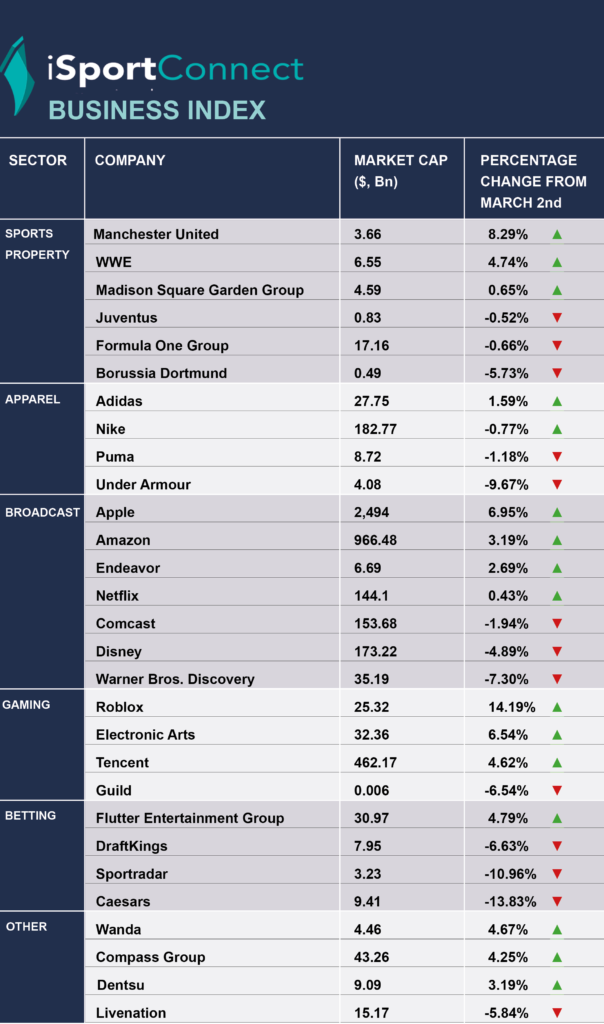
In this month’s iSportConnect Business Index Ian Whittaker, Founder and MD of Liberty Sky Advisors, and twice City AM Analyst of the Year, explains the moves in this month’s index and looks into how general stock market volatility is affecting sport.

The stock markets have been volatile in recent weeks as the collapse of Silicon Valley Bank and the problems at Credit Suisse have dominated the headlines. As such, it has been a volatile month and that is reflected in the performance of the 30 names on our iSportConnect Top 30 stock list with a lack of uniformity even within sub-sectors. It is fair to say that Tech has probably been a beneficiary of the recent turmoil, part because of sector rotation as investor money came out of Banks and part because reduced expectations of interest rate rises is generally favourably to the sector as a whole. Apple is up nearly 7%, Tencent close to 5% and Amazon up over 3% against a S&P500 index that has barely risen. It is also being reflected in a healthy performance in the Games sector, with both Electronic Arts and Roblox performing well, although that reflects more a recovery versus previous lows than anything else. 

Elsewhere, there is no uniform picture to say the least and stock specific factors tend to be the main driver rather than sector rotation. Dentsu, for example, has benefited from growing positive sentiment towards the Agency space but Live Nation has been impacted by recent lawsuits and negative press coverage. The main US Broadcast groups such as Disney and Warner Bros Discovery have suffered over concerns on TV advertising in particular while Netflix has remain flat. In sports property, unsurprisingly, Manchester United was the strongest performer in Sports Property, given the two competing bids for the club. WWE remains an attractive property given its strong franchise. Elsewhere the performance of sports properties were less good but it is worth remembering that names such as Juventus and Dortmund can have limited liquidity which can cause its own issues. That is not the case in the sports apparel sector, Adidas has been pummelled mainly due to the Yeezy debacle and the lost inventory but has regained some ground as investors hope the new CEO can turn things around. Some of that sentiment may be reflected in the poor performance of Puma, which had been as somewhat of a “safe haven”.

Not subscribed to our weekly newsletter? Click here to sign up and receive more content like this to your inbox every week.

So, overall, there is no uniform picture for the numbers against a backdrop of a global economy where things remain uncertain but where the chances of a soft landing are increasing.

Let’s take a look at the index in full:

How to deal with passive churn

In case you’ve been asleep these past few months, you’ll know that we are facing a very complex economy. It’s in times like these that a CFO can sink or swim.

When the chips are down, the most important question is: what kind of a CFO are you?

Because if you are not doing everything to ensure a healthy stream of revenue, that’s a financial fail.

And you want to be the Chief Financial Officer, not the Chief Failure Officer.

Not subscribed to our weekly newsletter? Click here to sign up and receive more content like this to your inbox every week.

That’s why we need to talk about passive churn.

Passive churn is an epic fail

If a customer decides they don’t want or need your subscription anymore, and they cancel it, that’s a fail. If they move to a competitor because they are no longer happy with what your subscription provides, that’s also a fail. 

But perhaps the worst churn of all is the unnecessary churn that could easily have been prevented. That’s passive churn, which basically means “failed transactions.”

When the customer is satisfied with your subscription and wants to stay connected, but they can’t or don’t because of payment friction, it’s a failure that just did not have to happen. 

Deal with churn

The good news is that passive churn is solvable.

In a difficult economy, that 50% can be the difference between sinking and succeeding, between Finance Officer and Failure Officer.

Dealing with passive churn demands the right tech stack to identify and prevent passive churn, and the use of automated mechanisms to rectify failed transactions 24/7 and recover the maximum possible amount of lost revenue. 

Not just “reducing expenses”

When the economy is suffering, CFOs look for ways to cut, cut, cut. Every expense and salary is analyzed, and any ounce of fat trimmed to maximize the financial outlook. 

But reducing expenses isn’t enough. What about analyzing the income that is already owed to you, but not coming in for whatever reason? What about examining the customer relationship with every aspect of the subscription – including recurring payments and renewals – to make sure there is no friction, no disruption, and no excuse for passive churn?

Be revenue focused

The best CFOs take a proactive stance when it comes to passive churn. In these problematic financial times, it’s not just about saving money, but also recovering money. It’s about being revenue focused from every direction.

By Jesus Galloway, Chief Strategy Officer, Vindicia. To find out more about Vindicia click here

SEG3 announce comprehensive two day agenda

SEG3 is thrilled to announce its comprehensive program for the upcoming summit being held at the Emirates Stadium, London, on June 28th-29th, 2023. 

With web3 and immersive technologies offering the opportunity to transform the way organisations interact with their audiences and generate revenue, SEG3 will provide a meeting place for the sports, entertainment and gaming communities to learn and collaborate with the web3 community.

The conference will feature two packed days of interactive sessions, immersive experiences, and deep dives into the latest trends, developments and projects in the sports, entertainment, and gaming industries.

Co-Founder & Managing Partner of Web3 Media Group & SEG3, Joe Condon said: “Despite the wider macro and web3 market conditions, there has been an overwhelming amount of development and innovation across our industries since we last gathered together for our inaugural event in June. This year’s event will not only give the opportunity to learn from these industry-leading organisations, but also the opportunity to see, test and experience the products and platforms that are utilising immersive and web3 technology to change the face of the industries”.

Key sessions will cover themes of how to build communities, how to build your brand in web3, how to maintain control and value of your rights in an open environment, the impact of generative AI on building games and experiences, and much more.

Click here to download the full agenda

Registration for SEG3 is now open. For more information about the event and to register, visit seg3.com.

Basketball England tops latest Race Representation Index

Basketball England has been lauded as the top publicly funded national governing body (NGB) in sport for delivering diversity, equity and inclusion within their working practices – evidenced by the Race Representation Index (RRI) 2022 from Sporting Equals.

Sporting Equals – an independent body that actively works to champion ethnic diversity within sport and physical activity – launched the RRI last year to act as a method of measuring and monitoring sport and physical activity organisations against progress with the race equality agenda, with a particular focus on ethnic representation.

The RRI evaluates and grades data submitted by NGBs across four criteria; Board, Senior Leadership/Management Teams, Senior Coaches and Players/Athletes, and then provides an aggregated grade; ranging from A to F. 

For 2022, Basketball England was the only NGB to achieve an overall A grade. Other notable mentions include the Lawn Tennis Association who rose from 23rd to 13th place, and the England & Wales Cricket Board and Rugby Football Union who debuted this year at 7th and 35th place respectively.

Ama Agbeze MBE, former England Netball Captain and member of the Sport Monitoring Advisory Panel set up by Sporting Equals to manage the RRI, commented; “Basketball England has achieved the highest grading, which is not by accident. 

“They attract diverse candidates through their governance, coaching and talent pathways from a wide range of diverse backgrounds. They also have an EDI committee and have put in place EDI training to support recruitment and retention.”

The 2022 RRI saw limited change among NGBs on race representation compared to the previous year, with the overall average grade remaining at a D.

Densign White MBE, Chair of Sporting Equals commented; “The RRI is a baseline for NGBs to work from and show the journey they are making in delivering DEI in the workplace.

“This will be a long process, but we can see from the NGBs who submitted data for this year’s RRI are committed to the journey. By continuing to improve diversity this will mean the quality and equity of participation within each NGB’s sporting activities will be positively impacted.”

2022 saw more NGBs invited to participate in the RRI, and a greater number of those invited did participate; with this year seeing an 86% engagement rate compared to 2021’s 75%. This highlights that there is more cross-sport commitment to monitoring progress and making actionable changes to improve ethnic diversity in the workplace.

Arun Kang OBE, CEO of Sporting Equals added; “We are hopeful that the RRI will continue to be a useful tool for NGBs undertaking changes to better reflect the UK’s ethnic diversity. The rise in engagement illustrates there is an appetite from NGBs to change and to be transparent with the public. Sporting Equals will be there to support and work with them as they undertake this lengthy journey.”

Airspeeder announce collaboration with Intel

Airspeeder is delighted to announce a new collaboration with Intel that brings the global tech giant’s computing technologies to flying car racing. As the Airspeeder Series’ Official Intelligence Partner, Intel® Core® processor and Intel® Xeon® Scalable processors will help shape the sport to maximise its appeal to racers and fans alike. 

The new strategic sponsorship deal was revealed in a joint presentation at the Motorsport Show in Adelaide on March 25th, where Adelaide-based Alauda unveiled its new Mk4 Airspeeder – the first-ever piloted craft to take part in the Airspeeder race series.

“We’re incredibly excited to have Intel on board. The technology, insight and innovation it’s bringing to Airspeeder will transform our racing series, making it even more immersive and dynamic for pilots and spectacular for our audiences. Just as importantly, Intel’s ‘pervasive connectivity’ perfectly matches our vision of an always-connected, vertical-enabled future. Through the actionable insights provided by AI, we can achieve next-level eVTOL performance and control, which we see as the key to unlocking the future of private air mobility.” – Matt Pearson, CEO, Alauda Aeronautics

Not subscribed to our weekly newsletter? Click here to sign up and receive more content like this to your inbox every week.

“This is another example of Intel continuing to deliver the compute power needed to stretch the notion of what’s possible, make what was once science fiction a reality, and transform the way we live our lives. Helping Airspeeder bring this new concept to life has the potential to not only change the way we race, but also opens up endless possibilities in urban mobility.”- Andrew McLean, Managing Director ANZ, Intel

FIBA debut full video floor with increased opportunities for commercial partnerships

There will be a striking new dimension to this year’s edition of the FIBA U19 Women’s Basketball World Cup with the first ever use of an innovative glass flooring court in an official FIBA competition. 

This exciting state of the art surface will provide a fantastic opportunity for some of the best young female players and teams in the world to become the first to play on it at a flagship FIBA event.

Rigorously tested and having gone through FIBA’s Equipment and Venue Centre Approval program, ASB GlassFloor systems have already been utilized in the 3×3 Pro League in the Netherlands and in pre-season German Bundesliga games, as well as other sporting competitions.

The introduction of the glass flooring court contributes strongly to the successful delivery of one of FIBA’s strategic priorities – namely, to ‘Enlarge the FIBAFamily’ by endorsing and encouraging innovation in basketball.

The LumiFlex court provided by ASB GlassFloor is a full video floor allowing for interactive applications as well as an enhanced show staging with additional options for advertising.

The flooring can also feature the ability to add player tracking to the video floor, making it possible to display live stats and athletic achievements on the floor, providing fans with enhanced interaction and better engagement.

FIBA Secretary General Andreas Zagklis said: “It is with great pride that we look forward to witnessing the premiere of this glass flooring court on the world stage in July. This innovative surface, made possible by the recent rule change, clearly demonstrates FIBA’s appetite to embrace new technology and innovation.


“Delivering on one of our strategic priorities, it also underlines just how much FIBA is determined to advance our sport so we can make basketball even more appealing and engaging for fans, while also enhancing the experience for players.”

Meanwhile, Spanish Basketball Federation President Jorge Garbajosa was also quick to point out the benefits ahead of his nation hosting the FIBA U19 Women’s Basketball World Cup 2023 in Madrid between July 15 and 23.

“We are very happy and supportive of the decision to use the glass flooring court for this important event, especially as we celebrate our 100th anniversary this year,” enthused Garbajosa.

“As a former player, I know the athletes getting ready to compete at the FIBA U19 Women’s Basketball World Cup will now be even more excited knowing they will be the first to play at such a big event on this new state of the art surface.”

He added, “As the host nation, we know it can provide us with additional opportunities from a marketing and branding standpoint, both in terms of engaging with commercial partners and enhancing the fan experience.”

The use of the glass flooring court at the FIBA U19 Women’s Basketball World Cup 2023 was made possible by the decision of the FIBA Central Board last year to implement a rule change to allow the use of LED glass in Level 1 competitions. The glass flooring will be used for all Final Phase games at the Palacio de los Deportes de la Comunidad de Madrid.

Member Insights: Why the NBA’s media rights might not be worth as much as you think

The NBA’s current media rights cycle comes to an end in 2025. Our content manager Alex Brinton takes a look at why they might struggle to get the figure they want. 

It is not for a humble fan of the NBA to tell one of the best-run, forward-looking sports organisations that they have got something wrong, but there are a few issues around the next round of media rights that I think might cause the NBA more problems than they expect.

Record-breaking media rights deals are being done with incredible regularity all over the sports business at the moment, as broadcasters look for something that will guarantee subscribers and viewers – nothing can compete with sport on that front.

The Premier League’s rights are out for tender and there is plenty of talk that Apple plan to enter the market, and that the price is expected to increase from the £5.1 bn deal signed in 2021. 

The NBA are expecting a considerable increase as well. The ten-year deal they signed with ESPN and Turner Media (owned by Warner Bros. Discovery) worth $24bn in 2014 will run out in 2025, and it is reported they are looking for $75bn for the next decade. 

Not subscribed to our weekly newsletter? Click here to sign up and receive more content like this to your inbox every week.

ESPN and Turner have been broadcasting the NBA for over 20 years, and to many Americans the networks are the home of the NBA. Turner’s Inside the NBA show has won a combined 17 Sports Emmy Awards and was inducted into the NBA Hall of Fame in 2021. 

When the tender process opens, the money the NBA are reportedly looking for could price Turner out of the market. Despite handing huge contracts to the Inside the NBA team in October, including a ten-year $317m deal for pundit Charles Barkley, the CEO of Warner Bros. Discovery then said a month later: “We don’t need the NBA.” 

The NBA already have a streaming platform of their own called NBA League Pass which gives subscribers access to every game, every night, for $49.99 a season. Despite this it wouldn’t be a surprise if one of the big streaming platforms decided to get involved,  Apple and Amazon are said to be looking at the NBA as part of their expansions into sport.

So far, so good for the NBA in their pursuit of $75bn. Indeed, around the league journalists and teams are already looking forward to what a TV deal of this magnitude could mean to the salary cap. The NBA has a cap on players’ wages which is currently set at $123.655m per team. Income from media deals has a direct impact on the salary cap: when the income from the $25bn deal signed in 2014 kicked in before the 2016-17 season, the cap was raised by a record $24m. The cap increase allowed the Golden State Warriors to add All-Star Kevin Durant to their roster and create arguably the greatest team of all time. The franchises will be well aware of the opportunities created by a new, lucrative media rights deal. 

I see a few potential bumps in the road, though. 

Firstly, the viewing numbers for the biggest games are in decline. Since the last TV deal was signed in 2014, the NBA finals have attracted an average viewership of 15.4m. The highest came in 2017 when the Golden State Warriors, with the addition of Durant, took on Lebron James and the Cleveland Cavaliers and avenged their loss in the previous year’s finals. 

Of the last nine NBA finals, the last three have had the lowest viewership. The 2020 Covid-related finals pulled in an average of only 7.45m, despite containing LeBron James and his Los Angeles Lakers team winning their first title in a decade. The 2021 finals saw a rise to 9.91m and last year’s finals rose again, but only to 12.4m. 

The NBA All-Star Game is a marquee moment in the league’s calendar, but this year it flopped. Just 4.59m people tuned in to watch the game – an all-time record low. The previous lowest was 6.1m in 2021. This is the biggest decline from one game to another since 2000.

Looking at the figures, is it possible that the NBA have misjudged the appetite of the American public for live basketball?

The second problem the league faces is load management. For those not familiar with the term, it refers to players missing games to rest so that they are at the optimal level for when the play-offs begin. This has led to some star players missing large parts of the 82-game regular season. With an increase in ticket prices around the league, there have been complaints from fans shelling out for tickets without knowing whether or not they are going to be seeing the best players. 

This problem has grown in the last few years. Of the 52 players to be awarded the regular season MVP, 35 have played in at least 80 games. In the 1970s, 90% of the MVPs played in at least 80 games, in the 1980s this fell to 70%. But of the last ten MVP winners only four have played 80 games and this trend will continue this year. 

One possible solution is reducing the number of games, something commissioner Adam Silver hasn’t ruled out, although he certainly isn’t keen on the idea. “It’s something we have been talking a lot about the last few years,” Silver said before Game 1 of the 2022 finals. “I’m not against potentially changing the format of the season, possibly even shortening it a bit, if we can demonstrate that’s going to have a direct impact on injuries.”

If broadcasters can’t be sure the stars are going to be playing in the games they select, or even how many games are going to be in a season, they may feel uneasy about tripling the amount of money they will be paying to broadcast the games.

The NBA is all about its star players. This is one of the things it has over the NFL, because NFL players are required to wear their helmets, while they are on the field even during touchdown celebrations it is harder to market them. With NBA players you can see their emotions at all times.

Stars such as James, Steph Curry, Durant and James Harden are moving towards retirement age: it is time for the league to have a new face. After the Dream Team won Gold in the 1992 Olympics, basketball became a global game and the league has increasingly been filled with foreign stars. But now they are taking over: the MVP hasn’t been won by an American since 2018 and of the five main contenders for it this season four are from abroad. At the moment there are several candidates for taking over as the ‘face’ of the league; only two are American. In addition to this, next year’s projected No.1 draft pick, Victor Wembenyama, is French. The 7ft 4in Frenchman is predicted to revolutionise the NBA and is the most anticipated draft prospect since LeBron James entered the league back in 2003.

This is great for the NBA globally, but it will be interesting to see how the American audiences react to a foreign invasion, and whether or not it will put them off the sport.