
The power of three: the Rugby League World Cup

In October 2022 a World Cup came to England; the Rugby League World Cup to be precise. 

It was a World Cup that was postponed a year due to the Pandemic. It was a World Cup that saw three different Prime Ministers in power. And it was the first World Cup where the national anthem was God Save the King. 

But what really made the RLWC2021 special, was that for the first time in the sports’ 127 year history, the Men’s, Women’s and Wheelchair Games came together to form one record-breaking tournament. 

Over 30 million people tuned in to 61 fixtures broadcast live on the BBC. The tournament was shown in over 150 countries. While new attendance records were set thanks to 500,000+ tickets being sold over the course of a five-week period. 

Exciting and unpredictable, the tournament garnered unprecedented media interest. There were monumental moments and real upsets as local heroes and global stars were made across the Men’s, Women’s and Wheelchair games. 

Not subscribed to our weekly newsletter? Click here to sign up and receive more content like this to your inbox every week.

Particularly England’s Wheelchair Team who arguably stole the show; defeating France to once more earn themselves a World Cup. A well earned victory that epitomises the culture of the tournament, as the RLWC 2021 set out to be ‘the biggest, best and most inclusive World Cup ever’. 

So, what was the logic behind having the Men’s, Women’s and Wheelchair Games appear under one World Cup? 

Women’s Sport is undoubtedly having its moment (and long may it continue). Female teams and athletes are finally being championed in the way they deserve. It’s so encouraging to look at Women’s Football and see their own tournament, sponsors, superstars, fans and culture evolving around the Women’s game. So it’s only natural to wonder why Women’s Rugby League didn’t have a stand alone gig too? 

The simplest answer is numbers. From a funding perspective, having all three tournaments played together was a logical decision. The World Cup required Government backing, and this structure meant we could share stadiums, pool resources and that the Men’s, Women’s and the Wheelchair games would benefit from overall tournament awareness. After all, while Rugby League is one of Australia’s favourite sports, it isn’t as front of mind in the UK. To fill stadiums, we needed to not only to bring all rugby league fans together; but go beyond the core fanbase by getting the country to care. Uniting the Men’s, Women’s and Wheelchair games gave us the best chance of doing that. 

Our theory was, that whatever the discipline, being a fan of sport means certain things. It means you appreciate stories of human endeavour. It means you’ve likely experienced sports’ unique ability to bring people and communities together. And it means you’re likely to take pride in representing the Nation. You might not be a follower of Rugby League; but if you’re a fan of sport, you’re likely to get behind a World Cup that champions inclusivity. 

Our theory proved true. Social stats and ticketing data showed that new audiences were being introduced to Rugby League. Better yet, both existing and new fans were choosing to attend a mixture of both Men’s, Women’s and Wheelchair fixtures. Logistics supported the inclusivity and shared success of the tournament. Rather than hosting the World Cup in one city, it was shared across the country; meaning wherever you lived, you had access to a game (and from as little as £2 a ticket). Alongside the big games, advertising budget was reserved to promote key fixtures like double headers which were designed to encourage fans to embrace all three tournaments. 

Scheduled for 2021, the RLWC was postponed a year due to the pandemic. Its original campaign had focussed on ‘assembling your squad’ and the social side of the sport. While ticket sales were important, we also set ourselves targets that supported the tournament’s legacy and the future of Rugby League in England; so we made a strategic gear change to promote inclusivity. 

What sets Rugby League apart is the grass roots impact of the game; it’s a prime example of sport as a force for good. That is where our campaign, ‘This Is Real Impact’ came from. A nod to the beautiful, full contact nature of the sport; and the real life impact the sport has on and off the pitch. The impact of the RLWC2021, was over 25 million invested back into community clubs. An investment that will pay for local leagues and the ever important community officers that provide vital support and training for young players. And an investment into inclusivity that will see more and more women and wheelchair players welcomed into the game. 

Even the RLWC2021’s branding was designed to be inclusive. For example, the iconic trophy logo was built from coloured ribbons; each colour representing each tournament. While advertising was split between being tournament and fixture specific, it was important that Men’s, Women’s and Wheelchair was represented equally. 

Presenting disability and Women’s sport was a huge cultural responsibility we didn’t take lightly. Our art direction was gritty, rare and real. While our visual style made sure that athlete’s from all three games were represented on the same level. Our TVC didn’t shy away from disability, putting players like Tom Halliwell and Jodie Boyd-Ward in the spotlight, showing off their inspiring mental and physical strength. 

‘This is Real Impact’ also cut through on social, which championed individual impactful stories from players. Resulting in over 194 million social media impressions. A testament to the culture of the tournament; big names from the men’s game used their social platforms to shout about and divert attention towards Women’s & Wheelchair fixtures. Deciding to host three tournaments under one World Cup was a practical decision that reflected the ethos of the event and the sport itself. From day one, the tournament had key values; World Class, Authentic, Bold, Brave and Inclusive – the key pillars that saw the three tournaments played together. Bringing the Men’s, Women’s and wheelchair was how we got the Nation behind the Rugby League; helping us grow the game in the country it was born.

By Niamh Deenan, Senior Strategist for Cravens. To find out more about the work Cravens do click here.
Wimbledon still most popular British summer sporting event despite fall

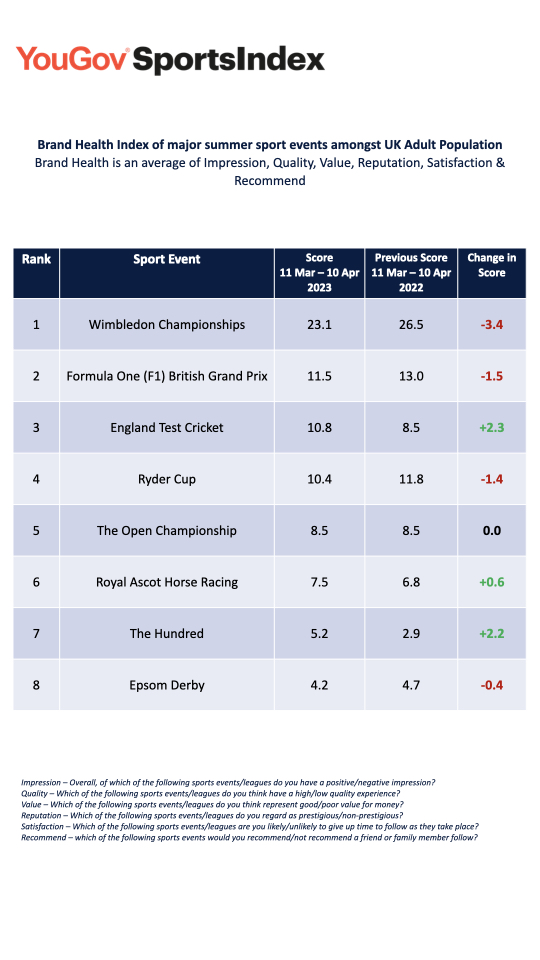
It is starting to get a bit warmer outside which means that the sporting summer in the UK is on the way in a real way. In this week’s index powered by YouGov we are going to be looking into the eight pillar sporting events of the summer and analysing how their brand health score has changed over the year.

Wimbledon’s Brand Health score is by far and away the highest of any of the events. It scores incredibly high on the quality and reputation metrics along with the high impression which will be down to it being only one of two events on free-to-air TV. However, Wimbledon has seen the biggest drop in score from last year to this year. In the individual metrics the biggest fall is in value which could be related to the cost of living crisis that we are seeing in the UK and people being less likely to part with their cash when it comes to attending the championships.

The England Test Cricket team have revolutionised their fortunes in the last year. A new coach, a new captain and a new style of play have led to them winning ten of the 12 Test matches they have played. We are also entering an Ashes summer, a Test series against Australia always peaks the public’s interest. Both these could factors have contributed to the team being the biggest rises in the Index. 

Not subscribed to our weekly newsletter? Click here to sign up and receive more content like this to your inbox every week.

Staying on cricket, The Hundred has seen a big increase as interest in the tournament appears to be holding firm as we enter its third season. This is particularly interesting because it seems little has changed from last year’s tournament apart from the increased availability of England’s international stars. Viewing figures dipped from the first tournament to the second – it will be interesting to see what happens this time.

Impression – Overall, of which of the following teams do you have a positive/negative impression?

Quality – Which of the following teams do you regard as prestigious/non-prestigious?

Value – Which of these teams do you think is worth/not worth the time spent following or supporting?

Reputation – Which of the following teams would you be proud/embarrassed to work for?

Satisfaction – Which of the following teams make you feel satisfied/dissatisfied as a fan?

Recommend – which of the following teams would you recommend/not recommend a friend or family member follow or support?

Member Insights: Broadcasters need to sit on the sofa with the casual fans to understand what they want

In this Member Insights piece Richard Brinkman looks into why broadcasters and rights holders need to get in the heads of the casual fans.

April is a fantastic month to be a sports obsessive in the UK. Not only does the spring indicate the start of the cricket season (obviously good) and sunnier days ahead (obviously great) but it also means a golden overlapping period with the climax of the football and rugby seasons (good both because they are exciting and the marathon sagas are coming to an end!). 

Add into this mix totemic annual events like The Masters, Grand National, the Boat Race and the IPL. The viewer is really spoilt for choice in terms of what to give time and attention to. In addition, we also now have the choice to focus on the greater profile and coverage that standalone Women’s events such as the 6 Nations enjoy.

This embarrassment of riches and the challenge of giving all these great sporting events the time and attention that they deserve led to me recently being forcefully struck by how important it is for a sport to make itself as available and visible as possible. And then, preferably, in the most positive light. In a few moments of slightly alarming clarity I found myself experiencing and viewing sport not through a professional prism but rather as a bog-standard consumer with all the joy and frustration that comes with it.

This issue sounds obvious but, from what I am seeing, is seemingly often under-rated. The quality of decisions around this consideration needs serious thought if they are to garner the time, attention, eyeballs and credibility that will make or break their ongoing success and relevance. The established way of thinking about a mix of free-to-air, pay, stream and social media considerations seems very homogeneous and, in some cases, outdated.

Not subscribed to our weekly newsletter? Click here to sign up and receive more content like this to your inbox every week.

Very few sports can raise enough revenue from the echo-chamber of their relatively small number of “avid” fans to ensure their long-term survival at current levels of spend and future ambitions. Appealing to and winning over the attention of large numbers of casual or intermittent followers has been, and will remain, the key to being a major event or being relegated to a niche interest.

The supply side orientation of thinking about broadcast access (ie which mix of channels and routes to market will give me best £ vs eyeballs) needs challenging and, to my mind, some reconsideration. After all, this is a dynamic environment and the consumer consideration is not driven by channels but rather by want and ease. This has often been characterised as chicken and egg – easy access drives want but nobody wants to show on free-to-air or widely viewed channels content that is not wanted. However, over time and slowly, behaviours do change. And I would argue that frictionless access to prime content should now be the prime consideration.

A couple of weeks ago with the EPL entering its final “run in” (is it me or, like Christmas, does this seem to start earlier every year?!) I thought I would settle down with my son on a Wednesday evening to watch Man Utd v Brentford. I thought this might be a decent game and an interesting barometer as to where Utd were after their Anfield thrashing. Sky had selected to show the only other game happening that evening, West Ham v Newcastle, as their live game. Even with an intimate understanding and some historical involvement in how TV rights packages work I instantly turned (naively) to BT for the coverage. Obviously, none was forthcoming!

I was nonplussed, my son was not bothered. He simply went on his laptop and within 30 seconds had sourced the US live footage of the game. And whilst watching on a laptop is suboptimal this was made up for by the impressive US coverage. I was amazed by the high standard of commentary and punditry – so much so that I would not hesitate to source coverage again in this way if necessary.

This was my first “live” experience of piracy – it’s a real thing and serious precisely because it is so simple. With what we now know of the music industry and their initial stance regarding Napster, Spotify etc it seems an antiquated approach to deny UK broadcast of EPL matches because of scarcity supposedly driving up value or fears regarding attendance. Surely EPL clubs have more faith in the live experience than that? And if they don’t, they should look at what they are providing for their (high) paying customers. Equally, Covid let the genie out of the bottle when it comes to viewing any EPL match in the UK. 

Bearing this in mind I was delighted to read subsequently that the next round of UK TV packages are likely to offer 260 live games (of a total of 380), rather than the current 200. Even better that these matches are likely (why, by the way, are the PL so reluctant to comment on this once the reports come out? – it just looks lame!) to be spread across 4 parcels rather than the current 7. Both are sensible moves that will likely mean less friction and hassle for consumers. However, it looks likely that the Saturday 3pm “black-out” will remain despite it being, in effect, pointless when large-scale piracy is so straightforward.

In a similar vein of unnecessarily anachronistic broadcasting policies recent events at The Masters were laughable whilst simultaneously being completely infuriating! The delays due to storm interruptions subjected the Sky viewer to watching 3 folksy middle-aged men talk about golf around a plastic schmaltzy fireplace for 2 hours rather than showing what little action there actually was on the course. 

Apparently, we are only “allowed” to watch what are deemed to be “feature” groups. For as widely respected an event as The Masters, who are generally held up as an exemplar of doing the “right things”, this was as close to brand self-harm as you are ever likely to see. In an age of always on, instant access social media such an approach to broadcasting rights seems not just archaic but downright damaging. I am sure millions did as I did and found one of the many other sporting events or myriad other entertainment properties available to watch instead. If I can watch every match live at Wimbledon I fail to see why I cannot watch every group at Augusta?

In summary, I would encourage all rights holders (and, indeed, the broadcasters on the other side of the table) to think about their sport from the point-of-view of the casual fan – not just the noisy minority on Twitter or your owned social channels. You are in a highly competitive entertainment environment and creating unnecessary friction around access can only alienate and erode your brand equity. 

One final example – It may seem conceptually like a good idea to build value with the BBC by preventing ITV showing live replays of a 6 Nations game on their streamed ITVX hub until after the BBC’s Rugby Special programme on a Sunday evening. In reality, from the consumer perspective it is just irritating – thinking that creates friction and suits the broadcaster over the viewer. 

If someone wants to watch the entire match live, let them do it when they want to – if they want to watch highlights they would have selected that option instead anyway. Do not make life easy for pirates by building their market for them through artificially created barriers that serve no practical purpose for the broadcaster or your sport.

Meet the Member: “Generative AI will likely lead to more firms bidding for more contracts”

Despite being a massive part of the sports business the procurement process is still a mystery to some. To shine a light on how it works and the current trends in the industry we caught up with Nour-Eddine Boufertala, Head of Procurement for the ECB.

So Nour to kick us off, take us through your journey in sport?

I started my recreational sport journey as a boxer during my early years. I then transitioned into playing basketball and was actually part of the Young Academy of one of the elite basketball teams in France for a few years before going to Spain and playing in Barcelona. 

Like so many people who work in our world I do think some of the traits I picked up from playing have helped me in my professional career.I am still a massive sports fan – it is the first thing I check when I get up in the morning.  

On the professional side, I started my journey in sport when I joined the England and Wales Cricket Board (ECB) in 2019 to build the procurement department. My previous procurement roles had been in the automotive, aerospace and rail industries.

Since 2019, I have realised the growing importance of procurement in the sporting industry but also the lack of professional procurement expertise in this sector. In 2022, I started Oben Sports and Events Consulting to support sporting organisations to improve and develop their procurement journeys. Through this I have been fortunate to work on various exciting events like the Hundred but also supporting the Football Foundation (The Premier League, the FA and the government’s charity that helps communities improve their local football facilities through football grants).

What is it about procurement that attracted you?

The impact you can have on an organisation is extremely challenging and rewarding. The procurement department is right at the centre of the business. This job is also fitting with the skills I have developed over my studies. I graduated as an industrial and chemical engineer where I learned to solve and find pragmatic solutions to complex problems. It helps me a lot day-to-day.

Not subscribed to our weekly newsletter? Click here to sign up and receive more content like this to your inbox every week. 

I was also attracted by this fast-forward moving industry where we need to be on the top of the latest market innovation in order to bring more value to our own organisation. It means that we need to be constantly open to new ideas.

Being a massive sports fan makes it even more exciting to be part of the industry and support different sports like cricket and football. I love how it is a bit of a small world and everyone has the same passion.

How does your role as Head of Procurement fit into the ECB’s wider work?

My role is fully embedded into the ECB strategy, Inspiring Generation, to grow the game with the aim to inspire a new generation to believe that ‘Cricket is a game for me’. The ECB is committed to ensuring cricket is for everyone, connecting communities and improving lives by bringing people together through their shared passion for the sport. We are taking proactive action around equity, diversity, and inclusion (EDI) to create a game that belongs to us all, now and long into the future. 

The procurement function is involved in all projects that are developed to deliver the company wide strategy. One major success is our mass participation programmes, All Stars and Dynamos; through a robust supply chain, hundreds of thousands of children and volunteers have engaged with this programme and it has transformed loads of clubs up and down the country.

Talk to us a bit about the procurement process?

Generally speaking, the procurement process is divided into these parts: identification of the internal requirement, sourcing the market, negotiation of the contract terms, appointment and supplier relationship management

However, every procurement strategy/approach is different, it will depend on various factors like the category (product, construction, services,) and type of procurement (private or public).

It is also key to leave some room for manoeuvre for the suppliers to share their innovation, add values. We always must remind ourselves that we are in a fast-moving market and the innovation will come from the market. 

What are some of the challenges you are facing at the moment?

The most challenging aspect about my role is to make sure we are receiving the best value for money by including various factors like EDI, sustainability, and innovation. Procurement is not a transactional function but more than ever strategy-oriented one.

As a governing body, I must make sure we are receiving the best service, quality, and price from our partners in order to continue developing ourselves and investing the savings into our various programmes.

Also, the markets are becoming more volatile, with prices fluctuating, supplier shortage, Ukraine war and the post-Covid effect. All these challenges have pushed me to think outside of the box and explore unconventional ways of delivering the best possible outcome.

Sustainability is obviously a massive thing in sport at the moment, how much thought do you put into that?

Firstly, the ECB is committed to tackling climate change and promoting environmental sustainability. We have been taking action since 2010 to manage and reduce cricket’s environmental footprint and, more broadly, we recognise that all sports have a powerful platform, and a responsibility, to show leadership and inspire action from others. We can see the impact of climate change has on cricket, where extreme weather events are causing increased disruption. 

More widely than the environmental impact, as part of our EDI strategy, we are on an ongoing journey to further our ESG (Environmental, Social and Governance) commitments across environmental sustainability; equity, diversity & inclusion; social impact; and good governance across our supply chain. The procurement function is leading a pilot program with the ECB’s key suppliers and stakeholders to understand the collective impact of the ECB and its suppliers and stakeholders across these areas.

Going forward, we are working on a robust assessment process that will cover all the above ESG points with the adequate weighting at tender stage.

What sort of trends are you seeing in the procurement industry at the moment?

I would say AI. Artificial intelligence has always allowed procurement organisations to solve complex problems more efficiently or effectively using smart computer algorithms. AI can be embedded into a number of software applications from spend analysis to contract management and strategic sourcing.

Today, generative AI is changing the AI game, taking assistive technology to a new level, reducing application development time, and bringing powerful capabilities to nontechnical users. It will help every organisation to streamline their process, increase the exploitation of their data and ultimately reduce their costs.

On the public procurement side, writing bids for contracts takes time, investment, and resources, but by enabling suppliers to create bid text more quickly, generative AI will likely lead to more firms bidding for more contracts. This could lower barriers to entry for suppliers that may otherwise lack the resources to apply for government contracts, leading to more competition and better outcomes for the government. On the flip side, it is also likely to mean the government having to process a larger volume of bids and creates the risk of suppliers submitting more speculative bids due to the lower effort required. 

But as with every new technology, we must proceed with eyes wide open, because the technology today presents many ethical and practical challenges.

iSportConnect SportsTech Index powered by SportsTech Match – 13/4

Who’s hot in Sports Tech? Who is doing deals, launching new products and generally doing some of the best work in the sector? That’s what the Index attempts to dig into. Whether established players or the up-and-coming stars, we go a little deeper for you…

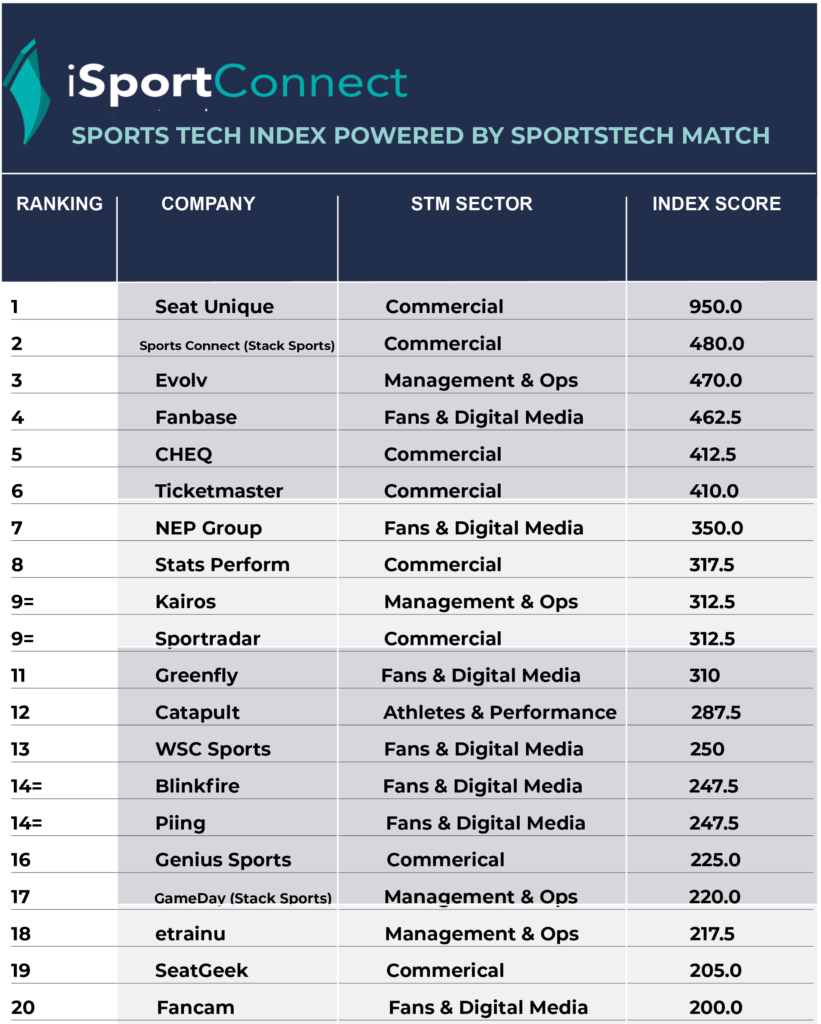
The second edition of our monthly sports tech index has produced an eclectic mix of sports tech companies representing all four SportsTech Match sectors. 

SeatUnique held on to the number one spot this month following the announcement of two recent deals in rugby and fellow ticketing platform, Ticketmaster (#6) also picked up points following the recent announcement of a major football club deal. 

Sports Connect (#2), collecting maximum points for two customer renewals in April, are the highest new entry this month and are joined by fellow Stack Sports brand, Gameday (#17) in the top 20.

Other new entries into the top 10 this month include venue security business, Evolv (#3), social payments platform, CHEQ (#5), and media technology provider, NEP Group (#7), all of whom have announced deals and/or customer renewals over recent weeks in the US. 

Completing our top five this month is fan engagement platform, Fanbase (#4) who announced new deals with two football clubs in the UK.

Catapult (#12) are a new entry into the top 20 this month following the announcement of a contract extension with a Dutch football club as well as recent product announcements. Their index score has been propped up by the award of points for a steady stream of new business wins, customer renewals and product updates over the last 12 months.

Finally, a special mention goes to OTT streaming platform, Stream Viral (#31) who are our highest climber on account of having collected full points for a verified 5-star customer rating as part of SportsTech Match’s Ratings & Reviews programme on top of points awarded for recent new business wins.

Want to know more?

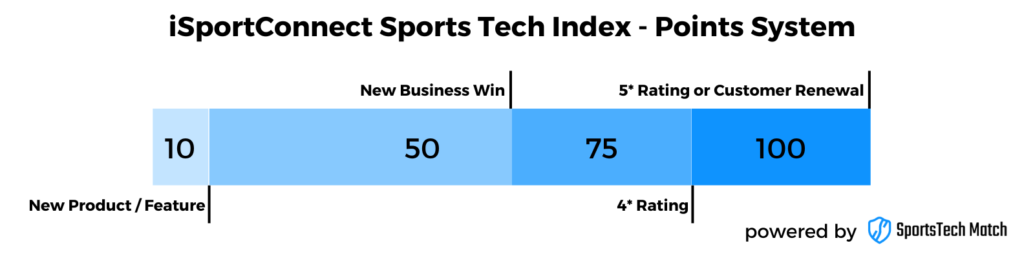
The iSportConnect Sports Tech Index is designed to help rights owners and investors quickly assess who is “hot” from a product and new business perspective and provides sports tech vendors with an incentive to focus their PR announcements on what matters to the market. It follows a simple scoring system (see below).

The iSportConnect Sports Tech Index will be published on a monthly basis on iSportConnect.com (subscribe to the newsletter here to stay informed) with in-depth analysis provided by SportsTech Match every 2 weeks (subscribe to the STM newsletter via sportstechmatch.com).

Click here to read more about how the Index is calculated.

Sported Rendez-vous is going back to Miami for highly anticipated 2023 event

After a sold-out event in 2022, which introduced a more streamlined 2-day format, SPORTEL is returning to Miami on 9 – 10 May, following directly on from the F1 Miami GP weekend. SPORTEL Rendez-vous Miami will once again connect international sports industry decision makers at the newly refurbished Miami Marriott Biscayne Bay venue and present a buzzing exhibition and market floor, multiple networking events and an innovative conference summit.

Our successful SPORTEL Rendez-vous series concept, also recently held in Bali, has ensured SPORTEL remains the global flagship event leader for the sports media and sports tech industry, with events bringing together international communities from all markets and diverse continents, in a more intimate and cost-effective format, which complement SPORTEL Monaco”, said Laurent Puons, CEO of Monaco Mediax.

The significant participant list, with over a 15% rise on 2022 attendees at the same period, include many long-standing clients: BeIN Media Group, Bundesliga International, Canal+, CAA Eleven, DAZN, Deltatre, FIFA, Formula One, CAA Eleven, NBA, NFL, MLB, Pitch International, Fox, Sportradar, Magnifi, PGA Tour, Premier League among others. Plus, first time attendees – Corporation Santiago, Bubble Agency, Caribbean Premier Sports Limited, Prodena, Sportsedtv, Zapping, Creator Sports Network, To The New Singapore, Canela Media Inc, Brand Brigade, Bluestone Equity Partners, Minuto 90 Films and many other newcomers to a SPORTEL event. 

More information can be found on the list of Registered Companies via the event website and on the newly launched SPORTEL Connect networking app*.

Participants at the 2023 event will discover new ways to monetize sports content and disruptive technologies which will be showcased on the market floor and in the conference summit. Topics will cover private equity investment, the growth of F1 and motorsports in the US, OTT, live sports streaming and FAST channels, media rights in women’s sports, evolutions in production and content delivery, AI data, the cloud and much more.

The upcoming event will feature executive speakers from leading organisations such as Bluestone Equity Partners, Florida Sports Foundation, Fox Deportes Studios, Harmonic Inc., Snipitz, Spiideo, Sportradar, Magnifi, Telstra Broadcast Services, The Raine Group, ViewLift with many more to be announced.

More details about the 2023 programme can be found on the website: Official Programme 

Press accreditation on: https://press.mysportel.com/wizard/step_1

Formula 1 announce multi-year deal with Paramount+

Formula 1 has announced a multi-year promotional deal with Paramount+ that will see the subscription service become an official partner of the sport.

As part of the arrangement – which follows on from a successful sports and entertainment collaboration between the two brands last season – the streamer’s popular content offering will come to life at F1 events around the world, with Paramount+ hit series, blockbuster movies and beloved characters taking centre stage inside Fan Zone areas.

Additionally, the partnership will include Paramount+ branding on track and physical trackside signage, digital sponsorships and promotional opportunities in Miami, Montreal, Spielberg, Silverstone, Monza, Suzuka, Austin, Mexico City, Sao Paulo and Las Vegas.

“This partnership exemplifies Formula 1’s ongoing commitment to exploring new avenues to help promote the sport and appeal to new audiences,” said Brandon Snow, Managing Director of Commercial at Formula 1.

“Paramount+ and the content on its platform are hugely popular and like F1 has experienced rapid growth in recent years.

“Together, we will use our global platforms and collective expertise in entertainment to further enhance the fan experience and take both Formula 1 and Paramount+ to new levels.”

Marco Nobili, Executive Vice President and International General Manager at Paramount+, added: “Paramount+ continues to seek new, innovative ways to reach our global audiences, and I am confident this partnership with Formula 1 will continue to support our growth globally.

“Becoming an official partner of Formula 1 means bringing the Paramount+ brand and all our characters to life for hundreds of millions of fans worldwide.

“Through this global deal the worlds of motorsport and entertainment will come together, resulting in powerful storytelling opportunities on and off the grid.”

Can esports become mainstream?

In this article EngageRM’s Brayden Scott is looking into whether or not esports can ever move from a niche community to mainstream.

30 years ago, if someone had said that playing video games at a professional level would merit global fame, big name sponsorship and millions in funding, they would have been laughed at. 

Right now, in 2023, esports is the biggest it has ever been and growing rapidly, with the opportunity to rival some of the growth we are seeing in more mainstream sports. However, like any emerging industry, it has its challenges. 

A Quick Overview

Esports stretches over thousands of games across countless formats. When it comes to online team sports, large continental tournaments will be held for games. Just as a season for the NFL has teams play one another for points, the same goes with most team esports.  

Not subscribed to our weekly newsletter? Click here to sign up and receive more content like this to your inbox every week.

Esports is generally viewed on streaming platforms YouTube and Twitch, however, for world tournaments, grand finals, and other major deciding games, it will often see a packed-out arena with fans able to watch their favourite gamers in person. 

The $$$ 

So, what seat at the table does esports have in the wider sporting landscape?   

Well if you had of asked ESPN’s former president John Skipper a few years ago, he wasn’t sold. 

“It’s not a sport – it’s a competition”, said Skipper back in 2015. Yet ESPN acquired broadcasting rights for multiple esports only a few years after that statement. 

Gaming’s valuation is US$365.60bn in 2023. For context, the entire sports industry in 2023 sits at US$512.14bn in 2023. Esports has seen a substantial increase in spending and viewership in the past few years, especially booming over COVID when everyone’s participation in competitive sport was limited to their couches and bedrooms.  

A handful of professional sports clubs have signed esports deals, creating a digital team for their given sport. Billions of dollars later, has esports established itself as much as some had hoped? 

Why the growth has slowed 

Despite all the influx of cash, it hasn’t been smooth sailing for esports. Esports has seen a huge number of layoffs recently. Major esports teams like 100 Thieves, Team Liquid, Immortals, OpTic and numerous others saw several staff cuts, much like every other industry in the current economic climate. The most notable being “The Guard” who released ALL their employees. Many have come to the realisation that the profitability of an esports organisation does not make financial sense currently, needing to spend more on talent than any prize pool, merchandising or brand deals could ever bring in.  

Despite the growth in gaming and esports, the revenue streams for these companies are not growing alongside. As these teams are usually owned by larger corporations, the first areas they cut from their business is sponsorship spend for these teams. 

A recent win however has been the announcement of the first ever Olympics esports in 2024 in Singapore, gaining a larger audience and mainstream coverage of the event. And while that might attract new fans, the question remains: will this culturally connect with its existing fans and its communities? 

Cementing itself 

What is missing from the teams and organisations is a feeling of culture. Traditional sports teams have the added bonuses of long-standing history’s and some of the most marketable and recognisable athletes in the world.  

But esports has a lot of work to do on their brand and cultural identity. Without a unified governing body, it is a bit of a free-for-all, managed by a variety of companies and game owners. That ground up approach does create a bit of brand chaos, though there are certainly some huge benefits. 

Esports has seen huge gains from forming communities with players and influencers associated within the sport. With watch-along and players sharing their personalities, they can create a closer relationship with their fans. 

For more insights like this sign up to EngageRM’s newsletter The Crowd here

Esports is also borderless, with communities stretching across the globe for any game and team. It’s low cost for viewers having free to view for all audiences, which has enabled it to grow a fanbase considerably faster. Not to mention a low barrier of entry into the sport, allowing anyone to play the game whenever they want from anywhere in the world.  

Esports having a largely online following allows for the most interactive viewing experience of any sport. The ability to be able to spectate the games however the viewer pleases, gives esports a benefit it hasn’t yet fully tapped into.  

Instead of being limited to a single camera, decided by a broadcaster, you can watch every centimetre, every angle, all at once. Allowing viewers to interact and create their own viewing experience is a new level of engagement that isn’t possible in other sports. 

Finally, it must focus on understanding its fans. Currently an esports fanbase is not attached to a club like a group of Man Utd season ticket holders at Old Trafford.  

Esports fans’ sense of belonging and connection comes from the game itself and watching the best players battle it out – not necessarily from the outcome of the teams that are participating. Esports audiences largely consist of teenagers and young adults, which mainstream sports are desperate to attain that demographic of fans, differentiating esports with mainstream sports. 

At the heart of it, esports is a young industry. In a world where technology and digital connection is continuing to move at breakneck speed, it is well positioned to ride a wave that could push it into the mainstream. 

To find out more about EngageRM click here

The House View: Gen Z loves violent sport

One of the benefits of our role is that we get to sit at the table and engage with Rights Holders and experts and listen to what is happening. The following article comes from conversations between apprx 50 such Rights Holders, Brands and Broadcasters…

So, before we tackle the headline we should ask. 

Do Gen Z want to engage with sport? 

As ever this is nuanced but the positives seem to be that:

  • 53% are sports fans and on average actively watch x4 separate sports leagues
  • 87% are interested in Sport video content
  • 30% of all their video subscriptions are for Sport

The negatives are that they want to consume it very differently and it appears there is a disconnect between marketeers and their target audience. For more insights from the report click here to email Max Signorelli at Omdia.

How are they watching?

No great shock here as obviously short form social video is king/queen and the consumption skews significantly to the smartphone, so I doubt there is much to learn for anyone here.

Will they pay?

Aside from some of the nonsense often written, Gen Z fans are willing to pay for content. But they also pirate content more than other groups and this probably has a lot to do with the fragmentation of paid sports content and the ease of finding illegal content compared with sport that’s behind paywalls. We don’t know how this will change over time, but marketeers will have to be very agile to retain this audience.

The disconnect.

Speaking to multiple execs it became clear that Rights Owners themselves recognise:

  • they lack agility and the ability to be on-trend
  • they don’t talk the right language 
  • they often lack the appetite to be brave and take risks
  • too many think it’s about being transactional and finding ways to quickly cash in on Gen Z

Essentially there is a clear disconnect between decision-makers and the Gen Z market they are trying to reach. Why? Quite simple – it’s because they don’t really understand how Gen Z thinks and behaves. 

2 very simple areas were highlighted.

  1. Organisations need to hire more Gen Z people to blend with as professionals that truly know the space 
  2. They aren’t properly looking at what the data is telling them as many admit that they defer to young family members for their Gen Z insight.

The pitfalls

  • Advertising is growing fast in the streaming market but reaching Gen Z is tricky because use of ad blockers is so prevalent.
  • There is a tendency for traditional sports to overlook the long term value of Gen Z. This goes back to Gen Z feeling very targeted which turns them off and the feeling that sports are trying to cash in on them as the next big golden goose fan group. They are absolutely the next fan group but a more considered, long term approach around monetisation and allowing Gen Z to become fans first before looking to monetise is the better approach. 
  • Unfortunately, sport has a poor track record of looking for the immediate cheque book rather than allowing Commercial Directors, CMOs and CTOs to take 5-year views. Just look at how the web3 space was approached.

What are they watching?

If you strip out the Premier League and Champions League giants, then 7 of the next 9 most watched sports by Gen Z have violence or combat

  • Boxing: UFC: WWE: NFL: Call of Duty: League of Legends: Fortnite
  • Which takes us back to the article headline – Violence – whether physical or digital. It’s an interesting insight into the type of sport that Gen Z is attracted to and clearly moving away from traditional sport like  football, cricket, tennis, golf. Are you listening marketeers? Only NFL would be considered traditional but it has physicality at its core
  • There are many thoughts why combat, and violence plays such a major factor and it is likely that entertainment (specifically movies and TV series) are far more violent these days therefore young kids find it culturally standard – Squid Games anyone? 
  • A report from the American Academy of Pediatrics found that violence in films has more than doubled since 1950 and gun violence in PG-13 films trebled since 1985 
  • A study of the 95 most popular US video games showed 83% featured violent themes.

The solution

Content

  • The single phrase that constantly gets mentioned is around “Building Stories”
  • There is no silver bullet when it comes to engaging Gen Z audiences in sports but to capture their attention, it’s clear that sports that have grown via digital have far greater reach – hence influencers playing such a role in boxing, MMA and of course esports. They tell stories of the athletes. And when that storytelling combines with violence/combat then you have the perfect combination
  • For further evidence of great efforts around stories just look at the recent Wrexham Twitter and viewer numbers – all about a story and the characters behind a club. It’s more about them than the fact there is another fixture on the horizon.

By Sandy Case, CEO of iSportConnect

The View From The Middle East: The top 10 drivers of sport in the Middle East

In this View From article Donal McElwee, Head of Middle East and Africa for Portas Consulting looks into what is driving sport in the Middle East.

Sport is booming in the Middle East and will continue to accelerate. A recent World Economic Forum report suggested that the Middle East’s sports industry is expected to grow by 8.7% by 2026 – compared with global sector growth of 3.3% over the same period. This is driven by a significant public investment, underpinned by both economic and social policy ambitions, and increasingly supported by local and global private sector investors. 

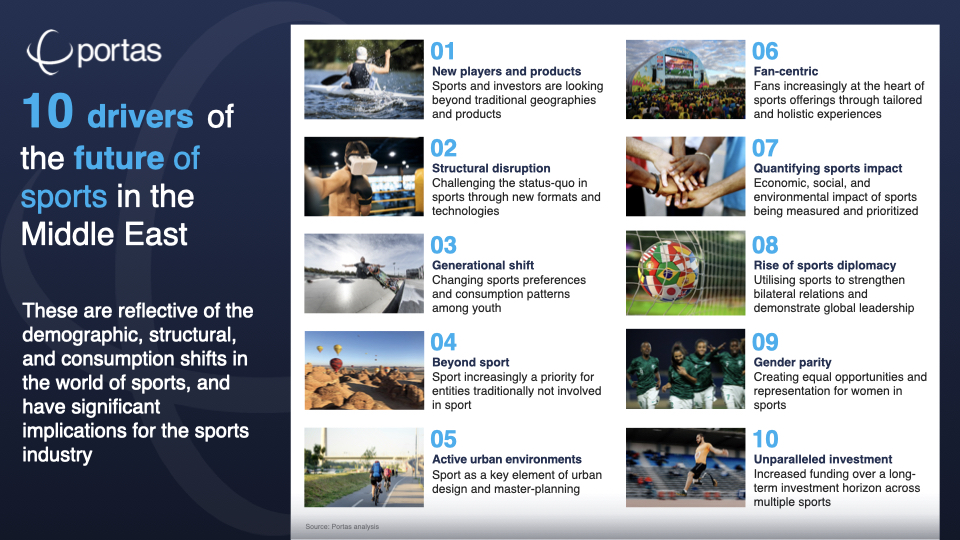
This article highlights 10 drivers of this growth in the Middle East. These are reflective of the demographic, structural, and consumption shifts in the world of sports, and have significant implications for the sports industry.

1. New players and products – Sport is looking beyond traditional markets and evolving its product to capture the next big opportunity.

  • Geographies: Rightsholders are expanding their calendars beyond Europe and the US e.g., Saudi Arabian GP and Qatar GP added to F1 calendar since 2021 
  • Product: Traditional sports are evolving to capture new audiences e.g., Influencer boxing – Tommy Fury vs Jake Paul sold over 775k PPV buys as part of Diriyah Season 2023 in Saudi Arabia

2. Structural disruption – New entrants, formats and technologies are challenging the status quo:

  • Competitions: Long-established tournament structures are being challenged e.g., LIV offering an alternative to the PGA for professional golfers and fans.
  • Consumers: Technology is allowing the lifetime value of sports consumers, which has historically been fragmented, to be captured and monetised more successfully e.g., AlHilal Blu mobile app is enabling the Saudi club to have a direct-to-consumer relationship with its large local and global fanbase.

3. Generational shift – Youth are participating and consuming sports differently to previous generations, accelerated in the Middle East by the uniqely young demographics: 

  • Participation: Non-traditional sports are thriving e.g., padel has grown 40-50% annually from 2019-2022 in the UAE 
  • Consumption: Sports content is being viewed differently e.g., usage of short-form content platform TikTok has increased from 24% to 60% from 2020 to 2022 among Saudi youth

4. Beyond sport – Sport is no longer just for dedicated sports entities, with non-sport ministries, cities, destinations and investors also recognising its value:

  • National objectives: Sports supports wider economic and social objectives for governments e.g., Saudi Vision 2030 requires multiple entities to deliver on sports objectives, to deliver quality of life, health, job creation, economic, education and tourism outcomes.
  • Measuring success: Sports is increasingly included as a KPI for non-sports ministries e.g., minimum physical education policy provision of 150 minutes per week for all schools in Dubai.

5. Active urban environments – Sport and physical activity is increasingly integrated into urban planning from the outset and viewed as fundamental to liveability and quality of life:

  • Master planning: Sport facilities are an essential part of the master planning of large-scale megaprojects and are being developed to leverage the unique landscapes e.g., sport is 1 of the 16 economic sectors for NEOM, with aquatic and adventure sports among those benefiting from the coastline and mountains
  • Public facilities: Cities are creating more public spaces for sports to improve the quality of life for citizens e.g., Riyadh Sports Boulevard being developed with 4.2m sqm of green and open spaces, 135km of cycling paths, and over 60 sport facilities 

6. Fan-centric – Fans are increasingly placed at the heart of sports offerings with tailored and holistic experiences:

  • Immersive experiences: New sport events are putting fans at the heart of the action e.g., GridPlay during Extreme E Desert X Prix allows fans to vote to influence race outcomes 
  • Holistic experiences: Large-scale purpose-built fan zones are being put in place to provide engaging activations beyond the main sports event e.g., 2022 Saudi Games offered fan zones with dedicated live music, sport activities, F&B pop ups

7. Quantifying sports impact – Economic and social value of sport is now top of mind for public and private investors in the sector:  

  • Impact of sport and physical activity: Governments are setting targets that benefit the nation and investing heavily into achieving them e.g., Saudi Vision 2030 set a goal of 40% of the population exercising weekly and a 3% target for sports contribution to GDP
  • Impact on environment: Sport, and major events in particular, is seeking to minimise environmental impact e.g., 2022 Qatar World Cup as first carbon neutral world cup aligned with FIFA sustainability objectives  

8. Rise of sports diplomacy – Sport is increasingly an avenue to foster bilateral collaboration and demonstrate global leadership 

  • Bilateral relations: Sports as a part of trade collaborations between countries e.g., esports, smart city infrastructure, and entertainment industry initiatives are part of Saudi Arabia-South Korea bilateral agreement
  • Cultural shifts: Development of new sport events demonstrating global leadership e.g., Aramco Saudi Ladies International shows Saudi Arabia’s commitment to gender equality 

9. Gender parity – Globally sport is providing females with better opportunities, with the Middle East is part of this movement: 

  • Participation: Creation of entirely new sporting ecosystems in the past 5 years has allowed for equal opportunities from the outset e.g., sports participation for females in Saudi Arabia has increased 150% from 2015 to 2021 
  • Workforce: Women are increasingly entering the sports workforce and represented in senior leadership positions – all 97 sports federations and committees in Saudi Arabia have female representation on their boards 

10. Unparalleled investment – Increased public sector liquidity and longer-term investment horizons are enabling funding across multiple sports and products:

  • Breadth: Increase in the number of sporting options available e.g., number of sports federations and committees in Saudi Arabia has increased from 50 to 97 between 2018 and 2023 
  • Depth: Increase in the funding to federations to drive development of their respective sports e.g., KSA Quality of Life program, Ministry of Sports and Saudi Olympic and Paralympic Committee allocated SAR2.6b to support Saudi sport federations to achieve sporting, economic and tourism goals.

These 10 drivers require the sports industry to take a broader cross-sectoral approach to partnerships, embrace technology and innovation, with coordinated and continued investment from the public and private sectors.

To find out more about Portas Consulting click here