IMG ARENA extends partnership with MLS to provide tracking data to MLS NEXT Pro

IMG ARENA, a leading sports data and technology supplier for the betting, media and performance sectors, has extended its partnership with Major League Soccer (MLS) to provide tracking data to MLS NEXT Pro. 

The extended agreement will see IMG ARENA integrate its deep tech, cloud-based platform to provide player and ball tracking data to MLS NEXT Pro to enhance their player performance analysis. The data points collected will include players’ total running distances, speed zones, sprints and separation between players, among others.

IMG ARENA will also provide tracking data of match officials to enable the Professional Referee Organization (PRO) to support on-going efforts to develop the next generation of referees in North America.

The innovative event tracking technology was integrated into IMG ARENA’s extensive data collection capabilities through its acquisition of Signality in 2022. It uses computer vision to extract highly accurate sports event and tracking data in real-time, utilising existing camera setups to derive positional data and event information automatically. The product is part of IMG ARENA’s Sport Services offering which helps rightsholders deliver fans a front-row-seat to the action with best-in-class data, content creation and production streams.

Last year, IMG ARENA announced its long term, global partnership to deliver the next generation of fan engagement in MLS and MLS NEXT Pro. Alongside its role as the league’s official data partner,  IMG ARENA is delivering innovative content solutions, next-generation fan analytics, and marketing tools to MLS’ betting and media partners, including the launch of three new MLS live data feeds, designed to enhance the fan experience.

“One of the areas of focus for MLS NEXT Pro is innovation so we are thrilled to be bringing this new player and ball tracking technology to the League ,” said Ali Curtis, Senior Vice President of Competition and Operations, MLS NEXT Pro. “IMG is continuing to create new solutions for soccer fans around the world and this is a great example of their commitment to delivering a best in class experience.”

Freddie Longe, President of IMG ARENA said: “This expanded partnership means we’re able to provide MLS NEXT Pro with an all-encompassing data collection system. Adding compelling ball tracking data and player analysis will provide enhanced performance insights, on top of our next-generation fan engagement analytics and innovative content solutions which are empowering the future MLS universe.” 

Headquartered in London, IMG ARENA is a sports data and technology hub serving the sports, sports betting and sports media eco-systems. IMG ARENA delivers live streaming and data feeds for more than 45,000 sports events annually, as well as for on-demand virtual sports products and front-end solutions including the UFC Event Centre. IMG ARENA’s clients include UFC, DP World Tour, PGA Tour, EuroLeague, UTR, USTA, Roland Garros, MLS, and the FA.

Volleyball World partners with VolleyStation

This year’s volleyball and beach volleyball events have kicked off with an exciting and innovative data and insights experience as Volleyball World partners with VolleyStation to level up the fan experience of the sport’s hundreds of millions of fans worldwide.

Polish-based tech startup VolleyStation will provide its software and technology for all Volleyball World and FIVB volleyball and beach volleyball events in 2023, including: the Volleyball Nations League, Beach Volleyball World Championships, Beach Pro Tour, Olympic Qualification Tournaments and Club World Championships.

VolleyStation’s powerful and efficient data collection tools will provide invaluable insights to help further transform the fan experience both onsite and online at major international volleyball events. Meanwhile, its software will bolster the competition management capabilities through world-leading technological solutions.

Volleyball World Chief Business Officer Guido Betti commented: “VolleyStation is trusted by professional volleyball leagues, clubs and coaches in Poland and around the globe to provide the best-in-class data collection tools and competition management technology. We know that VolleyStation has the expertise and knowledge to bring tremendous value to not only Volleyball World and the FIVB, but to the entire volleyball ecosystem.”

FIVB President Dr Ary S. Graça F° said: “We are delighted to join forces with VolleyStation to ensure the best in-class volleyball data collection and competition management tools as we strive for innovation across all the areas of our work. We understand the huge value of data in helping us bring volleyball and beach volleyball to the next level.” 

Volleystation Chief Executive Officer Lukasz Wrobel added: “We are proud of this remarkable partnership with Volleyball World, showcasing VolleyStation’s unparalleled expertise in volleyball collaboration. Our extensive understanding and capability to meet the global needs of volleyball organizations are evident in this partnership. Together with Volleyball World, our shared objective is to enhance our sport at all levels and drive innovation.”

Manchester United are this season’s biggest winners

In this week’s iSportConnect Brand Health Index powered by YouGov we are taking a look at how Premier League clubs have changed over the course of the season. As you would expect there has been a few ups and downs in this table as well. 

The Winners: 

Manchester United: + 6.7 points

Despite the Eric ten Hag era kicking off with back-to-back losses including a 4-0 drumming at the hands of Brentford, United have actually had the biggest increase in Brand Health score, jumping up to a score of 11.6 earning them fourth placed in this table. We think this is related to a strong season on the pitch, including a first trophy since 2017, and the possibility of the club being sold after years of fans protesting about the ownership.

Arsenal: + 5.6 points

Arsenal’s improvements on the pitch this season have translated to an improvement in Brand Health score as well, they scored 14.5 enough to claim third on this list. Mikel Arteta’s team have not only mounted a Premier League title challenge for the first time since 2016/17, but also seemed to have brought a previously divided fanbase together. The score is measured using a variety of different metrics, one of these being success, hence why the ‘winners’ in this list have all had strong seasons.

Not subscribed to our weekly newsletter? Click here to sign up and receive more content like this to your inbox every week. 

Newcastle: + 5.6 points

Newcastle have been a team and club transformed this year so it is not surprising to see them as one of our biggest winners of this season. Their increase in score is reflected by their jump up to fifth in this table. Boasting the best defence in the league, the Geordies have been consistently in the Champions League places and also got to their first final at the new Wembley.

The Losers:

Chelsea: – 9.2 points

Oh Chelsea, where did it all go wrong? It has been a long season for the West London club, spending £600 million on players has only resulted in turmoil with three or maybe even four managers by the time you read this depending on the timing of Mauricio Pochettino’s announcement. They have slumped to 17th in this table and currently find themselves an intensely disappointing 11th in the Premier League. 

Liverpool: – 8 points

Having gone toe-to-toe with Manchester City for the Premier League title over the previous five years. This season has been difficult for Liverpool. Despite being the league’s second biggest loser in terms of points, Liverpool are still top of this particular league. We believe this is down to the incredibly strong fan culture that the fans have and also the reputation that the club has.

Tottenham Hotspur: – 7.2 points

Like Chelsea it has been a difficult season for Spurs. Despite a strong start to the season, Antonio Conte’s time at the club ended in chaos after a dramatic loss to bottom side Southampton. Increasingly, it is felt that a toxic relationship between the fans and the Chairman Danel Levy is developing with fans chanting that they want him out of their club. Spurs now sit 14th in this table.

See the full table below:

Photo credit: Kevin Stattard

The channels sports brands can’t ignore

In this insight piece Heikki Rotko, Executive Chairman of Choicely, dives into second screen habits while watching sports.  

How do our fans consume sports media?

It’s a question that sports organisations should ask on a regular basis. It’s the fans who choose the channels and platforms, and the organisations that understand the fan behaviour and adjust the best will win in fan engagement.

We asked this question from professionals working in sports organisations, and looked into existing research where fans’ consumption was studied.

We found a surprising result. Only 2% of sports industry professionals think TV is fans’ favourite channel, and it held the last place among digital channels. In reality, TV is the clear number 1 channel to follow sports in the US and in the UK

The full aggregated results from different studies

These professionals’ answers were a part of the State of Sports Fan Engagement 2023 survey conducted by iSportConnect in partnership with Choicely. Fans’ media consumption statistics are from YouGov.

How did sports business professionals get TV so wrong?

How come television was so undervalued?

Maybe the sports business professionals overvalued other channels like social media because TV is a ‘traditional channel’?

Digital channels have received much more hype, and there might be a belief that TV isn’t very much used by younger generations anymore. But the fact is, TV is also popular among Gen Z.

The TV screen is even more popular than before, considering it’s not only used for linear TV but also for accessing OTT streaming services, among other things.

So what to do with this information?

  1. Make sure you’re on TV if you’re a bigger sport. 
  2. And for organisations of all sizes: build visibility on streaming services: their options range from free options to larger platforms.

The main goal is to provide ways to view your events in an easy way, and preferably on the TV screen.

Second screening: a great chance to strengthen engagement with fans

Another clear finding when looking at studies on fans’ media consumption is the huge importance of second screening.

While fans are watching the live event, 96% have used another device and for 74% it’s the phone – according to Global Web Insights.

When it comes to regular activities during a sports broadcast, 46% of Gen Z use apps.

According to Nielsen, mobile apps are the most popular means of second screening, making them an ideal platform to engage fans during and between events.

Fans’ second screen behaviour: Neilsen

So what to do with this information?

  1. Sports organisations should leverage second screening and provide information and entertainment, during and in between their events.
  2. Apps are the most popular platform for second screening. By building their own app, sports organisations can enhance the overall fan experience and increase the brand’s engagement with their fans.

Building a comprehensive mobile app allows sports organisations to aggregate content from various channels, including social media, ticketing, merchandise stores, and live streaming. 

Offer a premium ‘360 fan experience’, to your passionate and engaged fans who spend 6 times more on your brand than casual fans.

To maximise the engagement with mobile apps, organisations can incorporate features such as voting, ratings, surveys, gamification, and cutting-edge experiences powered by AI or AR solutions.

Additionally, seamless integration with ticket stores enables the fans that are already engaged to conveniently purchase tickets while watching a match.

A well-designed mobile app enhances fan loyalty, provides real-time updates, and fosters a strong connection between fans and sports organisations.

Conclusion

In today’s sports media landscape, the consumption of sports content spans multiple screens.

The reality is that television still is the primary channel for sports media consumption. The rise of second screening and the prevalence of smartphones have opened new avenues for fan engagement.

There, mobile apps have taken the centre stage. When you recognise their importance and offer a comprehensive fan experience, your organisation can deepen fan connections, generate monetisation opportunities, and embrace trends in both consumer behavior and technology.

Make full use of the power of multiple screens and you will build stronger relationships with your fans.

Find Choicely’s comprehensive blog post “Digital fan engagement insights: How fans consume sports media today” here.

Learn more results from The State of Sports Fan Engagement 2023 study here.

Meet the Member: “The club and the city are Premier League ready”

After 26 years at Crystal Palace, Phil Alexander joined Bristol City as CEO. We spoke to him about his new club, sustainability and playing American football.

So Phil to start, take us through your journey in sport?

I really have been fortunate enough to be involved in sport for pretty much my whole life. Growing up, I played football for England U-18s and then went on to play for Norwich City for a couple of years before going away to play in New Zealand. I came back and played non-League for a period before I was selected to play for the London Monarchs American Football team. This was an unbelievable experience, not only learning a new sport but playing in front of 75,000 people at Wembley Stadium. 

I was always really interested in the commercial side of sport and, following my time with the Monarchs , I had an opportunity to run Bracknell Town Football Club, which I did for a year and was a great learning curve for me. From there I had the opportunity to join Swindon Town as Head of Commercial and they were in the Premier League at the time.

Unfortunately, Swindon didn’t last long in the Premier League and I then got the opportunity to join Crystal Palace. I was in the CEO role there for over 25 years before I joined Bristol City a few months ago. 

You have been at Bristol City for just over four months now, what are your first impressions of the club? What has surprised you the most?

Simply by just walking around the stadium and training ground you can see that the club is Premier League ready. I have been really impressed by the ambition the owners have shown and the money they have invested into not just Bristol City, but the whole Bristol Sport Group, which includes the Bears Rugby and Flyers Basketball teams; as well as the planned development of the arena next door to Ashton Gate. So yes, the first impressions are just how Premier League ready this club is, now we just need to deliver it.

Has it been tricky joining halfway through the season?

It has been fine, it really has. I think I have worked in football for so long that I know the general rhythm of a football season. You have got the January transfer window, season ticket sales campaigns, summer sales campaigns and recruitment campaigns as well. The general ebbs and flows of the season are the same for pretty much every club so it hasn’t been a problem.

You were recently announced as the most sustainable football club in the championship, tell us about some of the work you have been doing as a club? 

It isn’t something I have been across massively having recently joined the club, but sustainability is incredibly important for us at the club. We have bought into the UN Sports Climate Action Plan which has the big target of reaching net zero emissions by 2040. 

It is also something we really believe in rather than just being used as a tick box exercise. We are doing some great things in terms of sustainability with initiatives ranging from our waste management to power generation.

Generally, sustainability can help you attract sponsors who have similar values. Most companies now, when they are tendering for new business, have to show proof of sustainability, so it is a great way to work together with local partners to help achieve our goals.

Phil, you were at Crystal Palace for so long tell us a bit more about that experience and what were some of your biggest learnings from the time you spent there?

Yes, 26 years in total. I think I saw about seven sets of owners and goodness knows how many managers and players. It was great in terms of experience, learning how to create revenue when you’re in administration and really have no money to get promoted to the Premier League and having a sustained run in the league. 

Not subscribed to our weekly newsletter? Click here to sign up and receive more content like this to your inbox every week. 

Going up through the play-offs in 2013 was a bit earlier than when would have been ideal but I suppose it’s never a bad time to get promoted! The transition to being a Premier League club was a challenge and we had to hire a lot of new people to fill the roles that came with promotion. I am so proud of what we achieved as a club at that time. Palace are safe in the Premier League for another year and with the new stand being developed it’s a great time for the club. Credit to Steve Parish as well, he’s been a great leader and champions the smaller clubs both in the PL and in European football.

One of the things I have really learnt is that if you get a good team all pulling in the same direction then you can achieve great things in football even without massive resources. You see this quite a lot in the EFL when clubs get themselves organised and aligned behind the scenes and suddenly find themselves flying up the league. That works the other way as well because if a club is dysfunctional then it can fall down the league rapidly no matter what they spend on the pitch.

Looking forward then, other than the obvious goal of promotion, what are you aiming to achieve at the club?

Like I said earlier, the club is Premier League ready and that is the absolute end goal for me and the rest of the club. In terms of goals for me it is really what I mentioned earlier on about trying to pull everyone together in the right direction from the top of the club to the bottom. I also want to be able to offer my experience to help guide individuals as well and then I really think we can make something special here.

What are some of the challenges the club faces at the moment?

Generally, I think working inside the financial frameworks and getting the squad in the right place to be able to compete. We have got some great young players coming through the Academy that will go onto to play in the first team next season. It is going to be exciting over the next few years giving these guys the chance to develop. But working within the financial framework of the league while trying to get the squad in the best shape it can be, is our biggest challenge.

How much would promotion mean to the club and to the city?

The club is Premier League ready, but the city is ready as well. Bristol is one of the biggest cities in the country, with so much passion for football. The fanbase is huge and I would expect Ashton Gate to be full every week even with a sniff of promotion. It would also mean so much to the Lansdown family after the investment they have poured into the club, not only with the football club but the Bristol Sport Group as a whole – they really deserve it.

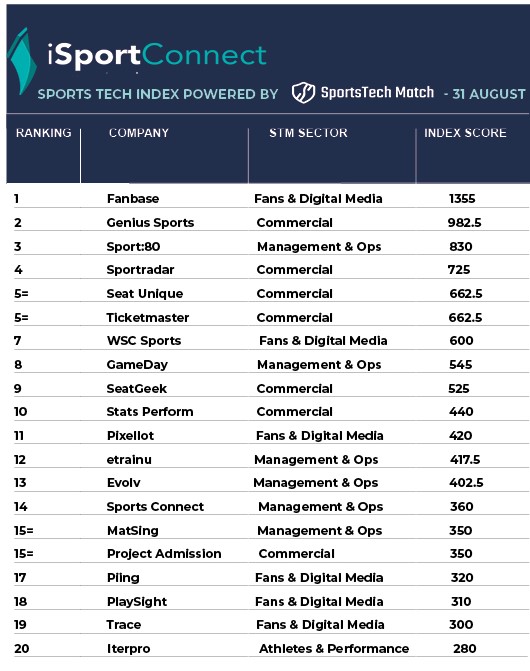
iSportConnect Sports Tech Index powered by SportsTech Match – 11/5

Who’s hot in Sports Tech? Who is doing deals, launching new products and generally doing some of the best work in the sector? That’s what the Index attempts to dig into. Whether established players or the up-and-coming stars, we go a little deeper for you…

The third edition of our monthly sports tech index features both familiar faces and a batch of newbies.

Despite their last deal announcement (with English rugby side Saracens) taking place around one month ago, Seat Unique stayed at the top of the table by virtue of a raft of deals and renewals going back several months.

Not subscribed to our weekly newsletter? Click here to sign up and receive more content like this to your inbox every week. 

Venue security solution, Evolv occupies second spot following recent new deal announcements with two US sports franchises.

Rounding out the top five are Fanbase at #3 (fan engagement platform), Ticketmaster at #4 (ticketing) and CHEQ at #5 (point-of-sale and mobile ordering).

First timers in our top 20 this month include Catapult at #20 (athlete performance tech), Low6 at #18 (iGames producer), Playsight at #16 (AI video platform), Sport:80 at #11 (sports business management system) and Trace at #10 (AI-personalised video for youth football).

GameDay are our highest climber – up 9 places from #17 in last months top 20 to #8 – on account of receiving two 5-star customer reviews via the SportsTech Match ratings and reviews programme.

Want to know more?

The iSportConnect Sports Tech Index is designed to help rights owners and investors quickly assess who is “hot” from a product and new business perspective and provides sports tech vendors with an incentive to focus their PR announcements on what matters to the market. It follows a simple scoring system (see below).

The iSportConnect Sports Tech Index will be published on a monthly basis on iSportConnect.com (subscribe to the newsletter here to stay informed) with in-depth analysis provided by SportsTech Match every 2 weeks (subscribe to the STM newsletter via sportstechmatch.com).

Click here to read more about how the Index is calculated.

WTT announce Floki as first ever crypto partner

World Table Tennis is delighted to announce a ground-breaking partnership with Floki, the people’s cryptocurrency, for the ITTF World Table Tennis Championships Finals 2023. This marks the first time ever that a cryptocurrency has partnered with an international table tennis event and points to the strong affinity to cryptocurrencies and leading technology shown by the growing global table tennis fanbase.
 
The ITTF World Table Tennis Championships Finals 2023 will take place from 20-28 May at the ICC Convention Centre in Durban, South Africa. The event will feature the world’s best players competing for the five coveted crowns in singles and doubles, and is expected to reach over 500 million fans across TV and digital platforms.
 
As part of the partnership, Floki will receive field of play advertising at all matches, as well as assets across all World Table Tennis digital platforms. This will provide Floki with a significant global platform and enable the company to engage with a wide audience of table tennis fans around the world.
 
Jonny Cowan, World Table Tennis Europe General Manager, said: “We are delighted to announce this partnership with Floki, which marks a significant milestone in the history of both table tennis and the cryptocurrency industry. Our mission at World Table Tennis is to revolutionize the sport of table tennis and lead its digital transformation, and we believe that this partnership with Floki will help us to achieve this goal.”
 
A spokesperson for Floki commented, “We are thrilled to be involved in the World Table Tennis Championships Finals in Durban, and to partner with WTT for this historic event. This is another unique sports platform for us to engage with our global community, and we look forward to supporting the world’s best table tennis players as they compete for the ultimate prize.”

Member Insights: How is sport battling against dementia

In this Member Insight piece, David Alexander MD Calacus PR, looks into the public relations story behind sport’s battle with dementia.

So much has been written in recent years about the risks of brain injury caused by rugby and latterly by football.

A number of high profile deaths has prompted concerns about the long-term health of footballers who head the ball regularly.

Former England and West Bromwich Albion and England striker, Jeff Astle, died of dementia in 2002, aged just 59 with a coroner ruling that he was killed by his work as a footballer having scored a large number of headed goals.

Since then, a number of former footballers have been diagnosed with, or died of, dementia, and many of them have had that diagnosis linked to their careers.

Not subscribed to our weekly newsletter? Click here to sign up and receive more content like this to your inbox every week. 

Former Leeds and England defender Jack Charlton died in 2020 while Nobby Stiles died in 2020 and Ray Wilson in 2018 – all suffering from dementia. Jack’s brother, Manchester United legend Sir Bobby Charlton, is also a sufferer.

No wonder a group of former football, rugby league and rugby union players have been taking legal action claiming they suffered brain injuries playing their respective sports including relatives of Stiles.

Some research undertaken by the Karolinska Institute in Sweden, published in the Lancet Public Health journal, found that footballers are 50% more likely to develop dementia than the rest of the population.

Its research found that 8.3 per cent of outfield footballers were diagnosed with Alzheimer’s disease and other dementias, compared to 5.1 per cent of the control group.

The study compared the health records of 6,000 elite footballers and more than 56,000 non-footballers between 1924 and 2019 and suggested that outfield footballers were 50 per cent more likely to develop dementia than the rest of the population.

The data shows concerning trends, so it is no surprise that in England, the Football Association is trialling banning children under 12 from heading the ball in certain grassroots competitions and leagues. If successful, it will apply to the International Football Association Board for a law change to remove heading for under-12s altogether.

Brain injury charity Headway criticised UEFA  for not allowing concussion substitutes in the Women’s Champions League after Arsenal and England’s Beth Mead suffered a head injury against Ajax.

Luke Griggs, Headway’s chief executive, said: “It is important that football is willing to evolve as our understanding of the long-term implications of repeated sub-concussive impacts increases.

“We know enough now to make balanced, sensible adjustments to limit exposure to head impacts.” This includes “limiting of heading practice drills for adults, and complete bans on children heading the ball as they move through key stages in their physical and neurological development,” he added.

Perhaps, then, the official charity partnership between England’s Football Association and dementia charity The Alzheimer’s Society is a natural fit, with recent activity around the England Lionesses’ match against Australia to raise awareness and funds for dementia research and support by encouraging fans to donate and share their memories.

ESG (environmental, social, and governance) is fundamentally important for every organisation – whether they are in governance or business in sport or beyond.

According to Deloitte, “The core values of the generation are reflected in their prioritising social activism more than previous generations and in the importance they place on working at organizations whose values align with their own, with 77% of respondents saying that it’s important. Gen Z no longer forms opinions of a company solely based on the quality of their products/services but also now on their ethics, practices and social impact. 

“To win the hearts of Gen Z, companies and employers will need to highlight their efforts to be good global citizens. While focusing on the quality of the goods/services you provide is still important, a company’s ethics are more important than ever. Moreover, actions speak more loudly than words.”

An estimated 850,000 people live with dementia in the UK (the writer also lost his Mum to dementia a few years ago), which is likely to increase to above 1 million by 2025.

By using the power of sport to drive positive social change, the campaign was able to create a sense of shared purpose and belonging among fans and players alike.

Most notably, players on both the England and Australia teams played without names on a third of their shirts to highlight the fact that one in three people could forget the name of their favourite player or treasured football memory.

Different players wore the nameless shirts after half-time, to further draw attention to the confusion and memory loss often experienced by those living with dementia, before being auctioned. 

Fans were encouraged to engage with the stunt using the hashtag #TheForgottenThird.

Kate Lee, Alzheimer’s Society CEO, said: “Right now, there are too many people facing dementia alone and without the right support.  With The FA’s backing and support, we can reach more people than ever before, and we can reach them sooner.

“The sport has an unrivalled ability to bring people and communities together, which is why we’re asking fans up and down the country to get behind this important cause and donate whatever they can, so no-one must face dementia alone.

“We hope by making this simple alternation with this gesture and getting both teams to show a sign of solidarity, we can put an important spotlight on just how much dementia can devastate lives.

“I hope it makes a massive impact from the stands to screens, inspiring people to donate so we can reach even more people with our life-changing support, which helps people through some of the hardest and most frightening times.”

Ahead of the game, 11-year-old Eve interviewed the Lionesses to discuss what football means to them and their experiences with dementia.

The international fixture was hosted at Brentford FC’s Gtech Community Stadium and saw the unveiling of a striking mural by sports correspondent Carrie Brown.

The large-scale art installation, designed and created by MurWalls, captured key moments of England Women’s football – with fans being encouraged to add their most unforgettable memories to the mural.

England coach Sarina Wiegman said: “Tonight was a chance for both sets of players to come together in recognition of the many people living with dementia and their families and friends who help them.

“I’m very proud to see our players again continue to use their platform to show support for important causes – I hope it inspires fans to donate and support Alzheimer’s Society’s important work.”

The social impact of the campaign, however, was significant. Over the past two seasons, the partnership has raised over £400,000, with thousands more fans, players and staff now knowing where to go to access vital dementia support.

The Alzheimer’s Society has created a sense of community and purpose around the cause, inspiring thousands of football fans to donate, share their stories, and engage with the issue of dementia in a meaningful way. 

The synergies between the Alzheimer’s Society and the Football Association make the partnership a natural fit which fans and other stakeholders can understand and get behind.

According to global media company, WPP, “While young people have always been catalysts for social change, Gen Z has the technology and skills to communicate and mobilise in digital spaces in a way in which previous generations did not.

“Demonstrating meaningful purpose and being transparent about how brands are tackling issues are key to building Gen Z engagement and loyalty. There is no longer a line between politics, societal issues and sport – brands, talent and rightsholders are expected to have a point of view about the moments that impact their audiences, or risk losing touch with them.”

It’s a further reminder to businesses and organisations in sport and beyond that contributing positively to society is summed up by a Winston Churchill quote: “We make a living by what we get, but we make a life by what we give.”

Click here to find out more about the work done by Calacus PR

Photo Credit: Paul Greenwood

The View From The USA: What drives the price of an NBA franchise

In this View From article, Kurt Badenhausen Sportico’s Sports Valuations Reporter, looks into the sale of the Phoenix Suns and explains why a middling NBA franchise is so expensive.

There are an unprecedented number of trophy sports assets on the market right now. Buyers have their choice of the Premier League’s two most valuable clubs, a storied NFL franchise, big market baseball teams on either coast and an NHL team in hockey-mad Canada.

The Phoenix Suns sale to mortgage-mogul Matt Ishbia was finalised on February 9, on the same day the Suns traded for NBA All-Star and former MVP Kevin Durant. 

Ishbia’s purchase of a controlling interest in the Suns and the WNBA’s Mercury eventually went through at a valuation of $4 billion, a record for an NBA franchise.

But what makes an NBA with middling revenue, with no Title and only two Finals appearances since 1993 so attractive for investors. 

Not subscribed to our weekly newsletter? Click here to sign up and receive more content like this to your inbox every week. 

Phoenix is a fast-growing metro and an attractive market for NBA free agents and billionaires alike, thanks to the Arizona climate in winter, but the chance to secure a franchise within the top half of the hottest sports league is why so many investors were kicking the tires on the Phoenix Suns.

Back in November Sportico valued the Suns at $3 billion, and it ranked 13th in our third annual NBA team valuations. But the Suns will likely sell for a higher revenue multiple—the standard valuation used for sports teams—than Manchester United, Liverpool, Washington Commanders, Washington Nationals, Los Angeles Angels or the Ottawa Senators.

Sportico spoke to more than 35 people involved in the business of basketball over the past month, including eight bankers and attorneys involved in team transactions. Most are bullish on the league’s prospects, relative to other sports properties. The average NBA franchise is worth $3 billion, up 16% versus last year. It is a strong showing, considering the S&P 500 is down 16% during the same period. Collectively, the NBA’s 30 teams are worth $90 billion, including team-related businesses and real estate held by owners.

The average is boosted by a top-heavy distribution of team values, with the Golden State Warriors ($7.56 billion), New York Knicks ($6.58 billion) and Los Angeles Lakers ($6.44 billion) all worth at least $2 billion more than fourth-ranked Chicago Bulls ($4.09 billion). The median NBA franchise is worth $2.38 billion.

Golden Dynasty

Golden State has built the model NBA franchise on the court, with six NBA Finals appearances and four titles during the past eight seasons behind Stephen Curry, Klay Thompson and Draymond Green. The Warriors’ status might be even better off the court. Last season marked the team’s first year in the Chase Center without COVID-19 restrictions and limitations. Gross revenue topped $800 million, including non-NBA events, and was an estimated $750 million after revenue sharing, 50% higher than the Lakers.

In addition to winning its fourth title in the current era, the Warriors ranked first by almost every measure last season—by a wide margin—including sponsorships ($150 million), premium seating ($250 million) and local TV ratings (6.98), which were all roughly double the second-ranked team in each category.

The Warriors passed the Knicks this year as the NBA’s most valuable team and trail only the Jerry Jones-owned Dallas Cowboys— worth $7.64 billion—among all sports teams. The New York Yankees are third at $7 billion, with the Knicks and Lakers rounding out the top five.

Joe Lacob, Peter Guber and their investment group paid $450 million for the Warriors in 2010. Lacob sees Disney as a model for diversifying the team’s business approach and isn’t satisfied with ranking second in anything. “Jerry has done a great job with the business of the Cowboys, but we are going to chase him down too,” Lacob said in a phone interview.

Phoenix Rising

In September, Robert Sarver announced he would sell the Suns and the WNBA’s Mercury following an investigation into accusations that he created and oversaw a racist and misogynistic workplace. The NBA suspended Sarver for one year and fined him $10 million.

Last season, the Suns generated an estimated $300 million in revenue and $70 million in earnings before interest, taxes, depreciation and amortisation. There have been multiple initial bids submitted to Moelis & Co., the investment bank Sarver hired to handle the sales process, and there is a strong possibility the team will command 10 times its 2021-22 revenue. The team’s valuation includes the Mercury and Suns’ practice facility.

The buyer pool extends well beyond Arizona, as Phoenix checks a key box for southern California billionaires who can catch a game at Footprint Center and still sleep at home after a one-hour hop in their private jets.

Last month, the NBA gave Suns bidders another funding source when it voted to allow investments from endowment, pension and sovereign wealth funds, as first reported by Sportico. In 2020, the NBA became the first major U.S. sports league to approve private equity investments. The framework allows a fund to purchase up to 20% in one team and allows franchises to have up to 30% of its total equity held by funds. The new groups of institutional money are expected to be granted a similar framework.

“It expands the investor base and opens the door for opportunities for us in the future,” Dallas Mavericks owner Mark Cuban said in an email. The top five university endowments hold $193 billion in assets, led by Harvard at $51 billion. CalPERS, which manages pension benefits for 1.5 million California public employees, had $442 billion in assets at the end of last year.

“The move puts more liquidity into the market, and these funds can write really big checks,” Sal Galatioto, longtime sports investment banker, said in a phone interview. “Sports teams offer some diversification, and these assets are not really correlated to the stock market.”

Private equity firms have invested in at least seven NBA teams since the start of 2021. Dyal HomeCourt bought stakes in the Atlanta Hawks, Suns and Sacramento Kings. Arctos Sports Partners’ portfolio includes the Warriors, Philadelphia 76ers, Kings and Utah Jazz. Sixth Street bought a 20% piece of the San Antonio Spurs. These funds are doing so strictly for a return on investment, and not some of the intangible perks that sometimes draw in limited partners.

The NBA’s new rules allow these other entities to invest directly into teams and avoid the fees associated with the Dyal and Arctos funds, but those funds will still play a role. They allow investors to have exposure to multiple teams, and also allow investment without the public scrutiny and deeper background check that comes with direct stakes as a team owner.

Dyal is poised to cash in on its Suns investment, which came at an LP-discounted $1.55 billion valuation during the first half of 2021. It’s believed the firm is the only Suns investor with “tag-along” rights, meaning anyone buying Sarver’s 35% stake would also need to buy out Dyal’s 5%. Sarver led an investor group that paid $401 million for the Suns in 2004.

Next Frontier

After two COVID-19 impacted seasons, business returned largely to normal and NBA teams generated $10.1 billion in revenue in 2021-22, including non-NBA events at arenas where owners own or control the venues. That compares to $6.5 billion for the 2020-21 season when attendance was off significantly because of capacity restrictions. The Raptors were the one team that continued to feel the COVID hangover; lingering rules forced the team to play a dozen games in early 2022 with no fans in attendance at Scotiabank Arena.

Teams are reaping the benefits of new revenue streams from gambling, jersey patches, and international sponsorships. The top three jersey sponsorships generate $100 million annually, led by the Warriors’ extension with Rakuten worth an estimated $45 million a year. The Brooklyn Nets (WeBull, $30 million) and Lakers (Bibigo, $27 million) are the next largest pacts. “We’re a respected brand here, but also internationally, and that’s a huge opportunity that we are just scratching the surface of,” Warriors’ president Brandon Schneider said in a phone interview.

The NBA’s outlook and flexible ownership rules have attracted bidders for the Suns but also has investors thinking about expansion franchises. LeBron James has voiced his interest in a team in Las Vegas, and Seattle is a near lock for expansion. “At some point, this league will invariably expand, just not at this moment,” Adam Silver, NBA commissioner, said during his 2022 NBA Finals press conference. The last expansion franchise was Charlotte, which started play in 2004 and cost $300 million.

The league has more pressing issues before it turns to expansion. The collective bargaining agreement expires after the 2023-24 season and both sides have an opt-out to end it after the current season—the Dec. 15 deadline for the opt-out was recently extended, giving the two parties more time to negotiate. There is cautious optimism that a deal will come together, with both franchise values and player salaries soaring. Once the CBA is done, league executives will need to lock in their next round of national TV deals, which are set to expire after the 2024-25 season. Any new pact probably won’t be reached until 2024.

Once those two pillars are in place, the NBA will turn its attention to expansion, but it will take multiple years to identify the right owners, cities, venues and get the franchises up and running, meaning it will likely be near the end of the decade before any new teams take the court. The math on an expansion fee becomes easier after the CBA and TV pacts are reached, and a couple of franchise sale prices that start with a three, or even a four makes a difference. Some owners won’t want to dilute their shared revenue or equity stakes in league properties, such as NBA Equity, NBA China and NBA Africa, but divvying up $8 billion in potential expansion fees will make that an easier pill to swallow.

TV Picture

The choppy RSN market has NBA teams covering their bases for an uncertain broadcasting future as consumers ditch cable. This season, the Clippers became the first team to offer local fans a series of options to watch games without a cable subscription. ClipperVision provides six different streams, including two non-English ones. “I have wanted to create a product like ClipperVision since the day I came to the Clippers,” Steve Ballmer, who bought the Clippers in 2014, said in a statement around the launch.

“We are progressing in the design and development of our direct-to-consumer offering and remain on track to launch in the second half of the current NBA and NHL seasons,” Andrea Greenberg, MSG Networks CEO, said on her company’s earnings call last month. “So while the media landscape is certainly evolving, we continue to believe in the value of our premium content and our ability to innovate, to drive value for partners, advertisers and viewers alike.”

In August, Ted Leonsis’ Monumental Sports & Entertainment, which includes the Washington Wizards, bought the 67% of NBC Sports Washington from Comcast that it did not already own. MSE already had its own streaming platform, Monumental Sports Network, that airs the WNBA’s Washington Mystics, and this provides more options. “It’s not unlike someone who owns teams and owns a building,” Ed Desser, who spent 23 years in the league office and helped launch NBA TV, said in a phone interview. “It’s a key asset, and you can package it and leverage it more when you have more control than you could as a pure tenant.”

The distribution options for NBA games will evolve over the next decade, but the content remains valuable with a young fan base that covers every corner of the globe. And any haircuts that teams might take in the short-term on the local level are expected to be offset by the next national deal.

The current TV deal is worth $2.7 billion annually and the next rights are expected to at least double that figure, assuming the NBA carves out a streaming service package. Moelis is highlighting this new financial picture in its Suns’ pitch, projecting a world where the team’s revenue is north of $400 million.

Warner Bros. Discovery CEO David Zaslav recently said at an investor conference that WBD does not “have to have” the NBA, as the company deals with a sluggish ad market and rising content costs. The NBA has been a cornerstone of TNT’s programming for three decades, and Zaslav’s comments were widely seen as posturing in a negotiation for the only major sports rights available over the next five years.“There’s not a major sports media company out there that is not going to want a relationship with the NBA if it becomes available,” media consultant Lee Berke said.

About the Author: Kurt Badenhausen is a sports valuations reporter at Sportico. Prior to joining, Sportico he was a senior editor at Forbes where he worked from 1998 to 2021. He co-engineered Forbes’ annual sports team valuations and launched numerous initiatives at the company, including annual features on brand valuations, best banks and top business schools. He profiled a bunch of athletes who go by one name: LeBron, Shaq, Danica and others for the magazine. Prior to joining Forbes, Badenhausen worked at Financial World magazine where his coverage focused on investing, mutual funds and the business of sports. He graduated from Colgate University with a degree in history and resides in New Jersey with his wife, two sons and black lab.

The House View – The winners and losers from the new EFL broadcast deal

You look at the price and you think ‘wow’. That is a lot of money for EFL rights. 

Sky have paid £935 million for five years of EFL broadcast rights, starting in 2024-25, an increase of 50% on the last deal. Over the length of the contract they will be broadcasting 1,059 matches a season, up from the 138 games they broadcast at the moment. 

THE  WINNERS

The Fans – EFL fans have been starved of the opportunity to watch their team from the comfort of their armchair since what feels like – for them at least – the dawn of time. Most of them will remember the dark days and late nights when the EFL Highlights Show was on after Match of the Day on BBC. 

This new deal will see six games across the three divisions broadcast every weekend on Sky Sports, or through a red-button streaming service. As a fan of a team who found themselves in the EFL for a few seasons, the frustration of a lack of TV games was real and the chance to regularly watch my team at home or in  pub is a benefit for fans.

Not subscribed to our weekly newsletter? Click here to sign up and receive more content like this to your inbox every week. 

The EFL and the clubs – To quote the Harry Enfield sketch they now have “loadsamoney”. As mentioned above this deal is worth £935 million for the next five years. Clubs will benefit massively from this sudden injection of cash as well. Championship clubs will see a TV revenue increase of 46% and League One and Two clubs will get a 25% increase. You will not be surprised to hear that the clubs voted unanimously in favour of the new deal.

The EFL clubs will hope this closes the gap between themselves and the Premier League. Over the last few years we have seen an increase in the number of clubs getting relegated from the Premier League only to get promoted the next season, Burnley, Fulham and Norwich City are all recent examples.

Sky – Sky was already the dominant broadcaster of domestic football in the UK with the Premier League, the EFL and the SPFL, but with this move they have truly stamped their authority on British football. 

On your average League weekend, Sky will be showing nine games through their different slots and ten during the week, including Monday Night Football, compared to one Premier League game and one National League game for BT Sport. 

Having spent heavily on the EFL rights it will be interesting to see what this means when it comes to the Premier League media rights with the tender process set to start this year. On one side you can say that they might be a bit short of money and maybe this deal is the start of them moving away from Premier League rights. Alternatively, you could argue that if they are prepared to commit this much for EFL rights then how much will they be prepared to pay for the Premier League? It will be interesting to see how this develops over the next few months. 

The British Football Pyramid – As a fan of Non-League football this is very important to me, so bare with me here. If the EFL had voted in favour of DAZN’s offer we would have seen an end to the 3pm blackout in the UK. That is the rule that stops matches taking place between 2:45 and 5:15 from being broadcast on television in the UK. It was introduced in 1960 and is designed to protect attendances up and down the football pyramid. It has been reported that the EFL estimated broadcasting all matches would lead to a matchday revenue loss of £37 million. 

THE LOSERS

The Fans – Yes, I can see you now thinking this bloke has lost his mind and forgotten what he wrote a matter of minutes ago. No, as it turns out, I haven’t. While the new deal is no doubt fantastic for the majority of fans, it isn’t good for the season-ticket holders who follow their teams home and away. 

Games kicking off at 12:30 on a Saturday makes travel even more of a hassle for fans, particularly on those long away trips. It means early trains, car journeys and even earlier coaches. In some cases it will mean travelling the night before and all the added expenses that come with that. 

DAZN – The sports streaming service which launched in 2016 and sent shockwaves through sport by signing a deal with Matchroom Boxing in 2018. Outside of boxing, they are yet to truly establish themselves in the UK with a marquee rights deal. A deal with the EFL giving fans the opportunity to watch their team play every week would have seen subscriptions surge – there can be little doubt about that. 

The fact the deal fell through will hurt DAZN, there are only so many UK sports properties that will drive subscribers in a meaningful way. Now, they may decide to enter the Premier League race next year.