
Member Insights: How tech progress in sport is out of this world

In this Member Insight piece, Cinch’s Content Director David Granger, looks into how tech that is pioneered in sport is going to impacting our every day lives.

Sport and technology have a complex, sometimes symbiotic, sometimes contradictory relationship. From the revelation that Hawkeye brought to tennis in 2006 to the confusion VAR occasionally brings to soccer, tech is there to improve the game, the experience and adherence to the rules. In most cases.

It works both ways. The innovation born from competition has improved all our lives in many ways – sport is not simply a new hobby for Hollywood stars.

Take the inextricable link between racing innovation and the progress of the road cars we drive. That mild-hybrid you plug in each night shares its DNA with KERS (kinetic energy recovery system) which was first run in F1 in 2009. And those fancy gear paddle shifters broke cover in the 1989 F1 season when Ferrari packed a semi-automatic gearbox to allow their drivers to change gear quicker. In the mid-90s, those paddles made it to the open road on the Ferrari F355 and now every high street SUV worth its designer salt has them as standard.

Not subscribed to our weekly newsletter? Click here to sign up and receive more content like this to your inbox every week. 

Carbon-fibre, buttons on your steering wheel, active suspension… all started off as ways to make F1 cars faster. Or safer.

And it’s not just the action technology can improve for sport: China managed to hold back the rain in 2008 when it fired silver iodide bullets skywards to disperse rain clouds and prevent the opening ceremony from being a complete wash-out. 

Smarter tech is there to improve athlete performance and safety. Helmets used in the NFL contain sensors which can detect any collision and also send concussion data to the physios for evaluation. 

Smart clothes mean that kit can now measure heart, breathing and activity as well as weight distribution and posture to assist coaches in extracting every last incremental advantage from their sportspeople.

Not every technical innovation could be considered progress, however. Thankfully the Fanboost in Formula E racing (where fans could improve car performance via an app or social hashtags) was consigned to the dustbin of sporting history this season. There’s a time and place for fan engagement – affecting cars’ performance is not it.

So, what’s next? Well, VR, AR, AI are all going to go from novel acronyms to part of how we compete, regulate and spectate. The enhanced experience is only going to become more enhanced and access to more stats and data, and more perspectives and experiences will escalate in number and opportunity. 

The cross-over of real and virtual and sport and gaming is also clearly on a trajectory which is only going one way. (Although arguably nothing will compete or beat with a live experience.) 

But perhaps the coolest sports-technology partnership which sport will bring to the world (and beyond) is the launch (sorry…) of the agreement UEFA signed with the European Space Agency (ESA). The proposal is to take what the ESA has learned in space and apply some of those lessons to soccer. (English football manager Brian Clough might be spinning in his grave. He once said: “If God had wanted us to play football in the clouds, he’d have put grass up there.” He was more of a balls played to feet kind of gaffer.)

The UEFA x ESA initiative will look at Pitch Mapping to show where football pitches are located, Crowd Management to demonstrate the movement around stadia, and Sustainability to explore technology which will “advance social and environmental solutions across European football.” Although mostly it’s a chance for decent headline writers to hone their (space)craft: pass it into space, rockets the ball into the back of the net, launched into the box…

The technology which supports sport, its spectators and federations is ever evolving and ever innovative… which brings us to the Sports Technology Awards. This week (or last week for those reading on catch-up) the Sports Technology Awards celebrates its tenth anniversary with a ceremony in New York. 

Entries are truly global, from five continents, more than 30 countries and from 50 different sports – all demonstrating tech-led innovation in sports.

The breadth of categories alone is indicative of how far we’ve progressed in the last decade. This year companies have been able to demonstrate ingenious new products and experiences in everything from fan engagement to athlete coaching and from injury prevention to data and analytics.

We’ll do a rundown of the winners and the trends another time, but in the meantime, do check out the shortlist to see who’s shaping the future of our business.
The View From The Middle East: Maximising the impact of sporting events

In this View From piece Clayton D’Costa, Head of Global Events and Partner at Portas Consulting, looks into how the region has made the most out of hosting global sporting events.

The Middle East has recently experienced an exceptional era of Major Events, putting the global spotlight on this region. According to the World Economic Forum, the Middle East is already a powerhouse in sports tourism, with a market value of $600 billion. From hosting prestigious global mega-events like the 2022 FIFA World Cup in Qatar and the 2019 Special Olympics World Games in Abu Dhabi, to annual Formula One races in Abu Dhabi and Jeddah, as well as organizing large-scale national games such as the Saudi Games, the region has proven its remarkable ability to successfully stage and showcase major sporting spectacles. 

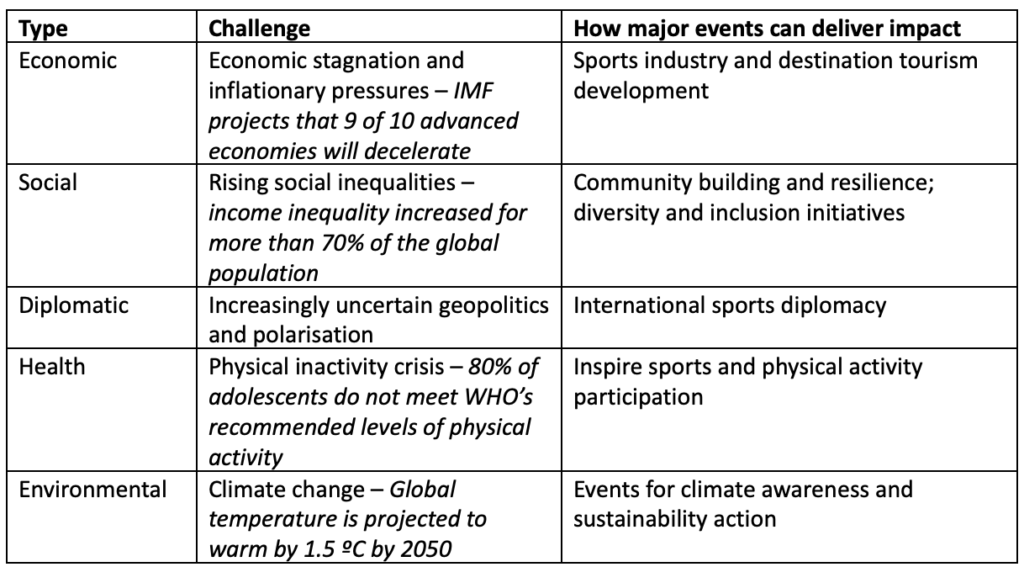
The growth of major events in the Middle East can be leveraged to deliver impact for an increasingly uncertain world facing several challenges.

A strategically planned and executed event is key to ensuring maximum impact, as research suggests – 86% of mega-events are unprofitable from strategic mismanagement. This article highlights the seven success factors in delivering an impactful major sporting event.

Not subscribed to our weekly newsletter? Click here to sign up and receive more content like this to your inbox every week.

  1. Leadership, Governance, & Team

Just like a great team who is successful at a sporting event, an exceptional and experienced team is needed to organise a major event. Clearly defined roles and responsibilities are needed to align various ministries or government departments, city halls, federations, and rights holders to ensure coordination, collaboration, and integration for delivery success.

  1. Strategy and Legacy

Strategic planning serves as the foundation for a successful major sporting event. Strategic planning ensures objectives, underpinning tactical plans and roadmaps for successful events. A supporting robust legacy strategy ensures impact beyond the event.

  1. Integrated Planning Framework

An integrated planning framework ensures a comprehensive and coordinated approach to delivery. The framework provides a blueprint for how different components of the event (clients, functions and venues for example) will be brought together in a seamless and efficient manner. Crucially, the integrated planning framework also ensures that potential event risks are identified and managed in the run up to operations.

  1. Benefits Realisation Planning

Benefits realisation planning ensures the achievement of desired outcomes (e.g., social, economic, environmental) for an event. By mapping event outcomes to measurable actions and key performance indicators (KPIs), it ensures continuous progress and tangible benefits throughout the event.

  1. Commercial Innovation

Continued commercial innovation is essential to gain the funding and investment needed to deliver maximum impact. A robust commercial strategy secures optimal partnerships, develops effective marketing strategies to increase reach, and explores all potential revenue streams to maximise funding. 

  1. Infrastructure Strategy

An effective infrastructure strategy enhances event execution and leaves a lasting impact through state-of-the-art facilities, considering long-term use and repurposing. This includes the development or enhancement of both competition and non-competition venues, transportation systems, accommodation, and other essential facilities. 

  1. Immersive Technology 

Immersive technologies, including Virtual and Augmented reality, 360 Live Streaming, and more, strongly contribute to enhancing event experiences and extending global reach. When integrated into comprehensive planning, these technologies play a pivotal role in fostering commercial innovation, creating revenue opportunities, and enhancing fan engagement.

In conclusion the Middle East has become a prominent destination for major sporting events, demonstrating its successful hosting capabilities for global and national competitions. Exploiting the growth of these events can have a positive impact in an uncertain world. Our ongoing research indicates significant disparities across all 7 areas between the perceived exceptional events and those considered mediocre. Given the magnitude and number of events scheduled in the Middle East over the next decade, along with the associated costs, revenues, SROI impact, and sustainability impact, the potential value at stake is substantial. With our experience highlighting a minimum of 30% difference in impact between exceptional and mediocre events, it is crucial major event organizers to consider the criteria noted in this article as key differentiators for success.

Click here to find out more about the work done by Clayton and Portas Consulting

IMG ARENA extends partnership with MLS to provide tracking data to MLS NEXT Pro

IMG ARENA, a leading sports data and technology supplier for the betting, media and performance sectors, has extended its partnership with Major League Soccer (MLS) to provide tracking data to MLS NEXT Pro. 

The extended agreement will see IMG ARENA integrate its deep tech, cloud-based platform to provide player and ball tracking data to MLS NEXT Pro to enhance their player performance analysis. The data points collected will include players’ total running distances, speed zones, sprints and separation between players, among others.

IMG ARENA will also provide tracking data of match officials to enable the Professional Referee Organization (PRO) to support on-going efforts to develop the next generation of referees in North America.

The innovative event tracking technology was integrated into IMG ARENA’s extensive data collection capabilities through its acquisition of Signality in 2022. It uses computer vision to extract highly accurate sports event and tracking data in real-time, utilising existing camera setups to derive positional data and event information automatically. The product is part of IMG ARENA’s Sport Services offering which helps rightsholders deliver fans a front-row-seat to the action with best-in-class data, content creation and production streams.

Last year, IMG ARENA announced its long term, global partnership to deliver the next generation of fan engagement in MLS and MLS NEXT Pro. Alongside its role as the league’s official data partner,  IMG ARENA is delivering innovative content solutions, next-generation fan analytics, and marketing tools to MLS’ betting and media partners, including the launch of three new MLS live data feeds, designed to enhance the fan experience.

“One of the areas of focus for MLS NEXT Pro is innovation so we are thrilled to be bringing this new player and ball tracking technology to the League ,” said Ali Curtis, Senior Vice President of Competition and Operations, MLS NEXT Pro. “IMG is continuing to create new solutions for soccer fans around the world and this is a great example of their commitment to delivering a best in class experience.”

Freddie Longe, President of IMG ARENA said: “This expanded partnership means we’re able to provide MLS NEXT Pro with an all-encompassing data collection system. Adding compelling ball tracking data and player analysis will provide enhanced performance insights, on top of our next-generation fan engagement analytics and innovative content solutions which are empowering the future MLS universe.” 

Headquartered in London, IMG ARENA is a sports data and technology hub serving the sports, sports betting and sports media eco-systems. IMG ARENA delivers live streaming and data feeds for more than 45,000 sports events annually, as well as for on-demand virtual sports products and front-end solutions including the UFC Event Centre. IMG ARENA’s clients include UFC, DP World Tour, PGA Tour, EuroLeague, UTR, USTA, Roland Garros, MLS, and the FA.

Volleyball World partners with VolleyStation

This year’s volleyball and beach volleyball events have kicked off with an exciting and innovative data and insights experience as Volleyball World partners with VolleyStation to level up the fan experience of the sport’s hundreds of millions of fans worldwide.

Polish-based tech startup VolleyStation will provide its software and technology for all Volleyball World and FIVB volleyball and beach volleyball events in 2023, including: the Volleyball Nations League, Beach Volleyball World Championships, Beach Pro Tour, Olympic Qualification Tournaments and Club World Championships.

VolleyStation’s powerful and efficient data collection tools will provide invaluable insights to help further transform the fan experience both onsite and online at major international volleyball events. Meanwhile, its software will bolster the competition management capabilities through world-leading technological solutions.

Volleyball World Chief Business Officer Guido Betti commented: “VolleyStation is trusted by professional volleyball leagues, clubs and coaches in Poland and around the globe to provide the best-in-class data collection tools and competition management technology. We know that VolleyStation has the expertise and knowledge to bring tremendous value to not only Volleyball World and the FIVB, but to the entire volleyball ecosystem.”

FIVB President Dr Ary S. Graça F° said: “We are delighted to join forces with VolleyStation to ensure the best in-class volleyball data collection and competition management tools as we strive for innovation across all the areas of our work. We understand the huge value of data in helping us bring volleyball and beach volleyball to the next level.” 

Volleystation Chief Executive Officer Lukasz Wrobel added: “We are proud of this remarkable partnership with Volleyball World, showcasing VolleyStation’s unparalleled expertise in volleyball collaboration. Our extensive understanding and capability to meet the global needs of volleyball organizations are evident in this partnership. Together with Volleyball World, our shared objective is to enhance our sport at all levels and drive innovation.”

Manchester United are this season’s biggest winners

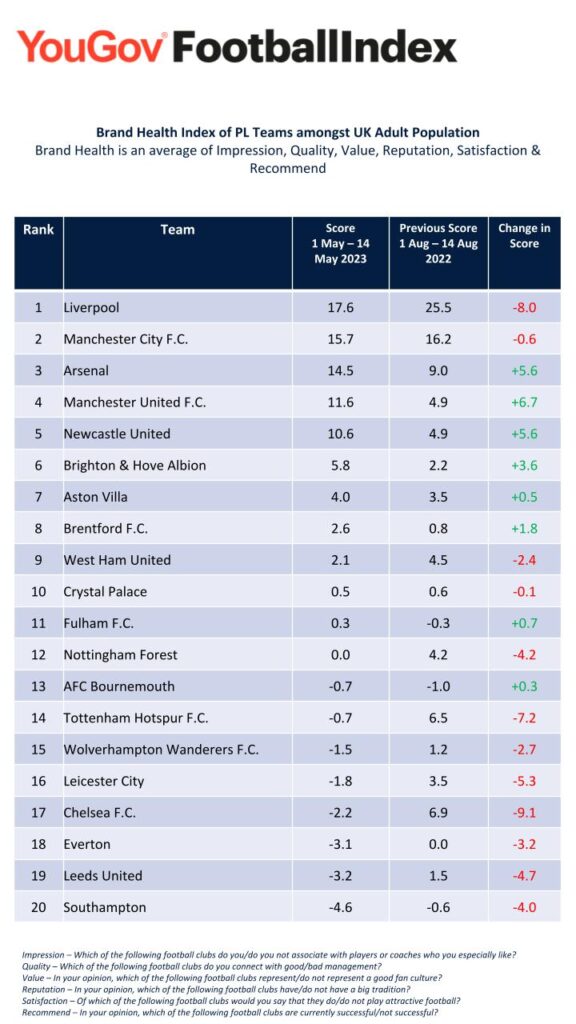
In this week’s iSportConnect Brand Health Index powered by YouGov we are taking a look at how Premier League clubs have changed over the course of the season. As you would expect there has been a few ups and downs in this table as well. 

The Winners: 

Manchester United: + 6.7 points

Despite the Eric ten Hag era kicking off with back-to-back losses including a 4-0 drumming at the hands of Brentford, United have actually had the biggest increase in Brand Health score, jumping up to a score of 11.6 earning them fourth placed in this table. We think this is related to a strong season on the pitch, including a first trophy since 2017, and the possibility of the club being sold after years of fans protesting about the ownership.

Arsenal: + 5.6 points

Arsenal’s improvements on the pitch this season have translated to an improvement in Brand Health score as well, they scored 14.5 enough to claim third on this list. Mikel Arteta’s team have not only mounted a Premier League title challenge for the first time since 2016/17, but also seemed to have brought a previously divided fanbase together. The score is measured using a variety of different metrics, one of these being success, hence why the ‘winners’ in this list have all had strong seasons.

Not subscribed to our weekly newsletter? Click here to sign up and receive more content like this to your inbox every week. 

Newcastle: + 5.6 points

Newcastle have been a team and club transformed this year so it is not surprising to see them as one of our biggest winners of this season. Their increase in score is reflected by their jump up to fifth in this table. Boasting the best defence in the league, the Geordies have been consistently in the Champions League places and also got to their first final at the new Wembley.

The Losers:

Chelsea: – 9.2 points

Oh Chelsea, where did it all go wrong? It has been a long season for the West London club, spending £600 million on players has only resulted in turmoil with three or maybe even four managers by the time you read this depending on the timing of Mauricio Pochettino’s announcement. They have slumped to 17th in this table and currently find themselves an intensely disappointing 11th in the Premier League. 

Liverpool: – 8 points

Having gone toe-to-toe with Manchester City for the Premier League title over the previous five years. This season has been difficult for Liverpool. Despite being the league’s second biggest loser in terms of points, Liverpool are still top of this particular league. We believe this is down to the incredibly strong fan culture that the fans have and also the reputation that the club has.

Tottenham Hotspur: – 7.2 points

Like Chelsea it has been a difficult season for Spurs. Despite a strong start to the season, Antonio Conte’s time at the club ended in chaos after a dramatic loss to bottom side Southampton. Increasingly, it is felt that a toxic relationship between the fans and the Chairman Danel Levy is developing with fans chanting that they want him out of their club. Spurs now sit 14th in this table.

See the full table below:

Photo credit: Kevin Stattard

The channels sports brands can’t ignore

In this insight piece Heikki Rotko, Executive Chairman of Choicely, dives into second screen habits while watching sports.  

How do our fans consume sports media?

It’s a question that sports organisations should ask on a regular basis. It’s the fans who choose the channels and platforms, and the organisations that understand the fan behaviour and adjust the best will win in fan engagement.

We asked this question from professionals working in sports organisations, and looked into existing research where fans’ consumption was studied.

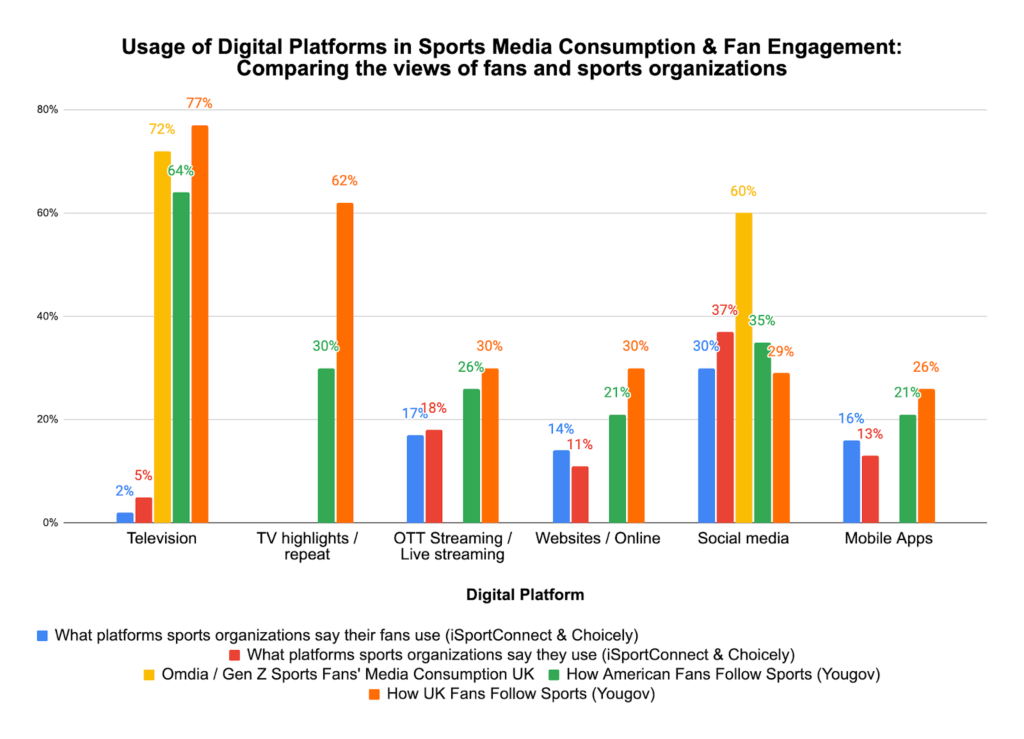
We found a surprising result. Only 2% of sports industry professionals think TV is fans’ favourite channel, and it held the last place among digital channels. In reality, TV is the clear number 1 channel to follow sports in the US and in the UK

The full aggregated results from different studies

These professionals’ answers were a part of the State of Sports Fan Engagement 2023 survey conducted by iSportConnect in partnership with Choicely. Fans’ media consumption statistics are from YouGov.

How did sports business professionals get TV so wrong?

How come television was so undervalued?

Maybe the sports business professionals overvalued other channels like social media because TV is a ‘traditional channel’?

Digital channels have received much more hype, and there might be a belief that TV isn’t very much used by younger generations anymore. But the fact is, TV is also popular among Gen Z.

The TV screen is even more popular than before, considering it’s not only used for linear TV but also for accessing OTT streaming services, among other things.

So what to do with this information?

  1. Make sure you’re on TV if you’re a bigger sport. 
  2. And for organisations of all sizes: build visibility on streaming services: their options range from free options to larger platforms.

The main goal is to provide ways to view your events in an easy way, and preferably on the TV screen.

Second screening: a great chance to strengthen engagement with fans

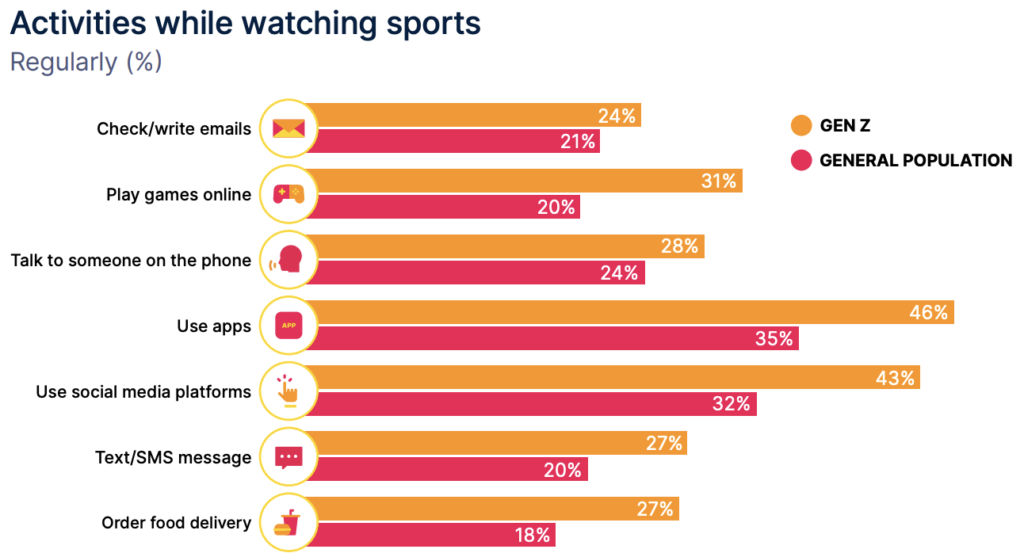
Another clear finding when looking at studies on fans’ media consumption is the huge importance of second screening.

While fans are watching the live event, 96% have used another device and for 74% it’s the phone – according to Global Web Insights.

When it comes to regular activities during a sports broadcast, 46% of Gen Z use apps.

According to Nielsen, mobile apps are the most popular means of second screening, making them an ideal platform to engage fans during and between events.

Fans’ second screen behaviour: Neilsen

So what to do with this information?

  1. Sports organisations should leverage second screening and provide information and entertainment, during and in between their events.
  2. Apps are the most popular platform for second screening. By building their own app, sports organisations can enhance the overall fan experience and increase the brand’s engagement with their fans.

Building a comprehensive mobile app allows sports organisations to aggregate content from various channels, including social media, ticketing, merchandise stores, and live streaming. 

Offer a premium ‘360 fan experience’, to your passionate and engaged fans who spend 6 times more on your brand than casual fans.

To maximise the engagement with mobile apps, organisations can incorporate features such as voting, ratings, surveys, gamification, and cutting-edge experiences powered by AI or AR solutions.

Additionally, seamless integration with ticket stores enables the fans that are already engaged to conveniently purchase tickets while watching a match.

A well-designed mobile app enhances fan loyalty, provides real-time updates, and fosters a strong connection between fans and sports organisations.

Conclusion

In today’s sports media landscape, the consumption of sports content spans multiple screens.

The reality is that television still is the primary channel for sports media consumption. The rise of second screening and the prevalence of smartphones have opened new avenues for fan engagement.

There, mobile apps have taken the centre stage. When you recognise their importance and offer a comprehensive fan experience, your organisation can deepen fan connections, generate monetisation opportunities, and embrace trends in both consumer behavior and technology.

Make full use of the power of multiple screens and you will build stronger relationships with your fans.

Find Choicely’s comprehensive blog post “Digital fan engagement insights: How fans consume sports media today” here.

Learn more results from The State of Sports Fan Engagement 2023 study here.

Meet the Member: “The club and the city are Premier League ready”

After 26 years at Crystal Palace, Phil Alexander joined Bristol City as CEO. We spoke to him about his new club, sustainability and playing American football.

So Phil to start, take us through your journey in sport?

I really have been fortunate enough to be involved in sport for pretty much my whole life. Growing up, I played football for England U-18s and then went on to play for Norwich City for a couple of years before going away to play in New Zealand. I came back and played non-League for a period before I was selected to play for the London Monarchs American Football team. This was an unbelievable experience, not only learning a new sport but playing in front of 75,000 people at Wembley Stadium. 

I was always really interested in the commercial side of sport and, following my time with the Monarchs , I had an opportunity to run Bracknell Town Football Club, which I did for a year and was a great learning curve for me. From there I had the opportunity to join Swindon Town as Head of Commercial and they were in the Premier League at the time.

Unfortunately, Swindon didn’t last long in the Premier League and I then got the opportunity to join Crystal Palace. I was in the CEO role there for over 25 years before I joined Bristol City a few months ago. 

You have been at Bristol City for just over four months now, what are your first impressions of the club? What has surprised you the most?

Simply by just walking around the stadium and training ground you can see that the club is Premier League ready. I have been really impressed by the ambition the owners have shown and the money they have invested into not just Bristol City, but the whole Bristol Sport Group, which includes the Bears Rugby and Flyers Basketball teams; as well as the planned development of the arena next door to Ashton Gate. So yes, the first impressions are just how Premier League ready this club is, now we just need to deliver it.

Has it been tricky joining halfway through the season?

It has been fine, it really has. I think I have worked in football for so long that I know the general rhythm of a football season. You have got the January transfer window, season ticket sales campaigns, summer sales campaigns and recruitment campaigns as well. The general ebbs and flows of the season are the same for pretty much every club so it hasn’t been a problem.

You were recently announced as the most sustainable football club in the championship, tell us about some of the work you have been doing as a club? 

It isn’t something I have been across massively having recently joined the club, but sustainability is incredibly important for us at the club. We have bought into the UN Sports Climate Action Plan which has the big target of reaching net zero emissions by 2040. 

It is also something we really believe in rather than just being used as a tick box exercise. We are doing some great things in terms of sustainability with initiatives ranging from our waste management to power generation.

Generally, sustainability can help you attract sponsors who have similar values. Most companies now, when they are tendering for new business, have to show proof of sustainability, so it is a great way to work together with local partners to help achieve our goals.

Phil, you were at Crystal Palace for so long tell us a bit more about that experience and what were some of your biggest learnings from the time you spent there?

Yes, 26 years in total. I think I saw about seven sets of owners and goodness knows how many managers and players. It was great in terms of experience, learning how to create revenue when you’re in administration and really have no money to get promoted to the Premier League and having a sustained run in the league. 

Not subscribed to our weekly newsletter? Click here to sign up and receive more content like this to your inbox every week. 

Going up through the play-offs in 2013 was a bit earlier than when would have been ideal but I suppose it’s never a bad time to get promoted! The transition to being a Premier League club was a challenge and we had to hire a lot of new people to fill the roles that came with promotion. I am so proud of what we achieved as a club at that time. Palace are safe in the Premier League for another year and with the new stand being developed it’s a great time for the club. Credit to Steve Parish as well, he’s been a great leader and champions the smaller clubs both in the PL and in European football.

One of the things I have really learnt is that if you get a good team all pulling in the same direction then you can achieve great things in football even without massive resources. You see this quite a lot in the EFL when clubs get themselves organised and aligned behind the scenes and suddenly find themselves flying up the league. That works the other way as well because if a club is dysfunctional then it can fall down the league rapidly no matter what they spend on the pitch.

Looking forward then, other than the obvious goal of promotion, what are you aiming to achieve at the club?

Like I said earlier, the club is Premier League ready and that is the absolute end goal for me and the rest of the club. In terms of goals for me it is really what I mentioned earlier on about trying to pull everyone together in the right direction from the top of the club to the bottom. I also want to be able to offer my experience to help guide individuals as well and then I really think we can make something special here.

What are some of the challenges the club faces at the moment?

Generally, I think working inside the financial frameworks and getting the squad in the right place to be able to compete. We have got some great young players coming through the Academy that will go onto to play in the first team next season. It is going to be exciting over the next few years giving these guys the chance to develop. But working within the financial framework of the league while trying to get the squad in the best shape it can be, is our biggest challenge.

How much would promotion mean to the club and to the city?

The club is Premier League ready, but the city is ready as well. Bristol is one of the biggest cities in the country, with so much passion for football. The fanbase is huge and I would expect Ashton Gate to be full every week even with a sniff of promotion. It would also mean so much to the Lansdown family after the investment they have poured into the club, not only with the football club but the Bristol Sport Group as a whole – they really deserve it.

iSportConnect Sports Tech Index powered by SportsTech Match – 11/5

Who’s hot in Sports Tech? Who is doing deals, launching new products and generally doing some of the best work in the sector? That’s what the Index attempts to dig into. Whether established players or the up-and-coming stars, we go a little deeper for you…

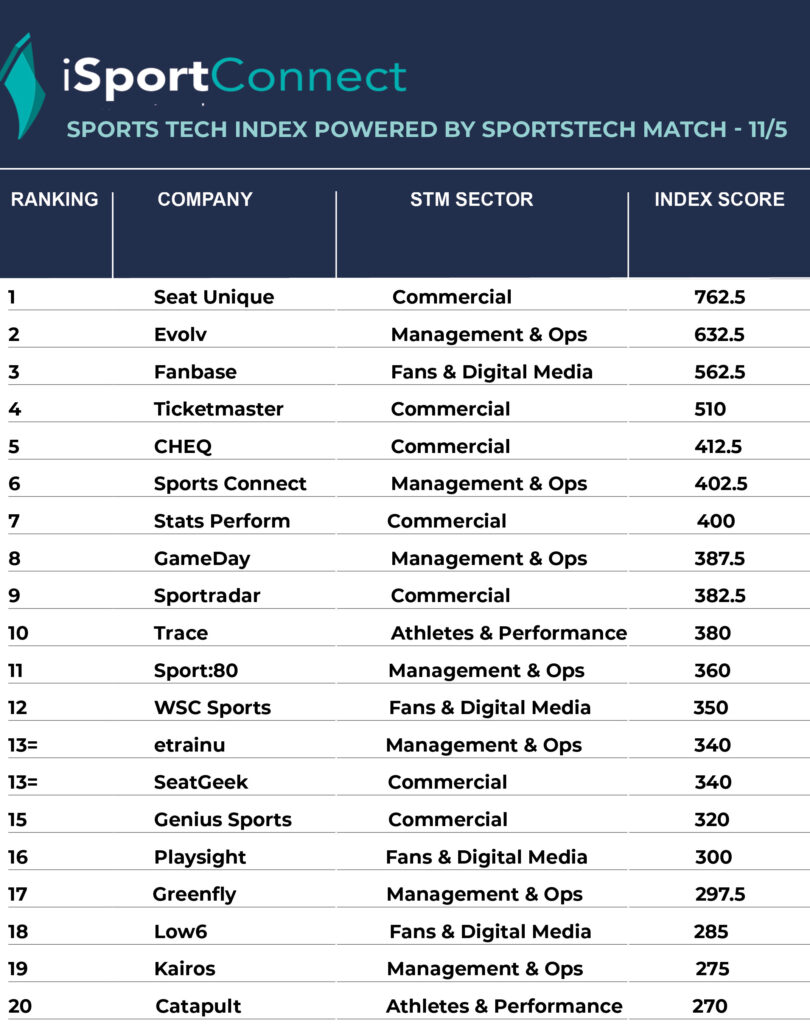
The third edition of our monthly sports tech index features both familiar faces and a batch of newbies.

Despite their last deal announcement (with English rugby side Saracens) taking place around one month ago, Seat Unique stayed at the top of the table by virtue of a raft of deals and renewals going back several months.

Not subscribed to our weekly newsletter? Click here to sign up and receive more content like this to your inbox every week. 

Venue security solution, Evolv occupies second spot following recent new deal announcements with two US sports franchises.

Rounding out the top five are Fanbase at #3 (fan engagement platform), Ticketmaster at #4 (ticketing) and CHEQ at #5 (point-of-sale and mobile ordering).

First timers in our top 20 this month include Catapult at #20 (athlete performance tech), Low6 at #18 (iGames producer), Playsight at #16 (AI video platform), Sport:80 at #11 (sports business management system) and Trace at #10 (AI-personalised video for youth football).

GameDay are our highest climber – up 9 places from #17 in last months top 20 to #8 – on account of receiving two 5-star customer reviews via the SportsTech Match ratings and reviews programme.

Want to know more?

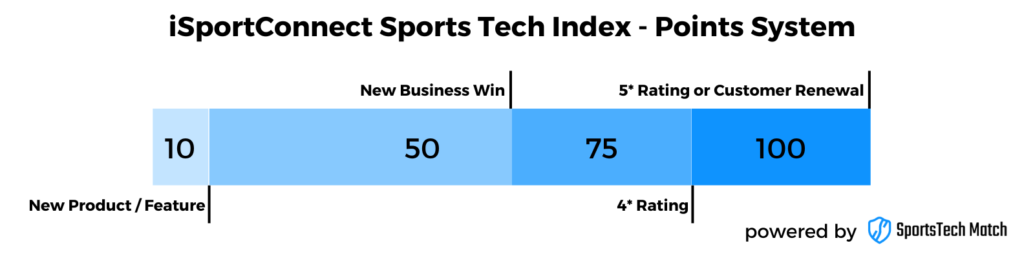
The iSportConnect Sports Tech Index is designed to help rights owners and investors quickly assess who is “hot” from a product and new business perspective and provides sports tech vendors with an incentive to focus their PR announcements on what matters to the market. It follows a simple scoring system (see below).

The iSportConnect Sports Tech Index will be published on a monthly basis on iSportConnect.com (subscribe to the newsletter here to stay informed) with in-depth analysis provided by SportsTech Match every 2 weeks (subscribe to the STM newsletter via sportstechmatch.com).

Click here to read more about how the Index is calculated.

WTT announce Floki as first ever crypto partner

World Table Tennis is delighted to announce a ground-breaking partnership with Floki, the people’s cryptocurrency, for the ITTF World Table Tennis Championships Finals 2023. This marks the first time ever that a cryptocurrency has partnered with an international table tennis event and points to the strong affinity to cryptocurrencies and leading technology shown by the growing global table tennis fanbase.
 
The ITTF World Table Tennis Championships Finals 2023 will take place from 20-28 May at the ICC Convention Centre in Durban, South Africa. The event will feature the world’s best players competing for the five coveted crowns in singles and doubles, and is expected to reach over 500 million fans across TV and digital platforms.
 
As part of the partnership, Floki will receive field of play advertising at all matches, as well as assets across all World Table Tennis digital platforms. This will provide Floki with a significant global platform and enable the company to engage with a wide audience of table tennis fans around the world.
 
Jonny Cowan, World Table Tennis Europe General Manager, said: “We are delighted to announce this partnership with Floki, which marks a significant milestone in the history of both table tennis and the cryptocurrency industry. Our mission at World Table Tennis is to revolutionize the sport of table tennis and lead its digital transformation, and we believe that this partnership with Floki will help us to achieve this goal.”
 
A spokesperson for Floki commented, “We are thrilled to be involved in the World Table Tennis Championships Finals in Durban, and to partner with WTT for this historic event. This is another unique sports platform for us to engage with our global community, and we look forward to supporting the world’s best table tennis players as they compete for the ultimate prize.”

Member Insights: How is sport battling against dementia

In this Member Insight piece, David Alexander MD Calacus PR, looks into the public relations story behind sport’s battle with dementia.

So much has been written in recent years about the risks of brain injury caused by rugby and latterly by football.

A number of high profile deaths has prompted concerns about the long-term health of footballers who head the ball regularly.

Former England and West Bromwich Albion and England striker, Jeff Astle, died of dementia in 2002, aged just 59 with a coroner ruling that he was killed by his work as a footballer having scored a large number of headed goals.

Since then, a number of former footballers have been diagnosed with, or died of, dementia, and many of them have had that diagnosis linked to their careers.

Not subscribed to our weekly newsletter? Click here to sign up and receive more content like this to your inbox every week. 

Former Leeds and England defender Jack Charlton died in 2020 while Nobby Stiles died in 2020 and Ray Wilson in 2018 – all suffering from dementia. Jack’s brother, Manchester United legend Sir Bobby Charlton, is also a sufferer.

No wonder a group of former football, rugby league and rugby union players have been taking legal action claiming they suffered brain injuries playing their respective sports including relatives of Stiles.

Some research undertaken by the Karolinska Institute in Sweden, published in the Lancet Public Health journal, found that footballers are 50% more likely to develop dementia than the rest of the population.

Its research found that 8.3 per cent of outfield footballers were diagnosed with Alzheimer’s disease and other dementias, compared to 5.1 per cent of the control group.

The study compared the health records of 6,000 elite footballers and more than 56,000 non-footballers between 1924 and 2019 and suggested that outfield footballers were 50 per cent more likely to develop dementia than the rest of the population.

The data shows concerning trends, so it is no surprise that in England, the Football Association is trialling banning children under 12 from heading the ball in certain grassroots competitions and leagues. If successful, it will apply to the International Football Association Board for a law change to remove heading for under-12s altogether.

Brain injury charity Headway criticised UEFA  for not allowing concussion substitutes in the Women’s Champions League after Arsenal and England’s Beth Mead suffered a head injury against Ajax.

Luke Griggs, Headway’s chief executive, said: “It is important that football is willing to evolve as our understanding of the long-term implications of repeated sub-concussive impacts increases.

“We know enough now to make balanced, sensible adjustments to limit exposure to head impacts.” This includes “limiting of heading practice drills for adults, and complete bans on children heading the ball as they move through key stages in their physical and neurological development,” he added.

Perhaps, then, the official charity partnership between England’s Football Association and dementia charity The Alzheimer’s Society is a natural fit, with recent activity around the England Lionesses’ match against Australia to raise awareness and funds for dementia research and support by encouraging fans to donate and share their memories.

ESG (environmental, social, and governance) is fundamentally important for every organisation – whether they are in governance or business in sport or beyond.

According to Deloitte, “The core values of the generation are reflected in their prioritising social activism more than previous generations and in the importance they place on working at organizations whose values align with their own, with 77% of respondents saying that it’s important. Gen Z no longer forms opinions of a company solely based on the quality of their products/services but also now on their ethics, practices and social impact. 

“To win the hearts of Gen Z, companies and employers will need to highlight their efforts to be good global citizens. While focusing on the quality of the goods/services you provide is still important, a company’s ethics are more important than ever. Moreover, actions speak more loudly than words.”

An estimated 850,000 people live with dementia in the UK (the writer also lost his Mum to dementia a few years ago), which is likely to increase to above 1 million by 2025.

By using the power of sport to drive positive social change, the campaign was able to create a sense of shared purpose and belonging among fans and players alike.

Most notably, players on both the England and Australia teams played without names on a third of their shirts to highlight the fact that one in three people could forget the name of their favourite player or treasured football memory.

Different players wore the nameless shirts after half-time, to further draw attention to the confusion and memory loss often experienced by those living with dementia, before being auctioned. 

Fans were encouraged to engage with the stunt using the hashtag #TheForgottenThird.

Kate Lee, Alzheimer’s Society CEO, said: “Right now, there are too many people facing dementia alone and without the right support.  With The FA’s backing and support, we can reach more people than ever before, and we can reach them sooner.

“The sport has an unrivalled ability to bring people and communities together, which is why we’re asking fans up and down the country to get behind this important cause and donate whatever they can, so no-one must face dementia alone.

“We hope by making this simple alternation with this gesture and getting both teams to show a sign of solidarity, we can put an important spotlight on just how much dementia can devastate lives.

“I hope it makes a massive impact from the stands to screens, inspiring people to donate so we can reach even more people with our life-changing support, which helps people through some of the hardest and most frightening times.”

Ahead of the game, 11-year-old Eve interviewed the Lionesses to discuss what football means to them and their experiences with dementia.

The international fixture was hosted at Brentford FC’s Gtech Community Stadium and saw the unveiling of a striking mural by sports correspondent Carrie Brown.

The large-scale art installation, designed and created by MurWalls, captured key moments of England Women’s football – with fans being encouraged to add their most unforgettable memories to the mural.

England coach Sarina Wiegman said: “Tonight was a chance for both sets of players to come together in recognition of the many people living with dementia and their families and friends who help them.

“I’m very proud to see our players again continue to use their platform to show support for important causes – I hope it inspires fans to donate and support Alzheimer’s Society’s important work.”

The social impact of the campaign, however, was significant. Over the past two seasons, the partnership has raised over £400,000, with thousands more fans, players and staff now knowing where to go to access vital dementia support.

The Alzheimer’s Society has created a sense of community and purpose around the cause, inspiring thousands of football fans to donate, share their stories, and engage with the issue of dementia in a meaningful way. 

The synergies between the Alzheimer’s Society and the Football Association make the partnership a natural fit which fans and other stakeholders can understand and get behind.

According to global media company, WPP, “While young people have always been catalysts for social change, Gen Z has the technology and skills to communicate and mobilise in digital spaces in a way in which previous generations did not.

“Demonstrating meaningful purpose and being transparent about how brands are tackling issues are key to building Gen Z engagement and loyalty. There is no longer a line between politics, societal issues and sport – brands, talent and rightsholders are expected to have a point of view about the moments that impact their audiences, or risk losing touch with them.”

It’s a further reminder to businesses and organisations in sport and beyond that contributing positively to society is summed up by a Winston Churchill quote: “We make a living by what we get, but we make a life by what we give.”

Click here to find out more about the work done by Calacus PR

Photo Credit: Paul Greenwood