How to deliver captivating sports action for today’s fan

The sports industry faces a significant challenge in attracting and keeping viewers, particularly in today’s fragmented media landscape where there is no such thing as a typical fan.

However, recent studies indicate that most adults already feel overwhelmed by information from technological platforms. Despite this, a well-curated strategy for sports highlights presents a compelling opportunity to break through the noise in a highly competitive environment. Advancements in technology enable rights-holders to create and deliver highlights faster and on a larger scale than ever before, all at a fraction of the previous cost. Moreover, artificial intelligence (AI) is enhancing efforts to personalise content-driven experiences for increasingly demanding audiences.

Magnifi and SportBusiness have collaborated on a White Paper titled “AI-driven highlights: How to deliver captivating sports action for today’s sports fan.” This paper explores the key considerations for rights-holders as they strive to implement impactful and cost-effective digital strategies. It examines how highlights can be effectively utilised alongside social media platforms to create new opportunities for engagement and monetisation. Additionally, the report discusses the challenges and implications that sports organisations of all sizes may face.

Drawing from the latest research on fan and viewer behaviour, the White Paper offers a comprehensive overview of cutting-edge technologies and distribution strategies aimed at taking digital engagement to the next level.

The World View: Taking a look back at what we have learned over the past five weeks

Over the past five weeks, we have flown around the globe from Asia, to the US, to Lausanne, touched down in the Middle East and finally landed in Africa. In this one piece you will have the chance to catch up on what you have missed.

Firstly, Michel Cutait, Acting Secretary General of the World Obstacle Federation, gave a fascinating insight into the benefits of individual athletes being members of international federations.

“Allowing individual athletes to become members of international federations as well would establish a new paradigm in the world of sports that could intensify the scope and purpose of international federations, without undermining the importance of the work done by national federations.”

Click here to read his article, including the six advantages that this model has

Next we heard from Kurt Badenhausen, Sportico’s Valuations Reporter, who took a look at the recent sale of the Phoenix Suns NBA franchise and explains why the franchise was so expensive.

“Phoenix is a fast-growing metro and an attractive market for NBA free agents and billionaires alike, thanks to the Arizona climate in winter, but the chance to secure a franchise within the top half of the hottest sports league is why so many investors were kicking the tires on the Phoenix Suns.”

Read the rest of his article, including Sportico’s list of the top 10 most valuable franchises

We then made a trip to the Middle East and heard from Clayton D’Costa, Head of Global Events and Partner at Portas Consulting, who detailed how the region has made the most out of hosting events.

“The Middle East has recently experienced an exceptional era of Major Events, putting the global spotlight on this region. According to the World Economic Forum, the Middle East is already a powerhouse in sports tourism, with a market value of $600 billion.”

Click here for the rest of Clayton’s article here including his seven success factors in delivering an impactful major sporting event.

Unmish Parthasarathi‘s article gave a fascinating insight into how institutional finance is playing a role to grow sport in Asia.

“In this article, I cite five trends with ten examples across a dozen markets that promise returns due to a positive demographic dividend, a growing supply of talent, and, rising per capita incomes.”

To find out his five trends, click here.

Cynthia Mumbo is the CEO of Sports Connect Africa, in her article she looks at the story behind Yanga FC.

“Yanga FC is a shining example of African football’s potential, with a rich history, remarkable commercial growth, passionate fan engagement, and strong governance.”

To find out more about the story of Yanga FC, click here

Member Insights: You say you want a revolution, four moments that changed sport

In this Member Insight piece, our Content Manager, Alex Brinton, looks at the PGA TOUR and DP World Tour merger with the PIF and some of the other times the world of sport has been changed by revolution.

PGA TOUR and DP World Tour merger with the PIF

Tuesday’s shock merger between LIV and the PGA TOUR has brought together golf’s two warring factions. The LIV tour came to life in 2021, but the first event didn’t take place until 366 days ago. Backed by the PIF, LIV’s tour has handed out eye-watering contracts to the leading players in the game, including $200 million for the services of Phil Mickelson. Throughout the last year, we have seen more of the world’s leading players move over to LIV including last month’s US Open winner, Brooks Koepka. 

It cannot be stressed enough how out of the blue this merger has come.

It is not clear how the merger will be structured, so I want to avoid commenting on that but from the initial press release it is clear that the Governor of the PIF will be chairman of the new joint venture. Yasir Al-Rumayyan, the new chairman, is a busy man: alongside his role in golf, he is the chairman of Newcastle United, chairman of Saudi Aramco and has been described by Forbes as a “confidante to Mohammed Bin Salman” the ruler of Saudi Arabia. It was reported in The Athletic that an anonymous source said Al-Rumayyan has been “given the responsibility of putting Bin Salman’s vision into practice.”  From the initial reporting, it looks like current Commissioner of the PGA TOUR, Jay Monahon, will take up a CEO role which could see him reporting into Al-Rumuyyan.

Kerry Packer and World Series Cricket

This is probably the most similar case to what we have seen with the PIF and the PGA TOUR. 

Back in the 1970s, the Australian cricket team was one of the most sought-after TV properties in Australia. Packer, who owned Channel 9, wanted to broadcast the games on his channel. Despite offering a lot more than rival channel ABC, the Australian Cricket Board chose the lower offer. 

Packer’s response to this was to sign up all the best players in Australia, West Indies and the rest of the world and create his own competition – broadcast on Channel 9. Australian players who joined the breakaway series were banned from playing for their country. Like LIV, World Series Cricket wasn’t an instant hit with poor attendances in its first year. After an extensive marketing campaign, the second season took off. Packer’s World Series Cricket brought to the fore lots of innovations that are now common in the game: day/night games, stump microphones and coloured clothes. After the second season, the Australian Cricket Board were suffering massive financial losses and came to a ten-year broadcast agreement with Packer.

The Bosman Ruling

Jean-Marc Bosman was an unremarkable Belgian midfielder plying his trade at RFC Liege. In his two seasons, he made three appearances. When his two-year contract expired he tried to move to Dunkerque, but Liege didn’t want to let him go. Bosman sued Liege, the Belgian FA and UEFA arguing that being forced to stay at a club when out of contract was a breach of his human rights. He was successful and set a precedent that changed football forever. 

Since then, players have been able to move from one club to another for free when their contracts expire.

Rugby Union turning professional

Looking back it is hard to believe that a sport that was capable of filling some of the nation’s biggest stadiums, hosting World Cups and unifying nations was still amateur. But that was the case for Rugby Union in 1995. The Rugby World Cup of 1995 was held in South Africa, a country still divided post-apartheid. 

During the tournament, there was talk among the players of the game turning professional, but the older generations who worked on the boards of the governing bodies were against the idea because it went against what they saw as the values of the sport. 

However, a lot of the best rugby union players were being poached by rugby league teams who – being fully professional – were able to offer them much higher salaries. Something had to give and it did after southern hemisphere players threatened to join a breakaway league, similar to Packer’s World Series Cricket, but this time funded by media rival Rupert Murdoch. The union’s relented and agreed to make the game professional.

Photo credit: http://www.tourprogolfclubs.com/

iSportConnect Sports Tech Index powered by SportsTech Match – June 8

Who’s hot in Sports Tech? Who is doing deals, launching new products and generally doing some of the best work in the sector? That’s what the Index attempts to dig into. Whether established players or the up-and-coming stars, we go a little deeper for you…

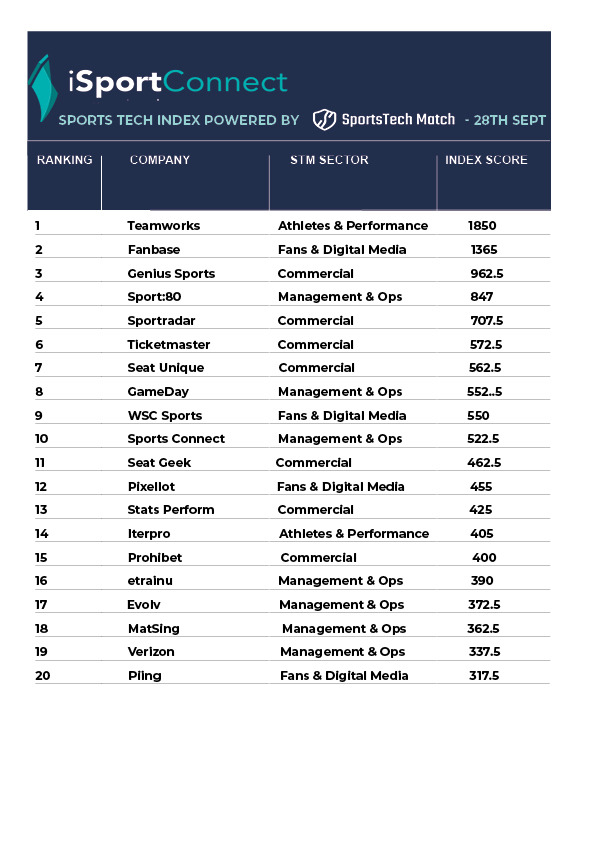
The fourth edition of our monthly sports tech index features a new company in the top spot. Following three consecutive editions at number 1, Seat Unique has been deposed at the top by sports organisation management platform, Sport:80. 

Sport:80 have consistently communicated product updates and new customer wins over recent months as well as collected several verified 4 and 5 star customer ratings via the SportsTech Match’s ratings and reviews programme.

Fanbase at #3 (fan engagement platform), Evolve at #4 (venue security) and Ticketmaster at #5 (ticketing) complete our top five.

Venue broadband connectivity solution, MatSing (#6) is our highest new entry this month on account of recent new deal announcements with venues across the US.

Our highest climber this month, and sitting just outside the top 20, is end-to-end digital platform solution, PT Sportsuite, who rose more than 50 places to #26 on account of receiving two verified 4-star customer reviews.

Want to know more?

Subscribe to the SportsTech Match monthly newsletter for an overview of the list of activity that generated points towards the index score this month (via the footer on the website).

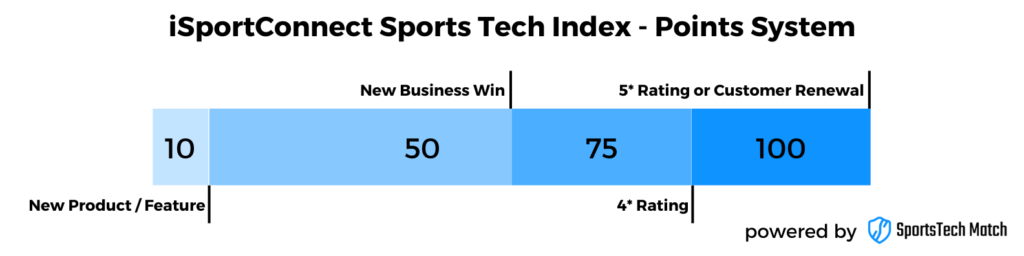
The iSportConnect Sports Tech Index is designed to help rights owners and investors quickly assess who is “hot” from a product and new business perspective and provides sports tech vendors with an incentive to focus their PR announcements on what matters to the market. It follows a simple scoring system (see below).

The iSportConnect Sports Tech Index will be published on a monthly basis on iSportConnect.com.

Click here to read more about how the Index is calculated.

PGA TOUR, DP World Tour and PIF announce major deal to reunify the game of golf

The PGA TOUR, DP World Tour and the Public Investment Fund (PIF) today announced a landmark agreement to unify the game of golf, on a global basis. The parties have signed an agreement that combines PIF’s golf-related commercial businesses and rights (including LIV Golf) with the commercial businesses and rights of the PGA TOUR and DP World Tour into a new, collectively owned, for-profit entity to ensure that all stakeholders benefit from a model that delivers maximum excitement and competition among the game’s best players. 
 
In addition, PIF will make a capital investment into the new entity to facilitate its growth and success.  The new entity (name TBD) will implement a plan to grow these combined commercial businesses, drive greater fan engagement and accelerate growth initiatives already underway.  With LIV Golf in the midst of its second, groundbreaking season, the PGA TOUR, DP World Tour and PIF will work together to best feature and grow team golf going forward. 
 
Notably, today’s announcement will be followed by a mutually agreed end to all pending litigation between the participating parties.  Further, the three organizations will work cooperatively and in good faith to establish a fair and objective process for any players who desire to re-apply for membership with the PGA TOUR or the DP World Tour following the completion of the 2023 season and for determining fair criteria and terms of re-admission, consistent with each Tour’s policies.  
 
“After two years of disruption and distraction, this is a historic day for the game we all know and love,” said PGA TOUR Commissioner Jay Monahan.  “This transformational partnership recognizes the immeasurable strength of the PGA TOUR’s history, legacy and pro-competitive model and combines with it the DP World Tour and LIV – including the team golf concept – to create an organization that will benefit golf’s players, commercial and charitable partners and fans.  Going forward, fans can be confident that we will, collectively, deliver on the promise we’ve always made – to promote competition of the best in professional golf and that we are committed to securing and driving the game’s future.
 
“We are pleased to move forward, in step with LIV and PIF’s world-class investing experience, and I applaud PIF Governor Yasir Al-Rumayyan for his vision and collaborative and forward-thinking approach that is not just a solution to the rift in our game, but also a commitment to taking it to new heights. This will engender a new era in global golf, for the better.”
 
“Today is a very exciting day for this special game and the people it touches around the world,” said PIF Governor Yasir Al-Rumayyan. “We are proud to partner with the PGA TOUR to leverage PIF’s unparalleled success and track record of unlocking value and brining innovation and global best practices to business and sectors worldwide.  We are committed to unifying, promoting and growing the game of golf around the world and offering the highest-quality product to the many millions of long-time fans globally, while cultivating new fans. 
 
“There is no question that the LIV model has been positively transformative for golf. We believe there are opportunities for the game to evolve while also maintaining its storied history and tradition. This partnership represents the best opportunity to extend and increase the impact of golf for all.  We look forward to collaborating with Jay and Keith to bring the best version of the game to communities around the world.”
 
Under the terms of the agreement, the Board of Directors of the new entity will oversee and direct all the new entity’s golf-related commercial operations, businesses and investments. The new entity will work to ensure a cohesive schedule of events that will be exciting for fans, sponsors and all stakeholders.  PIF will initially be the exclusive investor in the new entity, alongside the PGA TOUR, LIV Golf and the DP World Tour. Going forward, PIF will have the exclusive right to further invest in the new entity, including a right of first refusal on any capital that may be invested in the new entity, including into the PGA TOUR, LIV Golf and DP World Tour. The PGA TOUR will appoint a majority of the Board and hold a majority voting interest in the combined entity.
 
Separately, PGA TOUR Inc. will remain in place as a 501(c)(6) tax exempt organization and retains administrative oversight of events for those assets contributed by the PGA TOUR, including the sanctioning of events, the administration of the competition and rules, as well as all other “inside the ropes” responsibilities, with Jay Monahan as Commissioner and Ed Herlihy as PGA TOUR Policy Board Chairman.  PIF’s Governor Yasir Al-Rumayyan will join the PGA TOUR Policy Board. The DP World Tour and LIV Golf will retain similar administrative oversight of events on their respective Tours.
 
The Board of Directors of the new commercial entity will include Al-Rumayyan as Chairman and Monahan as Chief Executive Officer; the new entity’s Board will also include an Executive Committee comprising Al-Rumayyan, Monahan, Herlihy and PGA TOUR Policy Board member Jimmy Dunne.  The full Board will be announced at a later date, and it is anticipated that all three founding members will have representation.
 
Keith Pelley, Chief Executive of the DP World Tour, said “This is a momentous day. We are delighted to be able to not only reignite our relationship with PIF, but also to have the opportunity to build on our current Strategic Alliance partnership with the PGA TOUR.  Together we will be stronger than ever and well positioned to continue to bring the game to all corners of the globe. To partner in this new entity and influence the growth of the game for all our DP World Tour members is energizing and exciting.”
 
All parties will work in the months to come to finalise terms of the agreement, with details to be announced in due course.

Scottish FA and Scottish Gas announce five-year agreement

Scottish Gas, Britain’s leading supplier of energy and services, and the Scottish Football Association are proud to announce an unprecedented five-year agreement – that will also drive real and meaningful impact through participation in the grassroots game.

To power positive change across Scotland, Scottish Gas will significantly invest in grassroots football – with funding used to launch 120 new week-long holiday camps. These camps will offer 6,000 opportunities for children to play football and include free lunches to combat “holiday hunger” for those that need it most.

Scottish Gas will also boost investment in Scottish Para-Football’s disability community initiatives, which use the power of football to improve people’s lives, by working with six clubs each year to set up the required infrastructure and playing conditions for the local para community.

This unique partnership will help bring to life the historic 150th anniversary of the Men’s Scottish Cup next season and makes Scottish Gas the first dual-partner of both Cups, following the Women’s Scottish Cup coming under the Scottish FA’s jurisdiction this season, culminating in the first ever final at Hampden Park in front of more than 10,000 supporters.

Additionally, the partnership will help to deliver on the Scottish Government’s Net Zero ambitions by 2045, by working with the Scottish FA to explore options to make Hampden Park more sustainable, as well as designing a programme for Scottish football clubs to help reduce their carbon footprint and create more sustainable communities.

Chris O’Shea, Chief Executive of Centrica, owner of Scottish Gas said: “Our partnership with the Scottish FA is the perfect match of energy and passion for Scottish Gas as we team up to support the nation.

“We’re delighted to be investing in our customers’ communities, and I’m particularly excited about the work we will be doing to support holiday camps, Para-Football and the women’s game across Scotland. Looking after our people and the communities we serve is at the heart of who we are, so we are delighted to be tackling key issues like hunger and mental health to drive positive impact through a more diverse and inclusive grassroots game.”

Ian Maxwell, Scottish FA Chief Executive: “I am absolutely delighted to welcome Scottish Gas on board as a committed multi-level partner and supporter of the Power of Football.

“As part of our 150th anniversary celebrations, they will help us activate the oldest and youngest cup trophies in world football, bringing new and existing fans on that famous Road to Hampden. 

“Through this agreement, Scottish Gas will also help reinforce the impact our national game has at grassroots level, especially among those whose need is greatest. We look forward to bringing the partnership to life and highlighting the ways in which, together, we can inspire the nation and transform lives.”

The announcement follows research into the positive impact of football participation by the Scottish FA, with 93 percent of grassroots players saying that football helps them cope with anxiety, stress or depression and 98 percent of players admitting that they are happier because they are part of a club.

The partnership aligns with Centrica’s People & Planet Plan which aims to build a more inclusive and sustainable future for communities by supporting organisations up and down the UK.

ICC and DP World announce long-term partnership

The International Cricket Council (ICC) today announced a new long-term partnership with DP World, a leading provider of worldwide smart end-to-end supply chain logistics, as the ICC’s Official Global Logistics Partner.

The partnership starts from the highly anticipated ICC World Test Championship Final in London on Wednesday and includes all major ICC events in men’s and women’s cricket, including the Cricket World Cup, T20 World Cup and Champions Trophy.

The tie-up was unveiled at the Oval Cricket Ground in London and is the first committed partnership for the ICC’s commercial rights cycle, starting in January 2024. As a Global Logistics Partner of the ICC, DP World will implement bespoke logistics solutions across its operations. 

Over the course of the partnership, DP World will own the match ball delivery moment as their headline asset complemented by a series of digital and experiential initiatives co-created with the ICC.

The partnership will also offer a unique opportunity to strengthen the bond between local communities and cricket. DP World will explore avenues to support the ICC’s criiio cricket programme, helping to deliver the game to all corners of the world and promoting the sport’s positive impact on society at large.

The collaboration coincides with cricket’s global growth strategy aspiring to deliver world class ICC events in more cricketing nations over the next few years. As the ICC event footprint expands, with countries such as the USA and Namibia set to co-host future World Cups for the first time, DP World, that has operations in 75 countries across six continents, is uniquely placed to help meet the ICC’s growing logistical needs.

From major international events to managing the smooth flow of equipment and infrastructure, DP World helps deliver cricket to people all around the world, from the cork in the balls to the linseed oil on the bat, across the spectrum of grassroots to professional cricket. 

DP World’s day-to-day operations account for 10% of global trade and their logistical capabilities will enhance the efficiency of cricket’s global events.

DP World Chief Communications Officer, Daniel van Otterdijk said: “DP World is truly delighted to embark on this journey with the International Cricket Council. Our global partnership represents a shared commitment to driving the success of men’s and women’s cricket, breaking down barriers, and propelling the sport into a new era of innovation and growth. We are excited about the limitless possibilities that lie ahead, offering our smart logistic expertise, and the positive impact we can make together.”

ICC Chief Commercial Officer, Anurag Dahiya said: “It is with great excitement and pride that we welcome DP World to the ICC Commercial Partnership Programme. This partnership will not only span our upcoming events during 2023 but will also form an integral part of the ICC’s new commercial rights cycle, beginning in January 2024. It is set to be a partnership marked by deep integration and collaboration.

“With our hosting of an increasing number of events in the upcoming cycle and an expansion into more markets, our logistical demands are growing in scope and complexity. We firmly believe that DP World is in an ideal position to help ICC meet these growing needs. Launching this partnership in such a landmark year for the sport is particularly exciting, with the ICC World Test Championship Final kicking off on Wednesday, and the ICC Men’s Cricket World Cup slated to capture the spotlight in October and November.”

Meet the Member: “The sponsorship market is a lot more mature over here; if something can be branded, it will be!”

Ali Kyrke-Smith is InCrowd’s new Director of Strategy for North America. She landed in the Big Apple a couple of months ago so we decided to catch up with her and find out about the differences she’s seeing in how American sport plays out between leagues, franchises, athletes and fans as well as discussing her recent conversion to bagels…

So Ali, to kick us off, take us through your journey in sport?

I began working in sport nine years ago specialising in market research, having started out in healthcare market research after university. Over time, my remit broadened into strategy consulting. I had always been interested in not just the research itself but the application of the insights to inform strategy, so it was a very natural transition. I joined InCrowd in January 2021 as part of the consulting team, and since the start of the year have been heading up our operations in the US. I’ve been lucky enough to work with some amazing clients over the years, including the Rugby World Cup, F1, the ECB, and most recently the MLS – to name just a few!

You have recently moved to New York; what are your first impressions of US sport now you are on the ground?

The scale is undeniably massive. That is the one thing everyone talks about in the UK, but you only truly understand it when you start working here. In the UK, there is obviously a massive interest in football, but here there are so many different sports and events that get that same level of exposure. It creates great moments in your calendar all year round. 

For example, when I arrived, the college basketball tournament March Madness was going on and that was on at every bar in the city, all the time and then the MLB season started and it was the same. 

What are the key differences and similarities vs the UK sports market?

I think the biggest difference is the volume. For example, every Major League Baseball team has 81 home fixtures in a season, and it is similar for the NBA – they have an 82-game regular season. This means that there inevitably has to be a massive focus simply on selling tickets, with huge sales teams dedicated to that at each franchise.

I also think the sponsorship market is a lot more mature over here, in the stadium and on broadcast. If something can be branded, it will be!

On the flip side, I think that the volumes of tickets to be sold has perhaps detracted from other elements. For example, historically it has created such an emphasis on selling to a local audience, which means there has been less focus on engaging wider digital audiences or those who may not attend in person.There’s definitely missed revenue there as a result.

Broadly speaking, though, I think a lot of the challenges and opportunities are similar in both markets, just with a slightly different context. 

Building up to the World Cup in 2026, we are seeing massive growth in men’s football in the US. As we get closer to the tournament how do you think work between clubs, the national team and the fans will evolve?

Well – firstly I’ve had to start calling it Soccer, but I’m not sure that will ever come naturally!

It does feel like the sport is really getting ready to explode here. Working with the MLS, I’ve seen first hand the focus on leveraging the opportunity that the World Cup will provide, in order to attract and engage new fans with the league. With the recent announcement of a 30th team, and the Leagues Cup to be played this summer featuring all MLS teams and all Liga MX teams, soccer is only moving in one direction and it’s an exciting journey to be a part of.

We have seen Pickleball explode in the US over the last 18 months; what have they done well in terms of securing investment and growing a participant base?

It all really started with the participant base, which has skyrocketed, and the investment has followed on from that. I think a lot of that comes from the nature of the sport. It is so accessible; relatively easy to pick up, and can be played anywhere. You walk around New York on a sunny evening and in every open space all you can see is people playing pickleball. 

I think that the reality is that if a sport is easy for beginners and sociable in its nature then it is going to become popular. From that popularity we have seen some amazing investment in the elite end of the sport as well. It’s definitely one to keep an eye on over the next couple of years.

Gamification is undeniably on the rise across digital platforms; do you think sports fans will buy into this new way of consuming content and engaging with their favourite sports?

Outside of sport, the most successful digital products have tapped into the human psyche, employing what we would broadly term ‘gamification’ techniques to drive deeper engagement with their platforms and build relationships with users that have real longevity. Take Duolingo: we’re creatures of habit, so the ‘streak’ feature encourages us to build habits. 

We’re social beings, so the ability to follow friends and see how others are learning motivates us by creating a social layer. We’re goal-oriented, so the use of ‘challenges’ makes us stay longer on the App than perhaps we originally intended, until we meet the goal. The best gamification executions don’t need a conscious decision from the consumer to ‘buy in’, but instead underpin the digital experience itself – and there is a huge opportunity for sport to embrace that.

Over here we are seeing a lot of rights holders personalising digital experiences for fans. Is this something that is being picked up in the US as well?

I don’t think this is something that has been a priority for sports in the US, but I think that it is beginning to change. As I mentioned before, the focus has tended to be on the fans attending games and trying to keep them coming back. There are also some structural factors – for example, the geographical restrictions on marketing for NFL teams means that until recently there has been an incredibly local focus. 

At the moment, we are having a lot of conversations around widening the opportunity for rights holders to engage fans on a global scale. We are also trying to help rights holders move past the assumption that the majority of fans are in the local area, and will be attending games frequently. There is still a long way to go in terms of making sure that each fan enjoys a great experience, tailored to them as an individual, when they are following their team online.

Quick fire questions

Black Cab or Yellow Taxi?

As a born and bred Londoner, it has to be the Black Cab

Tube or Subway?

Neither, give me my bike anyday

Sandwich or Bagel?

Bagel – I am a recent convert. 

Nets or Knicks?

I will have to see which team I end up going to see first.

Jets or Giants?

Jets – looking forward to seeing what Aaron Rogers can do for them next year

Mets or Yankees?

Yankees – my first baseball game was the Yankees so they will always have a place in my heart.

Click here to find out more about InCrowd and Ali here

Why piracy is the biggest threat to our industry at the moment

In this House View piece, iSportConnect CEO Sandy Case tackles the complex issue of piracy and tries to find a one-size fits all solution.

The problem.

  • At a recent iSportConnect event over 70% of attendees said they had illegally watched sport in the last year on at least one occasion and research from Omdia highlighted 1/3 of Gen Z regularly pirate live content. This is not a small number. It’s a giant problem.
  • A report released by Synamedia and Ampere Analysis in March 2021 revealed that sports piracy is costing the industry as much as $28.3 billion a year. This is all money that could be finding it’s way back into sport. Of course, not all of it would as it assumes everyone currently using an illegal stream pays full price in their region but it’s still s chunky number. 
  • With less revenue, organisations risk losing control of their IP meaning it becomes harder to market a league/organisation leading to further decreases in revenue and reputational decline.

Why is it happening?

Too many sports, too many channels and too high a price

  • We have talked many times about the fact that 10-20 years ago there were your core traditional major sports and a select number of channels to consume them on.
  • Every Federation is now looking at whether it is commercially viable to create their own streaming service.
  • The proliferation of new sports that have emerged in the last decade that are all vying for attention includes: All Women’s sport, Parkour, XFL, eSports, PTO, Kings League, T10 & T20 cricket, Airspeeder, eSkootr, eBikeGP, Ultimate Frisbee, Floorball to name a few. 
  • To watch all this new content means taking out multiple services and this just forces people to find ways around paying for multiple subscriptions.

The market is broken.

  • Just looking at some recent Broadcaster financial results and it doesn’t look great – look at these Q1 losses.
  • I realise the bare numbers don’t tell the story as the major players are switching stance from PayTV to streaming but they make horrendous reading.
  • Netflix lost $1.4bn on $8.0bn revenue.
  • Disney+ lost $1.1bn on $5.1bn revenue.
  • Paramount + lost $750mn on $1.8bn revenue.
  • Discovery + lost $1.0bn on $1.7bn revenue.
  • Warner Bros lost $1.1bn on $10.7bn revenue.

What does it cost the consumer?

I was listening to a podcast that compared the average cost of watching sport across Europe. This was to effectively watch all your domestic topflight football, Champions League and national sport of that country.  

  • starts from £20-£30 per month in countries like France and Spain 
  • All the way up to £60-£80 in the UK. 
  • India is sitting at around £20 as well (see more on that later) 
  • The UK sits as the most expensive exclusively due to the current premier league rights value being as high as they are and the need for services to recoup that money.

The legalities

  • Piracy is pretty much illegal all over the planet but the enforcement hasn’t always been easy
  • Pirate streams of sporting events are not difficult to find on the internet and shutting these down has proved to be an impossible task for sports leagues. While legal action has been successfully brought against several illegal streamers, many are still fully operational. When one stream gets taken down, more pop up in its place. It was interesting to see the recent success in the UK with illegal streaming of the Premier League seeing various prison sentences handed down in a landmark case. 
  • Although previous attempts to introduce an anti-piracy bill in North America were effectively stopped by tech giants.

Bundling

This is where it gets confusing for the consumer – another reason people give up and head for the illegal sites

  • “Disney Bundle” customers who take Hulu and ESPN+ along with Disney+ get an attractive bundled price,
  • Comcast alone you can subscribe to NBCU’s Peacock, Xumo, and Now TV
  • To watch the Champions League semi finals in Italy you needed x2 separate services
  • To watch the next 5 Yankees matches you would need x4 different services 
  • David Zaslav (Warner Discovery) recently stated that bundling is the only option remaining and went on to talk about the fact that only high quality content would survive https://deadline.com/2023/05/david-zaslav-streamers-max-bundle-1235371789/

Solutions

  • Stricter laws against piracy making it more difficult for people to pirate sports content without fear of punishment. The recent action in the UK over Premier League illegal streaming is a case in point 
  • Working with social media platforms that are used to share pirated content to remove these links. 
  • Using technology to make it more difficult to pirate sports content such as watermarking, encryption, and content protection systems. Blockchain technology probably has the answer and this is likely to be the single source of optimism for any sports or entertainment business looking to solve the problem
  • Education: Educating fans about the negative impact of piracy 
  • Illegal streaming boxes and apps usually lack parental controls meaning children are exposed to explicit advertisements or age-inappropriate content.
  • Where legitimate devices and power cables will have been tested, some illegal devices have failed safety standards so could be a real danger to you, like causing a fire in your home.
  • Every time you access illegal content you are infringing copyright and may be committing a crime. 
  • You risk being exposed to dangerous malware and/or the risk of fraud and data theft. This risk increases significantly when you exchange credit or debit card information to view content on unregulated and pirate-run websites.
  • The creative industry offers employment for more than 1.9 million people and contributes £84.1 billion to the UK economy. You are depriving industry of the money it needs to fund the next generation of TV programmes, films and sporting events.
  • Buying and using these devices and apps funds organised crime
  • Making sports content more accessible and affordable:
  •  If fans can easily and affordably access sports content, they are less likely to pirate it. This can be done by making sports content available on more platforms and by reducing the price of sports content. India is a great example where there were many issues with piracy but this changed significantly recently when many of the services like Netflix, Spotify were bundled together as part of the domestic wifi offer for somewhere in the region of £20 pcm. A clear case of “if you get the price right then people will pay”
  • Cable’s biggest problem was the inflexibility of the bundle. Any streaming bundling will require multiple price points with multiple content choices. Some content and some networks won’t make the cut for enough consumers to be viable, but this is the only way

With four weeks to go until SEG3 take a look at who is attending

The SEG3 event is taking place at the Emirates Stadium on June 28 and 29, it is the meeting place for the global sports, entertainment and gaming industries to learn and collaborate with the web3 community.

​Immersive and web3 technologies are enabling a wave of new opportunities for organisations to reimagine their brand, relationship with their audience and revenue models. 

SEG3 will shine a light on those leading the charge, with two days jam packed with an array of interactive sessions, immersive experiences and deep dives into innovative use cases all being used across sports, entertainment and gaming industries.

Buy your tickets by clicking here