
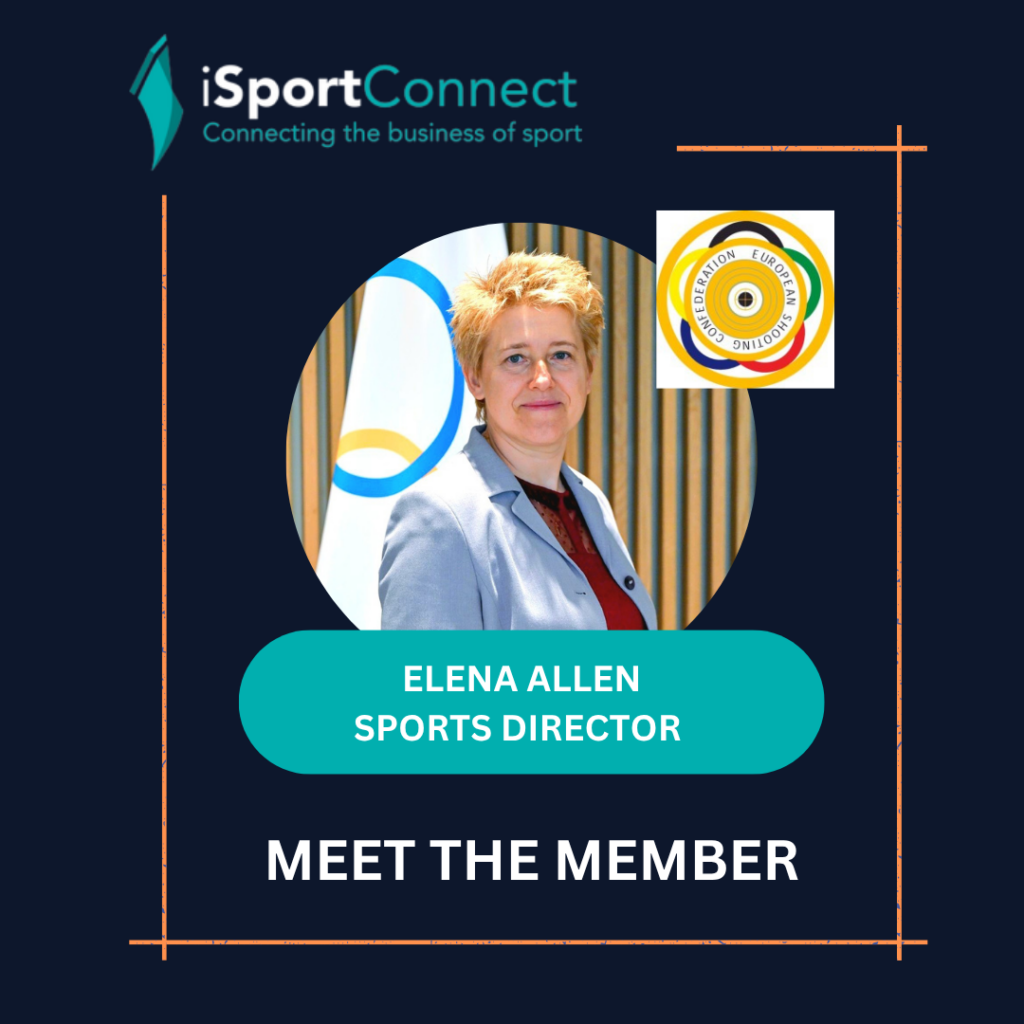
Inside European Shooting: Elena Allen On Growing The Sport, Youth Development And Commercial Challenges
July 23, 2026
As participation, innovation and athlete development continue to shape the future of Olympic sport, the European Shooting Confederation (ESC) is investing heavily in youth pathways, federation support and modern competition formats while addressing the commercial challenges unique to shooting sports.
iSportConnect’s Taruka Srivastav spoke with Elena Allen, former Olympian and Sports Director at the European Shooting Confederation, about the ESC’s long-term vision, its €200,000 federation grant programme, strategies to attract more young athletes and women to the sport, the challenge of securing commercial partners, and how her experience as an elite athlete continues to shape her leadership today.
What is the primary role of the European Shooting Confederation (ESC) and how vast is its reach?
The ESC is the governing body for shooting sports in Europe. It represents 58 national federations and thousands of athletes. The organization manages all European shooting under the Olympic program and hosts all European Championships across every Olympic shooting discipline.
What age-specific competition formats does the confederation offer to keep youth engaged?
The ESC has introduced custom competition formats for youth to ease transition phases and keep athletes from dropping out:
- Under-16 & Under-18: Features 10-meter events. Additionally, the under-18 category covers 25-meter pistol, 50-meter rifle, and shotgun disciplines.
- Under-23: Newly established to support junior shooters transitioning into senior-level competitions, a difficult period where many athletes find themselves struggling to remain competitive and are often lost to the sport.
- Youth Leagues: Includes targeted programs like the Youth League Championships and the Youth League Finals in shotgun and 10-meter events.
Beyond organizing competitions, what initiatives does the ESC provide to support its member federations?
The ESC runs various educational, development, and technical courses to help national federations grow. Following strong showings like the Paris Olympics—where European athletes won 18 medals—the confederation focuses heavily on expanding these programs so member countries do not simply rest on past successes.
What was the core idea behind the ESC’s major fund distribution, and how is it structured for member federations?
Attracting corporate sponsors to shooting sports is uniquely difficult because public perception occasionally views shooting negatively.
Due to this commercial challenge, the ESC has launched a grant programme to help national federations develop in the areas they most require support. This includes the purchase of new training equipment, preparation of athletes for international events, upgrading of facilities or the construction of new ones.
-Each federation can apply for a maximum grant of up to €200,000 structured over a four-year period.
-If a country operates two separate federations (such as independent shotgun and rifle associations), the €200,000 maximum is split equally, allowing each to receive up to €100,000.
What specific developmental areas can federations invest in using these grant funds?
The funds are highly flexible to help smaller federations and can be allocated toward:
- Purchasing technical equipment and weapons.
- Modernizing existing venues or building brand-new facilities.
- Covering athlete preparation and travel costs for European Championships.
- Funding training camps or custom development projects.
Can you share any immediate success stories resulting from this funding program?
The program has already yielded notable developmental breakthroughs:
- Liechtenstein: Used the financial support to purchase equipment, modernize facilities, and build a localized catalyst to attract youth, allowing them to compete internationally for the first time in years.
- Ireland: Funded its target shooting federation to send a full team to the European Championships in Osijek.
- Georgia & Sweden: Georgia utilized its funds upfront to build brand-new shooting facilities, while Sweden staggered its allocation to bring in international coaches for junior shooters and fund training camps.
Why is it notoriously difficult to attract commercial brands to shooting sports?
The primary hurdle is public perception and the literal word “shooting”. In places like Great Britain, the public often misperceives the sport as an elite, aristocratic activity reserved for the upper classes. Additionally, outsiders frequently disassociate the word “shooting” from “sport shooting,” completely overlooking the athletic discipline involved.
What is your main pitch to global brands to convince them to invest in shooting sports?
The pitch relies on the sport’s unmatched inclusivity, longevity, and heritage:
- Universal Accessibility: Unlike sports that require a specific athletic body type (such as javelin), shooting welcomes all shapes and sizes.
- Lifespan of a Surfer: Most sports have a short physical peak (e.g., gymnastics in the early 20s; elite swimming around 24–27). In shooting, athletes can compete at the absolute highest level well into their 60s, as demonstrated by a Kuwaiti shooter winning an Olympic bronze medal at age 54 and repeating the feat at the following Olympics.
- Mental & Physical Mastery: It is a precision-based, highly challenging outdoor sport that pulls participants away from computer screens and smartphones.
- Olympic Legacy: It carries immense historic prestige, having been an integral part of the modern Olympic movement since Pierre de Coubertin first introduced it.
What steps is the ESC taking to make the sport more engaging and easier for television audiences to follow?
To counter complex decimal scoring systems that confuse casual viewers, the ESC has pioneered a simplified point system format for its regional series. In this format, athletes win a set number of shots to earn two points, splitting them if they tie. This system is highly scannable, builds instant crowd excitement, and follows successful evolutionary steps taken by sports like archery to boost television viewership.
Has female participation increased over the years, and what barriers still exist for women?
Inclusivity has grown massively since early global events. Historically, women’s events were severely limited; during an early World Championship in Peru, organizers struggled to assemble even 10 women, forcing an athlete from a different discipline to fill in. While participation remains slightly lower than men’s due to family-raising responsibilities and a lack of local shooting clubs, countries like Slovenia have found success by building local, welcoming community clubs where the majority of local children participate.
How does your background as a former elite athlete help you run a sports federation effectively?
Having experienced the entire journey from the grassroots level to the peak of an athletic career gives an administrator a complete, authentic understanding of what it feels like to step into the circle. It establishes deep credibility when working with current athletes.
While active athletes naturally focus purely on what is best for them to win a medal, a former athlete in an administrative role can bridge that gap by teaching them the broader commercial reality: that the sport cannot survive in the Olympic movement without also cultivating audiences, attracting media coverage, and engaging fans.