The World Baseball Softball Confederation (WBSC), the international governing body for baseball and softball has chosen Alibaba Cloud, the digital technology and intelligence backbone of Alibaba Group, as its dedicated sustainability partner for Baseball5.
Under the collaboration, both parties will work together to develop tailor-made sustainable products, services and solutions, aiming to make WBSC events more eco-friendly. This cooperative effort is part of the WBSC’s ongoing commitment to achieve its sustainability targets, a key component of the Confederation’s Strategic Plan 2022-2028 that aims to utilise baseball/softball as a catalyst for sustainability and social development.
The WBSC Youth Baseball5 World Cup, taking place in Türkiye from 10-15 October, will be the first event to implement Alibaba Cloud’s sustainability initiatives. These measures will calculate the carbon footprint generated from various sources, including venue operation, temporary structure materials, accommodation and catering, participants’ business flights and local commute, as well as the transportation of sport materials and equipment.
The carbon footprint computation, powered by Alibaba Cloud’s AI-driven sustainability solution, Energy Expert, will provide valuable data for enhancing the operations of WBSC events starting with the WBSC Youth Baseball5 World Cup. This could involve increasing the use of diverse types of renewable energy and minimizing power consumption during venue construction in the game’s preparation phase.
“The WBSC, as the international governing body for baseball and softball, is proud to be able to continue to evolve our events and organisation to adapt towards a better and more sustainable future,” said Marco Ienna, WBSC Chief Operating Officer. “We are proud to partner with such an innovative and dynamic company such as Alibaba Cloud to help us achieve our objectives in the area of sustainability to ensure our forever increasing global fanbase will continue to enjoy our beautiful game all around the world.”
“We are thrilled to collaborate with the WBSC, applying our cloud-based, AI-driven sustainability solutions to their sports events,” said Selina Yuan, President of International Business, Alibaba Cloud Intelligence Group. “As sustainability becomes increasingly critical in the global sports industry, we are committed to offering sports organizations like the WBSC timely data, actionable insights, and optimization recommendations. Together, we can generate significant and positive impacts on the global sports community and foster a more sustainable future for sports.” added Yuan.
In 2021, the WBSC joined the United Nations Framework Convention on Climate Change (UNFCCC), a call to action for sports organizations to take responsibility in combating climate change. The Confederation has since been actively working to minimize the climate impact of its operations and events, promote sustainable and responsible consumption, and advocate for more climate actions within the sports community.
Alibaba Cloud’s Energy Expert platform has been utilized to enhance the sustainability of global events like the Hangzhou Asian Games and the Olympic Esports Week in Singapore. The platform has been employed by around 3,000 organizations worldwide to measure and mitigate the carbon footprint of their business activities to meet their sustainability targets.
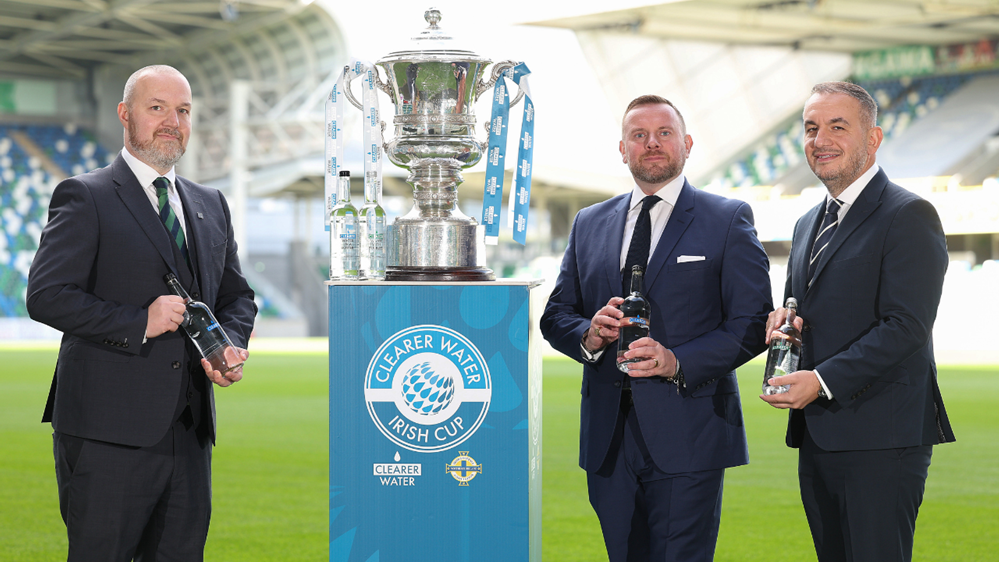
iSportConnect’s Taruka Srivastav spoke with Ross Lazaroo-Hood, Global CEO, Clearer Water on The Irish Cup title sponsorship, brand awareness in the sporting industry and reducing carbon footprints.
Tell us about your recent partnership with the Irish Cup.
We are very excited to be the title partner of The Irish Cup. This agreement and partnership marks a tremendous moment for Clearer Water. The Irish Cup is steeped in heritage and a huge part of Northern Irish football and to all the 48 clubs that participates through Northern Ireland. This prestigious cup has the same ethos, the same ethical credentials as us. And for us to have the further 10 years on this agreement, it shows our commitment, it shows the IRFA’s commitment that we’ll have a joined up thinking of an exciting 10 year journey together.
What are the other partnerships you have or are in the pipeline?
Claire Taggart, the first Boccia player to represent Northern Ireland at the Paralympics is our Brand Ambassador. Claire is an inspirational young woman and is currently the World Number 2 Boccia player within her classification. Among her many honours, she claimed Gold at the 2015 Boccia European Team and Pairs Championships. We’ve been very excited to work with her.
We recently partnered with The Antrim Coast Half Marathon which is going to be longest Sponsorships in road running history with an 8-year agreement. We are the principal sponsor and the marathon is now renamed as “Clearer Water Antrim Coast Half Marathon”. We want to partner with people with similar ethical credentials and we take our time and a cautious approach to bring these partners on board for us . We pick the right partners and we don’t want too many. Also, we do have a couple of exciting projects coming up.
Why is sports industry so attractive?
What goes hand in hand is hydration and sports. Sports, having a very large audience and the fact that it’s got sports sponsorship brand ambassadors, they all work great. And for the brands, it puts themselves into the spotlight in front of the 1000s, or millions of fans and potential long term Clearer Water product buyers as well.
Also not only do we help communities, but we do have to think about potential buyers of our product. And if we are doing a good sponsorship deal, does that have relevance to us? Do we help the brand of the sponsor? And how do they help us as well. But I think for us overall, we have to be backing local communities. They’re getting involved, and assisting. It isn’t all about the supporters. As much as we care deeply about supporters and fans but do all organizations give back to local communities? Clearer Water does. And that’s how we want to be seen.
What is going to be your branding and marketing strategy around these partnerships you already have and which are going to come?
At Clearer Water we believe in long term agreements. To have a title partnership, it not only increases our partnership portfolio, but more importantly, it enables us to work with many organizations to support their plans for the future, their marketing and branding and communities. Communities need to connect with Clearer Water. They need to connect with our brand, they need to connect with the sponsors, brands, and the fans. The fans, the teams, the staff, the communities, it’s about building brands and building brand awareness. And for us, it’s building our own brand awareness.
But we don’t do one or two year partnerships. We want to be able to grow. We want to see initiatives. We want to be able to work out programs through the journey together. And a long term partnership brings that to everybody.
How do you plan to compete with these already established brands?
For us to go up against our peers in the market we have only really brought this brand about in the last year and a half. But we have already seen quadruple increases in sales for us. We’ve already seen a move into a different beverage arena, we’ve taken Clearer Water and declare twist, which is our first range in two mixers. I think it is product diversification. From product diversification, multiple products, it’s also the fact that we stick to the original ethos of Clearer, which is having an amazing water. Our water is pH 7.8. It’s having great mineral content, it’s high sodium, high alkaline, which helps elite sports people. But the overarching umbrella, is that our USP is that 80% of our work or teams is either disabled, or have neurological tendencies, autism, etc.
We are champions of mixed ability workforce. And I know there are some water companies out there who give 5 p or 10p to charities might get swallowed up in management costs. The fact is, we not only hire people who have mixed ability but we are also training them, we’re giving them a job and we’re also giving them a community within our company. And I’ll give you the examples is that we have for mental health, we actually give fishing tools, and they go out and have twice a week fishing expeditions, which is great.
And that’s really been seen by three leading universities that help with mental health, we promote life skills. So it isn’t about learning how to do Excel and it’s not also learning about high water plant works. It’s also giving them the care and interest from us in their lives. I don’t think there’s many water companies who have a high ethical brand like us. We are number one in the UK, Ireland and Europe for ethical brands after only a year and a half.
If you look at the other two who sit on the same position as number one as us, they’ve been going for decades. And they took a long time to hit number one. We don’t just do it. We live our team, we live an ethical brand. And we will continue to do that going forward and even when we expand globally. We will continue that in both our partners, in regard to our third party service providers. We will make sure that anybody who looks at Clearer Water, it comes across as thorough ethical brand and that should excite customers. These days people care more about where their water comes from, how does that water interact both with them and with the workforce or work teams that the company uses.
Lot of brands are going for sustainable packaging as well. Is there anything you’re doing on these lines where you’re trying to create sustainable packaging?
Yeah, for the record, at over 80% of our packaging is glass, which is recycled glass. Second, any plastic range that we have, they are from recycled plastic. And all the items of the plastic bottle are recyclable, as well. So I know there’s again, a lot of move towards canning. But if you look at the statistics of what it takes to produce an aluminum can, it’s actually worse for the environment than that of a plastic bottle. So it isn’t just about plastic, I think you have to look at the process that is involved. What percentage of recycled plastic has been used in your bottle, and are all the items off your bottle recyclable as well. So we do take the whole thing in.
And then the overarching thing is what your carbon footprint is. Currently, over 85% of our supply chain is less than 11 miles. So we’re not doing the likes of an Italian brand, who have massive carbon footprint of through boats through plane, lorries etc. to get their product in to different countries. Our supply chain is less than 11 miles. So we will continue to put our carbon footprint down. And we have plans to be 100% Carbon Neutral within the next five years that will take in consideration of solar power to other items as well.
The International Canoe Federation has joined forces with digital technology giant Alibaba to find ways to monitor and improve the sustainability of its events around the world.
As a leader in environmental sustainability practices, the ICF is taking a pioneering step by joining forces with Alibaba Cloud, the digital technology and intelligence backbone of Alibaba Group, to optimise organisational practices in support of global sustainability goals.
The strategic partnership between ICF and Alibaba Cloud was announced at the 19th Asian Games. During this event, ICF President Thomas Konietzko and Secretary General Richard Pettit visited the athletes’ village in Hangzhou and experienced the sustainable lifestyle tools offered by Alibaba Cloud. These tools are designed to help participants in the Asian Games adopt low-carbon habits and reduce carbon emissions.
The ICF is deeply committed to protecting the environment and playing a significant role in delivering sustainable events. As the Official Cloud Services Partner of the International Olympic Committee, Alibaba Cloud launched its AI-driven sustainability solution, Energy Expert, last June. This solution has been successfully deployed in various events, such as the Olympic Esports Week in June this year and the Hangzhou Asian Games, allowing event organisers to identify sources of carbon emissions, quantify a venue’s carbon footprint, and provide an integrated dashboard with online reports for visualizing sustainability performance.
The collaboration between ICF and Alibaba Cloud encompasses various aspects. These include the development of fit-for-purpose sustainability toolkits based on ICF’s strategy; improving efficiencies in adopting sustainability measurement such as increasing the use of renewable energy; creating sustainable event management programmes to assist national federations and organisers in promoting sustainability for all ICF’s global events; and enhancing fan experiences for both high-performance and recreational sports through innovative sports presentations and digital channels. Additionally, it involves enhancing fan engagement by incorporating gamification of sustainability messages during events.
“We are a sport that is very much connected to the environment, and we must lead the way in remaining at the cutting edge as an international sport in terms of sustainability. The win-win collaboration with Alibaba Cloud will introduce ICF to AI-driven digital technology and solutions, making Canoe a vehicle for sustainability values,” said Mr. Konietzko.
“Alibaba Cloud has been committed to advocating sustainability practices through technologies, and we are deploying our latest cloud and AI technologies to support organisations worldwide to make their events more sustainable and efficient,” said William Xiong, Vice President of Alibaba Cloud Intelligence Group and General Manager of Enterprise Service Cloud. “The partnership with ICF is another testimony to our long-term devotion to sports innovation and sustainability initiatives.”
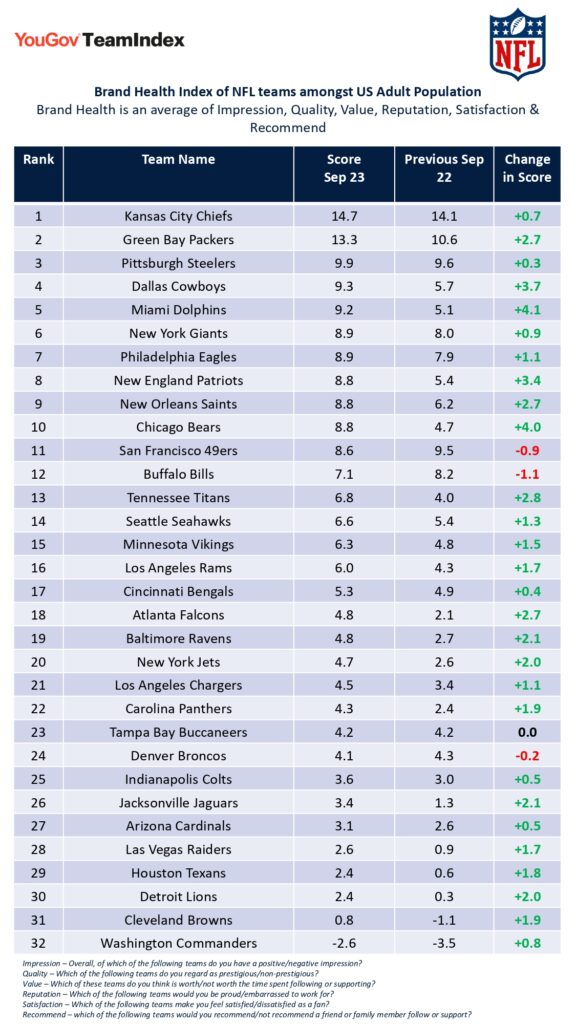
This month’s Brand Health Index, powered by YouGov shows the Brand Health Index of NFL teams amongst US Adult Population. The data is recorded from September 2022 VS September 2023.
Despite their recent loss to Bills, Miami Dolphins have managed to see a whopping +4.1 increase from 5.1 in last September to 9.2 this September. Miami’s 2,044 total yards this season are the most in NFL history through a team’s first four games. The Dolphins are tied for the best record in the AFC. They’ve won 31 of the last 55 overall and are one of just three NFL teams (Buffalo and Kansas City) with winning records in each of the past four seasons (2020-23).
Meanwhile, Chicago Bears are the second team to record a 4.0% jump on the index from 4.7 to 8.8. This comes as a surprise if one was to take into account their performance so far this year. The Bears haven’t won a game since last October, their 14-game slide is tied for the 19th longest losing streak in the history of the NFL, and fans have only witnessed one winning season from the Monsters of the Midway in the last decade.
Buffalo’s might have notched an impressive win against the Dolphins this Sunday but they are biggest loser on the index registering -1.1 drop down from 8.2 in September 2022 to 7.1 in September 2023.
McLaren Racing has announced a partnership extension and expansion with Merchants Fleet.
Merchants Fleet will continue as an Official Partner of the NEOM McLaren Extreme E Team, while expanding to become an Official Partner of the NEOM McLaren Formula E Team for Season 10 of the ABB FIA Formula E World Championship.
Merchants Fleet is North America’s fastest growing fleet management company. The partnership with the NEOM McLaren Extreme E Team began in November 2021 and focuses on accelerating both brands’ sustainability journeys, and goals to promote DE&I (Diversity, Equity, and Inclusion).
McLaren Racing and Merchants Fleet initially launched the partnership at COP26 and have since gone on to collaborate at Merchants Fleet Annual Fleet and Strategic Summits in 2022. McLaren Racing CEO Zak Brown and NEOM McLaren Extreme E driver Emma Gilmour have spoken alongside Brendan P. Keegan, Chairman, CEO & President of Merchants Fleet, about both brands’ focuses in ESG (Environmental, Social and Governance). Zak and Brendan have also recently joined forces on a regular podcast series, the Fast & Fearless: Accelerating Leadership, discussing the tools of leadership, growth and business.
The partnership will see McLaren continue to support Merchants’ ACCELER8 ESG programme, focussing on electrification and DE&I. Merchants Fleet branding will continue to be present on the NEOM McLaren Extreme E race car, and on the race suits of the drivers.
Ian James, Managing Director, NEOM McLaren Electric Racing and Team Principal, NEOM McLaren Formula E Team, said: “We are delighted to expand our partnership with Merchants Fleet. Adding this valued partner of our NEOM McLaren Extreme E Team to our NEOM McLaren Formula E Team is a significant step for our collaboration as we enter our second season in the ABB FIA Formula E World Championship. We look forward to working together to continue to drive positive change across our industries.”
Brendan P. Keegan, Chairman, CEO & President, Merchants Fleet, said: “This exciting partnership underscores our joint commitment to sustainability through electrification, and our deep dedication to diversity, equity and inclusion (DE&I). We are excited to showcase how a partnership based on the genuine alignment of values, has the potential to drive awareness for these important issues on a global scale.”
In this week’s View From Africa piece Cynthia Mumbo, CEO of SportsConnect Africapens down a whirlwind of exciting developments in the sporting world and how East African nations have stepped into the limelight with a series of groundbreaking announcements over the past few weeks.
These revelations span various sports and promise to boost the region’s influence on the global stage. Here’s a closer look at the key highlights:
Rwanda’s Landmark Partnership with Bayern Munich:
In a landmark move, Rwanda has partnered with one of the giants of world football, Bayern Munich. This collaboration announced recently, is set to revolutionize Rwandan football and solidify the nation’s position on the global sporting map while promoting tourism through the VISIT RWANDA platform. It is worth noting that Rwanda has had remarkable partnerships with Arsenal, PSG and the NBA through the same initiatives.
Bayern Munich, a club renowned for its footballing excellence and worldwide fan base, will provide technical support and expertise to Rwanda’s football infrastructure. This partnership aims to improve the country’s footballing capabilities, nurture local talent, and enhance football education.
Jan-Christian Dreesen, FC Bayern Chief Executive Officer, said: “I am very pleased with this collaboration agreed upon until the summer of 2028. FC Bayern can become active on the African continent and gather important experiences. The new platinum partnership is aligned with long-term goals. We will promote ‘Visit Rwanda’ and help Rwanda grow in sports with projects for youth football. These are challenging and responsible tasks. Africa is a continent of opportunities. For FC Bayern, this is the next important step in internationalisation.”
Clare Akamanzi, CEO of the Rwanda Development Board, said: “The Rwanda Development Board is pleased to welcome yet another strategic partner in FC Bayern Munich. It’s been five outstanding years since the Government of Rwanda announced the Visit Rwanda campaign and adding FC Bayern as another additional partner allows us to reach out to its millions of fans across the globe and tell them to visit Rwanda. Germany is among Rwanda’s top five tourism source markets and we aim to use this partnership to attract more tourists to Rwanda, showcase investment and business opportunities and encourage all to stay in Rwanda.”
CAF’s Decision to Award 2027 AFCON Hosting to East African Nations:
The Confederation of African Football (CAF) recently announced that Kenya, Uganda, and Tanzania will co-host the 2027 Africa Cup of Nations (AFCON). This is an important milestone for the area, since it marks the return to East Africa of one of Africa’s most renowned football games after several decades.
The decision to give the hosting rights to this trio of nations, rather than the typical one, underlines CAF’s trust in their capacity to organise a world-class event. East African nations will invest in new stadiums, infrastructure, and tourism amenities, giving the world a chance to see their cultural and sports capabilities. This historic announcement is not only a celebration of East African football but also a testament to the unity and collaboration between the participating nations in the spirit of the beautiful game.
Expressing faith in the hosts, CAF President Patrice Motsepe said “Tanzania, Uganda and Kenya have demonstrated their commitment and capabilities to host a world-class tournament. We look forward to a memorable AFCON that will unite and inspire the entire continent.”
NBA’s Expansion into East Africa with Office in Kenya:
The National Basketball Association (NBA) has set its sights on East Africa, announcing the opening of an office in Kenya in November 2023 in collaboration with the Kenyan government. This is a huge step forward for the region’s basketball growth.
The NBA’s presence in Kenya will serve as a platform for the sport’s growth, developing local talent and linking East African players to the global basketball community. It will provide coaching, training, and educational opportunities, paving the road for future basketball stars.
The Kenyan Government’s partnership with the NBA showcases their commitment to developing sports and youth talent. It also underscores the NBA’s dedication to making basketball a global game, with East Africa being the next frontier.
These statements mark a watershed moment in East African athletic history, with nations not merely participating but actively leading in world sports. These programmes’ collaborations and chances will definitely inspire future generations of athletes and contribute to the general growth and recognition of East African sports on the global stage. As these changes unfold, the athletic world’s gaze will be fixated on East African nations, eagerly anticipating the good influence these initiatives would have on the region’s sporting future.
Ian Whittaker, Twice City AM Analyst of the Year pens down how the involvement of American investors has become one of the main trends of the European football landscape in recent years and that seems to have accelerated in recent months.
In England, Chelsea is majority owned by Clearlake Capital while both Liverpool clubs have seen American funds invest, with 777 Partners buying out Farhad Moshiri’s 94% stake in Everton (to the relief of many Everton fans) while Dynasty Equity has taken a stake in Liverpool FC from fellow US investor Fenway Sports Group.
10 out of the 20 PL clubs are now owned by US-based owners, including (still) Manchester United. Lower tier clubs are also in the target line with NFL star Tom Brady becoming a part-owner of Birmingham City post their acquisition by Knighthead Capital Management LLC (and, of course, Wrexham FC’s famous ownership duo of Ryan Reynolds and Rob McElhenney).
However, the trend has not been confined to English clubs. Bloomberg found that 17 out of the 98 clubs across Europe’s top five leagues in 2022-23 were US owned, far ahead of the 6 from the Middle East, and that number has only increased. France’s Ligue 1 has been another country of interest, with Olympique Lyonnais and Toulouse both majority US owned. The other leagues are less impacted, mainly because their ownership structures encourage fans participation (the Bundesliga in Germany) or local owners still have a strong grip (Italy and Spain). Nevertheless, 777 Partners also owns Hertha Berlin and RedBird owns AC Milan.
The attraction of European clubs for US funds is not hard to see. Particularly the Premier League, but also the other leagues to varying degrees, have worldwide followings and lucrative revenues from both domestic and international leagues. They have passionate fan bases and strong franchises. They are also a lot cheaper than buying major US franchises in the likes of the NFL. And the explosion of interest in Major League Soccer (MLS) post-Lionel Messi’s move to David Beckham-backed Inter Miami has raised the possibility that soccer, finally, is about to take off in the United States.
Nevertheless, there is the question of whether US owners have fully thought through the implications of buying European clubs. I am not so much thinking of the cultural and management differences between Europe and the US (although there are plenty of examples of where that has been an issue) nor the fact that the US franchise model, where teams can literally be moved across the US, is at contrast with a football culture where clubs are inherently rooted in their localities. I am actually thinking more on the money side.
US sports rights are enjoying a purple patch as the major Tech giants have entered the sports rights fray and acquired major rights for large sums of money. Apple’s $2.5bn 10 year deal for US soccer streaming rights, Google’s $14bn deal to stream NFL rights and Amazon’s 10 year deal to show NFL TV rights, while raising questions over the future of traditional US sports broadcasters such as ESPN, NBC Universal and Fox, has brought a new range of deep-pocketed entrants into the game. When looking at this, it is not hard to think – if you are based in the United States – that ownership of European football assets look attractive given the smaller sums they raise, even for the Premier League.
Yet that is missing the inherently different dynamics and economics between the two markets. Sports rights are probably the one thing keeping the US linear TV landscape going. Given the desire of Google in particular to capture a large share of TV advertising revenues, the foray of the giants makes sense. The US is also a very big market, meaning that the Tech giants in particular have a good chance of also monetising the rights in other ways, mainly subscription. Americans are used to paying a lot to watch sports.
However, it is noticeable that these players have been more cautious in Europe. Yes, Amazon has the majority of Ligue 1 rights but it is no coincidence that the one European market it is the major player in football rights is the one market both where the TV rights are far less expensive than the other major leagues and its payment is relatively small. In most other major leagues, the Tech players have been relatively minor players.
The reason for that is simple. The economics do not work because the scale isn’t there and therefore the revenues in either advertising or subscriptions. European consumers are not going to pay US-style amounts for their football. That is unlikely to change.
I don’t think many US owners have grasped the full implications of this. There is a lot of hope in D2C streaming at the moment but, again, that is a US phenomenon. 85%+ of US households have Subscription Video on Demand services but for markets such as the UK, which is at the higher end of penetration, there is probably around 30%+ less takeup – and this seems more of a structural issue than one that can be resolved. As the main US streaming companies have found, what works in the US does not necessarily in Europe.
So let’s see in a decade’s time whether the interest will remain strong.
SNAIFUN, the app created by the Snaitech Group, which rewards a passion for sport and culture with news, quizzes and predictions, has become a Premium Partner of AC Milan.
Thus, the historical collaboration between AC Milan and the Snaitech Group, which has seen the two brands embark on a joint path to spread the values of sport and sports culture, continues and is strengthened.
Together for over ten years, the two entities are continuing down a path founded in the world of sport and its values, including togetherness, participation, fair play, inclusion and social recognition. A consolidation that will promote the emotions that only sport can provide, true passion and healthy fun.
AC Milan and the Snaitech Group will celebrate their new agreement with a special event at the SNAI Hippodrome San Siro which will be attended by not only a strong representation of the two brands and important stakeholders but also 200 lucky SNAIFUN users.
Giorgio Furlani, AC Milan CEO said: “This partnership between AC Milan and the Snaitech Group is a solid and special bond that has been going on for over ten years, making it one of the Club’s longest-running and most successful partnerships. We continue this journey together with pride, aware of how the sports industry and football, in particular, are constantly evolving and with a renewed desire to enrich this partnership by putting our fans at the centre.”
Fabio Schiavolin, Snaitech CEO, commented: “We are enthusiastic to celebrate this strong bond that unites our company to the Rossoneri, with whom we share important principles, that sport conveys and represents, actively supporting the spread of sporting practice. Sport has always been at the base of our business model; for us, that also means your relationship with your territory, with the institutions and the sporting associations. The partnership with AC Milan is a source of pride for the Group: born over ten years ago, it has been enriched and consolidated over time through numerous entertainment initiatives aimed at all sports fans.”
As a Premium Partner, SNAIFUN will also expand its presence at the San Siro stadium during Serie A and Coppa Italia matches, promoting fan engagement, through a ‘pre-match quiz’ aimed at the Rossoneri fanbase, designed to reward and share their passion.
By virtue of this partnership, SNAIFUN will allow all users to take part in fan engagement activities and win exclusive experiences such as the Walkabout at San Siro, an AC Milan training session live at Milanello, a visit to the Casa Milan museum in the company of a Rossoneri Legend and tickets to the Rossoneri’s home matches. The agreement further enhances and expands SNAIFUN’s offer, which is ready to return to the big screen with the TV programme “SNAIFUN MATCHDAY” on air on Milan TV, dedicated to entertainment for all sports fans on Matchdays.
The United States Football League (“USFL”) and the XFL have announced their intention to merge.
Subject to customary regulatory approvals and if the transaction is consummated, the new league will establish best-in-class operations based on the most recent seasons of both leagues. This historic combination will anchor professional spring football with substantial capabilities and resources to ensure future growth and continue to enhance the development of the collective players, coaches, and staff that are coming together.
IMG has secured an agreement to exclusively manage the National Football League’s media rights in 30+ international markets across Asia and Europe from 2024.
The three-year deal will see IMG manage the NFL’s network of broadcast deals across the territories for its current rights cycle. IMG will also provide strategic advice and guidance on the local media landscape across the regions.
Terence Ihm, Director, International Business Development at the NFL said: “We’re thrilled to be working with IMG in our efforts to expand the NFL’s media footprint in over 30 international markets across Asia and Europe. Together with help from IMG, we will strategically and effectively reach new audiences and current fans around the world in the seasons ahead.”
Rebecca Levin, VP, Media for North America at IMG, added: “The NFL is home to some of the most valuable media rights in world sport. Harnessing our expertise as global media specialists, with local experts, we look forward to working with the NFL to drive further value from its media rights in these international territories.”
The deal strengthens IMG and Endeavor’s relationship with the NFL, which includes:
Managing the NFL’s UK, Africa and France social media accounts via IMG’s digital team
Broadcasting the NFL’s games live via the IMG-owned in-flight and in-ship channel, Sport 24.
Managing the NFL’s licensing programme in Europe, Asia, Australia, New Zealand and the Middle-East via IMG’s licensing team.
A partnership with On Location to provide hospitality during regular season games for 26 NFL teams, and manage experiences and hospitality for the League’s major events, such as the Super Bowl, Pro Bowl Games, NFL Draft, the Pro Football Hall of Fame, and international games which this year are being held in London and Frankfurt.
Representing top athletes, players, coaches and on-air talent through WME Sports