New Digital Studio Yellow Panther Launches

Yellow Panther is a full-service digital studio that has already created ground-breaking tech products for Nike, Rajasthan Royals and eBay since its inception. 

Founded by former Digital Director of the ATP Tour, Rajasthan Royals and Blenheim Chalcot, Stuart Cope, and CEO of Industrial Software Systems, Gunjan Parikh. The company has scaled fast with a team of 28 best in class software engineers and project managers. Yellow Panther is based out of two offices in the UK and one in India. 

Yellow Panther’s services include app and website development, augmented and virtual reality creation, gamification, 3d rendering and e-commerce builds. The studio is already working with over 40+ different clients and has achieved staggering results in driving revenue and first party data. 

Stuart Cope said “Our philosophy is simple, we aim to build beautiful digital products that put people first, that’s why we have been trusted by some of the biggest brands in the sport and lifestyle sectors. The team we have created is truly innovative and they push each other every day. Gunjan and I complement one another well, my background is heavily focused on marketing & project delivery whilst Gunjan’s 20 years of experience specialises in product development and software engineering. We’re excited to help grow the digital footprint of sports properties around the world”.

Sport Is The Key Driver Of Orlando’s Tourism Recovery

  • “Greater Orlando has a ten to twelve-month head start on many other major city travel destinations”
  • Influential voices endorse sports vital role in supercharging recovery from the pandemic.
  • Orlando’s emphasis on soccer tourism underlines the city’s 2026 World Cup™ host credentials ahead of FIFA visits.
  • City’s $26billion tourism industry biggest in the US

Al Kidd, President & CEO of Sports ETA, the international association for the sports events and tourism industry, is one of a several influential voices hailing Orlando’s rapidly recovering tourism industry and identifying sport as a key driver.

“As we emerge from the restrictions and challenges of the pandemic and return to business, great cities like Orlando are poised to recover faster than others. Sports events and sports tourism in Orlando have shown to be the re-entry catalyst, generating new and much needed business”, he said. 

Jesse Martinez, General Manager at The Alfond Inn, Chairman of the Central Florida Lodging Association Board of Directors, and Board Member at Visit Florida, agrees. “In my opinion, Central Florida has a tremendous head start on all other major city travel destinations. After seeing a huge influx of travelers this past spring break, we have not slowed down since.”  

“In my opinion, Central Florida has a tremendous head start on all other major city travel destinations. After seeing a huge influx of travelers this past spring break, we have not slowed down since.”

“Sports tourism was an early bright spot when Orlando began to reopen in the summer of 2020 as we hosted the NBA bubble, the MLS is Back Tournament and youth events such as the AAU’s Jr. National Volleyball Championship,” said Casandra Matej, president and CEO of Visit Orlando, who echoed the sentiments of Jesse Martinez by saying that “Orlando has a one-year head start”.   

To underline this, the 2021 edition of the same AAU Youth Volleyball event – hosted just a few weeks ago – drew over 130,000 participants and visitors.  Mark Tester, Executive Director at the Orange County Convention Center said: “The event drove one of our highest food and beverage totals in the Center’s history.”

Don Welsh, President and CEO of Destinations International, added: “All eyes were on Orlando during the pandemic as the NBA and MLS restarted their seasons. It was impressive to watch their collaborative community come together to host in the most trying of circumstances.”  

Orlando believes its emphasis on encouraging sports-related travel and welcoming teams and players has been a game-changing factor in keeping its infrastructure ticking over.

“When business travel collapsed, some cities were saved by their youth and amateur sport travel business” said Jason Siegel, CEO of the Greater Orlando Sports Commission. “There is no doubt in my mind that sports tourism is a viable pathway for generating visitor spending and promoting a destination – which is why Orlando puts such a high priority on it”. 

“I believe our reputation as a collaborative tourism community and reliable partner to sport – and our popularity as a destination – suggest we surely deserve a place”

In normal times, Orlando has the largest tourism industry in the USA, producing $26 billion a year, exceeding Las Vegas with $19 million. One in five workers in Orlando (21%) worked directly in hospitality and leisure in 2019. When COVID-19 struck, the unemployment rate skyrocketed.  “Our neighbors at Port Canaveral, who derive significant revenue from the cruise industry, lost 43% of their workforce,” said Siegel.

But as life normalizes, the recovery is swift, much more so than many anticipated. Hotels are taking bookings; forward occupancy is very promising and optimism abounds. 

According to a study authored by Adam Sacks of Tourism Economics, hotel room demand overall has reached 89% of 2019 figures and air passengers are at 71% (June 2021). Leisure trips will be nearly back to pre-pandemic levels in 2022, although business will take longer. He has said: “Overall, sports are outperforming the market as youth sports have returned well before other business-related events. In fact, we are hearing from clients that sports have been the star performer in what has been an otherwise dismal market”

Orlando, one of 17 US candidate host cities for the 2026 FIFA World Cup™, is hoping to be selected for the final 10. “I believe our reputation as a collaborative tourism community and reliable partner to sport – and our popularity as a destination – suggest we surely deserve a place” Siegel summed up.

CONTACTS:

Jennifer Lastik

Senior Vice President, Events

Greater Orlando Sports Commission

jlastik@greaterorlandosports.com

+44 724 516 1940 

Richard Gillis

International media consultant 

RichardGillis@me.com

+44 7825 409109

Sports Leagues & Federations Heralding The Change From Pay-Per-View To Average Revenue Per User

Ivan Katanaev, deputy CEO of Sportrecs looks at the changing dynamic of sporting organisations now being directly engaged with their fans through OTT channels.

How do the leading sports leagues and federations around the world generate revenue today? By selling their video content rights. For leading sports organizations it has long been their main source of income. In parallel with the sale of their media rights, leading sports organizations have increasingly moved into the D2C space and created their own OTT platforms. For the first time in history, they are able to engage directly with their audience. 

For now, the sale of media rights makes much more money than selling subscriptions. Therefore NBA League Pass or UFC Fight Pass subscribers can access only very limited content. In some regions, they get access only to archive content as a consequence of the broadcast rights having been sold in the region to a large local broadcaster.

“What kind of audience coverage would the league achieve if all of its games and all of its content was available for free?”

The English Premier League (EPL) reported that in the 2018/19 season, the league’s total audience worldwide reached 1.35 billion people. In the same year (according to a Deloitte report), the league earned about €3.46 billion from selling its media rights.

In other words, the main football league in England generated approximately €2.50 per fan.

Revenue of the top 5 European football leagues in the 2018/19 season

Now let’s ask ourselves a few crucial questions.

1. What kind of audience coverage would the league achieve if all of its games and all of its content was available for free? Would the audience increase by a factor of 2 or 3?

2. How can the league increase the revenue generated from each fan (commonly known as ARPU or Average Revenue per User)?.

For me, it is obvious that today with the development of a huge number of fan engagement services – watch together, interactive voting (and various other live widgets), gamification, NFT technologies and much more – there is an opportunity for the right holders to earn more and more on each individual fan. 

Moreover, for the majority of sports leagues and federations, this will soon become the only opportunity to earn money with their video content. Why? Because there are only 20-30 leagues in the world that are comparable to the EPL. The majority of sports organizations will never earn even a fraction of what the EPL, NBA, NHL or F1 can earn on their media rights today. For this reason, a focus on ARPU is the cornerstone of the revenue model for the sports business of tomorrow.

Recently, Rob Shaw, Facebook’s director of sports league and media partnerships, spoke about how the world’s largest social network is pulling out of the race for sports rights around the world. Facebook has a crucial advantage over everyone else – they have more data on the fans than anyone else (okay, maybe Google will disagree with this statement!). Facebook’s strategic vision is simply to analyze and leverage the huge amount of user data it holds.

“Broadcasts and highlights will be the entry points for the audience to interact with brands.”

Most recently, the biggest players in the US were fighting for the NFL media rights. Amazon invested more than a billion dollars in them, and Facebook did not even participate in the auction. Facebook is not even trying to extend its rights to the UEFA Champions League and La Liga in Latin America and India. Starting this year, I don’t see Facebook renewing any of its sports rights contracts in any country in the world! They just got out of the race.

Why?

They believe that they can offer sports rights holders more than just money for the rights. They believe that sports right holders will be able to make more profit not from selling their media rights, but from monetizing each individual fan. Broadcasts and highlights will be the entry points for the audience to interact with brands. You watch football – and immediately buy boots like your favorite player. You watch MMA and sign up for the nearest gym. You watch hockey and make a bet with a bookmaker.

And Facebook proves this with specific examples.

  • MLB sold half a million dollars worth of tickets alone to their games to those who watched their free broadcasts on Facebook.
  • IRONMAN drives the sales of advertising spots for its races with live broadcasts. Furthermore, they calculated that these broadcasts generate 14.6 times (!) more ROI compared to placing regular race ads!
  • World Surf League is increasing its sponsorship contracts with better brand integration into its Facebook broadcasts.

“Today, there are more and more companies on the market that offer rights holders interactive services that involve fans with the content.”

Today, there are more and more companies on the market that offer rights holders interactive services that involve fans with the content (and create revenue generating opportunities) such as watch together and others I mentioned previously. Today, most of these services are forced to work with large regional or domestic broadcasters who buy the rights to all the leading sports events in their region or country. As a consequence of this, these interactive services are not available for right holders from Tier2 and Tier3. 

What will happen when these services eventually become available to all sports rights holders and they will have direct access to their audience and to all the tools to monetize them effectively? The answer is clear – the rules of the game will change again. Given current realities and how quickly new technologies come into our lives, I would be surprised if this doesn’t already happen in the next 2-3 years.

The Hundred – Challenging Status Quo And Designing Sport From Bottom-Up

Gareth Balch, Chief Executive & Co-Founder of Two Circles, looks at the journey The Hundred has taken to get to the launch, six years after the idea was first broached.

Two Circles has partnered with cricket, and the ECB, from day one. Before we had an office. Even before we had a name.

Cricket is in our DNA, and over the last 10 years we’re hugely proud that we’ve been able to play a small role in bringing this amazing sport into the lives of more people across clubs, counties, countries and continents.

But I wanted to write something today because this afternoon’s match at the Kia Oval represents one of our biggest days yet in cricket. I know others Two Circlers feel the same.

“A very simple question was posed: ‘How do we protect and grow the game of cricket in England and Wales?'”

I can remember the day in 2015 when the journey for The Hundred began…of course we didn’t know it would be called The Hundred, or even indeed that it would be a new format of cricket, but I do vividly remember a strong sense of being brave and bold to grow the game.

That day was a workshop at Lord’s which Sanjay Patel had asked Two Circles to attend. A very simple question was posed: “How do we protect and grow the game of cricket in England and Wales?”

The answer arose easily – cricket, after all, has amazing qualities. There’s enough simplicity – who scores the most runs wins – but a level of complexity for those who want it. And for centuries bat versus ball sport has delivered unscripted gladiatorial battles for moments or even days at a time.

But the ‘how’ was far from easy. That’s because challenging the status quo is never easy, particularly in sport, and as someone who has been involved in the long-term building of businesses I know first-hand that pioneers are often cast as failures until they succeed.

The six-year journey to today represents pioneering innovation and a challenging of the status quo on a level that I haven’t seen from another national governing body in my time in the sports industry. Over the last six years the ECB have made bold decision after bold decision to ensure a strong future for cricket. Their moral compass to grow the game and make it better has never wavered.

I thought hard about what picture to put on this piece. This afternoon, for the first time, I’ll be taking my kids to see a professional sports event that has been designed for them from the bottom-up. A family experience. I don’t think that ever happened to me, or most of us reading this for that matter. They and the other millions of kids in the UK are why The Hundred exists.

The fact that through The Hundred we’ve built a family-first experience that can engage my five-year-old daughter whilst simultaneously creating a best-versus-best cricket product that the cricket badgers in the Two Circles offices around the world will love too is completely unprecedented.

I’m in no doubt that cricket will benefit from The Hundred and flourish in the years ahead as it helps cricket fans deepen their love of the game, helps create new lovers of cricket, helps engage new brands with new propositions, and crucially helps create a media audience unparalleled in English cricket previously.

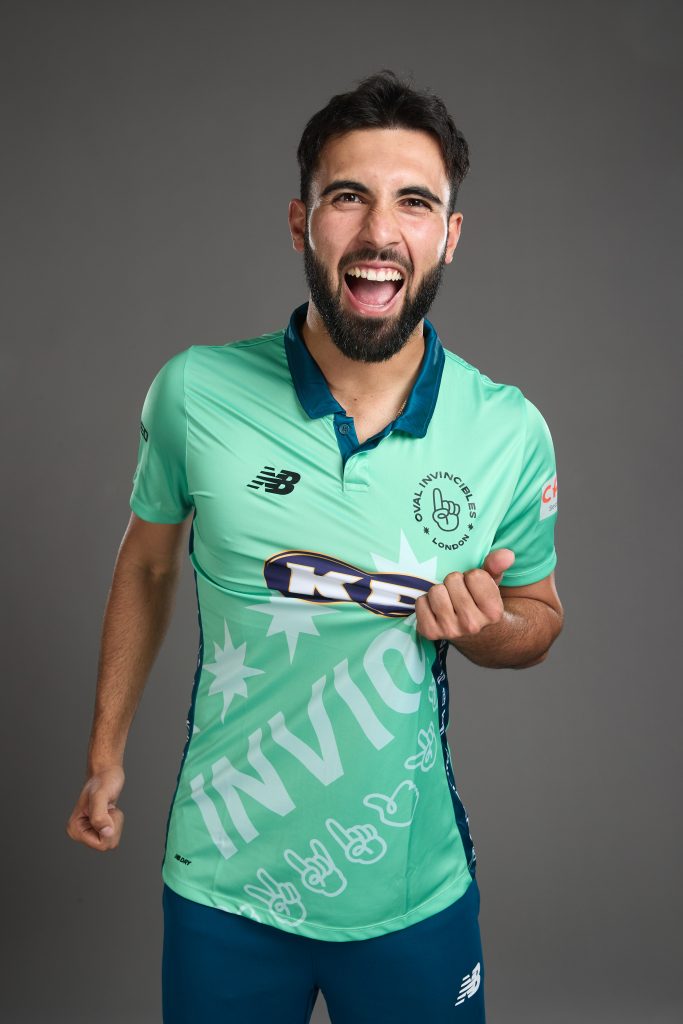
Saqib Mahmood of Oval Invincibles

The data is already telling us The Hundred will succeed. As Sanjay said over the weekend, The Hundred will be profitable in year one. The broadcast and brand partnerships deals signed have been outstanding.

But I’m most excited and interested by fan engagement. That underpins every sustainably-successful sports property in the post-internet era. I’ve been on The Hundred dashboard this morning and all the meaningful metrics around engagement – content consumption, ticket sales, fan demographics and others – are flying, and beyond expectations. Not to mention a record attendance for a domestic women’s match in England awaits. All of this despite the uncontrollable and continued challenge of Covid.

“The data is already telling us The Hundred will succeed. As Sanjay said over the weekend, The Hundred will be profitable in year one.”

So, as I sit there waiting the first ball of The Hundred with my wife, kids, Two Circlers and thousands of other people – many attending a sports event with their families too – it’ll be emotional.

And as Two Circles we’ll raise a toast to everyone who wrote the case of change, who participated in an experience cricket workshop, attended fan research groups, was in the room that day at Royal Institute of British Architects or at a COVID-scenario planning meet. This has been a massive team effort, the results of which I’m certain will grow and protect the game of cricket for generations to come.

The author Gareth Balch is Chief Executive & Co-Founder of Two Circles.

Experts Weigh In Their Opinions At The iSportConnect’s Blockchain And NFT eMasterclass

iSportConnect’s Blockchain and NFT eMasterclass today provided a platform for those within the sports industry to gain a greater understanding of how these two new innovations will play a role in the development of the business of sport.

To open our event we had a session on ‘Blockchain 101 – The Fundamentals of Blockchain Technology and Cryptos/Coins’, where John Palfreyman, former Director of Blockchain at IBM and Sam Volkering, Investment Director and Editor at Southbank Investment Research.

John and Sam took you through the basic principles of both blockchain and cryptocurrencies, which provided all of our attendees with some great knowledge and additional background to how these technologies work.

As to why blockchain gained the sudden momentum despite being around for so long, John said: “If you look at blockchain, it is really interesting because it is plugged together from different technologies. Starting from file sharing technology which was pioneered in 1999, privacy that is cryptography so you can clearly see the components of the technology have been around for very long.

But clearly in the computational context, we need to wind the clock to 1970 when computer security started to be taken very seriously. My old employer IBM started the world’s first crypto group in the early 1970s looking at securing customer data. Then all the components moved really forward to when bitcoins was created. Blockchain is the technology that underpins bitcoin. Bitcoin was first used as donation for WikiLeaks in 2007.”

When it comes to defining bitcoin, one can use lot of different approaches as per Sam. He said: “We are talking about security, computing networks and fundamentally that’s what blockchain technology is. It’s a network between peers whether those are public peers or private peers. It can be a data network, monetary network and can hold many different forms. One of the thing that irks me is when someone talks about ‘The Blockchain’ ; in a singular form. In a reality when we look at this space, there are number of different blockchains and there are some networks involved with data sharing that don’t use blockchain technology but are still fundamentally computational or peer networks.”

“People want to know how they can use the blockchain and what it means and how they can utilise it for themselves and their organisations. When we talk about NFTs or bitcoin, we need to look at what does the network represent in this sense. Bitcoin originally is designed to be a medium of exchange, a monetary network and that’s how it started and it has now evolved into what some will consider to store as value, some would consider property. Bitcoin is something we have never had before like it is not property, money, it is not shares and equity but it could be all of these things. When we start to look around the new concepts of what money is, what assets are, how can people transact it anywhere around the world, we are cutting new grand really and so everyone is really finding their feet in this industry,” explained Sam.

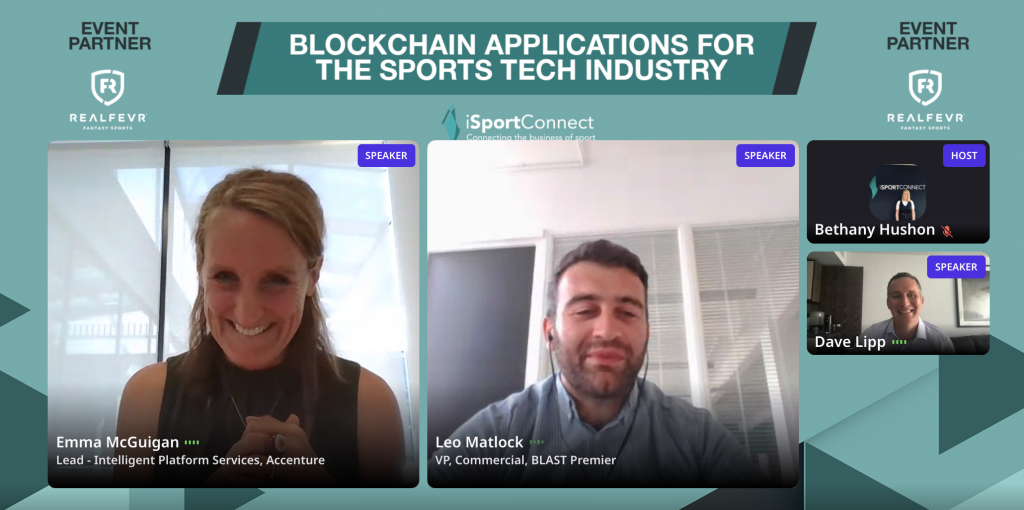
Following the opening session, our second panel was centred on ‘Blockchain Applications for the Sports Industry’, featuring Emma McGuigan, Lead – Intelligent Platform Services at Accenture and Leo Matlock, VP – Commercial for BLAST, looking at how this technology is infiltrating the sports industry and the best potential uses for it.

As to how blockchain is revolutionary for the sports industry, Leo explains: “When I look at blockchain, we have already been using things like NFT and build in the gaming environment. I am looking at blockchain both as a customer and a seller and how we can use this technology on the front in customer using applications to drive our business forward commercially. Some of those are new commercial activities like NFTs and some are replacing our current activities with more efficient and better ways of working.”

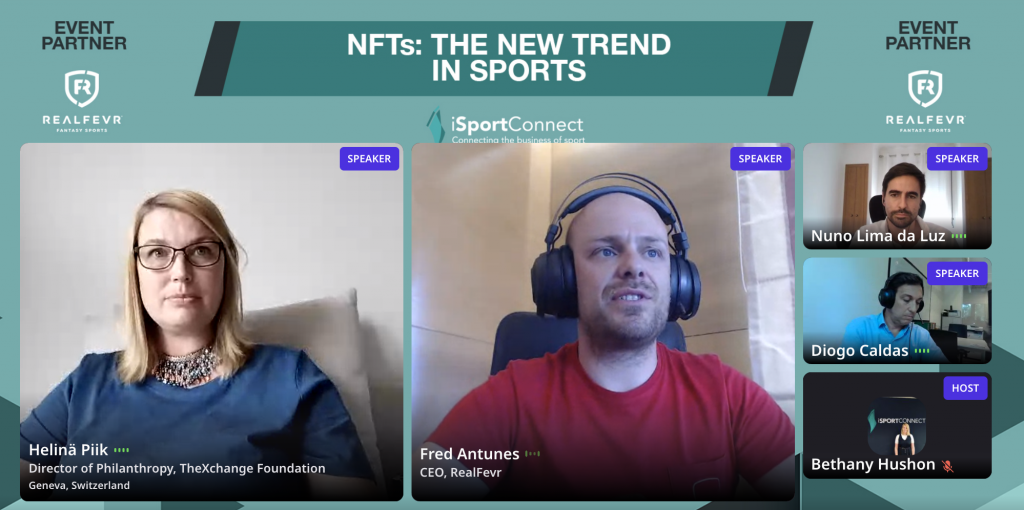
Our final session looked at ‘NFTs – The New Trend in Sport’, where we heard from three people working within the NFT space, Fred Antunes, CEO of RealFevr, Nuno Lima da Luz, Principal Associate at Cuatrecasas and Diogo Caldas, Executive Board Member of Sport Multimedia.

The market for collectible digital products has been growing stratospherically during 2021, with sales already in the hundreds of millions of dollars. Our panel looked at how you can use NFTs to unlock the value of your organisation’s content assets.

Fred shared his experience of starting his career in the gaming industry and his first conact with bitcoin happened in 2010. He explained NFTs as “digital representation of something that is unique and non-fungible”.

“There are multiple applications of digital representation of something. It started ofcourse with the idea of the digital kits that were represented inside the blockchain. We have reached around 1.2 active million users in our app store, website,” he added.

We would like to thank all of our speakers for their participation in today’s event which provided a huge amount of knowledge and insight for our audience into burgeoning areas within the industry that will play a key role over the coming years across various sectors of sport.

The full video will be available for viewing next week. Stay tuned to iSportConnect till then.

Wimbledon Viewership Remains Strong Despite Impact Of Euros Clashes

Wimbledon was back on our screens this summer after a year off due to the pandemic, but how did fans at home respond to the tournament’s return? At the same time as the tennis event was staged, EURO2020 was also being held, Andy Milnes, Head of Client Services for Nielsen Sports looked at how UK TV viewers reacted to Tennis’ showpiece event.

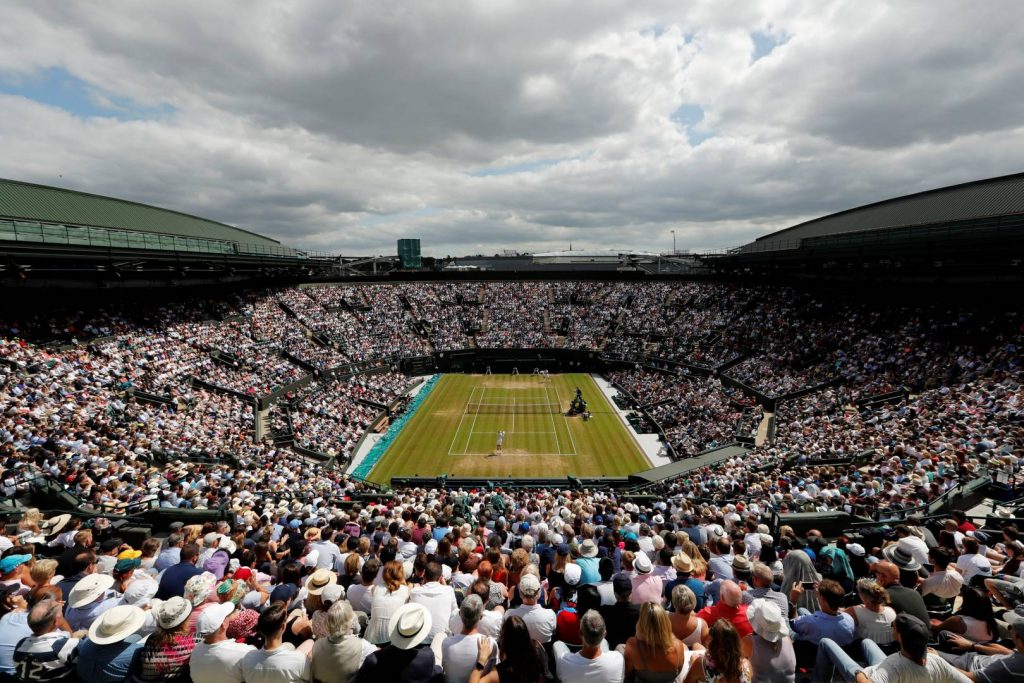
After last year’s cancellation due to the pandemic, the 2021 Wimbledon Championships went ahead, albeit with a few differences. The traditional queue was absent, all tickets were sold online and there were fewer spectators on the ground to witness the action prior to the finals.

While the event eventually allowed for full capacity crowds during the finals, the initial 50% capacity didn’t impact the way people viewed at home. As a permanent fixture of the British sporting calendar every year, Wimbledon has become more of a cultural event, according to Nielsen Fan Insights. One that sporting and non-sporting fans alike have grown to love, which was reflected in the viewership figures once again, remaining consistently high year on year.

“Overall, the combined viewership is slightly down compared to 2019. This can mostly be attributed to the much more congested viewing schedule and competition for audience share.”

Looking at the viewership for the Finals alone we can see that the Ladies Final attracted an average audience of 2.54m vs. 2.49m in 2019. Similarly, the Men’s Final attracted an average audience of 5.08m vs 6.00m in 2019, only a small decline despite many English fans no doubt making plans to watch the final of the Euros later in the evening.

Overall, the combined viewership is slightly down compared to 2019. This can mostly be attributed to the much more congested viewing schedule and competition for audience share, with the Euros, Lions Tour and Home Nations rugby also occupying free to air TV slots.

While the audiences remain largely consistent with what we expected to see pre-tournament, there seems to have been a slight move towards showing the bigger matches, often involving British talent, towards later start times to encourage larger viewership’s.

This was also driven by excellent performances on display from young British talent resulting in some exciting ties with big players. For example, Emma Raducanu’s early success as a British wild card resulted in her 4th round tie with world number 51 Alja Tomljanovic, giving her a chance to play on Centre Court.

Similarly, Britain’s’ Katie Boulter and Cameron Norrie were also given the opportunity to play on Centre Court during their ties with Aryna Sabalenka and Roger Federer respectively. This British success coupled with Andy Murray’s resurgence all contributed to spikes in TV viewership figures at various points during the tournament. For instance, Andy Murray and Emma Raducanu’s matches alone attracted almost double the audience of matches scheduled at the same timeslots in 2019.

While there was a large interest in the British talent on show at Wimbledon, the knockout stages of the Euros still managed to have an impact on viewership. For example, Andy Murray’s third round match vs Denis Shapovalov clashed with both Switzerland vs Spain (5pm KO) on ITV which attracted 1.7m viewers (peaking at 3.2m for the penalties at 7.35pm) and Belgium vs Italy on BBC 1 (8pm KO) which generated 7.2m viewers and 38% share of audience. Murray’s match started at 7pm on BBC2 and had an average audience of 2.6m and peak of 3.7m at 7.55pm, which was considerably lower than his second-round match vs Otte which benefited from not clashing with the Euros and being a more competitive game. The numbers from that match drew an average audience of 4.36m, which peaked at 6.75m in the deciding set.

“Despite the limited capacity at this year’s event, Wimbledon has been able to adapt to the new post-covid age which prioritises digital activation over those on site.”

Despite the limited capacity at this year’s event, Wimbledon has been able to adapt to the new post-covid age which prioritises digital activation over those on site. Wimbledon has always been a leader in digital activation and while this pivot has most certainly impacted sponsors ability to engage with fans it has also advanced their digital offering.

This improved digital offering combined with the consistently high audiences results in a reliable and exciting opportunity for brands to engage with fans and gain exposure to new audiences during this unprecedented summer of sport.

The Power of Purpose

“The true power of purpose is when purpose is instrumental to an organisation’s goals and what it seeks to achieve.” – Phil Coverdale, Managing Director of Cravens.

Over the past couple of years, there has been a shift in the commercialisation of brands within the sports industry, with their purpose becoming a key driver in aligning with rights holders. This new, dynamic and complex element of non-commercial messaging has given influence and power to brands with positive associations.

Competitions such as Extreme-E are at the forefront of these new purposeful initiatives in sport. A motor racing series featuring electric off-road vehicles, which takes place in areas of the planet affected by climate change, showcases these issues and becomes a proponent for more environmental efforts. 

“It must not be forgotten that by having a true purpose it can be of great commercial value”

Many others are now starting to match these efforts, with numerous football clubs, including Arsenal FC and Liverpool FC, and sporting organisations, such as Paris 2024, signing up for the UN’s Climate Action Framework. This in turn, is having an impact on brands who have a business interest in sport – all leading back to ‘the power of purpose’.

Brands looking to be involved with sport sponsorship are deciding it is of great importance to be involved with those who have a strong purpose that fits in with what the brand wants to embody.

However, brands don’t solely join forces with sport on this basis, it must not be forgotten that by having a true purpose it can be of great commercial value – as consumers are more likely to want to support them.

“Looking at the ethics of purpose more than 90% of CEOs believe their companies need to adopt a broader measure of success not just profits but social goals” – McKinsey and Company.

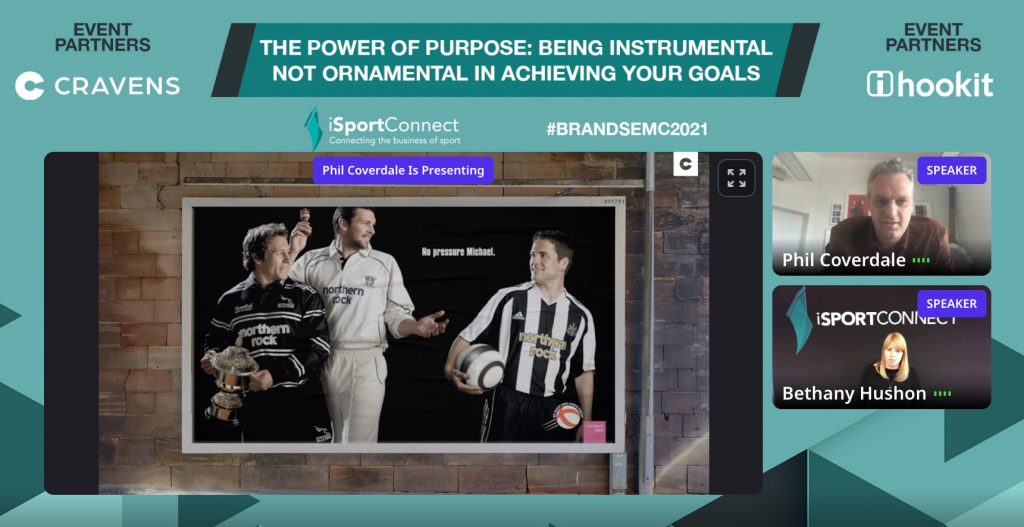
Phil Coverdale speaking during our Brands eMasterclass

Phil Coverdale, Managing Director of Cravens, last week presented on ‘The Power of Purpose’ during iSportConnect’s latest Brands eMasterclass, stating that; “When getting purpose right, and when it’s really powerful, it has the ability to inspire communities, colleagues and also the commercial bottom line as well.”

“Organisations that truly have that sense of motivation, not just what they do or how they go about it but why they exist, have the potential to really outperform those that don’t,” Phil added.

Purpose provides a framework for decision making, linking short-term action to long-term goals and longevity. You should be looking to inspire ‘on purpose’ through:

  • Product
  • Experiences
  • Processes
  • Culture
  • Communication
  • Innovation

This, however, is not just through a marketing message. Purpose needs to be aligned throughout the organisation and at the forefront of how the business is run. Corporate Social Responsibility (CSR) should not be institutionally separate from the core business, but part of the existence of everything a brand does.

“When you look at London 2012 – it had a clear sense of the event they wanted to deliver, inclusivity and legacy.”

Organisations that have attempted to ‘cover up’ areas of their business by using CSR projects have often been caught out by people exposing their hypocrisy in alignment with these programmes.

As Phil discussed in his presentation: “There is a danger of the pitfalls of PR purpose… or indeed overstating what this CSR purpose actually means in the real world of business.”

Some examples of who Cravens work with across different sectors

When you look at London 2012 – it had a clear sense of the event they wanted to deliver, inclusivity and legacy. Whether that was through ticket pricing, the way they did the torch relay or the opening ceremony, the way the Games-makers played such a fundamental part. They were saying – this is for everyone.

Cravens work with a number of major brands both inside and outside of the world of sport, but the key message remains the same for every company – the reason for purpose in organisations is through the power it can produce through inspiration.

How Social Media Has Changed The Way We Watch Sport

Over the past decade sports broadcasting has been competing with the growth of mobile viewership and second screen viewing. Beatrice Cain looks at how social media has changed how we watch sport.

With Euro 2020 viewing figures hitting a record high of 31 million viewers across England for the final on Sunday, it clearly shows that people are still watching coverage of live sport. However, social media’s impact on the way we interact with and watch live sport has been changing the game. 

The emergence of social media has provided viewers with an alternative platform to consume sports content. Today, social media platforms such as Twitter and Facebook have created and enabled an all-new viewing experience for individuals through phones, tablets, and computers. A platform with immediate access to information regarding live sport and highlight reels. Twitter particularly has seen fan increase during live events, with many using the platform as their primary second screen app.

Simultaneous viewing, often referred to as ‘dual screening’ or ‘the second screen’, has allowed people to gain an extra viewing insight and experience in conjunction with main TV broadcasting. Millennial sports fans are watching games differently, and a large proportion not at all. eMarketer found that in 2014, only 51 percent of respondents used their smartphone while watching TV, a figure that rose sharply to 74% in 2017, a significant acceleration in second screen multitasking. 

The idea of simultaneous viewing allows fans to use social media alongside traditional viewing of live sport. Whether it be for live commentary, player updates or to follow multiple games at once, usually the case in the Premier League with multiple games starting at the same time. The rise of simultaneous viewing, or dual screening does not threaten the experience of first screen viewing, it is simply an opening to provide complementary content to enhance these experiences. 

Twitter, for me, has been the most significant social media platform in changing the way I watch live sport.

Twitter, for me, has been the most significant social media platform in changing the way I watch live sport. I often find myself following live commentary from online journalists, tweeting every few minutes providing updates and personal opinions on a game I too will be watching live. The usage of Twitter to compliment live sports has shown how users gain a higher level of engagement and increases memorability, proving how a second screen can heighten the viewing experience. But it is not just live commentary that allows many to be encompassed by Twitter, the emergence of meme culture has added another dimension.

It is a matter of minutes on Twitter for memes to be circulating, whether it be a video or picture, these are spread rapidly amongst internet users on multiple platforms and have become integral to the way people communicate online. Meme culture is particularly significant in the NBA Twitter scene, with the NBA inspiring more memes in common usage than any other sport and has now become woven into the fabric of internet discourse. 

YPulse conducted research into how young people are watching sport. 70% of 13–37-year-olds no longer feel the need to watch a live game to know and keep up with the events. This is down to social media channels providing non-traditional forms of content. Younger viewers will instead opt to watch highlights of the sport, a quicker, shorter way of keeping up to date with sports events and results. 

Social media companies are constantly searching for innovative ways to advance live sport viewership on their platforms, for example Facebook Watch.

This research aligns with the shift in ‘social first’ content produced by social media brands such as YouTube and Facebook. These platforms are creating exclusive shows designed to air online, separate to TV broadcasts. The partnership between both social media and sport, often described as a ‘match made in heaven’, shows how something between the two is working. Social media companies are constantly searching for innovative ways to advance live sport viewership on their platforms, for example Facebook Watch. A platform launched in 2017 which is currently attempting to muscle onto the sports broadcasting scene, putting social media and live sports viewing on the same platform. The service has become another broadcast competitor after obtaining the rights to numerous sports, from Women’s Basketball to surfing. 

Viewers have been enabled to consume information without delay, which is now something social media platforms are required to ensure, creating competition to keep doing so, and pressure to release the most accessible, high quality content to supply appropriate information about live sporting events.

Sporting bodies have learned to move and evolve with the ever-growing social media phenomenon, with the emergence of sporting body ownership of media platforms, such as NBL TV and AFL media, for the Australian National Basketball League and Australian Football League, after social media was proven effective in increasing millennial interaction with sporting content. 

YouTube has created a social platform for individuals to create live content or upload pre-recorded videos. Regarding how this affects live sport viewing, it has grown in significance. YouTube channels such as AFTV, run by Arsenal supporters will stream a watch-along live, where viewers will not be able to watch the game, but witness live reactions and commentary from the channel, a prime example of how ‘second screen’ viewing heightens live sports coverage. 

Phones and social media will become the primary method of watching and interacting with live sports.

It is not just social media that has changed the experience of watching live sport, the increase of online sports betting has allowed viewers to engage in dual screening, with in-play betting on the rise. Premium sportsbook provider, Kambi predicts that 65% of bets placed come from mobiles or tablets during major tournaments, such as European championships, with Euro 2016 showing that two thirds of users used a second screen to bet during the tournament. 

Social media has impacted how we interact with live sports coverage, but what heights will it go to next?

I think it is plausible to see that with more people not only watching on their phones and tablets but combining that with alternative methods of commentary and interaction, coverage of live sporting events through TV will instead become the ‘second screen’. Phones and social media will become the primary method of watching and interacting with live sports, with traditional TV broadcasting becoming an afterthought. 

Roc Nation And The United Rugby Championship Announce A Revolutionary Partnership

Paving the way for a new era of club rugby, the United Rugby Championship announces a strategic consulting partnership with Roc Nation, the world’s leading entertainment company.

Built on a foundation of clear purpose and identity, the partnership strives to provide a platform that embraces and celebrates difference, capturing the imagination of the next generation of rugby fans and talent.

With both brands built on a strong notion of entertainment, the partnership has been designed to drive innovation, community and integrity, reaching new audiences via purpose-driven initiatives and creative activation. The relationship will add value to current and future commercial partnerships through innovative ideas and Global amplification.

Roc Nation will assist in the development of a Player Advisory Group, offering players a seat at the table to voice opinion and share their views on the promotion and marketing of the game.

The partnership follows last month’s announcement of the formation of the United Rugby Championship, an evolution of the PRO14 into a world-class 16-team league format, from September 2021, introducing the top 4 teams in South African rugby.

Martin Anayi, CEO of The United Rugby Championship said“Roc Nation is at the cutting edge of sports, entertainment and culture, and we believe there’s no better partner to help us reach new audiences and develop new experiences for fans. We are looking forward to this partnership helping us achieve our ambitions of becoming a strong, purpose-led league where players and fans can have a voice and an influence. With an unparalleled network in the world of entertainment and a track record in building strong connections between sporting heroes and their communities this is an opportunity to build towards the ambitious future we have for the United Rugby Championship. We believe that rugby holds a unique inspirational quality and alongside Roc Nation our goal is to inspire the next generation of players and fans from all walks of life to keep growing the game.”

Michael Yormark, Co-CEO of Roc Nation Unified added: “Roc Nation is thrilled to embark on this unique partnership with the United Rugby Championship, as they kick start an exciting new chapter in their history, guided by a clear blueprint for success.

Leveraging our subject-matter experts across our international offices we are confident that the United Rugby Championship will continue to attract some of the biggest names in world rugby with its modern and collaborative approach to player management and re-define the concept of live entertainment on-and-off the field. Roc Nation is excited to be on this journey with the league.”

What ATPI Sports Event Did When One Of The Biggest Sporting Events In The World Was Postponed

Hear from ATPI’s Kevin Perrin, Head of Commercial & Sports Relations at ATPI Sports Events, based in Canada and Ellen de Weijer, Senior Project Manager at ATPI Sports Events about how the organisation adapted following the postponement of the 2021 Olympics.

On 24th March , 2020 the International Olympic Committee (IOC) confirmed that the Tokyo Olympics were to be postponed to 2021.

For ATPI Sports Events, a travel partner used to providing travel to international athletes and offering guest and hospitality experiences for a range of corporate clients and customers, the cancellation of the games represented a rapid departure from ‘business as usual’ and signified just how serious the Covid-19 pandemic had become around the world.

A year later, with the pandemic still developing, it was announced that international spectators would not be permitted to attend the Olympics and once again, all plans were turned on their head.

“Within a typical year, two months ahead of the Olympics games would see us spending most of our time finalising the itineraries of our corporate clients here in the Netherlands.” – Ellen de Weijer, Senior Projectmanager at ATPI Sports Events, NL

Kevin Perrin, Head of Commercial & Sports Relations at ATPI Sports Events, based in Canada and Ellen de Weijer, Senior Project Manager at ATPI Sports Events, based in the Netherlands, talk about how they and their teams have dealt with all of the uncertainty that has surrounded one of the biggest sporting events in the world for the last year.

Kevin says: “We worked with our colleagues in the Netherlands to pull together a document to keep track of which suppliers had been contacted and store the various cancellation fees of various suppliers. This document then helped us to talk to our stakeholders about what the best options for them would be moving forwards.”

To read the full interview and get more insight from Kevin and Ellen, head to this link – https://insight.atpi.com/story/interview-kevin-and-ellen-olympics/page/2/1