Meet the Member: “I fell in love with Esports because it doesn’t matter about physical differences between people”

The Esports industry is growing at a rapid speed, to find out what the International Esports Federation is doing we caught up with its President Vlad Marinescu. We discussed the challenges the industry faces, what it can learn from traditional sport and what makes a great host city for a World Championships.

Vlad, take us through your journey in sport and how did you end up at the International Esports Federation?

I have always been around sport from a really early age, my father was actually massive in the martial arts space in Romania so naturally that was a sport I had to pick up. As I suspect is the case with so many people you interview, sports played a massive role in founding me as a person.

In terms of esports, I have always been a bit of a gamer. When I was growing up in California we used to take the old LAN Router out of the school at the weekend and take it to someone’s house and just play games from Friday evening through to Sunday morning. It was so much harder to game back then because you couldn’t just turn on a controller like you can now, this is where my passion for technology started. 

This is where I fell in love with Esports because I realised it doesn’t matter what the physical differences between two people are, it just comes down to who is better at the game. 

Going back to my work in traditional sport, I got involved in martial arts and helped organise my first Olympic Games for Judo at Beijing. The skills I learnt in the traditional sports world helped so much when it came to working and leading the International Esports Federation.  

How different has it been working for an Esports Federation to your previous positions?

As I touched on in my last answer I was so fortunate for everything that I learnt while working with Judo and SportAccord. In my role at the International Judo Federation we were organising 20 events a year and doing so much for it with TV rights, prize money, TV production and also working on the Olympics and with the IOC as well. 

I understood very quickly that the differences between passion and professionalism and throughout the lifecycle of a federation, traditionally, we can see that at the beginning of the federation, you have passionate people, people who love that, that’s their sport, they’ve grown up in it, they bleed it, they breathe it, they cry it, they’ll do anything for it. As the sport develops, professionally, and financially, you start having more professional people. Like I said I was really lucky to be able to learn from all these different people, which meant when I came into lead the International Esports Federation I was in a good place. 

Not subscribed to our weekly newsletter? Click here to sign up and receive more content like this to your inbox every week. 

The team here are so passionate about Esports, it really is amazing and especially working through the pandemic we really came together as a team and evolved like so many different federations. Esports and gaming really took off in the pandemic as well, in many ways I think it saved a lot of people’s mental health, because it enabled people to socialise even without social distancing.

What are the challenges that Esports faces as an industry in order to grow?

Like so many sports the pandemic meant we couldn’t host our 2020 World Championships in person. I do acknowledge that we were probably in a better position than most when it came to moving events online but it still wasn’t easy. What has emerged though is actually a much better World Championships as a result. Instead of a ten-day in-person event the Championship’s now last three months. Starting with national qualifying events which take place online and then build up to an in-person finals in the host city. The three month build up to the finals gives us better opportunities to create narratives around players, get fans invested and also it is fantastic for the host cities because they get a big increase in exposure.

We also have a fantastic team here, I am incredibly confident that whatever challenges we are facing as a sport we will be able to overcome together.

Coming from the traditional federation world, how do you see Esports fitting into the olympics?

The International Olympic Committee has just undergone the Olympic Esports week. I’m very happy to see them taking a strong direction in assisting the International Federation to modernise and to control and develop what they want to do with Esports. 

We also need more people playing sports generally and if Esports can lead to that along with traditional sports then that is a massive positive.

There’s obviously esports which is professional gaming and then there is using informal gaming as a route towards increasing participation in the sport. Do you think both can help each other grow?

I mean, how many hours do you have. Firstly, learning about the rules and how to play a sport through gaming definitely leads to people taking up the sport for real. 

We are also partnering together with fitgamer to instil such principles of physical fitness around the sports athletes. It’s very evident through all the research and the studies that have been conducted, from all the research papers that in order to be very successful in Esports. If you’re physically healthy, as well, you will have a higher capacity of delivery, and of course, a better result.

It’s one of our top priorities, to ensure the physical competencies, and mental health and lifestyle of all our sports athletes.

In your view, what can traditional sports learn from Esports and what can Esports learn from traditional sports?

Esports has a lot to learn from traditional sports values, particularly the Olympic values which underpin so many great things about sports. A few of these values are socialisation and teamwork which can easily be lost in an Esports setting. We are increasingly trying to get these values into Esports and overtime we will be able to implement them.

What Esports can give back to traditional sports is modernisation and fun and access most importantly, to a young demographic of people who today are not interested as much in the participation of traditional sports nor viewing it. 

I think there is a massive value exchange to be had between Esports and traditional sports, it is definitely something that we are looking to facilitate. 

Looking forward you’re looking to find host cities for World Championships in 2024 and 2025. With Esports being different to traditional sports, what sort of requirements are you looking for from a host city?

We obviously need the technological infrastructure to start with which most cities do have but it is a pretty key element of what we are doing. We are getting a lot of interest from cities because of the young demographic that we bring in and give them an opportunity to communicate with. 

It isn’t just about the cities and an arena though it is about the environment. We want to give our athletes and spectators the opportunity to visit and experience great culture, great food and music. We want a city that is going to really buy into it with us and really try and show themselves off as much as possible.

The House View – New Premier League gambling rules are a halfway house

It all started in West London, back in 2002, when Fulham’s deal with Pizza Hut came to an end and they put Betfair on the front of their shirt.

Fulham were the first of many Premier League teams to put the name of a betting brand on the front of their kit, but after last week’s landmark decision made by the clubs we will only see them until 2026/27. 

This season eight of the 20 clubs in the Premier League have a gambling brand as their front of shirt sponsor. The total combined value is estimated at £60 million. 

Front of shirt is only one of the assets Premier League teams have for their sponsors. For a start betting brands will still be allowed to appear on the shirt sleeves – we will see the value of these sponsorships soaring as a result of this. It is not just shirt sleeves where we will see values increase, clubs will be desperate to make up for the lost revenue where they can and LED, stadium and stand naming rights will all increase in value.

Looking back, the 2016/17 season was when gambling front of shirt deals peaked with 50% of the clubs having them.

Currently, gambling brands make up for 22% of front of shirt sponsorships across Europe’s top three leagues despite restrictions on sponsorships in Italy and Spain. They have even gone up 3% in the last year.

Italy and Spain tightened their rules on gambling sponsorship in both 2019 and 2021 respectively. Javier Tebas, President of LaLiga estimates that they have lost £80 million and the Italian Football Federation say they have lost closer to £90 million. In both of these countries the regulations were brought in without a great deal of lead time leaving clubs in a tricky position. 

Down in the EFL, they have not placed the same restrictions on front of shirt deals. Clubs are deemed to be too dependent on gambling brands for financial solvency. It will be interesting to see how sponsorship deals will be structured now because if clubs achieve promotion they will have to change sponsors. 

The vast majority of the gambling brands that are on club’s shirts are Asian bookmakers. For example, Labrokes has not had their brand on the front of a shirt since 2016/17 when they partnered with Notts County. 

Another sports loss is another sports gain, the ICC has decided to open up and will allow betting brands to appear on the front of international cricket shirts for the first time. Over the pond in the US, we are seeing a relaxation around all sorts of regulations around betting sponsorships – it will be interesting to see where this leads.

While the front of shirt is very visible, I would argue LED and stand/stadium naming rights have the potential to draw even more attention to a brand. LED is especially interesting with betting brands being able to advertise live odds to the viewers at home during the game. Surely this is more likely to encourage people to part with their money than any name on the front of a top.

Stoke City for instance are owned by the Bet365 Group, have Bet365 on the front of their shirts and play at the Bet365 stadium. If they get promoted they would have to find a new front of shirt partner, but be able to keep the naming rights and stadium branding. That doesn’t make a great deal of sense.

I don’t see the ban being an issue for clubs, their commercial directors will find ways to make up the revenue. My problem is with the stopping at front of shirt deals, they are at a halfway house, if they want to get gambling out of football they need to be stronger. If not then why bother doing this.

By Alex Brinton, Content Manager iSportConnect

Socios announce partnership with GB Wheelchair Rugby

Great Britain Wheelchair Rugby (GBWR) has today announced a new three-year partnership with Socios.com, the leading fan engagement and rewards platform, to support the sport’s continued growth. This comes as part of Socios.com’s community and social impact initiative, Socios.com Supports.

The move feeds into GBWR’s strategy to continue raising the profile of wheelchair rugby by forging new partnerships and pursuing commercial opportunities, with the ultimate goal of increasing nationwide participation and driving performance to secure podium finishes at major tournaments.

It comes ahead of the 2023 Wheelchair Rugby European Championship, where Paralympic gold medallists Great Britain will host the continent’s top teams as they vie for European glory and the chance to defend their Paralympic title by qualifying for the Paris 2024 Paralympic Games.

Socios.com will also be partnering with the European Championship, taking place at Cardiff’s iconic Principality Stadium, 3 to 7 May.

Both partnerships form part of Socios.com’s community and social impact initiative, Socios.com Supports. The programme has committed to donating £2 million to partner organisations over the next two seasons to help tackle the issues that matter to fans and their communities across inclusion, health and employability.

England Football partner with Howdens

Howdens’ Game Changer Programme in partnership with England Football will see the kitchen company aim to fund £3m worth of kitchens over three years for England Football Accredited grassroots clubs.

The Programme will look to provide better kitchen facilities to help clubs make their matchday experience more enjoyable and increase revenue opportunities.

Find out if your grassroots club is eligible by reading the guidance information, and applying here

The application window will run from 19 April 2023 until 26 May 2023.

To help launch the programme, football legends Jill Scott and Chris Kamara lent their support, driving home the importance of grassroots football and clubhouse facilities on their own careers.

Jill said: “I have so many fond memories both on and off the pitch.  Over the years I’ve visited hundreds of clubhouses and it’s fair to say the kitchen facilities have certainly varied – from a tiny counter at Boldon Girls (my first club) where I used to spend 20p on a bag of mixed sweets after the game, to a bar serving hot food (including my favourite post-match treat – pizza!) at Marine FC, where we played our Everton matches.

“The kitchen is the hub of the club, bringing together players, supporters and the wider community and that’s why I’m so pleased to be involved with the Howdens Game Changer programme, where grassroots clubs all over the country are set to benefit.”

Kammy added: “When I started out, clubhouse facilities were pretty basic!  I went to many a tournament with just a bag of crisps and some water to keep me going, hoping that the manager would remember to bring the fruit for our half-time snack.  And, if we won, we’d often stop off at the chippy on the way home!

“Thankfully, we’ve come a long way since then, but many clubhouses still need help to improve much-needed facilities.  So, the new kitchens from Howdens will make a real difference to grassroots clubs and bringing local communities together.”

FIFA announce CISCO as Official Network Infrastructure Partner for Women’s World Cup 2023

FIFA has announced that Cisco has been appointed as the Official Network Infrastructure Provider for the FIFA Women’s World Cup Australia & New Zealand 2023™. As an Official Tournament Supporter for the Asia-Pacific region, Cisco will deliver a secure and reliable network that connects the entire tournament ecosystem, from the venues and operations to the administration and media.

The FIFA Women’s World Cup 2023™ is expected to be watched by two billion people globally, and Cisco’s networking technology will enable the seamless delivery of the event. Cisco is renowned for its ability to connect and protect the world’s largest sports and entertainment events and will be deploying its networking solutions across nine host cities and ten stadiums, some of which are already built on Cisco infrastructure.

In addition to connecting the competition venues, Cisco’s network will also connect the non-competition venues that are necessary to support the tournament’s operations, including the International Broadcast Centre (IBC). Cisco’s IP Fabric for Media solution will be deployed at the IBC to ensure the secure and efficient delivery of 4K content to fans around the world.

“The FIFA Women’s World Cup 2023™ will be a historic event, and we are thrilled to have another great company, Cisco, now on board as our Official Network Infrastructure Provider,” said FIFA Secretary General, Fatma Samoura. “With Cisco’s expertise and solutions, we will have a seamless and securely connected tournament experience.”

Cisco’s Senior Vice President and Chief Marketing Officer, Carrie Palin, added: “The FIFA Women’s World Cup 2023™ is unequivocally one of the marquee global sporting events, and we are proud that Cisco will be the trusted provider to connect and protect the network on which the entire ecosystem will operate.”

“We’re committed to enabling a connected experience for football fans worldwide and are proud of our role in supporting the game of football and using it as a platform to make a positive impact on players and fans.”

As part of its sponsorship, Cisco’s Networking Academy, which provides free IT educational courses and career growth opportunities, will offer an all-female team of local students the chance to gain real, hands-on experience by assisting with the installation and servicing of the network leading up to and during the FIFA Women’s World Cup 2023™.

Cisco’s support of the FIFA Women’s World Cup 2023™ is a testament to its ongoing commitment to connecting more people and things and enabling a more inclusive future for all. The company has extensive involvement across the global sports and entertainment landscape, and its solutions and expertise are relied upon by some of the most prestigious events, organisations, and venues worldwide.

The View From Africa: What you need to know to understand our continent

In this View From Africa piece, Cynthia Mumbo Founder & CEO of Sports Connect Africa, looks into some of the key trends in Africa and why the NBA is so successful in the region.

The African sports business industry is an exciting and rapidly growing sector. With the growing popularity of sports, the African market is attracting more investment from both domestic and international sports organisations.

There are numerous opportunities for investors to explore on the African continent, ranging from the NBA and FIFA to the NFL and CAF. This article will provide an overview of the African sports business industry, including its current state, potential growth areas, and challenges. We will also discuss some of the industry’s key players and their success strategies. Finally, we will consider how technology can help drive additional growth and development in this sector.

Understanding the continent

The African continent has a young and rapidly growing population, with over 60% of the population under the age of 25. By 2030, young Africans are expected to constitute 42% of global youth. As a key target audience for sports and entertainment, this demographic represents a significant opportunity for sports business. Furthermore, mobile penetration in Africa is high. By the end of 2021, 515 million people in Sub-Saharan Africa had subscribed to mobile services, accounting for 46% of the population, an increase of nearly 20 million from the previous year. By 2025, nearly 100 million new subscribers will have joined, bringing the total number of subscribers to 613 million (50% of the region’s population). This has led to a surge in digital consumption, with many Africans using mobile devices to access social media, video streaming services, other digital content and for mobile payment. The digital landscape is rapidly evolving in Africa, and this is likely to have a significant impact on the sports business industry. In the near future, we can expect to see increased investment in digital platforms, social media, and mobile applications that are tailored to the African market. This will create new opportunities for sports business, as well as new challenges as companies seek to navigate the unique cultural, linguistic, and regulatory landscapes of different African countries.

Fintech, Mobile Money and Micro transactions 

Fintech, mobile money, and microtransactions are rapidly changing the African financial landscape. The use of digital financial services is increasing at an unprecedented rate due to the increasing adoption of smartphones and mobile internet connectivity. This financial technology revolution is expected to have a significant impact on the African sports industry, from how fans interact with their favourite teams to how sports organisations manage their finances.

Fintech is the application of technology to the delivery of financial services. Fintech has been especially important in bringing financial services to the unbanked population in Africa, which has traditionally been excluded from the formal financial system. Mobile money has been a game changer in Africa. It is a type of fintech service that allows users to make payments and transfer money using their mobile phones. Their mobile numbers serve as bank accounts.

Because of its convenience, low transaction costs, and accessibility, mobile money has grown in popularity in Africa. According to a GSM Association report, mobile money services are available in 96% of Sub-Saharan African countries, with over 320 million registered mobile money accounts. This has resulted in an increase in microtransactions, which are lower than $10.

Microtransactions are especially important in the African sports industry, where the majority of fans earn low wages. Consider this scenario: you develop a solution that generates $2 for every 2 million transactions as a football team with a large fan base in Africa. That is $4 million (deduct costs). Microtransactions allow fans to buy tickets, merchandise, and other sports-related services in small, affordable increments. This has the potential to boost overall revenue generated by African sports organisations while also making it easier for fans to interact with their favourite teams.

How the NBA is winning in Africa.

NBA Africa and the Basketball Africa League (BAL) are two major players in Africa’s sports business industry, promoting basketball and creating opportunities for athletes and investors. NBA Africa is a subsidiary of the NBA that has been present on the continent since 2011 and was officially launched in 2020 with the mission of expanding the NBA’s presence in Africa and developing basketball talent across the continent. NBA Africa is based in Johannesburg, South Africa, and it is involved in a variety of initiatives aimed at promoting basketball in Africa. These initiatives include the NBA Academy Africa, which provides world-class training and education to top young basketball talent, and the Jr. NBA program, which teaches basketball skills and promotes the game among children.

Basketball Africa League (BAL) is a professional basketball league founded in 2019 in collaboration with the NBA. The league, which includes 12 teams from across Africa, aims to promote basketball development in Africa while also providing opportunities for players and teams to compete at the highest levels of international competition. Basketball is also being used by the BAL to help build infrastructure and create economic opportunities in Africa.

Challenges faced by players in the sports industry.

Despite Africa’s sports business industry’s potential for growth and development, significant challenges must be addressed. One of the most difficult challenges is infrastructure. Africa has 54 countries, over 2000 languages, and a wide range of cultures and norms. What works in Nigeria may not work in Ghana or elsewhere in Africa to the east. It is critical to comprehend these dynamics.

Many African countries lack the necessary facilities and equipment to support a thriving sports industry, which can impede athlete development and industry growth. Another issue is a lack of capacity and capability. There aren’t enough Africans who are knowledgeable about sports management and operations. Furthermore, political insecurity, corruption, and regulatory barriers can all pose difficulties for the African sports industry.

Conclusion

In conclusion, it is safe to say that the potential for sports business on the continent is enormous; however, teams, leagues, and investors must have a long-term perspective on the potential of sports business on the continent. The young population, as well as the mobile and digital landscape, present a clear opportunity for investment. Leading the way are brands such as the NBA, FIFA, and CAF, the local governing football authority affiliated with FIFA.

The power of three: the Rugby League World Cup

In October 2022 a World Cup came to England; the Rugby League World Cup to be precise. 

It was a World Cup that was postponed a year due to the Pandemic. It was a World Cup that saw three different Prime Ministers in power. And it was the first World Cup where the national anthem was God Save the King. 

But what really made the RLWC2021 special, was that for the first time in the sports’ 127 year history, the Men’s, Women’s and Wheelchair Games came together to form one record-breaking tournament. 

Over 30 million people tuned in to 61 fixtures broadcast live on the BBC. The tournament was shown in over 150 countries. While new attendance records were set thanks to 500,000+ tickets being sold over the course of a five-week period. 

Exciting and unpredictable, the tournament garnered unprecedented media interest. There were monumental moments and real upsets as local heroes and global stars were made across the Men’s, Women’s and Wheelchair games. 

Not subscribed to our weekly newsletter? Click here to sign up and receive more content like this to your inbox every week.

Particularly England’s Wheelchair Team who arguably stole the show; defeating France to once more earn themselves a World Cup. A well earned victory that epitomises the culture of the tournament, as the RLWC 2021 set out to be ‘the biggest, best and most inclusive World Cup ever’. 

So, what was the logic behind having the Men’s, Women’s and Wheelchair Games appear under one World Cup? 

Women’s Sport is undoubtedly having its moment (and long may it continue). Female teams and athletes are finally being championed in the way they deserve. It’s so encouraging to look at Women’s Football and see their own tournament, sponsors, superstars, fans and culture evolving around the Women’s game. So it’s only natural to wonder why Women’s Rugby League didn’t have a stand alone gig too? 

The simplest answer is numbers. From a funding perspective, having all three tournaments played together was a logical decision. The World Cup required Government backing, and this structure meant we could share stadiums, pool resources and that the Men’s, Women’s and the Wheelchair games would benefit from overall tournament awareness. After all, while Rugby League is one of Australia’s favourite sports, it isn’t as front of mind in the UK. To fill stadiums, we needed to not only to bring all rugby league fans together; but go beyond the core fanbase by getting the country to care. Uniting the Men’s, Women’s and Wheelchair games gave us the best chance of doing that. 

Our theory was, that whatever the discipline, being a fan of sport means certain things. It means you appreciate stories of human endeavour. It means you’ve likely experienced sports’ unique ability to bring people and communities together. And it means you’re likely to take pride in representing the Nation. You might not be a follower of Rugby League; but if you’re a fan of sport, you’re likely to get behind a World Cup that champions inclusivity. 

Our theory proved true. Social stats and ticketing data showed that new audiences were being introduced to Rugby League. Better yet, both existing and new fans were choosing to attend a mixture of both Men’s, Women’s and Wheelchair fixtures. Logistics supported the inclusivity and shared success of the tournament. Rather than hosting the World Cup in one city, it was shared across the country; meaning wherever you lived, you had access to a game (and from as little as £2 a ticket). Alongside the big games, advertising budget was reserved to promote key fixtures like double headers which were designed to encourage fans to embrace all three tournaments. 

Scheduled for 2021, the RLWC was postponed a year due to the pandemic. Its original campaign had focussed on ‘assembling your squad’ and the social side of the sport. While ticket sales were important, we also set ourselves targets that supported the tournament’s legacy and the future of Rugby League in England; so we made a strategic gear change to promote inclusivity. 

What sets Rugby League apart is the grass roots impact of the game; it’s a prime example of sport as a force for good. That is where our campaign, ‘This Is Real Impact’ came from. A nod to the beautiful, full contact nature of the sport; and the real life impact the sport has on and off the pitch. The impact of the RLWC2021, was over 25 million invested back into community clubs. An investment that will pay for local leagues and the ever important community officers that provide vital support and training for young players. And an investment into inclusivity that will see more and more women and wheelchair players welcomed into the game. 

Even the RLWC2021’s branding was designed to be inclusive. For example, the iconic trophy logo was built from coloured ribbons; each colour representing each tournament. While advertising was split between being tournament and fixture specific, it was important that Men’s, Women’s and Wheelchair was represented equally. 

Presenting disability and Women’s sport was a huge cultural responsibility we didn’t take lightly. Our art direction was gritty, rare and real. While our visual style made sure that athlete’s from all three games were represented on the same level. Our TVC didn’t shy away from disability, putting players like Tom Halliwell and Jodie Boyd-Ward in the spotlight, showing off their inspiring mental and physical strength. 

‘This is Real Impact’ also cut through on social, which championed individual impactful stories from players. Resulting in over 194 million social media impressions. A testament to the culture of the tournament; big names from the men’s game used their social platforms to shout about and divert attention towards Women’s & Wheelchair fixtures. Deciding to host three tournaments under one World Cup was a practical decision that reflected the ethos of the event and the sport itself. From day one, the tournament had key values; World Class, Authentic, Bold, Brave and Inclusive – the key pillars that saw the three tournaments played together. Bringing the Men’s, Women’s and wheelchair was how we got the Nation behind the Rugby League; helping us grow the game in the country it was born.

By Niamh Deenan, Senior Strategist for Cravens. To find out more about the work Cravens do click here.

Wimbledon still most popular British summer sporting event despite fall

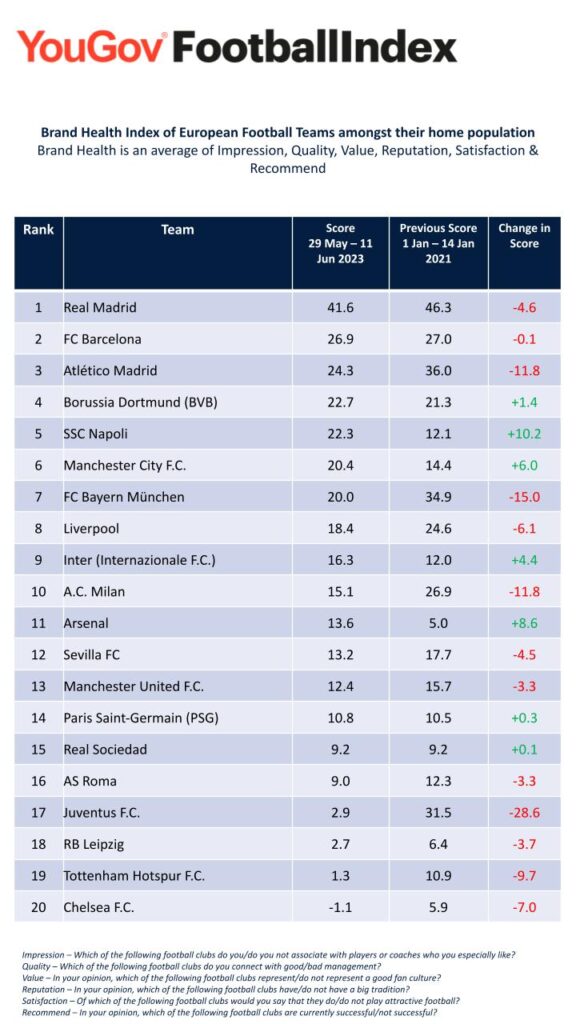
It is starting to get a bit warmer outside which means that the sporting summer in the UK is on the way in a real way. In this week’s index powered by YouGov we are going to be looking into the eight pillar sporting events of the summer and analysing how their brand health score has changed over the year.

Wimbledon’s Brand Health score is by far and away the highest of any of the events. It scores incredibly high on the quality and reputation metrics along with the high impression which will be down to it being only one of two events on free-to-air TV. However, Wimbledon has seen the biggest drop in score from last year to this year. In the individual metrics the biggest fall is in value which could be related to the cost of living crisis that we are seeing in the UK and people being less likely to part with their cash when it comes to attending the championships.

The England Test Cricket team have revolutionised their fortunes in the last year. A new coach, a new captain and a new style of play have led to them winning ten of the 12 Test matches they have played. We are also entering an Ashes summer, a Test series against Australia always peaks the public’s interest. Both these could factors have contributed to the team being the biggest rises in the Index. 

Not subscribed to our weekly newsletter? Click here to sign up and receive more content like this to your inbox every week.

Staying on cricket, The Hundred has seen a big increase as interest in the tournament appears to be holding firm as we enter its third season. This is particularly interesting because it seems little has changed from last year’s tournament apart from the increased availability of England’s international stars. Viewing figures dipped from the first tournament to the second – it will be interesting to see what happens this time.

Impression – Overall, of which of the following teams do you have a positive/negative impression?

Quality – Which of the following teams do you regard as prestigious/non-prestigious?

Value – Which of these teams do you think is worth/not worth the time spent following or supporting?

Reputation – Which of the following teams would you be proud/embarrassed to work for?

Satisfaction – Which of the following teams make you feel satisfied/dissatisfied as a fan?

Recommend – which of the following teams would you recommend/not recommend a friend or family member follow or support?

Member Insights: Broadcasters need to sit on the sofa with the casual fans to understand what they want

In this Member Insights piece Richard Brinkman looks into why broadcasters and rights holders need to get in the heads of the casual fans.

April is a fantastic month to be a sports obsessive in the UK. Not only does the spring indicate the start of the cricket season (obviously good) and sunnier days ahead (obviously great) but it also means a golden overlapping period with the climax of the football and rugby seasons (good both because they are exciting and the marathon sagas are coming to an end!). 

Add into this mix totemic annual events like The Masters, Grand National, the Boat Race and the IPL. The viewer is really spoilt for choice in terms of what to give time and attention to. In addition, we also now have the choice to focus on the greater profile and coverage that standalone Women’s events such as the 6 Nations enjoy.

This embarrassment of riches and the challenge of giving all these great sporting events the time and attention that they deserve led to me recently being forcefully struck by how important it is for a sport to make itself as available and visible as possible. And then, preferably, in the most positive light. In a few moments of slightly alarming clarity I found myself experiencing and viewing sport not through a professional prism but rather as a bog-standard consumer with all the joy and frustration that comes with it.

This issue sounds obvious but, from what I am seeing, is seemingly often under-rated. The quality of decisions around this consideration needs serious thought if they are to garner the time, attention, eyeballs and credibility that will make or break their ongoing success and relevance. The established way of thinking about a mix of free-to-air, pay, stream and social media considerations seems very homogeneous and, in some cases, outdated.

Not subscribed to our weekly newsletter? Click here to sign up and receive more content like this to your inbox every week.

Very few sports can raise enough revenue from the echo-chamber of their relatively small number of “avid” fans to ensure their long-term survival at current levels of spend and future ambitions. Appealing to and winning over the attention of large numbers of casual or intermittent followers has been, and will remain, the key to being a major event or being relegated to a niche interest.

The supply side orientation of thinking about broadcast access (ie which mix of channels and routes to market will give me best £ vs eyeballs) needs challenging and, to my mind, some reconsideration. After all, this is a dynamic environment and the consumer consideration is not driven by channels but rather by want and ease. This has often been characterised as chicken and egg – easy access drives want but nobody wants to show on free-to-air or widely viewed channels content that is not wanted. However, over time and slowly, behaviours do change. And I would argue that frictionless access to prime content should now be the prime consideration.

A couple of weeks ago with the EPL entering its final “run in” (is it me or, like Christmas, does this seem to start earlier every year?!) I thought I would settle down with my son on a Wednesday evening to watch Man Utd v Brentford. I thought this might be a decent game and an interesting barometer as to where Utd were after their Anfield thrashing. Sky had selected to show the only other game happening that evening, West Ham v Newcastle, as their live game. Even with an intimate understanding and some historical involvement in how TV rights packages work I instantly turned (naively) to BT for the coverage. Obviously, none was forthcoming!

I was nonplussed, my son was not bothered. He simply went on his laptop and within 30 seconds had sourced the US live footage of the game. And whilst watching on a laptop is suboptimal this was made up for by the impressive US coverage. I was amazed by the high standard of commentary and punditry – so much so that I would not hesitate to source coverage again in this way if necessary.

This was my first “live” experience of piracy – it’s a real thing and serious precisely because it is so simple. With what we now know of the music industry and their initial stance regarding Napster, Spotify etc it seems an antiquated approach to deny UK broadcast of EPL matches because of scarcity supposedly driving up value or fears regarding attendance. Surely EPL clubs have more faith in the live experience than that? And if they don’t, they should look at what they are providing for their (high) paying customers. Equally, Covid let the genie out of the bottle when it comes to viewing any EPL match in the UK. 

Bearing this in mind I was delighted to read subsequently that the next round of UK TV packages are likely to offer 260 live games (of a total of 380), rather than the current 200. Even better that these matches are likely (why, by the way, are the PL so reluctant to comment on this once the reports come out? – it just looks lame!) to be spread across 4 parcels rather than the current 7. Both are sensible moves that will likely mean less friction and hassle for consumers. However, it looks likely that the Saturday 3pm “black-out” will remain despite it being, in effect, pointless when large-scale piracy is so straightforward.

In a similar vein of unnecessarily anachronistic broadcasting policies recent events at The Masters were laughable whilst simultaneously being completely infuriating! The delays due to storm interruptions subjected the Sky viewer to watching 3 folksy middle-aged men talk about golf around a plastic schmaltzy fireplace for 2 hours rather than showing what little action there actually was on the course. 

Apparently, we are only “allowed” to watch what are deemed to be “feature” groups. For as widely respected an event as The Masters, who are generally held up as an exemplar of doing the “right things”, this was as close to brand self-harm as you are ever likely to see. In an age of always on, instant access social media such an approach to broadcasting rights seems not just archaic but downright damaging. I am sure millions did as I did and found one of the many other sporting events or myriad other entertainment properties available to watch instead. If I can watch every match live at Wimbledon I fail to see why I cannot watch every group at Augusta?

In summary, I would encourage all rights holders (and, indeed, the broadcasters on the other side of the table) to think about their sport from the point-of-view of the casual fan – not just the noisy minority on Twitter or your owned social channels. You are in a highly competitive entertainment environment and creating unnecessary friction around access can only alienate and erode your brand equity. 

One final example – It may seem conceptually like a good idea to build value with the BBC by preventing ITV showing live replays of a 6 Nations game on their streamed ITVX hub until after the BBC’s Rugby Special programme on a Sunday evening. In reality, from the consumer perspective it is just irritating – thinking that creates friction and suits the broadcaster over the viewer. 

If someone wants to watch the entire match live, let them do it when they want to – if they want to watch highlights they would have selected that option instead anyway. Do not make life easy for pirates by building their market for them through artificially created barriers that serve no practical purpose for the broadcaster or your sport.

Meet the Member: “Generative AI will likely lead to more firms bidding for more contracts”

Despite being a massive part of the sports business the procurement process is still a mystery to some. To shine a light on how it works and the current trends in the industry we caught up with Nour-Eddine Boufertala, Head of Procurement for the ECB.

So Nour to kick us off, take us through your journey in sport?

I started my recreational sport journey as a boxer during my early years. I then transitioned into playing basketball and was actually part of the Young Academy of one of the elite basketball teams in France for a few years before going to Spain and playing in Barcelona. 

Like so many people who work in our world I do think some of the traits I picked up from playing have helped me in my professional career.I am still a massive sports fan – it is the first thing I check when I get up in the morning.  

On the professional side, I started my journey in sport when I joined the England and Wales Cricket Board (ECB) in 2019 to build the procurement department. My previous procurement roles had been in the automotive, aerospace and rail industries.

Since 2019, I have realised the growing importance of procurement in the sporting industry but also the lack of professional procurement expertise in this sector. In 2022, I started Oben Sports and Events Consulting to support sporting organisations to improve and develop their procurement journeys. Through this I have been fortunate to work on various exciting events like the Hundred but also supporting the Football Foundation (The Premier League, the FA and the government’s charity that helps communities improve their local football facilities through football grants).

What is it about procurement that attracted you?

The impact you can have on an organisation is extremely challenging and rewarding. The procurement department is right at the centre of the business. This job is also fitting with the skills I have developed over my studies. I graduated as an industrial and chemical engineer where I learned to solve and find pragmatic solutions to complex problems. It helps me a lot day-to-day.

Not subscribed to our weekly newsletter? Click here to sign up and receive more content like this to your inbox every week. 

I was also attracted by this fast-forward moving industry where we need to be on the top of the latest market innovation in order to bring more value to our own organisation. It means that we need to be constantly open to new ideas.

Being a massive sports fan makes it even more exciting to be part of the industry and support different sports like cricket and football. I love how it is a bit of a small world and everyone has the same passion.

How does your role as Head of Procurement fit into the ECB’s wider work?

My role is fully embedded into the ECB strategy, Inspiring Generation, to grow the game with the aim to inspire a new generation to believe that ‘Cricket is a game for me’. The ECB is committed to ensuring cricket is for everyone, connecting communities and improving lives by bringing people together through their shared passion for the sport. We are taking proactive action around equity, diversity, and inclusion (EDI) to create a game that belongs to us all, now and long into the future. 

The procurement function is involved in all projects that are developed to deliver the company wide strategy. One major success is our mass participation programmes, All Stars and Dynamos; through a robust supply chain, hundreds of thousands of children and volunteers have engaged with this programme and it has transformed loads of clubs up and down the country.

Talk to us a bit about the procurement process?

Generally speaking, the procurement process is divided into these parts: identification of the internal requirement, sourcing the market, negotiation of the contract terms, appointment and supplier relationship management

However, every procurement strategy/approach is different, it will depend on various factors like the category (product, construction, services,) and type of procurement (private or public).

It is also key to leave some room for manoeuvre for the suppliers to share their innovation, add values. We always must remind ourselves that we are in a fast-moving market and the innovation will come from the market. 

What are some of the challenges you are facing at the moment?

The most challenging aspect about my role is to make sure we are receiving the best value for money by including various factors like EDI, sustainability, and innovation. Procurement is not a transactional function but more than ever strategy-oriented one.

As a governing body, I must make sure we are receiving the best service, quality, and price from our partners in order to continue developing ourselves and investing the savings into our various programmes.

Also, the markets are becoming more volatile, with prices fluctuating, supplier shortage, Ukraine war and the post-Covid effect. All these challenges have pushed me to think outside of the box and explore unconventional ways of delivering the best possible outcome.

Sustainability is obviously a massive thing in sport at the moment, how much thought do you put into that?

Firstly, the ECB is committed to tackling climate change and promoting environmental sustainability. We have been taking action since 2010 to manage and reduce cricket’s environmental footprint and, more broadly, we recognise that all sports have a powerful platform, and a responsibility, to show leadership and inspire action from others. We can see the impact of climate change has on cricket, where extreme weather events are causing increased disruption. 

More widely than the environmental impact, as part of our EDI strategy, we are on an ongoing journey to further our ESG (Environmental, Social and Governance) commitments across environmental sustainability; equity, diversity & inclusion; social impact; and good governance across our supply chain. The procurement function is leading a pilot program with the ECB’s key suppliers and stakeholders to understand the collective impact of the ECB and its suppliers and stakeholders across these areas.

Going forward, we are working on a robust assessment process that will cover all the above ESG points with the adequate weighting at tender stage.

What sort of trends are you seeing in the procurement industry at the moment?

I would say AI. Artificial intelligence has always allowed procurement organisations to solve complex problems more efficiently or effectively using smart computer algorithms. AI can be embedded into a number of software applications from spend analysis to contract management and strategic sourcing.

Today, generative AI is changing the AI game, taking assistive technology to a new level, reducing application development time, and bringing powerful capabilities to nontechnical users. It will help every organisation to streamline their process, increase the exploitation of their data and ultimately reduce their costs.

On the public procurement side, writing bids for contracts takes time, investment, and resources, but by enabling suppliers to create bid text more quickly, generative AI will likely lead to more firms bidding for more contracts. This could lower barriers to entry for suppliers that may otherwise lack the resources to apply for government contracts, leading to more competition and better outcomes for the government. On the flip side, it is also likely to mean the government having to process a larger volume of bids and creates the risk of suppliers submitting more speculative bids due to the lower effort required. 

But as with every new technology, we must proceed with eyes wide open, because the technology today presents many ethical and practical challenges.