

The View From The USA: What drives the price of an NBA franchise

In this View From article, Kurt Badenhausen Sportico’s Sports Valuations Reporter, looks into the sale of the Phoenix Suns and explains why a middling NBA franchise is so expensive.

There are an unprecedented number of trophy sports assets on the market right now. Buyers have their choice of the Premier League’s two most valuable clubs, a storied NFL franchise, big market baseball teams on either coast and an NHL team in hockey-mad Canada.

The Phoenix Suns sale to mortgage-mogul Matt Ishbia was finalised on February 9, on the same day the Suns traded for NBA All-Star and former MVP Kevin Durant. 

Ishbia’s purchase of a controlling interest in the Suns and the WNBA’s Mercury eventually went through at a valuation of $4 billion, a record for an NBA franchise.

But what makes an NBA with middling revenue, with no Title and only two Finals appearances since 1993 so attractive for investors. 

Not subscribed to our weekly newsletter? Click here to sign up and receive more content like this to your inbox every week. 

Phoenix is a fast-growing metro and an attractive market for NBA free agents and billionaires alike, thanks to the Arizona climate in winter, but the chance to secure a franchise within the top half of the hottest sports league is why so many investors were kicking the tires on the Phoenix Suns.

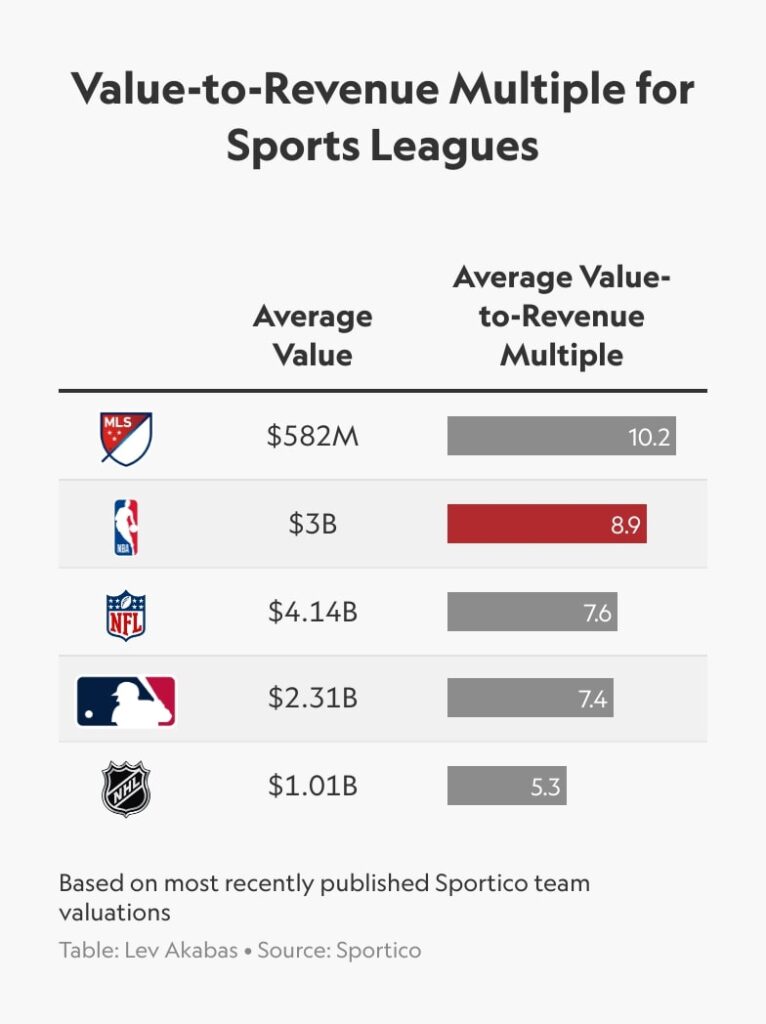
Back in November Sportico valued the Suns at $3 billion, and it ranked 13th in our third annual NBA team valuations. But the Suns will likely sell for a higher revenue multiple—the standard valuation used for sports teams—than Manchester United, Liverpool, Washington Commanders, Washington Nationals, Los Angeles Angels or the Ottawa Senators.

Sportico spoke to more than 35 people involved in the business of basketball over the past month, including eight bankers and attorneys involved in team transactions. Most are bullish on the league’s prospects, relative to other sports properties. The average NBA franchise is worth $3 billion, up 16% versus last year. It is a strong showing, considering the S&P 500 is down 16% during the same period. Collectively, the NBA’s 30 teams are worth $90 billion, including team-related businesses and real estate held by owners.

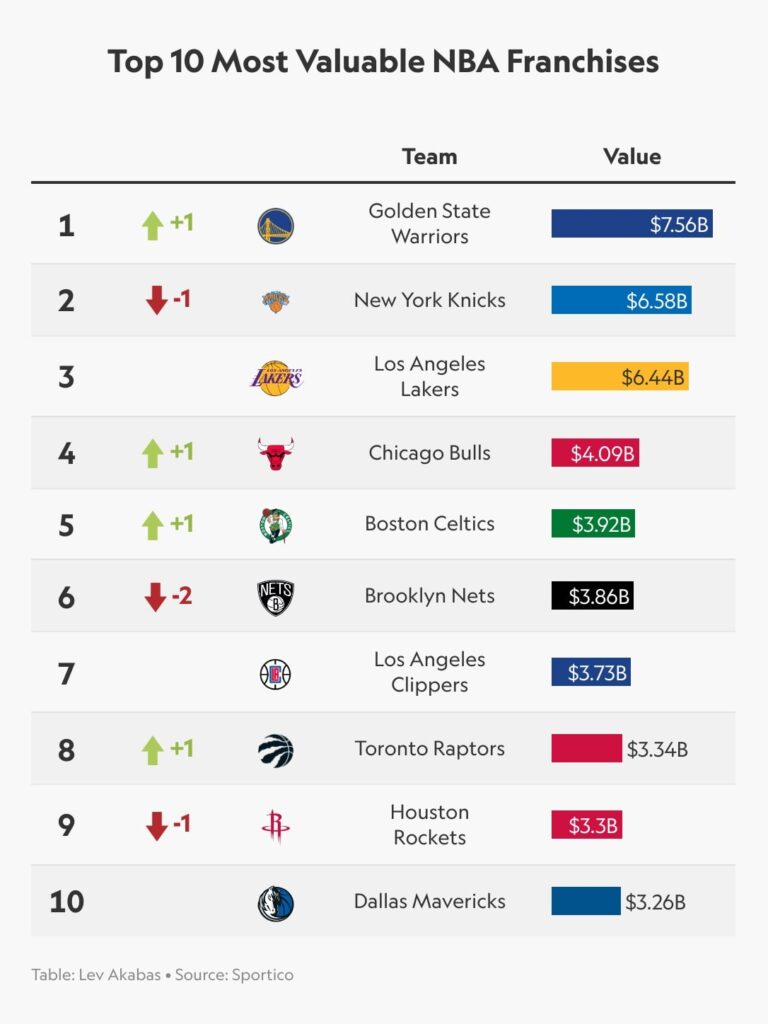
The average is boosted by a top-heavy distribution of team values, with the Golden State Warriors ($7.56 billion), New York Knicks ($6.58 billion) and Los Angeles Lakers ($6.44 billion) all worth at least $2 billion more than fourth-ranked Chicago Bulls ($4.09 billion). The median NBA franchise is worth $2.38 billion.
Golden Dynasty

Golden State has built the model NBA franchise on the court, with six NBA Finals appearances and four titles during the past eight seasons behind Stephen Curry, Klay Thompson and Draymond Green. The Warriors’ status might be even better off the court. Last season marked the team’s first year in the Chase Center without COVID-19 restrictions and limitations. Gross revenue topped $800 million, including non-NBA events, and was an estimated $750 million after revenue sharing, 50% higher than the Lakers.

In addition to winning its fourth title in the current era, the Warriors ranked first by almost every measure last season—by a wide margin—including sponsorships ($150 million), premium seating ($250 million) and local TV ratings (6.98), which were all roughly double the second-ranked team in each category.

The Warriors passed the Knicks this year as the NBA’s most valuable team and trail only the Jerry Jones-owned Dallas Cowboys— worth $7.64 billion—among all sports teams. The New York Yankees are third at $7 billion, with the Knicks and Lakers rounding out the top five.

Joe Lacob, Peter Guber and their investment group paid $450 million for the Warriors in 2010. Lacob sees Disney as a model for diversifying the team’s business approach and isn’t satisfied with ranking second in anything. “Jerry has done a great job with the business of the Cowboys, but we are going to chase him down too,” Lacob said in a phone interview.

Phoenix Rising

In September, Robert Sarver announced he would sell the Suns and the WNBA’s Mercury following an investigation into accusations that he created and oversaw a racist and misogynistic workplace. The NBA suspended Sarver for one year and fined him $10 million.

Last season, the Suns generated an estimated $300 million in revenue and $70 million in earnings before interest, taxes, depreciation and amortisation. There have been multiple initial bids submitted to Moelis & Co., the investment bank Sarver hired to handle the sales process, and there is a strong possibility the team will command 10 times its 2021-22 revenue. The team’s valuation includes the Mercury and Suns’ practice facility.

The buyer pool extends well beyond Arizona, as Phoenix checks a key box for southern California billionaires who can catch a game at Footprint Center and still sleep at home after a one-hour hop in their private jets.

Last month, the NBA gave Suns bidders another funding source when it voted to allow investments from endowment, pension and sovereign wealth funds, as first reported by Sportico. In 2020, the NBA became the first major U.S. sports league to approve private equity investments. The framework allows a fund to purchase up to 20% in one team and allows franchises to have up to 30% of its total equity held by funds. The new groups of institutional money are expected to be granted a similar framework.

“It expands the investor base and opens the door for opportunities for us in the future,” Dallas Mavericks owner Mark Cuban said in an email. The top five university endowments hold $193 billion in assets, led by Harvard at $51 billion. CalPERS, which manages pension benefits for 1.5 million California public employees, had $442 billion in assets at the end of last year.

“The move puts more liquidity into the market, and these funds can write really big checks,” Sal Galatioto, longtime sports investment banker, said in a phone interview. “Sports teams offer some diversification, and these assets are not really correlated to the stock market.”

Private equity firms have invested in at least seven NBA teams since the start of 2021. Dyal HomeCourt bought stakes in the Atlanta Hawks, Suns and Sacramento Kings. Arctos Sports Partners’ portfolio includes the Warriors, Philadelphia 76ers, Kings and Utah Jazz. Sixth Street bought a 20% piece of the San Antonio Spurs. These funds are doing so strictly for a return on investment, and not some of the intangible perks that sometimes draw in limited partners.
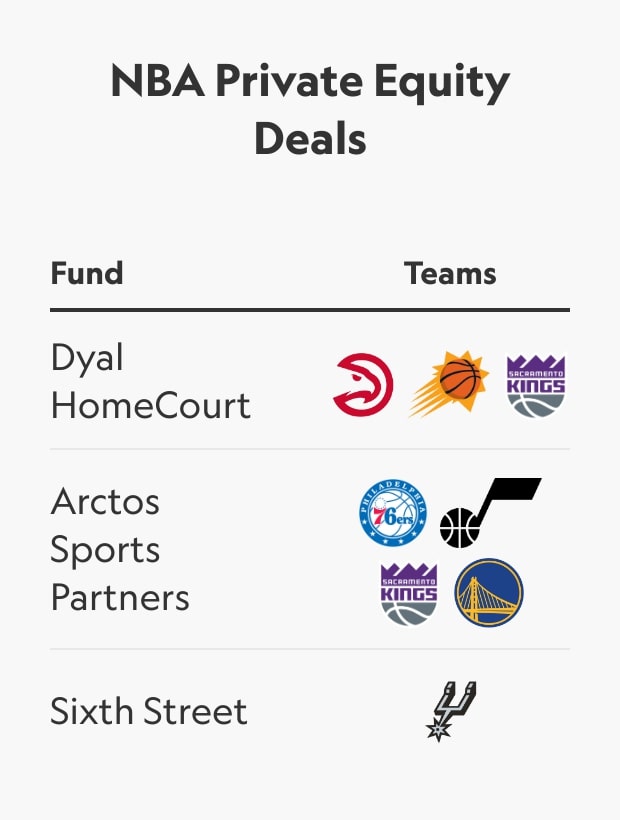
The NBA’s new rules allow these other entities to invest directly into teams and avoid the fees associated with the Dyal and Arctos funds, but those funds will still play a role. They allow investors to have exposure to multiple teams, and also allow investment without the public scrutiny and deeper background check that comes with direct stakes as a team owner.

Dyal is poised to cash in on its Suns investment, which came at an LP-discounted $1.55 billion valuation during the first half of 2021. It’s believed the firm is the only Suns investor with “tag-along” rights, meaning anyone buying Sarver’s 35% stake would also need to buy out Dyal’s 5%. Sarver led an investor group that paid $401 million for the Suns in 2004.

Next Frontier

After two COVID-19 impacted seasons, business returned largely to normal and NBA teams generated $10.1 billion in revenue in 2021-22, including non-NBA events at arenas where owners own or control the venues. That compares to $6.5 billion for the 2020-21 season when attendance was off significantly because of capacity restrictions. The Raptors were the one team that continued to feel the COVID hangover; lingering rules forced the team to play a dozen games in early 2022 with no fans in attendance at Scotiabank Arena.

Teams are reaping the benefits of new revenue streams from gambling, jersey patches, and international sponsorships. The top three jersey sponsorships generate $100 million annually, led by the Warriors’ extension with Rakuten worth an estimated $45 million a year. The Brooklyn Nets (WeBull, $30 million) and Lakers (Bibigo, $27 million) are the next largest pacts. “We’re a respected brand here, but also internationally, and that’s a huge opportunity that we are just scratching the surface of,” Warriors’ president Brandon Schneider said in a phone interview.

The NBA’s outlook and flexible ownership rules have attracted bidders for the Suns but also has investors thinking about expansion franchises. LeBron James has voiced his interest in a team in Las Vegas, and Seattle is a near lock for expansion. “At some point, this league will invariably expand, just not at this moment,” Adam Silver, NBA commissioner, said during his 2022 NBA Finals press conference. The last expansion franchise was Charlotte, which started play in 2004 and cost $300 million.

The league has more pressing issues before it turns to expansion. The collective bargaining agreement expires after the 2023-24 season and both sides have an opt-out to end it after the current season—the Dec. 15 deadline for the opt-out was recently extended, giving the two parties more time to negotiate. There is cautious optimism that a deal will come together, with both franchise values and player salaries soaring. Once the CBA is done, league executives will need to lock in their next round of national TV deals, which are set to expire after the 2024-25 season. Any new pact probably won’t be reached until 2024.
Once those two pillars are in place, the NBA will turn its attention to expansion, but it will take multiple years to identify the right owners, cities, venues and get the franchises up and running, meaning it will likely be near the end of the decade before any new teams take the court. The math on an expansion fee becomes easier after the CBA and TV pacts are reached, and a couple of franchise sale prices that start with a three, or even a four makes a difference. Some owners won’t want to dilute their shared revenue or equity stakes in league properties, such as NBA Equity, NBA China and NBA Africa, but divvying up $8 billion in potential expansion fees will make that an easier pill to swallow.

TV Picture

The choppy RSN market has NBA teams covering their bases for an uncertain broadcasting future as consumers ditch cable. This season, the Clippers became the first team to offer local fans a series of options to watch games without a cable subscription. ClipperVision provides six different streams, including two non-English ones. “I have wanted to create a product like ClipperVision since the day I came to the Clippers,” Steve Ballmer, who bought the Clippers in 2014, said in a statement around the launch.

“We are progressing in the design and development of our direct-to-consumer offering and remain on track to launch in the second half of the current NBA and NHL seasons,” Andrea Greenberg, MSG Networks CEO, said on her company’s earnings call last month. “So while the media landscape is certainly evolving, we continue to believe in the value of our premium content and our ability to innovate, to drive value for partners, advertisers and viewers alike.”

In August, Ted Leonsis’ Monumental Sports & Entertainment, which includes the Washington Wizards, bought the 67% of NBC Sports Washington from Comcast that it did not already own. MSE already had its own streaming platform, Monumental Sports Network, that airs the WNBA’s Washington Mystics, and this provides more options. “It’s not unlike someone who owns teams and owns a building,” Ed Desser, who spent 23 years in the league office and helped launch NBA TV, said in a phone interview. “It’s a key asset, and you can package it and leverage it more when you have more control than you could as a pure tenant.”

The distribution options for NBA games will evolve over the next decade, but the content remains valuable with a young fan base that covers every corner of the globe. And any haircuts that teams might take in the short-term on the local level are expected to be offset by the next national deal.

The current TV deal is worth $2.7 billion annually and the next rights are expected to at least double that figure, assuming the NBA carves out a streaming service package. Moelis is highlighting this new financial picture in its Suns’ pitch, projecting a world where the team’s revenue is north of $400 million.

Warner Bros. Discovery CEO David Zaslav recently said at an investor conference that WBD does not “have to have” the NBA, as the company deals with a sluggish ad market and rising content costs. The NBA has been a cornerstone of TNT’s programming for three decades, and Zaslav’s comments were widely seen as posturing in a negotiation for the only major sports rights available over the next five years.“There’s not a major sports media company out there that is not going to want a relationship with the NBA if it becomes available,” media consultant Lee Berke said.

About the Author: Kurt Badenhausen is a sports valuations reporter at Sportico. Prior to joining, Sportico he was a senior editor at Forbes where he worked from 1998 to 2021. He co-engineered Forbes’ annual sports team valuations and launched numerous initiatives at the company, including annual features on brand valuations, best banks and top business schools. He profiled a bunch of athletes who go by one name: LeBron, Shaq, Danica and others for the magazine. Prior to joining Forbes, Badenhausen worked at Financial World magazine where his coverage focused on investing, mutual funds and the business of sports. He graduated from Colgate University with a degree in history and resides in New Jersey with his wife, two sons and black lab.

The House View – The winners and losers from the new EFL broadcast deal

You look at the price and you think ‘wow’. That is a lot of money for EFL rights. 

Sky have paid £935 million for five years of EFL broadcast rights, starting in 2024-25, an increase of 50% on the last deal. Over the length of the contract they will be broadcasting 1,059 matches a season, up from the 138 games they broadcast at the moment. 

THE  WINNERS

The Fans – EFL fans have been starved of the opportunity to watch their team from the comfort of their armchair since what feels like – for them at least – the dawn of time. Most of them will remember the dark days and late nights when the EFL Highlights Show was on after Match of the Day on BBC. 

This new deal will see six games across the three divisions broadcast every weekend on Sky Sports, or through a red-button streaming service. As a fan of a team who found themselves in the EFL for a few seasons, the frustration of a lack of TV games was real and the chance to regularly watch my team at home or in  pub is a benefit for fans.

Not subscribed to our weekly newsletter? Click here to sign up and receive more content like this to your inbox every week. 

The EFL and the clubs – To quote the Harry Enfield sketch they now have “loadsamoney”. As mentioned above this deal is worth £935 million for the next five years. Clubs will benefit massively from this sudden injection of cash as well. Championship clubs will see a TV revenue increase of 46% and League One and Two clubs will get a 25% increase. You will not be surprised to hear that the clubs voted unanimously in favour of the new deal.

The EFL clubs will hope this closes the gap between themselves and the Premier League. Over the last few years we have seen an increase in the number of clubs getting relegated from the Premier League only to get promoted the next season, Burnley, Fulham and Norwich City are all recent examples.

Sky – Sky was already the dominant broadcaster of domestic football in the UK with the Premier League, the EFL and the SPFL, but with this move they have truly stamped their authority on British football. 

On your average League weekend, Sky will be showing nine games through their different slots and ten during the week, including Monday Night Football, compared to one Premier League game and one National League game for BT Sport. 

Having spent heavily on the EFL rights it will be interesting to see what this means when it comes to the Premier League media rights with the tender process set to start this year. On one side you can say that they might be a bit short of money and maybe this deal is the start of them moving away from Premier League rights. Alternatively, you could argue that if they are prepared to commit this much for EFL rights then how much will they be prepared to pay for the Premier League? It will be interesting to see how this develops over the next few months. 

The British Football Pyramid – As a fan of Non-League football this is very important to me, so bare with me here. If the EFL had voted in favour of DAZN’s offer we would have seen an end to the 3pm blackout in the UK. That is the rule that stops matches taking place between 2:45 and 5:15 from being broadcast on television in the UK. It was introduced in 1960 and is designed to protect attendances up and down the football pyramid. It has been reported that the EFL estimated broadcasting all matches would lead to a matchday revenue loss of £37 million. 

THE LOSERS

The Fans – Yes, I can see you now thinking this bloke has lost his mind and forgotten what he wrote a matter of minutes ago. No, as it turns out, I haven’t. While the new deal is no doubt fantastic for the majority of fans, it isn’t good for the season-ticket holders who follow their teams home and away. 

Games kicking off at 12:30 on a Saturday makes travel even more of a hassle for fans, particularly on those long away trips. It means early trains, car journeys and even earlier coaches. In some cases it will mean travelling the night before and all the added expenses that come with that. 

DAZN – The sports streaming service which launched in 2016 and sent shockwaves through sport by signing a deal with Matchroom Boxing in 2018. Outside of boxing, they are yet to truly establish themselves in the UK with a marquee rights deal. A deal with the EFL giving fans the opportunity to watch their team play every week would have seen subscriptions surge – there can be little doubt about that. 

The fact the deal fell through will hurt DAZN, there are only so many UK sports properties that will drive subscribers in a meaningful way. Now, they may decide to enter the Premier League race next year.

EFL and Sky Sports agree landmark deal

EFL clubs have unanimously approved a record domestic rights deal with broadcaster Sky Sports worth £935m over a five-year period with over 1,000 matches to be broadcast each season – a record number of games for any club football agreement.

Running from season 2024/25 to season 2028/29, the arrangement will be made up of guaranteed payments of £895m and £40m in marketing benefits. In total, 1,059 EFL matches are set to be broadcast exclusively across existing Sky Sports channels or live via a Sky Sports streaming destination available on TV and mobile devices.  

Increased value and promotion 

The new deal represents a 50% increase on the value of the current rights agreement and will see significantly enhanced exposure for all EFL clubs provided through on-air and digital support from Sky Sports to promote EFL competitions, clubs, and community initiatives.  

Each season, Sky Sports will broadcast a minimum of:  

  • 328 Sky Bet Championship matches 
  • 248 Sky Bet League One matches 
  • 248 Sky Bet League Two matches 
  • All 15 Play-Off matches
  • All 93 Carabao Cup matches
  • All 127 EFL Trophy matches 

Each League weekend fixture round will see 10 live EFL fixtures shown. Five matches will be shown from the Sky Bet Championship and supporters of Sky Bet League One and League Two teams will now benefit from greater coverage than ever before with five of their games being broadcast live. For the first time ever, fans will be also able to watch every match from the Carabao Cup and EFL Trophy. 

All opening, final day, and midweek fixtures in the Sky Bet EFL will be shown live as will all games played on Bank Holidays including Easter, Boxing Day and New Year’s Day alongside the matches played in Sky Bet League One & Two during international breaks. 

Increased notice for fans  

With the substantial increase in the number of live matches, Sky Sports and the EFL will introduce a new commitment for clubs and fans which will provide longer notice periods on TV selections. The defined notice periods will enable clubs and fans to plan further in advance and this will include the placement of all live matches selected for broadcast for the period to FA Cup 3rd Round before the start of the season. Greater parity in the number of times that clubs are selected for TV coverage is also guaranteed. 

Article 48 to remain 

The new deal allows for ‘Article 48’, the blocked broadcast period between 2.45pm and 5.15pm on Saturday afternoons to remain, meaning that main broadcast fixtures will be scheduled for outside of this time. Final fixture slots will be confirmed at a later date. 

Domestic Streaming

From the 2024/25 season onward, this agreement makes more matches available to stream and will effectively replace the current Sky Sports EFL red button coverage and the EFL’s domestic streaming option provided via iFollow and club streaming services. Domestic streaming audio services will remain alongside existing audio-visual arrangements for international audiences via iFollow and club streaming services.  

Enhanced production values and camera numbers  

The EFL and Sky Sports will continue to work together to innovate, seeking opportunities to improve coverage and take viewers closer to the action, while the EFL will be investing significantly in production infrastructure to enhance the viewing experience. Sky Sports will have a minimum of eight cameras for each game broadcast on existing channels. For matches available to stream, Sky commentary will be provided and a minimum of four cameras will be used at Championship and League One matches, and a minimum of two cameras in League Two. 

Commenting, Chief Executive of the EFL, Trevor Birch said:  

“After completing an extensive tender and negotiation process, this is a landmark broadcast deal for EFL clubs, establishing the League as a premium partner with a world-renowned broadcaster in Sky Sports.  

“The EFL is an iconic sports property and one of the biggest and best attended Leagues in European football. This increased investment and coverage from Sky Sports will showcase much more of our compelling match action to fans, while delivering record rights values as we seek to make our clubs sustainable at all levels. 

“For decades, Sky Sports has been a fantastic broadcast partner for both the EFL and English football, helping our sport grow through its sustained support, so we are delighted to announce this innovative agreement that combines the strength of an established brand with a modern streaming service for the benefit of EFL clubs, fans and Sky Sports alike. 

“With some 20 million attending Sky Bet EFL matches each season and significant interest in the League at home and abroad, we look forward to growing our collective fanbase further and we’d like to thank Sky Sports for its ongoing commitment to the clubs and the communities which this investment will directly support.”

Sky Sports Managing Director, Jonathan Licht said: 

“This is a ground-breaking deal for Sky and our long-standing partners, the EFL. We believe that fans of all 72 league clubs will benefit with increased coverage across all the leagues and competitions. With four times as many matches than we currently offer, we will capture even more of the excitement created by this unique league – and in a way that will be immediately accessible to millions of supporters. 

“This is the biggest deal in football, in terms of the number of matches being broadcast and we look forward to working with the EFL and its 72 member clubs to give fans the most entertaining viewing experience.  

“Between Sky and the league, we’re pleased to be able to make a commitment to fans that will ensure greater notice periods around the movement of matches for broadcast. There’ll also be greater parity in the number of times clubs are selected to be live on Sky Sports.

“The EFL stands alongside our key rightsholders we have partnered with for the rest of the decade, keeping Sky Sports as the number one destination for sports fans. We thank the EFL clubs and EFL board for their support and look forward to our future together.” 

UIPM and World Obstacle join forces in new title partnership

UIPM and World Obstacle have collaborated on the rebranding of two major Obstacle competitions to include the name of both International Federations (IFs).

The two competitions are now named the World Obstacle UIPM 2023 OCR World Championships and World Obstacle UIPM 2023 Ninja World Cup USA.

The alliance reflects the collaboration between the sports enabled by the decision of the UIPM 2022 Congress to add Obstacle as a new discipline of Modern Pentathlon.

This historic change provides a pathway for obstacle athletes around the world to realise their Olympic dream.

It also transforms Modern Pentathlon, creating the potential to engage an estimated 1bn people who watch global hit television show competitions like Ninja Warrior and SASUKE, and compete worldwide in mass participation events like Spartan.

At least nine UIPM National Federations have led the way by implementing the change in national competitions, helping athletes to prepare for the three UIPM Pentathlon World Championships in summer 2023 that will go down in history as the first global competitions to include the new format.

Running in parallel to those age-group competitions will be two major Obstacle events that become the first to reflect UIPM’s collaboration with World Obstacle.

World Obstacle / UIPM 2023 OCR World Championships

Taking place in Genk (BEL) from September 14-17, the flagship annual Obstacle Course Racing (OCR) event includes a 100m sprint category similar to the format that is being introduced in Modern Pentathlon, as well as 3km and 15km endurance events. There are numerous age categories starting at Youth (age 10-15), including para categories.

The Belgian Obstacle Course Racing Association (BOCRA) and the City of Genk will host the 2023 Championships in the 12,000-hectare Thor Park.

World Obstacle / UIPM 2023 Ninja World Cup USA

Taking place in Orlando (USA) from July 27-30, the North American leg of the 2023 Ninja World Cup follows the opening Asian event which took place in Manila (PHI) in April and the upcoming European leg in Swiecie (POL).

Produced by World Obstacle and The ATS Team, Ninja World Cup USA will be hosted at the Orange County Convention Centre alongside the International Obstacle Sports Expo. The format is a 100m head-to-head sprint familiar to viewers of the popular Ninja television shows. 

World Cup USA will be held in conjunction with the Ultimate Ninja Athlete Association (UNAA) World Series Finals, World Ninja Athlete Games (WNAG) Championships, and the Federation of International Ninja Athletics (FINA) World Finals. 

UIPM President Dr Klaus Schormann said: “UIPM’s partnership with World Obstacle in the naming of two major Obstacle racing competitions in 2023 is a significant step.

“Through this partnership we can demonstrate that UIPM is getting actively involved in the existing Obstacle racing scene and creating pathways for athletes who are ready to transfer their skills to a new challenge and join our multi-sports movement.

“The new, more accessible Modern Pentathlon with Obstacle creates an incredible opportunity for athletes in all countries. We are merging a new, TV-friendly and mass participation sport with the prestige and heritage of the Olympic Games.”

World Obstacle President Ian Adamson said: “Obstacle athletes and national federations are collaborating with their pentathlete colleagues in many countries, putting into practice sport solidarity and the power of the unity of multi-sports. Obstacle athletes of all ages are excited for the possibilities the collaboration presents.”

PickleballEngland and UK Pickleball sign two-year partnership

PickleballEngland and UK Pickleball Shop have signed a two-year partnership agreement to collaborate and grow pickleball in England.

Pickleball – a hybrid of tennis, badminton & table tennis, is one of the fastest growing sports in America, and now has a firm foothold here in the UK.

With over 7,000 active players in the UK, the sport has seen exponential growth in the past year, with Pickleball England reporting a 60% year to date increase in membership in 2022.

Designed to be played across different age groups and demographics, Pickleball is one of the most inclusive sports around – and its rapid growth has as much to do with the enjoyment of playing, as it has to do with bringing groups of people together.

The partnership will see UK Pickleball Shop as a preferred supplier for PickleballEngland and includes an agreement for the provider to be present at the English Open and English Nationals, as well as exclusive first rights to attend PickleballEngland Festivals.

Speaking about the partnership, Karen Mitchell, Chair & Co-founding Director of PickleballEngland said: ‘We are excited to be partnering with UK Pickleball Shop. Having UK Pickleball Shop in the UK market has given new players access to a huge range of equipment, helping to rapidly grown the game this side of the pond.

We know in other countries where access to equipment is more difficult, growth has not been as fast, so we know how much of a difference it makes here. What’s more, UK Pickleball Shop have also offered PickleballEngland members a £15 discount on the club net which has already been taken up by hundreds of members.’

Freddie Gratton, Co-owner of UK Pickleball Shop added: ‘We are very excited to sign this agreement, and to continue with our mutual pursuit of growing pickleball here in the UK. Looking at the growth trends in the US, we recognise the enormous potential of our game, and we look forward to working closely and supporting the Pickleball England team to help achieve our mutual goals’.

To celebrate this announcement, UK Pickleball Shop will be giving away a Wheeled Portable Net. This is a full-sized tournament grade net with wheels, fully compliant with regulations set by USA Pickleball Association. Head to UK Pickleball Shop’s social channels for more information.

Photo credit: PickleballEngland

How AI is going to change the game (part 2)

Ready or not, ChatGPT is coming to change the sport and entertainment game 🤖

Here we go, we’re diving back into ChatGPT once again, but for good reason. It’s safe to say that everyone is starting to get a grip on how the tool can provide us with some form of efficiency in our everyday lives. You might’ve asked it to meal plan your week or draft that book report due on Friday.  

As we shared with you last month, ChatGPT can also transform the days of those who work in sport and entertainment. There is a significant opportunity for organizations in our industry to utilize this newfound power and transform their operations.   

This month, we’ll dive into marketing and omnichannel customer service after covering ticketing and partnerships in part 1 last month. 

And (once again) we promise we actually wrote this ourselves. 

Part 2: Marketing and Omnichannel Customer Service

The skinny

Integrating AI technology will be a game-changer for sports organisations looking to improve their day-to-day business activities.  

Not subscribed to our weekly newsletter? Click here to sign up and receive more content like this to your inbox every week. 

By using natural language processing and machine learning, AI can provide personalised recommendations, automate routine tasks, and handle customer inquiries with speed and accuracy.  

As a Microsoft powered business, we are integrating it within the EngageRM platform. This will help sports organisations to enhance their customer experience, increase sales, and optimize their business operations with these new features at your fingertips. 

Spending more time building meaningful campaigns? Marketing teams:  

How it will change Marketing

Improved Fan Engagement

ChatGPT can provide personalised responses to inquiries and feedback on social media, email, or chat, as well as provide real-time updates on events, promotions, and other fan-facing activities.  

If this feature sounds like a time saver, it’s because it is. Your marketing team will be free to focus on strategies to increase fan engagement and build customer loyalty, i.e. the stuff that matters.  

Streamlined Operations

ChatGPT can automate routine tasks, such as posting on social media or sending out email campaigns, freeing up marketing executives’ time for more strategic activities. 

Additionally, the chatbot can help to identify issues or opportunities that require the marketing executive’s attention, such as negative fan feedback or high-performing campaigns, so you’re using your time effectively.  

Personalised Campaign Management

ChatGPT can analyze data on fan demographics, preferences, and behaviors to help marketing executives create more targeted campaigns that resonate with specific fan segments.  

For example, if the Chicago Bulls know that they have a growing demographic of young fans who don’t live in Chicago, but always look at the scores on their app, they could create a mobile game where they can play to earn points and win prizes like merchandise or even tickets. 

Rather than skimming through mountains of data to find out that information, they’ll have it in milliseconds. 

Additionally, the chatbot can provide personalised recommendations for marketing channels and tactics based on the goals of each campaign.  

This feature can help businesses optimise their marketing efforts through mega-personalised materials that target the specific wants and niches of an organisation’s fans.   

How it will change omnichannel customer service

Improved Case Resoultion

Integrating ChatGPT with Dynamics 365 Omnichannel customer service can help customer service executives resolve cases quickly by providing personalized responses to inquiries and support requests.  

The capability of chatbots can also be turbocharged, with ChatGPT enabling them to handle routine inquiries, freeing up executives to focus on the more complex work on their plate. 

Enhanced Communication

ChatGPT can automate responses and notifications to customers through various channels, such as email, messaging, or chat, which can improve customer satisfaction and reduce response wait times (so less grumpy calls, stern emails and internal finger-pointing…which would be nice). 

The chatbot can also route cases to the appropriate customer service executive based on their availability and expertise, streamlining communication and once again, freeing up more space in your day. 

Improved Lead Qualification and Performance Tracking

By integrating ChatGPT with Dynamics 365’s analytics and reporting modules, customer service executives can access real-time insights on case resolution times, customer satisfaction scores, and other key performance indicators.  

This feature can help identify areas for improvement and adjust workflows as needed, ultimately leading to better customer satisfaction scores and retention rates. 

By Callum Chambers, Global Head of Marketing for EngageRM

To find out more about the work done by EngageRM click here

Meet the Member: “I can’t wait to get involved in the workings of British Cycling”

Jon Dutton has worked in professional sport for years and has worked on the last three Ruby League World Cups before recently moving to become the new CEO of British Cycling.

So Jon to kick off, take us through your journey in sport?

Firstly, I would just like to say that I have been incredibly privileged to work in professional sport for about 28 years now. I did a degree in sports management at Northumbria University and from there I went to work at the European Tour for about six years. That was an amazing experience, the highlight of which was definitely the Ryder Cup in 1997 at Valderrama. I then moved to Manchester FA as Chief Executive, so that was covering everything from grassroots football to the Champions League Final at Old Trafford in 2003. 

After that I took a break from the rights holder side of the sports business and with a business partner set up a consultancy. We did a lot of work with the FA around blind and visibility football and helped out on the Blind Football World Championship in 2010. Then for the last 12 years I have been immersed in Rugby League World Cups delivering the last three and now after a little break I have just started as the CEO of British Cycling. 

You have just finished as CEO of the 2021 Rugby League World Cup, talk us through that experience?

Yeah I mean it certainly feels like it has been a long time. We started work on the project in 2015 so we are talking really seven years from inception to delivery. I am incredibly proud of our achievements. We came up against significant adversity, the same as everyone in the pandemic, but we had postponements and then last summer we had the cost of living crisis as well. 

In the end we delivered 61 games, 21 venues, 18 host towns and cities, 32 teams and three tournaments all running simultaneously. Delivering the three tournaments at the same time was a massive achievement for us. It was the first time it had ever been done and I hope it becomes the standard for events moving forward. 

We have also done our best to have social impact in and around the north of England where the games were played. There has been around £30 million invested in trying to change people’s lives for the better. For me that is the best legacy of the tournament.

You have worked on three consecutive Rugby League World Cups tell us a bit about the similarities and differences of each?

Yeah, it started off with the 2013 tournament. This was the first tournament that had the every four-year format that we have come to recognise in the FIFA World Cup. It was the first tournament with quarter finals and 14 teams. We also set a record crowd at Old Trafford for the final between Australia and New Zealand. For that tournament it was still very much a small team, a small budget and no real post-tournament legacy and that was never really in the plan. 

I then moved on to 2017 in Australia, New Zealand and Papua New Guinea which was completely different because every team flew to every game. It was great to be out there and we were running both men and women at the same time. 

For 2021 we had a little more lead time than the other tournaments and this meant we were able to expand the tournament and really plan in and create a legacy after the tournament. It was fantastic to add wheelchair Rugby League in and we got some great feedback from people who were following it on BBC Sport. 

All three tournaments were very different from a personal perspective and there are so many great memories from each of them. 

How has Rugby League evolved in your time working in the sport?

It is a sport with a great heritage going all the way back to 1895. I think the small part we have been able to play is increasing the visibility of the sport through the BBC coverage. We have tried to make the sport more inclusive and try to get rid of some of the barriers that are stopping people from participating. 

With the legacy from this tournament we are trying to get more people involved in the sport and that doesn’t just mean playing it means volunteering and spectating as well. We also can see the effects of Covid on people so we tried to encourage people to get out more even with art and culture projects that aren’t intrinsically linked to the sport. 

Let’s dive a bit deeper into the fact that RLWC 2021 was the first tournament to have male, female and disability teams competing at the same time. Tell us a bit about the decision making process and how you executed it?

It was really based on our values and our ambition really. It looked great written down on a slide, but when it came to delivering it was a real challenge but I am so proud of the team for being able to pull it off. 

We introduced prize money for the women’s and wheelchair competitions for the first time. We also had to tackle scheduling challenges because the female athletes are not full time athletes.

Look it was a big task and it meant that we needed a lot of venues, 21, to be precise and the diversity in arena’s from Old Trafford to the EIS in Sheffield which was our smallest arena for the wheelchair competition. It was great to have the vision and we had a brilliant board supporting us in all the decisions that we made. 

Then you take it back to August 4th and 5th 2021 with two months out from the tournament. Australia and New Zealand were not going to come over and take part in the tournament so we had a real big decision to make. It was an incredibly difficult decision to make especially when we were relying a lot on Premier League and EFL grounds. The team did an incredible job putting the schedule back together in two weeks and we only lost two venues in the end. We really had to make sure that the athletes and their well being were at the centre of what we were trying to do.

I am not going to sit here and say we got everything right, because we really didn’t but there are so many things we can learn from. 

You have been on the Major Events Panel for UK Sport for the past five years. What has that experience been like?

It was an absolute privilege to be asked to be part of the panel and I am now in my second term. I think we’ve seen such a dramatic shift in the delivery and the aspirations of sports events, that just reflects society. So if you look at the Olympic and Paralympic sports and the introduction of sport climbing, breaking, skateboarding, that then is reflected in some of the applications that we’ve seen on the panel. It has been great to be involved in that evolution. 

We need to ensure that coming to live sports to an event remains really special, it brings people together. It’s a celebration of humanity. And I think that’s why events will remain really special. But everyone in the industry needs to continue to work hard and ensure events gett the attention they deserve because it’s harder than ever before to deliver any events of any kind. 

Looking forward then, you have just been appointed CEO of British Cycling. Tell us about that opportunity and what excites you about it?

First of all, I am really passionate about cycling and have enjoyed it for a really long time. I was the Director of Readiness for the Grand Depart in 2014 which was a fantastic opportunity to show off Yorkshire. I am currently working on the board to deliver the UCI World Championships in Glasgow in August. It is going to be a really magical event. 

I can’t wait to get involved in the workings of British Cycling as CEO. It is going to be a tricky time because nobody is immune from the economic, social and geopolitical challenges we are facing at the moment. That will be the same for British Cycling as it is for any other governing body.

8 WEEKS TO GO: Join FIFA, Roblox, Salesforce, Napster and more on June 28/29

We are now just eight weeks away from SEG3 at the Emirates Stadium – the meeting place for the global sports, entertainment, gaming and web3 industries.

SEG3 brings you an action-packed two days, with 32 sessions from industry leading organisations that will help to keep you on top of the latest developments, build long-lasting relationships, and position your business to capitalise on the opportunities web3 and immersive technologies present.

With industry-leading speakers including the likes of Christian Volk, Director Gaming and Esports, FIFA; Jonathan Vlassopulos, CEO, Napster; Michael Meltzer, Head of Business Development, Sorare; Tian Pei, Head of Sports Partnerships, Roblox; Michael Thomas, Business Director Sport, Animoca Brands and Marc Mathieu, SVP, Web3 & Emerging Tech Studio, Salesforce, and many more, it’s one not to be missed.

With the Early Bird pricing closing soon, secure your place now for June 28th & 29th!

Book here

Meet the Member: “Sometimes people are shocked to learn I’m not the founder’s PA”

We sat down with Queenie Porter, Global Managing Director of WOW HYDRATE, to discuss the drinks industry, partnering with ambassadors and TikTok.

So Queenie to kick us off, take us through your journey in sport?

I don’t have the traditional route into the sports business, I started off at the Arcadia Group working quite closely with Sir Phillip Green. While there I worked my way up from a buyers admin assistant to head of buying for the cold weather and jewellery categories. Then, aged 26, I took a bit of time out and ended up being head hunted by the Co-Op group on LinkedIn. I started off by heading up everything non-food for them, but quickly transitioned into food as well.

This is how I got introduced to the founders of WOW HYDRATE. They pitched me their healthy, sugar free, electrolyte drink that at the time I thought was a really nice product and seemed to be ahead of the curve.

They then asked me if I wanted to hop over and work with them on the brand side. I came over and took up the role of Head of Commercial and since then we have grown our retail accounts from two to six and we are on track to sell about 20 million bottles this year.

You are five months into your position as Global MD of UK for WOW HYDRATE, how are you finding it and how is it different to your previous position as Head of Commercial?

When I was Head of Commercial, I was only looking after one department and just looking after the KPIs for that department. Now I am overseeing the whole business. I have really had to learn how to split my time and attention between each department. Initially, it was a bit tricky going from a finance meeting to a marketing chat and then a meeting with one of our retail accounts, but I am definitely getting better at it. Also, it has been really enjoyable working with all the department heads and understanding what they need to feel supported and make sure we are all pulling in the same direction.

What is it like being a female leader working in sport from your experience?

I actually think it is really exciting and a privilege to be working in a space where unfortunately it isn’t being driven by a lot of women. I also think it works to my advantage at times because it can make you more memorable whether that be meeting brands at events or going to conferences people are more likely to remember you because you stand out. Sometimes people are shocked to learn I am not the founder’s PA.

Not subscribed to our weekly newsletter? Click here to sign up and receive more content like this to your inbox every week. 

WOW HYDRATE is actually a very women-driven business which is really refreshing and having the chance to lead a group like that is something I take great pride in. I do want to try and inspire them and make them feel they can stand in a room and be taken seriously.

What are some of the challenges that are facing the drinks industry at the moment?

Over saturation. There is so much competition out there at the moment and the consumers have so much choice. There are lots of brands out there that pay ambassadors a lot of money to appear like they drink their drink when in reality they don’t. We are very different in that sense, to be an ambassador for us you either have to own equity in the company or the drink has to be a part of your staple diet. What is difficult is being authentic and being recognised for that because it is so easy for content creators with TikTok and social media to just look affiliated with brands without actually having any interest. 

Authenticity is one of the traits that Gen Z appreciate the most, is that why you have chosen this route when it comes to who you partner with?

That definitely is a factor, but it also about having credibility within sport as well. Professional sport is a small world and it can get round quickly if the athletes you partner with aren’t actually drinking your drink. It really helps us create a narrative that people want to be a part of the WOW HYDRATE family because they know it is real.

On Gen Z we are moving into using TikTok a lot more, Instagram was great a few years ago but now whenever the audience sees #ad they turn off from what the person is actually saying. Our TikTok strategy is very different to what we have done before we post entertaining Q&A’s with members of the public so that when people organically find out content we are not doing a hard sell.

It’s a mixture of credibility, authenticity, and also making sure that the elite stars within the sports world understand that it’s a great product because their colleagues affiliated below sportsmen and women are committed for the right reasons.

You have recently signed deals with Tyson Fury, Kevin De Bruyne and Ella Toone, talk us through the strategy of using sports stars and how you identify the right people to use?

We really started off in Boxing because hydration is such a key part of the sport not just in the training but then when the fighters are trying to make a certain weight and then need to rapidly rehydrate after. The initial strategy was to partner with Tyson because he was just his comeback from his time away from the sport and everything that came with that and we wanted to go on this journey with him. The rest is history with him really and he is now an equity partner within the business and he is part of the WOW HYDRATE family.

In terms of Ella Toone we were able to pinpoint her as a real rising star and partnered with her early on. She has obviously gone on to do incredible things scoring in the European Championship Final at Wembley. We’re still aware, there’s lots to do for us and the female support space, which is a big strategy, the big concentration for us this year.

Your social media campaigns, particularly on TikTok, are interesting where you ask people questions without overtly promoting your drink. Talk us through the thought process behind that strategy?

At the moment our strategy is all about making our channel an entertaining place for people to visit and have a laugh. We are really trying to create an audience that people want to be a part of and have fun interacting with. Once we have grown an audience that we feel has our trust and is receptive to us then we will start to introduce elements of buying through TikTok shop and other ways. We are really planning to start this during this summer’s FIFA Women’s World Cup. We want to get the company’s ethos across rather than just a hard sell.

Click here to find out more about WOW HYDRATE

Is sport about to eat itself?

In this Member Insight piece our Content Manager, Alex Brinton, looks into why sport needs to tread carefully moving forward.

You can’t have too much of a good thing.

Except we all know that you can. Scarcity value is something that is treasured in sport. What makes the Olympic Games, FIFA World Cups, ICC Cricket World Cups, Rugby World Cups and most other big tournaments so special is that they happen only every four years.

It gives us plenty of time to build up to them, creating storylines that fuel media hype and public interest. It gives teams the chance to evolve from one tournament to the next and players know they will only appear in three or four of them at the most, placing significance  on each one.

There’s jeopardy, the word we all love in sport, on every match. Why do viewing figures always go up after the group stages of any major tournament? Because it is win or go home, everything a team has been building up for the last four years rests on that game. There is jeopardy in bucket loads. 

Not subscribed to our weekly newsletter? Click here to sign up and receive more content like this to your inbox every week. 

The Olympics and FIFA World Cups are the most profitable sporting events in the world. For last year’s Qatar World Cup, FIFA earned a record-breaking $7.5bn from commercial deals in the four-year cycle. So naturally, it would make commercial sense to hold these tournaments as often as possible. 

FIFA did look into plans for having the World Cup every two years, the project was the brainchild of legendary Arsenal manager Arsène Wenger but it has since been shot down in flames. Nobody, bar FIFA themselves, seemed keen on the idea. Instead, they have used a Trojan horse technique to introduce a tournament expansion. The 2026 edition of the men’s World Cup will be hosted by three countries, 16 cities, four time zones, 48 teams and a reported 80 matches. More games, more commercial opportunities, and no doubt more lucrative broadcast deals.

In Formula One there is a championship every year, so there’s not much chance to shoehorn in another competition, but what they have done is increase the number of races. The F1 calendar has been expanding for years. This season will see the cars race on 23 different weekends and next year this is projected to increase again to either 24 or 25. 

More races means more money for the sport. Each country or city which hosts a Formula One Grand Prix has to pay between a reported $15 million (Monaco) and $55 million (Qatar). But the increase in races means that the importance of each race as an individual event is decreased because there are more points on offer. 

I am not suggesting that we go back to the seven races for the first F1 World Championship in 1950, but the more races the smaller the chance we have that the World Championship is still up for grabs going into the final race.

In the past ten years it has only come down to the final day on three occasions. We all remember the final race of the 2021 championship with Lewis Hamilton and Max Verstappen going head to head – it was some of the best sporting drama that I have ever seen. Why? Because it was all or nothing, win or bust and the viewing numbers were up 29% from the same race the year before. Sport needs these moments to grow and produce drama. 

The Indian Premier League (IPL) is the commercial jewel in cricket’s crown. Last summer’s media rights deal saw the tournament shoot up and become the second most valuable sports property behind the NFL in price paid per game. It really is a remarkable achievement and you can take nothing away from the BCCI, the tournament’s governing body. 

It is the crème de la crème of T20 franchise cricket. But do we really need 74 games? It is not only a lot of games, it is a lot of time. The tournament lasts from March 31 to May 28 – that takes up a fair portion of the international calendar. Would the tournament not be better served having the best players, play the best competition, in front of the best crowds in fewer games. So much more would rest on each game, that word jeopardy pops up again. 

The expansion of all these sports properties is not necessarily a bad thing. They are some of the most valuable properties in the world and their balance sheets are some of the strongest. That isn’t going to change if they play a few more matches, but where do we draw the line?

At some point we will be in danger of killing the goose that laid the golden egg.