
Why piracy is the biggest threat to our industry at the moment

In this House View piece, iSportConnect CEO Sandy Case tackles the complex issue of piracy and tries to find a one-size fits all solution.

The problem.

  • At a recent iSportConnect event over 70% of attendees said they had illegally watched sport in the last year on at least one occasion and research from Omdia highlighted 1/3 of Gen Z regularly pirate live content. This is not a small number. It’s a giant problem.
  • A report released by Synamedia and Ampere Analysis in March 2021 revealed that sports piracy is costing the industry as much as $28.3 billion a year. This is all money that could be finding it’s way back into sport. Of course, not all of it would as it assumes everyone currently using an illegal stream pays full price in their region but it’s still s chunky number. 
  • With less revenue, organisations risk losing control of their IP meaning it becomes harder to market a league/organisation leading to further decreases in revenue and reputational decline.

Why is it happening?

Too many sports, too many channels and too high a price

  • We have talked many times about the fact that 10-20 years ago there were your core traditional major sports and a select number of channels to consume them on.
  • Every Federation is now looking at whether it is commercially viable to create their own streaming service.
  • The proliferation of new sports that have emerged in the last decade that are all vying for attention includes: All Women’s sport, Parkour, XFL, eSports, PTO, Kings League, T10 & T20 cricket, Airspeeder, eSkootr, eBikeGP, Ultimate Frisbee, Floorball to name a few. 
  • To watch all this new content means taking out multiple services and this just forces people to find ways around paying for multiple subscriptions.

The market is broken.

  • Just looking at some recent Broadcaster financial results and it doesn’t look great – look at these Q1 losses.
  • I realise the bare numbers don’t tell the story as the major players are switching stance from PayTV to streaming but they make horrendous reading.
  • Netflix lost $1.4bn on $8.0bn revenue.
  • Disney+ lost $1.1bn on $5.1bn revenue.
  • Paramount + lost $750mn on $1.8bn revenue.
  • Discovery + lost $1.0bn on $1.7bn revenue.
  • Warner Bros lost $1.1bn on $10.7bn revenue.

What does it cost the consumer?

I was listening to a podcast that compared the average cost of watching sport across Europe. This was to effectively watch all your domestic topflight football, Champions League and national sport of that country.  

  • starts from £20-£30 per month in countries like France and Spain 
  • All the way up to £60-£80 in the UK. 
  • India is sitting at around £20 as well (see more on that later) 
  • The UK sits as the most expensive exclusively due to the current premier league rights value being as high as they are and the need for services to recoup that money.

The legalities

  • Piracy is pretty much illegal all over the planet but the enforcement hasn’t always been easy
  • Pirate streams of sporting events are not difficult to find on the internet and shutting these down has proved to be an impossible task for sports leagues. While legal action has been successfully brought against several illegal streamers, many are still fully operational. When one stream gets taken down, more pop up in its place. It was interesting to see the recent success in the UK with illegal streaming of the Premier League seeing various prison sentences handed down in a landmark case. 
  • Although previous attempts to introduce an anti-piracy bill in North America were effectively stopped by tech giants.

Bundling

This is where it gets confusing for the consumer – another reason people give up and head for the illegal sites

  • “Disney Bundle” customers who take Hulu and ESPN+ along with Disney+ get an attractive bundled price,
  • Comcast alone you can subscribe to NBCU’s Peacock, Xumo, and Now TV
  • To watch the Champions League semi finals in Italy you needed x2 separate services
  • To watch the next 5 Yankees matches you would need x4 different services 
  • David Zaslav (Warner Discovery) recently stated that bundling is the only option remaining and went on to talk about the fact that only high quality content would survive https://deadline.com/2023/05/david-zaslav-streamers-max-bundle-1235371789/

Solutions

  • Stricter laws against piracy making it more difficult for people to pirate sports content without fear of punishment. The recent action in the UK over Premier League illegal streaming is a case in point 
  • Working with social media platforms that are used to share pirated content to remove these links. 
  • Using technology to make it more difficult to pirate sports content such as watermarking, encryption, and content protection systems. Blockchain technology probably has the answer and this is likely to be the single source of optimism for any sports or entertainment business looking to solve the problem
  • Education: Educating fans about the negative impact of piracy 
  • Illegal streaming boxes and apps usually lack parental controls meaning children are exposed to explicit advertisements or age-inappropriate content.
  • Where legitimate devices and power cables will have been tested, some illegal devices have failed safety standards so could be a real danger to you, like causing a fire in your home.
  • Every time you access illegal content you are infringing copyright and may be committing a crime. 
  • You risk being exposed to dangerous malware and/or the risk of fraud and data theft. This risk increases significantly when you exchange credit or debit card information to view content on unregulated and pirate-run websites.
  • The creative industry offers employment for more than 1.9 million people and contributes £84.1 billion to the UK economy. You are depriving industry of the money it needs to fund the next generation of TV programmes, films and sporting events.
  • Buying and using these devices and apps funds organised crime
  • Making sports content more accessible and affordable:
  •  If fans can easily and affordably access sports content, they are less likely to pirate it. This can be done by making sports content available on more platforms and by reducing the price of sports content. India is a great example where there were many issues with piracy but this changed significantly recently when many of the services like Netflix, Spotify were bundled together as part of the domestic wifi offer for somewhere in the region of £20 pcm. A clear case of “if you get the price right then people will pay”
  • Cable’s biggest problem was the inflexibility of the bundle. Any streaming bundling will require multiple price points with multiple content choices. Some content and some networks won’t make the cut for enough consumers to be viable, but this is the only way
With four weeks to go until SEG3 take a look at who is attending

The SEG3 event is taking place at the Emirates Stadium on June 28 and 29, it is the meeting place for the global sports, entertainment and gaming industries to learn and collaborate with the web3 community.

​Immersive and web3 technologies are enabling a wave of new opportunities for organisations to reimagine their brand, relationship with their audience and revenue models. 

SEG3 will shine a light on those leading the charge, with two days jam packed with an array of interactive sessions, immersive experiences and deep dives into innovative use cases all being used across sports, entertainment and gaming industries.

Buy your tickets by clicking here

Envision Racing announce new partnership with Cartoon Network EMEA

New partnership will energise children’s movement to protect the planet and make a world of difference

Envision Racing, the leading Formula E race team and Cartoon Network EMEA, Warner Bros. Discovery’s number one animated series network, have announced a new partnership to engage children and young people in the Race Against Climate Change.  

Cartoon Network EMEA will work alongside Envision Racing to create awareness of the global issue of electric waste through joint marketing campaigns, promotions, and gamification. This comes as annual electronic waste production is on track to reach a staggering 75 million tonnes by 2030 and includes items such as mobile phones, laptops, MP3 players, plugs and batteries.

Opportunities for participation include the Recover-E-Waste to Race competition, where kids can learn how to design and build a mini–Formula E race car using e-waste, with prize winners being showcased at the London Formula E-Prix on 29 July.

Cartoon Network’s Climate Champions initiative empowers and inspires children to act and help the environment. Kids aged 6-12 can become Climate Champions by taking up daily challenges and making a world of difference together. 

With the help of beloved characters from hit shows that include “The Amazing World of Gumball” and “Craig of the Creek,” children can complete tasks and create real, tangible change in their lives while contributing to a community driving sustainability globally. 

Since its launch in June 2021, more than 1.5 million challenges have been accepted worldwide and this number continues to grow daily. 

Sylvain Filippi, Managing Director and CTO at Envision Racing said: “Envision Racing exists to engage fans and the public on the urgency of the climate crisis with the Race Against Climate Change at the centre of our activity. As well as testing new battery technology for cars, we are on a mission to tackle e-waste and to help build a circular economy for electric vehicles.

“This partnership is an incredible opportunity to engage children and young people in the creation of a sustainable future. We’re excited to be working with Cartoon Network to inspire action across the world and can’t wait to get started.” 

Monika Oomen, VP Brand, Communications and Digital Content Strategy, Kids EMEA at Warner Bros. Discovery: ”E-waste is an incredibly important issue, but we don’t pay enough attention to it. Through our strategic collaboration with Envision Racing, we want to raise awareness amongst kids and help educate them about how they can play a part in reducing it. We’re delighted to partner with Envision Racing because this will help open up to kids a whole new sporting environment and a world where they are even more empowered to impact the planet positively. Together, we can make a world of difference.

“We look forward to extending our Cartoon Network Climate Champions campaign to equipping kids with the tools to tackle electronic waste in their lives.”

FIA Formula E World Championship is the only sport to be certified net zero carbon since inception and has been independently ranked and recognised as the most sustainable sport in the world by the Global Sustainability Benchmark in Sports. 

In addition to being the all-time leading points scorers in Formula E, Envision Racing also has a leadership position for sustainability. Its Race Against Climate Change™ program is inspiring and empowering fans and the wider public to take climate action, using Formula E’s platform, Envision Racing aims to make electric mobility and renewable energy a global reality.

FIBA 3×3 confirm agreement with Eurovision Sport

FIBA 3×3 confirmed today an agreement with Eurovision Sport, the sports arm of the European Broadcasting Union (EBU), to broadcast all FIBA 3×3 flagship events in 2023 and 2024.

The agreement covers a range of 3×3 world and European events, including the upcoming FIBA 3×3 World Cup 2023 in Vienna from May 30 – June 4, 2023. The agreement will enhance free-to-air coverage of two Europe Cups and the three Olympic qualification tournaments, as well as the FIBA 3×3 professional circuit in both men and women, bringing 3×3 basketball to millions of new fans across the continent.

Through this partnership, the EBU will receive exclusive live rights for its Members in the territories of Belgium (RTBF and VRT), Greece (ERT), Hungary (MTVA), Lithuania (LRT), Netherlands (NOS), Poland (TVP), Spain (RTVE) and Switzerland (SRG-SSR) with the option to include more Members from additional territories if their national teams qualify for an event.

The partnership will see news clips distributed via Eurovision Sports News and FIBA 3×3 events will receive widespread promotion via the social media of EBU Members and FIBA’s 3×3 digital media platforms. EBU Members will base their coverage on their national teams and use the content on their linear and non-linear platforms.

Alex Sanchez, FIBA 3×3 Managing Director, said: “We are excited to partner with Eurovision Sport to bring the most thrilling urban team sport to new fans across Europe. Through this partnership, we have the opportunity to bring the incredible stories of world class 3×3 players and competitions to millions of households and elevate 3×3 basketball to new heights.”

Andreas Aristodemou, Head of Summer Sports at Eurovision Sport, said: “We are thrilled to start this new partnership with FIBA 3×3, an exciting, urban and youth-oriented sport. This agreement covers all the FIBA 3×3 flagship events in 2023 and 2024, providing great, gender-balanced content to our Members for their linear and digital platforms. We look forward to the next couple of years, which we hope will be the start of a long journey.”

In today’s fast-paced and competitive world, 3×3 has experienced significant growth since its inception, with more events and increasing prize money attracting top talent from around the world. It is now considered the most thrilling urban team sport.

How hyper-personalisation is reshaping sport

In this piece EngageRM’s Global Head of Marketing, Callum Chambers, takes a look at why hyper-personalisation is needed in sport and what sport can learn from other industries.

Everywhere you look, our experiences and interactions are becoming drastically more personalised. As technology evolves, organisations can connect on a much deeper level with their customers, in what is now a new battleground for the sports industry.

I mean, who doesn’t like to feel special right?

Here’s a few well-known consumer examples:

Spotify: If you had 450M subscribers, it would feel like a tall task to personalise each individual experience. Not for Spotify, thanks to its discovery and recommendation AI engine.

You know when you aren’t sure what you want to listen to on your morning walk? Hit the Discovery Weekly tile and it gifts you a bunch of songs you have never listened to but are magically tailored to your taste. Or the Spotify Wrapped feature at the end of each year that everyone posts on their Instagram, which makes you feel like Spotify really ‘get’ you. That’s no accident.

Netflix: If you are like us, you spend a lot of time scrolling through Netflix. No, it’s not perfect, but in the background, Netflix is using AI to generate 76,000 micro-genres to help categorize viewer preferences, just for you. They will even A/B test multiple artwork thumbnails depending on your psychology and preferences.

Your local Coffee shop: You know, the one you’ve been going to for a little while now and when you arrive, you’re greeted by name (unless its Starbucks, where they’ll butcher the spelling) and already know your order? Even that micro-example makes you much more likely to come back, to the point it feels like you’re cheating on them when you go somewhere else for your caffeine hit.

Not subscribed to our weekly newsletter? Click here to sign up and receive more content like this to your inbox every week. 

So, where do sports teams and organisations fit in here? While they might be battling on field with each other, their off-field competition are the likes of Amazon, Spotify and Tiktok, where people are having these very tailored experiences. There is now an expectation from customers to be understood and catered for in the same way, by the teams they love.

Untapped opportunity

Sports teams have one huge advantage over the average business, and that’s the emotional connection fans have with them. I mean, what other business could break your heart week after week and yet you still come back with the whole family, sit in the stands, buy a scarf and a hot dog? Only in sport do you have that innate, undying loyalty that fans have.

And that’s something that teams have historically taken for granted.

So how are we communicating to them? A lot of the time, its via megaphone marketing. You’ve likely got a few of these sitting in your inbox, and they probably read like this:

In the business world, a Deloitte report suggests that 80% of customers are more likely to purchase from companies that offer personalized experiences.

Sports teams and organisations have always had the luxury of undying loyalty, so they haven’t had the burning platform to lean into this. The LA Lakers might know that they’ll sell out Crypto Arena regardless – but not everyone has that luxury.

And that’s why this is so important. Sport is at the very beginning of the personalization journey, which means there is mountains of value waiting to be unlocked.

Lesson from the NBA

A great example of this in practice is some work we recently did with one of our NBA customers. After ensuring the data was spot on, we targeted fans that had purchased certain sections at their arena the season prior.

From a single email template, we delivered personal introductory emails to each fan – thousands of fans – with a personalised greeting, an image of their (new) contact representative (some whom they knew personally), along with a few of their rep’s personal interests – fishing, cooking, or their favourite dunk from last season. There were 12 dynamic versions of the email, and it made those fans feel like they were being communicated with on a truly personal level.

While it took upfront time to develop each of these emails, the customer’s strike-rate of renewal for the following season in those premium tickets was much higher than it would have been with a general blast email. Not to mention it saved a lot of time for the reps creating an email for every single person.

That’s the power of having strong membership and ticketing data, to then interact with those ‘superfans’ who may have otherwise been ‘on the fence’ for the next season.

There you can see the value of hyper-personalisation and the technology behind it that enables these interactions. Fans want to feel truly connected with their team and the humans that power them, and this is a sure-fire way to sell more tickets and ensure deeper brand loyalty.

If you want to explore the art of the possible across hyper-personalisation at your organisation, click here

Member Insights: I don’t understand why anyone would want to run a National Governing Body.

In this Member Insight piece, Richard Brinkman, looks into life inside a national governing body and asks why anyone would want to run one?

It seems that whichever sport you look at the organisation responsible for running it is grappling with a major issue – if not many simultaneously. Finance/Revenue, Governance, Participation, Broadcast and visibility, Ethics, Wellbeing/Safe-guarding, and Gender issues are generally the major topics under scrutiny.

In truth, it is rather in the nature of NGBs to have an “existential crisis” on the go. Indeed, you can go back to well before the Second World War and observe, for example, the creation of Rugby League or the Football League or the Bodyline series, to see that issues of control, money, codification, geo-politics and “doing the right thing” have existed as long as governing bodies have. 

Not subscribed to our weekly newsletter? Click here to sign up and receive more content like this to your inbox every week. 

Plus, of course, these areas have always made a titillating sub-plot for the media to augment the on-field action with. It is amazing how much more attention these issues get when results are not so good on the pitch, track, in the field or pool. And this is without touching on sport’s relationship with gambling!! There are some extraordinary tales relating to boxing and horse racing in particular dating back to the 19th Century that still resonate today.

And yet there appears to be a weightier gravitas to the issues at play currently. Never have so many people been able to hold NGBs to so much account – they have never previously been able to see the inner workings so well or question them so freely. And never before have there been such large sums of money at play – never have so many sports been attempting to keep such a deep and well-established “professional” level of sport afloat.

It is inevitable then that there have been a number of articles and podcasts over recent weeks examining and discussing the structure of NGBs – in particular, the creation of “skinny” governing bodies. In other words, the separation of responsibility for the elite “professional” end of the sport and the “grassroots” that seeks to drive participation and the health and social cohesion benefits that come with it. 

After all, this is the model that the more objective view of politicians and civil servants have thought preferable in the creation of Sport England and UK Sport. Given that these two bodies award significant sums to NGBs could there be merit in mirroring their focus?

Focus and clarity are the key words here. In addressing any issue or problem every successful endeavour starts by doing two things. The first is to establish a very clear “reason why”. What do they exist to do, what is it that gets them out of bed in the morning and gives them the energy and motivation to strive to do their best? The second is to have very defined and measurable goals. This helps to establish and maintain focus as the project progresses.

Unfortunately, for most NGBs history and a legacy of wanting to maintain control of as many aspects of their sport as they possibly can is not their friend in establishing a clear “reason why” and establishing defined and measurable goals.

Most governing bodies find themselves simultaneously trying to support both ends of the pyramid. The theory being that driving as much interest at the bottom as possible will turn into as many participating in our sport as we can get. Some of these will develop into highly committed participants ,and some of those will be talented enough to reach the top level. Of those, a few with the correct guidance, the right attitude and some god-given talent will be world class. If we have enough striving to transition from top-level to world class then we will have an attractive spectacle that people might pay to watch in person or (in one way or another) on a media platform. This will create enough money to attract the talent to keep striving (ie a competitive “professional” structure) whilst simultaneously attracting more into the bottom of the pyramid as curious and ambitious participants with an end-goal to work towards.

Even if this virtuous circle theory of “legacy inspiration” throughout the pyramid does hold water – and, personally, I am extremely sceptical; how many more people row after London 2012’s golds, how many more play tennis after Andy Murray won Wimbledon, how many more go on to play structured cricket (not Dynamos/All Stars) after attending The Hundred? – it creates huge issues in terms of having a clear “reason why” as an organisation and creating focussed, defined, measurable, (and therefore achievable) goals.

In this instance, of course, most NGBs spend a disproportionate amount of their time and resources on the smallest part of the pyramid at the top end because that is the most high-profile area. The elite end of the sport is where executive reputations are made and lost, it is where the news cycles focus. However, overly concentrating on this area quickly translates into becoming all about money and it is but a short-step from there to losing the “soul” of the sport and the goodwill of many of your staff and most of the volunteers that every sport relies on at the grassroots level. 

It is for this reason, then, that I am conceptually a supporter of the “skinny” NGB model. One only has to look at the annual reports of the FA, RFU, British Cycling or ECB to see the sheer breadth and range of issues that they are responsible for and trying to improve simultaneously. I do not envy them and they make an exceptionally good fist of it given limited budgets and resources. However, in reality they have very little chance of covering all the ground required successfully each year. This results in some weak reporting even with frequently marking their own homework as well as, on occasion, an excuse culture blaming other parties or events out of their control that does not reflect well.

The reason I caveat my support with “conceptually” is that the England rugby team should perform better if run by Premiership Rugby. The English football team likewise if run by the EPL. This would allow RFU and FA considerably more bandwidth to tackle the issues that effect the game as a whole whilst, theoretically, aligning national team interests more closely with the dominant club interests. 

However, in practice would I trust the owners of the leading Premier League clubs to not just further the interests of their clubs at the national team’s expense? Do we think that Premiership Rugby are best placed to administer the national team given what has happened to some of their constituent clubs recently? This is even before you begin to consider how the money would flow from national team interests back into the game at large. After all the EPL’s record when it comes to financial redistribution is questionable at best.

Recently, both British Swimming and British Cycling have appointed new CEOs so clearly, and thankfully, there are plenty who are still keen to run UK governing bodies. And, even better, both gentlemen are very impressive – talented, sensible, approachable and experienced operators. However, they are very different roles given British Swimming’s focus on high performance aquatics (with the home country governing bodies responsible for growing the sport) and British Cycling’s membership driven model encompassing everything from learning to ride to commuting to all forms of racing. I know which one I would give the best chance of quickest success – and it is purely down to having a clear “reason why” and the most focussed, defined and measurable goals.

It will not be easy given how entrenched structures and tradition are in sport – however, I do believe that slimmed down NGBs are the way to go if they can be engineered. This gives the best chance of creating the clarity of thought and focussed goals that will enable real progress on the “existential threats” that need urgent attention.

Click here to give Richard a follow on LinkedIn

The View From Africa: The rise and rise of Yanga FC: A Tanzanian football powerhouse

In this View From column Cynthia Mumbo, Founder and CEO Sports Connect Africa, shines a light on the story behind Yanga FC, a shining example of Africa’s potential.

Introduction:

Yanga Football Club (Yanga FC) has emerged as a dominant force in Tanzanian football, captivating fans both at home and abroad. Yanga FC is a shining example of African football’s potential, with a rich history, remarkable commercial growth, passionate fan engagement, and strong governance. This article delves into the club’s history, highlighting its commercial success, fan engagement strategies, strong governance, key partnerships, recent accomplishments, and innovative ownership model.

History and Commercial Growth:

Yanga FC was founded in 1935 and has a nearly nine-decade history. The club has seen significant commercial growth over the years, securing sponsorship deals, expanding merchandise lines, and leveraging its brand to attract investments. Yanga FC’s financial stability and marketability have been aided by partnerships with brands such as Azam Media Group, Vodacom Tanzania, Kilimanjaro Premium Lager, SportPesa, and Haier. The recent historic agreement with LaLiga and Sevilla FC raises the club’s commercial value even further, opening the door to global sponsorships and investments.

Innovative Ownership Model:

Yanga FC’s ownership structure was altered in order to involve the public and increase fan engagement. Under the leadership of current chairperson Hersi and his team, the club adopted a model in which it became 51% publicly owned and 49% privately owned. In phase two, they formed Young Africans Sports Company, which has a 51% public and 49% private board. This approach provided fans with a voice and a financial stake in the club’s success, as well as an opportunity for external investors to invest in the club.

Fan Engagement Model:

Yanga FC created a fan engagement model in which fans could register and pay registration fees. This model aimed to ensure that the club’s financial fortunes were no longer dependent on a single individual, but rather shared collectively among the fans. The establishment of a limited company composed of representatives from the club’s investors and fan groups increased the fans’ influence in decision-making processes. 

Not subscribed to our weekly newsletter? Click here to sign up and receive more content like this to your inbox every week. 

Yanga FC’s dedication to fan engagement extends beyond traditional methods and into innovative strategies that captivate their fans. One notable example is their recent fan engagement campaign, which took place during their incredible journey to the CAF Confederation Cup Finals. The club launched an interactive campaign in which fans could purchase tokens using a mobile USSD code. Fans who purchased these tokens were entered into a drawing for a chance to win an all-expenses-paid trip to South Africa to watch Yanga FC’s semi-final match against Marumo Gallants.

This fan engagement campaign served several functions. For starters, it increased fan excitement and involvement, strengthening their bond with the club and the journey to the finals. Second, it used a microtransaction model, in which fans made small purchases to enter the draw, resulting in revenue for the club. This strategy demonstrated Yanga FC’s innovative thinking and ability to use technology to engage fans while also developing a sustainable financial model.

Yanga FC successfully encouraged their fans to actively support the club while generating additional revenue streams by combining the allure of a prize and the thrill of participating in a high-stakes competition. This strategy not only strengthened the club’s bond with its fans, but it also demonstrated the potential for innovative fan engagement strategies to drive financial success.

Financial Success and Expansion:

Yanga FC’s fan engagement strategy has been a resounding success. Today, the club has up to 900 branches throughout Tanzania, with fully paid-up subscribers contributing to the financial stability of the club. Yanga FC has generated significant revenue through registration fees, membership fees, the sale of membership cards, partnerships, media rights partnerships, ticketing (their games are almost always sold out) and merchandise sales.

Conclusion:

Yanga FC’s rise and rise demonstrate the potential and resilience of African football. With their commercial growth, fan engagement strategies, strong governance, key partnerships, and recent accomplishments, Yanga FC has positioned itself as a leading Tanzanian football club with global recognition. The innovative ownership model that involves the public and empowers fans has transformed the club’s financial landscape, ensuring a more sustainable and inclusive future. The success of Yanga FC serves as an inspiration for other African clubs, encouraging them to explore similar models and embrace fan engagement as a pathway to success.

Click here to find out more about Cynthia’s work and follow her on LinkedIn

Why Food & Beverage is the most popular sector for sponsoring NBA franchises

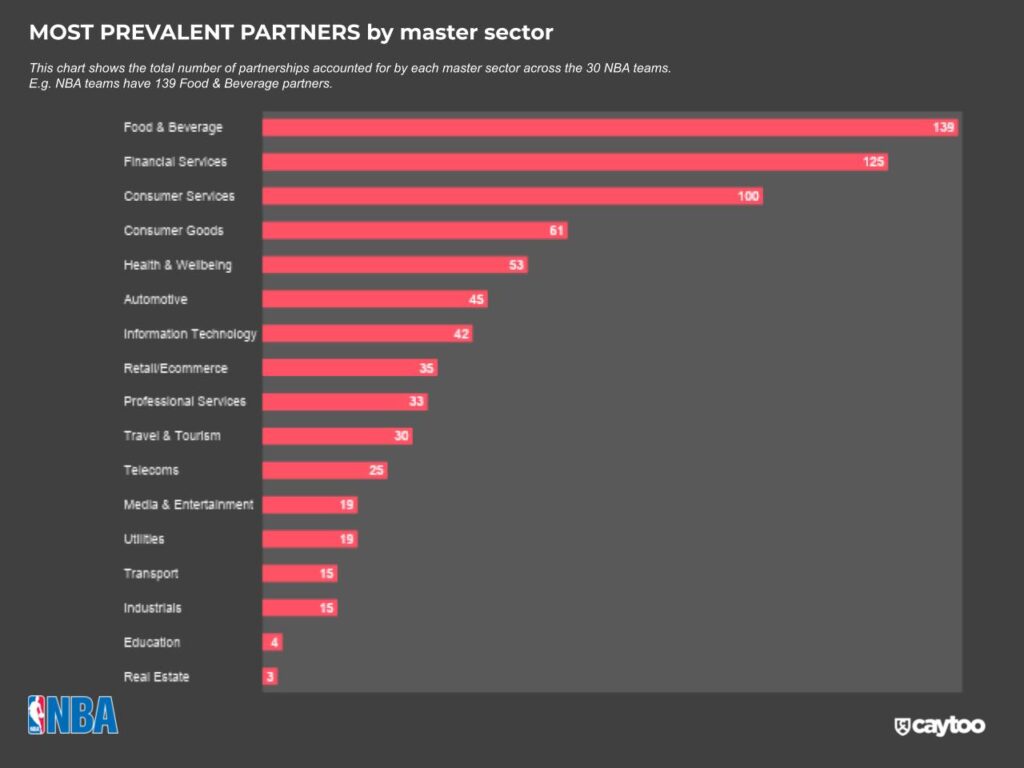
While most eyes around the NBA are turning towards Denver with the city hosting Game 1 of their first NBA finals tonight, we have taken a step back to give you a full breakdown of who is sponsoring the 30 NBA franchises.

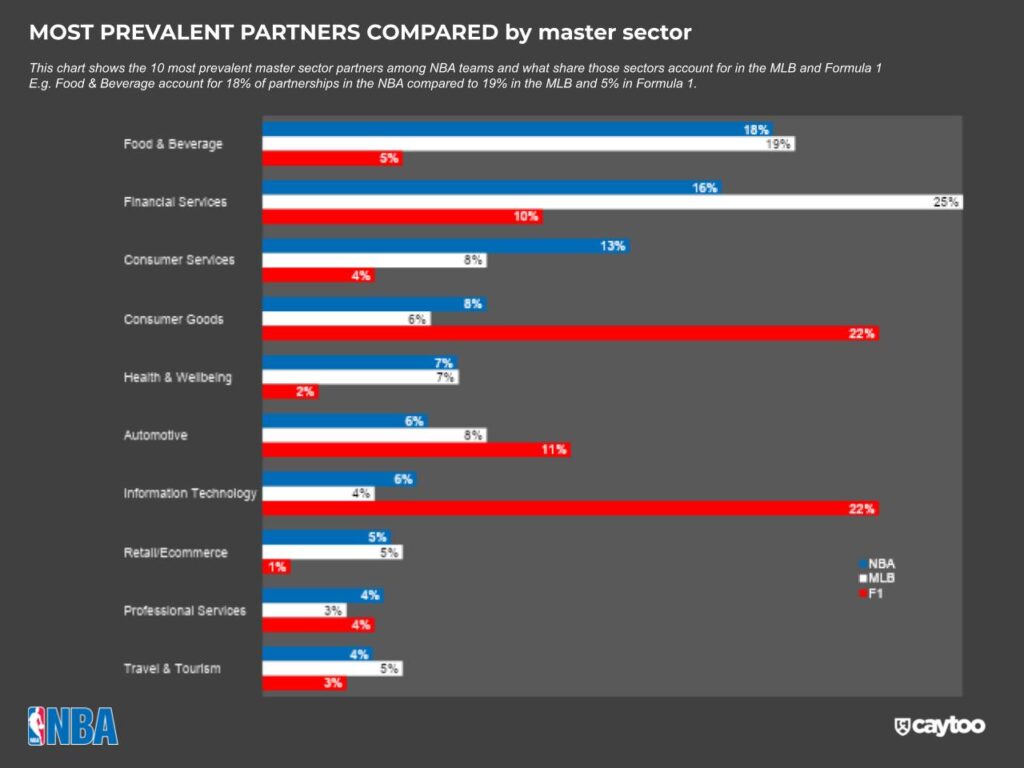
Food & Beverage (F&B) (18%), Financial Services (16%) and Consumer Services (13%) are the most prevalent sectors partnering with NBA teams, accounting for nearly half of all sponsors.

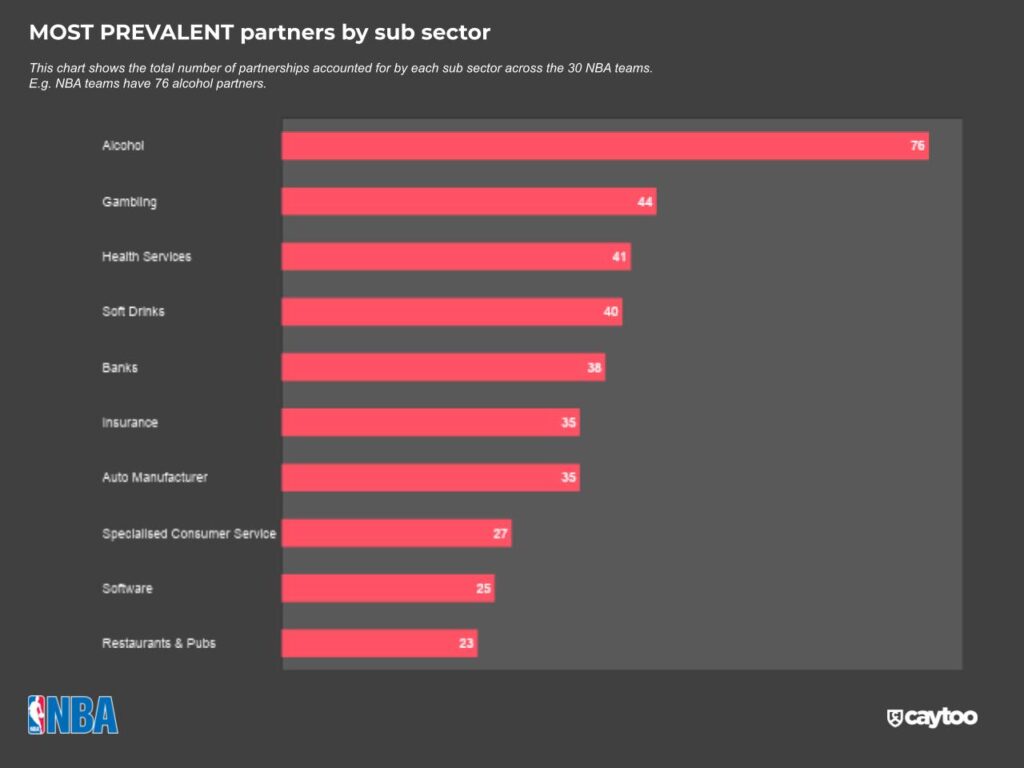
F&B partnerships are driven by Alcohol and Soft Drinks, the former being the most dominant sub-sector by far with 76 partnerships, followed by gambling at 44. Like the MLB, Alcohol brands account for around 10% of all partnerships but a significant difference is that in the MLB, beer brands account for around 86% of alcohol partners compared to just 50% in the NBA. This shows that spirits and wine brands clearly consider basketball to be a much better avenue to reach their drinkers than baseball. 

Not subscribed to our weekly newsletter? Click here to sign up and receive more content like this to your inbox every week. 

In an Atlantic article in 2014, Derek Thompson, looked into the different demographics that watch US sports. In a time where brands are increasingly aware of who they want to target to make sure their advertising dollars, a look at these demographics could explain why certain sectors target different sports. As of 2014 the NBA had a 45% black, 45% under 34 and 70% male viewership, it would be surprising if these figures had moved much in the last decade. If so, it’s more likely to be more concentrated around these demographics. Over in the MLB, the TV audience was 83% white, 50% over 55 and 70% male. Different audiences, different sponsors.

Financial Services is driven by insurance and banks – much like it is in the MLB. However, in the NBA they account for significantly less share (16%) than in the MLB (25%). This suggests that baseball is more likely to be seen by potential FS partners as a better way to differentiate their ‘drier’ product sectors and drive loyalty through team loyalty than basketball.

Consumer Services is driven by Gambling and Specialised Consumer Services. The sector accounts for a higher share of partners (13%) than in the MLB (6%). Notably, gambling is the second most prevalent sub-sector in the NBA, much higher than that in both the MLB (ranked 7th) and Formula 1 (19th). In the NBA, Gambling is driven by fantasy sports brands, such as FanDuel and DraftKings, which account for a much larger share of Gambling brands than in the MLB.

Click here to find out more about the work being done by caytoo

Meet the Member: “In 2023, we could reach more than 1,500 matches a year”

The European Cricket League has grown rapidly since its inception in 2018, the CEO and Co-Founder Roger Feiner has been at the centre of it all. In this interview we discuss the challenges, the impact of the pandemic and their OTT platform.

So Roger, to kick off take us through your journey in sport?

A long story short, I was a Swiss national tennis player and a lawyer. In my career as a lawyer I headed the sport and marketing department of SRG. I then moved over to work for FIFA as Director of Broadcasting from 1999 to 2002 so I left after the Korea and Japan World Cup in the summer of 2002. After that I became the founder of two private sports TV channels in Switzerland. Then I met my co-founder of the European Cricket League, an Australian by the name of Daniel Weston and together we founded the ECL in 2018.

What was it about the European Cricket League – ECL – project that made you want to get involved?

We wanted to create something that was similar to the UEFA Champions League in football. We know how much power cricket has around the world, it is one of the biggest sports, you only have to look at the amount of money that the broadcast rights for the IPL were sold for. What we realised was that cricket wasn’t a big deal at the elite level in central Europe, but it is growing rapidly. What really fascinated me was the potential we had to reach cricket fans on a global scale and also the chance to try and play a role in evolving the game through our T10 format.

How has it evolved since it was founded in 2018?

In 2019 we kicked-off the very first European Cricket League in Murcia, Spain in a partnership with eight nations and its respective club champions – it was a highly successful event with about 120 million TV spectators only on three event days – but – like everything – it was not easy to find further traction in the upcoming months when the pandemic hit the world. 

However it did mean that in 2020 we were able to get the European Cricket Network ECN started in its true sense. We were able to play matches (the European Cricket Series – ECS) without any spectators but there were still quite a few restrictions and they tended to be different in different countries which made it a bit more challenging. 

That year in Helsinki, we held our first ECS tournaments and we were able to play even 700 matches between June and the end of the year. The following year we were able to integrate 30 European Cricket federations within the ECN family. This gave us the ability to create our version of the European Cricket Championship – ECC (the EUROS of Cricket) with 21 national teams competing to be crowned the best in Europe. And in the same year, we were able to organise 1,200 matches and we have continued to grow since. Since 2022, the ECL and the ECC are being played and together with all the ECS our annual calendar is almost full.

Roger Feiner with his Co-Founder Daniel Weston (right)

In 2023, with the introduction of women’s events and international friendlies called ECI, it is expected that we could reach more than 1,500 matches. Broadcasting these games is a big part of what we do. All the games are produced to a high standard TV format where we produce around ten hours of TV coverage daily!

How easy has it been to attract sponsors for the league?

Just as I am sure it is with any other sport it is not easy to get sponsors, especially early on. One of our strengths is the number of TV / OTT eyeballs we bring in throughout the year thanks to the number of games and the fact we are playing on 330 days in the year. There aren’t many platforms that can compete with us in that regard.

We have also been able to tailor the packages we offer depending on the needs of the partners. Being flexible has really helped us when it comes to making sure our partners sign on the dotted line in the end.

What are some of the challenges that you are facing as a business?

The challenges have mainly come from how quickly we have grown as a business and trying to keep it all under control. Trying to make commercial partners aware of the potential of European Cricket is one of our main jobs at the moment. We also have to understand that for the vast majority of Europe, football is still in the DNA, but we have to be able to tell the cricket story and convey potential new partners of this fantastic opportunity. If we do this successfully, we will also be able to bring new, young Europeans to cricket, but that will naturally take a bit of time.

There’s so many different formats and tournaments out there from the Blast in the UK to the SA20. What makes the European Cricket League stand out?

Our T10 format makes it fast and easy to understand. There is always lots of action going on and on a normal day we can have up to five matches a day running. I think for spectators and viewers at home the length of the game is very attractive – it is shorter than a football match. With this new format, we attract a new cricket clientele – which is key for the future of this sport and we have top cooperation and support from the ICC.

Tell us a bit about the thought process behind live streaming your fixtures and how did you go about making that happen?

Producing more than 1500 matches per season from January until December can only happen with a great deal of planning, discipline and a superb team that works incredibly hard behind the scenes.

We get a lot of help from external partners as well with companies such as Spring Media and Sportz Interactive to name just a few. One of the key aspects of what we do is the very close cooperation with the data intelligence and software partner Palantir. Their system helps us a lot with the planning, preparation and delivering of events.

What work are you doing to attract new fans?

Attracting new fans is a daily job. We are constantly working on building a community of fans through our social media. Just through the amount of cricket being played we have mountains of content, but we also invest a lot into our school project (Cricket’s cool) that is aimed at bringing in thousands of young school boys and girls to the cricket grounds to get first hand experience of watching the games and then taking part in cricket coaching clinics supported by professional coaches.

The Bottom Line: Streaming wars continue to disrupt broadcaster’s share price

In this month’s iSportConnect Sports Business Index our Content Manager, Alex Brinton, dives deep into this month’s movers and shakers with a particular focus on the world of broadcast.

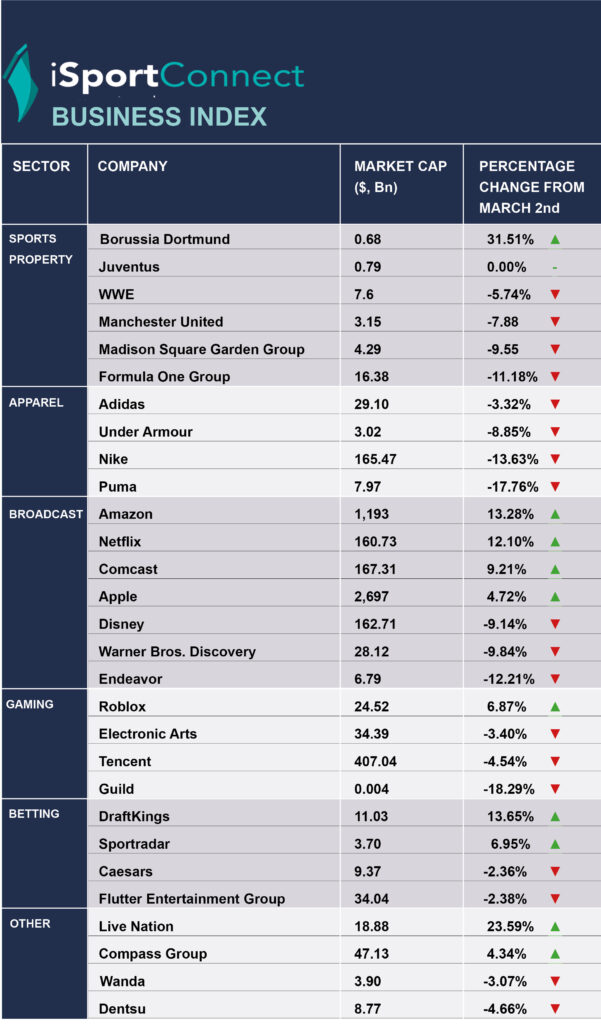
Let’s start by focussing on the wonderful world of television and streaming. There are some big winners and big losers all over the industry. Amazon are the biggest winners of this month, and the year so far, they have seen a share price increase of 38% in 2023, 29% more than the 9% average on the S&P 500. While their Q1 results have not set the world alight, they were better than expected and as a result have result in an encouraging response from the market.

Not subscribed to our weekly newsletter? Click here to sign up and receive more content like this to your inbox every week. 

Comcast have had a strong month as well seeing their market cap overtake Disney this month by moving from $155bn to $167bn. It has also been a strong month for Netflix as well with a share price increase of 12.097%, their biggest jump since October 2022. This came after they announced that nearly five million account holders are using the service’s advertisement tier.

Both Comcast and Netflix are benefitting from a growing perception that the major media companies are becoming more rational in their investment decisions together with a general move towards Tech as investors become more positive on the economy.

Further down the list Live Nation, Ticketmaster’s parent company, saw a rise of 23.58% after announcing impressive Q1 earnings. The company’s CEO, Michael Rapone said: “What is clear as we look at our results and operating metrics is that global demand for live events continues to reach new heights — demand has been growing for a long time and is showing no signs of letting up.”

They are benefitting from the pattern of consumers wanting to enjoy live experiences again, which we see across many sectors such as Travel and Entertainment.

Take a look at how the rest of the Index performed below: