
The “fantastic plastic” roof cladding system – Populous’ Richard Breslin & Ron van Sluijs
April 25, 2014
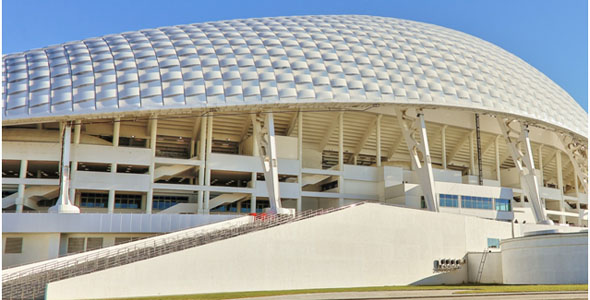
While the Sochi 2014 Winter Olympics dominated our news and sports pages in February/March, perhaps not so remarked upon was the intriguing ‘plastic’ cladding that completed covered the newly built 40,000 seat Fisht Olympic stadium, host of the Sochi opening and closing ceremonies.
This ‘plastic’ cladding, ETFE, is one of the exciting new materials of the last few decades. My colleague, engineer and architect, Ron Van Sluijs explains more about this versatile roof cladding system which was initially used in green houses but is now an increasingly common feature of stadia and large atria.
When you look at the Sochi stadium’s roof cladding for the first time, it is easy to believe the roof is clad with a series of ‘arched panels’, acrylic perhaps, with open gaps leaving the tier below vulnerable to the rain. However nothing could be further from the truth! The impression of arched ‘panels’ is an illusion, created by alternating clear and opaque ETFE sheets welded together to one long inflated cushion from ridge to gutter.
Creative use of the material has allowed a clever balance of light ingress, shading and architectural interest within the application of a single material.
ETFE – Ethyl-Tetra-Fluor-Ethylen- to give it its full name- is a weather resistant thermoplastic, which is UV stable with a high light and UV transmittance. Although ETFE, a polymer, can be installed as a single sheet foil in a similar technique as tension fabrics PTFE and PVC, ETFE is more often used as a double sheet pneumatically inflated cushion system. The system is comprised of two or more thin foils sealed around its perimeter, internally inflated to form an enclosed cushion which is then inherently rigid, lightweight, capable of spanning large distances without immediate supports and also capable of bearing substantial loads, as well as being self-cleaning to a degree.
Cushions of 5-6m wide and 25 up to 125m lengths can be inflated and kept under constant air pressure. On top of the foil, flexible Photovoltaic cells (PV) can be integrated. Furthermore, these cushions weigh less than 1% of a glazed equivalent roof structure. The cushions are both strong and elastic at the same time, characteristics that count when designing large free span roofs and facades. It’s a constant battle in roof design to keep the roof light yet robust, span the distance without the steel clutter, easy and quick to install and all within a certain budget. Though ETFE is expensive per square meter, the savings are considerable, because less steel structure is needed and installation time is much faster.
The first large scale commercial application of pneumatic ETFE was the 6000m² roof enclosure over the desert hall of Burger’s Zoo in Arnhem, in the Netherlands. 30 years later the facility is still operating with no deterioration to the ETFE material.
 Sochi’s Olympic stadium is Populous’ third major stadium where ETFE has been successfully applied in the last five years. The other venues were stadia constructed for the 2011 Rugby World Cup in New Zealand – Eden Park Stadium in Auckland and Forsyth Barr Stadium in Dunedin, the world’s first fully fixed roofed stadium with natural indoor grown grass.
The high light and UV transmittance of ETFE has allowed grass to successfully grow in a fully enclosed ETFE shell. Initially, no one was clear whether the growing conditions inside an ETFE venue would be good enough for proper grass growth. A team of turf experts, engineers and the stadium architects undertook rigorous studies over two years to understand the effects of growing grass under ETFE all year round, and an ETFE test rig was built on site in Dunedin to monitor grass growth both under the rig and outside it. In the end, for a climatic location as cold and exposed as Dunedin, it emerged that the new roof meant the indoor growing conditions could be far better controlled than an adjacent outdoor location, and, in fact, led to healthier and stronger growing grass.
The term ‘fantastic-plastic’ comes to mind when working with ETFE. The material is versatile and can look spectacular, particularly when used as a roof over a large venue. The material is interesting architecturally, structurally, thermally, ecologically and is likely to be used more and more as a roof cladding option in the future. As a roof engineer and architect, I believe there is also a future for ETFE in public buildings where it can be applied in combination with newer trends such as green-wall-architecture, or as part of an internal atrium, enclosing a semi indoor-outdoor public space while positively adding to the climatic conditioning of the particular space.

Richard Breslin is a Senior Principal at Populous and a Director of the Asian/Pacific office headquartered in Brisbane. Richard also sits on the worldwide strategic Board of Populous. Richard is responsible for all of the firm’s projects in New Zealand and Australia.
Richard is currently leading the Populous team on the Darling Harbour Live project in Sydney in a HASSELL+ Populous joint venture. The $750M project includes the design of a convention centre, exhibition centre and theatre. He is also Director in charge of the redevelopment of Margaret Court Arena in Melbourne.
In 1997, Richard commenced work with the team on the design of Stadium Australia (now ANZ Stadium), the main venue for the Sydney 2000 Olympic and Paralympic Games. At this time, he also worked on the event overlay for the Games before moving to London where he worked on the design of the 90,000 seat Wembley Stadium, and the design of the Soccer City Stadium in Johannesburg, South Africa, for the 2010 FIFA World Cup. He was also project leader for Populous’ successful master plan for the London 2012 Olympic Park.
In 2007, Richard immigrated to New Zealand, where he led the teams on Eden Park redevelopment in Auckland and Forsyth Barr Stadium in Dunedin; – both were venues for the 2011 Rugby World Cup.
Richard’s 
 Ron is an Associate Principal of Populous and a member of the Australasian Management Team. He was born in the Netherlands and worked as an Architect in Europe before immigrating to Australia in 2002.
Ron’s background is in Architectural Engineering and he has specific skills in structural aspects of architecture, including the building envelope, structural design and analysis and detailing skills.
Throughout his architectural career, Ron has managed the architectural development and documentation of a variety of large scale buildings including sports stadia, arenas, airport terminals, subway stations and a number of office blocks.
Ron is the Project Architect for the Philippine Arena in Manila, the world’s largest arena, and the Taipei Dome – a baseball stadium which forms part of a large commercial mixed use development in Taiwan. He was also Project Architect for the innovative Forsyth Barr Stadium in Dunedin, New Zealand.
Ron’s
{jcomments on}