
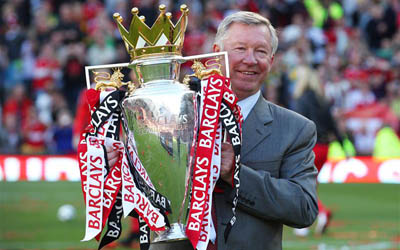
Sir Alex Ferguson Retires as Manchester United Face Summer of Boardroom Change
May 8, 2013
Manchester United have confirmed the retirement of Sir Alex Ferguson, arguably the greatest football manager of them all. A note was issued by the club at 9.15am after overnight speculation grew in intensity.
United launched a partial flotation in New York on August 10 and the rules and regulations mean that any significant information affecting the running of the club could not be held back.
In pre-quoted days clubs could afford to sit on speculation about a managerial change for days, weeks and even months. But this is not an option when the credibility of public valuation is at issue.
Ferguson’s retirement had been the subject of rumour ever since he called a halt to his planned retirement in 2002. He is 71, has a heart pacemaker and will undergo hip surgery this summer. Not that these factors appear to have affected his energy, focus and ferocious ambition.
The Scot will not be the only major departure from Old Trafford this summer.
Chief executive David Gill, who managed the transition of Manchester United’s ownership from the Edwards to Glazer era, is stepping down as ceo at the end of June.
Gill will be succeeded by Ed Woodward, the former Goldman Sachs banker who was instrumental in advising the Glazer family in their controversial leveraged buyout. Woodward has been the driving force behind the construction of United’s 30-plus raft of sponsorships.
Favourite to succeed Ferguson is fellow Scot David Moyes whose 10 years at Everton are likely to come to an end with the expiry of his current contract this June.
Outstanding
Moyes has been a regular face in the directors’ box at Old Trafford down the years when Everton have not been in simultaneous action.
Ferguson, born in Glasgow on December 31, 1941, played centre-forward for Rangers and was then an outstanding manager of Aberdeen and of Scotland at the 1986 World Cup. He joined United on November 6, 1986 and has now won 38 major trophies, making him the most successful manager in the history of world football.
In 2008, Ferguson became the third British manager to win the European Champions League Cup on more than one occasion (after Liverpool’s Bob Paisley and Nottingham Forest’s Brian Clough).
Various tributes have been offered to Ferguson by United. In November 2010 the North Stand was named after him and then last year a statute of him was unveiled.
Work ethic
When the stand was renamed Sir Bobby Charlton, another United icon, paid effusive tribute to Ferguson, saying: “Alex is unique. I’ve never known anyone who works as hard as him. He’s been sensational for United. When we first got him you could tell at once he had this incredible work ethic: he wasn’t satisfied with second best, he wanted to be winning all the time.
“That hasn’t changed but in our wildest dreams we couldn’t have expected Alex to be so successful over all this time – especially when the average time for a manager to stay in any one place is just three and half years.
“He still loves the game and the challenge as much as ever and there is something special about how he sees into the future when he looks at young players. I don’t know how he does it. He’s marvellous. We directors have had very little to do since Alex came here.”
That is about to change.
United have two matches remaining before they can take formal charge of a record-extending 20th league title; they end their season at West Bromwich on May 19 but play their last home match against Swansea this Sunday.
That, presumably, will be the occasion for Fergie’s Farewell.
Keir Radnedge has been covering football worldwide for more than 40 years, writing 33 books, from tournament guides to comprehensive encyclopedias, aimed at all ages.
His journalism career included The Daily Mail for 20 years as well as The Guardian and other national newspapers and magazines in the UK and around the world. He is a former editor, and remains a lead columnist, with World Soccer, generally recognised as the premier English language magazine on global football.
In addition to his writing, Keir has been a regular analyst for BBC radio and television, Sky Sports, Sky News, Aljazeera and CNN.
Keir Radnedge’s Twitter: @KeirRadnedge
Keir Radnedge’s 
{jcomments on}