
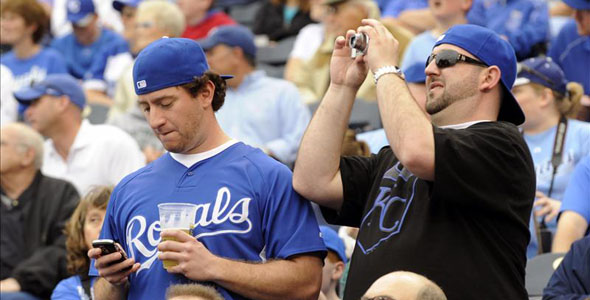
REPORT: Internet at Sports’ Biggest Stages by Kelley McGrath
December 30, 2013
Social media plays a larger role than ever for sports fanatics across the globe.
Twitter is a gigantic newswire.
YouTube is an endless source of bloopers and video highlights.
Facebook is a place for trash talking amongst friends and foe.
However, beyond anecdotal evidence, it’s not easy to estimate how many fans use which networks, and where the greatest opportunities for marketers lie. Catalyst PR recently took a shot at quantifying sports fans’ Internet engagement and how the unique segment can be reached.
The company’s latest project, released in October 2013, surveyed 2,100 sports fans age 16 to 64. They included fans of college soccer, basketball and football, as well as the NBA, MLB and NFL. While small, the sample size is representative of most fans of major sports.
According to the study, 73 percent of participants reported using Facebook regularly, compared to 37 percent using Twitter. On game day, however, fans admitted to checking Twitter 1.5 times more frequently than Facebook.
The study also indicates post-game social media use has risen since 2012 for Instagram (115%), Twitter (39%), Facebook (20%) and YouTube (13%).
Before the Internet, fans caught up on sports highlights on television or read results in the newspaper. The integration of social media and the Internet have drastically changed the way fans watch and interact with sports.
Internet can provide a valuable method of communicating between fans. They’re able to connect with each other, post-game scores, upload videos of big plays and share photos of their favorite players in action using one or more of several social media networks available.
In fact, the street is quickly becoming a two-way road as companies take notice of what the fans are doing, and sharing, on game days. According to Doug Wernert, manager of brand networks for the Detroit Pistons and Palace Sports & Entertainment, the wonderful thing about social media marketing is that everything is trackable. This not only allows fans to have a more personal relationship with the team and stars that they idolize, but gives teams unique insights on their fans and how they are engaging.
Technological influx is not without its complications; many fans complain about Internet connectivity issues at live sporting events, and some venues are better equipped to handle the deluge of game day web activity than others.
Raymond James Stadium in Tampa, Fla., known by locals as the Ray Jay, is home to the NFL’s Buccaneers. Site of the 2017 college football national championship, Raymond James Stadium joined forces this year with Verizon FiOS Quantum to provide fans with high-density fiber connectivity through hotspots set up throughout the stadium.

Gillette Stadium teamed teamed up with Enterasys to provide stadium-wide high-density Wi-Fi to home game crowds. In addition to the new network, the home of the New England Patriots also has game day apps available exclusively for the use of fans attending a game in the venue.
The NFL’s commitment to providing high-density Wi-Fi at each of its stadiums illustrates that connectivity between the Internet, social media sites and fans at sporting venues is beginning to improve. With the NFL’s declining attendance and ticket sales over the past five years, the league hopes that improvements to the infrastructure will lure fans away from the couch and back into the stadiums.
Kelley McGrath is a freelance sports writer from Vienna, Virginia, in the United States. Originally from Winston-Salem in North Carolina, Kelley also has experience in marketing.
You can follow Kelley on Twitter here.
Kelley’s 
{jcomments on}