
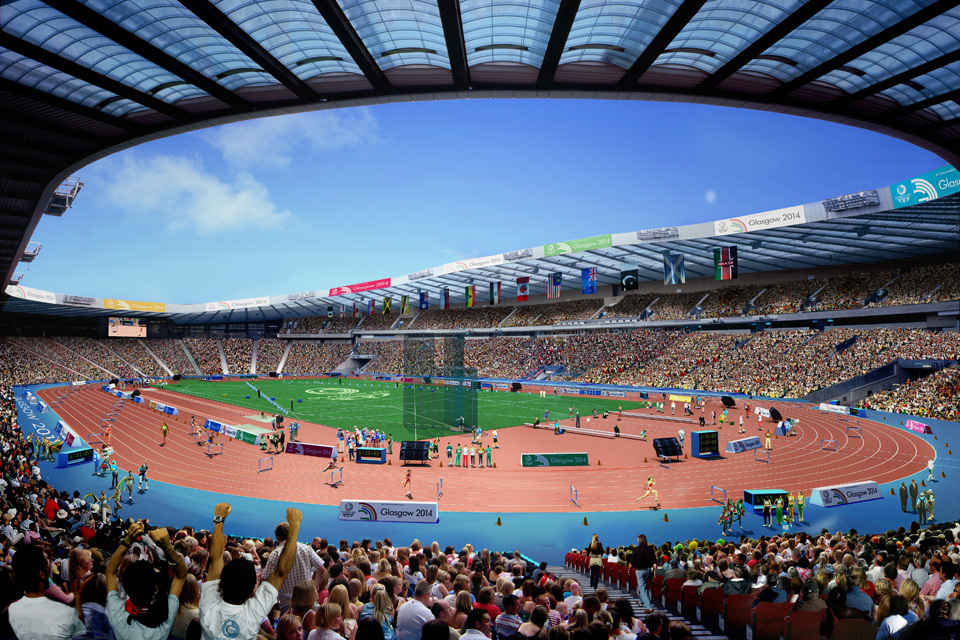
Glasgow 2026 Impact Evaluation Highlights £223 million Economic Activity
November 2, 2026
Glasgow 2026 generated £223 million in economic activity across Scotland (Gross Output), using the city’s existing infrastructure and expertise to deliver a world-class sporting event, according to an independent impact evaluation of this summer’s Commonwealth Games.
The 11-day Games generated a significant £158.6m economic boost for the Glasgow City Region, part of a £223m figure across Scotland, with £117.3m Gross Value Added (GVA) throughout the country.
The report also highlights how the reimagined Games model broke new ground by staging sports entirely in venues powered by renewable energy for the first time. The event drew on Glasgow’s community assets and experienced events workforce to create a more inclusive and greener event broadcast to a global audience of 510 million, reaching viewers in 166 territories within and beyond the Commonwealth.
The Games’ public programme drew a live audience of one million across ticketed events as well as the Game On Live Site, the King’s Baton Relay across Scotland and through the Glasgow 2026 festival programme. The competition brought together 2,749 athletes from all 74 nations and territories of the Commonwealth across 10 sports and six Para-sports. During 11 days of action, 152 Games records and six world records were set.
Building on the knowledge, talent and partnerships developed through Glasgow 2014 and successive major events, the city stepped forward in October 2024 to save the Commonwealth Games under the new model introduced by Commonwealth Sport, within a compressed delivery timeline.
The Games were delivered for less than £160m, with the evaluation highlighting substantial sporting, social, cultural and economic benefits, alongside valuable lessons for future Games hosts. An investment of £5.7m across three sites – Scotstoun Stadium, Tollcross International Swimming Centre and Glasgow International Arena – points to the Games’ visible legacy.
Beyond the sporting programme, community activity reached all 32 Scottish local authorities. Schools, cultural organisations, volunteers and local groups helped people experience the Games in their own communities, and free celebrations brought sport and culture into the heart of the city.
Inclusive, Greener, Welcoming and Financially Responsible
The evaluation examines four ambitions at the heart of Glasgow 2026
An inclusive Games
Glasgow delivered the largest Para sport medal programme in Commonwealth Games history, with 47 medal events across six sports. Integrated competition placed Para athletes at the centre of the sporting story, with Para powerlifter Mark Swan winning the first gold medal of the Games.
Accessibility improvements were made to venue routes, entrances and wayfinding, with accessible viewing platforms, Changing Places facilities, hearing assistance and sensory support also improved.
The report identifies opportunities to build on this work by planning and testing accessibility across the complete spectator journey, including ticketing, information and transport, and engaging underrepresented communities earlier.
A greener Games
Using existing venues within a compact eight-mile corridor reduced the need for construction, while hiring and reuse limited the demand for new materials. Almost all (96%) of temporary venue infrastructure was hired, and 79% of purchased assets were recycled, donated or resold.
The Games achieved independent ISO 20121 certification for sustainable event management. All competition venues were entirely powered through renewable electricity tariffs, and 100% of waste was diverted from landfill.
The evaluation also evidences a low-carbon Games, and provides recommendations to shape more sustainable future events. The report highlights opportunities to minimise material consumption, prevent waste at source, improve recycling performance and embed circular economy principles throughout event planning and delivery.
A welcoming Games
The All In programme involved 755 organisations across Scotland, enabling communities to shape their own celebrations. Over £2m was awarded to community groups and communities through the Festival Fund and Awards for All.
Athlete visits reached 27,827 pupils, while Games Mascot Finnie reached children from more than 500 Scottish schools including 158 school visits.
131,000 people attended the Game On Live Site in Kelvingrove Park, funded through Scotland’s Summer of Sport. 97% of surveyed visitors rated their experience good or very good, 99% felt welcomed and 95% felt it was inclusive.
4,000 volunteers delivered 156,000 hours of volunteering. More than a third of the volunteer Legends were new to volunteering with 87% indicating they intend to volunteer again in future.
A place-based event, delivered in a financially responsible format
Existing facilities, local expertise and specialist delivery partnerships enabled Glasgow to stage the Games within its organising budget. Approximately 85% of Games revenue originated outside Scotland.
The Games supported an estimated 2,400 FTE years of employment. At least 82 students secured paid Games-time roles, gaining practical experience in the major events industry. The largest direct impacts were concentrated in accommodation, professional and technical services, arts, entertainment and sport, construction of temporary overlay, food and beverage services and retail.
Phil Batty OBE, Chief Executive of Glasgow 2026, said:
“Glasgow showed what can happen when you build a Games around the strengths of a place and the people who make it special. This report provides the evidence that we delivered great sport and a proud Glasgow welcome, while creating opportunities for people across Scotland to be part of something altogether brilliant.
“Our ambition was for a more sustainable Games. Our thanks go to the workforce and volunteer Legends, partners, and the communities who brought their own creativity and energy to the celebration.
“We are proud of what we achieved in Scotland on behalf of the whole Commonwealth. By sharing both our successes and the lessons learned, we have left a valuable legacy. This will inform and strengthen future editions of the Commonwealth Games.”
Katie Sadleir CNZM, Chief Executive of Commonwealth Sport, said:
“Glasgow stepped forward with courage, generosity and ambition at a defining moment for the Commonwealth Games. We are deeply grateful to the city and to Scotland for delivering a Games that gave athletes a wonderful stage and helped move our Movement forward with confidence. It was a celebration of sport, culture and friendship, with integrated Para sport at its heart and a welcome that once again reflected the very best of Glasgow.
“This evaluation shows the value of shaping a Games around the capabilities of its host: existing facilities, experienced people and communities with the imagination and enthusiasm to make it their own.
“Crucially, it provides valuable evidence for our reset, protecting the quality of integrated sport while opening up more adaptable approaches to hosting. Glasgow’s circumstances were distinctive, but its experience provides a blueprint for more nations and territories to shape future Games around their own strengths, communities and ambitions.
“Glasgow 2026 marked the beginning of a new era for our Movement as we look towards the Centenary Commonwealth Games in Amdavad in 2030. Glasgow’s contribution is both a successful Games in its own right and an important foundation for what comes next.”
Ian Reid CBE, Chair of Commonwealth Games Scotland, said:
“Two years ago, when the future of these Games was uncertain, we believed Scotland could step forward and lead to provide a solution that could not only reset and secure the future of the Games but also deliver an outstanding event in a responsible and sustainable way, while showcasing our athletes on the world stage.
“Glasgow 2026 made this a reality. It was a fantastic Commonwealth Games for Team Scotland, our athletes won a plethora of medals, set individual and team records and inspired the nation while generating an unforgettable atmosphere across the city.
“It was a reminder of what makes the Commonwealth Games so special. Everyone who worked tirelessly to deliver this altogether brilliant Games should be immensely proud.”
Robyn Love, Team Scotland 3×3 Wheelchair Basketball player/coach and Glasgow 2026 silver medalist, said:
“To come away with a silver medal at a home Games was the stuff of dreams. Glasgow 2026 will live with me for the rest of my life. I’ll never forget the noise of the Scottish crowd when we won the semi-final, and to have my little girl there in the stands capped it all.
“I hope the visibility that the Commonwealth Games gives, particularly to para sport, means others may find and benefit from sport earlier than I did, and that the inspiration provided by Glasgow 2026 lives long into the future.”