
China’s new World Class Zhuhai Hengqin International Tennis Centre Hosts its First Major Competition
October 30, 2015
By Populous’ Richard Breslin and Tiric Chang
In the coastal city of Zhuhai, in Southern China, out of some disused ponds, has risen something exceptional – a tennis facility that’s been labelled one of Asia’s most advanced.
It’s scarcely a year since Populous won the design competition for the Zhuhai Hengqin International Tennis Center. Yet, next week, some of the world’s best female players will descend on the completed first stage of the venue, to vie for the coveted WTA Elite Trophy.
Tiric Chang, Populous’ chief representative in China, is best placed to explain how the watery site was transformed into a spectacular playing space, and to reveal how locals have reacted, and what happens next in Zhuhai.
…
When the competition to design the Hengqin International Tennis Center was announced, Populous was invited to take part.
Our architects, the team behind Wimbledon Centre Court and Margaret Court Arena, were confident they could create an exceptional playing environment. Most exciting for me were the challenges and opportunities I knew would exist, creating it in this region.
China has seen significant sports development over the last decade, but too often projects have consisted of just one stand-alone arena or field. Usage hasn’t been anywhere near what it could be.
But with significant growth of the Chinese middle class has come much greater interest, time and money for sports like tennis, plus much greater expectation of the facilities where they’re played.
Chinese officials are responding, hence the investment in developments like the Hengqin Center, an $84 million USD project. In this case the client, state-owned enterprise the Huafa Group, was clear about its vision for Zhuhai’s new Tennis Center from the outset.
The Zhuhai Culture, Sports and Tourism Bureau’s Deputy Director, Cheng Yurong, said that the city was elected most liveable in China in 2013 and 2014 and is a favourite destination with tourists as well.
“Zhuhai is committed to continuing the process of internationalization and the tennis centre can help elevate us onto the wider world stage, significantly helping to improve our international and image and influence,” said Mr Cheng.
So, along with meeting the highest of technical and professional criteria, the development needed to surpass community, and international expectation. Populous talked extensively with stakeholders about the logistics of making the Centre work for players and visitors and how to maximise financial return. We also discussed the important goal of giving Zhuhai locals a park to be proud of.
Zhuhai is a small city by Chinese standards; and its size and reputation as picturesque and highly liveable served as inspiration when we embarked upon the Center design – what we were going to create didn’t need to be the biggest, or the most expensive in China, it just needed to be unique.
The Government wanted that uniqueness to be evident right from the entrance, requesting that the entry plaza be designed to be “iconic and memorable”. Populous accepted that challenge, creating a forest entryway made of harvested and live bamboo.
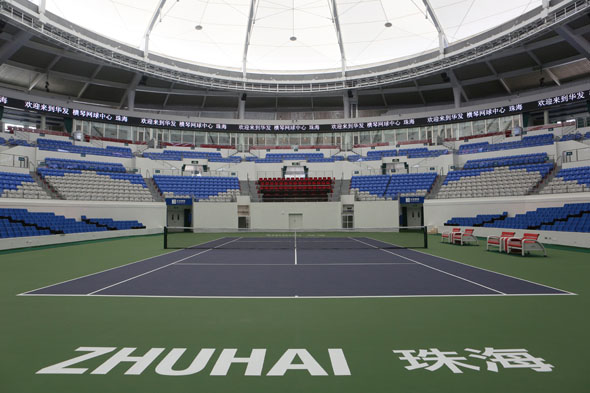
We envisaged suspense growing for visitors as they then crossed bridges, and followed scenic paths right through to the main arena. There they’d find the 5,000 seat Centre Court. We drew up five other match courts with some 12 training courts positioned alongside.
Again, in this space, we weren’t aiming for ‘biggest’ but we were aiming for most advanced. The roof over Centre Court is a good example of how we succeeded. It has two components – a cantilevered outer roof over the seating, and a circular inner roof over the court, both of which are designed to allow light to filter into the arena.
Players, including China’s Li’ Na, have noted how well it protects them from harsh sun. The roof is also designed to be a cost-effective means of allowing play to continue in wet weather, something tournament organisers and broadcasters are pleased with.
Our plans for back-of-court facilities were equally innovative, with a focus on specialised amenities for tournament organisers. Tennis arenas worldwide too often fail to prioritise these patrons. We wanted Zhuhai to be a notable exception.