The IBA Ordinary Congress concluded last week in Dubai where 170 National Federation members made their voices heard. SwissBoxing was welcomed back following its resignation from IBA under new leadership, a direction that was then reversed at their last General Assembly. Granted provisional membership by IBA before the Congress, members supported their return by a majority of vote.
In addition, the US Boxing Federation, a new organization led by legendary Roy Jones Jr was formed following the disaffiliation of USA Boxing. Oceania gained two new members as the Norfolk Island Boxing Association and Tuvalu Amateur Boxing Association were accepted.
Meanwhile, three organizations had their memberships terminated by the Congress, as the Czech Boxing Association’s, German Boxing Association’s and Dutch Boxing Federation’s termination was approved.
IBA under Umar Kremliv, President of the IBA who completes 3 years today has ensured positive conditions for athletes including huge prize money, high competition standards, help to National Federations via Financial Support Program and equipment support. IBA has further made significant strides towards achieving gender equality in the sport of boxing and has been working hard to ensure that women boxers receive the same level of recognition and support as their men counterparts. Now gender equality is written in Constitution where the Board should have minimum 5 women representatives from each continent and it is in place.
Tereza Atilio Lual, President of the Boxing Association, Republic of South Sudan said: “I am very impressed with IBA. They want to bring gender balance within the organisation and boxing community globally. A few years ago, I was the only female president from the Africa region and now we have more female presidents. Some people think that boxing is only for men but that it not the truth. The association is further empowering girls and training them to be more self-reliant and financially independent.”
Projects that the Women’s Committee had launched already last year included: the IBA Women’s Boxing Questionnaire; the appointment of five IBA Confederation Women Ambassadors; the creation of Outstanding Women in Boxing Awards; the development of the Women Coaches Manual, the Women’s Community of Practice and “Invisible to Visible” project which highlights prominent women involved in boxing.
Wissam Zoubida, a member of the African Boxing Confederation further added: “IBA has introduced good policies to include women representation within the federation. To speak about my Moroccon organisation, for the first time we have a world champion Khadija El-Mardi and we have several women silver medalists as well. Because of this positive picture of boxing, the number of women participating in boxing has increased a lot. Boxing provides a lot of confidence to these women and my hope is for more women to take up boxing.”
At the global forum, Dutch-born boxer and IBA Champions’ Night winner Megan de Cler shared her story of how after being banned by the Dutch boxing organisation, how IBA is supporting her through its Financial Support Program (FSP) to help her achieve her dream of bagging a gold medal at the Olympics.
IBA Board of Directors Members Marta Forcen Celaya reinforced that inclusivity and gender balance are the priority of IBA. She said: “The development of women in Spain is super important to us. We must achieve gender parity. At IBA on the board of directors, for example, we are 50% women and 50% men, and this is true that it gives the impetus to be able to develop all women in the field, not only in sports.”
IBA further announced a $5 million prize money for the women’s world championship. Also, superstar fighters Conor McGregor and Petr Yan had a staredown officiated by IBA President Umar Kremlev.
TNT Sports and its streaming home discovery+ will show every match of FIFA Club World Cup 2023 Saudi Arabia™ live from Jeddah in the UK and Ireland including each match featuring current UEFA Champions League holders and Premier League champions Manchester City.
Live coverage of FIFA Club World Cup 2023 Saudi Arabia kicks off on TNT Sports 3 on 12 December (KO 18:00 GMT) with a first round clash between an Al-Ittihad FC side featuring Karim Benzema, N’Golo Kante and Fabinho and Oceania Football Confederation champions Auckland City at the King Abdullah Sport City Stadium.
Pep Guardiola’s 2022-23 treble winners enter the competition at the semi-final stage where they will face the winner of the second round tie between Club Leon (Winners of the 2023 CONCACAF Champions League) and Urawa Red Diamonds (Winners of the 2022 AFC Champions League) with TNT Sports 2 broadcasting the match live from 18:00 GMT.
The final of FIFA Club World Cup 2023 Saudi Arabia™ is scheduled for TNT Sports 2 on Friday 22 December, kick-off 18:00 GMT.
Manchester City qualified for FIFA Club World Cup 2023 Saudi Arabia™ after defeating Inter Milan by a single goal to win the UEFA Champions League final in Istanbul in June.
The WTA (Women’s Tennis Association) is moving forward with its strategic plan for the growth of women’s tennis with a further revision to its structure.
The revised structure will separate the roles of Chairman and Chief Executive Officer (CEO) to allow greater focus on the WTA’s mission and goals and will bring on an additional new leader to assume the CEO role. The CEO will be charged with responsibility for managing and growing the operations of the WTA and its many initiatives. The WTA has begun a comprehensive selection process for the WTA CEO position, supported by the global executive search firm Korn Ferry.
Once the position of CEO has been filled, Steve Simon, currently Chairman and CEO of the WTA, will assume the role of Executive Chairman. In this role, Simon will focus on governance, strategic interests of the WTA within the sport, integrity issues and the development of new markets and frontiers for the WTA. In addition to his designated role as Executive Chairman of the WTA, Simon continues to serve as Chair of the WTA Ventures Board.
In parallel with the changes to the Chairman and CEO roles, Micky Lawler, who has served as President of the WTA since 2015, has decided to leave the organization at the end of the year to pursue new opportunities.
The planned revision to the WTA’s structure is the latest step in the WTA’s strategic development, which has led to a landmark collaboration with CVC Capital Partners and the creation of a new commercial division, WTA Ventures. The new structure will help the WTA to secure its objectives of growing the game and delivering equal prize money for women by 2033. It will ensure that the organization benefits from breadth and depth of expertise and experience across sporting, operational and commercial matters, allowing it to take advantage of future growth opportunities while delivering world-class events and providing an excellent experience and increased compensation for players. The changes have been developed with the WTA and WTA Ventures Boards since the summer.
Steve Simon, the WTA’s Executive Chair designate, said: “Following investment from CVC Capital Partners and the creation of WTA Ventures earlier this year, we are now moving ahead and implementing further change to ensure the WTA is well positioned for future opportunities. WTA Ventures is achieving significant progress under the leadership of CEO Marina Storti, and we are looking to replicate this model by bringing in additional operational expertise for the Hologic WTA Tour. By putting in place additional leadership capability and capacity, we are getting ready to accelerate the development of women’s tennis as the WTA moves beyond its 50th year. I would also like to take this opportunity to pay tribute to Micky Lawler. She has been a valued colleague who has made a significant contribution to the WTA and we wish her every success for the future.”
Victoria Azarenka, former WTA World No.1 and member of the WTA Players’ Council, welcomed the development, commenting: “I wish Steve all the best in his new role, and the continued progress and development of the WTA as an organization. The partnership with CVC has been a great opportunity for growth to our sport, and the addition of an added leadership role for increased aid will continue pushing the WTA forward and the progression of women’s sports. I look forward to seeing the benefits this will bring for everyone involved in our sport.”
Adam Barrett, Chair of the WTA Tournament Council and WTA Board member, added: “On behalf of the tournaments, we are committed to delivering the highest-quality experience for players and fans. Adding a strong CEO to the WTA leadership who will be laser focused on key operational issues will have a positive impact as we work together to further elevate women’s tennis for players, fans, partners, and our tournaments.”
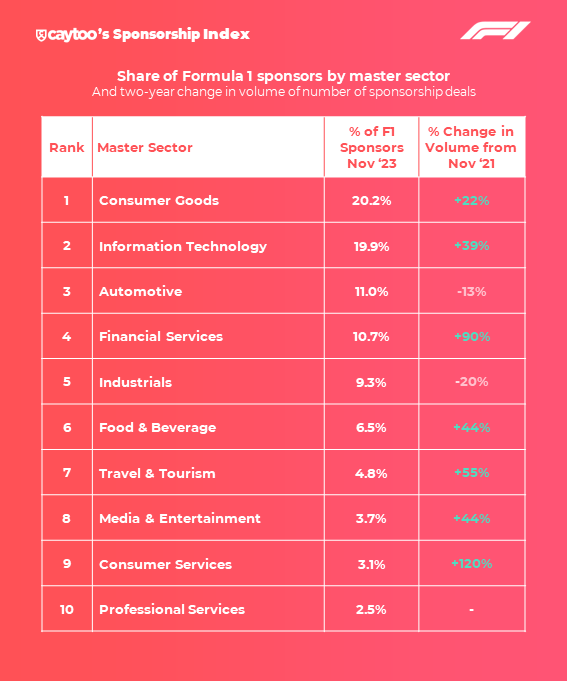
With the Formula 1 season having just finished and the teams no doubt taking stock of the sponsorship sales strategy ahead of the 2024 season, caytoo analysed the ~360 sponsors of the 10 teams and F1 itself to understand how the landscape has changed over the last two years in terms of the fastest-growing and declining sectors.
The number of F1 sponsors has jumped considerably in that time by 23% due to a combination of various factors. These include F1’s growing global fan base across TV, race attendees and social media, that audience becoming younger and more gender diverse, plus a near 10% increase in the number of races (factoring in the 2024 schedule). This growth has been particularly pronounced in the US through the extra number of races held in ‘glitzy’ locations – Las Vegas, Miami and Austin – which are heavily promoted and also create more global interest.
Over 75% of sponsor growth is being driven by just three sectors – Information Technology, Financial Services and Consumer Goods – and all of these can be attributable in some way to the sport’s younger audience.
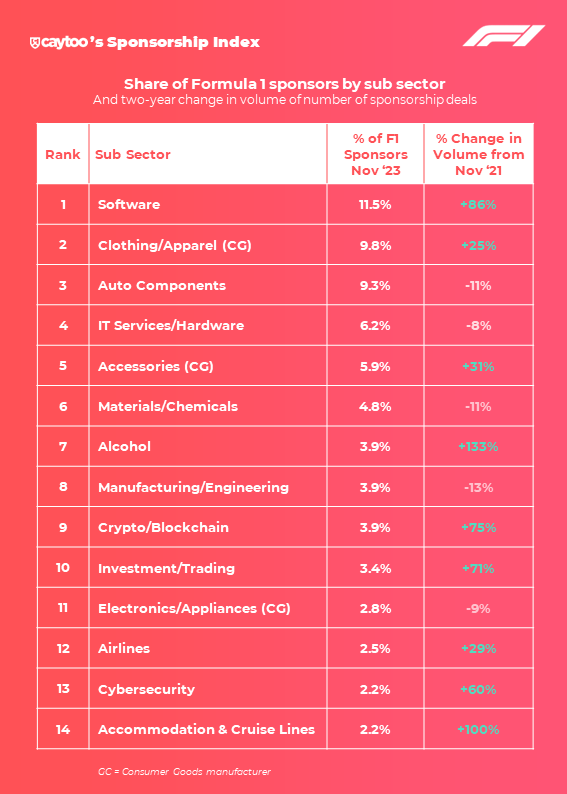
IT’s growth is dominated by Software brands; this sub sector seeing by far the biggest rise in the actual number of deals. F1’s emphasis around technology and innovation has always been a naturally strong fit with software and, although the sector itself doesn’t particularly target younger demographics from a purchasing perspective, many of the deals are centred around helping the teams to better engage with that fanbase, particularly on social, app and web channels.
For example, Salesforce x McLaren, with Salesforce stating the aim being: “to bring McLaren even closer to their fans across their digital platforms and deliver amazing digital experiences that help them connect with their global fanbase in a whole new way.”
Financial Services’ growth has been driven by the amount of Investment/Trading and Crypto/Blockchain sponsors rising by nearly 75%. Consequently, FS has overtaken Industrials as the fourth most prolific sponsor in F1. Many Investment/Trading sponsors are focused on online trading which targets a younger audience, such as Hantec Markets x Haas. This is the same for large crypto-related brands, such as Binance, OKX and OpenSea, increasingly jumping into F1 to generate awareness and, more crucially, trust and credibility on the global stage – particularly targeting Millennial and Gen Z audiences.
Consumer Goods remains the most common sector sponsoring F1 and its growth is mainly being driven by challenger brands to the traditionally dominant players in both Clothing/Apparel and Accessories. Clothing/Apparel includes the likes of newcomer shoe brands P448 x AlphaTauri and clothing brands such as K-Way x Alpine.
In turn, Accessories includes the like of upcoming glasses brands such as Web Eyewear x Alfa Romeo and luggage brands such as Globe Trotter x Aston Martin. Most are trying to reach a largely younger audience than the more traditional brands.
The fact that F1’s sponsor landscape is increasingly shifting towards younger audiences is reflected by Industrials and Automotive having the biggest drops in the number of sponsors. Industrials is primarily driven by a reduction in Construction sponsors while Automotive’s drop is mainly due to Auto Component brands. The latter in particular reinforces the sport moving away from its ‘petrol-head’-based roots to being positioned primarily as an entertainment brand, more in line with activations more typically seen in festivals and music.
Carlo De Marchis, ‘a guy with a scarf’ pens down this month’s business index.
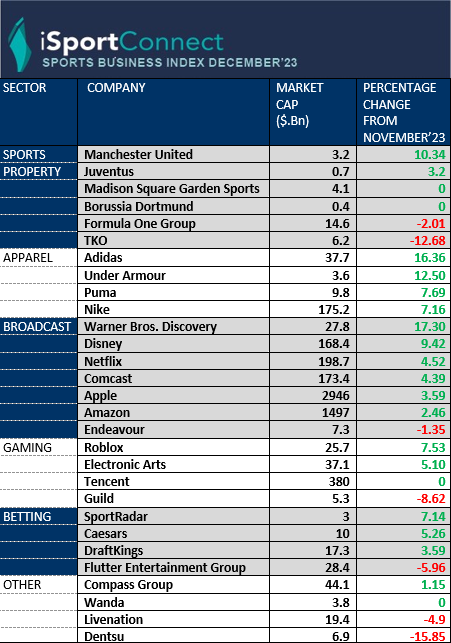
Fun fact: This month there is a lot of green on the iSportConnect Business Index! This does match the overall global market sentiment of positivity.
Ones to watch: Man Utd UP, Apparel sector is UP (holidays season?), TKO down
The latest market capitalization snapshot for major sports-affiliated industries reveals a strong showing from broadcasters and brands, but a retrenchment for properties and betting outfits.
In the broadcasting category, valuations grew 3.4% over the past month to over $5 trillion. The combined force of television stalwarts and streaming giants like Apple, Amazon, Disney and more continues to yield impressive gains, even in a turbulent economic climate. With Warner Bros. Discovery’s recent merger fueling more content and reach, the category appears poised for sustained growth.
Apparel also saw valuation expansion, with an 8% increase highlighting the endurance of performance brands like Nike, Adidas and Puma. Through technical innovation, lifestyle resonance and star partnerships across sports, the apparel giants continue to drive profits amidst broader retail contraction.
However, sports real estate struggled, with venue and team owners seeing combined market caps fall 3.1% to $29.2 billion. Formula One, Madison Square Garden Sports all trended negatively, reflecting macroeconomic pressures on live events. Sports betting also declined 0.9%, with regulatory uncertainty around firms like Flutter Entertainment’s FanDuel persisting. The only standout positive was Man Utd – will we be getting closer to a deal between the Glazers and Sir Jim Ratcliffe?
Other insights include gaming’s mild 0.7% uptick showing resilience for Electronic Arts and others. Compass Group’s steady football stadium and arena food service business boosted “other” related markets slightly as well.
Keep an eye on Roblox. Yes the shares are benefitting from the huge rally in Crypto (BTC is well over 100% higher than a year ago) but they are also connecting their online world back into the physical world. This could be a gamechanger and the first real example of the “Phygital’ world working. One to watch in 2024.
In summary, sector rivals broadcasting and apparel are leveraging content and branding to lift valuations, while economic uncertainty weighs on venues, teams, and sportsbooks. With these trajectories diverging widely, the interplay between streaming dollars, live attendance, licensed goods sales, and betting handle will remain crucial to track.
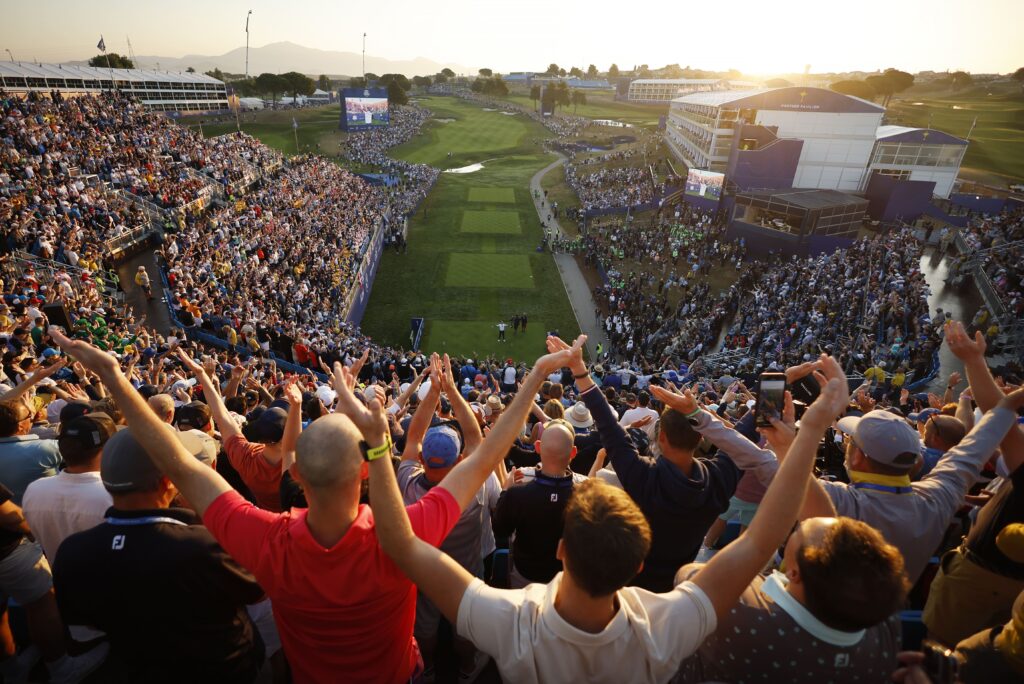
The Ryder Cup has become one of the world’s greatest sporting events. Every two years, 24 of the best players from Europe and the United States go head-to-head across three days of match play competition in front of hundreds of thousands of fans and an addressable global audience of more than 620 million households.
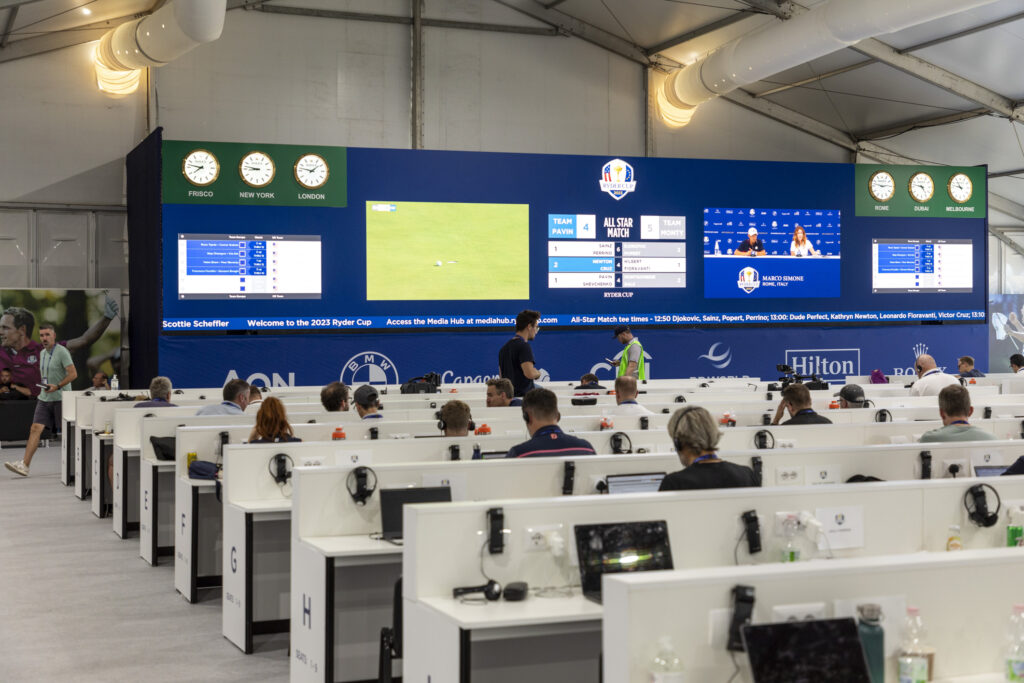
The 44th edition of the event was held at the Marco Simone Golf & Country Club in Rome from September 29th till October 1st 2023 and was under the spotlight perhaps more than any edition in recent memory. Italy were hosting for the first time and the event was played amidst LIV Golf’s challenge to golf’s established tours.
In addition to this wider context, and from a technology delivery perspective, iSportConnect’s David Fowler spoke with Michael Cole, the Chief Technology Officer (CTO) at the PGA European Tour to know more about his team’s work in a “technologically challenging” environment.
“Golf is arguably the most technologically challenging sport. There is not one single stadium to connect, but 18 fields of play spread across many acres. A mini smart city was essentially built from scratch in the middle of the countryside”.
“Our vision was to match the gladiatorial contest between the US and the Europeans inside the ropes with a rich amphitheatre of technology to match. The historical city of Rome meeting the technological innovation of the Ryder Cup”.
Helping to deliver on this vision were the event’s technology partners, such as Capgemini, HPE and CDW, who used their vast experience to shape a best-in-class technology experience.
Re-Imagining the Spectator Experience
Technology is perhaps more relevant in golf than many other sports because it can be challenging for spectators to understand the status of play across a vast competitive landscape. The challenge was to bridge the gap between armchair fan and on-course spectator.
“The genesis for the fan development I describe simply as three Es: Engagement, Excitement and Experience. Engagement through location-based services and targeting but importantly relevant rich media content. Generate the excitement through the delivery of new course features such as Match Probabilities and “Every Shot” commentary, and as they leave, ensuring their experience of the Ryder Cup was one of the best sporting events they’ve ever attended”.
“Great connectivity, enhanced navigation and interactive communications optimised the tournament experience enabling fans to spend more time watching golf, soaking up the atmosphere and immersing themselves in the unique experience of live sport, whilst enjoyed new features such as Shot Commentary and the revolutionary Outcome IQ technology, providing unique insights into matches never experienced before in the Ryder Cup”.
Spectator experience highlights:
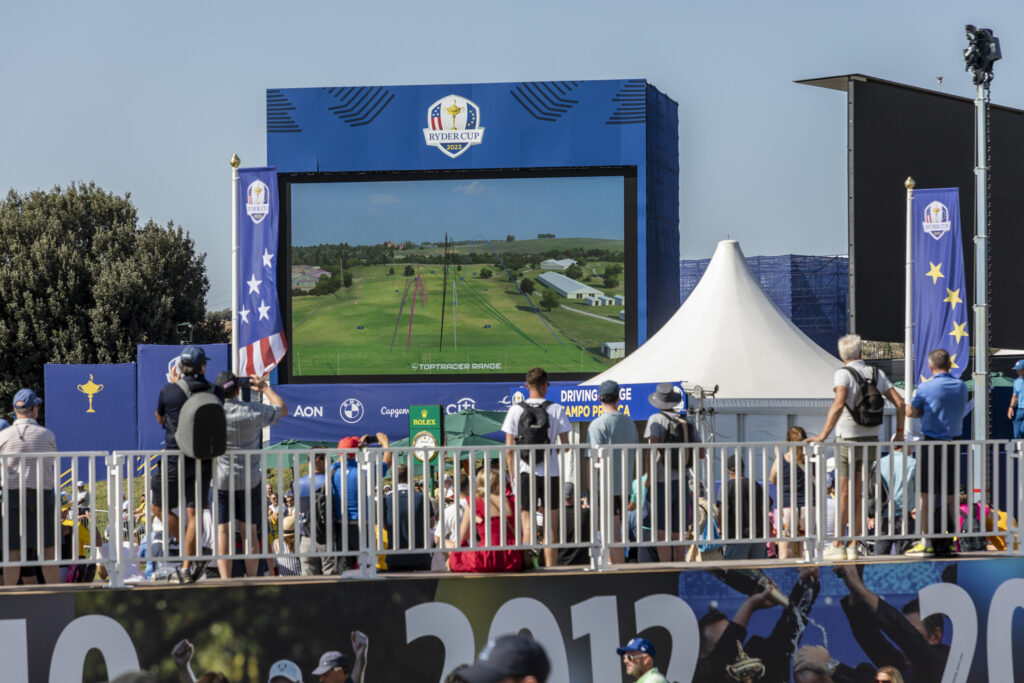
24 Large LED screens, with over 2,000m2 of LED (which was a 25% uplift versus 2018), and over 500 Digital TVs.
One of the first and definitely the largest deployment of WiFi6 for any temporarily-delivered major sporting event in the world – over 800 Access Points.
Launched Outcome IQ, which gave constant updates on who was statistically likely to win each match.
A shot-by-shot tracker on the mobile app with multiple data points (distance, number of strokes, resulting lie etc) to reach the fans across a series of Wifi hotspots.
Location-based insights to facilitate rich media push notifications to drive interaction on site by telling people when a player was on a hot streak, or showing merchandise offers.
Infrastructure intelligence drove an Occupancy indicator – where to watch, eat and buy.
Narrative for every shot displayed on the large on-course digital screens – customised feeds for every hole.
The Intelligent Course
The intelligent course was about collecting a number of data points from IoT devices to understand spectator behaviours, and generally empower smarter, data driven decision making in real time.
“Our technology partners ensured this Ryder Cup was the most data-driven ever by implementing a visualisation platform for multiple data sources across the course that created smarter real-time data driven decisions. Spectator flows and interactions with the venue for food, merchandise, grandstand seating were collected, analysed and visualised for both on-course spectators and the staging teams, generating behavioural-outcomes based on real insights”.
Intelligent course highlights:
The topology for Ryder Cup critically used edge devices to generate data sources and cloud-computing to surface key insights and intelligence, a true edge-to-cloud hybrid deployment.
The European Captains Dashboard was driven by key stats collected by a specialist team mobilised across the course.
Using the player locator app, fans could see where each match was via a map and check-out their latest scores at any time.
Spectator flows and interactions with food stalls, merchandise stores, and grandstand seating were collected, analysed and visualised via the edge-to-cloud Crowd Analytics platform.
Website features and digital screens across the site showed where to watch, eat and buy, and based on occupancy levels, how busy key areas were via a graded display system.
Hybrid Cloud network connectivity was at the core of this data-in intelligence-out digital experience, turning data into actionable intelligence.
Improving Connectivity
Best of breed next-gen technology networking infrastructure was leveraged to lay the foundation for connectivity with location-based services, Wi-Fi 6e (a first at a major sporting event) and a true environmental IoT platform (a first for Golf).
“The experience was a highly secure and frictionless onboarding, using a complementary range of services from wifi, cellular, satellite, 5G and LTE to optimise connectivity across the course, and an environment to deliver richer content on every device for every spectator”.
Connectivity highlights:
Utilising Wi-Fi 6e and a true environmental IoT platform, the experience was highly secure and at the same time, easier to get connected than ever before, using a complementary range of services from Wi-Fi, cellular, satellite, 5G and LTE to optimise connectivity across the course, and an environment to deliver richer content on every device for every spectator.
Three additional mobile masts for enhanced connectivity.
A private 5G network service creating two POCs – solar-powered Wifi and private 5G direct internet connectivity.
Satellite connectivity for areas where power was restricted, and microwave point-to-point where ducting wasn’t possible.
The infrastructure supported over 20,000 concurrent devices at its daily peak, and over 90 Terabytes of data across the Ryder Cup week, one of the highest volumes of data for any single venue sporting event.
Creating Operational Efficiency
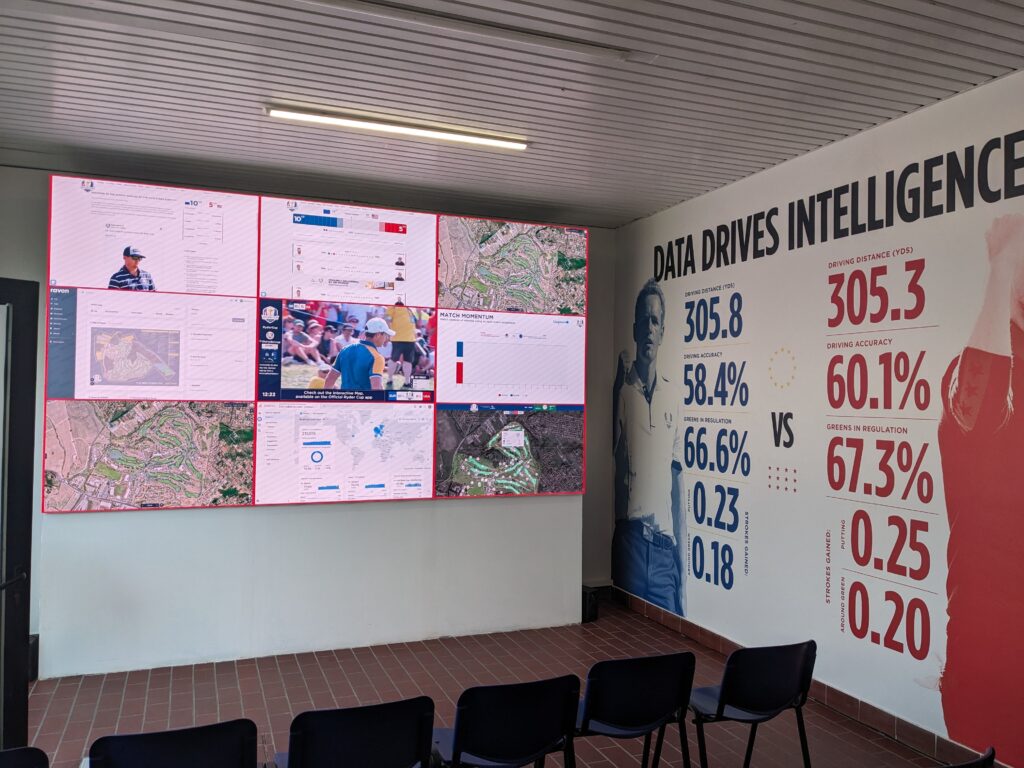
Michael’s team created sports first ever “intelligence wall” to manage tournament operations and monitor the fan experience.
“This enabled proactive monitoring of the technology across the course, and ensured robust deployment to ensure the focus of the fan and the world’s media remained on the gladiatorial contest inside the ropes”.
Operational efficiency highlights:
An IoT platform based on edge devices to cloud computing (a first in golf and possibly sport), with proactive monitoring of the technology across the course, ensured robust deployment and the focus of the fan and the world’s media remained on the action.
The IoT platform based on a range of IoT Environmental Sensors for remote and proactive monitoring of the IT infrastructure enabled the IT support teams to identify potential issues in advance and proactively manage them to optimise availability levels.
Also deployed was a platform for auto-locate functionality on an imminent release of software, fully automated integration of Access Point locations, as well as the integration for accredited personal for auto-wifi onboarding.
The Most Sustainable Technology for a Ryder Cup Ever
The core emissions of the event were offset, including all staging operations and player/ staff travel, with only fan travel excluded. There was also a big focus on fan engagement – educating and asking for their support to offset their journey to Rome via technology-enablement on the App. However, the ambition to deliver the most sustainable technology in the history of the Ryder Cup was more complex than simply implementing a carbon offsetting programme.
“Unifying fibre infrastructure, legacy re-use, solar-powered access points, power-efficient infrastructure, environment sensors and avoidance of single-use technology all contributed to the most sustainable Ryder Cup ever, and all being measured and monitored by a first-time launch of a revolutionary sustainability dashboard, measuring in real-time the carbon footprint of our IT infrastructure, graphically reporting carbon impacts, power consumption and energy costs”.
Sustainability highlights:
Free drinking water refill stations for fans across the site to reduce single use plastic waste.
All 117 BMWs in the courtesy car fleet were electric.
Programme to recycle/ reuse significant amounts of build materials.
550 Buggies on site – 240 buggies were tracked and monitored and run on solar-powered energy sources.
This Ryder Cup created the platform for a range of other sustainability initiatives, as part of the commitment to reduce the carbon footprint to zero by 2040, and a number of sporting firsts.
Ensuring Robust and Reliable Technology Delivery
An Olympic-type operational structure was deployed for the Ryder Cup, establishing a call-handling facility for triaging technology calls coming through from Incident Control.
In addition, given the threat of global cyber-attacks, a Security Operations Centre (SOC) was also established on-site, with a Cyber Incident Response team on stand-by for immediate action if needed. The SOC monitored an average of 175 million firewall session log records per day, and was able to actively block 143 malicious attempts from across the globe.
“The proactive structure of the technology operations proved incredibly successful, with the number of troubleshooting tickets raised for technology reduced from 84 during the 2018 Ryder Cup to just 40 for Marco Simone, a reduction of over 50%”.
A Record-Breaking Ryder Cup, Enabled by Technology
The 2023 Ryder Cup in Italy set new records across the board. A total of 271,191 people from 100 different countries attended the event in person, with millions more following the action from afar on television and digital platforms.
The event is scheduled to return to Europe in 2027 and, the rapid advancement of technology, will undoubtedly bring new opportunities.
“I expect connectivity to be better serviced as 5G matures and the team to potentially leverage a range of satellite services. AI advancements will also present opportunities to create further operational efficiencies as well as drive fan engagement”.
The 2027 Ryder Cup will come with its own technological challenges but for Michael and his team the guiding principles remain fairly straight forward, “It’s always a balance between how to use technology in a frictionless way while not distracting from the event and protecting the traditions of the game, for the benefit of all our key stakeholders”.
The SportAccord World Sport & Business Summit 2024 in Birmingham, West Midlands, announces its first wave of high-profile speakers for sport’s most influential industry gathering.
A total of seven leading experts, unveiled today, will address some of the biggest challenges and opportunities in global sport with over 1,500 delegates at Birmingham’s award-winning International Convention Centre (ICC) on 7-11 April 2024 under the Summit’s theme “The Power of Sport”.
The complete speaker line-up across the Summit’s Plenary Session and four streams – CityAccord, LawAccord, HealthAccord and MediaAccord – will be revealed over the next two months.
Summit’s stellar speaker line-up – first reveal
Chris Boardman MBE – Olympic gold medallist and world champion cyclist, and now Chair of Sport England and Commissioner of Active Travel England – will be speaking at the Summit’s CityAccord session.
“I believe we have a broader responsibility – to advocate for the transformational impact that sport and activity can have on the nation’s health and wellbeing.
“I’m looking forward to speaking with leaders from all corners of the world of sport in Birmingham next year at the SportAccord World Sport & Business Summit, where among other topics we’ll be looking at the impact that active travel can have in making our towns and cities more civilised and more prosperous.”
Boardman is joined by six distinguished experts who operate in various sectors of the global sports landscape. These experts, spanning host cities, Esports, sports medicine, sustainability, and athlete representation, will lead Summit sessions centred around the transformative impact of sport on society, emphasising its unifying potential and role as a force for good.
Melanie Duparc – Secretary General of World Union of Olympic Cities
Paul Foster – CEO of Global Esports Federation
Dr Margo Mountjoy – Clinical Professor and sports medicine specialist, Chair of ASOIF Medical and Science Consultative Group
Dale Vince – Chairman of Forest Green Rovers and Founder/Owner of Ecotricity
Ross Wenzel – WADA General Counsel
Brendan Schwab – Director of Schwab Legal and former Executive Director of World Players Association
Birmingham and West Midlands – outstanding host and location
Birmingham’s ICC is located in the centre of the city, less than half an hour away from Birmingham Airport, which has direct flight connections with more than 150 destinations worldwide. SportAccord’s high-quality official hotels and various dining, leisure and entertainment facilities are also within easy walking distance of the venue.
SportAccord President Uğur Erdener said: “Birmingham and the West Midlands are an outstanding host for the SportAccord World Sport & Business Summit. This is a city and region with a rich sporting history that is keen to build on the legacy of hosting the successful 2022 Commonwealth Games.
“With excellent transport links by air and rail, superb facilities and accommodation all highly accessible within a square mile of the Convention Centre, and a well-earned reputation as a hub of sport, entertainment and culture, Birmingham and the West Midlands are an ideal destination for SportAccord 2024.”
Andy Street, Mayor of the West Midlands, said: “After last year’s spectacular Birmingham 2022 Commonwealth Games, we were clear that we wanted that to be the start of a new sporting journey for our region – not the end.
“If we want to keep hosting the world’s biggest sporting events then showcasing our region to sport’s global decision makers is mission critical. That’s why this SportAccord Summit is so important and I’m delighted we’ve been able to pull it off.
“This is the first time the conference has been held in the UK for over a decade, and the last host – Australia’s Gold Coast – secured the 2032 Olympic Games. There is no question therefore just what a major coup this is for the West Midlands, and we now must ensure we make the most of the opportunity and use it as a springboard for our future.”
Leader of Birmingham City Council Cllr John Cotton said:
“Last summer’s Commonwealth Games cemented Birmingham’s reputation as a global destination with the venues, culture, hospitality sector and expertise to successfully host major events. As a famously friendly city, we can also guarantee a warm Birmingham welcome to all SportAccord World Sport & Business Summit delegates.”
Summit registration – opening soon
Registration for the SportAccord World Sport & Business Summit 2024 is set to launch shortly – stay tuned to benefit from the early bird rate.
FIBA has reached an agreement with Kuehne+Nagel to become its Official Global Logistics Supplier in a collaboration that will enhance event delivery and minimize its carbon footprint.
Kuehne+Nagel will provide shipment and logistical consulting services for an array of future FIBA tournaments spanning over the next two years. This will encompass the FIBA Olympic Qualifying Tournaments 2024 for both men and women, the next FIBA U17 and U19 Basketball World Cups for both men and women, the FIBA Continental Cup Qualifiers for men, and the FIBA Continental Cups in 2025 for both men and women.
The objective of the agreement is also to build a long-term partnership. This will support FIBA not only in the enhancement of shipping and logistical operations but also in the important ambition of further increasing sustainability and environmental performance by reducing FIBA’s CO2 footprint worldwide.
Kuehne+Nagel offers substantial experience in sports sponsorship, projects and partnerships. They are collaborating with the likes of SailGP and are also the logistics partners for both Team Germany and Team Great Britain at the 2024 Olympic Games in Paris.
Frank Leenders, FIBA Media and Marketing Services Director General, commented: “We are thrilled to welcome Kuehne+Nagel as our newest partner and this further strengthens FIBA’s Global Partner network.
“We are excited with this agreement since we appreciate the expertise Kuehne+Nagel brings to the table, and we know it can help us significantly with our efficiency and in our quest to become even more sustainable in what we do.
“FIBA is committed to reducing its carbon footprint by maximizing sustainability at all events, so we can be confident that through this partnership, we will see that happen.
“Kuehne+Nagel also have a strong track record within the field of logistics specifically for sporting events and we look forward to working with them to secure what we know will be some impressive outcomes,” Leenders concluded.
“We are delighted to be able to support FIBA as a Global Supplier with our logistics services. Our highly committed exhibition and event teams will ensure that all shipping and logistics processes run smoothly,” said Tobias Jerschke, Managing Director of Kuehne+Nagel in Germany. “After playing basketball for many years, I know that success can only be achieved as a team. The same applies to logistics.”
The International Cricket Council (ICC) and Prime Video have announced a four-year deal to provide exclusive live broadcast rights in Australia for ICC cricket, which will be available on Prime Video Australia.
The partnership will see Prime Video Australia exclusively stream all men’s and women’s events, including the Men’s and Women’s Cricket World Cups, T20 World Cups, Champions Trophy, U19s and the World Test Championship Final. The deal includes streaming rights in Australia for 448 live games from 2024 to 2027.
The deal follows the success of the ICC Men’s Cricket World Cup 2023 which broke a number of records culminating in Australia lifting the trophy. The biggest Cricket World Cup ever set new records for in-stadium attendance and broadcast viewership, whilst becoming the most digitally engaged event to date, showcasing that the appetite and demand for World Cup cricket is bigger than ever.
The new partnership, which begins in January 2024, will give cricket fans across Australia exclusive access to all matches in every tournament of elite ICC competition in all cricket formats, at no extra cost to a Prime membership.
ICC Chief Executive, Geoff Allardice said: “We are very excited to be entering a new four-year partnership with Prime Video for ICC cricket rights in Australia. The recently concluded Men’s Cricket World Cup has highlighted the interest and passion for ICC Events across the globe, and especially in Australia where cricket fans have enjoyed the recent success of their men’s and women’s teams. We look forward to working with Prime Video Australia to provide an innovative coverage of world class cricket to more fans in Australia.”
Head of Prime Video Australia and New Zealand, Hushidar Kharas said: “Prime Video has worked to create a single destination for audiences to find new movies, live sports, and their favorite TV shows. We are always looking for ways to deliver more value to our customers and live sports is consistently one of their top requests. We are thrilled to be able to offer our customers the live broadcast of the Cricket World Cup included in their Prime membership!
“The Cricket World Cup is one of the most viewed sporting events in the world; the recently concluded edition was watched by hundreds of millions of people! Over the next four years, Prime members in Australia will be able to watch their favourite cricket teams and players compete for the game’s biggest prize, on demand, on the device of their choice—exclusively on Prime Video.”
The International Boxing Association (IBA) has collaborated with the Instituto Superior de Derecho y Economía (ISDE) to unveil an educational initiative; the “Sports Management” course.
Designed to cater for athletes, officials, federation, and confederation staff, as well as other stakeholders in the world of boxing, this course is set to empower individuals with the knowledge and skills necessary for success in the sports management arena.
At its core delivery, this educational program seeks to offer retired athletes a unique opportunity to embark on a new career path following their boxing journey. IBA’s commitment to supporting athletes’ transition beyond the ring is reflected in the course’s priority enrollment for retired athletes. However, other boxing stakeholders are also welcomed to join the course based on initial availability.
The “Sports Management” course is structured into three distinct tiers: Tier 1 (basic), Tier 2 (intermediate), and Tier 3 (advanced). Each tier culminates with the issuance of a certificate, and successful completion of those respective tiers, grants students the eligibility to progress to the next level. Note that both Tier 1 and 2 will be conducted as distance learning (online), whereas Tier 3 will be a residential learning environment to take place in Madrid at the University. Students are required to complete the modules in sequence dependent on success at each level or stage of the course.
‘IBA is committed to delivering the best for its Family, and continuous professional development for our managers is one of the core tools to excel. With this Sports Management education course at ISDE, we aim to educate more qualified managers to serve the sport of boxing worldwide at all levels, be it clubs, National Federations, Confederations or the IBA. We are looking forward to offering new opportunities and the whole career path for retired athletes and supporting them on their journey. Such initiatives make our Boxing Family stronger, and I thank ISDE for such a great opportunity,’ IBA Secretary General and CEO Chris Roberts OBE said.