The Bottom Line: iSportConnect Business Index – February 16

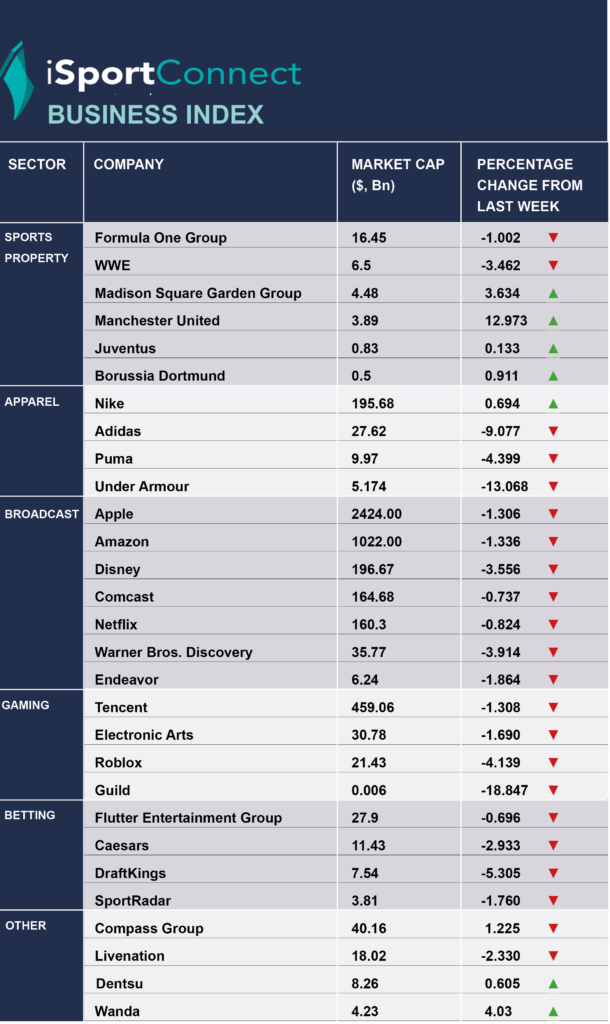
Welcome to this week’s edition of the iSportConnect Business Index, after last week’s gains the Index has generally struggled this week, with only seven of our Top 30, having a positive week. 

Let’s have a deeper dive into the stories of the week then:

Manchester United – +12.973%

You can’t keep them out of the news and since our last Index, the Reds beat Yorkshire rivals Leeds United 2-0, but that isn’t why their share price is on the up. Last Thursday it was announced that a group from Qatar would be interested in buying the club and their share price shot up as a result. 

The deadline for submitting bids to buy the club is tomorrow, Feb 17, and suitors from the US, UK, Saudi Arabia and possibly a certain Elon Musk might be preparing bids. It is thought that the asking price will be close to $6bn so why is their market cap stuck below $4bn, at $3.89 bn. Interestingly in the first edition of the Index back in January the market cap was at $3.72 bn. The interesting angle is that since the Glazers announced a formal sale the share price has gone up x2.5 times. I still think there is upside. 

Adidas, Puma and Under Armour all down

The whole sector has taken a hit this week. Last Friday, Adidas announced they were severing ties with Yeezy. It is reported by Bloomberg that they are sitting on between $1.2 and $1.3 bn worth of Yeezy stock ,and the dispute between Adidas and Yeezy may even cause Adidas to have an operating loss for 2023. From last week they are down 9.077%. These are really big moves.

Under Armour are down a huge 13.068% from last week despite a better than expected earnings report which showed the company beating earnings and revenue predictions for the holiday period. However the sell-off that occurred on Thursday was caused by investors being worried by a sharp increase in unsold stock that could have an effect on the company’s gross margin in the coming quarters.

Betting brands struggle

More bets than ever were placed on Sunday’s Super Bowl, by the looks of our companies share prices most of them were on a Kansas City win. FanDuel reported taking 50,000 bets per second at the game’s peak. Fascinating that despite this most of the share prices were lower. too much already baked into the price?

Our friends at DraftKings had to pay out $2.68 million to one lucky punter, but given the fact they staked a cool $1.68 million, I doubt they are short of cash.

Let’s take a look at this week’s Index:

SailGP and Rolex announce ten-season partnership

SailGP, the global racing league and Swiss watchmaker Rolex have announced a groundbreaking new ten season partnership which will see the iconic brand extend the relationship as the global presenting partner and as the exclusive official timepiece of the championship through to the end of Season 13. 

Rolex joined as a presenting partner from the launch of SailGP in 2018, which this May will reach the conclusion of a record-breaking third season before beginning an expanded fourth season this June. This partnership highlights the strong alignment forged between the two brands as the championship continues its rapid growth. 

As part of the agreement Rolex will become title partner for the Season 4 opening event – Rolex United States Sail Grand Prix | Chicago at Navy Pier – this June 16-17, 2023. 

Rolex will also continue as presenting partner of SailGP’s ground-breaking docuseries Racing on the Edge, which takes fans behind the scenes of the global championship, to look at the high’s and low’s of the sport’s top professional athletes in their pursuit to be the best. In its second season, Racing on the Edge has been watched by over 2.1 million viewers since its creation. The latest edition, featuring Australia’s Tom Slingsby and his team’s rise to the top of SailGP, can be viewed here

SailGP CEO Russell Coutts said: “SailGP is only in our third season and this long term partnership shows the value we are continuing to create for our partners. Rolex has been an integral part of the success of our championship from the outset and we are honored to continue this exciting journey together.” 

Rolex Director of Communication & Image Arnaud Boetsch said: “Rolex has long supported those who go above and beyond to drive innovation and positive change. The Swiss brand’s involvement with yachting stretches back 65 years, during which time it has forged deep-rooted connections with elite organizations and individuals at the forefront of the sport. The unrelenting pursuit of excellence, together with the marriage of human achievement and technical development, as well as the fierce team spirit required to succeed, make Rolex a natural partner of SailGP.”

SailGP’s third season continues later this month at the KPMG Australia Sail Grand Prix | Sydney on February 18-19, before heading across the Tasman Sea for the ITM New Zealand Sail Grand Prix | Christchurch on March 18-19. The season will conclude at the Season 3 Grand Final | San Francisco on May 6-7. Season 4 commences with the Rolex United States Sail Grand Prix | Chicago at Navy Pier, June 16-17.

Formula E and Tata Communications announce multi-year partnership

Formula E and Tata Communications have announced a strategic multi-year relationship with the global commtech company becoming the Official Broadcast Distribution Provider to the ABB FIA Formula E World Championship.

The new agreement will see Tata Communications deliver high-definition, high-resolution and high-speed live broadcast content to viewers around the world as part of Formula E’s new remote broadcast production of live races, reducing the environmental impact typical of major live international sports events on TV.

Tata Communications technologically advanced, software-defined media edge platform will deliver more than 160 live video and audio signals from Formula E races across continents within milliseconds, using 26 media edge locations across North America, Europe and Asia.

The new super-fast race broadcast distribution will be supported by Tata Communications specially trained experts, providing round-the-clock global end-to-end managed services at all 16 races this season. Tata Communications and Formula E are also working together to further enrich experiences for motorsport fans with innovation and efficiency.

Today, Tata Communications will be making history with Formula E as the ABB FIA Formula E World Championship races in India for the first time. Viewers around the world follow the action live as 22 drivers from 11 teams including Mahindra Racing, Jaguar TCS Racing, Maserati MSG Racing and NEOM McLaren Formula E Team compete in the 2023 Greenko Hyderabad E-Prix.

Jamie Reigle, CEO, Formula E, said:

“Formula E is an intense tour given its on-the-go nature. Tata Communications’ support over the years has enabled state-of-the-art remote production possible, with real-time TV signal transmissions from the race venues to our broadcast centre in London and finally to the audience’s screens. Thus, bringing down multiple logistical challenges, driving cost efficiencies, travel flexibilities for our employee, especially women, and reducing emissions.”

A.S Lakshminarayanan, MD and CEO, Tata Communications, said:

“There are 85 cameras capturing the event for over 400 million people watching all over the world. To be able to facilitate that truly speaks about the power of internet that we have been able to leverage, with our dedicated media cloud and edge computing capabilities. And apart from our long-standing partnership with FIA, we extend the services to multiple major sporting leagues across the world.”

Member Insights: Beijing 2022, a year on – The prelude to war & The Olympic Games in an era of constant crisis and change

In this Member Insights article, Michael Pirrie examines the legacies and impacts of the Beijing 2022 Olympics in the countdown to the war on Ukraine.

There is a distinctive emotional weather front that accompanies the arrival of the Winter Olympic Games.

This includes high and low pressure zones of anxiety, excitement, and uncertainty in the cold pre-dawn mornings and shortened days that precede Games competition.  

Danger can lurk ominously, hidden beneath snow and ice.

A practice pirouette can break an ankle and a blossoming career; a final training session can end in tragedy and cost you your life  – Nodar Kumaritashvili, a young Georgian luger, died on a rehearsal practice run just hours before the Opening Ceremony of the Vancouver 2010 Winter Olympic Games.

The scale of the threat confronting the world’s best winter athletes and organisers of the Beijing 2022 Games is clearer a year on from the historic event.

The enormity of Beijing’s challenge was grimly illustrated by China’s soaring Covid death toll following the recent lifting of the world’s strictest lock down.

The external forces that shaped Beijing’s global winter spectacle are also clearer on the first anniversary of the Games as the political snow cover continues to dissolve

The Beijing Winter Games marked a new era of super power sport and politics.

Much of the spectacle was delivered on mountains of machine-manufactured snow, giving organisers a level of control over sport and climate matched only by Qatar’s refrigerated desert football world cup stadiums.

The political climate was more difficult to control.

A diplomatic cold front formed over China’s capital in response to more revelations of human rights abuse, while Chinese fighter jets also scrambled Taiwan’s air space in the countdown to the Games, forcing Olympic peace doves to find alternative flight paths into the host city.

The Beijing Games challenged sport’s status quo as well as athletes.

The Communist Party’s focus on total pandemic and political control chipped away at traditional Olympic freedoms and values.

The diplomatic boycotts also forced governments and international audiences to take sides over China’s controversial human rights record.

The political climate in China meant the voices of athletes were quieter on podium platforms and in the mixed zones.

Beijing’s legacies are more complex a year on, complicated by the close relationship between the Chinese and Russian leaders and subsequent war on Ukraine.

While London took the world from war to sport at the 1948 Olympic Games following the devastation of World War Two, Beijing 2022 formed a backdrop to Europe’s first major war this century.

Western intelligence reports indicate Putin may have delayed the invasion of Ukraine until after the Games in a concession to Chinese counterpart Xi.

While the delay gave Russia – and other Olympic nations – time to get teams home from Beijing before troops invaded, the postponement also avoided an international crisis which could have stopped the Games, seen as vital to Xis historic third term campaign for leadership of China.

Beijing 2022 framed the war on Ukraine – from the meeting between Xi and Putin on the eve of the opening ceremony to the commencement of the invasion just days after the Games.

Devastating invasion images quickly united the international community, challenging governing bodies and federations to respond in meaningful ways that reflected the gravity of the situation and sport’s position of influence.

The Ski Federation of Norway was one of the first to respond: “Sport is not detached from this (invasion) and cannot remain passive to what is happening now,” the federation said.  “The Norwegian Ski Federation’s message to Russia and Russian athletes is crystal clear – we do not want your participation.”

Beijing was constantly tense and threatening  – just a two hour flight from the Wuhan epicentre of the pandemic that had crushed the world.

Those risks began to subside as China’s closed loop system moved into overdrive and locked out the virus.

Beijing’s biosecurity bubbles and barriers minimised human contact and infections. 

The loop’s strict isolation and quarantine requirements also overwhelmed several athletes, and organisers scrambled to provide more food and shelter on mountain locations.

Athletes cut through the Covid and geopolitical gloom as Games services and operations became more familiar, finding rhythm and routine.

Electrifying performances generated an overlay of hope and meaning, sought increasing by audiences from sport in uncertain times.

Peggy Noonan, acclaimed speechwriter for late US President Ronald Reagan, once observed that “the bravest things we do in our lives are really known only to ourselves.” 

If so, the Olympic Games brought uncommon bravery to global attention.

Few showed more valour than the young Georgian luger Saba Kumaritashvili, who made good on a profound personal promise to compete at the Olympic Games on behalf of his cousin, Nodar, fatally injured at the Vancouver Games. 

Saba transformed a family tragedy into a towering triumph of the human spirit, realising the Olympic dreams of his beloved cousin 12 years after Nodar’s death. 

“Thinking about him (Nodar) is painful but gives me strength as well,” he said.

The key themes have also come into sharper focus from Beijing as the ‘Gender Games’ – the high impact story lines of many women athletes compelling, relevant and enduring a year on.

They include: 

·     The teenage ski sensation, Eileen Gu, who bridged the growing super power divide between her birth nation of America and Chinese ancestry, with grace, style and almost faultless performances. 

·     The ‘Little Girl Lost,’ teenage Russian skating prodigy Kamila Valieva, who has probably spent more time on the ice rink than in school exams; caught up in an international doping scandal at the Winter Olympics, only 4 editions of which she has been alive for.

·     Fallen but unconquered US world skiing champion Mikaela Shiffrin, who inspired in defeat. Despite failing to win any of the many medals expected of her in Beijing, Shiffrin recently tied for the most medals in Alpine skiing world championship history.

·     The mysteriously lost, found and gone again former Chinese Olympic tennis star Peng Shuai. 

Beijing was a Games of improbable Olympic outcomes.

US snowboarder Lindsey Jacobellis was an Olympic time traveller, who turned a haunting error from her past into a gold medal 16 years later in Beijing.

This was an uncommon story of self-belief and perseverance steeped in Olympic mythology. 

After a last minute swerve robbed her of first place at the Turino Winter Games in 2006, Jacobellis secured Olympic gold in Beijing at her fifth Games attempt.

Beijing also reinforced truisms for major sporting events in turbulent times, especially the interdependence between high performing venues and high performing athletes. 

Giant decommissioned cooling towers formed the surprise post-industrial backdrop to Beijing’s Big Air venue – the most compelling sports setting of 2022.

HIGH FLYERS

Athletes became new aviation pioneers, blessing themselves before launching so high off the slopes on snowboards that a pilot’s license, oxygen mask, and parachute might otherwise have been required for a safe landing.

Fellow boarders waited below to welcome their high flying colleagues back to earth, embracing fellow frequent flyers on landing, composing a new, more youthful image of Olympic sport following surfers and skateboarders from the Tokyo Games just months earlier.

The industrial towers produced high impact global viewing experiences prized by high paying broadcasters, while showcasing stunning sporting images for international federations and world governing bodies.    

RISE OF SMALLER NATIONS

Winter athletes from unlikely destinations in tropical Oceania succeeded against the odds and the weather.

These included two snowboarders from New Zealand who provided a new movie script for local Hollywood Lord of the Rings director Peter Jackson.

The athletes soared high above middle earth to capture their nation’s first two winter gold medals in 70 years, creating a new fellowship of the rings.

CONCLUSION

The Olympic Games in Beijing, like Tokyo, must be seen largely through the prism of the pandemic.

If the primary threat to the Games and the athletes was the pandemic, Beijing was successful with infection levels amongst the lowest in the world

The sports venues, services and operations were organised at a high level amid the most dangerous conditions encountered in modern sport 

While the Pyeongchang Winter Olympic Games generated unlikely gestures and overtures of peace on the heavily nuclearised and politically divided Korean peninsula four years earlier, the Beijing Games was less optimistic in tone and outlook

Beijing 2022 delivered high impact sporting performances and drama in one of the most politically charged environments of modern sport.  

The Beijing Games pointed to new geopolitical challenges and uncertainties for international sport in a rapidly changing and divided world.

This was highlighted by IOC President Thomas Bach in his Beijing ceremony addresses, observing that “division, conflict, and mistrust are on the rise.” 

The Beijing boycotts demonstrated that strong international support is needed for cities and governments to host Games that engage and relate to the world.

While the diplomatic stand offs were condemned and dismissed by China, the boycotts widened the spotlight on China’s human rights record and further challenged its international image.

Along with Beijing, Almaty, the biggest city in the former Soviet Republic of Kazakhstan – where government shoot-to-kill orders were issued in recent times to crush protests – was the only city that completed the bidding process for the 2022 Winter Games.  

The Games did not produce the legacy of international respect and recognition sought by the Communist Party of China for Beijing, as the first city to host the winter and summer Olympiads.

China created a new modern day ice-age for winter sports in Asia built on mountains of artificial snow

While the Beijing Games was the catalyst for a new international winter sports destination, the subsequent war launched on Ukraine by China’s ally has had a more dramatic impact on world sport.

Devastating daily images of the suffering inflicted by Russia continue to test of sport’s capacity to respond authentically to the crisis.

While Olympic stakeholders seek a credible pathway to bring Russia back into the fold for the Paris Games, opposition to Russia’s Olympic return is hardening due to the unrelenting brutality of the invasion.

Russia’s war also continues to disrupt nations and cities involved in the initial application process to host the 2022 Winter Games.

These include especially, Poland, which became a haven for Ukrainian refugees, and Sweden.

And in one of the harshest of modern historic ironies, Lviv, Ukraine – now fighting for its survival – also applied to host the world’s foremost sporting event dedicated to peace, the Olympic Games in 2022, delivered by Beijing, Russia’s ’no limits’ partner!

Michael Pirrie is an international communications advisor and consultant who has worked in senior positions on major global sporting events and campaigns. These include the London 2012 Olympic Games, Brisbane 2032 Olympic Games bid, and the Invictus Games. 

Ear to the Ground announce new US Webinar

Future of Fandom: How can brands tap into the global explosion in fandom of the major US sports leagues?

The power of listening: LIVE From the All Star Weekend in Salt Lake City

US Sport popularity is on a global upward trajectory – How can brands take advantage of this and which brands are already smashing it. Ear to the Ground are a global agency with global opinions from their Fan Intel network – we can help your brand understand how you can tap into this growing market.

Global Fan Intelligence® Network Members will join our own experts to share their opinions on the topic and the opportunity for brands.

Join us from 4PM GMT (11AM EST, 8AM PST) on Friday 17th February.

https://us02web.zoom.us/webinar/register/WN_hJ0B5H5ASyeYNXwwkcIN6A

How can you make your event more sustainable?

The demand for a more sustainable approach to organising events is increasing. As an event planner, you have the ability to make significant changes in your field, because let’s face it, change is in your own hands. What options do you have for a more environmentally friendly event?

Read on to discover several ways in which you can introduce sustainable initiatives into your upcoming event:

Reuse

  • Encourage guests to bring reusable water bottles that they can refill throughout the day. This reduces the amount of waste produced by attendees.
  • Badge holders, lanyards, notebooks and pens are just a few items that can be saved and reused at future events rather than thrown out.
  • Use recyclable materials when creating branded items for the event or create branded items that are not event specific and can be used at multiple events.

Zero Waste

One of the major problems is the event location itself. Choose an event location that is committed to clean energy and take measures to reduce waste.

Reduce the amount of waste generated by your event and its attendees by providing composting for uneaten food and sourcing recyclable materials to use.

Zero waste requires a closed loop. Products should be reused and recycled rather than discarded, burned, or dumped. Waste is inefficient and does not fit into this cycle of sustainability.

Travel & Food

Encourage guests to use public transportation or hire shuttle buses from the accommodation/airport. You could even take it a step further and provide a sporty alternative, such as cycling. This is especially appropriate for hospitality programmes during a city trip.

Say goodbye to meat and instead provide more sustainable catering, such as vegetarian or vegan. Meat consumption is one of the leading causes of CO2 emissions, so limiting suppliers who only offer meat-based meals will reduce the event’s carbon footprint.

Buy and use materials, food and drink from local suppliers and businesses in the community of the event’s location.

Go Digital

An easy way to make a big impact is to go paperless. Instead of sending out physical invitations, send an email invite, or create an event page on social media. Not only does this reduce your footprint, but an event page also allows you to easily communicate with guests. A last-minute change? No problem, it is easily adjusted online!

Following the online invitation, you could create an online registration platform that is paperless and cost-effective. Send registration notifications via email, followed by an e-ticket that can be scanned from smartphones.

Printed invitations, maps, and tickets are a thing of the past. Mobile apps and websites are a much more environmentally friendly way to interact with guests before, during, and after an event.

Article written by ATPI, click here to find out more about the work they do

Meet the Member: “We are trying to short-circuit our growth path as a sport. That is a real challenge”

Last weekend Formula E held their first race in Hyderabad, one of a number of new cities they are racing in this year. Before he flew out to watch the race, Strategy Director Harry Browne sat down with our Content Manager Alex Brinton to talk about the new season of Formula E and where the sport will be in five years time.

To start, let’s take it back five years. What was it about Formula E that so attracted you and made you join the business from Altman Solon?

I was in strategy consulting at Altman Solon for about five years. It was an environment where I learned a hell of a lot, it was quite high pressure and had a lot of tough deadlines. I found that jumping from one business to another was not giving me a lot of in-depth experience. That is why I wanted to go in-house, to get stuck in and take some real ownership. 

The opportunity came up to work in Strategy at Formula E, and it was a really exciting one for me because the subject matter is so interesting and the opportunity and room for growth was massive.

Season 9 of Formula E has just started, how has it changed in your time there?

Over the time I have been here investment in the team has increased a lot, and with that expectations and standards have as well. We have really good people who are subject matter experts in their discipline.

That also means that the focus of my role has shifted a bit from leading on a lot of projects to now making sure that the company is all pulling in the same direction.

In terms of the business of Formula E, the popularity and audience has grown hugely, as has the revenue generation, especially from sponsorship. 

On track, we are now onto our third generation of cars. When I started the GEN1 cars would only last half the race and then the drivers would have to get out and swap. With each iteration the technology has moved on a great deal, and that has allowed us to do more with the racing product as well.

As we just touched on, Season 9 is just getting underway, what’s new this year?

The short answer is lots! It was the busiest off-season since I started.

We have a new GEN3 car, which is a massive step forward in terms of performance (capable of 200mph top speed) and is the most sustainable electric race car ever. We’ve got new venues: we’ve just raced in Hyderabad, India, next up is Cape Town, which will look fantastic. And then Sao Paulo, which is going to be great. Brazil is obviously a huge racing market, so we are really excited to go there. And we also go to Portland in the US for the first time later on in the season. We also have new teams, McLaren, Maserati and Cupra have all joined bringing huge motorsport pedigree.

Another element of the new car is that it is compatible with fast charging. So that is something that we are looking to implement during the season, and with that an update to the ruleset needed. 

Finally, we have a new website and app, and have also been through a whole new brand refresh. The update has a far more entertaining feel and positions us as more of a challenger brand, whereas before if you were being critical you could say that we were coming across as a bit clinical.

So yeah, a lot has changed!

What are the particular challenges that are facing Formula E at the moment?

Firstly, with all those changes we really need to work to maximise each of those opportunities. We really need to make sure we nail every point on the implementation and use data to help us do that. 

Secondly, what we are trying to do is to short-circuit our growth path as a sport, that is the real challenge. Most sports take decades to grow and mature; we are only in our ninth year and we are striving to become a tier one sport. The UFC and perhaps the IPL are the best examples in recent years, but not many people have been successful trying to do what we are doing. 

We have all seen the extra attention that Formula 1 has got as a result of Drive to Survive, is this something that Formula E is looking into?

Drive to Survive has been a massive success for Formula 1, you only have to look at how much the sport has grown in the US in that time. It has also recently spawned a few sports doing similar with Break Point for Tennis and Full Swing for Golf. For it to be a success obviously the content needs to be great to cut-through, but also you need the right platform partner, promotional strategy and the content needs to fit with the strategy of what you are trying to achieve as a rightsholder.

We have been experimenting with our series Unplugged, which is a behind-the-scenes look at the sport, telling the stories of some of the teams and some of the drivers. As a sport that is so young we are highly agile so we can change things depending on what hits and what doesn’t.

Obviously with an electric sport it is important to be as sustainable as possible and you announced that you were Net Zero Carbon since inception in 2020, how difficult was it to get there?

It has always been so ingrained in the company that we have to set the standard when it comes to being sustainable that it was a natural to become Net Zero Carbon. As a company we are acutely aware of where our emissions are coming from and what we need to do minimise them. Becoming Net Zero Carbon was actually more of an extension of what we were already doing than actually changing a lot of practices in order to achieve it. 

We also work with our partners to run local initiatives, including UNICEF and DHL. We want to make ourselves as sustainable as possible, but we also want to make a difference to the communities in which we race through smaller, local projects, for example making drinking water readily accessible in Mexico with the help of UNICEF.

There are so many ways in which you can engage fans digitally, how are Formula E evolving in that space?

Firstly, we have had a complete overhaul of our website and app. We took a step back, looked at all the user journeys and the experience fans would get and then re-designed them with that in mind. We also introduced some gamification elements to the website to keep people coming back again and again. 

Secondly, we want to create really fun and engaging content on third party platforms. TikTok has been a great success for us this year, we are up 600% on last year. It is a great example of a platform where you can be more playful with the brand and show a funny, offbeat side to the sport.

Also when it comes to the licensing side of the business we are definitely looking at more games and products to try and introduce Formula E to a new audience. 

Looking forward then, where do you see Formula E in five years time?

As I mentioned earlier our goal is to become a tier one sport. I think we can achieve that in five years but we will have to be really on it and nail our execution to get there. First and foremost we need to ensure our race product is top-tier, so that when they watch it once they want to come back again and again. If we rewind to two years ago, we completely overhauled the qualifying format. We went from a groups-based system to a head-to-head knockout system, and our qualifying audience increased 50% – it shows the power of making a positive change to the product, and it’s amazing the impact that that can have.

Fundamentally, we need to get the best teams and manufacturers with the best drivers racing in the best locations with the best coverage around that. That’s how we will become a tier one sport.

SEG3 to fuel Sports, Entertainment & Gaming businesses web3 ambitions

Web3 Media Group today announces the first global summit part of its portfolio, the SEG3 Summit.

With the continued blurring of sports, entertainment, gaming and wider culture, the opportunities and challenges web3 and immersive technologies offer are becoming universal across these industries.

Due to that fact, the successful Web3 Summit held in 2022 has been rebranded to SEG3, with the 2023 edition expanding its scope to now also meet the needs of the entertainment and gaming communities, as well as sports.

The summit returns to the Emirates Stadium, London on 28th & 29th June 2023, and will address key themes including:

  • How to futureproof your brand in a web3 world 
  • How to engage and grow a web3 native community through storytelling
  • The impact of the creator economy on content creation, distribution and monetisation
  • Building immersive experiences, and its impact on traditional activation 
  • Raising investment in a bear market, and how to structure the agreement to get the best deal
  • The building of the open metaverse, and the opportunities associated to a interoperable digital identity

Full agenda and industry-leading speakers to be announced in early March.

“We’re really excited to be building on the successes of our inaugural web3 summit in 2022, and feel strongly that by widening the scope of the event, we can play a small part in helping these industries to flourish in the coming years as they look to reimagine their brand, relationship with their audience and revenue models through web3 and immersive technologies” said Co-Founder & Managing Partner of Web3 Media Group, Joe Condon.

Click here to visit the SEG3 website

Sportel Bali announce event programme

An engaging series of Masterclasses and Presentations will take place at the inaugural SPORTEL Rendez-vous Bali international market and summit being held from 23 – 24 February 2023. 

Sessions will dive into trends shaping the future of the sports media and tech industry and provide thought-provoking discussions led by influential sports business executives. The international blend of culture and experience, includes speakers from Indonesia, Asia, Europe, North America and beyond.

Attendees will gain vital insights to complement their meetings during the two-day market and exhibits, to evaluate and help make informed decisions when evolving their business strategies which unlock potential new revenue streams.

Monaco meets Indonesia, with Louis Ducruet, nephew, and Official Representative of SPORTEL’s Honorary President H.S.H. Prince Albert II, joining Laurent Puons, SPORTEL CEO, and event host, Transvision’s President Director Peter F. Gontha, who will officially open the event together on the morning of 23 February.
 
A scene-setting panel “Asia the Big Picture’, in collaboration with SportBusiness’s Kevin McCullagh, will feature Asian sports media industry leaders, including EMTEK’s Sutanto Hartono, SPOTV’s Mitch Hong, AFC’s Andrew Rogers and IMG’s Tom Broom, who will share their expert insights on the state of the industry today, how it got here, and where it is heading in 2023 and beyond.
 
“The “Asia the Big Picture” panel will be an excellent opportunity for AFC to share and debate with industry colleagues the major trends and challenges shaping the future of sports business in APAC and beyond”, said Andrew Rogers, Director, Commercial, Asian Football Confederation (AFC).
 
Another star-studded panel shining the spotlight on “Asian Audiences Embracing International Football Properties” will highlight how European and global properties have established their brands within the region, by expanding digital footprints and working side by side with broadcasters to enhance fan experiences, while adapting to sometimes challenging live sports scheduling times.

The stellar line-up includes FIFA’s Paul Calder, Serie A’s Anna Guarnerio, Bundesliga International’s Peer Naubert and Pitch International’s Henri Kamerling, and will be hosted by SportBusiness’s Imran Yusuf.
 
“This season marks the 10th anniversary of Bundesliga International’s office in South East Asia, and a perfect time to reflect on the lessons we’ve learned, as well as the plans for the future, as the Bundesliga fanbase continues to grow rapidly in Indonesia and across Asia.” announced Peer Naubert, CMO Bundesliga International.
 
Changing gear, Dorna Sports, Alex Arroyo, will share how MotoGP is “Revving up the Motorsports Experience” with Fox  Sports Adam Howarth and Telkom Indonesia’s  Dedi Suherman discussing the massive popularity of motorsports across the region. Harmonic’s Alexandre Paugam will also present a case study along with partner WRC Promotor and Philipp Maenner, titled “Accelerating Motorsports Global Reach with Rally.TV.”

The explosion in women’s sports and the importance of regional focus and innovation, will highlight how “Culture and Diversity are Shifting the Direction of Sports Media in Asia” and will be addressed by executives including, Reddentes Sports & Redd+E’s Mark Chew, RCTI’s (MNC’s) Dini Putri and Sportfive Asia’s Karen Lay and moderated by Magnifi’s Meghna Krishna who will look at best practices and shifts within the region.
 
Asia is the world’s biggest esports market, with a notable explosion in mobile esports and the sector is brimming with opportunities for savvy media companies that truly understand the space.  “The Future of Esports in Asia “panel, will be brought to you by SportBusiness’s Callum McCarthy and includes some of the most game changing organisations in Asia such as ESL Faceit’s Roland Lam, Moonton’s Martinus Manurung and Reddentes Sports & Redd+E’s Ren Kai Yip.
 
“The Esports scene in Asia has seen a rocketed increase in popularity over the years, especially during the COVID period. Now that Asia has came out of the pandemic and many sporting events return, there will be added competition for eyeballs and an increasing spotlight on what opportunities Esports can offer to the market.” commented Ren Kai Yip, Managing Director & Co-founder, Redd+E Pte Ltd.

Turning to tech, WSC Sports Guy Port, will illustrate how they are “Delivering Video Fan Experiences with AI” and how it is increasingly playing a critical role from personalized content to virtual and augmented reality. The tech theme continues with a panel looking at the current state of “The Cloud AI, NDI & Sports” as well as a debate where things are headed. The panel will be led by GSIC’s Raj Sambwani who will be joined by Snipitz’s Denny Darmo, Magnifi’s Meghna Krishna, and Ideal Systems, Fintan McKiernan.
 
The “OTT Streaming & FAST Channels” panel will focus on the FAST TV channels trend and how the model benefits sports content owners and broadcasters. The expert line-up includes Vision +/ MNC’s Clarissa Tanoesoedibjo, Origins Digital’s François d’Azemar and OTTera’s Stephen Hodge and moderated by SoFAST’s Sandrine Durand.
 
“SPORTEL Rendez-vous Bali will be the perfect opportunity for us to share with the international sports community, the opportunities in the OTT and streaming space in Indonesia, as well as MNC’s Vision+ role in the development of the media ecosystem.” said Clarissa Tanoesoedibjo, Managing Director, PT. MNC OTT Network (Vision+)
 
“I’m honored to be part of a diverse panel that brings together voices from many different backgrounds, genders, and ethnicities. It’s incredibly empowering to see how our collective experiences offer insight, encouragement, and represent the wonderful diversity that our world has to offer.” Stephen L. Hodge, Chairman & CEO, OTTera

A new concept for the conference programme will see the introduction of a “Pitch Session” featuring selected innovative newcomers to SPORTEL who will present quick fire pitches in front of a jury and event attendees.