The House View: Why we should make the TV license an NFT

I recently received my bill for my UK TV Licence of £164 for the year. It comes from the TV Licensing Authority. It doesn’t actually say BBC on it, but TV Licencing Authority is one of the BBC’s trade names. 

Basically the bill is for the right to watch live TV (any channels, not just BBC) and use the BBC iPlayer. I’m not going to get into the question of why I should pay a fee to watch live ITV or Channel 4 and have all the money go to BBC. It certainly didn’t help them get the Masters golf tournament I tuned in to watch last month only to find out they didn’t buy it. As for iPlayer as a stand-alone, it works out to £13.67 a month, twice as much as Netflix. Say no more.

Not subscribed to our weekly newsletter? Click here to sign up and receive more content like this to your inbox every week. 

My favourite BBC moment is when the news does ‘what the papers say.’ Hold on, I pay you so your TV channel can tell me what’s in the newspaper? How about I get to keep my £13.47 and I buy the papers myself if I feel like it?

But enough levity and I am not beating up on BBC (life without the Eurovision Song Contest isn’t worth living). I have a serious point to make. Isn’t the TV Licence a perfect example of something that should be an NFT? (As much as I hate that term NFT, we seem to be stuck with it for now.)

In fact, a TV licence is already a ‘token’ (to use the lingo of the Web3 rabbit hole). Now BBC needs to tune in some technology and create products for younger audiences and a market changing too fast for comfort. 

Instead of just compelling people to give them money for their token, they should be creating genuine loyalty by personalising it and building in some real utility beyond the feeble offer of ‘I get to watch live TV and use the iPlayer.’ They can build authentic, engaged BBC communities (instead of one big compulsory one including many disgruntled citizens thereof).

I even have a name for the BBC NFT. 

Sacred Cow.

Sorry again, I’m not really talking about the BBC but any company that sells TV subscriptions. The old pay business model is worn out. Media companies need to be offering new experiences, more value. 

There are so many ways for content providers to do this with blockchain. There’s a whole new Web3 world emerging out there as the boundaries blur between sports, entertainment and gaming. And it can generate more revenue than plain vanilla subs. 

They may not see it this way, but the BBC has a history of investing in NFT-type content. Years ago I visited the BBC Special Cameras Unit. It was a place where they had a bunch of boffins building wacky camera devices just like Q in James Bond movies. The whole purpose was to improve the viewer’s experience of the Olympics. 

That is value creation. Build that kind of innovation into an NFT. Make your TV Licence an entry pass to the metaverse. Shift the BBC brand from living in the past to the future, from yesterday to tomorrow.

I mention Special Cameras, but we are talking about something a lot bigger. BBC and kindred organisations will need partners. One of the things that has characterised public broadcasters over the years is a perceived need to do everything in-house. That won’t cut it anymore. Web3 is about maximum collaboration. 

Partnerships will define the evolution of Web3 (and generative AI). That is the whole rationale behind SEG3: Sports Entertainment & Gaming taking place at Emirates Stadium in London June 28-29. Learn what others are doing and connect. Find out more here.

It’s entirely possible that in-house boffins at BBC (if they still exist) are already working on their NFT. Let’s hope it’s so good that the thing becomes voluntary.

By Jay Stuart, Content Director iSportConnect.

The View From Asia: How is institutional finance playing a role to grow Sport in Asia

In his second View From Asia column, Unmish Parthasarathi (Founder & Executive Director of Picture Board Partners, a Singapore-based strategy & ventures boutique), shares examples of how Venture Capital, Private Equity, and Sovereign Funds are making a play to serve the next billion fans.

The last 24-months have been notable for the variety of sports investments in the US and Europe, be it Private Equity (CVC/Six Nations), Venture Capital (Sapphire/Overtime, Buzzer), Strategics (Endeavour/WWE), Sovereign Funds (PIF/LIV) or Family Offices (Walton-Penner/Denver Broncos). In this article, I cites five trends with ten examples across a dozen markets that promise returns due to a positive demographic dividend, a growing supply of talent, and, rising per capita incomes. 

Trend 1: The situation in Asia is similar but different with notable patterns often seen in the West a decade ago:  

  • Cheque sizes reflects the gap between current value and future potential as leisure in the cities matures; 
  • VCs were the first movers from the period before the pandemic with PE making a play more recently; 
  • Sovereign Funds and Family Offices are few & far between, but are curious about rends in the West. 

Not subscribed to our weekly newsletter? Click here to sign up and receive more content like this to your inbox every week. 

Trend 2: Venture Capital has been led by growth stage investments followed by a more thematic approach:  

In May 2021, Dream Capital  invested $50 Mn in FanCode, a next-generation digital platform that combines live streaming a la DAZN with match day editorial akin to ESPN.com and a Fan Shop. Dream11, a fantasy sports platform used by 180 Mn fans, raised $840 Mn in late 2021 at a $8 Bn valuation backed by Redbird Capital, Falcon Edge, Tiger Global et al. The other big-cheque recipient is FanCraze, the official digital collectibles partner of the International Cricket Council (ICC). In April 2022, it raised $100 Mn from New York-based Insight Partners (an investor in Calm) and Singapore-based B Capital, co-owned by Facebook co-founder Eduardo Severin and Raj Ganguly of Bain Capital. 

Trend 3: Seed/Pre-Seed stage investments are being led by the largest global sports federation in the region.  

In mid 2021, Tennis Australia (TA) launched WildCard Ventures, a fund focussed on Sport, Health and Entertainment with their IC (Investment Committee) includes the CEO, CFO and General Counsel of TA. In early 2023, TA launched AO Startups, focussed on three experiential areas (Athlete, Event, Racquet Sports). Such initiatives by a globally-recognised federation based in the region can be a possible playbook for other Asia-based/focussed federations in Cricket, Badminton or Table Tennis. 

Trend 4: Much like in the West, PE plays lagged VCs in Asia but has made a notable presence when it did. 

In early 2021, CVC paid ~$740 Mn to buy the Gujarat Titans, one of two new franchises brought to market by the IPL. Valuations sky rocketed for two reasons – a scarcity premium as the IPL hadn’t expanded beyond the eight franchises at launch in 2008, and the assured annuity payments from a $6 Billion media rights deal that made the IPL the world’s second most valued league, at $15 Million per match, after the NFL. 

In late 2021, Affinity Equity Partners committed $150 Mn to Vidio, an OTT platform owned by the Emtek Group, a market leader in Indonesia. Premium sports rights, such as the English Premier League and the FIFA World Cup have been key to Vidio’s brand development and user acquisition. Unlike DAZN and like Hotstar in India, Vidio has diversified its content, commissioning 100 local language entertainment shows.  This dual-genre play recalls a quote by Rupert Murdoch – of “sport being the battering ram of Pay TV” – that was key to Sky UK’s early success consolidated later by Hollywood movies. 

In late 2021, Eclat, a Korean Sports TV company, bought most of Fox Sports Asia’s rights. This followed the former News Corp. network being shuttered after Disney bought 21st Century Fox. SPOTV Asia is unique in two ways – being funded privately, not institutionally, and, moving away from the historical reliance of regional channels on football. It’s two pillar content strategy based on motorbikes (centred on MotoGP) and racquet sports (with BWF, World Table Tennis, Wimbledon) is economically viable with a higher chance of break-even.  

Trend 5: Whilst most of the digital plays cited above depend on licensing rights from a league, Asia has also witnessed the ground-up build of new sport properties that aggregate talent across multiple countries. 

ONE Championship (ONE) is the world’s largest martial arts organization, ranked by Nielsen in June 2021 as one of the most viewed sports properties in the world. It closed a global deal with Amazon Prime Video in 2022 and hosted its first US event in Colorado, recently. The success Stateside was the tip of the iceberg as a new property takes time – and investment – to come of age. In mid 2016, Heliconia, a division of Temasek, one of Singapore’s two sovereign funds, invested an eight-figure sum. A year later, founder Chatri Sityodtong famously met Michael Moritz, Douglas Leone and Shailendra Singh of Sequoia Capital for breakfast to secure $100 Mn. In late 2021, at the peak of the pandemic, the company closed a $150 Mn round that welcomed Qatar Investment Authority (QIA) and Guggenheim Investments on the cap table.

The East Asia Super League (EASL) is another, similar, and more recent, example. It’s aggregated the best basketball talent in China, Japan, Korea, Taiwan and the Philippines; a UEFA Champions League of Basketball! In 2019, the venture arm of Raine Group, that brokered the sale of Chelsea FC, participated in EASL’s Series B. In mid 2020, FIBA granted EASL exclusive recognition and support under a 10-year agreement. Raine’s merchant bank is currently advising EASL on its $ 40 Mn Series C that is looking to close over the Northern Summer. 

In summary, there is no going away from the fact that Asia is home to the next billion fan that will be coming online over the next decade. The reality of this demographic dividend is not being lost on investors although they are being choosy – as they should be! Watch this space, closely. 

Meet the Member: “My vision is to create the first specialist cricket state school”

Steve Elworthy has been around the game of cricket for a long time leading on the first Twenty20 World Cup in 2007 and the 2019 World Cup here in the UK. He is now into his second season as CEO of Surrey CCC, in this interview we discuss his journey in sport and his exciting plans for the future of the club.

So Steve to kick off, take us through your journey in sport?

Well, it started out as effectively as soon as I could walk. I grew up in a really sporty house with both my Dad and brother being big cricket fans. I grew up in Zimbabwe and we had a really close knit family and there was a really strong community feel that was based around the sports club. Like most kids growing up I played other sports as well and I really enjoyed my athletics and golf.

In the early 80s the family moved to South Africa where I continued playing cricket while studying and I ended up with an electrical engineering diploma. After I finished my education, I started playing cricket regularly, was awarded my first professional contract, which was obviously good news and I was first called up to play for South Africa when I was in my 30s, quite late from a cricket point of view. I also got a flavour for English cricket as I played some club cricket in the UK and also playing for Lancashire and then Nottinghamshire before I retired. 

Not subscribed to our weekly newsletter? Click here to sign up and receive more content like this to your inbox every week. 

I had been doing a marketing diploma part time, while I was playing, so when I retired I successfully applied for the role of Sponsorship Manager for Cricket South Africa (CSA). That was in 2003 and because we were hosting the Cricket World Cup that year the Commercial Director for CSA moved over to work on the tournament and I ended up taking his job after only six months.

A couple of years later we were awarded the first World Twenty20 and I remember our CEO saying we needed someone to run it and I managed to secure the role. Looking back it is so funny how a decision I made then has had a massive impact on my life.

That was the start of my role as tournament director and after the tournament in 2007, the ECB offered me a two-year contract to look after the 2009 Ashes and then next edition of the World Twenty20 the same summer. That was a two year contract and 15 years later I am still here. I worked on the Champions Trophy in 2013, the Women’s World Cup and Champions Trophy in 2017 and the Cricket World Cup in 2019. Then in 2020 covid hit and I helped develop and organise the ‘behind closed doors’ Covid bubbles and the internationals at the Ageas Bowl and Emirates Old Trafford. 

And of course most recently this job became available when Richard Gould moved from this position to be CEO of the ECB and I have now been here for 15 months.

This is your second season as CEO of Surrey, what are your goals for this year both on and off the field? 

My main aim for the first season was really assessing the club and ground and getting my feet under the table to understand the scale of the club. I had some idea of the size of the club from working with them as a host venue for international tournaments, but what I hadn’t got my head around was the breadth and depth of this Members club. We are one of the biggest counties in the country when it comes to membership. We have got a membership base of around 19,500 and they’re very supportive and influential in the club. 

We were also aware that, after Covid, the world changed and is evolving and as a club we have to be aware of that. I took some time when I first arrived to determine what and how we needed to shift our position to reflect that change. I then set about determining our long term ambition for the club, with the input of the entire club, to map out our long term ambitions. This was backed up with strategic priorities developed year on year to meet those ambitions.  As an example, sustainability became a strategic goal as our supporters and commercial partners wanted to know what our long term ambition was in this space, so we have committed to being net zero by 2030.  

We are very lucky that we have got a really strong pathway of talent, both boys and girls, coming through but we need to ensure it is accessible to anyone who wants to choose cricket as career. For me, I see the club more as a social enterprise which understands its position in London, and more importantly, in the local area. Lambeth is one of the most deprived areas of London and if we want to be the most inclusive sport in the country, then we as a club, need to play our part in making that happen.  

It is going to be really exciting to work on this plan over the next few years and watch how we can develop as a club. 

In your eyes what are the challenges that are facing county cricket as a whole at the moment?

The first problem that is staring everyone in the face is that there is a huge amount of cricket that is being played at the moment, in both international and domestic cricket. But I also think that presents a really exciting opportunity for us as a sport because we have so many entry points for different people to get engaged. There is something for everyone.

At the moment there is a lot of congestion in the season due to the different formats because at the moment I do think there is too much cricket being played. There is only so much grass (pitches) you can play on and the players can only play so often. I do think the game as a whole needs to address this issue over the next few years. 

It is easy to be negative about the domestic game in the UK but I think if you look at the quality of overseas professionals that are playing over here at the moment then I think that is a massive testament to how English cricket is perceived overseas. 

Some counties face different challenges to others. As a ground where international cricket is regularly played, you have a Hundred team, and fantastic support in the T20 Blast, your problems are different to smaller counties. Do you sympathise with the challenges they face?

Absolutely, every club has its own challenges no matter what the size of it. Yes, we probably have a stronger balance sheet than a lot of the counties out there but if you look collectively at all the first class counties, regardless of size, they are all doing a great job in their respective localities.  

I think if we can get to a place where clubs can become financially sustainable, which is no mean feat, then they can really look into ways that they can grow. A lot of the smaller counties which do not hostinternational cricket are reliant on the domestic game, so we need to make that as vibrant as possible. 

Financially, they may be smaller clubs but they are absolutely vital to the ecosystem that is the domestic game here in England which then feeds into the international team. 

How is the global T20 calendar changing the way you operate as a county?

I think, like I touched on earlier, that there is probably too much cricket being played at the moment. But from a players perspective you have to be able to manage your time but it can provide you with some unbelievable opportunities to earn life-changing amounts of money. 

As a club, we have to make decisions around certain players who are more suited to playing multiple formats than others. It is tricky and all very case specific, but it is a challenge that a lot of counties are dealing with at the moment.

With the current commercial climate proving particularly tough for many sports, what challenges are the county’s facing to grow revenues and how are they overcoming these?

I think there are a couple of things particularly in this area that we have paid particular attention to over the last year. As a club we have to try and diversify our income as much as possible because while we are pretty consistent with our matchday income through tickets and hospitality, we need to try and come up with new revenue streams. 

The new Galadari stand has given us fantastic opportunities to host events throughout the year in an iconic setting. We have found now that people want extra experiences around events and we are uniquely equipped to deliver that. They love the open space, the views of London, standing by the pitch, watching close up the players in the nets, they want to play softball cricket on the outfield or go into the nets and face the bowling machine.

We are seeing a lot more of these trends around the county circuit, you will see CEO’s utilising their spaces as much as they can. You can see clubs are really trying to move their economic dependence and become more self-sufficient.  

One of the biggest challenges counties are facing is converting T20 fans into county championship fans and then members, how do you try to do that?

Yes, this is really something I have been grappling with since the first Twenty20 World Cup back in 2007. Over time I have realised that it is actually more of a natural progression from T20 through to county or Test fans. As people get older they naturally move from one to the other, so I think we don’t need to do too much when it comes to trying to convert people straight away.

I like to think about it as a sort of music analogy. Your taste in music generally evolves as you get older and I think cricket can be the same. So you start fans out on T20 or the Hundred and then naturally as you get older you move to longer formats of the game.

So for me T20 and The Hundred is all about getting as many people as possible in the grounds. The aim then is to convert them into playing, or volunteering, or officiating, or even possibly working in cricket which would just be fantastic.

County cricket fans are in the vast majority in the older, white demographic, we have seen the work being done by the ACE programme which started here to try and get more black players on the field. What are you doing in terms of trying to grow fanbases in different communities? 

This is something I am really passionate about and is the reason we are doing so much work in the local community. For a start, we have to work to make sure that our ground is accessible for people in the local area. 

Just to touch on the fantastic work being done by the ACE programme, which is something we are very proud to have started here and to see it rolled out by lots of different counties across the country is really encouraging. There is also some great work being done with the ECB’s South Asian Action Plan. 

In September we are starting a new initiative in three state school, sixth form colleges in the local area. These are at George Abbott, Lillian Baylis and St Francis Xavier. The idea is that pupils can apply to attend these sixth form programmes and they will be able to play cricket as a part of their curriculum and receive fantastic coaching. It is more of a socio-economic inclusion programme rather than a specificaction plan. 

My vision is that we create the first specialist cricket state school. There are private schools and universities that are specifically strong in their cricket offering and we want to create something similar with state schools right here in South East London. We have a large Portuguese community right on our doorstep here at the Oval and with a program like this, what is to say that soon we will have players coming from that community.  

There’s a lot of talk about trying to get Gen Z involved in sport at the moment, how are you tackling that challenge?

To be honest, both of my kids are Gen Z and I am learning every day.

It really is the million dollar question in sport at the moment, if we have learnt a few things about Gen Z is that they care a lot about the experience and you only get one shot to impress. If they don’t like what you offer them they could turn their backs on you pretty quickly. We do have some really solid data from the ECB via Two Circles to try and guide us as much as possible though. 

We know that Gen Z have some disposable income and want to attend live sporting events, but they aren’t basing the decision purely on the quality of the on-field product but a lot more on the overall experience at the event and whether or not they will have a good time. 

Because of this we have actually recruited a Head of Fan Engagement last year whose job it is to make sure that the overall experience is as good as it can be. We have got a better understanding of what oursupporters are looking for. We have seen a massive increase in sales of non-alcoholic drinks and we have also introduced a lot more healthy and foodie options. People don’t just want Fish and Chips or Burger and Chips anymore they want healthier options, such as duck wraps, but the processing time for awrap is a lot different to Fish and Chips so it is a big undertaking and that in turn increases waiting times. All factors that need addressing when looking at your customer experience.  

It is a lot of work but if we create a great experience then they will keep coming back and like we said earlier hopefully down the road they become full members of the club.

The PFA announce new player-focussed business school initiative

The Professional Footballers’ Association (PFA) has announced the launch of its new player-focused initiative, the PFA Business School, aimed at helping its members prepare for life after football. The programme, led by experts from the world of football, sport, and beyond, is designed to enable players to acquire new skills, discover their potential and unlock new career opportunities within the industry.

Maheta Molango, PFA CEO said: “We strongly believe that football people should hold football jobs, with players occupying key positions that shape the sport’s future. An innovative training and personal development programme is necessary to equip players with the tools and knowledge to complement their on-pitch leadership qualities, including decision-making, resilience and discipline.

“Our programmes are adaptable to players’ individual needs in terms of schedule and content. Our practical, hands-on approach sets us apart, exposing players to industry experts who provide valuable insights into running successful football clubs on and off the field. In addition, with an international outlook, we have attracted speakers with global experience and expertise who will help us produce the next generation of leaders within the game.”

The PFA Business School includes over 75 lecturers from within professional football, sport and the media. Collectively they will share their experiences in managing strategy in top football clubs worldwide, representing 50 clubs from 13 different countries, including AS Roma, Sevilla FC, AC Milan, Atlanta United and Red Bull Leipzig.

Andoni Zubizarreta, a former Spanish international, FC Barcelona player, and Sporting Director who is now a Co-Director at the PFA Business School, said: “Successful management in a football environment demands personnel who possess a comprehensive understanding of decision-making in the sporting arena and within the structure of a football club. It requires a global perspective, willingness, and ability to adapt to the industry’s rapidly changing landscape. Additionally, candidates must stay informed about emerging opportunities to stay ahead of the game. 

“The programmes on the new PFA Business School will prepare candidates with the skills and knowledge to succeed, enabling them to operate with the highest levels of efficiency and sporting effectiveness.”

The PFA Business School launches seven specific programmes to prepare players for football and sports industry jobs, focusing on topics such as Global Football Business Management, Psychology, Emotional Intelligence and Leadership, Football Data Analytics and Communication and Media. All the courses are designed for the busy schedules of current players and working professionals, utilising a mixture of online learning and face-to-face seminars.

Alejandro Cardenas, Director of the PFA Business School, said: “We recognise that our members, the players, have gained their skills and expertise through hands-on experience. Therefore, we have developed all of our programmes with a practical approach in mind, as we believe it is the most effective way to learn.

“Our faculty members have been carefully selected to reflect this methodology. They possess extensive knowledge and experience in the football industry, bringing a wealth of real-world insights to the table, including exposure to situations, conflicts, and challenges that cannot be found in textbooks.

“This hands-on experience is critical in preparing you for a successful career in football. We are confident that our approach will enhance the candidates’ knowledge and skills, enabling them to thrive in a highly commercialised and competitive industry.”

The PFA Business School represents a major step forward in supporting football players in career transition and personal development. It provides an excellent platform for them to develop new skills, explore new career options and increase their employability when their sporting career ends.

The House View: Why Table Tennis is the world’s other game

If you know me well, you will know that there are three things that matter in my life. Family, Crystal Palace and Table Tennis. In that order, I promise. 

So when the content team gave me the opportunity to write about a sport I am so passionate about, I jumped at the opportunity.

As we approach the end of the football season most eyes are being drawn to the Champions League Final and Play-Off Finals. However in Africa the World Table Tennis Championships will be taking place between May 20-28. The championships are being hosted on the continent since 1939.

The nine-day tournament takes place in Durban, South Africa, and will feature nations from all across the globe. In 2019, the International Table Tennis Federation (ITTF) created World Table Tennis (WTT), is the commercial arm of the ITTF to transform table tennis by putting players and fans to the forefront and by creating great event experiences through new events and commercial platform.

Not subscribed to our weekly newsletter? Click here to sign up and receive more content like this to your inbox every week. 

The 2021 edition of the World Championships was held in Houston, Texas, the first time that the tournament had been held in the US. The hugely successful event saw 1,328 hours of broadcast to a cumulative audience of 369 million people globally and 430 million impressions on social media.

You will not be surprised to learn that this number of eyeballs attracted premium sponsors. The tournament generated a total of $752 million in sponsorship media value. Could we see South Africa generate even more? 

Table Tennis is huge. It is one of the top five participation sports worldwide, with an estimated 300 million people playing on a regular basis.

The sport has fans and followers all over the world including 141 million in India, 87 million in the US, 46 million in Japan, 22 million in Germany and 21 million in South Korea.

Over the years China has dominated the sport. It was declared the national sport in 1952 and in their time they have produced 116 World Champions, won 32 Olympic Gold Medals and 149 World Championship Medals. 337 million Chinese people have an active interest in the sport and it is their most watched sport during the Olympics. 

I bet almost all of you reading this have picked up a Table Tennis bat at some point during your life whether that be in school, down your local club or in the new public tables you see in parks and shopping centres. There aren’t many sports that are as easily accessible as Table Tennis for everyone. 

Having the first tournament in Africa since 1939 is a great way to start growing the sport in a continent that is ripe with opportunity. 

I am looking forward to seeing how this tournament is received in a new market and how the championship can be used as a catalyst to grow the sport in this region.

All statistics provided by World Table Tennis, unless otherwise stated.

By Ray James

Photo Credit: Remy Gross

Member Insights: How tech progress in sport is out of this world

In this Member Insight piece, Cinch’s Content Director David Granger, looks into how tech that is pioneered in sport is going to impacting our every day lives.

Sport and technology have a complex, sometimes symbiotic, sometimes contradictory relationship. From the revelation that Hawkeye brought to tennis in 2006 to the confusion VAR occasionally brings to soccer, tech is there to improve the game, the experience and adherence to the rules. In most cases.

It works both ways. The innovation born from competition has improved all our lives in many ways – sport is not simply a new hobby for Hollywood stars.

Take the inextricable link between racing innovation and the progress of the road cars we drive. That mild-hybrid you plug in each night shares its DNA with KERS (kinetic energy recovery system) which was first run in F1 in 2009. And those fancy gear paddle shifters broke cover in the 1989 F1 season when Ferrari packed a semi-automatic gearbox to allow their drivers to change gear quicker. In the mid-90s, those paddles made it to the open road on the Ferrari F355 and now every high street SUV worth its designer salt has them as standard.

Not subscribed to our weekly newsletter? Click here to sign up and receive more content like this to your inbox every week. 

Carbon-fibre, buttons on your steering wheel, active suspension… all started off as ways to make F1 cars faster. Or safer.

And it’s not just the action technology can improve for sport: China managed to hold back the rain in 2008 when it fired silver iodide bullets skywards to disperse rain clouds and prevent the opening ceremony from being a complete wash-out. 

Smarter tech is there to improve athlete performance and safety. Helmets used in the NFL contain sensors which can detect any collision and also send concussion data to the physios for evaluation. 

Smart clothes mean that kit can now measure heart, breathing and activity as well as weight distribution and posture to assist coaches in extracting every last incremental advantage from their sportspeople.

Not every technical innovation could be considered progress, however. Thankfully the Fanboost in Formula E racing (where fans could improve car performance via an app or social hashtags) was consigned to the dustbin of sporting history this season. There’s a time and place for fan engagement – affecting cars’ performance is not it.

So, what’s next? Well, VR, AR, AI are all going to go from novel acronyms to part of how we compete, regulate and spectate. The enhanced experience is only going to become more enhanced and access to more stats and data, and more perspectives and experiences will escalate in number and opportunity. 

The cross-over of real and virtual and sport and gaming is also clearly on a trajectory which is only going one way. (Although arguably nothing will compete or beat with a live experience.) 

But perhaps the coolest sports-technology partnership which sport will bring to the world (and beyond) is the launch (sorry…) of the agreement UEFA signed with the European Space Agency (ESA). The proposal is to take what the ESA has learned in space and apply some of those lessons to soccer. (English football manager Brian Clough might be spinning in his grave. He once said: “If God had wanted us to play football in the clouds, he’d have put grass up there.” He was more of a balls played to feet kind of gaffer.)

The UEFA x ESA initiative will look at Pitch Mapping to show where football pitches are located, Crowd Management to demonstrate the movement around stadia, and Sustainability to explore technology which will “advance social and environmental solutions across European football.” Although mostly it’s a chance for decent headline writers to hone their (space)craft: pass it into space, rockets the ball into the back of the net, launched into the box…

The technology which supports sport, its spectators and federations is ever evolving and ever innovative… which brings us to the Sports Technology Awards. This week (or last week for those reading on catch-up) the Sports Technology Awards celebrates its tenth anniversary with a ceremony in New York. 

Entries are truly global, from five continents, more than 30 countries and from 50 different sports – all demonstrating tech-led innovation in sports.

The breadth of categories alone is indicative of how far we’ve progressed in the last decade. This year companies have been able to demonstrate ingenious new products and experiences in everything from fan engagement to athlete coaching and from injury prevention to data and analytics.

We’ll do a rundown of the winners and the trends another time, but in the meantime, do check out the shortlist to see who’s shaping the future of our business.

The View From The Middle East: Maximising the impact of sporting events

In this View From piece Clayton D’Costa, Head of Global Events and Partner at Portas Consulting, looks into how the region has made the most out of hosting global sporting events.

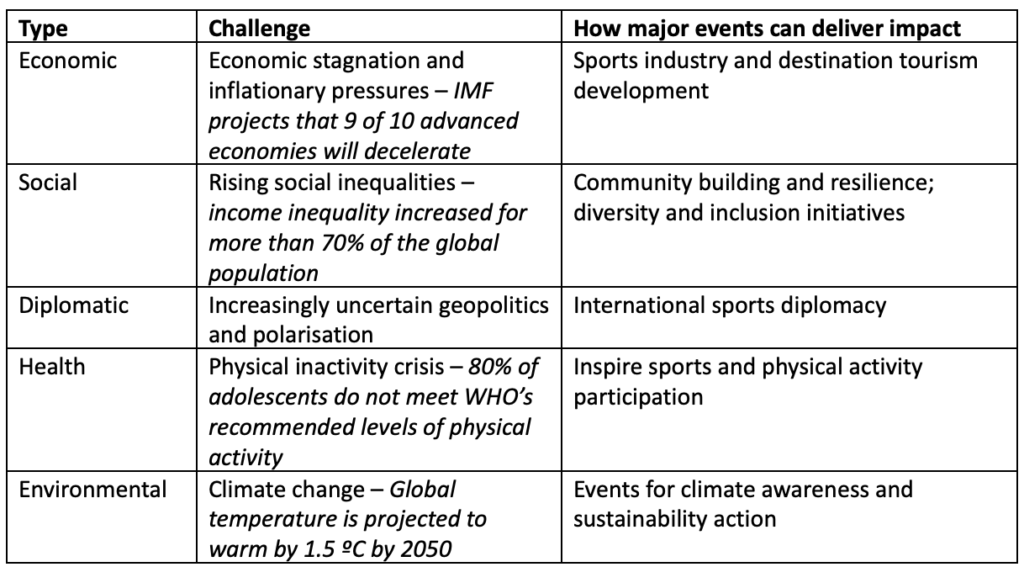
The Middle East has recently experienced an exceptional era of Major Events, putting the global spotlight on this region. According to the World Economic Forum, the Middle East is already a powerhouse in sports tourism, with a market value of $600 billion. From hosting prestigious global mega-events like the 2022 FIFA World Cup in Qatar and the 2019 Special Olympics World Games in Abu Dhabi, to annual Formula One races in Abu Dhabi and Jeddah, as well as organizing large-scale national games such as the Saudi Games, the region has proven its remarkable ability to successfully stage and showcase major sporting spectacles. 

The growth of major events in the Middle East can be leveraged to deliver impact for an increasingly uncertain world facing several challenges.

A strategically planned and executed event is key to ensuring maximum impact, as research suggests – 86% of mega-events are unprofitable from strategic mismanagement. This article highlights the seven success factors in delivering an impactful major sporting event.

Not subscribed to our weekly newsletter? Click here to sign up and receive more content like this to your inbox every week.

  1. Leadership, Governance, & Team

Just like a great team who is successful at a sporting event, an exceptional and experienced team is needed to organise a major event. Clearly defined roles and responsibilities are needed to align various ministries or government departments, city halls, federations, and rights holders to ensure coordination, collaboration, and integration for delivery success.

  1. Strategy and Legacy

Strategic planning serves as the foundation for a successful major sporting event. Strategic planning ensures objectives, underpinning tactical plans and roadmaps for successful events. A supporting robust legacy strategy ensures impact beyond the event.

  1. Integrated Planning Framework

An integrated planning framework ensures a comprehensive and coordinated approach to delivery. The framework provides a blueprint for how different components of the event (clients, functions and venues for example) will be brought together in a seamless and efficient manner. Crucially, the integrated planning framework also ensures that potential event risks are identified and managed in the run up to operations.

  1. Benefits Realisation Planning

Benefits realisation planning ensures the achievement of desired outcomes (e.g., social, economic, environmental) for an event. By mapping event outcomes to measurable actions and key performance indicators (KPIs), it ensures continuous progress and tangible benefits throughout the event.

  1. Commercial Innovation

Continued commercial innovation is essential to gain the funding and investment needed to deliver maximum impact. A robust commercial strategy secures optimal partnerships, develops effective marketing strategies to increase reach, and explores all potential revenue streams to maximise funding. 

  1. Infrastructure Strategy

An effective infrastructure strategy enhances event execution and leaves a lasting impact through state-of-the-art facilities, considering long-term use and repurposing. This includes the development or enhancement of both competition and non-competition venues, transportation systems, accommodation, and other essential facilities. 

  1. Immersive Technology 

Immersive technologies, including Virtual and Augmented reality, 360 Live Streaming, and more, strongly contribute to enhancing event experiences and extending global reach. When integrated into comprehensive planning, these technologies play a pivotal role in fostering commercial innovation, creating revenue opportunities, and enhancing fan engagement.

In conclusion the Middle East has become a prominent destination for major sporting events, demonstrating its successful hosting capabilities for global and national competitions. Exploiting the growth of these events can have a positive impact in an uncertain world. Our ongoing research indicates significant disparities across all 7 areas between the perceived exceptional events and those considered mediocre. Given the magnitude and number of events scheduled in the Middle East over the next decade, along with the associated costs, revenues, SROI impact, and sustainability impact, the potential value at stake is substantial. With our experience highlighting a minimum of 30% difference in impact between exceptional and mediocre events, it is crucial major event organizers to consider the criteria noted in this article as key differentiators for success.

Click here to find out more about the work done by Clayton and Portas Consulting

IMG ARENA extends partnership with MLS to provide tracking data to MLS NEXT Pro

IMG ARENA, a leading sports data and technology supplier for the betting, media and performance sectors, has extended its partnership with Major League Soccer (MLS) to provide tracking data to MLS NEXT Pro. 

The extended agreement will see IMG ARENA integrate its deep tech, cloud-based platform to provide player and ball tracking data to MLS NEXT Pro to enhance their player performance analysis. The data points collected will include players’ total running distances, speed zones, sprints and separation between players, among others.

IMG ARENA will also provide tracking data of match officials to enable the Professional Referee Organization (PRO) to support on-going efforts to develop the next generation of referees in North America.

The innovative event tracking technology was integrated into IMG ARENA’s extensive data collection capabilities through its acquisition of Signality in 2022. It uses computer vision to extract highly accurate sports event and tracking data in real-time, utilising existing camera setups to derive positional data and event information automatically. The product is part of IMG ARENA’s Sport Services offering which helps rightsholders deliver fans a front-row-seat to the action with best-in-class data, content creation and production streams.

Last year, IMG ARENA announced its long term, global partnership to deliver the next generation of fan engagement in MLS and MLS NEXT Pro. Alongside its role as the league’s official data partner,  IMG ARENA is delivering innovative content solutions, next-generation fan analytics, and marketing tools to MLS’ betting and media partners, including the launch of three new MLS live data feeds, designed to enhance the fan experience.

“One of the areas of focus for MLS NEXT Pro is innovation so we are thrilled to be bringing this new player and ball tracking technology to the League ,” said Ali Curtis, Senior Vice President of Competition and Operations, MLS NEXT Pro. “IMG is continuing to create new solutions for soccer fans around the world and this is a great example of their commitment to delivering a best in class experience.”

Freddie Longe, President of IMG ARENA said: “This expanded partnership means we’re able to provide MLS NEXT Pro with an all-encompassing data collection system. Adding compelling ball tracking data and player analysis will provide enhanced performance insights, on top of our next-generation fan engagement analytics and innovative content solutions which are empowering the future MLS universe.” 

Headquartered in London, IMG ARENA is a sports data and technology hub serving the sports, sports betting and sports media eco-systems. IMG ARENA delivers live streaming and data feeds for more than 45,000 sports events annually, as well as for on-demand virtual sports products and front-end solutions including the UFC Event Centre. IMG ARENA’s clients include UFC, DP World Tour, PGA Tour, EuroLeague, UTR, USTA, Roland Garros, MLS, and the FA.

Volleyball World partners with VolleyStation

This year’s volleyball and beach volleyball events have kicked off with an exciting and innovative data and insights experience as Volleyball World partners with VolleyStation to level up the fan experience of the sport’s hundreds of millions of fans worldwide.

Polish-based tech startup VolleyStation will provide its software and technology for all Volleyball World and FIVB volleyball and beach volleyball events in 2023, including: the Volleyball Nations League, Beach Volleyball World Championships, Beach Pro Tour, Olympic Qualification Tournaments and Club World Championships.

VolleyStation’s powerful and efficient data collection tools will provide invaluable insights to help further transform the fan experience both onsite and online at major international volleyball events. Meanwhile, its software will bolster the competition management capabilities through world-leading technological solutions.

Volleyball World Chief Business Officer Guido Betti commented: “VolleyStation is trusted by professional volleyball leagues, clubs and coaches in Poland and around the globe to provide the best-in-class data collection tools and competition management technology. We know that VolleyStation has the expertise and knowledge to bring tremendous value to not only Volleyball World and the FIVB, but to the entire volleyball ecosystem.”

FIVB President Dr Ary S. Graça F° said: “We are delighted to join forces with VolleyStation to ensure the best in-class volleyball data collection and competition management tools as we strive for innovation across all the areas of our work. We understand the huge value of data in helping us bring volleyball and beach volleyball to the next level.” 

Volleystation Chief Executive Officer Lukasz Wrobel added: “We are proud of this remarkable partnership with Volleyball World, showcasing VolleyStation’s unparalleled expertise in volleyball collaboration. Our extensive understanding and capability to meet the global needs of volleyball organizations are evident in this partnership. Together with Volleyball World, our shared objective is to enhance our sport at all levels and drive innovation.”

Manchester United are this season’s biggest winners

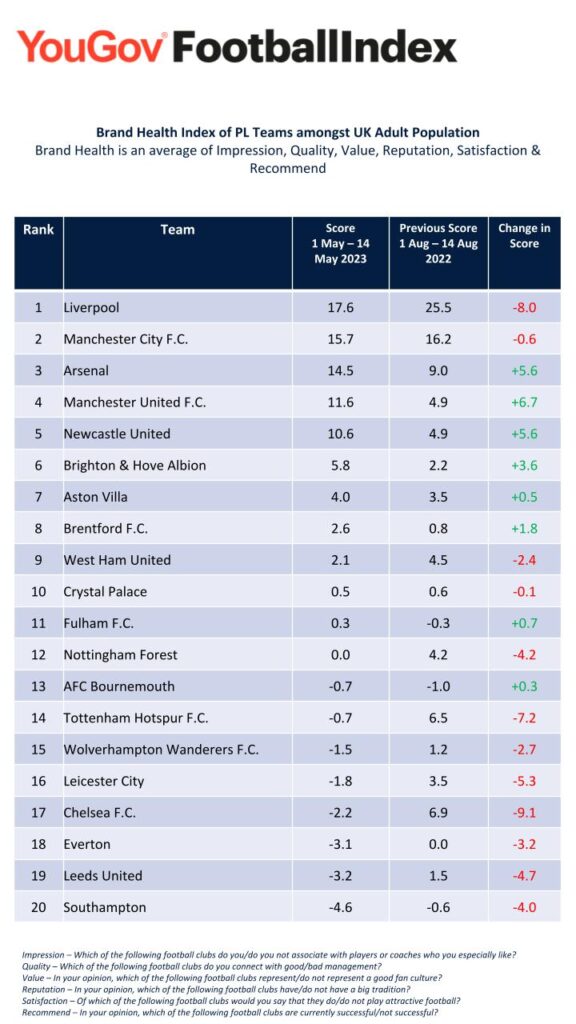
In this week’s iSportConnect Brand Health Index powered by YouGov we are taking a look at how Premier League clubs have changed over the course of the season. As you would expect there has been a few ups and downs in this table as well. 

The Winners: 

Manchester United: + 6.7 points

Despite the Eric ten Hag era kicking off with back-to-back losses including a 4-0 drumming at the hands of Brentford, United have actually had the biggest increase in Brand Health score, jumping up to a score of 11.6 earning them fourth placed in this table. We think this is related to a strong season on the pitch, including a first trophy since 2017, and the possibility of the club being sold after years of fans protesting about the ownership.

Arsenal: + 5.6 points

Arsenal’s improvements on the pitch this season have translated to an improvement in Brand Health score as well, they scored 14.5 enough to claim third on this list. Mikel Arteta’s team have not only mounted a Premier League title challenge for the first time since 2016/17, but also seemed to have brought a previously divided fanbase together. The score is measured using a variety of different metrics, one of these being success, hence why the ‘winners’ in this list have all had strong seasons.

Not subscribed to our weekly newsletter? Click here to sign up and receive more content like this to your inbox every week. 

Newcastle: + 5.6 points

Newcastle have been a team and club transformed this year so it is not surprising to see them as one of our biggest winners of this season. Their increase in score is reflected by their jump up to fifth in this table. Boasting the best defence in the league, the Geordies have been consistently in the Champions League places and also got to their first final at the new Wembley.

The Losers:

Chelsea: – 9.2 points

Oh Chelsea, where did it all go wrong? It has been a long season for the West London club, spending £600 million on players has only resulted in turmoil with three or maybe even four managers by the time you read this depending on the timing of Mauricio Pochettino’s announcement. They have slumped to 17th in this table and currently find themselves an intensely disappointing 11th in the Premier League. 

Liverpool: – 8 points

Having gone toe-to-toe with Manchester City for the Premier League title over the previous five years. This season has been difficult for Liverpool. Despite being the league’s second biggest loser in terms of points, Liverpool are still top of this particular league. We believe this is down to the incredibly strong fan culture that the fans have and also the reputation that the club has.

Tottenham Hotspur: – 7.2 points

Like Chelsea it has been a difficult season for Spurs. Despite a strong start to the season, Antonio Conte’s time at the club ended in chaos after a dramatic loss to bottom side Southampton. Increasingly, it is felt that a toxic relationship between the fans and the Chairman Danel Levy is developing with fans chanting that they want him out of their club. Spurs now sit 14th in this table.

See the full table below:

Photo credit: Kevin Stattard