How can you make your event more sustainable?

The demand for a more sustainable approach to organising events is increasing. As an event planner, you have the ability to make significant changes in your field, because let’s face it, change is in your own hands. What options do you have for a more environmentally friendly event?

Read on to discover several ways in which you can introduce sustainable initiatives into your upcoming event:

Reuse

  • Encourage guests to bring reusable water bottles that they can refill throughout the day. This reduces the amount of waste produced by attendees.
  • Badge holders, lanyards, notebooks and pens are just a few items that can be saved and reused at future events rather than thrown out.
  • Use recyclable materials when creating branded items for the event or create branded items that are not event specific and can be used at multiple events.

Zero Waste

One of the major problems is the event location itself. Choose an event location that is committed to clean energy and take measures to reduce waste.

Reduce the amount of waste generated by your event and its attendees by providing composting for uneaten food and sourcing recyclable materials to use.

Zero waste requires a closed loop. Products should be reused and recycled rather than discarded, burned, or dumped. Waste is inefficient and does not fit into this cycle of sustainability.

Travel & Food

Encourage guests to use public transportation or hire shuttle buses from the accommodation/airport. You could even take it a step further and provide a sporty alternative, such as cycling. This is especially appropriate for hospitality programmes during a city trip.

Say goodbye to meat and instead provide more sustainable catering, such as vegetarian or vegan. Meat consumption is one of the leading causes of CO2 emissions, so limiting suppliers who only offer meat-based meals will reduce the event’s carbon footprint.

Buy and use materials, food and drink from local suppliers and businesses in the community of the event’s location.

Go Digital

An easy way to make a big impact is to go paperless. Instead of sending out physical invitations, send an email invite, or create an event page on social media. Not only does this reduce your footprint, but an event page also allows you to easily communicate with guests. A last-minute change? No problem, it is easily adjusted online!

Following the online invitation, you could create an online registration platform that is paperless and cost-effective. Send registration notifications via email, followed by an e-ticket that can be scanned from smartphones.

Printed invitations, maps, and tickets are a thing of the past. Mobile apps and websites are a much more environmentally friendly way to interact with guests before, during, and after an event.

Article written by ATPI, click here to find out more about the work they do

Meet the Member: “We are trying to short-circuit our growth path as a sport. That is a real challenge”

Last weekend Formula E held their first race in Hyderabad, one of a number of new cities they are racing in this year. Before he flew out to watch the race, Strategy Director Harry Browne sat down with our Content Manager Alex Brinton to talk about the new season of Formula E and where the sport will be in five years time.

To start, let’s take it back five years. What was it about Formula E that so attracted you and made you join the business from Altman Solon?

I was in strategy consulting at Altman Solon for about five years. It was an environment where I learned a hell of a lot, it was quite high pressure and had a lot of tough deadlines. I found that jumping from one business to another was not giving me a lot of in-depth experience. That is why I wanted to go in-house, to get stuck in and take some real ownership. 

The opportunity came up to work in Strategy at Formula E, and it was a really exciting one for me because the subject matter is so interesting and the opportunity and room for growth was massive.

Season 9 of Formula E has just started, how has it changed in your time there?

Over the time I have been here investment in the team has increased a lot, and with that expectations and standards have as well. We have really good people who are subject matter experts in their discipline.

That also means that the focus of my role has shifted a bit from leading on a lot of projects to now making sure that the company is all pulling in the same direction.

In terms of the business of Formula E, the popularity and audience has grown hugely, as has the revenue generation, especially from sponsorship. 

On track, we are now onto our third generation of cars. When I started the GEN1 cars would only last half the race and then the drivers would have to get out and swap. With each iteration the technology has moved on a great deal, and that has allowed us to do more with the racing product as well.

As we just touched on, Season 9 is just getting underway, what’s new this year?

The short answer is lots! It was the busiest off-season since I started.

We have a new GEN3 car, which is a massive step forward in terms of performance (capable of 200mph top speed) and is the most sustainable electric race car ever. We’ve got new venues: we’ve just raced in Hyderabad, India, next up is Cape Town, which will look fantastic. And then Sao Paulo, which is going to be great. Brazil is obviously a huge racing market, so we are really excited to go there. And we also go to Portland in the US for the first time later on in the season. We also have new teams, McLaren, Maserati and Cupra have all joined bringing huge motorsport pedigree.

Another element of the new car is that it is compatible with fast charging. So that is something that we are looking to implement during the season, and with that an update to the ruleset needed. 

Finally, we have a new website and app, and have also been through a whole new brand refresh. The update has a far more entertaining feel and positions us as more of a challenger brand, whereas before if you were being critical you could say that we were coming across as a bit clinical.

So yeah, a lot has changed!

What are the particular challenges that are facing Formula E at the moment?

Firstly, with all those changes we really need to work to maximise each of those opportunities. We really need to make sure we nail every point on the implementation and use data to help us do that. 

Secondly, what we are trying to do is to short-circuit our growth path as a sport, that is the real challenge. Most sports take decades to grow and mature; we are only in our ninth year and we are striving to become a tier one sport. The UFC and perhaps the IPL are the best examples in recent years, but not many people have been successful trying to do what we are doing. 

We have all seen the extra attention that Formula 1 has got as a result of Drive to Survive, is this something that Formula E is looking into?

Drive to Survive has been a massive success for Formula 1, you only have to look at how much the sport has grown in the US in that time. It has also recently spawned a few sports doing similar with Break Point for Tennis and Full Swing for Golf. For it to be a success obviously the content needs to be great to cut-through, but also you need the right platform partner, promotional strategy and the content needs to fit with the strategy of what you are trying to achieve as a rightsholder.

We have been experimenting with our series Unplugged, which is a behind-the-scenes look at the sport, telling the stories of some of the teams and some of the drivers. As a sport that is so young we are highly agile so we can change things depending on what hits and what doesn’t.

Obviously with an electric sport it is important to be as sustainable as possible and you announced that you were Net Zero Carbon since inception in 2020, how difficult was it to get there?

It has always been so ingrained in the company that we have to set the standard when it comes to being sustainable that it was a natural to become Net Zero Carbon. As a company we are acutely aware of where our emissions are coming from and what we need to do minimise them. Becoming Net Zero Carbon was actually more of an extension of what we were already doing than actually changing a lot of practices in order to achieve it. 

We also work with our partners to run local initiatives, including UNICEF and DHL. We want to make ourselves as sustainable as possible, but we also want to make a difference to the communities in which we race through smaller, local projects, for example making drinking water readily accessible in Mexico with the help of UNICEF.

There are so many ways in which you can engage fans digitally, how are Formula E evolving in that space?

Firstly, we have had a complete overhaul of our website and app. We took a step back, looked at all the user journeys and the experience fans would get and then re-designed them with that in mind. We also introduced some gamification elements to the website to keep people coming back again and again. 

Secondly, we want to create really fun and engaging content on third party platforms. TikTok has been a great success for us this year, we are up 600% on last year. It is a great example of a platform where you can be more playful with the brand and show a funny, offbeat side to the sport.

Also when it comes to the licensing side of the business we are definitely looking at more games and products to try and introduce Formula E to a new audience. 

Looking forward then, where do you see Formula E in five years time?

As I mentioned earlier our goal is to become a tier one sport. I think we can achieve that in five years but we will have to be really on it and nail our execution to get there. First and foremost we need to ensure our race product is top-tier, so that when they watch it once they want to come back again and again. If we rewind to two years ago, we completely overhauled the qualifying format. We went from a groups-based system to a head-to-head knockout system, and our qualifying audience increased 50% – it shows the power of making a positive change to the product, and it’s amazing the impact that that can have.

Fundamentally, we need to get the best teams and manufacturers with the best drivers racing in the best locations with the best coverage around that. That’s how we will become a tier one sport.

SEG3 to fuel Sports, Entertainment & Gaming businesses web3 ambitions

Web3 Media Group today announces the first global summit part of its portfolio, the SEG3 Summit.

With the continued blurring of sports, entertainment, gaming and wider culture, the opportunities and challenges web3 and immersive technologies offer are becoming universal across these industries.

Due to that fact, the successful Web3 Summit held in 2022 has been rebranded to SEG3, with the 2023 edition expanding its scope to now also meet the needs of the entertainment and gaming communities, as well as sports.

The summit returns to the Emirates Stadium, London on 28th & 29th June 2023, and will address key themes including:

  • How to futureproof your brand in a web3 world 
  • How to engage and grow a web3 native community through storytelling
  • The impact of the creator economy on content creation, distribution and monetisation
  • Building immersive experiences, and its impact on traditional activation 
  • Raising investment in a bear market, and how to structure the agreement to get the best deal
  • The building of the open metaverse, and the opportunities associated to a interoperable digital identity

Full agenda and industry-leading speakers to be announced in early March.

“We’re really excited to be building on the successes of our inaugural web3 summit in 2022, and feel strongly that by widening the scope of the event, we can play a small part in helping these industries to flourish in the coming years as they look to reimagine their brand, relationship with their audience and revenue models through web3 and immersive technologies” said Co-Founder & Managing Partner of Web3 Media Group, Joe Condon.

Click here to visit the SEG3 website

Sportel Bali announce event programme

An engaging series of Masterclasses and Presentations will take place at the inaugural SPORTEL Rendez-vous Bali international market and summit being held from 23 – 24 February 2023. 

Sessions will dive into trends shaping the future of the sports media and tech industry and provide thought-provoking discussions led by influential sports business executives. The international blend of culture and experience, includes speakers from Indonesia, Asia, Europe, North America and beyond.

Attendees will gain vital insights to complement their meetings during the two-day market and exhibits, to evaluate and help make informed decisions when evolving their business strategies which unlock potential new revenue streams.

Monaco meets Indonesia, with Louis Ducruet, nephew, and Official Representative of SPORTEL’s Honorary President H.S.H. Prince Albert II, joining Laurent Puons, SPORTEL CEO, and event host, Transvision’s President Director Peter F. Gontha, who will officially open the event together on the morning of 23 February.
 
A scene-setting panel “Asia the Big Picture’, in collaboration with SportBusiness’s Kevin McCullagh, will feature Asian sports media industry leaders, including EMTEK’s Sutanto Hartono, SPOTV’s Mitch Hong, AFC’s Andrew Rogers and IMG’s Tom Broom, who will share their expert insights on the state of the industry today, how it got here, and where it is heading in 2023 and beyond.
 
“The “Asia the Big Picture” panel will be an excellent opportunity for AFC to share and debate with industry colleagues the major trends and challenges shaping the future of sports business in APAC and beyond”, said Andrew Rogers, Director, Commercial, Asian Football Confederation (AFC).
 
Another star-studded panel shining the spotlight on “Asian Audiences Embracing International Football Properties” will highlight how European and global properties have established their brands within the region, by expanding digital footprints and working side by side with broadcasters to enhance fan experiences, while adapting to sometimes challenging live sports scheduling times.

The stellar line-up includes FIFA’s Paul Calder, Serie A’s Anna Guarnerio, Bundesliga International’s Peer Naubert and Pitch International’s Henri Kamerling, and will be hosted by SportBusiness’s Imran Yusuf.
 
“This season marks the 10th anniversary of Bundesliga International’s office in South East Asia, and a perfect time to reflect on the lessons we’ve learned, as well as the plans for the future, as the Bundesliga fanbase continues to grow rapidly in Indonesia and across Asia.” announced Peer Naubert, CMO Bundesliga International.
 
Changing gear, Dorna Sports, Alex Arroyo, will share how MotoGP is “Revving up the Motorsports Experience” with Fox  Sports Adam Howarth and Telkom Indonesia’s  Dedi Suherman discussing the massive popularity of motorsports across the region. Harmonic’s Alexandre Paugam will also present a case study along with partner WRC Promotor and Philipp Maenner, titled “Accelerating Motorsports Global Reach with Rally.TV.”

The explosion in women’s sports and the importance of regional focus and innovation, will highlight how “Culture and Diversity are Shifting the Direction of Sports Media in Asia” and will be addressed by executives including, Reddentes Sports & Redd+E’s Mark Chew, RCTI’s (MNC’s) Dini Putri and Sportfive Asia’s Karen Lay and moderated by Magnifi’s Meghna Krishna who will look at best practices and shifts within the region.
 
Asia is the world’s biggest esports market, with a notable explosion in mobile esports and the sector is brimming with opportunities for savvy media companies that truly understand the space.  “The Future of Esports in Asia “panel, will be brought to you by SportBusiness’s Callum McCarthy and includes some of the most game changing organisations in Asia such as ESL Faceit’s Roland Lam, Moonton’s Martinus Manurung and Reddentes Sports & Redd+E’s Ren Kai Yip.
 
“The Esports scene in Asia has seen a rocketed increase in popularity over the years, especially during the COVID period. Now that Asia has came out of the pandemic and many sporting events return, there will be added competition for eyeballs and an increasing spotlight on what opportunities Esports can offer to the market.” commented Ren Kai Yip, Managing Director & Co-founder, Redd+E Pte Ltd.

Turning to tech, WSC Sports Guy Port, will illustrate how they are “Delivering Video Fan Experiences with AI” and how it is increasingly playing a critical role from personalized content to virtual and augmented reality. The tech theme continues with a panel looking at the current state of “The Cloud AI, NDI & Sports” as well as a debate where things are headed. The panel will be led by GSIC’s Raj Sambwani who will be joined by Snipitz’s Denny Darmo, Magnifi’s Meghna Krishna, and Ideal Systems, Fintan McKiernan.
 
The “OTT Streaming & FAST Channels” panel will focus on the FAST TV channels trend and how the model benefits sports content owners and broadcasters. The expert line-up includes Vision +/ MNC’s Clarissa Tanoesoedibjo, Origins Digital’s François d’Azemar and OTTera’s Stephen Hodge and moderated by SoFAST’s Sandrine Durand.
 
“SPORTEL Rendez-vous Bali will be the perfect opportunity for us to share with the international sports community, the opportunities in the OTT and streaming space in Indonesia, as well as MNC’s Vision+ role in the development of the media ecosystem.” said Clarissa Tanoesoedibjo, Managing Director, PT. MNC OTT Network (Vision+)
 
“I’m honored to be part of a diverse panel that brings together voices from many different backgrounds, genders, and ethnicities. It’s incredibly empowering to see how our collective experiences offer insight, encouragement, and represent the wonderful diversity that our world has to offer.” Stephen L. Hodge, Chairman & CEO, OTTera

A new concept for the conference programme will see the introduction of a “Pitch Session” featuring selected innovative newcomers to SPORTEL who will present quick fire pitches in front of a jury and event attendees.

The House View – Why might Apple enter the race for Premier League rights?

Last month, it was widely reported that Apple TV are going to enter the bidding war for the next round of English Premier League TV rights that will be going out for tender towards the back end of this year. Is this for real or just a rumour? Let’s look at some of the facts.

The American tech giants have already made some moves into sport with a 10-year MLS deal that starts next year – was that just them whetting their appetite to grab a part of the action on this side of the pond and get into sport on a global rather than a regional basis?

If the plan is to get into sport in a major way then the Premier League is clearly one of those crown jewel rights packages so it would be strange that a global company such as Apple would leave this as a US sporting play and would therefore be taking a far bigger global approach to sport. And no sport is bigger globally than soccer/football. Of course the NFL is just one elephant in the room and even the IPL audiences are worth keeping an eye on but neither attract genuine global eyeballs. But I think all of the above misses the point of Apple’s strategy…

There is no doubt that Apple has deep enough pockets that they are more than able to compete in this space. 

One thing is for sure they won’t be lacking for options when it comes to which rights to go after. Live Premier League rights are split into seven packages. In the current cycle Sky own four of them broadcasting 128 matches. BT Sport own two of them, broadcasting 50 games a season. Amazon Prime picked up Package F and show 20 games every campaign. Then there’s delayed rights with Sky showing match replays in full later on in the day and obviously Match of the Day running on Saturday and Sunday nights every weekend of the season. Then there’s the clips. Sky currently own these rights and upload three-minute highlights of every Premier League match a matter of moments after the referee blows the final whistle.

Sky is in at least 12 million homes in the UK according to Advanced-Television.com and only 8 percent of households have Apple TV according to Finder. A figure that hasn’t moved since 2019. Although the Apple TV app is already available on Sky’s EPG (Electronic program Guide) there could also be interesting possibilities around Apple doing some form of deal with Sky that would mean Apple TV becomes embedded and visible on more devices  as well. It would be complicated but aggregation, or re-aggregation, is still the likely end goal as it’s impossible for consumers to continually be asked to sign up for yet more platforms

Away from Apple, Warner Bros. Discovery completed their acquisition of BT Sport back in September, they are another company with deep pockets that could be looking at acquiring more than their current 52 games. Additionally the recent news about DAZN and the NFL GamePass International is really exciting as DAZN make their move towards the title of the “Netflix of Sport”

For what it is worth, I don’t think Apple are likely to come in and try to take over from Sky as the Premier League’s main broadcaster, I would wager they have their eye on taking BT Sport’s share or even trying to carve out a niche package similar to Amazon Prime’s.

I don’t believe Apple would be able to make commercial sense through an increase in subscriptions or advertising to make the numbers work were they to take Sky’s position. Apple will use the MLS as an experiment to understand the experience and gather the data and they may well do the same with the Premier League rights. But I believe it is no more than a small stepping stone rather than an outright play into sport. I don’t think there are any plans for Apple to make a major move in sport but instead they have the ability to play the long game and learn from small stakes.

But one thing is for certain the clubs will be licking their lips at another major player entering the race for rights. Whether this is actually good for the sport is questionable given the richness of the Premier League versus all their rival leagues. Sport needs competition so this might even enhance support for some form of European Super League. It’s a complex old space.

By Sandy Case, CEO of iSportConnect

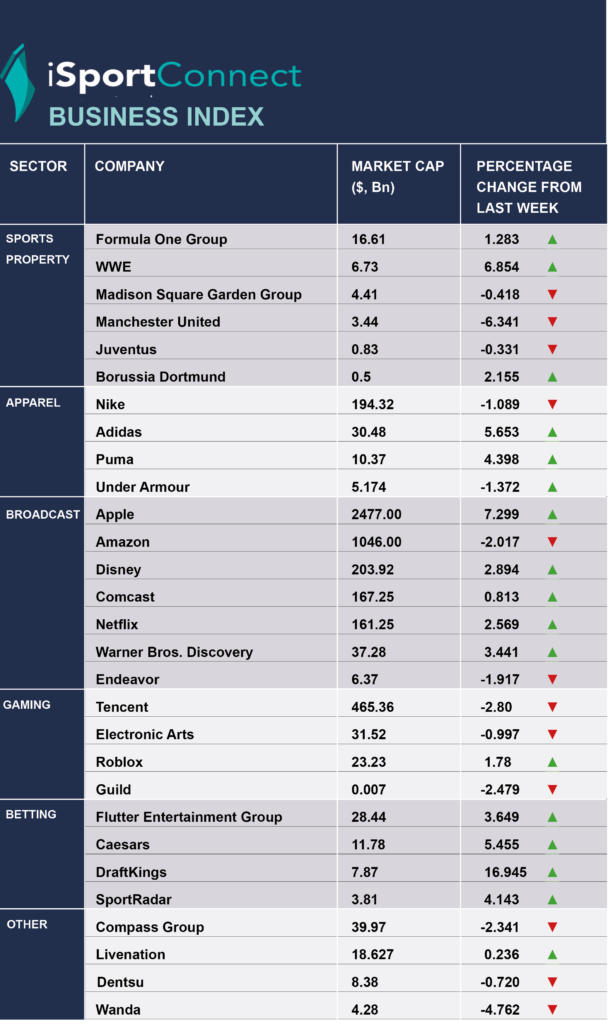
The Bottom Line: The iSportConnect Business Index – February 9

Welcome to this week’s edition of the iSportConnect Business Index, in a week the FTSE has hit a record high surpassing its previous peak in 2018.

That means it has been a positive week for the majority of the Index. We are getting rid of the winners and losers section and instead are going to focus on the stories that have caught our eye this week, in a section we are calling the movers and shakers. Index figures correct as of 8/2 am.

Movers and Shakers

DraftKings – up 16.945%

It’s amazing how a Super Bowl can generate huge betting interest and with LV11 on the horizon the numbers being gambled continue to astound and resulting in upgraded predictions for DraftKing’s upcoming quarterly results. It has been a hard Super Bowl to predict the Philadelphia Eagles are the better team and therefore command slight ‘favourite status’ but punters are reluctant to bet against the star power of Kansas City Quarterback Patrick Mahomes.

It’s promising to be a hugely positive commercial Superbowl on all fronts as advertising has replaced all the crypto brands revenues and figures being quoted remain very strong across all commercial channels.

Manchester United – down 6.341%

The timing of our Index means we miss out on the news that Qatari investors are potentially already in talks. This has seen a near 15% spike in the price. Given the Glazers want a reputed $6bn there is massive upside if they can achieve that. The market is saying they wont…..

Madison Square Garden Sports Group – down 0.418%

The New York based group have revealed they would be open to selling stake’s in both their Basketball team the New York Knicks or the Ice Hockey team the New York Rangers. “We have no plans to sell either team … but we would certainly not rule out the possibility of selling a minority stake in the Knicks or the Rangers,” said Madison Square Garden Sports president and COO David Hopkinson on Tuesday.

Disney – up 2.894%

Yesterday, CEO Bob Iger announced plans to cut the company’s workforce by 7,000 as part of a restructuring plan he believes will save the company $5.5 billion over the next few years. Their share price jumped 9% after the news was announced, unfortunately too late to be included in this week’s index.

Institutional investment in sport to grow in the next five years according to PwC Global Sports Survey

Institutional investment in sport to grow in the next 3-5 years with overall sports industry growth prospects more positive compared to last year – PwC Global Sports Survey

  • Continued levels of investment in sport forecast and valuations are expected to rise
  • Women’s sport revenues expected to grow significantly over the next few years
  • Big tech companies are predicted to become more active in the sports media rights market 
  • Nearly 40% of sports executives reported prioritising a balanced approach to E, S and G moving away from ad-hoc initiatives 

The PwC Global Sports Survey, now in its seventh edition, features responses from 507 senior sports executives from across 43 countries and analyses the market forces likely to transform the sports sector over the next three to five years and looks at how those perceptions have changed in the last 12 months.

Overall, the survey respondents reported optimism about the future of the sports sector following the debilitating impact of the COVID-19 pandemic, with the outlook for growth improving in the last year from 5 to 6.5%. The key revenue drivers of the improving growth are increased media rights, the resumption of ticketing and hospitality and growing betting related revenues. 

Clive Reeves, Global Sports Leader at PwC, said:

“Following a difficult few years due to the COVID-19 pandemic, the sports industry is on the path to recovery and it is great to see in our survey results that the spirit of optimism has returned. With fans now back in stadiums and strong consumer demand for sports content, growth expectations have increased compared to previous years”

Sports Investment

Following a number of significant investments in sports leagues and teams in the past year, the PwC Global Sports Survey reveals that more than three quarters (83%) of senior sports executives believe institutional investment (Private Equity and sovereign wealth funds) will continue to grow in the next three to five years.

More than two-thirds (68%) of respondents believe the focus for Private Equity and sovereign wealth investment will be on premium sports properties.  The view is that further value can be unlocked through seizing new streaming and digital opportunities, creating alignment across stakeholders and transforming ways of working.

Clive Reeves, said:

“More than ever sports organisations are looking for additional resources to remain competitive both on and off the pitch, while investors have been buoyed by the underlying resilience of consumer demand. Institutional investment has the potential to transform sports organisations and help capitalise on new market opportunities.”

“However, sports organisations face a dilemma as they balance the level of control they are willing to give up in return for investment. This is evident in the results of our survey which show that almost two thirds of respondents believed investors, sports organisations and fans may have misaligned objectives.”

Rising valuations

The value of sports clubs and franchises are expected to rise according to those surveyed amidst growing interest from investors and the increase in sports M&A activity across the globe. For the first time in the survey, PwC analysed the expected growth in sports club franchise valuations with respondents predicting a 6.6% growth rate over the next three to five years. Driving this demand is the scarcity of assets which combined with increasing demand from investors and a strong media rights market is driving valuations higher. In the last 12 months, teams in the NBA, NFL, Premier League and Serie A have all sold for record sums.

Clive Reeves, continued: 

“With strong expectations on the media rights market and the belief that further commercial potential is still to be unlocked, the number of parties interested in investing in teams or leagues is expected to rise, driving up valuations further. We have seen from recent transactions that the valuations of premium sports properties are increasing, which reinforces the views gathered in our survey.”

Women’s sport on the rise

The majority of sports executives view the women’s sport market as a critical part of future industry growth with over 70% believing revenues will grow by more than 15% in the next three to five years. This forecast is supported by the growing interest from media companies and sponsors who are increasingly seeking to realise the opportunities women’s sport offers, with a number of improved partnerships formed in the past year. However, institutional investment is yet to follow this trend, adopting a more cautious wait and see approach.

In order for women’s sport to accelerate its growth, 50% of respondents indicated that greater media coverage is the most impactful driver of growth. Increasing live coverage and achieving wider reach is essential to set the flywheel in motion as increased visibility will attract more commercial partners which in turn will stimulate revenue growth and enable greater investment in talent and sport development. 

Clive Reeves, said:

“Increasing the visibility of women’s sport on high-reach networks can set a powerful flywheel in motion. Extending reach and growing fandom are essential to attract commercial partners and investors who are willing to invest in women’s sport and provide the required financial resources to enable growth at all levels”

“It is essential that all stakeholders work together to accelerate the growth of women’s sport and build a strong, sustainable platform for long-term success”

Big tech companies becoming more active

In the last 12 months the sports industry has seen tech giants, such as Apple and Google, make significant moves in the sports media rights market. In our survey, 76% of sports executives stated that large tech companies are best positioned to win the battle for sports rights in the next 3-5 years. In addition, 75% of respondents also reported that rights owners will need to be more creative in their media rights distribution models to succeed in the future. 

Clive Reeves added:

“The recent rights acquisitions from the big tech companies are great for sport, having new media partners investing in sport and helping grow reach, engagement and fandom can only be good for the sector. It will be interesting to see how the fan experience evolves and new monetisation models emerge over the next few years.”

Member Insights: Why you have to be open-minded when trying to address a challenge

In this week’s Member Insight article, Richard Brinkman, looks into the dangers of narrow thinking and the value and importance of opening the mind to as many possibilities as you can when trying to address a challenge or opportunity, or achieve a defined goal.

It is an oft-quoted cliché that sport is a results-driven business. On the field, and in the boardroom, the soundbites we frequently hear are all about focus, definition of roles, clear direction, clarity of purpose, precise execution, established targets and goals etc.

This is as it should be if we are chasing a singular outcome such as the correct result or achieving a goal. The important thing, however, is to be aware that this singular and, by necessity, narrow approach demands closed, or focussed, thinking. The mental blinkers have been attached in order to solely concentrate on the one thing we want to happen.

This is all well and good, focussed or closed thinking is the right thing to do if we are seeking clarity, wanting to reach a decision, or looking to assess or measure an issue. It is the most efficient and direct way to chase a particular result.

However, if we are looking to address a problem, or find a solution, it is crucial that we open the mind to all possibilities; engage the imagination to consider alternatives and come up with as broad a selection of new ideas to assess. After all, as the old saying goes, if we keep doing the same things, we will keep getting the same results.

And this is the essential issue for the sports industry – far too often it is stuck in Einstein’s insanity loop of doing the same things (or, more accurately, a slightly different version of the same things) and expecting different results. A loop that is driven by an expertise and over-reliance on closed thinking and an unwillingness (or inability) to open the mind and engage the imagination to other possibilities.

This is an entirely natural situation. Being “open-minded” feels like comparatively hard work. A highly focussed mental approach, in contrast, feels very tangible and thorough. It drives precision and quickly makes us feel better about our thinking because it seems safe, allows us to revisit the comfort of the known, and leads rapidly to tangible actions and “doing something” – or being seen to do something. We feel like we are being busy and decisive.

Due to closed thinking being quick, familiar and comfortable it is habit-forming. Collective habits become a culture. Long-running and widespread cultures become institutions. The sports industry has institutionalised closed and focussed thinking – at the expense of open, possibility based thinking. To deliver the best results you need both – each at the appropriate time – not just one mode of approach.

Solutions require both approaches, in the correct order, in order to have any chance of achieving successful results.

As an example, take Ashley Giles’ words on his sacking as England and Wales Cricket MD just 12 months ago following the debacle of the England men’s Ashes defeat in Australia.

“Unless we look at more systemic change, a collective responsibility, and collective solutions, we can’t make whatever changes we want. You can change me, we can change the head coach and change the captain, but we’re only setting up future leaders for failure. That’s all we do. It’s only pushing it down the road.”

This is a very traditional and conventional – dare one say, institutionalised – response that can actually be seen in many businesses : we have an issue (we cannot win any Test matches – 1 win in previous 17) so whilst I am happy to take responsibility (because I am being forced to) it must be the system or process that delivers the players that is at fault since I know what I am doing and work hard.

The ECB’s solution in this instance : do a thorough review (like we did last time we were beaten heavily in Australia only this time give it a different name – Strauss report), consult more widely (talk to people who have won a lot from other sports) and then suggest radical changes to things tangentially linked to the issue, continue to promote and invest in the one thing that will definitely not help with the issue and cross your fingers that performances in test matches improve in the future. The insanity loop in action!

Unfortunately for Ashley Giles, who was undoubtedly a hard-working and well-meaning administrator (as well as a good man and very fine cricketer), and the Strauss report, history has not been kind to them.

Since last January England have won the T20 World Cup (they now hold both white-ball World Cups) and 9 out of 10 Test matches. This is about as strong a return from an England cricket team as has ever been seen.

What has changed – structure of the ‘system’/season, process of selection and coaching, the players themselves, equipment, locations of matches, incentives? None of the above. None of the traditional tangible reasons that closed and focussed thinking would associate with creating a winning team.

The only major thing that has changed is the mindset and thinking (and therefore actions) of the players – the very same players (virtually man-for-man) that could not win a game 12 months ago.

They have resisted the temptation to revert back to the methods that have worked in the past and try to work harder to implement and perform them better. This would be the focussed, blinkered and traditional way of approaching the problem. The wrong approach for addressing a problem. Led by a new captain and coach the England men’s cricket team have opened their mind to a new way of playing.

They have tried to imagine what interests and excites them and will therefore get the best out of themselves. An approach that recognises, and embraces, the possibility of losing but is willing to live with this possibility because of the excitement and rewards that the increased likelihood of winning delivers. White ball, red ball, home, away, Asia, Australia, Trent Bridge the positive mindset and willingness to be flexible and open to different possibilities at any stage of any match and tour is consistent.

One of the often unintended benefits of this kind of more open and imaginative thinking is that it far more readily and rapidly elicits buy-in from those involved. As Simon Sinek famously commented “Dr King gave the “I have a Dream” speech not the “I have a plan” speech. Dreams change the course of history”. Or put another way – people remember how you made them feel long after they have forgotten what you said. Emotional buy-in trumps rational understanding when it comes to driving positive action.

One has only to witness the RFU’s ham-fisted attempt to limit concussion in rugby through reframing the tackle laws to see how closed, focussed, and seemingly decisive, thinking can play out. They are trying to do the right thing but appear to have almost totally alienated the entire playing-base (including the professionals who will not be effected – yet) through a very binary and closed response to a highly nuanced issue that will require a high-degree of buy-in across multiple stakeholders to have any chance of success.

I am sure that had they been seen to open their mind to many possibilities other than just the obvious waist-only tackle proposal, and used their imaginations around who else they could possibly have involved in trying to arrive at solutions, the RFU would be moving forward to towards solutions to this important issue, rather than fighting fires and trying to reassert some credibility.

This scenario, in a similar way to Tom Harrison’s ridiculous branding of an entire sport (cricket) as “institutionally racist”, demonstrates it is often more important to sport’s leaders to be seen to be doing something (anything!) quickly than it is to do the right thing in a measured way. Knee-jerk reactions demand clarity and defined actions – closed thinking.

Not that head injuries in Rugby is a topic that has sprung upon the sport overnight – it has been bubbling up for years – but that is another story for another day.

I would implore those in the sports industry to be aware of how they are thinking and not instantly default to closed and focussed “blinkered” thinking as they look to move forward. Particularly when addressing problems or challenges (and there are plenty of those!) let’s be aware that it is crucial to open our minds to all, and any, possibilities and engage our imaginations rather than default to different versions of what we have previously known. Once possibilities have been prioritised we can then look to involve others, gain valuable further insight, and then focus our minds as we clarify definitive actions that will help sport move forward.


How to use an app as a marketing channel

In this article, Kaius Meskanen founder and CEO of Choicely, looks into the ways in which apps can be used for marketing.

Practically everyone of us uses apps as consumers. But how many businesses actually have their own app, and use it in their marketing?

At the moment, those companies are among the biggest and richest.

This situation is changing fast thanks to no code app builders. App builders lower the cost of making an app, and speed up the time-to-market.

Today more companies have a realistic possibility of making an app. Because apps are a new channel for many of us, implementing one might feel scary. Even if the cost wouldn’t be an issue, one might still have questions about apps, like:

  • How does my marketing benefit from an app?
  • How would I use my app in practice?
  • Is it a lot of extra work on top of everything else?
  • Is it difficult to update and edit the app?

Let’s dig into these questions!

Reaching your own core audience in today’s marketing

Today, it is difficult to reach your own audience without paying extra money to advertising platforms.

Several years ago – around 2016 – social media algorithms started to become unwelcoming towards company pages, and links to external websites. It has been the case ever since. Now company pages only reach a certain percentage of their followers, unless you “boost” the posts by targeting ads to your own following.

How to reach your core audience then? Direct marketing channels aren’t a conclusive solution either. Email click rates are going down as inboxes tend to be already saturated with emails; according to MarketingCharts.com and Epsilon click rates dropped by 42% during the 2010’s in North America.

This is where mobile apps shine. You’ll get your push messages delivered with less competition: you don’t have to fight social media algorithms or crowded inboxes. You’ll reach your app users for free, with an unrivaled customer experience.

Not everyone downloads your app, but those who do are more likely to be your loyal customers and fans. With an app you can communicate with those who want to hear from you on a consistent basis.

What’s the role of a mobile app among your digital marketing channels

So, apps are the channel for superfans and loyal customers. Apps will help you give them premium treatment and a VIP pass to your content.

Use your app to centralize your content into one place:

  • bring your website content to your app automatically – all content or the select ones.
  • show your social media feed automatically in the app, or simply provide links to your social accounts.
  • generate leads for email nurturing or sales campaigns.
  • encourage customers to use the app in your physical location, using loyalty campaigns, offers or in-app purchases.

On top of these, you can create visual and interactive content where apps are at their best. Apps are somewhat comparable to direct marketing channels. The difference is that apps enable versatile means for two-way communication. You can interact with your audience by with features like reactions, commenting, voting, feedback collection, messaging, and so on.

This way, apps can become a centralized content and interaction hub among your core audience.

Apps have similar capabilities as the other channels. Still, the channels work best in tandem. Not all platforms serve the same function and get followed by the same people. Your fans usually find your brand through other channels. Thereafter, your app is an “upgrade” to the next level of the customer relationship.

Website vs. apps

Websites are usually seen as the biggest “competitor” for apps. Isn’t the website your content hub afterall? Well yes, that too. Here’s a comparison of websites and apps:

Websites

Your website is where you get found, especially through organic search. Usually your website ranks number one there – not an App Store or Google Play listing. If a person knows the name of your brand, it’s natural to look for the name on a search engine. Some might even type the full address on the browser address bar.

The website offers a decent landing page for all devices. Compared to apps, it has inferior user experience in a mobile setting. Mobile apps can be made pixel-perfect whereas there’s less control of the exact outcome with websites.

Apps

Apps are often important from a branding point of view – it’s the premium brands that tend to have an app. It shows you’ve gone the extra mile, you’ve made this platform that’s easy to use for your customers.

The user experience is great in apps. With apps it’s easier to reach your brand, find information and perform transactions with you.

Customers can buy more just because they love your app, and the functionalities it provides. Here’s a couple of our examples from our personal experiences as consumers:

  • If a customer uses a clothing store app where they can mark down your favorite clothes easily, it already commits them to do more purchases later.
  • If a customer prefers to use the same app to order takeaway, it’s cumbersome for them to switch restaurants or apps. They would rather keep on using the same app and explore the restaurants that are already there.

Apps also have great opportunities that other channels don’t. Apps have access to all the features of the mobile phone – like GPS, camera and flashlight. Those can be run from within the app to support its functionalities.

Click here to find out more about the work done by Choicely