Sports Industry Group reveals shortlist for Sport Industry Awards 2023

Sport Industry Group is delighted to reveal the shortlist for the FEVO Sport Industry Awards 2023 in what was a record-breaking year for submissions.

The FEVO Sport Industry Awards celebrates the immense work done around the sector, whether it’s delivering world-leading events of all formats and scale, or using sport as a platform to drive social change, to those campaigns that have an ingenious creative spark which reverberates throughout the industry and beyond.

Following a three-week ‘Industry Selects’ phase, a range of senior voices from sport business and beyond have reviewed all submissions across the 18 prestigious categories and shortlisted a total of 112 entries.

On announcing the shortlist, Sport Industry Group Managing Director, Dylan Pugh, “On behalf of everyone at SIG, I’m delighted to reveal the shortlist for the FEVO Sport Industry Awards 2023.

“It’s been a real pleasure to learn about the work that the sector produced last year, and I’d like to thank everyone who was involved in the selection process for their efforts over the last couple of weeks.

“Of course, huge congratulations must go to all the organisations who have been named on the shortlist today. It was an incredibly tough selection process and to make the shortlist is a significant achievement. I hope to see you all at the Awards in April to celebrate the sector’s finest work.”

Following the shortlist announcement, a judging panel of leading figures within sport and business will meet in March to decide on which shortlisted entries take home the trophies, with the entire process fully overseen by independent adjudicators.

The next edition of the FEVO Sport Industry Awards will take place on Thursday 27th April at Evolution London. Don’t miss out on the biggest night of the sport industry calendar.

Click here to find out the full list

BT Sports and Eurosport to be rebranded as TNT Sports

TNT Sports will be the new name for the premium sports brand to be launched later this year by the Joint Venture (JV) between BT Group and Warner Bros. Discovery.

The new name heralds an important step in the previously announced plans to unite the enviable collection of premium rights from BT Sport and Eurosport under a single offer in the future. In July 2023, TNT Sports will replace the BT Sport name and represents the start of a new journey and relationship with sports fans in the UK & Ireland that will continue the spirit of what BT Sport has built over the past decade. 

This new sports brand in the U.K & Ireland will be brought to life for the first time later this year shortly before the start of 2023/2024 football season. Until then, fans will continue to enjoy BT Sport on all of the channels and platforms as they do today.

Andrew Georgiou, board member of the Joint Venture and President and Managing Director, Warner Bros. Discovery Sports Europe, said: “Today is another important step towards the launch of a simpler and even more compelling offering for sports fans in the U.K & Ireland. The TNT Sports name is already synonymous with premium live sport in a number of countries around the world and a further sign of the global scale and expertise that Warner Bros. Discovery brings to its partnership with BT.

“While Warner Bros. Discovery is excited to contribute its global scale and capabilities, together with its growing portfolio of premium entertainment, we are also determined to ensure we don’t compromise on the inimitable, local style that is at the heart of the way BT Sport has connected with fans over the past decade. Remaining authentically local will remain key to our success.”

Marc Allera, CEO BT Consumer Division and Chairman of the Joint Venture with Warner Brothers Discovery, said: “We’re delighted with the progress being made on the joint venture. This change marks the next logical step for BT Sport as well as the broader transformation of our Consumer business. Once launched this will become a hugely exciting new premium sports offering for customers in the UK and Ireland.”

While TNT Sports will have a dedicated brand for the U.K & Ireland that reflects the fan-first approach for which BT Sport has become renowned, the name already has a strong association with premium live sport in other territories and under Warner Bros. Discovery’s family of brands. This includes being home to top-level domestic and European football in a number of countries in Latin America, while live sport has been a longtime staple on the TNT network in the U.S, including the NBA, NHL and NCAA.

TNT Sports will present the live sports rights carried by BT Sport today, while Eurosport in the U.K & Ireland will continue to be available in the same way as it is today before being rolled into the new brand at some time in the future.

Shortly before the 2023/2024 football season, discovery+ will become the streaming home for sports fans who can enjoy a subscription that includes TNT Sports, Eurosport and entertainment in one destination. BT Sport subscribers already enjoy complimentary access to discovery+ which includes Eurosport’s streaming offer and wide range of entertainment programming. 

Taken together, this provides one of the most extensive line-ups of live sports coverage for fans in the UK & Ireland – including the Olympic Games, the Premier League, UEFA Champions League, UEFA Europa League, Premiership Rugby, MotoGP, UFC, Boxing, WWE, tennis Grand Slams, cycling Grand Tours and the winter sports season. 

The 50:50 BT and Warner Bros. Discovery Joint Venture was formed on 1 September 2022. Warner Bros. Discovery manages the operation of the JV with the production and operational assets of BT Sport having transferred to the company on this date.

Airspeeder unveils first crewed flight

Alauda Aeronautics today unveils the Airspeeder Mk4, the first crewed version of its flying racing car.

Designed and built in Adelaide, South Australia, the Airspeeder Mk4 is the world’s fastest hydrogen electric Vertical Take-Off and Landing (eVTOL) aircraft. Capable of reaching a top speed of 360 kph (225 mph) in just 30 seconds from a standing start, it’s designed to set the bar for performance and technology in the radical new sport of piloted Airspeeder racing.

This now opens the door to OEM teams to join Airspeeder in a motorsport revolution, as it unveils the world’s first, and fastest, crewed flying racing car for performance sports. 

The world’s fastest electric vertical take-off and landing (eVTOL) aircraft, with a top speed of 360 kph (225 mph).

Thunderstrike Hydrogen Turbogenerator offers exceptional range of 300km (188 miles).

Artificial Intelligence Gimballed Thrust technology produces handling qualities of a Formula 1 car.

First crewed races scheduled for 2024.

Team entries now open for Airspeeder crewed racing series.

“We, and the world, are ready for crewed flying car racing. We have built the vehicles, developed the sport, secured the venues, attracted the sponsors and technical partners. Now is the time for the world’s most progressive, innovative and ambitious automotive brands, OEM manufacturers and motorsport teams to be part of a truly revolutionary new motorsport. In unveiling the crewed Mk4 we show the vehicles that will battle it out in blade-to-blade racing crewed by the most highly-skilled pilots in their fields.” – Matt Pearson, CEO, Alauda Aeronautics

With its sophisticated electric propulsion system, advanced aerodynamics and a take-off weight (MTOW) of just 950kg, the Airspeeder Mk4 is also extremely efficient, with a projected range of 300km (188 miles) while producing near-zero emissions. 

The Airspeeder Mk4 is powered by a 1,000 kW (1,340 horsepower) turbogenerator which feeds power to the batteries and motors. Specifically designed for use in eVTOLs, this revolutionary technology allows green hydrogen to be used as fuel, providing safe, reliable and sustainable power over long distances and flight times. The Mk4 has a projected range of over 300 km (188 miles).

As well as taking the existing eVTOL industry into the next-generation H2eVTOL era, this technology has the potential to significantly reduce emissions and create a sustainable future for individual air travel.

Our racing multicopters are developed at our advanced aerospace engineering hub in Adelaide, South Australia by engineers drawn from elite motorsports, automotive, aviation and even FPV drone, electric plane, electric vehicles and passenger drone backgrounds. This is supported by our established partnerships with IWC Schaffhausen, Telstra Purple, DHL, Intel and Acronis Teknov8.

Meet the Member: “The sheer scale of the sport has been really surprising – it’s the second biggest in the UK”

A few weeks ago our Content Manager Alex Brinton caught up with Arena Racing’s Matt Bennison. They spoke about why it is key to understand your audience, investing in data and the Racing League.

So to kick us off Matt, take us through your journey in sport?

My first foray into sport was when I was working at Hanbury Manor Hotel, selling golf days. 

In terms of professional sport though, my first position was at the Kia Oval, home of Surrey County Cricket Club. I started off in non-match day sales and then moved to hospitality sales, then sponsorship. So, I covered the whole commercial department really. 

After the Kia Oval I moved north of the river to Lord’s. When I was there I was a part of the Debentures team, which involved selling and managing debenture seats to companies and high-net-worth individuals that want a guaranteed ticket for every single match at Lord’s. These are particularly valuable for people who want to know they have a seat for the biggest games, a prime example being an Ashes Test match, or the now-legendary 2019 World Cup Final. I was also charged with finding new Commercial Partners for Lord’s. 

In summer last year, I jumped sports and am now in horseracing, working for Arena Racing Company. I’m learning rapidly about furlongs, Polytrack and bumpers!

You’ve been at Arena Racing for around seven months now, what has surprised you about the business?

The sheer scale of the sport has been really surprising – it’s the second biggest spectator sport in the UK. At Arena, we have 16 racecourses and we race over 550 times a year. The thing with Horse Racing is that it is “always on”. That isn’t something I really understood before I started at the company. And it’s not just us at Arena – when you add The Jockey Club and then the independent courses as well, the volume of racing and the amount of spectators that the sport attracts has been really surprising for me.

As we touched on previously you had worked in cricket at Lord’s and the Oval, how is Horse Racing different?

Horses are always racing, whether in the UK or around the world. By contrast, cricket is much more of a seasonal game by its very nature. You tune into cricket at certain times of the year, whether that be a Lord’s Test in the summer or a T20 World Cup in Australia over our winter. But if you like racing, you’ve probably chosen the best sport in terms of being able to watch it whenever you want.

What challenges are facing you as a business at the moment?

I think commercially, akin to a lot of sports out there, it’s really getting to grips with understanding our audience. It’s being able to interpret the data that we’re sitting on. My job is to find new commercial Partners for the Group. I talk to marketing directors and their level of sophistication in terms of the knowledge of their key audience who they want to talk to is massive. They know exactly what they want. And I think sport in general is a little bit behind in that understanding.

Just at Arena Racing Company alone, we get 1.2 million people attending races every year. We will often have information on the ticket buyers but not always on their full group. The ability to know everyone who attends would be a really powerful tool in terms of marketing. It would help us find and speak to new partners, sell more tickets and hospitality and give us the ability to go and find new audiences. It’s firstly about collating the data, then we need to interpret it and make decisions based on it. 

What are you doing to make Horse Racing an attractive proposition for sponsors?

Again I think this comes down to investing in data. The great thing about Horse Racing is that we have lots of different audiences. We have your hardcore racing fans and racehorse owners who visit racecourses on a very regular basis alongside also those who visit less regularly, to celebrate special occasions, or to enjoy a day out with friends, for example.

Each of these audience groups is attractive to a different type of sponsor, so we need to really get to grips with who is attending our events to be able to go out and sell our sponsorship a lot more strategically. Sponsorship has evolved from the old school approach of ‘have a bit of hospitality and an advertising board’ to a sophisticated understanding of our audiences which we think will strongly resonate with your brand. To be able to do that requires investment in the data.

Horse Racing is quite a traditional sport, do you face any challenges in terms of getting younger generations involved?

We’re really ramping up our efforts around attracting younger audiences with the creation of the Racing League. It is going into its third season this year. It’s a race series designed specifically to attract families and Gen-Z. It’s almost like a hybrid between The Hundred in cricket, and F1, in that you’ve got eight regional-based teams, so if you’re from London, you can support London and the South, if you’re from Cardiff, you can support Wales and the West. 

As for the events themselves, we’re making them more family friendly with all sorts of entertainment in the gaps between racing, with the fixtures also taking place in the summer holidays, spread all over the country. And we’ve relocated some of them this year so that they take place in the regions where the teams are. 

Looking forward, what are we going to see in the future for Arena Racing?

We’ve adjusted our ticket price strategy across the board for this year and, so far, early signs are promising. We’ve introduced a bundle at a lot of our racecourses, where you get admission, a snack, a drink and a racecard at a great value price. People are really feeling the pinch at the moment and we want to offer them a great day out. Also, we’re investing into our venues – racehorse owners and trainers are really important to us so we’re investing in their facilities and food and beverage experiences to make sure they have a really enjoyable time when they visit our racecourses.

And finally, any tips?

If I had one tip, it would be to go racing at your nearest racecourse. There is a huge variety of tracks around the country to chose from, all hosting a range of meetings from smaller mid week fixtures to huge marquee events. At either end of the spectrum you’re going to have a great day watching some brilliant sport!

The House View: Generative AI – good, bad or just a great party trick

A new term has gripped the business of sport – Generative AI. Chat GPT’s meteoric rise to one million users in just five days of release was impressive. However, the nascent stage of the technology as well as the risks of running too far too fast were exposed during last week’s launch of Google’s AI chatbot, Bard. The launch, during which Bard gave incorrect answers to questions posed by users, did not go down well on Wall Street. 

What is Generative Artificial Intelligence (AI)? 

According to McKinsey, Generative AI “describes algorithms (such as ChatGPT) that can be used to create new content, including audio, code, images, text, simulations, and videos”.

The sport business would be a dull place without buzzwords. But where do people working inside the business see the short and long term potential of generative AI? I asked a few experts across the sports industry for their thoughts on the potential use cases – both good and bad.

Sharpening our message and overcoming communication barriers

There is an undoubted short term use case around helping organisations to communicate more effectively internally as well as externally.

“It is important to see generative AI in a broad context for sport where LLM’s (Large Language Models) are just one domain. ChatGPT (I say it stands for Great Party Trick) and Bard will allow for efficiencies and changes to how we do things – so for instance we recommend that people in our organisation that have to share information in English ask for a better version or a summary and it works a treat”. 

(National Federation)

“Generative AI isn’t something which we’ve looked at as a business, but there’s a wealth of comms that we produce all year round – there’s definitely scope for AI to help in this area. We send pre- and post-event emails to all our guests, and we host hundreds of events each year. The tech seems to be 99% there, but it’s still throwing up small mistakes which can have big consequences – just look at what happened to Google’s share price when they launched their bot! With the reputation that sports brands need to uphold, I don’t think they’ll quite be replacing communications teams just yet!”

(Sports Venue Owner / Operator)

Accessing education 

The use of generative AI to access education and to deliver course work is a concern that is shared by some experts in the sports industry…

“From a sports management perspective, this is a point of interest and concern. I think we have maybe even seen our first evidence of this being used on applications for next year. I think it reinforces the quintessential role of real learning experiences at all levels”.

(Sports Management Education Institution)

Scaling commercial products

For first movers, there are some commercial use cases which are or soon will be within reach and will no doubt create more work for the lawyers amongst us along the way…

“I personally feel the real step change is coming from other domains such as image, video and audio. GAN (Generative Adversarial Networks) and VAE (Variational Autoencoder) based services have shown stunning developments and are extending into video and audio already. A synthetic Messi that talks to you in his own voice is very doable now – someone just has to pay the licence fee as they have done with James Earl Jones for Darth Vader. The next version will be a full 3D synthetic version of Haaland that you experience as very real – look at the latest from Unreal and other gaming engines. These will allow for a development of new experiences and can put you right in the box as that cross from Guro Reitan came in”.

(National Federation)

Improving the search for information and data

Internet search is currently one of, if not, the most commercially attractive use case for this technology. However, the concept of search goes much wider and can open up a number of use cases for sports organisations on a micro level… 

“We can also include chat based search into our areas like coach education or finding tickets. No doubt new services and ideas will come from LLM’s too and it’s going to be interesting to see how the billions of queries related to sports data and events change going ahead”.

(National Federation)

The revolution is coming, like it or not!

Like it or not, generative AI is here to stay. We are only at the beginning of understanding its potential, both the good and the bad. It’s clear from the small number of conversations that we had, that it is too soon for many sports organisations to invest resources to actively investigate generative AI and some remain cautious or sceptical.

“I’m not sure how I feel about Chat GPT just yet. Sports teams already use chatbots to assist with customer service and interaction. However, this brings up the fact that we are relying on technology more but not necessarily in a productive way. The fact that these are “learning” chatbots and that there have been issues such as misinformation or hostility is a little frightening”.

(Sports Team)

For those of you whose thinking is more advanced, the use cases are almost infinite…

“So I think that Generative AI can and will affect everything from how we administer our sport (an AI generated fixture list), to how we experience it (it was really me who scored that winner in the Champions League final), to how we monetise it (rights for “real” players and rights for “synthetic” players). As always there will be a full-on hype cycle where angels fear to tread. It will be best for us in an association to watch, learn and be ready because this is definitely coming”.

(National Federation)

David Fowler is the Managing Director of the iSportConnect Advisory team and Co-Founder of SportsTech Match. If you want to find out more about the iSportConnect Advisory team or chat about how Generative AI will impact your organisation, then contact David on david@isportconnect.com.

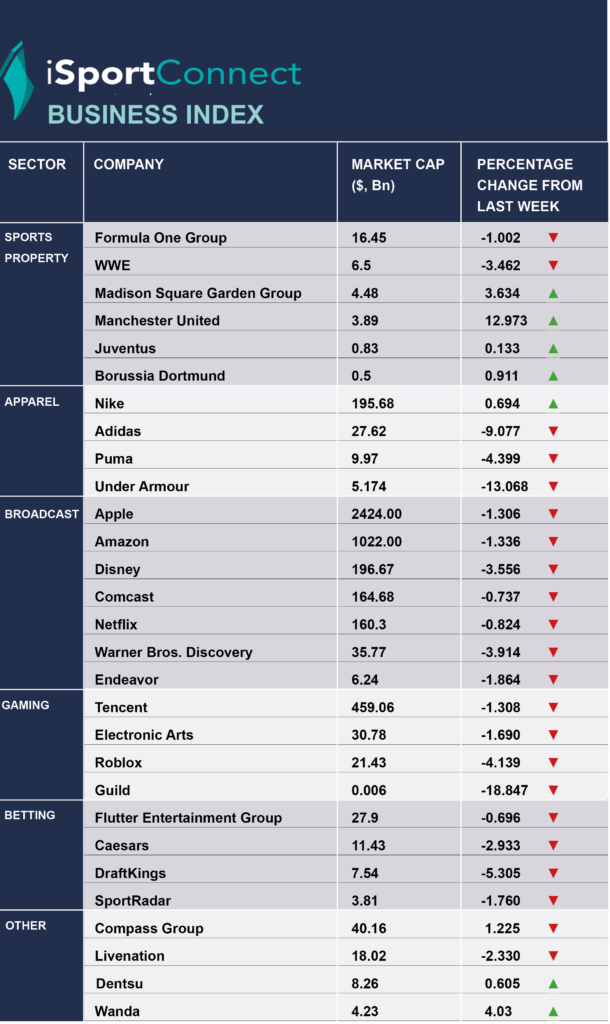
The Bottom Line: iSportConnect Business Index – February 16

Welcome to this week’s edition of the iSportConnect Business Index, after last week’s gains the Index has generally struggled this week, with only seven of our Top 30, having a positive week. 

Let’s have a deeper dive into the stories of the week then:

Manchester United – +12.973%

You can’t keep them out of the news and since our last Index, the Reds beat Yorkshire rivals Leeds United 2-0, but that isn’t why their share price is on the up. Last Thursday it was announced that a group from Qatar would be interested in buying the club and their share price shot up as a result. 

The deadline for submitting bids to buy the club is tomorrow, Feb 17, and suitors from the US, UK, Saudi Arabia and possibly a certain Elon Musk might be preparing bids. It is thought that the asking price will be close to $6bn so why is their market cap stuck below $4bn, at $3.89 bn. Interestingly in the first edition of the Index back in January the market cap was at $3.72 bn. The interesting angle is that since the Glazers announced a formal sale the share price has gone up x2.5 times. I still think there is upside. 

Adidas, Puma and Under Armour all down

The whole sector has taken a hit this week. Last Friday, Adidas announced they were severing ties with Yeezy. It is reported by Bloomberg that they are sitting on between $1.2 and $1.3 bn worth of Yeezy stock ,and the dispute between Adidas and Yeezy may even cause Adidas to have an operating loss for 2023. From last week they are down 9.077%. These are really big moves.

Under Armour are down a huge 13.068% from last week despite a better than expected earnings report which showed the company beating earnings and revenue predictions for the holiday period. However the sell-off that occurred on Thursday was caused by investors being worried by a sharp increase in unsold stock that could have an effect on the company’s gross margin in the coming quarters.

Betting brands struggle

More bets than ever were placed on Sunday’s Super Bowl, by the looks of our companies share prices most of them were on a Kansas City win. FanDuel reported taking 50,000 bets per second at the game’s peak. Fascinating that despite this most of the share prices were lower. too much already baked into the price?

Our friends at DraftKings had to pay out $2.68 million to one lucky punter, but given the fact they staked a cool $1.68 million, I doubt they are short of cash.

Let’s take a look at this week’s Index:

SailGP and Rolex announce ten-season partnership

SailGP, the global racing league and Swiss watchmaker Rolex have announced a groundbreaking new ten season partnership which will see the iconic brand extend the relationship as the global presenting partner and as the exclusive official timepiece of the championship through to the end of Season 13. 

Rolex joined as a presenting partner from the launch of SailGP in 2018, which this May will reach the conclusion of a record-breaking third season before beginning an expanded fourth season this June. This partnership highlights the strong alignment forged between the two brands as the championship continues its rapid growth. 

As part of the agreement Rolex will become title partner for the Season 4 opening event – Rolex United States Sail Grand Prix | Chicago at Navy Pier – this June 16-17, 2023. 

Rolex will also continue as presenting partner of SailGP’s ground-breaking docuseries Racing on the Edge, which takes fans behind the scenes of the global championship, to look at the high’s and low’s of the sport’s top professional athletes in their pursuit to be the best. In its second season, Racing on the Edge has been watched by over 2.1 million viewers since its creation. The latest edition, featuring Australia’s Tom Slingsby and his team’s rise to the top of SailGP, can be viewed here

SailGP CEO Russell Coutts said: “SailGP is only in our third season and this long term partnership shows the value we are continuing to create for our partners. Rolex has been an integral part of the success of our championship from the outset and we are honored to continue this exciting journey together.” 

Rolex Director of Communication & Image Arnaud Boetsch said: “Rolex has long supported those who go above and beyond to drive innovation and positive change. The Swiss brand’s involvement with yachting stretches back 65 years, during which time it has forged deep-rooted connections with elite organizations and individuals at the forefront of the sport. The unrelenting pursuit of excellence, together with the marriage of human achievement and technical development, as well as the fierce team spirit required to succeed, make Rolex a natural partner of SailGP.”

SailGP’s third season continues later this month at the KPMG Australia Sail Grand Prix | Sydney on February 18-19, before heading across the Tasman Sea for the ITM New Zealand Sail Grand Prix | Christchurch on March 18-19. The season will conclude at the Season 3 Grand Final | San Francisco on May 6-7. Season 4 commences with the Rolex United States Sail Grand Prix | Chicago at Navy Pier, June 16-17.

Formula E and Tata Communications announce multi-year partnership

Formula E and Tata Communications have announced a strategic multi-year relationship with the global commtech company becoming the Official Broadcast Distribution Provider to the ABB FIA Formula E World Championship.

The new agreement will see Tata Communications deliver high-definition, high-resolution and high-speed live broadcast content to viewers around the world as part of Formula E’s new remote broadcast production of live races, reducing the environmental impact typical of major live international sports events on TV.

Tata Communications technologically advanced, software-defined media edge platform will deliver more than 160 live video and audio signals from Formula E races across continents within milliseconds, using 26 media edge locations across North America, Europe and Asia.

The new super-fast race broadcast distribution will be supported by Tata Communications specially trained experts, providing round-the-clock global end-to-end managed services at all 16 races this season. Tata Communications and Formula E are also working together to further enrich experiences for motorsport fans with innovation and efficiency.

Today, Tata Communications will be making history with Formula E as the ABB FIA Formula E World Championship races in India for the first time. Viewers around the world follow the action live as 22 drivers from 11 teams including Mahindra Racing, Jaguar TCS Racing, Maserati MSG Racing and NEOM McLaren Formula E Team compete in the 2023 Greenko Hyderabad E-Prix.

Jamie Reigle, CEO, Formula E, said:

“Formula E is an intense tour given its on-the-go nature. Tata Communications’ support over the years has enabled state-of-the-art remote production possible, with real-time TV signal transmissions from the race venues to our broadcast centre in London and finally to the audience’s screens. Thus, bringing down multiple logistical challenges, driving cost efficiencies, travel flexibilities for our employee, especially women, and reducing emissions.”

A.S Lakshminarayanan, MD and CEO, Tata Communications, said:

“There are 85 cameras capturing the event for over 400 million people watching all over the world. To be able to facilitate that truly speaks about the power of internet that we have been able to leverage, with our dedicated media cloud and edge computing capabilities. And apart from our long-standing partnership with FIA, we extend the services to multiple major sporting leagues across the world.”

Member Insights: Beijing 2022, a year on – The prelude to war & The Olympic Games in an era of constant crisis and change

In this Member Insights article, Michael Pirrie examines the legacies and impacts of the Beijing 2022 Olympics in the countdown to the war on Ukraine.

There is a distinctive emotional weather front that accompanies the arrival of the Winter Olympic Games.

This includes high and low pressure zones of anxiety, excitement, and uncertainty in the cold pre-dawn mornings and shortened days that precede Games competition.  

Danger can lurk ominously, hidden beneath snow and ice.

A practice pirouette can break an ankle and a blossoming career; a final training session can end in tragedy and cost you your life  – Nodar Kumaritashvili, a young Georgian luger, died on a rehearsal practice run just hours before the Opening Ceremony of the Vancouver 2010 Winter Olympic Games.

The scale of the threat confronting the world’s best winter athletes and organisers of the Beijing 2022 Games is clearer a year on from the historic event.

The enormity of Beijing’s challenge was grimly illustrated by China’s soaring Covid death toll following the recent lifting of the world’s strictest lock down.

The external forces that shaped Beijing’s global winter spectacle are also clearer on the first anniversary of the Games as the political snow cover continues to dissolve

The Beijing Winter Games marked a new era of super power sport and politics.

Much of the spectacle was delivered on mountains of machine-manufactured snow, giving organisers a level of control over sport and climate matched only by Qatar’s refrigerated desert football world cup stadiums.

The political climate was more difficult to control.

A diplomatic cold front formed over China’s capital in response to more revelations of human rights abuse, while Chinese fighter jets also scrambled Taiwan’s air space in the countdown to the Games, forcing Olympic peace doves to find alternative flight paths into the host city.

The Beijing Games challenged sport’s status quo as well as athletes.

The Communist Party’s focus on total pandemic and political control chipped away at traditional Olympic freedoms and values.

The diplomatic boycotts also forced governments and international audiences to take sides over China’s controversial human rights record.

The political climate in China meant the voices of athletes were quieter on podium platforms and in the mixed zones.

Beijing’s legacies are more complex a year on, complicated by the close relationship between the Chinese and Russian leaders and subsequent war on Ukraine.

While London took the world from war to sport at the 1948 Olympic Games following the devastation of World War Two, Beijing 2022 formed a backdrop to Europe’s first major war this century.

Western intelligence reports indicate Putin may have delayed the invasion of Ukraine until after the Games in a concession to Chinese counterpart Xi.

While the delay gave Russia – and other Olympic nations – time to get teams home from Beijing before troops invaded, the postponement also avoided an international crisis which could have stopped the Games, seen as vital to Xis historic third term campaign for leadership of China.

Beijing 2022 framed the war on Ukraine – from the meeting between Xi and Putin on the eve of the opening ceremony to the commencement of the invasion just days after the Games.

Devastating invasion images quickly united the international community, challenging governing bodies and federations to respond in meaningful ways that reflected the gravity of the situation and sport’s position of influence.

The Ski Federation of Norway was one of the first to respond: “Sport is not detached from this (invasion) and cannot remain passive to what is happening now,” the federation said.  “The Norwegian Ski Federation’s message to Russia and Russian athletes is crystal clear – we do not want your participation.”

Beijing was constantly tense and threatening  – just a two hour flight from the Wuhan epicentre of the pandemic that had crushed the world.

Those risks began to subside as China’s closed loop system moved into overdrive and locked out the virus.

Beijing’s biosecurity bubbles and barriers minimised human contact and infections. 

The loop’s strict isolation and quarantine requirements also overwhelmed several athletes, and organisers scrambled to provide more food and shelter on mountain locations.

Athletes cut through the Covid and geopolitical gloom as Games services and operations became more familiar, finding rhythm and routine.

Electrifying performances generated an overlay of hope and meaning, sought increasing by audiences from sport in uncertain times.

Peggy Noonan, acclaimed speechwriter for late US President Ronald Reagan, once observed that “the bravest things we do in our lives are really known only to ourselves.” 

If so, the Olympic Games brought uncommon bravery to global attention.

Few showed more valour than the young Georgian luger Saba Kumaritashvili, who made good on a profound personal promise to compete at the Olympic Games on behalf of his cousin, Nodar, fatally injured at the Vancouver Games. 

Saba transformed a family tragedy into a towering triumph of the human spirit, realising the Olympic dreams of his beloved cousin 12 years after Nodar’s death. 

“Thinking about him (Nodar) is painful but gives me strength as well,” he said.

The key themes have also come into sharper focus from Beijing as the ‘Gender Games’ – the high impact story lines of many women athletes compelling, relevant and enduring a year on.

They include: 

·     The teenage ski sensation, Eileen Gu, who bridged the growing super power divide between her birth nation of America and Chinese ancestry, with grace, style and almost faultless performances. 

·     The ‘Little Girl Lost,’ teenage Russian skating prodigy Kamila Valieva, who has probably spent more time on the ice rink than in school exams; caught up in an international doping scandal at the Winter Olympics, only 4 editions of which she has been alive for.

·     Fallen but unconquered US world skiing champion Mikaela Shiffrin, who inspired in defeat. Despite failing to win any of the many medals expected of her in Beijing, Shiffrin recently tied for the most medals in Alpine skiing world championship history.

·     The mysteriously lost, found and gone again former Chinese Olympic tennis star Peng Shuai. 

Beijing was a Games of improbable Olympic outcomes.

US snowboarder Lindsey Jacobellis was an Olympic time traveller, who turned a haunting error from her past into a gold medal 16 years later in Beijing.

This was an uncommon story of self-belief and perseverance steeped in Olympic mythology. 

After a last minute swerve robbed her of first place at the Turino Winter Games in 2006, Jacobellis secured Olympic gold in Beijing at her fifth Games attempt.

Beijing also reinforced truisms for major sporting events in turbulent times, especially the interdependence between high performing venues and high performing athletes. 

Giant decommissioned cooling towers formed the surprise post-industrial backdrop to Beijing’s Big Air venue – the most compelling sports setting of 2022.

HIGH FLYERS

Athletes became new aviation pioneers, blessing themselves before launching so high off the slopes on snowboards that a pilot’s license, oxygen mask, and parachute might otherwise have been required for a safe landing.

Fellow boarders waited below to welcome their high flying colleagues back to earth, embracing fellow frequent flyers on landing, composing a new, more youthful image of Olympic sport following surfers and skateboarders from the Tokyo Games just months earlier.

The industrial towers produced high impact global viewing experiences prized by high paying broadcasters, while showcasing stunning sporting images for international federations and world governing bodies.    

RISE OF SMALLER NATIONS

Winter athletes from unlikely destinations in tropical Oceania succeeded against the odds and the weather.

These included two snowboarders from New Zealand who provided a new movie script for local Hollywood Lord of the Rings director Peter Jackson.

The athletes soared high above middle earth to capture their nation’s first two winter gold medals in 70 years, creating a new fellowship of the rings.

CONCLUSION

The Olympic Games in Beijing, like Tokyo, must be seen largely through the prism of the pandemic.

If the primary threat to the Games and the athletes was the pandemic, Beijing was successful with infection levels amongst the lowest in the world

The sports venues, services and operations were organised at a high level amid the most dangerous conditions encountered in modern sport 

While the Pyeongchang Winter Olympic Games generated unlikely gestures and overtures of peace on the heavily nuclearised and politically divided Korean peninsula four years earlier, the Beijing Games was less optimistic in tone and outlook

Beijing 2022 delivered high impact sporting performances and drama in one of the most politically charged environments of modern sport.  

The Beijing Games pointed to new geopolitical challenges and uncertainties for international sport in a rapidly changing and divided world.

This was highlighted by IOC President Thomas Bach in his Beijing ceremony addresses, observing that “division, conflict, and mistrust are on the rise.” 

The Beijing boycotts demonstrated that strong international support is needed for cities and governments to host Games that engage and relate to the world.

While the diplomatic stand offs were condemned and dismissed by China, the boycotts widened the spotlight on China’s human rights record and further challenged its international image.

Along with Beijing, Almaty, the biggest city in the former Soviet Republic of Kazakhstan – where government shoot-to-kill orders were issued in recent times to crush protests – was the only city that completed the bidding process for the 2022 Winter Games.  

The Games did not produce the legacy of international respect and recognition sought by the Communist Party of China for Beijing, as the first city to host the winter and summer Olympiads.

China created a new modern day ice-age for winter sports in Asia built on mountains of artificial snow

While the Beijing Games was the catalyst for a new international winter sports destination, the subsequent war launched on Ukraine by China’s ally has had a more dramatic impact on world sport.

Devastating daily images of the suffering inflicted by Russia continue to test of sport’s capacity to respond authentically to the crisis.

While Olympic stakeholders seek a credible pathway to bring Russia back into the fold for the Paris Games, opposition to Russia’s Olympic return is hardening due to the unrelenting brutality of the invasion.

Russia’s war also continues to disrupt nations and cities involved in the initial application process to host the 2022 Winter Games.

These include especially, Poland, which became a haven for Ukrainian refugees, and Sweden.

And in one of the harshest of modern historic ironies, Lviv, Ukraine – now fighting for its survival – also applied to host the world’s foremost sporting event dedicated to peace, the Olympic Games in 2022, delivered by Beijing, Russia’s ’no limits’ partner!

Michael Pirrie is an international communications advisor and consultant who has worked in senior positions on major global sporting events and campaigns. These include the London 2012 Olympic Games, Brisbane 2032 Olympic Games bid, and the Invictus Games. 

Ear to the Ground announce new US Webinar

Future of Fandom: How can brands tap into the global explosion in fandom of the major US sports leagues?

The power of listening: LIVE From the All Star Weekend in Salt Lake City

US Sport popularity is on a global upward trajectory – How can brands take advantage of this and which brands are already smashing it. Ear to the Ground are a global agency with global opinions from their Fan Intel network – we can help your brand understand how you can tap into this growing market.

Global Fan Intelligence® Network Members will join our own experts to share their opinions on the topic and the opportunity for brands.

Join us from 4PM GMT (11AM EST, 8AM PST) on Friday 17th February.

https://us02web.zoom.us/webinar/register/WN_hJ0B5H5ASyeYNXwwkcIN6A