
Four Strategies Emerge As Sports Rights Owners Size Up The NFT Opportunity

It’s early days for the decentralised web or “web 3.0” (the blockchain era) and it’s impossible to predict the impact blockchain technology will ultimately have on the business of sport. What is clear is that the sports industry continues to obsess over non-fungible tokens (NFTs).

If you need a refresher on NFTs and how they fit into the context of blockchain, then read this explainer article.

“It is an understatement to say that, in our experience, it is rare for sports rights owners to take a product-focussed strategy over a commercial-focussed strategy.”

Based on many conversations with rights owners across the iSportConnect community, we in the iSportConnect consulting team see four strategies emerge as sports rights owners size up the NFT opportunity.

Four NFT Strategies For Sports Rights Owners
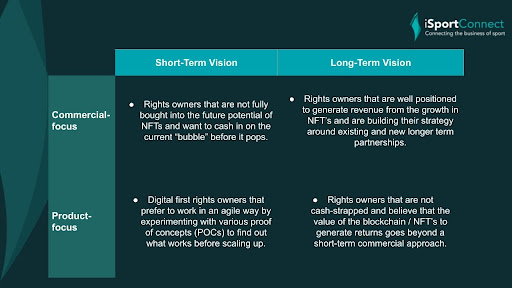
The most common NFT strategy that we have seen emerging over the past six months is that of the short-term commercial approach. Our assumption is that some in this segment don’t necessarily believe that NFTs (at least in their current fan engagement incarnation) will be around for long and want to generate the maximum amount of income in the shortest possible time (typically two to three years). They look to get the best possible minimum guarantee from any deal.

Certain rights owners feel comfortable enough to enter into longer-term commercial deals. They have a stronger conviction that the current fan engagement-driven NFT phase will last and are open to deals up to, in some cases, as much as eight years.

It is an understatement to say that, in our experience, it is rare for sports rights owners to take a product-focussed strategy over a commercial-focussed strategy. Nevertheless we have spoken to rights owners in our community that prioritise the user experience (and marketing gains) over the immediate commercial gains on offer. Rights owners in these segments generally don’t see NFTs as a sponsorship or a licensing category.

“The rarest of the rare are those with a long-term vision and a product focus. These rights owners have the belief that the NFT opportunity is part of something much bigger.”

Those with a short-term vision and product focus, are looking for NFT partners whose product vision aligns with theirs and with whom they can run proof of concepts (POCs) to find out what works before scaling up to their fan community. The very nature of their short-term focus is based on an openness to the agile way of working (more common seen in the digital-first world of Esports).

The rarest of the rare are those with a long-term vision and a product focus. These rights owners have the belief that the NFT opportunity is part of something much bigger. They are willing to be patient and put more emphasis on finding the right partners with an aligned vision. They are confident that commercial gains will come in time, but don’t have the financial pressures that other rights owners might have.

The PWC Sports Survey 2021 suggests that the majority of sports rights owners have not yet entered the market and in fact over half have either “yet to define concrete use cases” or “lack the knowledge on NFTs”.
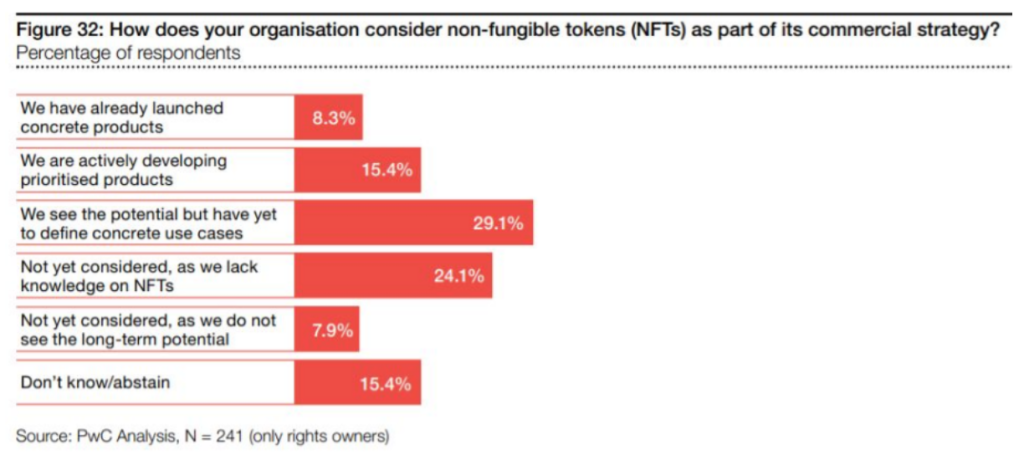
This uncertainty is likely only to be counteracted by education and direct experience. Nevertheless, it is not helped by the fact that NFTs in sport have become synonymous with fan engagement use cases (particularly in terms of collectibles and fan voting). This great article, which has been circulating in sports business circles, helps to explain why NFTs are far more than a mechanism to enable fans to engage with their favourite club or athlete. Indeed, NFTs can go way beyond to become the underlying layer of ownership on the web.

None of the strategic directions we outlined above are “wrong”. Every sports rights owner must weigh up their own options and decide which strategy is right for them. What is clear is that we are only at the beginning and the impact of web 3.0 on sport is only going to become more profound.

About iSportConnect’s consulting team

iSportConnect’s consulting team work on a daily basis with a select number of best-in-class companies to grow their business in sport. The team also helps rights owners across the iSportConnect community to navigate the diverse challenges they face, from data and revenue generation to sustainability. The team have worked in some of the sports world’s most influential and innovative businesses including City Football Group, FIFA, Chelsea FC, Millwall FC, Sky, the BBC, Kiswe and Eleven Sports.

To find out how we can help you contact us on info@isportconnect.com

Five Go To Market Tips For Sports Tech Startups

Recently I spoke to a friend working in a leading sports business media group who agreed with my assertion that deep pockets are enabling a relatively small number of sports technology companies to dominate the sports business media, putting lots of great startups at a major disadvantage. This idea wasn’t mine. It’s based on frustrations that I have heard from several leading sports tech startups.

The reality is that it’s getting more and more difficult for the next generation of B2B sports tech companies to break through as the purse strings of sports rights owners are drawn tighter and sales cycles get even longer.

This is prompting many sports startups, without the big budgets, to spam the hell out of rights owners and other potential buyers. The sports tech marketplace feels like a scene from the movie Scarface. Metaphorically speaking, many sports tech companies are pulling out large machine guns and spraying emails and cold calls everywhere with a blatant disregard for the destruction they are leaving in their wake.

“Look at other companies in your value chain who provide complementary services to yours. Can you create value for the market by collaborating?”

Here are five tips to help your sports tech startup to get noticed on a budget (without the machine gun). A small disclaimer…what follows assumes you have clear company and commercial / marketing objectives in place.

Build alliances within your value chain

If you are reading this as a startup and you’re searching for creative solutions to reach your potential customers, but can’t spend USD10K to speak at a leading sports business event or to talk on a podcast, you need to think creatively.

As this Sports Tech World Series article predicted, “Winning organisations are focused on open collaboration. The truth is that we can’t create the best of everything in-house. Partnering together in an “Open Innovation” ecosystem is the winning strategy in 2021 and beyond for sports technology”.

Look at other companies in your value chain who provide complementary services to yours. Can you create value for the market by collaborating?

Integrations offer start ups a road to accelerated growth. Partners can be a source of product feedback, they can help you solve customers problems quicker or better, they can bring exposure to interesting clients and they can contribute financially to shared marketing activities.

For example, let’s say you are a streaming platform. You could build integrations with an IP-transmission partner, a cloud-based commentary solution and a watch together solution. Suddenly this gives you (and your partners) options. This can be a risky area of course and is a topic that merits a blog post of its own.

Put the focus on customer problems, not cash

If you are a startup, you will be short on time and hungry for product feedback. Don’t approach every conversation as a sales conversation unless you are in the small minority that have already nailed your product market fit. Try to understand the barriers facing your potential customer to experience your product and work out how you can make it more accessible. In many cases sports rights owners simply don’t know where each of their problems sits in terms of priority, and this is often the start of their challenge to innovate.

“If you want to succeed, spend more time talking to potential customers about their problems and, just as importantly, try to speak in a language that they understand.”

In these cases, running a proof of concept together can be the most effective way to get the conversation started. There is nothing better than running a successful proof of concept with a potential customer and helping that customer to better understand the benefits you can bring and build a case to secure a budget. On the flip side, you might also figure out through the process that you are incompatible.

Talk like your customers

I’m in many product demo meetings these days. The fun part is that I see some great products in their nascent stages. However, I’m often lost after the first five minutes due to a focus on “cool” features and an over use of technical terms and acronyms.

If you want to succeed, spend more time talking to potential customers about their problems and, just as importantly, try to speak in a language that they understand. Consider whether you’re addressing someone with a business background or technical / product background and always remain focused on the problem you want to help them solve.

Apply the basics of good content marketing

The fundamental importance of search engine optimisation (SEO) can’t be overstated. Put simply, SEO is the science (and art) of ensuring your website is top of the search engine results pages for search terms that are relevant to your potential customers.

“If there is one thing that start-ups have in abundance, it is learnings! The worst blog content pushes the company’s products and services centre stage.”

If your website is being crawled by search engines effectively, and you understand the key words that are relevant to your potential customers, then you are (more or less) ready to start producing content that effortlessly incorporates these key words.

As a contributor to sports technology company blogs, I understand how challenging it can be to write impartial and interesting content. The best content coming from sports tech companies focuses on the pain points of their customers and on sharing the learnings that have lead them to the particular solution that they are offering. If there is one thing that start-ups have in abundance, it is learnings! The worst blog content pushes the company’s products and services centre stage.

Avoid door-stepping

The spamming or “door-stepping” culture I referred to in the opening paragraph is pervading the sports technology sector as it becomes more and more competitive and long sales cycles continue to bite. Frankly speaking, this practice is hurting good early stage companies as it is driving sports rights owners, and other potential customers, to disengage from the market.

Align yourself with good people who have trusted networks and respect these networks as one of your most valuable assets. If you are a B2B company, personal selling will be critical to your growth, but it requires a clever balance.

My advice? Break the mould. Put an end to door-stepping. I guarantee it’s not working for your competitors.

About David

David Fowler is Co-Founder of SportsTech Match and a Marketing Consultant helping sports rights owners to make sense of technology as a means to innovate their business models and sports tech companies to get to market. He was the Director of Marketing at football streaming platform MyCujoo and a commercial executive at FIFA for over ten years.