
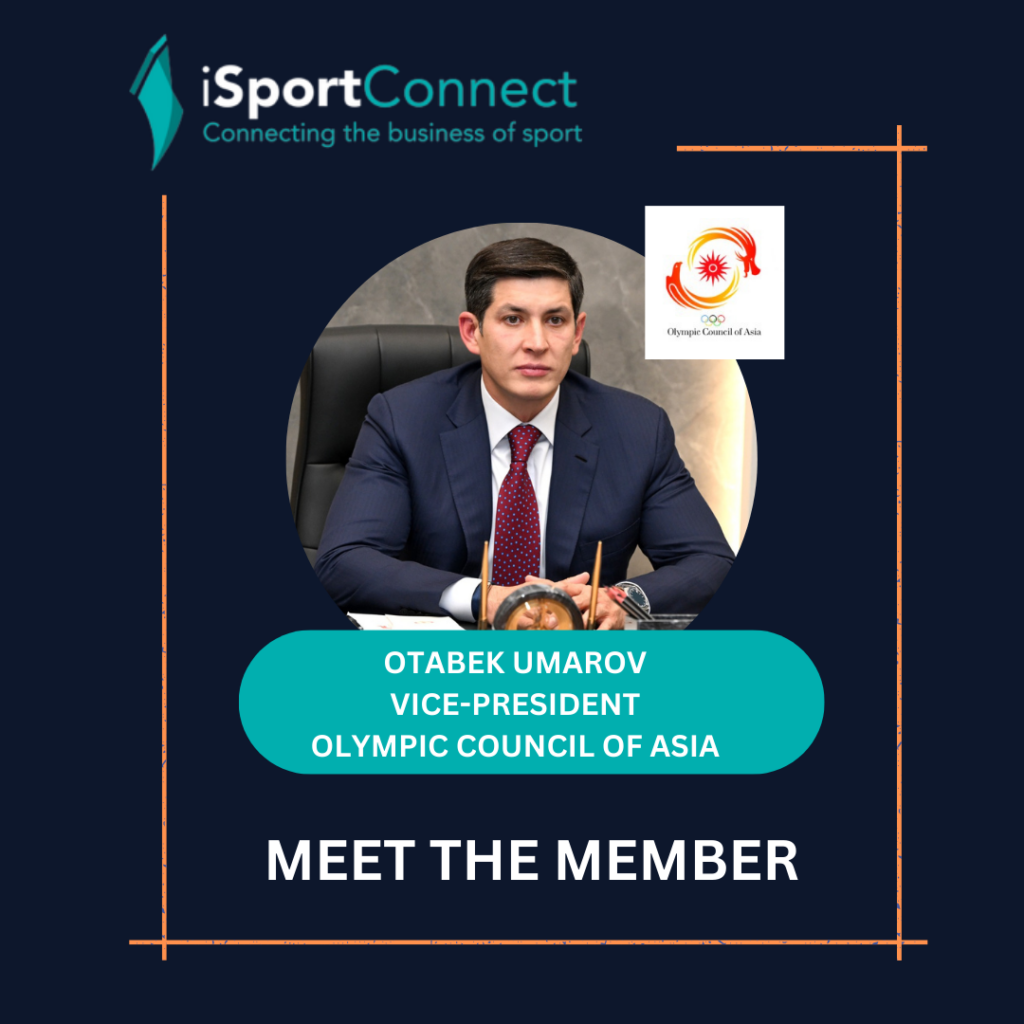
Otabek Umarov: How Uzbekistan Is Building a New Sporting Hub in Central Asia
March 12, 2026
As Uzbekistan accelerates its ambitions to become a major hub for international sport, the country is investing heavily in infrastructure, event hosting and athlete development to strengthen its global presence. In this exclusive interview with iSportConnect, Taruka Srivastav speaks with Otabek Umarov, First Vice President of the National Olympic Committee of Uzbekistan and Vice-President of the Olympic Council of Asia, about the strategic vision behind the country’s sporting rise, the impact of landmark projects such as Olympic City in Tashkent, and how sport is being used to drive youth development, international partnerships and long-term national growth.
Uzbekistan has significantly strengthened its presence on the global sporting stage. What has been driving this strategic push to host more international sporting events in recent years?
Guided by the strategic vision of President Shavkat Mirziyoyev, Uzbekistan has been steadily strengthening its position as a destination for major international sporting events.
At the core of the country’s sports policy lies the national philosophy “Healthy Person – Healthy Nation.” The initiative promotes physical activity and encourages a healthier lifestyle among the population. According to research, around 44% of Uzbekistan’s population does not engage in regular physical activity, which is why the development of sport has become a key national priority.
To support this strategy, Uzbekistan has been actively investing in modern sports infrastructure. One of the most notable examples is Olympic City in Tashkent – the largest sports complex in Central Asia – which provides world-class conditions for both athlete preparation and the hosting of major international competitions.
At the same time, Uzbekistan continues to strengthen cooperation with international sports federations and organizations, allowing the country to regularly host world championships, continental tournaments, international series events and major sports forums.
Hosting such events plays an important role not only in the development of sport but also in promoting the country internationally, boosting sports tourism and strengthening global partnerships.
Our goal is to inspire the next generation, build a healthier society and firmly establish Uzbekistan as a reliable partner and one of the emerging centers of global sport.
The development of the new Olympic City has been a landmark project. How will this complex transform athlete preparation, grassroots participation and Uzbekistan’s ability to host world-class competitions?
As mentioned earlier, Olympic City is the largest sports complex in Central Asia and a symbol of our long-term investment in the future of sport.
Spanning nearly 100 hectares and officially opened in August 2025, the complex includes five major venues, among them a 12,000-seat stadium, a velodrome and a modern aquatic center.
The project was designed not only as a competition venue but as a complete sports ecosystem. The site houses national team training bases, offices of sports federations and the State Sports Academy. In essence, we have created a unified sports cluster where education, athlete development and international competitions come together in one place.
The complex is already delivering tangible results. In October, Olympic City will host a stage of the World Aquatics Swimming World Cup, bringing together more than 750 athletes from over 50 countries. This will be a historic event for Tashkent and another sign of the international sports community’s trust in Uzbekistan.
In addition, the venue hosts the unique multi-sport event known as the Presidential Olympiad, where the strongest athletes from all regions of the country compete. These games help identify new talents, increase youth interest in sport and also serve as an important step in preparation for the Asian Youth Games Tashkent 2029.
Olympic City has therefore become much more than just sports infrastructure. It is now a key platform for elite sport development, grassroots participation and the strengthening of Uzbekistan’s role in the global sporting movement.
Uzbekistan’s qualification for the FIFA World Cup is a historic achievement. How has this influenced national sports policy, youth development and public interest in football?
Uzbekistan waited more than 34 years for this moment – qualification for the FIFA World Cup. It is not only a major sporting milestone but also a powerful social moment for the entire nation.
This achievement inspires young people, strengthens belief in their potential and opens new horizons. Most importantly, it significantly increases the younger generation’s interest in sport.
Our footballers will not only demonstrate their sporting abilities this summer but will also have the opportunity to showcase Uzbekistan’s rich culture and history on the world’s biggest sporting stage to a global audience estimated at more than five billion people.
Uzbekistan already inspired millions of fans during the Olympic Games in Paris 2024, and that journey will continue at the FIFA World Cup.
Hosting the largest-ever General Assembly of the Olympic Council of Asia was an important diplomatic milestone. What did this event demonstrate about Uzbekistan’s growing role in the Olympic movement?
It was a great honor for Uzbekistan to welcome leaders of the Olympic Movement and representatives of international media and give them the opportunity to experience the country’s traditional hospitality.
Hosting the largest General Assembly in the history of the Olympic Council of Asia reflects the rapid development of sport in Uzbekistan and the strong attention the government places on this sector.
The successful organization of such a large-scale event demonstrated to the Olympic Movement that Uzbekistan is fully capable of hosting major international sporting competitions and global events.
As Uzbekistan expands its sports infrastructure and event-hosting ambitions, how do you ensure long-term social and economic impact rather than just short-term image benefits?
The year 2026 will be particularly significant for Uzbekistan, as the country will host several major international events.
These include a stage of the World Triathlon Championship Series in Samarkand on April 25–26, the 46th FIDE Chess Olympiad in Samarkand from September 15–28, and a stage of the World Aquatics Swimming World Cup in Tashkent from October 8–10.
These events represent an investment in the future. With around 60% of Uzbekistan’s population under the age of 30, sport has been identified as one of the country’s national priorities alongside healthcare and education.
By investing in sport today, we are building a healthier and more resilient Uzbekistan for tomorrow.
Sporting success and sports diplomacy often go hand in hand. How does Uzbekistan use sport to strengthen international partnerships and its global image?
Today, sport has become an important platform for international dialogue and cooperation. Uzbekistan actively uses it to strengthen partnerships, exchange experience and expand its presence within the global sporting community.
Hosting major events such as the FIA General Assembly and Awards ceremony in 2025, as well as the Olympic Council of Asia General Assembly, creates unique opportunities not only to deepen relationships within the Olympic Movement but also to establish new international partnerships.
For example, during the week of the OCA General Assembly, more than 20 cooperation agreements were signed, including initiatives to establish regional academies for wrestling and weightlifting aimed at developing sport and supporting young talent.
As a result of Uzbekistan’s consistent sports strategy, the country is increasingly becoming a meeting point for global sports leaders. In 2025, Uzbekistan welcomed major figures from the international sports community including FIFA President Gianni Infantino, World Aquatics President Husain Al-Musallam, United World Wrestling President Nenad Lalovic, International Judo Federation President Marius Vizer, World Triathlon President Antonio Arimany, International Weightlifting Federation President Mohammed Jalood and FIA President Mohammed Ben Sulayem.
These visits are not merely ceremonial. They are meaningful working meetings where concrete projects, international competitions and long-term cooperation programs are discussed.
Thanks to this comprehensive approach, Uzbekistan is steadily emerging as one of the key sporting hubs of Central Asia and a reliable partner of the global sports community.
Looking ahead to the next decade, what is your vision for Uzbekistan’s place in the Olympic and global sporting landscape?
At the Olympic Games Paris 2024, Uzbekistan achieved its best-ever result, finishing 13th in the overall medal table. This is a strong indication that the country’s athlete development system and sports infrastructure are moving in the right direction.
As we continue to strengthen our sports ecosystem, we aim to build on this success at the Olympic Games Los Angeles 2028. Statistics show that Uzbekistan’s performance improves from one Olympic cycle to the next, reflecting a systematic approach to athlete development, modern infrastructure and strong support for talented athletes.
Our progress is also evident at other major international competitions. Uzbekistan finished second at the Asian Youth Games in Manama and the Islamic Solidarity Games in Riyadh, and achieved a historic first place at the Asian Youth Para Games in Dubai.
However, for us sport is not only about medals. Our long-term vision is to make sport an integral part of everyday life.
Such achievements inspire young people to take up sport and lead active, healthy lifestyles, which ultimately strengthens the health and wellbeing of the nation.
We are confident that in the coming decade Uzbekistan will continue to grow as a competitive sporting nation, a trusted host of major international competitions and a country where sport plays a central role in society.