
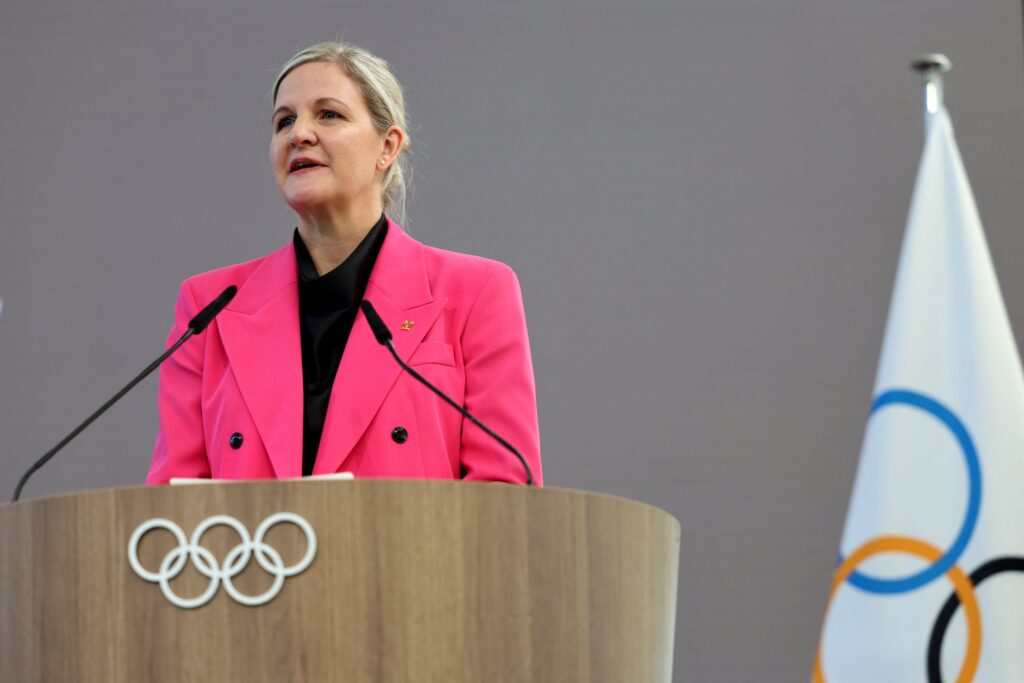
The New Olympic Era: Kirsty Coventry’s Leadership in a Time of Global Upheaval
January 27, 2026
With the Milano Corina 2026 Winter Olympic Games set to showcase a new year of international sport, Michael Pirrie reflects on the events, issues and figures who shaped Olympic and global sport over the past 12 months in a multi crisis world, and also looks at the growing influence of new IOC President Kirsty Coventry.
“In the epochal change we are living through, there is a need for hope, and sport contains and transmits this precious value,” Italian President Sergio Mattarella, December 2025, said on the arrival of Olympic flame in Italy for the Milano Cortina 2026 Torch Relay.
Final preparations have now commenced for the world’s premier winter sporting event in the mountains, valleys and regions of northern Italy. Levels of adrenaline and anxiety are beginning to increase in the countdown to competition as each new day breaks, more venue overlay is brought in and floodlights and generators cut through the cold. There is excitement, expectation and uncertainty.
The memory of Nodar Kumaritashvili, the young Georgian luger who died during a training session just hours before the Opening Ceremony for the Vancouver 2010 Winter Olympic Games, lingers vividly over winter sports and sport more widely as the ultimate moral duty and responsibility for athlete safety.
The usual pre-Games worry over government funding gaps and delays in venue completion and testing are also present, perhaps with more urgency this time. The atmosphere and settings have added significance here, where new IOC president, Kirsty Coventry, will soon oversee her first Games in charge of the Olympic movement.
TESTING TIMES
The former Olympic champion has placed athlete welfare and representation high on her agenda and is sensitive to dangers inherent in the spectacle of sport.
Milano Cortina will not only be a test of athlete conditions, new sporting events, integrated operations for a new decentralised Games model, and legacies for venues, the environment and regional host communities.
From Salt Lake City’s vote buying scandal, Sochi’s almost incomprehensible venue costs and Russian Government’s state orchestrated doping operations to Beijing’s synthetic winter of snow manufactured mountains, the Winter Games have been a bellwether for major issues and challenges that have expanded and shaped Olympic and world sport over the past year – from host city selection and event costs, venues and service level budgets, military conflicts and geopolitical instability to economic uncertainty, worsening weather conditions, political neutrality, gender fairness and moral complexity.
SPORT’S PERSON OF THE YEAR
These and other issues will be addressed by Coventry and her teams in the coming months and beyond as the new IOC president attempts to navigate the Olympic movement through increasingly fragmented and unpredictable global landscapes into a new world of sport still forming on near and far horizons.
In a year of enormous international instability, Coventry was the sports person and story of 2025
Her election as president of the IOC eclipsed the grandest sporting events of the past year because it will shape how world sport is governed, where the Games take place, who it includes, where investment in sport flows and where sport will survive, thrive and grow for decades to come.
More than a Wimbledon or Champions League final in a non-Olympic year, Coventry’s election was a milestone moment for the international community and for sport more significant than the presentation of a trophy or cup
The significance of Coventry’s election from outside the long-established geopolitical networks of power and influence is matched only by the position itself.
The IOC presidency and policies influence how politics, economics, diplomacy, human rights, national identity and global development can play out through sport.
SPORTING BRILLIANCE
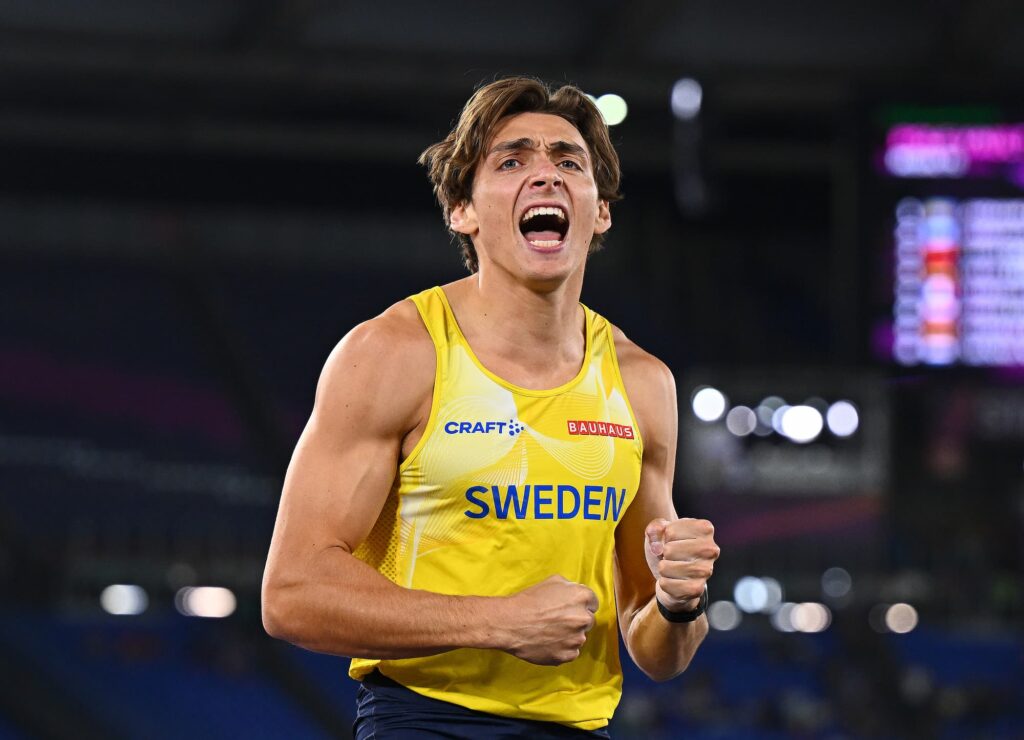
In a year of extraordinary sport, Armand Duplantis eclipsed the pole vault world record for the fourteenth time.
The performances of two female athletes however perhaps best captured some of the dramatic shifts underway in world sport over the past 12 months, realized with Coventry’s election.
China’s 12-year-old Yu Zidi became the youngest swimming medalist in world championships history, while Lindsey Vonn of the US became the oldest alpine skier to win a World Cup race, aged 41.
The two athletes expanded the biological boundaries of sport and human achievement and were part of a landmark year for women in sport.
The two record breaking performances and accomplishments by other female athletes also underscored the importance of protecting the women’s category and integrity of women’s sport as it has surged culturally and commercially, with broadcast audiences soaring and investment growing.
Female athletes around the world led the most significant global discussions on eligibility, fairness and safety in sport for decades
The federations listened and reviewed policies, led by World Athletics and its president, Seb Coe, who introduced genetic testing to confirm the sex of athletes in track and field – the biggest and most important Olympic sport.
Coventry also established an expert working group to look at the complexities of transgender participation shortly after gaining office.
Coventry’s presidency was born in a multi crisis world that will shape the priorities, directions and challenges of her leadership.
Sport over the past year was impacted profoundly by upheavals, conflicts, and devastation the world over
The search for meaningful peace in Ukraine and Gaza was a roller coaster that transformed sport into a moral and geopolitical battlefield.
Putin’s unrelenting slaughter of human life in Ukraine developed into a deeper crisis inside and outside sport, highlighting how differently the Russian government views the world and sport
The mounting death toll of innocent Ukrainian civilians and families – as well as athletes and coaches – filled more cemeteries and graveyards and further eroded the distinction between sport neutrality and moral neutrality
The world’s leading federations and governing bodies could not remain neutral to the apocalypse war, with the IOC and Fifa banishing Russian national delegations and teams from the world’s biggest sporting stages this year, ensuring the Winter Olympic Games and Football World Cup do not become Trojan Horses for Putin propaganda.
The bans create an exclusion zone, helping to defend sport’s humanity and integrity, and isolate Kremlin controlled sports systems and National Olympic Committee which require athletes to support and defend Putin’s full-scale invasion.
These and other bans also follow Russia’s violation of the Olympic Truce, , intended to shield athletes and competitions from armed conflict, and years of documented systematic state sponsored doping designed to manipulate, weaponize and dominate global sport for Putin and Russia’s power and prestige.
The bans against Russia’s atrocities also recognizes that sport does not occur in a moral vacuum and were widely supported by the international community on which the Olympic movement depends. The International Paralympic Committee misread the mood and was strongly condemned after lifting suspensions on Russian and Belarusian paralympic teams.
The move immediately prompted anger from athletes and concerns it would dilute credibility of the brand and commercial interest and support for the paralympic movement.
The fates and fortunes of Olympic host and bid cities and nations, on which the Olympic Movement depends, were impacted in different ways by geopolitical violence and deteriorating climate and political conditions in 2025, which continue to intensify
The turbulence spanned the year, beginning with the destructive climate change driven LA wildfires in January, in the next summer Games host city, and ending in December with the Bondi horror mass shootings, the worst terrorist attack in the history of Australian, host nation of the Brisbane 2032 Games.
While Bondi did not happen in Brisbane, it was felt more broadly across Australia as a profound attack on its open, multicultural and faith inclusive way of life and will form part of the wider national background and story of the host nation and 2032 Games.
The Bondi shootings will also form part of the broader global geopolitical environment in which Games are now planned and delivered.
COVENTRY’S EARLY INTERVENTION & IMPACT
The political and human catastrophe of Gaza began to impact sport more significantly in 2025, and Indonesia withheld visas from Israeli gymnasts to enter the Muslim-majority nation for a major sporting event.
In a defining early intervention, Coventry’s IOC acted swiftly and decisively to its first major international test, applying a principle of collective Olympic solidarity that treated an attack on one nation as an attack on the Movement itself, and suspended early Games bid engagement and advised federations against hosting events in Indonesia.
A brutal, murderous crackdown on citizen protests over deteriorating living conditions in Iran along with the return of Islamic State fighters in Syria further destabilized the Middle East region, where Qatar and Saudi Arabia are seeking to host the Games.
India launched missile strikes on Pakistan in response to claimed terror attacks but will not deny athlete visas, keeping alive its powerful bid backed strongly by the Modi government to bring the Games to the new superpower with the world’s biggest youth sports market.
OLYMPIC CRITICAL SUCCESS FACTORS
Meanwhile, a new approach to Games success and athlete welfare and career planning and development, core Coventry KPIs, was launched by the Australian Olympic Committee in late 2025
The strategic $50 million Olympian Futures Fund provides retirement grants linked to Olympic appearances and selection, as well as targeted financial support for athlete mothers returning to elite competition.
Its purpose is to enable athletes to better plan for their post competition lives and to extend the careers of Australia’s Olympians in order to maximize medal winning performances at Brisbane 2032 by domestic athletes – the single most consistent driver behind the success of iconic host Games in recent times, including Sydney 2000, Vancouver 2010, London 2012 and Paris 2024
THE ‘FIRST LADY PRESIDENT’
While the IOC presidency is regarded as one of the most complex roles in international affairs, internal reviews of Kirsty Coventry’s early leadership have been impressive and overwhelmingly positive, with a marked strengthening of confidence within the IOC administration and among members since taking over.
Despite a low-profile election campaign, Coventry has consolidated authority quickly and calmly and with quiet self-confidence, buoyed by the scale of her election victory and mandate.
One former IOC executive board member described Coventry as “the First Lady President with a first-class Olympic pedigree and political judgement to meet the moment.”
Coventry’s inclusive leadership style – particularly with broader member engagement, including direct consultation on Zoom calls – was cited as having materially shifted internal attitudes.
Sources report improved coordination across specialist advisory committees and groups discussing issues vital the future of the Games.
These include seasonal scheduling and locations for some Olympic sports to combat the expanding impacts of climate change on sport.
There was growing support for change that would provide members with a genuine choice of multiple bid cities to stage the Games.
PARIS GENDER DIFFICULTIES
Significantly, sources emphasized the need also to protect the core intention behind the recent redesigning of the host selection model, recognizing the Games now represent a uniquely complex, high risk global undertaking that requires best practice boardroom governance to prevent possible block voting, external manipulation, geopolitical interference, fraud and reputational damage.
Members and staff have also responded positively to a change in strategic direction, encouraging the IOC to approach Games rules issues more proactively. These include sensitive areas such as gender eligibility following “difficulties in Paris,” according to a senior member.
The long-awaited IOC findings into the globally controversial issue of transgender rights, differences in sexual development and male-to-female athletes, looms as a milestone moment in modern sport and society.
The IOC rulings, expected later this year, will attempt to balance inclusion and fairness in sport with safety and equality paramount for female athletes.
The IOC’s new rules to protect the women’s category are fundamental to the integrity of the Olympic Games as the world’s biggest sporting event for women and will form an important part of Coventry’s legacy.
While debate and protest are unlikely to disappear, there is emerging international legal and community consensus recognizing the fundamental importance of biological sex in women’s sport.
A specialist United Nations report has warned of the risks to women’s safety in gender diverse sporting competitions and environments. “To avoid the loss of fair opportunity, males must not compete in the female categories,” and human rights positions “must continue to be consistent with science and fact,” the post Paris 2024 report said.
COVENTRY’S NEW OLYMPIC WORLD
CONCLUSION
The world’s geopolitical, economic, climate and security fault lines deepened and widened during the Bach era.
The old paradigms and protocols that protected sport from sudden international jolts are less able to isolate sport and neutralise new geopolitical shocks.
While much has been made of the changing rules-based global order, the rules governing orderly planning for the successful location, preparation and hosting of major world events are also changing.
This shift is impacting western nations, values and conditions that have long sustained, grown and globalised the modern Olympic Games, linked to strong government financial and public support for the mega event
According to recent World Bank reports, political stability has fallen everywhere, especially in Europe and the US, where the vast majority of Games have been hosted.
There has also been a marked decrease in the proportion of the global population living in a democracy, down from more than 50 per cent a decade ago to not much more than a quarter now, governed for the first time by mostly right-wing populists.
SELECTING CITIES IN TESTING TIMES
While the total value of global companies is back near a record high, the global cost of living, affordability and inflation, which traditionally influence public and government support for major events, currently show little sign of diminishing.
Selecting cities and nations capable to host the Games, the world’s biggest event and piece of project planning and management, in such fragile conditions, will be Coventry’s biggest challenge.
The central test for the new IOC leader is whether the Olympic movement can embody humanity, cooperation and a credible pursuit of peace in a multi crisis world when millions live amid insecurity, division and conflict- and whether the Olympic Games and its host cities and programs can be spaces and places where these values and goals are visibly demonstrated, pursued and practiced.
HOPE & THE NEW OLYMPIC NARRATIVE
The performance of host cities as well as the athletes in these new geopolitically complex times is central to new Games narratives.
The Olympic Games are being judged less by how perfectly they are staged but also by how resiliently they respond to crisis in a fractured world.
In a new age of overlapping crises, the Games have evolved into something greater than a sporting spectacle, taking on renewed significance as events and experiences of collective hope.
We saw this in London in 2012 when the city showed the world that in the face of terrorism societies can still move forward together with courage and confidence; in Tokyo where the Games was a reminder that even amidst the greatest global public health crisis of our times, the world could still come together even when separated; and in Paris, nations of athletes journeyed from around the world to the French capital to compete during the first major European war in nearly 80 years.
This new narrative which also extends to LA 28 – designed to show how major cities, urban areas and major events can respond with new solutions and resilience to destructive climate conditions – is starting to transform how the world sees the Olympic Games.
The Milan o Cortina Games will soon arrive under the leadership of Kirsty Coventry, who symbolizes this shift in the Olympic narrative.
Her appointment as leader of one of the last global institutions capable of bringing the people and cultures of the world together is also a reminder that the Olympic Games can stand as an international expression of hope and space for nations to gather in peace, choosing competition over confrontation and a better world over a divided one.
As European countries prepare for possible conflict in the background of Milano Cortina 2026, rearming and reintroducing national service on the Olympic home continent, the Games can show why the world needs an event like the Olympics in these tumultuous times.
Michael Pirrie is an international communications and major events consultant who has advised and worked on several major global events and was Executive Advisor to the London 2012 Olympic Games Organizing Committee.