
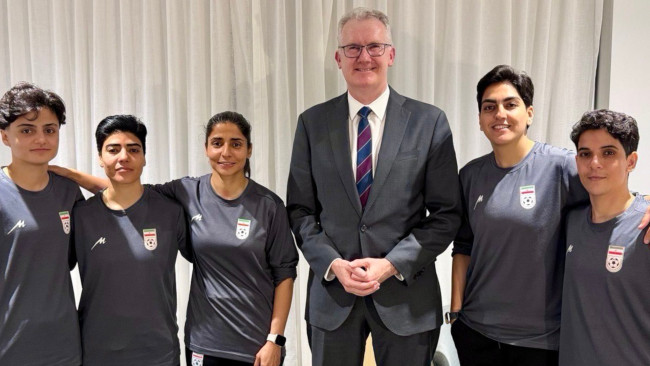
From Football Match to Cold War Spy Thriller – Inside the Defections that Shook World Sport
March 19, 2026
Olympic Games organizing executive and bid adviser, Michael Pirrie, outlines the significance of the national anthem protest and daring midnight bid for freedom by the Iranian Women’s Football Team and why it symbolizes a new era in international sport linked to rising geopolitical tensions, military conflict and uncertainty.
The music began to play as it always does in a pre-match ritual as old as international sport itself – players standing shoulder to shoulder, eyes forward, voices raised in unison.
But on this occasion something was amiss. As the broadcast cameras panned the stadium and the anthem of Iran echoed across the field of play, the team members stood in silence – no movement, no words, no acknowledgement. Just silence.
In that moment, far from home and under the protection of Australia, the familiar pre game ritual gave way to something far more consequential: an act of defiance that would shake world sport and the wider international community.
THE MOST DANGEROUS AWAY GAME IN SPORT
The women’s national football team from Iran walked off the pitch dejected and defeated after the match. On the scoreboard the team lost every game of its campaign, but the real contest was not the one played between the lines.
The AFC Women’s Asia Cup had become a tournament of survival and bid for freedom for several Iranian team members. The scoreboard didn’t matter any more
The countdown to ‘Escape from Iran’ started, more than ironically, on the previous evening of International Women’s Day, inside the team bus as it waited outside the Gold Coast stadium with several players sitting quietly in their seats surrounded by team members, officials and guards.
Through tinted bus windows it seemed the outside world and concerned local Iranian team supporters could hardly see or identify the players. Then came the spark that would ignite an international political and diplomatic firestorm: a cry for help disguised as a hand gesture.
The international SOS distress signal (holding one hand up with the palm facing out, tucking the thumb into the palm and closing the fingers over the thumb) was subtle and almost unseen.
The bus soon began its journey back to the team hotel but those fateful few seconds changed everything.
The plea for help was noticed and word began spreading that the players were afraid to go home. A tense high risk rescue operation was underway.
GAME OF SURVIVAL
After remaining silent during Iran’s national anthem and branded as “traitors” back in Tehran, the team’s true opponent was a hardline government waiting thousands of kilometers away for the players to return to Iran where refusal to sing the anthem was regarded as treasonous.
Instead of match suspensions or fines this was punishable by prison, torture or execution.
The tournament had become a game of potential life or death that would go deep into extra time and into locations far beyond the Gold Coast football stadium for team members seeking refuge from a vengeful Iranian government whose pursuit of nuclear weapons had triggered a war with the US and Israel and killed its supreme leader.
SOS
The initial bus hand signal for help and subsequent extraction of players from under the tight surveillance of guards loyal to the regime would develop into one of the most dramatic periods in contemporary sport and politics.
The granting of emergency humanitarian visas sought by team members – several of whom would later relinquish asylum and return to Iran following suspected death threats and coercion against their families – reads like a John le Carre Cold War spy thriller. This involved:
– a late-night escape from the team’s hotel
– evacuation to a safe house
– police protection
– emergency meetings with high level Australian Government figures and minister
– a dramatic early morning telephone call to the Australian Prime Minister from the President of the United States, Donald Trump, warning the team would “most likely be killed” if they returned to Tehran, unaware Australian authorities were already processing urgent asylum requests by team members.
– A suspected regime friendly infiltrator within the team group pressuring players to return to Iran or risk endangering their families
The drama in the Gold Coast city of Australia, which will co-host Olympic Games events in 2032, symbolizes a new era of disruption in world sport shaped by geopolitical tensions, wars, shifting trade and military alliances, and widening ideological and cultural differences.
While the Asian football competition is not normally a high-profile event, the team’s silent protest became the focus of global headlines as the war in Iran erupted in the background.
For a moment, the world seemed to hold its breath as the small group of female footballers – raised in a country where women’s lives are tightly policed and monitored and dissent can carry a terrible price – transformed a football competition into an act of defiance.
The decision by some team members to also seek refuge in Australia electrified global audiences who saw in them something bigger than sport – a rare expression of courage, resistance and the universal human longing for freedom.
International audiences understood and connected with the Iranian women footballers almost instantly. Much of the world was on their side.
The sounds of silence and unspoken words of the national anthem were heard around the world. This was sport’s silent night; a hymn to the human need for freedom over fear
It was also the soundtrack to a new sports era.
This is an era in which the fault lines of global politics run straight through the lives of athletes and the games they play.
The boundaries of sport and geopolitics are eroding and the actions of the Iran women’s team were more than an isolated act of protest disrupting sport.
In another era, defections involved secret agents and unfolded at embassies, airports or barbed wire borders. In this new era, they might begin in secret team meetings, stadium tunnels, on team buses, inside change rooms or in hotel hallways after a match.
Even as they faced pressure from Iran to surrender their asylum in Australia, the team’s refusal to sing the anthem became a defining moment of this new era in which athletes are no longer bystanders in the sporting events they attend.
In choosing silence over oppression, the Iranian players created a moment that transcended sport and reflected a changing world where power, identity and conscience increasingly collide on the stages of sport.
By refusing to sing or acknowledge the anthem of the hardline government the players drew a line between courage and coercion, sending a powerful message of solidarity with those living under pressure and fear of the regime.
This was also a message to FIFA and world governing bodies and wider world beyond the stadium that national representation on the sporting field without freedom is not representation at all.
Following the anthem protest the team was seen as an instant much needed symbol of hope that a new Iran could emerge from struggle at home for successful regime change.
The team’s protest captured the imagination of the international community and media with animations depicting images of the women surging down the football field before bending the ball beyond the reach of an outstretched ayatollah goalie into the net and scoring their goal for freedom
The plight of the Iranian footballers has dominated the quadrennial Asian football showpiece, which concludes on Saturday
The fate of the team was especially sensitive to tournament host nation, Australia, which has become familiar with Iran’s exported terrorist activities and feared for the welfare of women’s team after its own recent experiences with the sinister regime.
These included the imprisonment of Australian academic, Kyle Moore-Gilbert, on fake espionage charges while attending a conference in Iran in 2018 before her eventual release in a prisoner swap.
Australian intelligence has also identified direct involvement by the Iranian Government and its operatives in recent domestic incidents of violence, including a terrorist attack on a synagogue, resulting in the expulsion of Iran’s ambassador.
Australia has also become a popular destination for athletes fleeing hard line governments and political systems.
The nation granted humanitarian visas and sanctuary to dozens of female Afghanistan athletes and footballers following the return of the repressive Taliban in 2021.
A former world top 10 Russian born tennis player, Daria Kasatkina, moved to Australia last year to seek safety and freedom.
SPORT AT WAR IN NEW ERA OF DISRUPTION
In a time when governments, wars and political rivalries are increasingly intruding into sport, stadiums are struggling to remain islands of neutrality in a turbulent world.
This is dividing governing bodies, international federations and the international community on which sport depends.
From conflicts that divide teams and federations to political protests that follow athletes across borders into host cities and venues, the playing fields are no longer isolated from the struggles of the outside world
This is causing growing concern for world governing bodies as the fault lines of geopolitics increasingly run through stadiums as sport evolves and adapts in a multi crisis world.
The AFC Women’s Asia Cup, scene of the Iranian women’s team protest, is the third significant sporting event already this year that has been impacted by major geopolitical incidents since the start of the year.
These include the banning of a Ukraine skeleton racer from wearing a memorial helmet in competition to honor fellow athletes killed in Putin’s apocalyptic war on Ukraine.
The international support for the Ukraine skeleton racer and his helmet in response to the IOC ban at the recent Milano Cortina 2026 Winter Olympic Games signaled a shift in direction for greater support and solidarity with Ukraine and its victims at sporting events as opposition against Russia hardens.
This was further demonstrated at the Milano Cortina Paralympic Winter Games, with seven nations boycotting the Opening Ceremony in a diplomatic protest against the International Paralympic Committee’s (IPC) decision to allow Russian and Belarusian teams to fully participate at the Games while Russian forces were still bombing and murdering Ukraine’s citizens with the support of Belarus.
The IPC decision was strongly condemned by the European Paralympic Committee, highlighting the discomfort and distress it caused among athletes and fears of a negative impact on the brand and sponsorship support.
Russia’s return also triggered protests by athletes from different nations, including Germany, when its cross country skiing sprint classic silver medalists turned their backs on Russian gold medalists during the medal ceremony.
“Four years ago, in Beijing we had a great exchange with the Ukrainians. We wanted to show solidarity with them…I simply do not believe it’s right that Russia can compete …while the Ukrainians are also here, ” one of the German athletes said.
In another incident, a Ukrainian athlete was forced to remove earrings that read “stop war” before being awarded her gold medal.
The disruption likely to continue in the coming months as sporting bodies struggle to respond to changing social, political and military landscapes that are challenging the pillars of global sport established of last century.
The current wave of global disruption is impacting sport in different regions and in different ways – from planning to participation.
The IOC has cancelled preliminary discussions with Indonesia as a potential future Olympic Games host after visas for an Israeli team to compete in the Muslim nation were withheld by the government during the Gaza conflict.
Iran did not send an athlete to the Milano Cortina Paralympic Games because it said it was too dangerous to travel.
FUELLING SPORT & DISRUPTION
Iran has also recently confirmed it will not send a team to the FIFA World Cup finals later in the year due to the conflict with the US and Israel, plunging the showpiece into chaos as organisers seek a replacement team, likely to be Iraq
Iran’s withdraw announcement came within days of the women team’s anthem protest, prompting speculation the move was taken as a precaution to avoid humiliation over a similar a protest by the men’s team and anti-regime Iranians living in America, a cohost world cup nation.
FIFA Cup organisers are also working on contingency plans should games need to be relocated from Mexico to alternative sites in the US or Canada due to safety and security fears for players and fans from highly organized and resourced violent military styled criminal drug cartels.
The conflict in Iran will have its greatest initial impact on sport in the surrounding Middle East region where the rich Gulf states host a growing number and range of major international events but have suffered a range of random missile and drone attacks on their critical energy infrastructure.
F1 events in Bahrain and Saudi Arabia scheduled for next month could be among the biggest events to be impacted in the coming weeks but much will depend on the duration of the war and its intensity in coming days.
The worsening conflict is causing serious concerns within governing bodies, organizing committees and host governments staging events in 2026.
These concerns include soaring petrol and jet fuel costs, available open sky space and flight paths, and other restrictions that could impact transportation of logistics and supply chain items and infrastructure needed to support major events, along with travel costs and safety of teams, officials and fans.
With no end to war on the horizon, there are fears conditions for world sport could deteriorate rapidly if petrol and energy costs continue to escalate, causing inflation to spike and triggering a cost-of-living crisis and possible recession.
A GOAL FOR FREEDOM & A TERRIBLE CHOICE
The plight of Iran’s women’s football team has also provided greater moral clarity over the motivations of the state and culture of death and violence that pervades the regime, which, along with its nuclear aspirations is involved in fueling the war.
Fears were mounting among experienced Iran watchers with player connections that families and relatives of the female footballers were targeted by regime operatives to force team members to abandon their quest for asylum in Australia
Shiva Amini, a former Iranian soccer player, said in a post on X that “the Iranian Football Federation, working with the Islamic Revolutionary Guard IRGC, has placed intense and systemic pressure on the players’ families in Iran.”
Anger is also mounting that not enough was done by FIFA and the AFC (Asian Football Confederation) to intervene sooner to protect the players from manipulation and coercion to return to Iran.
LINE OF FIRE – SPORT’S SHOOTING STARS & TARGETS
Athletes, footballers and sports stars have long been targeted by the Iranian regime to instill fear and deter dissent and public demonstrations against the regime.
These have included athletes and civilian victims killed during peaceful anti-government gatherings earlier this year in which defenseless Iranians seeking better living conditions were slain in the streets with high powered weapons wielded without warning by Iranian guards and troops.
According to recent reports up to 30,000 or more Iranians were slaughtered, among them Zahra Azadpour, a footballer for Mehrgan Pardic Women FC, who was killed by Islamic Republic forces during a protest near Tehran in January.
Aged just 27, Zahra had been training with the national team in preparation for the current tournament in Australia when she was fired on by Iran security forces.
A dedicated athlete, Zahra’s death shocked the football community and is reported to have fueled protests and defiance against the regime.
The assassination of footballer is reported to have inspired the Iranian team’s recent refusal to sing the national anthem.
Other victims of the January massacres also included a female football umpire.
The exiled crown prince of Iran, Reza Pahlavi, leader of the Iran democratic opposition, called on FFIFA and the Asian Football Confederation to accept responsibility for athletes who participated in the tournament in Australia and hailed the actions of the Iranian football team as a landmark for Iranian women
The exiled leader wrote that while the Islamic Republic has tried to own Iranian women’s bodies, voices and choices, “these young women on a football pitch on the other side of the world (in Australia), refused. And they will not be the last.”
CONCLUSION
The Iranian women’s football team arrived in Australia simply hoping to compete. They finished the competition winless but left a legacy what will endure as something far more powerful than winning the tournament trophy
The Asian Women’s Football Cup will be remembered for when a group of women footballers from a violent, murderous regime turned a tournament into an epic bid for freedom and for positive change in the life of their nation.
A MORAL FOR ESCAPE
The anthem protest, signal for help, and midnight escape from the Gold Coast hotel into a police protected safe house transformed the continental football competition into an act of defiance and resistance heard around the world.
The pitch that night became more than a field of play. It became a modern-day political minefield and Rubicon crossing moment from fear to empowerment.
While the players left the tournament without a win, in the greater contest of courage against repression they walked away champions.
This was an overwhelming victory of resistance over repression delivered on a football pitch and not in a Human Rights Commission or Tribunal hearing.
SPORT IN A CHANGING WORLD
The story of the Iranian Women’s Football team highlights sport’s changing role and relationship with society in turbulent times,
The players who arrived in Australia as footballers became something else entirely – reluctant freedom fighters.
The women who had sought asylum told Australian government officials they wished to be known as athletes rather than activists.
In doing so, they also highlighted the transition underway in world sport where the geopolitical struggles of the 21st century are increasingly played out at major sporting events.
For the Iranian team, the stadium was a crossing point between repression and freedom.
In the end, the Iranian women’s team did not need to sing to be heard. Despite seemingly immense pressure to abandon their asylum in Australia and submit once more to the repressive rule of Iran, the players’ protest secured something that will endure long in international sport and society.
By refusing to sing the anthem of the state that oppressed them and its own people, the players rejected the legitimacy of that oppression and will be remembered as sporting icons for freedom and for women in Iran and everywhere who live under coercion and repression.
The Iranian women footballers reminded the world that in an era of global crisis and uncertainty the most important victories in sport may not always be measured in goals or medals
It was significant Iran’s much feared clerics were initially defeated and humiliated when the women’s football team refused to honor the anthem of the ayatollahs on a distant football field in Australia while bombs and missiles reigned down around them at home in the Middle East.
In one of history’s sharpest sporting ironies, the Iran regime encountered a silence that greeted its own anthem in front of the world at a sporting event it could not control, cancel or punish.
This is what sport might begin to look and sound like in an era when geopolitics, conflict and morality come into play and spill across the boundary line.
Sport has long prided itself on being a neutral field where politics stopped at the stadium gates. In this new era those gates can resemble border crossings between two worlds.
In one world lie governments, ideology and power. In the other world stand athletes who can sometimes carry the hopes and fears of entire societies, like the Iranian Women’s Football Team, and decide on which side of history they want to live
Sport stadiums are built for noise and for chants, cheers, celebrations and for anthems sung with pride. The Iranian women’s football team showed that silence in a stadium that can sometimes have the greatest impact. n, and defend the simple right to live – and play sport – in peace and freedom.