The time has come to embrace AI in sport – whether we like it or not. David Granger, content director at Cinch looks at where we’re heading and where things can occasionally go wrong.
The Emirates Stadium is wrapped in flags, images and banners celebrating Arsenal’s former players and past glories, but eyes were firmly on the future this month as it hosted an event examining the state of artificial intelligence. And where we’re going.
Generative AI for the Creative Industries had among its delegates, representatives from our hosts Arsenal, Scuderia Ferrari, Manchester City and Wimbledon to learn more about what AI is currently doing and how it’s going to affect sport in the future.
Because we’re currently in a period of early adoption and – as we had with the internet, with ecommerce and with social media – there are going to be mistakes made, errors and failures which seem almost comic to the outsider.
One blunder which made the headlines was the headlines created by an AI-generated sports reporter.
It seems like a decent idea – report the facts of a match, but do it using artificial intelligence, cut out the writer’s fee, the travel time and expense and the cost of a half-time hotdog. In the US, Gannett newspapers had been using an AI service, according to the Washington Post, which created high school sports reports.
The concept went viral though when some of the reports didn’t exactly pass muster. An example? Well, it’s been deleted now, but this is one heck of a report:
“The Worthington Christian defeated the Westerville North 2-1 in an Ohio boys soccer game on Saturday.”
So, it’s not all plain sailing for the early adopters.
However, the next phase is when the lessons from these early adopters are noted and learned and the next phase – I’m going to call it as the early adapters’ phase – get hold of the technology. And this is already happening.
For the sceptics, however, we can already see examples where AI is advancing the fan experience (FC Barcelona’s chatbot), virtual training, augmented reality at baseball stadiums, virtual training for cyclists, Manchester City’s virtual fan experience or the NFL’s augmented reality. It’s affecting how we train for, prepare, participate in and spectate sport. And things are only just getting started.
From the conference speakers, there are several areas which need to be addressed by every organisation:
Acceptance – from the chief executive to the junior ticket office operator, like social before it, AI needs to be understood and accepted
Integration – making sure AI is used to make our lives easier
Governance – ensuring no sensitive team, federation or athlete is uploaded into prompts
This week also saw the launch of the 2024 Sports Technology Awards – if ever there was a content which celebrated the advent of AI, it’s this one. Take a look at last year’s winnersand the majority are either explicit in their use of artificial intelligence or it’s used in their offering.
AI is not going away – quite the opposite. Whether we like it or not – and it certainly has its detractors – like social and websites before it, what once seemed far-off, foreign and futuristic, is very quickly going to be the mainstream.
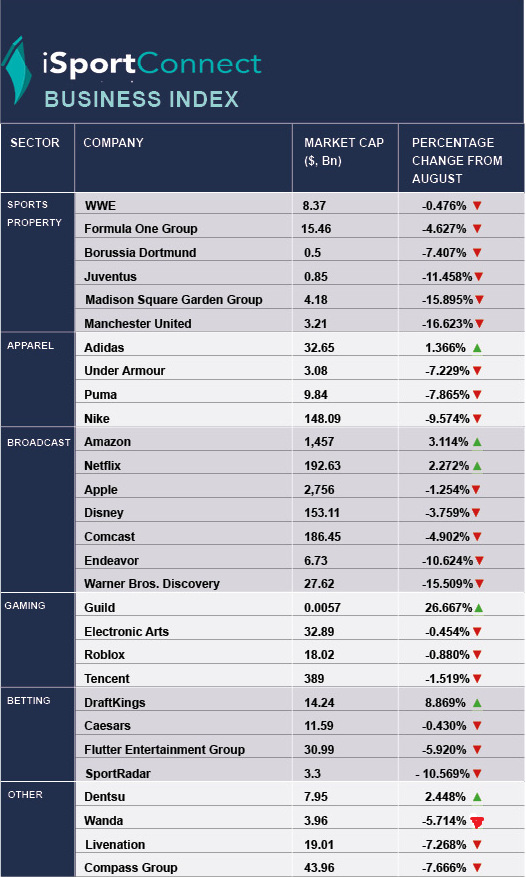
TKO (Technical Knock Out) a knockout declared by the referee who judges one fighter unable to continue. Carlo De Marchis pens down this month’s business index.
Let’s talk about TKO, the new publicly traded combat sports and entertainment powerhouse.
Facts and forecasts
Endeavor owns 51% of the newly formed TKO putting together WWE and UFC. They bought UFC for $4 billion in 2016, WWE is publicly traded at $8.37 billion. The new outfit generated over $2.4 billion in revenue in 2022 with a 10% annual growth rate since 2019, according to Endeavor. Expected annual operating synergies of $50-$100 million, not unrealistic as UFC did $70 million savings in two years under Endeavor.
People and places
Ari Emmanuel, mighty CEO of both TKO and Endeavor, same as Mark Shapiro COO for both. Dana White is UFC CEO, and Nick Khan ex-CEO is now WWE President. Controversial enough Vince McMahion is Chairman, not sure it’s a great idea based on the many conduct issues.
Merging companies and cultures is not easy, especially as they start from different places with different vibes – Las Vegas for UFC and Stamford, Connecticut for WWE.
Product and growth
This deal creates the new super-destination of combat sports with a combined content IP, production strength, audience footprint and marketing power that is enviable.
Creating mega platforms around content and media seems to be a trend but also the recipe for sustainable business in this space, so TKO seems well positioned in that regard.
WWE and UFC media rights, soon to be renewed, are a clear avenue for growth, if we assume the joint proposition will be even more appealing to media companies, as well as expanding the footprint even more internationally.
The obvious challenge is about merging (to whatever extent) and like any operation of this size – and we have seen many recently – the risks are well known.
Callum Chambers, Global Head of Marketing for EngageRM spotlights on the evolution of fan engagement.
I’m going to quickly ask you to jump into a time capsule and transport yourself to the 90’s.
Do you remember what it was like to be a sports fan then? Can you picture how you interacted with the team you supported? What did you see? What did you feel? Are the Spice Girls on in the background?
I still recall watching my Aussie Rules heroes on a Friday night, glued to the TV. I was no less of a die-hard than the young fans of today, but my engagement with the team was completely one way.
It’s crazy to think now, but in the 90s, you could count those fan interactions on one hand:
Go to the game
Buy merchandise
Read about them in the newspaper
Watch them on TV or listen on the radio
And that hadn’t changed since the first ever sports broadcast on TV in 1939, when Columbia edged Princeton in the baseball 2-1 at Baker Field. 400 people watched that, which was the maximum amount of TV’s that could pick up the broadcast signal.
Like a flywheel, the industry has generated endless momentum as it builds off the increasing connectivity of the world, rapid technology advancements and the general public’s insatiable appetite for content.
Now we’ve got it all. 24/7 news, apps, web, videos, VR, online stores – its utter chaos for the fan to keep up, let alone for the teams marketing departments. You can’t pull every lever, so deciding which ones to focus on is no easy task.
For sports brand and marketing teams charged with leading fan engagement activities for their organisations, their goals are all the same; sell more tickets, more merchandise and generate more revenue.
The amount of Premier League documentaries on our vast network of streaming platforms rival that of the big leagues in the US. They have similar approaches to content strategy that engages their fans and are great at telling the stories of their players and clubs’ history.
In social media land, British F1 teams’ joke around and have as much fun as their US counterparts, Premier League teams spend just as much time producing short form social content for jersey/kit reveals and many produce high level podcasts.
But there is a huge space where the US leaves the UK in its wake when it comes to fan engagement across digital and technology.
Innovation Attitude
Whilst this is a broader cultural element at play between the UK and US as to why this is the case, let’s first compare a Premier League team and a Major League Baseball Team.
A Premier League team has 18 home games to sell out. The average venue capacity is 38,000. That’s 684,000 bums on seats across a season. They don’t have to try very hard to sell out these games and there isn’t much local competition to push them. Aston Villa aren’t losing fans to Birmingham any time soon.
Now let’s look at a typical US baseball team. They have 81 home games to pack out with an average stadium capacity of 42,000. I had to get the calculator out for this one, but that’s 3,402,000 seats. There’s a lot more work to do to maximise their revenue.
They are also competing with the local NFL and NBA teams for attention, so they are constantly being challenged at pace to generate new fans and maintain the interest of existing ones.
Digitally, they are competing with everyone for eyeballs, not just other teams. Our attention spans are now shorter than your average goldfish and we only have so many hours in the day to consume the endless pit of content on our devices and TV’s.
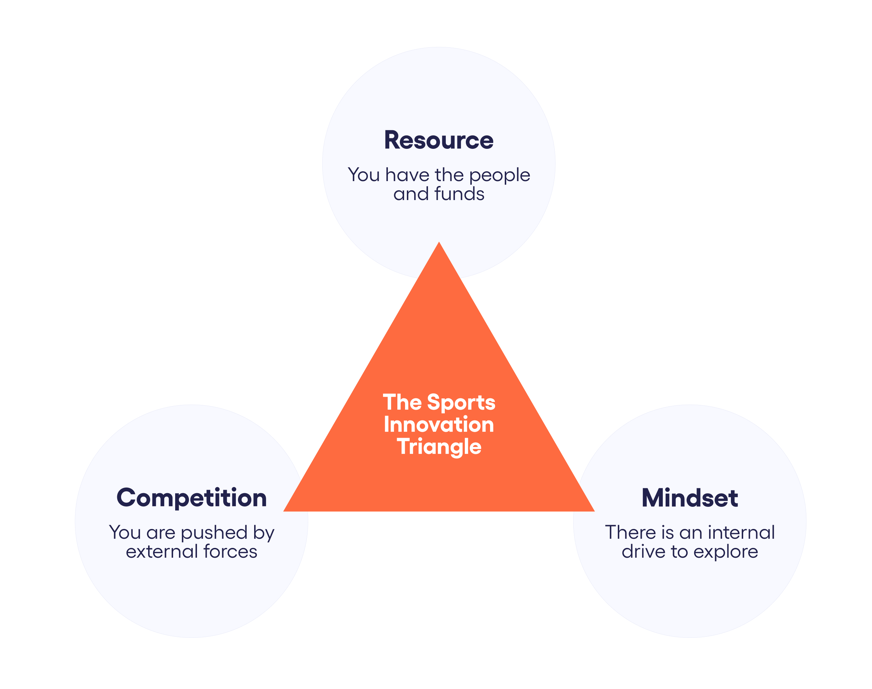
One of the major advantages US teams have are the budget and resource dedicated to advancing and driving digital innovation. They have separate Navy SEAL style small teams experimenting and trialling new technology to see if they have something that will move the needle just an inch.
All these elements create an innovation machine for US pro sports teams and venues.
That combined with an unmatched mindset allows them to transcend perceived limitations of engaging their fans digitally.
“We need to keep getting smarter about what our fans need from us and creating more customized and personalized experiences at scale”, said Becky Kimbro, SVP of Brand at the San Antonio Spurs.
“It may mean that the broadcast looks different for you than it would for me. It may mean that when I open my version of the app, I’m served a completely different experience than you are.”
Focusing on the fan as ‘an individual at scale’ almost sounds like a contradiction, but the US are obsessed with it, because they have to be. This fierce competition drives innovation, but it’s also an inherent part of American culture and business.
The ‘Silicon Valley effect’ permeates across the business landscape and the country’s psyche that gives them the permission to fail fast and iterate quickly.
“There’s also a whole host of fascinating technologies out there that we don’t yet have a grasp on yet and how those will impact our business”, added Kimbro.
“Web3 being one of those technologies as well as AI which we haven’t stopped hearing about in 2023.”
Teams and venues in the US are always hunting the next shiny new thing that could give them the edge, that’s why they are so tapped into these emerging technologies.
They also have a different attitude to the UK.
Scott Kegley, VP of Digital and Strategy for AMB Sports and Entertainment (ownership group for Atlanta Falcons and Atlanta United) discussed this on our podcast earlier in the year.
“We aren’t doing brain surgery, we just innovate and have fun”, he said.
And perhaps that’s the biggest learning curve for the UK sports marketing and tech teams when it comes to engaging fans in the digital space – the innovation mindset.
Being overly cautious about these emerging technologies is a missed opportunity.
When you read about the latest sports-owned DAO, fan loyalty app built on the blockchain or a new teams metaverse experience, I can all but guarantee that it’s coming out of the US.
Even for those UK-based organisations that don’t have endless resources and stretched teams, a mindset that permeates from the top goes a long way. Senior leaders need to create spaces for their people to trial new things or release more budget to truly commit to development and innovations that engage fans using technology. The evidence would suggest that there is significant financial upside when you get it right.
Thinking bigger will galvanise these teams to push boundaries that unlock new avenues to connect with their fans. Social media, OTT platforms and CRM will continue to be the bedrock of digital fan engagement strategies, but what is beyond the horizon that they could pioneer? All in the name of connecting fans with their team like never before? It’s time to be brave and find out.
“Lionel Messi’s fans didn’t have to wait long for his first signature moment with Inter Miami CF. But they will have to wait if they want to buy his jersey.Listings for pink or black Messi No. 10 jerseys from the official MLS shop currently feature a pre-order warning that says Adidas will be delivering the product in “mid October.” The disclaimer covers the $195 authentic jersey, the $125 adult replicas and the $105 youth replicas.”
Michel Cutait, Acting Secretary General of the World Obstacle Federation, takes a look at the need of sports partnerships to have a purpose and why they are so much more powerful when they do.
“Purposeful partnerships in the sports sector transcend traditional transactional relationships. They are built on a shared purpose, common values, and a commitment to achieving collective goals. Organisations need to view their collaborators as strategic allies, working towards a greater cause. This requires open communication, transparency, and a willingness to co-create innovative solutions to confront societal challenges.”
Felicien Dillard, Partner and Head of Active Places at Portas Consulting looks at the unprecedented investment being made in the sports infrastructure in the Middle East.
“The UAE has so far taken a more gradual and selective approach to developing sports infrastructure. Abu Dhabi is filling the ‘opportunity-gap’ by selecting sports to invest in, such as the first indoor Velodrome in the region and the world’s largest wave pool, both under development on Hudayriyat Island. These will be landmarks in an ambitious destination that combines sport and leisure for tourists and residents.”
Unmish Parthasarathi, the Singapore-based Founder of Picture Board Partners, the Strategy, Innovation & Venture Development boutique, spotlights on the rise of Singapore as a sporting destination.
“Singapore is at the epicentre of the next billion fans, who will play, participate and partner with a variety of sports codes. Government agencies such as Sport Singapore (aka Sport SG) and the Singapore Tourism Board (STB) have brought new competition formats such as World Table Tennis, FIBA 3×3 Basketball and most recently, Triathlon with the PTO.”
In this week’s View From Africa piece Cynthia Mumbo, CEO of SportsConnect Africa, shines a light on the work being done by non-profit organisation Giants of Africa.
“Giants of Africa is an admirable non-profit organization that utilizes basketball to empower the youth of Africa through education, leadership, and teamwork. It was established by NBA Executive Masai Ujiri in 2003 and has been conducting basketball camps throughout the continent every summer for young girls and boys aged 15 to 19. Additionally, the organization constructs basketball courts and implements outreach programs to create more opportunities for African youth.”
The Walt Disney Company and Charter Communications have announced a transformative, multiyear distribution agreement that maximizes value for consumers and supports the linear TV experience as the industry continues to evolve.
As part of the deal, the majority of Disney’s networks and stations will be immediately restored to Spectrum’s video customers.
In a joint statement, Robert A. Iger, CEO, The Walt Disney Company, and Chris Winfrey, CEO, Charter Communications, said: “Our collective goal has always been to build an innovative model for the future. This deal recognizes both the continued value of linear television and the growing popularity of streaming services while addressing the evolving needs of our consumers. We also want to thank our mutual customers for their patience this past week and are pleased that Spectrum viewers once again have access to Disney’s high-quality sports, news and entertainment programming, in time for Monday Night Football.”
Among the key deal points:
In the coming months, the Disney+ Basic ad-supported offering will be provided to customers who purchase the Spectrum TV Select package, as part of a wholesale arrangement.
ESPN+ will be provided to Spectrum TV Select Plus subscribers.
The ESPN flagship direct-to-consumer service will be made available to Spectrum TV Select subscribers when it launches.
Charter will maintain flexibility to offer a range of video packages at varying price points based upon different customer viewing preferences.
Charter will also use its significant distribution capabilities to offer Disney’s direct-to-consumer services to all its customers – in particular its large broadband-only customer base – for purchase at retail rates. These include Disney+, Hulu and ESPN+, as well as The Disney Bundle.
Effective immediately, Spectrum TV will provide its customers widespread access to a more curated lineup of 19 networks from The Walt Disney Company. Spectrum will continue to carry the ABC Owned Television Stations, Disney Channel, FX and the Nat Geo Channel, in addition to the full suite of ESPN networks. Networks that will no longer be included in Spectrum TV video packages are Baby TV, Disney Junior, Disney XD, Freeform, FXM, FXX, Nat Geo Wild and Nat Geo Mundo.
To preserve all these valuable business models, the parties have also renewed their commitment to lead the industry in mitigating the effects of unauthorized password sharing.
FIBA and Ganten have agreed to extend their strong collaboration until 2027 and the FIBA Basketball World Cup, which will take place in Qatar.
The extension of the partnership was marked with a special ceremony during the FIBA Basketball World Cup 2023 Semi-Final game between Serbia and Canada at the Mall of Asia Arena in Manila.
Asia’s leading natural mineral water brand, Ganten, has enjoyed principal commercial rights and exclusivity in the water category across all FIBA competitions since 2018.
During the FIBA Basketball World Cup 2023, Ganten supplied more than 270,000 liters of water in the three host countries. Ganten also provided reusable bottles for players at all 92 games of the World Cup and enjoyed strong brand exposure on the new innovative LED backstop units.
For many years, Ganten has been partnering with high-end sports events, connecting with consumers through sports and actively supporting the development of basketball. Having partnered with the domestic CBA league in China for many years the relationship with FIBA has seen them able to focus on simultaneously growing the sport and their brand worldwide. Ganten has leveraged its outstanding supply chain capabilities to export products to nearly 30 countries and regions.
Frank Leenders, FIBA Media and Marketing Services Director General, said: “We are really happy to announce the continuation of our partnership with Ganten as we have had an impressive collaboration with them since we joined forces in 2018. At events like the FIBA Basketball World Cup, which has taken place across three host countries, it is crucial for partners to activate both on the grand stage and within local communities.”
He continued: “Our successful activations with Ganten have brought a range of benefits to both organizations, and we are determined to continue offering the best possible experience at all of our events.”
Ms. Meihua Wang, General Manager of Ganten Brand Center, said: “Over the past six years of collaboration, Ganten has been providing high-quality natural mineral water to FIBA events worldwide, ensuring that players stay in their best shape during the games, contributing to the success of these events.
“Ganten and FIBA have advanced the development of global basketball together and built a strong friendship. This renewal is not just a business partnership but also a commitment to sport and social responsibility. Ganten aims to continue to actively promote basketball globally, providing exciting experiences for fans worldwide.”
This agreement was brokered by FIBA Marketing, the strategic partnership between FIBA and Infront.
Liberty Media Corporation has entered into a definitive agreement to acquire greater than 90% of QuintEvents, LLC (“Quint”) in a transaction valuing the company at $313 million.
Quint will be attributed to Liberty Media’s Formula One Group tracking stock, and the transaction, which is expected to be accretive, will be funded with cash on hand.
Quint is a global provider of official ticket, hospitality and travel experiences to many of the world’s most prominent sports and entertainment events. Quint packages and sells ticket and hospitality inventory with unique experiences through marquee relationships with sporting event rightsholders including Formula 1 (“F1”), the NBA, the Kentucky Derby and MotoGP.
“We are excited for Quint to join the Liberty family and strengthen our position in sports and live entertainment,” said Greg Maffei, Liberty Media President and CEO. “Brian Ruede, Brian Learst and their team have built an innovative business that delivers unique consumer experiences at the world’s most sought-after events. Quint is a high-growth company with attractive free cash conversion. As a commercial partner to F1, Quint has proven their expertise in product development and sales through their creation of the F1 Experiences program. We have high conviction in the demand for premium, live events and will work with Quint’s management to enhance F1 offerings and bring Quint’s services to more sports.”
“We could not be more thrilled for the Quint team to join forces with Liberty Media,” said Brian Ruede, Quint CEO. “This has been an incredible journey and is a transformative moment for Quint and our position in the experiential and travel economy. Liberty Media is the right partner for our next evolution of growth. Together, we can deepen our commitment to our existing partnerships through the continued development of our tech stack and service offering, while providing a pathway to expand into complementary vertical markets that will enhance our customer and partner experience. This is just the beginning.”
F1 and Quint will continue to be operated as separate companies. The enhanced partnership creates numerous growth opportunities within F1 and for Quint’s other partnerships like the NBA, Kentucky Derby and MotoGP. The transaction will accelerate Quint’s specialized sales engine and leverage onsite event expertise to deliver best-in-class experiences to fans.
Viacom18 will be the exclusive media rights holder for ISL, India’s top-tier football league, across Digital and Linear TV platforms. The telecast will be available for football fans in multiple languages keeping in mind the diverse audience of the league, and will also be streamed free on JioCinema.
Over the past decade, ISL has proven to be a driving force behind the overall development of football in India both on and off the field. In its next phase of growth Viacom18 will be the perfect partner to take ISL to a larger audience, with its strong digital capabilities and connect with new-age sports fans. Viacom18’s digital streaming platform JioCinema, which will stream ISL for free, has brought a pioneering viewing experience through livestreaming of properties such as the FIFA World Cup Qatar 2022™ and the TATA IPL and it will continue to bring a similar experience for ISL.
Football Sports Development Limited Spokesperson said, “We are pleased to have Viacom18 as our media rights partner for the Indian Super League. When we set on our journey of ISL, we had the vision to revolutionise the Indian football ecosystem. As we enter our 10th year of growing football in India, it is great to associate with a partner who shares the same vision and believes in growing the consumption of football in the country. Viacom18’s proven record and impact in offering a fan-first football experience to the Indian audience, starting with the FIFA Football World Cup, makes them the best partner as we enter the next decade of growing Indian football.”
Viacom18 Media Private Limited Spokesperson, said, “Winning the streaming and broadcast rights to the ISL is a big step forward for us in the direction of building a glittering stable of footballing action. The ISL has led the resurgence of Indian football in recent years and coming on board with the league as the exclusive media partner enables us to contribute to the development of the sport in the country. We believe this is an exciting time in Indian football and through our extensive presentation of the league we aim to stoke a renewed interest in the heart of every Indian football lover.”
With just over a week to go, IBC 2023 – which is one of the world’s most renowned content and technology events, will once again boast a stellar delegate list comprising tens of thousands of executives from across the worldwide media content and technology community all aiming to learn, collaborate and network.
The event draws together the global media, entertainment and technology industry for a compelling live experience that enables every attendee to gain critical insights, share expertise and unlock business opportunities. Attracting representatives from 24 countries in its first year, IBC now welcomes exhibitors, speakers and visitors from more than 170 nations.
IBC this year will feature ‘’The Innovation Stage’ which brings you a concentrated dose of insights and innovative projects. Also, each year at the show, The International Trade Association for the Broadcast & Media Industry (IABM), Society of Motion Picture and Television Engineers (SMPTE) , Society for Broadband Professionals (SCTE) and The Institute of Engineering and Technology (IET) deliver a multitude of sessions covering a wide variety of topics from the latest industry standards and strategies for business transformation, to defining future networks and building new broadcast infrastructures.
You can also meet over 1,250 exhibitors from over 170 countries who will be showcasing their latest products and services.
IBC has brought back its Changemakers Programme addressing critical industry social issues after highly successful launch in 2022. The free-to-attend Changemaker programme, on Sunday 17 and Monday 18 September at the IBC will put a spotlight on People and Purpose.
Trends to look forward to at the IBC 23
Spotlight on Gaming
The global video game market size was estimated at USD 217.06 billion in 2022 and is expected to grow at a compound annual growth rate (CAGR) of 13.4% from 2023 to 2030.IBC2023 is set to host an extensive gaming and esports programme with a full day of sessions on the Showcase Theatre, a dedicated zone on the showfloor and focused tech tours, as the worlds of film, TV and gaming continue to converge.
Sporting rights to be a key battleground
Sports clearly represents the next battleground for ownership of the living room among the big tech companies, as it drives users to watch TV live and allows brands to tap into a lucrative ad space for the company.
Rise in AVOD and FAST set to continue
Even though ad-supported streaming video predates subscription-focused streaming, much of the conversation around streaming services has focused on the latter, thanks to the rapid rise of Netflix. Indeed, more than 90% of OTT video service users watched content via a subscription service at least monthly in 2022 and the number is increasing.
The result of this may well be success for some FAST and AVOD players, able to attract valuable eyeballs and successfully monetise them in a period where consumer spend will be increasingly tough to attract for advertisers. Whether this will necessarily see success for direct-style retail models – and many flavours of hybrid model – remains to be seen, but it seems likely experimentation will bring dividends.
AI language improvements
The utility of AI in broadcast contexts such as speech-to-text use cases, content localisation and metadata creation is rapidly improving, and 2023 has plenty more of this in store.
One of the major signposts for this will be the release of GPT-4, the next generation of OpenAI’s generative language model. The new model will undoubtedly be more powerful than the previous iteration, highly likely to have been trained on a much larger dataset than before (OpenAI’s GPT-3 is 175 billion parameters in size) and will have a profound influence on the accuracy and speed possible.
5G beginning to gain traction
There’s been much talk around 5G in broadcast and the potential opportunities around the new technology, but the increasing traction of the standalone (SA) version of 5G should begin to approach critical mass in 2023. Achieving ‘critical mass’ around 5G SA deployment will enable a range of enhanced network services to become viable in the real world, such as network slicing.
The event is happening in Amsterdam from 15-18 September 2023. If you are attending the event, do get in touch with iSportConnect’s David Fowler who will also be attending (david@isportconnect.com).
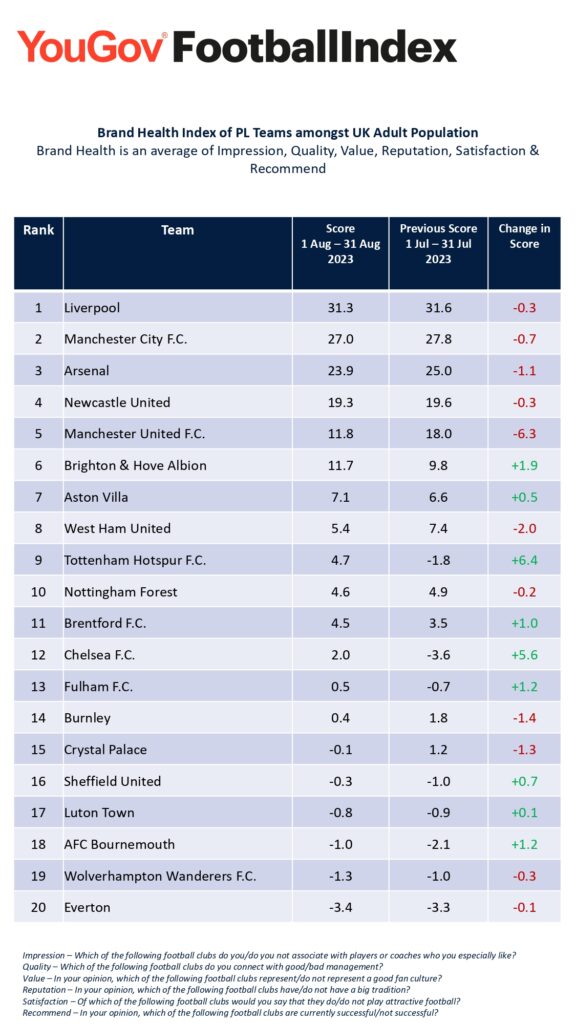
This month’s Brand Health Index, powered by YouGov shows the impact of the beginning of the season has had on the teams brand health.
The biggest winners of the index include Brighton and Spurs. Brighton & Hove Albion ensured they will play in Europe for the first time in their history after beating Southampton in May and they also went on to crush Arsenal’s dream of winning the Premier League title. Meanwhile,
Liverpool remains on top, driven by tradition of the club. They had a good summer transfer window and an even better start to the season. Although they were on a tight budget, the board did well to recruit in the right areas and avoided losing their best players.
Unfortunately, Manchester United has become one of the biggest losers on the index. The club hasn’t started the season in a good way both on and off the field. The club is reportedly set to be taken off the market by the Glazer family after a huge U-turn. Shares for the Red Devils fell by a whopping 21 per cent after the news broke that the Glazers may not sell, before bouncing back slightly to end 18 per cent down till yesterday.
The index below compares the August vs. July, to show the impact of the beginning of the season has had on the teams brand health.