
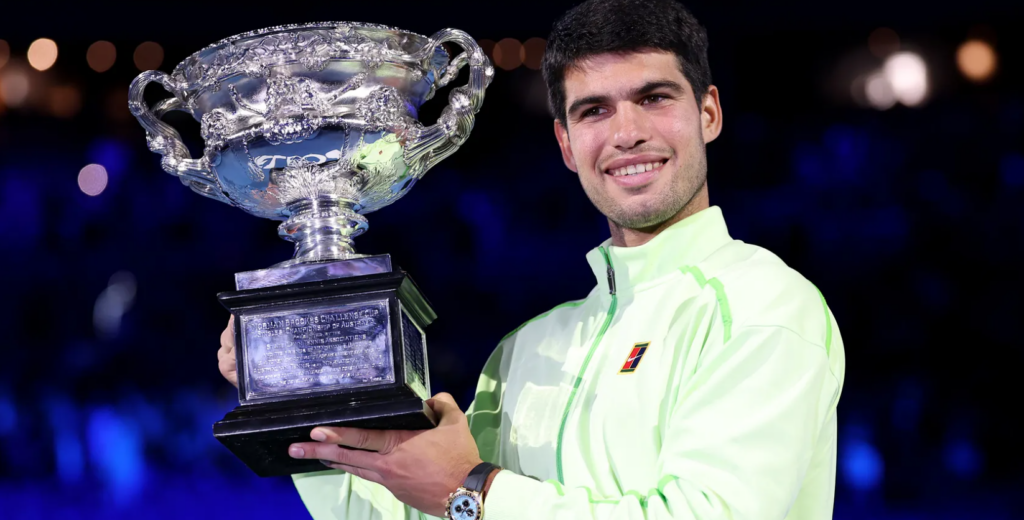
Alcaraz, Record Crowds, Concerts & Heat Transforming the Australian Open and Grand Slam Tennis
February 5, 2026
When Carlos Alcaraz completed a unique career Grand Slam last Sunday and concluded a tournament of unprecedented crowds, soaring heat conditions and concerts, the Australian Open revealed not just a new champion but a new vision for the sport – and a new sporting model, entering a decisive new phase. Michael Pirrie reports.
Carlos Alcaraz was on top of the world and it seemed the whole world was serenading the youngest ever career Grand Slam winner – celebrating in sports bars and local communities across his home nation of Spain and in other locations around the world which took on a Spanish flavor.
These included the Grammys in Los Angeles, where Latin artist Bad Bunny was awarded Album of the Year, the first entirely in Spanish. The unique Spanish music ensemble was acclaimed for its uncompromising authenticity, innovation and cultural force – signature hallmarks of the Alcaraz game and style.
This was one of the most highly anticipated sporting events of recent times.
Under the weight of extraordinary pressure and expectation, Alcaraz produced a modern-day classic to seize the only grand slam title that had escaped the young trophy hunter.
This was the stuff of legend, a performance masterpiece of genius stroke making, conjured on the blue hard courts of Melbourne Park, full of high notes and high drama as Alcaraz dispatched the legendary Novak Djokovic with relative ease at the Australian Open in sport’s great southern land.
THE BEAUTY & TERROR OF SPORT IN A NEW CLIMATE AGE
The AO was more than the first major international sporting event of the year – it was a microcosm of the pressing climate and economic conditions now facing global sport – pressures also confronting the Winter Olympic Games, underway soon in Milano-Cortina, and Fifa World Cup later in the year.
Alcaraz not only conquered the best players on the planet but also its changing climate conditions.
While the Spaniard was triumphant in a nation that has successfully hosted several of the world’s biggest sporting events, wild weather impacted the AO and other premium sport this summer
The adverse weather evoked images from Dorothy McKellar’s poem, ‘My Country’, famously depicting the beauty and the terror of her beloved Australia as a ‘sunburnt country, a land of far horizons and jewel sea, of sweeping plains, sapphire misted mountains, droughts and flooding rains.’
Alcaraz and his tennis colleagues and teams endured heatwave conditions at times that suspended play and closed courts, while the host nation was on high alert following fatal floods, cyclones, and bushfires that reached outer suburban fringes and darkened the Melbourne skyline.
This was a warning not only for AO organizers but for governing bodies and federations of outdoor sport everywhere.
The Australian Open and other sporting events this summer have made visible both the growing impacts and challenges for sport in the age of climate change.
Rising heat forced more flexible starts and scheduling, suspended play and triggered player and spectator welfare protocols sufficient to keep the AO tennis extravaganza on air.
As heat thresholds for players were implemented, schedules extended, and on-court brilliance continued, ‘the beauty and the terror’ from McKellar’s verses became an operational challenge for organisers and not just a classic piece of poetry.
Flexible scheduling, heat limits, closed roofs, night sessions and other responses to the heat have already been built into Olympic planning but will need to be more comprehensively integrated into planning for other sporting events.
Even with contained and airconditioned courts and adjustable timetables, further adjustments will be needed for the AO and other Grand Slams as heat waves are predicted to become more intense and last longer.
Australia has long defined itself through McKellar’s love of a land marked by beauty and terror and that was on display as Alcaraz produced moments of extraordinary brilliance pushed by Djokovic – and by the punishing summer heat that is redefining how sport is organized and staged.
McKellar’s poem is no longer a metaphor but a context for sport where events and brilliance now play out in a climate of beauty and terror.
This is looming as a generational challenge spanning global sport and its governing bodies and federations.
The Australian Open heat mirrors Milano-Cortina’s thinning snow in response to growing climate volatility
While summer sport is fighting heat thresholds and player welfare, winter sport is challenged by the disappearance of reliable snowfall, showing no season for sport is safe.
Both seasonal mega events rely increasingly on engineering and technological solutions. Night sessions, retractable roofs and heat policies in Melbourne; artificial snowmaking and higher altitude venues in Cortina
The Australian Open and Milano Cortina importantly are also showing that climate change does not need to cancel events, while sporting brilliance is occurring in increasingly artificial environments.
A NEW GRAND SLAM MODEL
Like Alcaraz, the AO also that plays differently and is changing the Grand Slam model.
While Slams, traditionally, have been dedicated to tennis and everything else has come second, what is emerging now is the Slam as a multi-dimensional sporting experience; an all-day urban festival where elite tennis is the anchor rather than sole focus.
While a milder version of this model can be seen at the US Open and at Rolland-Garos, it has evolved further at the Australian Open, which set a Grand Slam attendance high this year that exceeded more than 1.3 million spectators.
This is changing the identity of the AO and will influence the personality of other Grand Slams, which effectively serve as tennis world championships.
Record crowds at the AO are no longer simply spectators but participants in a mass entertainment event experience with an abundance of food, drink, fashion activations, music, concerts, wellness pop ups, water slides, heat managed seating and shaded social spaces.
People are encouraged to come to the tennis precinct earlier, stay longer and return repeatedly
To encourage this, shade structures, water misting zones, cooler seating and wellness areas have become part of the infrastructure for heat management, comfort and a wider visitor entertainment experience
This new approach, derived from the Sydney 2000 Olympic Games Live Sites and Fifa Fan Zones, drew in record numbers to the Melbourne Park tennis site, even if many may have only had a fleeting relationship with the tennis or not even seen a match.
Tennis for many is the support act in this new era.
The ‘sport-as-a-festival experience’ model has perhaps been most successfully rolled out by Formula 1, with one recent survey revealing 75 per cent of race goes attended for the experience, while 25 per cent were there as fans of the sport.
‘F1: The Movie’ has now grossed over $630 million as the most successful sport movie of all time.
While this new approach is becoming a hot debate amongst tennis purists over the future direction and purpose of the Grand Slams, it also reflects the economic pressures shaping global sport.
Broadcast revenues remain fundamental while growth from on-site revenue and experience loyalty are increasingly important in the audience economy where fashion, food, and lifestyle activations provide essential financial support for major sporting events amid fragmented markets and rising costs.
A Slam that feels like a cultural event like the Olympic Games will attract more sponsors who might never invest in a pure sporting event.
The new experience model is also vital for engaging the interest and investment of young people, less inclined to sit through five long sets but more likely to gather at tennis tournaments and come in and out of matches while socializing, filming, listening to music or seeking relief from the heat.
Record crowds, diverse entertainment, and climate sensitive event design will not just redefine the Grand Slam tournaments but are essential to helping counter extreme heat, audience fatigue and economic pressures, especially in a high inflation world.
CONCLUSION
The narrative for this AO focused heavily on record crowd numbers and growing festival atmosphere and activities as evidence of the tournament’s ever widening appeal to the public as well as sponsors, partners, government tourism, infrastructure and economic ministers.
The AO’s most important achievement however was in getting conditions right for the courts and functional support areas to operate correctly for players, referees, spectators, sponsors, broadcasters and other key constituents and stakeholders.
When tennis courts, staff and support facilities and structures operate well, players perform at their best and spectators celebrate.
This creates a party-like atmosphere that radiates out beyond the courts to surrounding venues and audiences at Live Sites and on screens of all shapes and sizes around the host city, nation and across the world.
Alcaraz himself also addressed the real success story behind the tournament in his post-match comments – its appeal to tennis athletes
“Thanks to everyone who made this tournament possible,” he said.
“It’s a great tournament for the players, I think, and the site here is amazing, every year making upgrades to make us, you know, feel comfortable.”
“So, I just appreciate and am really grateful for everything you are doing for us. I’m just really happy to come here every year. It’s an honor playing here in Melbourne every year.”
“I think the privilege is the love we are receiving every year that I come. It’s a great support and great love, not only in matches but every time I step on the courts for practice.”
“I just feel the love of the people, so thank you for supporting me in tough moments during the matches.”
We had not seen tennis performed like this before – instantly inventive and innovative, played from almost any angle and every part of the court in ways that previously could only have been imagined programmed into a gaming console
Long after the pop-up beauty, wellness, fashion, music, and high-end restaurants, bars and concert stages have been folded away, the enduring memories and legacies from this AO should be those that relate to the Alcaraz performance and the planning that enabled this to happen.